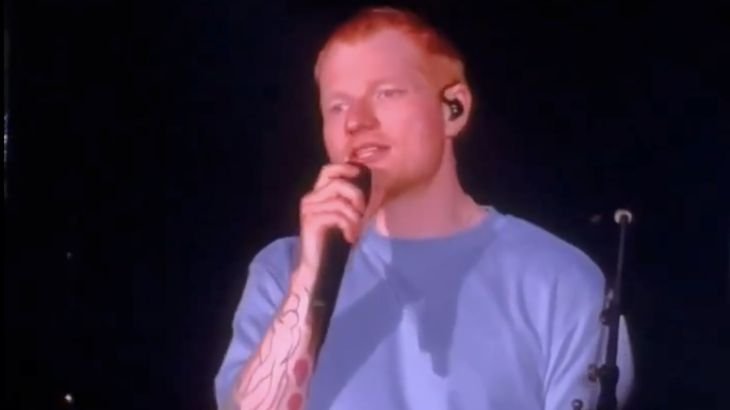
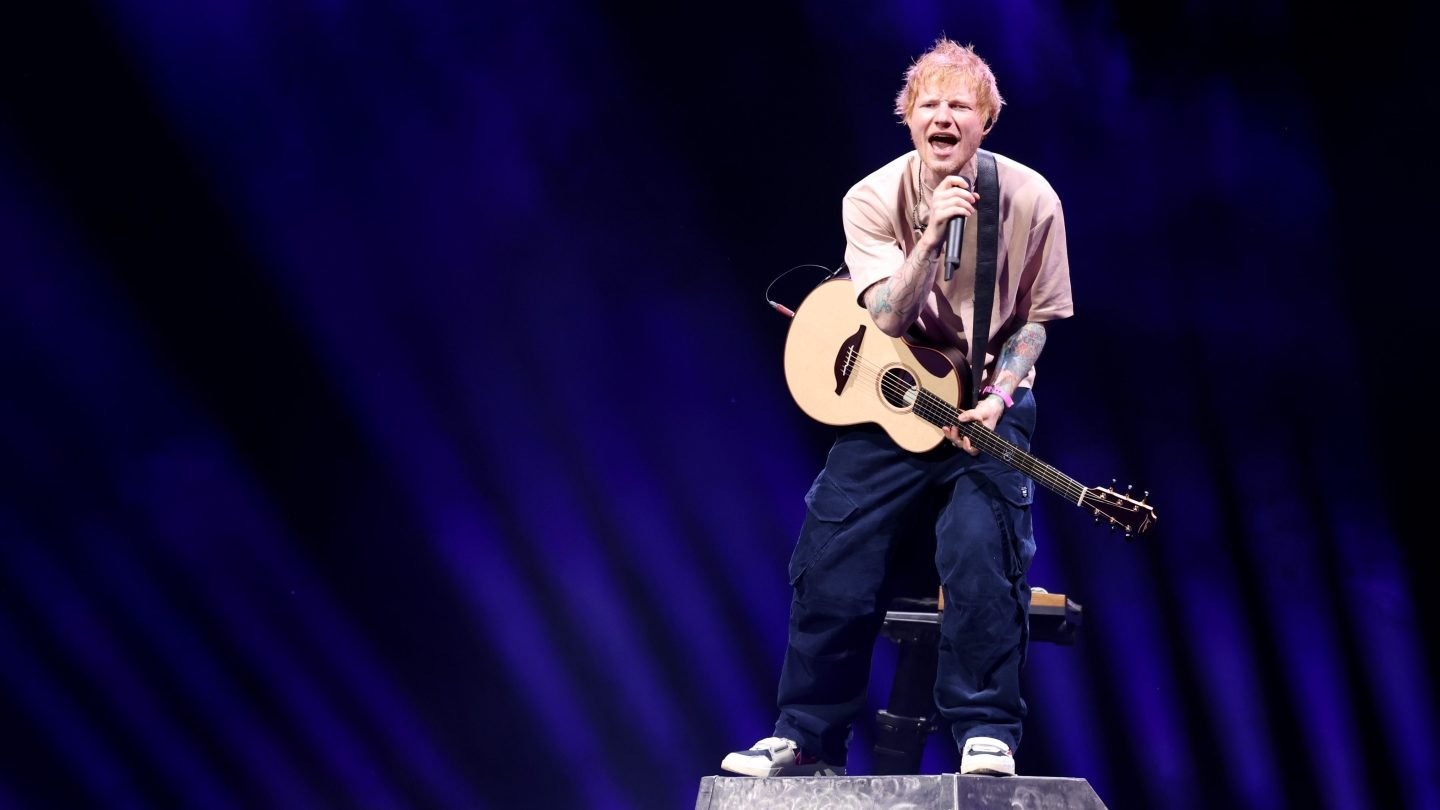
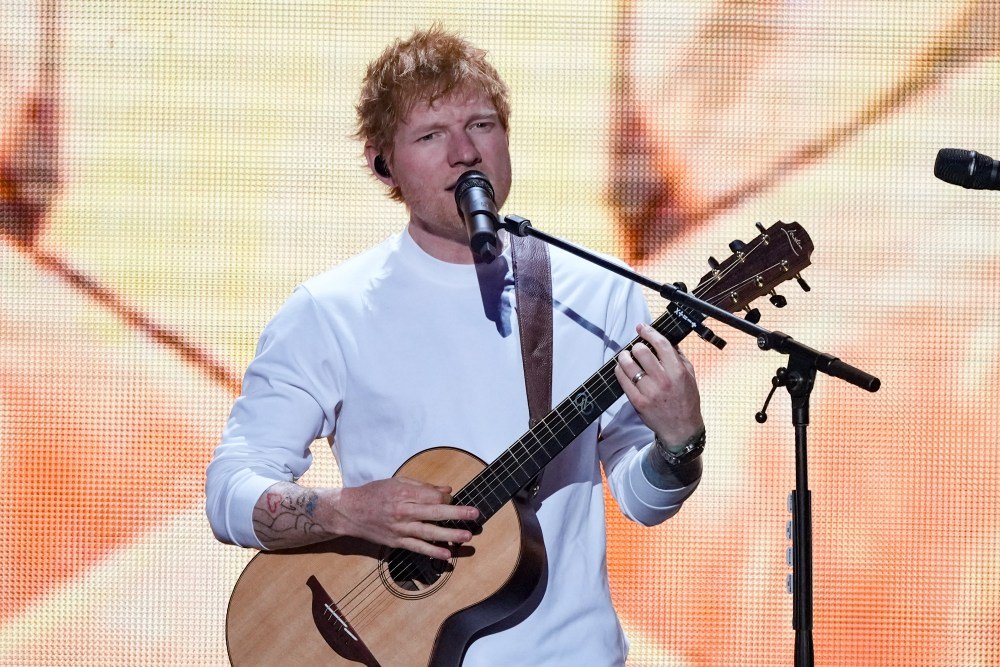
Ed Sheeran addressed the ongoing controversy surrounding the removal of Macklemore from his Loop Tour during Saturday’s stop in Philadelphia at Lincoln Financial Stadium.
“This is not usually how I would open the show, but before I play some songs tonight, I hope it’s okay if I say a few words about this last week. I’m used to my music being criticized, and I’m always happy to take that because I’m lucky. A lot of you like my stuff, and to be honest, I’m surprised,” he began. “But this week, the criticism was about something much more important, and I’ve had to take and make difficult decisions, and I am making mistakes, and I’m so, so sorry.”
Sheeran continued, “I don’t want to disappoint fans, and I’ve never wanted to be an activist musician, but this has put me in the middle of an important and passionate argument about freedom of speech and the most complex political issue on the planet. My concerts have always been a safe space for everyone, and that matters hugely to me. Honoring my commitment to my fans is also completely essential to who I am, and that is why I’m here tonight on my own and continuing my current tour.”
The “Thinking Out Loud” singer said he was “deeply worried about the idea that venues pre-approve content for performance.” He added, “This happens in so many places that I perform around the world, but it should never happen in the free world.”
The Grammy winner continued, “Now, I want to address the question of where I stand in the situation in Israel and Palestine.”
“I am trying in my career not to be a political commentator of any kind because I want my music and shows to be about unity, not division. About humanity, not politics. But, this is a humanitarian issue, and I cannot hide how I feel about it anymore,” he said. “What happened in Israel and at the Nova Music Festival on October 7th was horrific and compounded centuries of Jewish pain. What is happening in Gaza is catastrophic and unjustifiable, and disproportionate. Our hearts can be broken by the scale of devastation and loss of civilians’ lives, of children’s lives, and the systemic injustice we’re seeing unfold in the West Bank cannot be overlooked.”
He added, “I am already speaking to people across the spectrum to work out how to make a contribution that helps victims of these terrible times, and listening and learning because I do not know enough.”
Sheeran’s comments follow backlash he faced for his decision to remove former opener Macklemore from the 22-city North American leg of his world tour after the rapper showed footage of Gaza and made statements in support of Palestine while performing across two shows at New Jersey’s MetLife Stadium on Sept. 4 and 5.
Following the announcement of Macklemore’s removal, Sheeran’s supporting acts, including Aaron Rowe, Finneas, Lukas Graham, and Sheeran’s backing band, Beoga, announced they were dropping out of the tour in solidarity with the Grammy winner behind the 2024 protest anthem “Hind’s Hall.” Rowe and Graham were also expected to open for Sheeran alongside Macklemore in Philadelphia, with the “Shape of You” singer ultimately going on without any opening act.
With all of his planned openers removed or withdrawn, ticket holders were notified Friday afternoon that the concert start time had been adjusted from 5:30 p.m. to 8 p.m. — the typical time Sheeran has launched his around two-and-a-half-hour set at previous stops. That was preceded by alleged refunds requested by fans that began earlier in the day, with the lowest ticket prices on Thursday going for $90 before dropping to around $54 on Friday night. By Saturday afternoon, the average was around $62 a ticket, according to a 50 percent drop from a week earlier.
After playing his opening, Sheeran joked as he acknowledged his lack of openers and described his musical setup without a backing band.
“I didn’t know whether I’d be here or not,” he told the crowd. “I hope you enjoyed my support performers this evening. I hope you’re great. This is the Loop Tour. The Loop Tour is this thing at my feet, which is called a loop station. It’s this loop station. Everything you hear tonight is completely live. It’s made on the spot, controlled my feet. There’s no backing track whatsoever.”
Following an inquiry, Ticketmaster told the magazine refund policies are set by event organizers and directed The Hollywood Reporter to Messina Touring Group/AEG. The Loop Tour promoter was contacted for comment.
Despite the time shift, fans still began filing into Lincoln Financial Field stadium, tailgating as early as 3:30 p.m. on Saturday.
Outside the venue, a pre-concert rally in part protesting Sheeran as well as Gillette Stadium owner Robert Kraft and Lincoln Financial Field owner Jeffrey Lurie was held by pro-Palestine activists, beginning at 4:30 p.m.
Inside the stadium ahead of Sheeran’s message, an uneven energy permeated the venue in the act-less two hours before the gates opened, as fans acknowledged the tour fallout in various ways. A particular focus of conversation was the ticket price drops and visible number of empty seats.
While making her way to her seats, Megan, a mother from New Jersey, was approached by either a member of the venue or event’s staff, and asked if she’d like to move to any of the available lower level seats with her family. Megan told THR that her decision to come was entirely driven by her young daughter.
“I just wanted to have a night out with my husband and my daughter where we could enjoy music that we love. She’s a huge Sheeran fan,” Megan explained, nodding to her daughter. “I was just hoping we could make it here and not disappoint her and that we would be safe in doing so. We gave [the tickets] to her for the holidays last year as a gift and she’s been waiting all that time asking, ‘How many more months? How many more months?’ I didn’t want to tell her that it wasn’t happening. It’s the last thing I wanted to do.”
Another attendee, a woman in her late 30s who traveled from New Jersey and requested her name not be used, said she was coming because she “had bought tickets months ago, and I was still coming to see him. No politics involved.” An older mother-daughter duo, who also asked that their names not be used but live in the Philadelphia suburbs, noted that they were both major fans of Sheeran, and the night marked the first time they would see him live together.
“He was caught between a rock in a hard place,” said the 32-year-old daughter. “With the timing, it was really a lose-lose.” Added her mother: “The entire situation was unfortunate.”
The backlash to Sheeran and Macklemore’s removal hovered over the concert in big and small ways. At various points, Sheeran made references to the Eagles, arguably Philadelphia’s most popular pro sports team, but whose owner was also allegedly among those who refused to allow the tour to go on with Macklemore still on the bill. The “I Don’t Care” singer also acknowledged the MetLife stadium was “louder” during one moment of call and response. “You’ve got to be louder than MetLife,” he told the crowd. The biggest moment probably came as Sheeran shared that he’d “been feeling [down] all week,” but the crowd had picked him up.
“There’s been a lot said about the musicians that were playing before me not being here tonight, but also the musicians that I usually play with on stage from being here tonight,” he told the crowd. “At this point in the show, to be honest, I usually go out to a B stage and I’m going to be totally honest with you, I didn’t know what this audience would be like tonight. I didn’t know if I would have things thrown at me. I didn’t know if people would be angry.”
He revealed he took the B stage out “because I was afraid of what might happen if I stood in the [middle of the audience] and I will admit that. So the show’s a little bit different, but there are certain songs that just don’t work on the loop pedal.”
Still referring to his backing band as his friends, the musician noted that when they “dropped out of this show, I was thinking, ‘How am I going to keep the show the same? And how am I going to get musicians to stand on stage with me in a week when no one wants to stand on stage with me?’” He shared he found the answer in another friend and artist he toured with “all of last year, all the year before and the year before that. And I said to her, ‘Would you stand on stage with me?’ And she said yes.”
Sheeran eventually revealed the entire backing band, which learned the music in three days. “They said yes to being on stage with the knowledge that the world thought I was a certain type of person,” he added. “They said yes with the knowledge that the world may hate them too for standing on stage with me. And I am so grateful for them being here.”
At another point, ahead of singing “Camera,” he expressed “there are very few places in the world where this many people can congregate and all have differing opinions, but then all come together in one night and agree on the same thing. And I think it’s a really wonderful thing.
“I kind of think without it, without this sort of thing, I think the world is heading to a very, very, very dark place,” Sheeran said. “If we get too divided — we need to come back to humanity and realize that we are all the same and we understand each other. I’ve had a week of learning, that’s what I’ve had, week of learning.”
Ahead of the concert and protest, a spokesperson for the Philadelphia Police Department told THR in a statement that “as with all large events at the stadium complex, the Philadelphia Police Department is working closely with venue and event organizers to help ensure the safety of concertgoers, employees and neighborhood residents.”
As part of the department’s routine monitoring and assessment of event capacity and staffing, the city’s Civil Affairs Unit — deployed for potentially contentious public gatherings like protests or labor actions — would be “on hand to ensure everyone’s safety during protected 1st Amendment activity.”
The protest was organized and supported by a coalition of local groups, including NO ICE Philly, The Philly Palestine Coalition, Philly Writers Against the War on Gaza, the Boycott CookNSolo Coalition and Shut Down Day & Zimmermann. Ahead of Saturday’s event, the group expressed their intention to appear outside Sheeran’s concert, “his first show after caving to Zionist threats and dropping Macklemore as his opening act,” they said in a statement earlier in the week. “On Saturday, we take to the streets to return the conversation to Palestine, and return Philadelphia to action.”
The group described Macklemore’s removal from the tour lineup as done by Sheeran “in the name of ‘neutrality’ and being ‘apolitical’ and due to threats from stadium owners, including Lincoln Financial Field.”
Earlier this week, it was reported that alongside Kraft, several other stadium owners allegedly called for Macklemore’s removal from Sheeran’s tour, including Carolina Panthers’ David Tepper, Atlanta Falcons’ Arthur Blank, and Philadelphia’s Lurie.
THR reached out to representatives of Lincoln Financial Field for comment regarding concert security measures as well as artists’ and guests’ speech policies in and around the stadium.
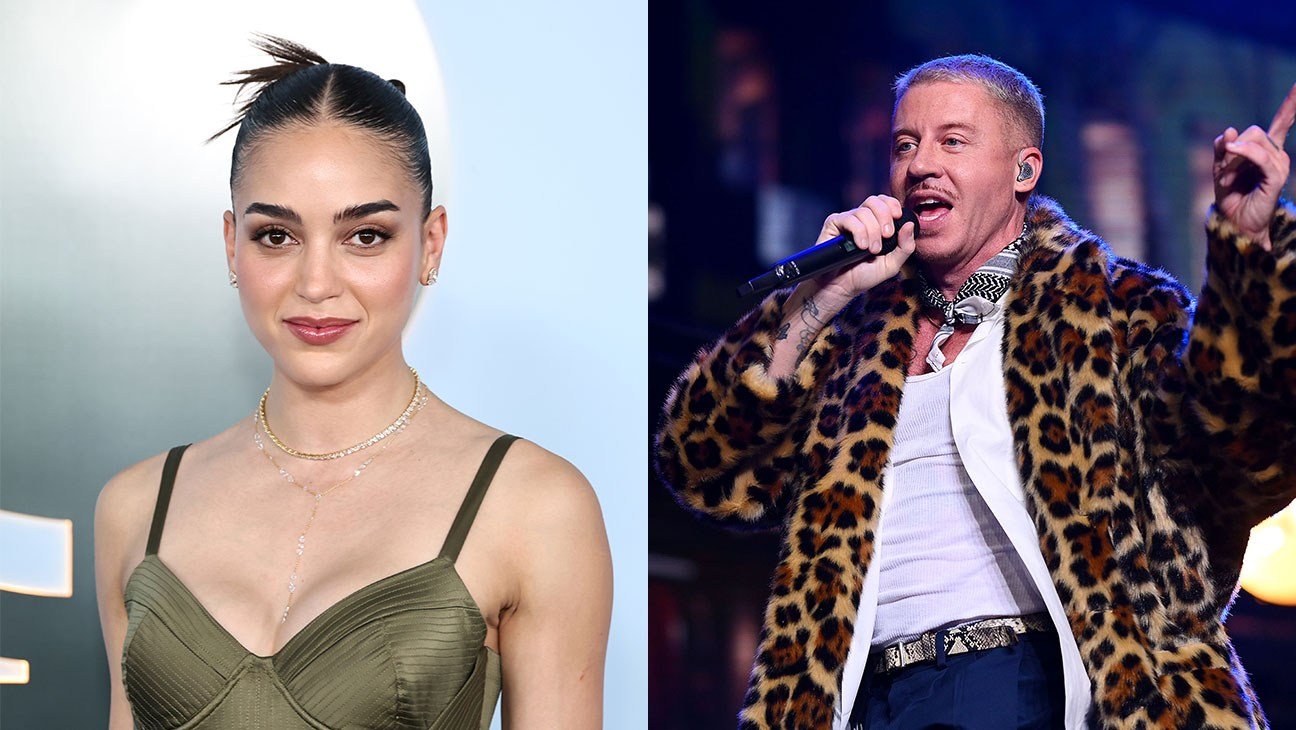
Saturday’s events were sparked nearly two weeks earlier, when the “Thrift Shop” rapper appeared on stage and spoke to a packed MetLife Stadium crowd in New Jersey. “One of the reasons why I wanted to come on this tour was because I wanted to stand up here on stages and stadiums across America and say two words that are very near and dear to my heart: Free Palestine!” Macklemore told concertgoers. “I want to say this to all of my Jewish brothers and sisters. Criticism of Israel, criticism of apartheid, being against genocide in no way is a criticism of you.”
In response, Macklemore was removed from the remaining U.S. Loop Tour dates. Sheeran’s concert promoter Messina Touring Group was the first to confirm that Macklemore would “not be performing on the remaining support dates.” The rapper was scheduled to open at eight out of 10 remaining cities on the tour, including Saturday’s Philadelphia stop.
In his own public statement following his removal from the tour, Macklemore stated the decision was due in part to the outcome of conversations involving Sheeran, who “told me that the words ‘Free Palestine’ and the image of the Palestinian flag were hurtful to a lot of people he spoke with,” he wrote on his Instagram. “I told him that if those words were more offensive than tens of thousands of Palestinian children being killed by Israel, then there was a fundamental disconnect between where those people stood and where I stood. But he couldn’t get past his public facing, ‘I don’t take sides.’”
While still referring to Sheeran as a friend, Macklemore also pointed to New England Patriots and Gillette Stadium owner Kraft as the reason he was pulled from the lineup. According to Macklemore, Kraft “had rallied some of the other stadium owners and collectively they gave him an ultimatum: if Macklemore stays on the tour, you will not be allowed to play in our venues.”
Kraft later confirmed in a statement shared with THR that the decision to remove the rapper from Sheeran’s stadium tour lineup was made “based on Macklemore’s recent actions, material shared from the stage during Ed Sheeran’s shows in New Jersey, and a broader history of antisemitic rhetoric and imagery that we believe has been deeply offensive and hurtful to the Jewish community.”
Sheeran described the situation as “the promoter’s decision, not mine” and was “based on how Macklemore conveyed part of his message during his performance, rather than on everything that was said.” In that same social media post, he expressed that after discussion with multiple parties, including “direct talks with promoters along with activists on both sides to try and find a mutual resolution for all,” both “the venue’s and promoter’s decision was final.”
“I would never let down the fans who had made plans, nor would I abandon the touring crew and the other support acts and musicians who rely on me for work and to make a living,” he added. “There is a reason I do not use my professional platform for politics – my audience includes young people, often children, of all backgrounds. Those who come to my shows do not expect a political forum.”
In the week since, Macklemore shared that he donated “$1 million of my net earnings from Ed Sheeran’s Loop Tour to six organizations working directly to support the Palestinian people,” before calling on Kraft to match the donation. In response, the Patriots owner shared that he and Sheeran had agreed to donate $2 million each “to aid in the region to fight this humanitarian crisis.”
THR reached out to a representative for the Philadelphia stadium and Lurie for comment on potential plans to match Kraft’s donation.
More to come.