Blog

  • Despite praise and White House visits, Trump avoids endorsing Netanyahu

    Despite praise and White House visits, Trump avoids endorsing Netanyahu

    In a Time interview, Trump avoids directly endorsing Netanyahu but defends him over reports of warnings before October 7 attacks.

    United States President Donald Trump has avoided directly endorsing Benjamin Netanyahu in an interview ahead of Israel’s upcoming elections, despite repeatedly heaping praise – and White House visits – on the Israeli prime minister.

    Trump thrice avoided making an endorsement in an interview with Time magazine published on Thursday, instead pivoting to his own popularity in Israel and actions in support of Israel’s government.

    Recommended Stories

    list of 3 itemsend of list

    The US president was initially asked if the “Israeli people should give Netanyahu another term?”

    “Well, I can only say that I’m not involved in politics any more, except that we’re popular,” Trump said, claiming “99 percent” popularity in Israel.

    When pressed a second time on whether Netanyahu should have another term, Trump pointed to Washington’s continued security support for Israel and his decision to move the US embassy from Tel Aviv to Jerusalem during his first term.

    The interviewer responded: “It seems like you’re doing a lot of work for him. Should he have another term?”

    Trump replied: “No, my primary thing – I do want to help them defend Israel. My thing that I mention all the time is Iran cannot have a nuclear power because they are crazy and you can’t let crazy people have nuclear weapons.”

    Trump has repeatedly hailed his relationship with Netanyahu throughout his second term, even as government officials have leaked accounts of private discord between the two leaders.

    Trump has met with Netanyahu at least seven times since January 2025, more than any other leader, and has publicly pushed for a pardon in the Israeli leader’s ongoing corruption trial.

    Still, the latest statements come as Trump and his Republican Party have contended with growing discontent with his administration’s policy towards Israel, particularly amid perceptions that the Israeli government influenced Trump to launch the US-Israel war against Iran in February.

    The conflict, which has driven up petrol prices in the US, has become a key vulnerability ahead of the US midterm elections in November, which will determine whether Democrats or Republicans control the US Senate and House of Representatives for Trump’s final two years in office.

    Nevertheless, Trump hosted Netanyahu most recently at the White House in July, flouting concerns over Israeli obstructions to ending the conflict, as well as to achieving a more lasting peace in Israel’s genocidal war in Gaza.

    Speaking to Time magazine, Trump defended the war with Iran, saying he may still seek to “annihilate” Iran and could resume bombing after the midterm vote.

    Trump also came to Netanyahu’s defence, batting away reports that Egypt and the United Arab Emirates had warned Netanyahu of the impending Hamas-led attacks on southern Israel on October 7, 2023.

    “I think if he would have known, he would have done something about it,” he said.

    He later acknowledged that “people have written off Bibi many, many times, just like they’ve written off me many, many times”, using Netanyahu’s nickname.

    “I wouldn’t underestimate Bibi,” he added.

    Trump was also asked if US security support would change if Gadi Eisenkot, whose opposition bloc has been leading in  Israeli polls, were to win the October 27 vote.

    He replied: “Well, I don’t know. I don’t hear bad things about him.”

  • Nithya Raman Reaches Out To David Ellison To Make Sure L.A Production & Jobs Return Now That ParaBros Deal Is Done

    Nithya Raman Reaches Out To David Ellison To Make Sure L.A Production & Jobs Return Now That ParaBros Deal Is Done

    Leading in polls in the Los Angeles mayor’s race, Nithya Raman went on a charm offensive Thursday with the film and TV industry, and Paramount‘s CEO David Ellison in particular.

    “To David Ellison, to his co-CEO, I don’t just want those dollars that you’ve committed to productions to be spent in America — I want them to be spent in Los Angeles,” the two-term councilmember said today at the Bloomberg Screentime conference, which is taking place in her Hollywood district. Raman said that though she was opposed to $111 billion merger of Paramount and Warner Bros Discovery, now that the deal has been approved she has no interest in “relitigating this into eternity.”

    As has been the case many times in the past, the home of Hollywood has some unlikely bedfellows when it comes to the bottom line. It is unknown whether Raman has directly reached out to Paramount brass since U.S. District Judge Araceli Martínez-Olguín signed off Tuesday on the antitrust settlement between the Ellison-run company and a dozen state attorneys general. Paramount reps did not respond to Deadline’s request for comment on any communication between the councilmember and the CEO.

    David Ellison

    Paramount CEO David Ellison

    Getty

    In full campaign mode, Raman emphasized during today’s panel interview that she will be a “relentless advocate” for uncapping the state’s current $750 million a year film and TV tax incentive program as a further move to get production back to California and L.A. With a room full of execs before her, the spouse of TV comedy scribe Vali Chandrasekaran also reiterated she would “ensure that we had a film office in the mayor’s office that was liaising with other jurisdictions, that was making it as simple to shoot here as possible, as low cost to shoot here as possible, and that work would be established almost immediately.”

    To that, with production significantly on the decline over the past six years and more than 50,000 jobs lost, Raman followed the headlines as Ellison and his newly minted co-CEO Ynon Kreiz prepare to meld the two iconic Hollywood companies.

    “If I get to be mayor, I want to work with you and ensure and fight as hard as I possibly can to make sure that every single one of those shoots are happening here in Los Angeles,” the candidate said, addressing Ellison and Kreiz directly in absentia. “And I will do everything in my power to make sure that happens.”

    Although Raman leads incumbent Mayor Karen Bass by double digits in many polls, the fact is one-third of voters in the City of Angels remain undecided just more than a month before the election. To that, the candidate has to win over a portion of those who voted for ex-The Hills regular Spencer Pratt in the three-way primary earlier this year — and she had a pitch.

    “To every voter who voted for Spencer Pratt in the primary who is disappointed that he’s not in this general election, I want to speak directly to you,” Raman said of the Donald Trump ally. “I want to speak directly to them, and to say that I share your frustration with City Hall, and I will work with every molecule of my being to ensure that this city is working for you.”

    Among his various post-primary endeavors, former Palisades resident Pratt has been instrumental, by all bipartisan accounts, in the crafting of federal film and TV tax incentive legislation — a bill Raman has said she also supports.

    Leaning into her own outsider status, even with years on the L.A. City Council, Raman added, again addressing Pratt voters: “The frustrations that Angelinos have with the direction of our city is warranted. We have, under this mayor’s leadership, we have moved in the wrong direction and and away from actually delivering the kinds of services that we were able to deliver just a few years ago because of fiscal mismanagement under her leadership.”

    “So, to those Pratt voters, I just want to say to you, I will do better for you,” she said.

  • Ben Affleck’s ‘Animals’ Cast Wants Him to Run for Office: ‘Maybe They Hate Me’

    Ben Affleck’s ‘Animals’ Cast Wants Him to Run for Office: ‘Maybe They Hate Me’

    Ben Affleck plays a Brentwood businessman running for Los Angeles mayor in the new thriller “Animals.”

    The Oscar winner, who directed and co-wrote the film, is also a longtime political activist who has supported the presidential campaigns of Barack Obama, Hillary Clinton, Joe Biden and Kamala Harris.

    Now, his “Animals” cast would like him to run for elected office.

    “Maybe they hate me,” Affleck cracked at the “Animals” premiere on Wednesday night in Los Angeles.

    Kerry Washington co-stars as Affleck’s wife in the movie. “We keep telling him that he should, but he doesn’t want to,” she told me. “You know, we’re in a place in our politics right now where anything is possible, but I would hope that the people who are running for office want to be there and he has been very explicit in saying that he doesn’t want to run for office.”

    Luis Gerardo Méndez plays an undocumented Mexican immigrant in the film who finds himself unexpectedly — and dangerously — thrust into the mayoral hopeful’s life. “I would definitely vote for him,” Méndez said. “Go Ben Affleck! He’s smart and sexy — that’s all you need.”

    Affleck, however, isn’t announcing a candidacy anytime soon.

    “We don’t ask the question of what are your qualifications to hold public office any longer,” the Oscar winner said. “It’s, ‘You wanna join the circus? Who’s the biggest carny?’ I think that there is a whatever side of the aisle you’re on, one of the interesting things that people can agree on is a collective disappointment with the way that American politics has trended.”

    Affleck continued, “There’s nobody alive now who thinks, hey, we’re really doing it right and things are going great and I love this political system. And that’s a problem.”

    Being in office, Affleck says, is no longer about serving the people.

    “It’s just about money, raising money, it’s just about playing a sort of adolescent game of who can make fun of the other person better or be more reductive and stupid about something rather than actually trying to talk about the issues,” he said. “I think the thing that’s missing from politics, frankly, is you have to lead. You can’t just scare people. You can’t just hector them. You can’t lecture them. You can’t guilt them into it. You’ve got to inspire them. Otherwise they don’t want to vote for you.”

    And then he added, “Selfishly, I just see what a difficult grind of a job it is and I’d rather make movies about it.”

    Animals will be released on Netflix and in select theaters on Oct. 9.

  • ‘Cameron Winter at Carnegie Hall’ Review: Paul Thomas Anderson Directs a Rapturous Solo Concert Movie Built Around the Songs — and Haunting Sound — of Cameron Winter

    ‘Cameron Winter at Carnegie Hall’ Review: Paul Thomas Anderson Directs a Rapturous Solo Concert Movie Built Around the Songs — and Haunting Sound — of Cameron Winter

    You want a concert movie to sound great, and plenty of them do. But I don’t think I’ve encountered a concert film that casts the precise kind of sonorous spell that “Cameron Winter at Carnegie Hall” does. Directed by Paul Thomas Anderson, the movie, which had its premiere tonight at the New York Film Festival, is a record of the solo performance that Cameron Winter gave in front of a packed audience at Carnegie Hall on Dec. 11, 2025. The movie in only 75 minutes long, and it consists entirely of Winter seated at a Steinway grand piano, singing his gorgeous meditative trance tunes, but I swear you’ve never heard a sound quite like this.

    The slow rolling piano echoes through the hall like a rhapsody from the deep. The sound is rich, lustrous, bottom-heavy, grand. And that voice! Winter sings in a low baritone (and occasionally a high one) of astonishing power, the notes hanging there in a suspended quaver so bold it’s hypnotic. At different moments, he’ll remind you of a great many other singers. At times he’s a low-octave Thom Yorke, his lost-in-the-haze midnight rapture is like Tom Waits minus the gravel, and there are strong echoes of early Springsteen — the plaintive bard of “Incident on 57th Street” — in his soaring vocal caress, and the wide vibrato of it. The concert may remind you, at times, of John Cale’s great 1992 live album “Fragments of a Rainy Season.” But the artist the Cameron Winter of “Cameron Winter at Carnegie Hall” is most magically reminiscent of is Bob Dylan — the Dylan who let the words pour out of him in a blissful torrent, and sang them as if possessed. Winter, like Dylan, isn’t just singing. He’s crafting pop songs that add up to an incantation, a rhapsody, a prayer.

    At the start of the concert, Winter, very tall, in a black shirt and pants, with shaggy greasy unkempt indie hair (with his thick eyebrows and doleful countenance, he suggests a solemn version of Nicolas Cage in “Leaving Las Vegas”), lopes onstage and stands in front of the piano, introducing himself with what looks like a slight bow, though it’s so reticent it might just be a hipster stoop. Winter, of course, is the frontman of Geese, the indie-band-of-the-moment who, on the tuneful/tuneless scale, reside somewhere between Wilco and Arcade Fire. Geese are okay, but they’ve been overpraised. Winter’s 2024 solo record, “Heavy Metal,” is much more compelling; it gives voice to the meditative soul inside the noise rocker. “Cameron Winter at Carnegie Hall” is a showcase for that Cameron Winter, the chanteuse of sadness and faith.

    The piano is poised at a slight angle on the bare Carnegie stage, but basically Winter has his back to the audience. It’s not a hostile gesture; it’s a sign of how much he wants the music to dominate. But a movie is a whole other thing, and Paul Thomas Anderson, directing his second music-performance film (after “Junun,” a 2015 Jonny Greenwood-goes-to-India trifle), has crafted a visually spellbinding movie that’s never showy or grandiose. He frames the piano on the stage from different angles, and he brings us up close to Cameron Winter and right into his emotional orbit. There are stage-eye-view shots of the audience (the four balconies of Carnegie Hall separated by three rows of light), and the whole movie is suffused with an orange-yellow glow, as if all of Carnegie were lit by candlelight. It’s a classical sunset church vibe, and it matches Winter’s music, which is all about mystery and heartbreak, which he sings of with a beauty that makes it inseparable from joy.

    I could sit here and pretend that I know what Cameron Winter’s lyrics mean, but the truth is they’re often the kind of suggestive poetry that’s diminished by being overanalyzed. The meaning resides in how he sings them, his passion ringing out like a deep dark bell, with shades of accusation and awe running through the performance. He hooks you from the opening number, “It All Fell in the River” (which I think is about the catharsis of tears), he carries you through “If You Turn Back Now” (a relationship drama that finds room for an inquisition on the devil), and he makes you feel the emasculated belittlement of “$0,” but also the stirring declaration that “God is actually real.” The movie culminates in a performance of “Take It With You” (“I found a keepsake of you by the window in the kitchen, babe,/Take it with you when you leave”) that channels the scalded romanticism of Dylan at his most majestic.

    Cameron Winter’s solo songs are often beautiful, but most of them move at the same slow tempo, and they don’t have a verse-chorus conventionality. “Cameron Winter at Carnegie Hall” has the feel of a slow-motion song cycle, like Leonard Cohen’s first album. The movie might have been a touch lugubrious were it not for that voice of Winter’s, which is a miraculous instrument: indie in a low-slung operatic way. In “Cameron Winter at Carnegie Hall,” he’s possessed by the music he’s singing, so lost in it that you hope he’s never found.

  • Michael De Luca and Pamela Abdy to Depart at Warner Bros. Following Paramount Close

    Michael De Luca and Pamela Abdy to Depart at Warner Bros. Following Paramount Close

    Michael De Luca and Pamela Abdy‘s term as chiefs of Warner Bros. is coming to an end.

    Multiple sources told Variety that De Luca and Abdy will not be part of David Ellison’s management team after the merger between Paramount Skydance and Warner Bros. Discovery closes. The landmark $110 billion pact is expected to be finalized on Oct. 6.

    Paramount film heads Dana Goldberg and Josh Greenstein are reported to oversee both movie studios, which will each release 30 movies a year, per the provisions of the deal. It’s unclear if De Luca and Abdy will remain for a transitionary period.

    The news comes almost one year to the date when WBD CEO and president David Zaslav announced De Luca and Abdy’s contracts were being renewed at the studio, following the massive box office successes of Ryan Coogler’s “Sinners,” “A Minecraft Movie” and “Weapons.” Then, Warner Bros. tied the all-time studio record with 11 Academy Awards from an industry-leading 30 nominations, including a best picture win for Paul Thomas Anderson’s “One Battle After Another.”

    Ellison is keeping his new leadership structure close to the vest, and despite Cindy Holland’s exit as head of streaming for Paramount+, the company has yet to confirm Casey Bloys will ascend to the top streaming job in the new combined structure. However, it is known that Ellison tapped former Mattel CEO Ynon Kriez to serve as co-CEO, overseeing day-to-day operations and integration of the combined businesses.

    Puck first reported news of the executives’ impending exit. Paramount and Warner Bros. did not immediately return a request for comment.

  • QNT gets 50x OKX futures after 178% weekly rally

    QNT gets 50x OKX futures after 178% weekly rally

    $QNT gets up to 50x leverage on OKX

    Under OKX’s contract specifications, traders can use leverage ranging from 0.01x to 50x on the new $QNT perpetual market. The contract uses the QUANT/$USDT index as its underlying price reference and carries a face value of 0.01 $QNT.

    OKX states that funding fees normally settle every four hours. If funding reaches the contract’s upper or lower limit when a payment is due, the interval can automatically shorten to one hour.

    #NewPerpsListing: $QUANT@quantnetwork builds the infrastructure of programmable money, using Overledger and QuantNet to connect banks, blockchains, tokenised deposits, and traditional payment rails.

    QUANTUSDT global Perpetual Futures trading is now available on OKX.

    — OKX (@okx) October 2, 2026

    Perpetual futures let traders take leveraged long or short positions without a fixed expiry date. Higher leverage can magnify both profits and losses, while liquidation risk rises when price moves quickly against a position.

    The listing therefore arrives during an unusually volatile period for $QNT. CoinGecko’s latest data show a 24-hour range between roughly $242 and $305, with trading volume around $451 million. Volume has fallen around 41% from the previous day even as activity remains far above levels recorded before the September rally.

    OKX did not say $QNT’s recent price performance prompted the listing, and the exchange did not make a price forecast for the token.

    $QNT price cools after its huge September rally

    $QNT’s latest drop follows one of the crypto market’s sharpest rallies of September. CoinGecko historical data show the token around $90 on Sept. 24 before it accelerated above $150, $230 and eventually $300 over the following sessions.

    At the current price near $249, $QNT has surrendered part of the gains made around the end of September. Its market capitalization remains around $3.62 billion, placing the token 34th among cryptocurrencies tracked by CoinGecko. Roughly 15 million $QNT are in circulation.

    The pullback follows an earlier move above $300 covered in $QNT’s push toward the $343 resistance area. At the time, $QNT had reached $329 intraday as traders watched $312.50 and $343.75 as nearby technical levels.

    Earlier in the rally, $QNT surged more than 300% from its late-September lows, driven alongside heavy trading activity by a new U.S. banking infrastructure deal.

    The current retreat does not erase the weekly advance. $QNT remains roughly 178% higher over seven days, compared with a gain of less than 1% for the overall crypto market during the same period, according to CoinGecko.

    Quant’s U.S. banking deal remains the main catalyst

    The price rally began accelerating after The Clearing House selected Quant to provide technology for its On-Chain Money Initiative.

    The Clearing House announced on Sept. 24 that Quant will provide the interoperability, orchestration and transaction-management layer for a new network designed to clear and settle tokenized commercial bank deposits.

    Quant’s technology will connect the planned network with existing payment infrastructure including RTP and CHIPS. The Clearing House says its current U.S. payment networks clear and settle more than $2 trillion each day.

    The project is intended for financial institutions, with potential uses including corporate treasury operations, liquidity management, cross-border payments and digital-asset settlement. Participating banks are expected to gain access during the first half of 2027, though specific launch participants have not yet been disclosed.

    The deal provided the main fundamental backdrop for $QNT becoming one of the crypto market’s strongest weekly performers before its rally accelerated further.

    Quant CEO Gilbert Verdian described the U.S. project as a step toward programmable commercial-bank money. His statements about its future reach remain company expectations, while The Clearing House has confirmed Quant’s role and the planned 2027 availability window.

    UK banks have already used Quant infrastructure

    Quant’s U.S. deal followed live work with banks in the United Kingdom. UK Finance confirmed on Sept. 24 that seven major banks had completed live customer transactions using tokenized sterling deposits.

    Barclays, HSBC UK, Lloyds Banking Group, Monzo, Nationwide, NatWest and Santander participated in the Great British Tokenised Deposit project. Quant built the shared platform, EY handled project management and Linklaters developed the legal rulebooks.

    The transactions included person-to-person payments and remortgage use cases. Tokenized deposits in the project remain commercial bank money and retain the legal and regulatory characteristics attached to conventional deposits, according to UK Finance.

    Quant has continued presenting the system to financial institutions through Sibos in Miami, where its sessions this week covered tokenized deposits, programmable settlement and connections between distributed ledgers and existing banking systems.

    The Clearing House expects its Quant-powered U.S. network to become available to participating institutions in the first half of 2027 and said further details on participants and use cases will be released as development progresses.

  • The $459,000 Bot Hacker Was a Customer First, Researchers Say

    The $459,000 Bot Hacker Was a Customer First, Researchers Say

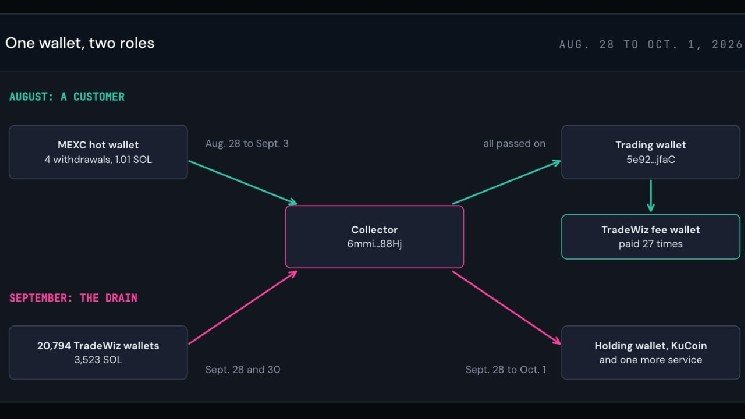
    The connection offers investigators a starting point. It does not establish who controlled the wallets or how the private keys were exposed.

    Source: Bitquery

    The Bot Stopped but the Theft Continued

    Bitquery found that trading activity through the bot stopped 41 minutes into the main drain. About 73% of the $SOL swept in that operation was taken afterward.

    Tradewiz’s September 30 security notice on X attributed the incident to private-key exposure involving its $SOL PVP export feature. It instructed customers to stop using existing $SOL PVP wallet addresses.

    “We will fully compensate users for losses caused by this incident,” the company wrote.

    A later X update said the first refunds had been sent and that each claim required verification. Tradewiz also announced a precautionary pause in EVM services while it conducted security checks.

    Those statements leave customers with two separate questions: when their losses will be reimbursed, and what failed in the system protecting their wallets.

    A Security Promise Meets a Private-Key Leak

    Tradewiz’s own documentation makes the incident particularly uncomfortable.

    Its FAQ allows users to import and export wallet keys, but recommends against exporting them. It states: “By not exporting your private keys, we can ensure 100% security of your assets.”

    The company’s subsequent disclosure puts that assurance under scrutiny. Users need an explanation of which wallets were exposed, how the export feature was compromised, and what changed before services resumed.

    The public statements issued so far by Tradewiz describe security upgrades and compensation commitments without resolving those questions.

    The Trail Reaches Exchange Accounts

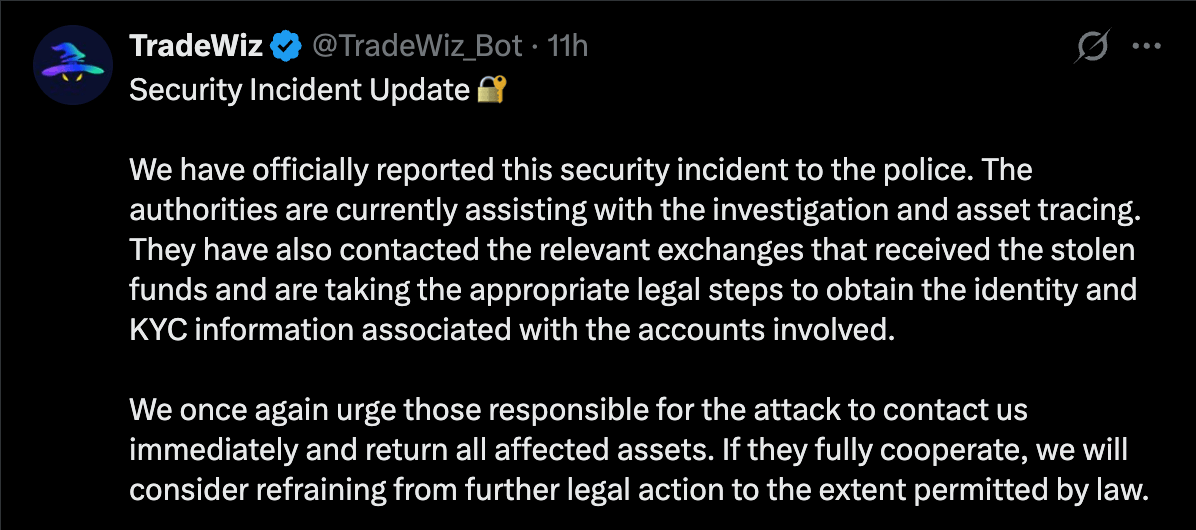
    On October 1, Tradewiz said on X that police were assisting with asset tracing and had contacted exchanges to seek identity and account-verification information.

    The company also offered to consider foregoing further legal action, where legally permitted, if those responsible cooperated and returned the assets.

    Source: Tradewiz on X

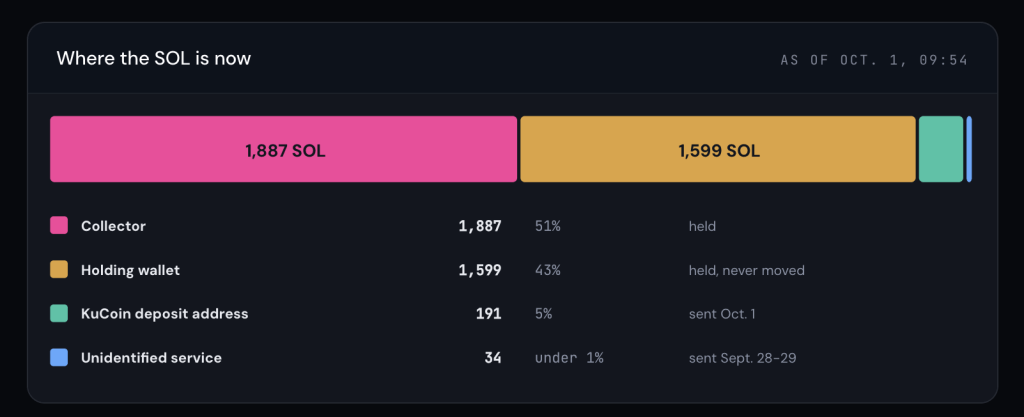
    Bitquery traced earlier funding to MEXC withdrawals and later transfers toward a Kucoin deposit address. Those connections do not implicate either exchange in the theft. However, they identify potential records for investigators to pursue.

    For affected traders, the next meaningful evidence will be completed reimbursements and a technical account of the breach. For investigators, the earlier customer activity may prove more useful than the theft itself.

  • Chinese hackers impersonated AI experts to target US policy minds

    Chinese hackers impersonated AI experts to target US policy minds

    TA419 hackers used deceptive tactics, impersonating real figures like a former White House AI official

    Chinese hackers have been impersonating artificial intelligence (AI) experts in the United States, including a former government official, according to a new report from cybersecurity firm Proofpoint.

    The report, released on Thursday, found that in July, a China-aligned hacking group called TA419 targeted a slate of US policy experts by impersonating prominent figures, including Lynne Edwards Parker, the former principal deputy director of the White House Office of Science and Technology Policy.

    Recommended Stories

    list of 4 itemsend of list

    The hackers, who had been operating since April 2025, first sent otherwise harmless-looking emails intended to engage a target, such as requests to join an “AI Policy Advisory Committee”, and, once they responded, the target would be sent to a fake login page designed to steal their credentials.

    The targets included policy experts at think tanks, defence contractors, universities and law firms in both the US and Japan.

    The report used a technique that creates a fake browser pop-up window inside a legitimate webpage that mimics an authentic-looking sign-in prompt to deceive victims and make it harder for them to realise they are handing over their information to hackers.

    Proofpoint did not specifically name the targets hacked, but the Reuters news agency was able to confirm at least one of them as Alex Engler, a former White House official who now heads the Penn Center on Media, Technology, and Democracy.

    Engler told Reuters that he got one of the emails, but after checking with industry colleagues, he discovered that he had received the email from an impersonator.

    In February, the same group was behind the impersonation of a “prominent” Anthropic employee in efforts to target AI policy experts. The cybersecurity firm behind the report believes that the group will continue to target think tanks and other policy experts and will continue to use the identity of real-world experts to do it.

    Parker did not respond to Al Jazeera’s request for comment.

  • Nithya Raman Reaches Out To David Ellison To Make Sure L.A Production & Jobs Return Now That ParaBros Deal Is Done

    Nithya Raman Reaches Out To David Ellison To Make Sure L.A Production & Jobs Return Now That ParaBros Deal Is Done

    Leading in polls in the Los Angeles mayor’s race, Nithya Raman went on a charm offensive Thursday with the film and TV industry, and Paramount‘s CEO David Ellison in particular.

    “To David Ellison, to his co-CEO, I don’t just want those dollars that you’ve committed to productions to be spent in America — I want them to be spent in Los Angeles,” the two-term councilmember said today at the Bloomberg Screentime conference, which is taking place in her Hollywood district. Raman said that though she was opposed to $111 billion merger of Paramount and Warner Bros Discovery, now that the deal has been approved she has no interest in “relitigating this into eternity.”

    As has been the case many times in the past, the home of Hollywood has some unlikely bedfellows when it comes to the bottom line. It is unknown whether Raman has directly reached out to Paramount brass since U.S. District Judge Araceli Martínez-Olguín signed off Tuesday on the antitrust settlement between the Ellison-run company and a dozen state attorneys general. Paramount reps did not respond to Deadline’s request for comment on any communication between the councilmember and the CEO.

    David Ellison

    Paramount CEO David Ellison

    Getty

    In full campaign mode, Raman emphasized during today’s panel interview that she will be a “relentless advocate” for uncapping the state’s current $750 million a year film and TV tax incentive program as a further move to get production back to California and L.A. With a room full of execs before her, the spouse of TV comedy scribe Vali Chandrasekaran also reiterated she would “ensure that we had a film office in the mayor’s office that was liaising with other jurisdictions, that was making it as simple to shoot here as possible, as low cost to shoot here as possible, and that work would be established almost immediately.”

    To that, with production significantly on the decline over the past six years and more than 50,000 jobs lost, Raman followed the headlines as Ellison and his newly minted co-CEO Ynon Kreiz prepare to meld the two iconic Hollywood companies.

    “If I get to be mayor, I want to work with you and ensure and fight as hard as I possibly can to make sure that every single one of those shoots are happening here in Los Angeles,” the candidate said, addressing Ellison and Kreiz directly in absentia. “And I will do everything in my power to make sure that happens.”

    Although Raman leads incumbent Mayor Karen Bass by double digits in many polls, the fact is one-third of voters in the City of Angels remain undecided just more than a month before the election. To that, the candidate has to win over a portion of those who voted for ex-The Hills regular Spencer Pratt in the three-way primary earlier this year — and she had a pitch.

    “To every voter who voted for Spencer Pratt in the primary who is disappointed that he’s not in this general election, I want to speak directly to you,” Raman said of the Donald Trump ally. “I want to speak directly to them, and to say that I share your frustration with City Hall, and I will work with every molecule of my being to ensure that this city is working for you.”

    Among his various post-primary endeavors, former Palisades resident Pratt has been instrumental, by all bipartisan accounts, in the crafting of federal film and TV tax incentive legislation — a bill Raman has said she also supports.

    Leaning into her own outsider status, even with years on the L.A. City Council, Raman added, again addressing Pratt voters: “The frustrations that Angelinos have with the direction of our city is warranted. We have, under this mayor’s leadership, we have moved in the wrong direction and and away from actually delivering the kinds of services that we were able to deliver just a few years ago because of fiscal mismanagement under her leadership.”

    “So, to those Pratt voters, I just want to say to you, I will do better for you,” she said.