Blog

  • Bitcoin’s quantum problem gets a recovery tool, but not for Satoshi’s 1.1 million coins

    Bitcoin’s quantum problem gets a recovery tool, but not for Satoshi’s 1.1 million coins

    Bitcoin signatures rely on elliptic curve cryptography, a system in which a private key generates a public key through math that runs only one way. Anyone can check the public key, but nobody can work backward to the private one. However, Shor’s algorithm, a quantum method published in 1994 for problems that ordinary computers cannot crack, can be fed a public key and return the private key that generated it.

    Hashing is a different kind of problem. A hash scrambles an input into a fixed-length fingerprint and cannot be run backward, and the best quantum attack on it, called Grover’s algorithm, only halves the exponent rather than collapsing it, taking a 256-bit hash from 2^256 guesses down to 2^128.

    That is still more guesses than a machine making a billion a second could get through in the lifetime of the universe.

    Modern wallets are built on hashing. A wallet generates addresses in a tree, deriving each key from its parent, and a “hardened” derivation step feeds the parent’s private key through HMAC-SHA512 to produce the child key.

    That is a one-way function. An attacker who breaks an address after Q-Day ends up holding exactly the key held, and cannot climb the tree to the key it came from.

  • Spain fans bring the party to New York before World Cup final

    Spain fans bring the party to New York before World Cup final

    NewsFeed

    ‘King [Messi] abdicates, but the prince [Lamine Yamal] takes the throne!’
    Spain fans filled the streets of New York with chants and songs ahead of the World Cup final against defending champions Argentina. Spain’s supporters are confident a new generation can bring the trophy home.

  • How to Watch the France vs. England World Cup Third-Place Match Live for Free

    How to Watch the France vs. England World Cup Third-Place Match Live for Free

    How to watch for free: Today’s bronze final will air for free on global channels like BBC iPlayer/ITV. You can use a VPN like ExpressVPN, our pick for location spoofing, to connect to a UK server to tune in for free. You may also be able to watch for free with a streaming trial from DirecTVFuboTV, or YouTube TV.


    After a month of adrenaline-pumping action, the 2026 FIFA World Cup draws to a close this weekend with two exciting finals. Argentina and Spain will fight for the sport’s ultimate achievement on Sunday, while France take on England in the bronze final today.

    There have been debates about whether FIFA should continue its third-place competition, but today we’ll find out whether France or England will take home the bronze. It’s also a chance for France’s Kylian Mbappé, England’s Harry Kane, and Jude Bellingham to still aim for the Golden Boot. Mbappé is tied with Lionel Messi at eight goals, while Kane and Bellingham are just behind with six goals each.

    It will be interesting to see if all of them start, as coaches do have a habit of playing rested players for this dead rubber. Whether you’re tuning in to back your team or to see how the Golden Boot race unfolds, here’s how you can watch the France vs. England third-place playoff live using a streaming subscription or for free using a VPN or free trial.


    When Is the France vs. England Third-Place Play-Off?

    The FIFA World Cup bronze final between France and England kicks off at 5:00 p.m. ET on Saturday, July 18, at Miami Stadium in Miami, Florida.


    How to Watch France vs. England Live in the US

    You can watch France vs. England live on Fox or Telemundo. If you don’t have cable and you live in the US, you can watch with a sports streaming subscription, such as DirecTV, Fox One, Fubo, Peacock, Sling, YouTube TV, and more. If you don’t have a live TV or streaming service, you may be able to watch the game with a free trial:


    How to Watch France vs. England Online for Free

    The France vs. England bronze final will air live for free on several streaming platforms across the globe, including:

    These platforms are geo-locked to their respective countries, but you can use a virtual private network (VPN) to watch matches for free from the US or elsewhere. For the France vs. England World Cup bronze final, we recommend ExpressVPN, our top pick for location spoofing. ExpressVPN has servers across the globe, making it easy to mask your actual location so you can access region-locked content. Additionally, ExpressVPN is also an official supporter of the 2026 FIFA World Cup.

    Editors’ Choice

    4.0

    Excellent


    ExpressVPN


    $3.49 Per Month (73% Off for 28 Months)
    at ExpressVPN

    $12.99 Per Month


    Learn More

    Here’s how you can access the France vs. England match with a VPN using BBC iPlayer as an example:

    1. Sign up for a streaming-friendly VPN (like ExpressVPN).

    2. Download the VPN app on your computer, phone, or preferred device.

    3. Connect to a server in the UK.

    4. Visit BBC iPlayer or ITV to start streaming.

    Note: If you’re new to BBC, you may be asked to create an account to access iPlayer. Add a UK postal code on the sign-up page to avoid possible disruptions. I tested this earlier this week to make sure it was still working.

    Usually, the top VPNs that let you connect to servers in other countries aren’t free. But if you already have a VPN subscription or qualify for a free trial, you may be able to use one to watch the FIFA World Cup third-place play-off between France and England at no additional cost.


    France: Road to Third-Place Playoff, Team News

    France's playing XI vs Spain in the 2026 World Cup semifinal

    (Credit: Omar Vega/Getty Images)

    France were the team to beat at this World Cup and played every game until the semifinal as if they were here to rule. In the semifinal, however, they were outclassed, outrun, and left stunned by a Spanish team that had mastered the art of moving the ball with pace and accuracy.

    That said, they have plenty of positives to take from this campaign, especially with regard to their roster’s potential. Kylian Mbappé, their best player, is still just 27 years old. He is second on the all-time World Cup scorers list, has already won the trophy once, and could end up being the greatest World Cup performer ever. Michael Olise, aged 24, is another young player who set the tournament on fire and could serve the country for many years to come. Similar hopes can be rested on several other young talents, such as Bradley Barcola, Aurélien Tchouaméni, William Saliba, Jules Koundé, Désiré Doué, and Manu Koné.

    • Group Games: Beat Senegal 3-1; Beat Iraq 3-0; Beat Norway 4-1

    • Round of 32: Beat Sweden, 3-0

    • Round of 16: Beat Paraguay, 1-0

    • Quarter-final: Beat Morocco, 2-0

    • Semi-final: Lost to Spain, 2-0

    • Top Scorer: Kylian Mbappé (8 goals) | Most Assists: Michael Olise (5)

    Expected lineup: As mentioned earlier, coaches often rotate their squad for this game, so all regulars may not start. That said, this is also Didier Deschamps’ final game as head coach. He is the only Frenchman to win the World Cup both as a player (1998) and a coach (2018), and he may want to wrap up his national career with yet another meaningful achievement.

    If that’s the case, he could play Maignan in goal; Koundé, Upamecano, Lacroix, and Hernández/Digne in defense; Tchouaméni/Kone and Rabiot in defensive midfield; Dembélé, Olise, Doué/Barcola as attacking midfielders; and Mbappé as the lone striker.


    England: Road to Third-Place Playoff, Team News

    England's Playing XI vs Argentina in the 2026 World Cup Semifinal

    (Credit: MAURICE VAN STEEN / ANP via Getty Images)

    England put up some stellar performances throughout the tournament, with Harry Kane and Jude Bellingham in the form of their lives. Against Argentina, though, soccer pundits say that coach Thomas Tuchel made some tactical errors that led to their defeat. England took the lead in the 55th minute with a clinical finish from Anthony Gordon, but Tuchel’s substitutions thereafter focused on guarding their narrow lead instead of increasing it. Argentina then attacked persistently and were rewarded with two goals that clinched a spot in the final.

    Looking back at England’s campaign, this felt like one of the few World Cups where it indeed looked like “it’s coming home.” If it wasn’t for the genius of Lionel Messi, they probably would be in the final with Spain.

    • Group Game 1: Beat Croatia 4-2; Drew Ghana 0-0; Beat Panama 2-0

    • Round of 32: Beat DR Congo, 2-1

    • Round of 16: Beat Mexico, 3-2

    • Quarter-final: Beat Norway, 2-1

    • Semi-final: Lost to Argentina, 2-1

    • Top Scorers: Jude Bellingham, Harry Kane (6 goals) | Most Assists: Bukayo Saka, Anthony Gordon (3)

    Expected lineup: Tuchel will have the services of Jarell Quansah again, following his two-game suspension for dangerous play against Mexico. If the coach picks Quansah, here’s what the playing XI could look like: Pickford in goal; Quansah, Stones, Guéhi, and Spence in defense; Rice, Anderson, and Bellingham in the midfield; and Rogers, Gordon, and Kane up front.


    2026 FIFA World Cup Schedule

    The 2026 FIFA World Cup runs from June 11 to July 19 and will be co-hosted by the US, Canada, and Mexico. This year, the tournament has expanded to 48 participating nations for a total of 104 games.

    • June 11 to June 27: Group stage

    • June 28 to July 2: The knockout stage begins with the first-ever Round of 32 at a FIFA World Cup. The eventual champion will have to win five consecutive knockout games, instead of the former four.

    • July 3 to July 7: Round of 16

    • July 9, 10, 11: Quarterfinals

    • July 14-15: Semifinals

    • July 18: Bronze final

    • July 19: Final

    We’ll be following the World Cup through this weekend, so stay tuned for more.

    The World Cup Has a Secret AI Command Center

    PCMag Logo

    The World Cup Has a Secret AI Command Center

    About Our Expert

  • ‘Call of Duty’ Movie From Taylor Sheridan and Peter Berg Will Be Set in ‘Modern Warfare’ Universe

    ‘Call of Duty’ Movie From Taylor Sheridan and Peter Berg Will Be Set in ‘Modern Warfare’ Universe

    Paramount and Activision’s upcoming Call of Duty movie will be set in the Modern Warfare universe.

    Director and co-writer Peter Berg announced the news Saturday during Fanatics Fest in New York City, confirming that the film will adapt the franchise’s most popular and recognizable subseries.

    Taylor Sheridan, the creator of Landman, the Yellowstone universe, Lioness and more, is co-writing the screenplay for the studio alongside Berg, whose directing credits include Friday Night Lights, Battleship, Lone Survivor and Deepwater Horizon. Sheridan, Berg and David Glasser of 101 Studios are also producing.

    During its CinemaCon presentation in April, it was revealed that the planned theatrical release date was slated for June 30, 2028. The release will coincide with the 25th anniversary of the Call of Duty franchise, which debuted in 2003.

    “I told everyone we were only going to make a movie if it’s right. In David Ellison, we found that partnership,” Activision head Rob Kostich said at the time. “We want to make sure that the authenticity of it is captured on a human level so that it feels really real and infuse that with epic scope.”

    Call of Duty is one of the best-selling video game franchises of all time, with more than 500 million copies sold worldwide. Past installments of the franchise have spanned wars from World War II to Vietnam to the present and future. The latest installment, Call of Duty: Modern Warfare 4, is scheduled to launch on Oct. 23 and follows a war between North and South Korea.

  • Bill Would Ban Chinese Connected Cars in the US—From Sale and on the Streets

    Bill Would Ban Chinese Connected Cars in the US—From Sale and on the Streets

    A bipartisan group of legislators is trying to advance a bill that would essentially put square wheels on Chinese cars in the US. 

    The Connected Vehicle Security Act of 2026 would go miles beyond past moves to make China’s booming auto industry unwelcome in the US and ban the “importation, manufacture, sale, resale, or introduction into interstate commerce” of connected cars made or designed by firms in the PRC as well as Iran, North Korea, or Russia.

    Backers of this measure–starting with Sens. Bernie Moreno (R-OH) and Elissa Slotkin (D-MI), who introduced it as S.4429, and Reps. Debbie Dingell (D-MI) and John Moolenaar (R-MI), who then sponsored a companion bill as H.R.8730–invoke the risk of the Chinese Communist Party requiring surveillance through these vehicles and its history of subsidizing its auto industry.

    “These cars have enormous amounts of data-collection capabilities,” Moreno said on a panel hosted Monday at the American Enterprise Institute in Washington, moderated by AEI fellow Chris Miller. “Imagine TikTok, but on steroids.” 

    (Allegations of Chinese surveillance via the social platform now controlled by a US-led group of investors remain unproven; the Supreme Court only held those concerns credible last January when it upheld a law banning app-store and hosting transactions with TikTok.)

    Citing scenarios of Beijing directing Chinese carmakers to exfiltrate data from connected cars or take control of them remotely, Moreno called these vehicles “obviously an insane national security threat.”

    Sitting alongside Moreno, Moolenaar backed up his risk assessment. “Their national security laws basically require anyone to do the bidding of the CCP,” he said of Chinese carmakers. 

    The Biden administration thought this enough of a risk to issue a regulation in its last days restricting connected-car systems from China. In June, the Commerce Department used that authority to deny Polestar, partly owned by the Chinese automotive giant Zhejiang Geely Holding Group and Geely-owned Volvo, permission to sell its EVs in the US after the 2026 model year.

    A May 15 AEI report noted a report by Norwegian researchers who found that Chinese-made battery-electric buses in use in that country had a component allowing remote shutoff. That conservative think tank highlighted restrictions imposed on Chinese cars by the UK, Israel, Norway, and Poland–for example, barring them from the vicinity of military bases–but did not call for a ban on their import. 

    An Unyielding Statute

    The Connected Vehicle Security Act, like the existing connected-car rule, would allow the Secretary of Commerce to issue waivers to the ban. But at AEI, Moolenaar and Moreno did not suggest that any would be forthcoming as long as China’s current government holds power.

    “We hermetically seal our market,” the senator said. “We go way beyond the current connected vehicle rule to go through the entire supply chain.”

    Moreno brought up Waymo as one company that would have to comply by parking its new Ojai minivans, based on Geely’s Zeekr model. “We’ve had great conversations with Waymo,” he said. “I think as a result of this bill they’re going to shift gears, hopefully […] to a Detroit-based vehicle.” 

    Waymo declined to comment on the record, but that Alphabet subsidiary has already emphasized how connected parts in its robotaxis don’t come from or talk back to China.

    “The technology that collects data and makes our vehicles autonomous—the software, sensors, and computing systems—is developed in the US,” spokesperson Sandy Karp told PCMag contributor Rakesh Agrawal as part of an Ojai test drive in San Francisco last month. “Waymo installs the autonomous driving technology on stripped-down, disconnected OEM-provided vehicles in our Arizona manufacturing facility.”

    The seal that Moreno described would meet land borders with Canada and Mexico, since the statute uses a legal definition of “import” that includes “any bringing in” of a product. The senator said a driver rolling up to a US border crossing in a Chinese vehicle would meet a U-turn sign: “They’ll have to buy another car, because their car will not be allowed in the United States of America.”

    A separate bill, the Protecting America from Chinese Cars Act introduced by Slotkin and Rep. Haley Stevens (D-MI), would make that no-crossings rule explicit, but it has yet to draw more sponsors.

    Cooling Towards China

    Chinese vehicles are off to a fast start in Mexico, with estimates putting the share of PRC-manufactured vehicles in 2025 at 15% to 19% of the total market. But those imports have since plunged after Mexico imposed a 50% tariff starting in January.

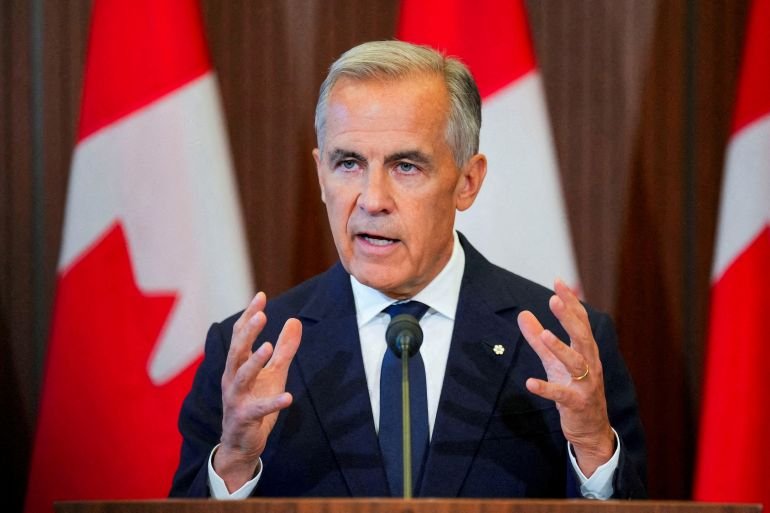
    In Canada, meanwhile, Prime Minister Mark Carney has responded to US unfriendliness–including tariffs on its exports and repeated threats of annexation by President Trump–by inking new deals with China that include allowing the import of 49,000 Chinese EVs at a 6.1% tariff. 

    Moreno called Canada’s slight opening of its EV market a “totally crazy move” but did not mention the things Trump has done to earn Canadian ire.

    Canada had begun charging a 100% tariff on Chinese vehicles in 2024, matching President Biden’s imposition of the same rate earlier that year. Governments have usually cited China’s auto subsidies as the reason for these taxes, and Moolenaar and Moreno agreed that they represent unfair competition. “They’ll use trade practices to drive our businesses out of business,” the congressman said.

    In Europe, the continued growth of Chinese EVs has recently led to calls for higher tariffs for the same reason.

    Recommended by Our Editors

    But China’s progress isn’t just a matter of prices. Automakers like BYD, the largest EV manufacturer in the world, have been doing innovative work that has earned recognition from competitors. Last year, Ford CEO Jim Farley, who had a Xiaomi SU7 sedan specially imported for him to drive–called China’s rapid progress as “the most humbling thing I have ever seen.” 

    Moreno, however, suggested that China’s success in EVs was part of a plot to make American expertise in building internal combustion engines irrelevant: “They pulled off the greatest scam on Earth.”

    Privacy, Please

    The House and Senate versions of the connected-vehicle bill have drawn dozens of co-sponsors, but it’s unclear if that will mean anything in a historically unproductive Congress. Moreno said backers hope to get this measure added to the must-pass National Defense Authorization Act spending bill

    Meanwhile, people already have good reasons to worry about the privacy of connected cars regardless of the national flag on the sticker. 

    A 2023 report by Mozilla flunked all 25 car brands evaluated on privacy standards, and a 2024 investigation by researchers for Sens. Ron Wyden (D-OR) and Ed Markey (D-MA) found weak data-protection practices across the industry, including at American automakers. 

    Neither lawmaker at AEI mentioned this, so I asked if they had plans to address those anxieties.

    “We should have guardrails to make sure we’re protecting people’s privacy,” Moolenaar said. “But there’s a huge difference between the American government and the Chinese government.”

    Moreno decried defaults that require a customer to “go through 17 different screens” to opt out of having their data circulated. “It should be no unless I actually say yes,” he said. “Let the person choose.”

    Congress as a whole has not acted as if that is a priority, year after year failing to enact any sort of comprehensive privacy statute. This year’s attempt, a Republican-written measure called the SECURE Data Act, is narrower than previous tries, has only been introduced in the House so far, and has only eight co-sponsors listed. Moolenaar is not among them.

    About Our Expert

  • BAFTA Student Award Winners Include Young Filmmakers From Spain, France, China and America

    BAFTA Student Award Winners Include Young Filmmakers From Spain, France, China and America

    Winners of the British Academy of Film and Television Arts’ 22nd BAFTA Student Awards include young filmmakers from Spain, France, China and the United States, it was revealed at a ceremony in Los Angeles on Friday night that was hosted by TV host Elle Osili Wood and featured presenters such as actor/producer Asif Ali, actor/writer Wil Wheaton, immersive artist Gina Kim and film executives Kathryn Busby and Niels Swinkels.

    The BAFTA Student Awards celebrate emerging creative talent from around the world across film, games and immersive storytelling. This year’s winners were chosen from more than 600 submissions from universities worldwide by a jury that included actor/writer Joel Kim Booster, composer Laura Karpman, documentarian Smriti Mundhra, actor/comedian Nico Santos and exec Heather Callow.

    “We continue to be inspired by the originality and ambition of student work from across the globe,” Courtney LaBarge Bell, BAFTA North America’s executive director, said in a statement. “Each year, these projects raise the bar for storytelling across film, games, and immersive media, and reflect the creative energy driving the future. We’re proud to provide a platform that recognizes this talent and helps support the next stage of their careers.”

    Here is a list of the 2026 BAFTA Student Award winners…

    THE ALBERT R. ‘CUBBY’ BROCCOLI SPECIAL JURY PRIZE

    Rage
    Fran Moreno Blanco, Santi Pujol Amat
    Escola Superior de Cinema i Audiovisuals de Catalunya, Spain

    FOR ANIMATION (PRESENTED BY CRUNCHYROLL)

    Gauze
    Noran Fikri Alezabi, Nicholas Arujah, Xinyue Ma, Yulin Yue, Xiaonan Zhou
    Gobelins, France

    FOR DOCUMENTARY (PRESENTED BY ESPN BOLD)

    Strangers on Our Land
    Zane Karram, Kelsey Oliver
    University of California, Berkeley, United States

    FOR LIVE ACTION

    Whispers of the Waves
    Patricia Xu
    Beijing Film Academy, China

    FOR GAMES

    Candellum
    Eva Martinello, Mattéo Gomez
    Isart Digital, France

  • Christopher Nolan Says It Will Be ‘At Least’ Three Years Until He Makes Another Movie After ‘The Odyssey’ Pushed the ‘Limits of My Own Stamina’

    Christopher Nolan Says It Will Be ‘At Least’ Three Years Until He Makes Another Movie After ‘The Odyssey’ Pushed the ‘Limits of My Own Stamina’

    Christopher Nolan recently told “Today” that after giving it his all for “The Odyssey,” it will be “at least” three years until he makes another movie.

    “I definitely hit the limits of my own stamina and everybody’s stamina, I think,” Nolan said. “I mean, it’s ‘The Odyssey,’ of course it should be difficult. We’re not doing the job right making a film of ‘The Odyssey’ if it doesn’t seem difficult.”

    One of the many challenging facets of “The Odyssey” was that it was shot entirely with Imax cameras. Nolan recalled telling the team at Imax before shooting, “If ever we are going to fulfill this dream of shooting the entire movie that way, this is the one. This is ‘The Odyssey.’”

    Even though “The Odyssey” proved to be a grueling production, Nolan would not have wanted it any other way. He recently told the New York Times that studios need to stop playing it safe with their blockbusters, because audiences are hungry “for something new.”

    “If you’re really interested in movies and the history of movies, the one thing you see absolutely is that you have to take risks to succeed. The biggest risk of all is to play it safe,” Nolan said. “That’s what, consistently in mainstream movies, doesn’t work. The audience is looking for something new.”

    “The Odyssey,” based on Homer’s ancient Greek epic, tells the story of Odysseus and his arduous journey back home after his victory in the Trojan War. Matt Damon stars as Odysseus, leading an all-star cast of Tom Holland, Zendaya, Anne Hathaway, Lupita Nyong’o, Robert Pattinson, Charlize Theron and more.

  • ‘Mexodus’ Review: The Underground Railroad Runs South to Mexico in a Pasadena Playhouse Musical That Feels as Spirited as a Two-Man ‘Hamilton’

    ‘Mexodus’ Review: The Underground Railroad Runs South to Mexico in a Pasadena Playhouse Musical That Feels as Spirited as a Two-Man ‘Hamilton’

    To paraphrase Aaliyah: Cast size ain’t nothing but a number. In the realm of the theater, no one exactly equates the number of headshots on a Playbill page with the ultimate fulfillment a stage show provides. Still, a question may arise: How few people can you have in a musical and still generate just as many killowatt-hours of energy as a full ensemble production?

    It’s not a theoretical question. An answer strongly comes to us with the musical now playing at Pasadena Playhouse, “Mexodus,” a two-hander that can feel like a 20-hander as you’re going with the boisterous flow and forgetting to do the math. The show has Brian Quijada and Nygel D. Robinson as both its writers and its stars, and these are two fellows who ought to be able to write their own tickets for some time to come, on the basis of this (asterisk: at least to the extent that anyone in the theater can), as actors and/or songwriters. Heck, if either of them decided to go really minimalist after this and do a one-man show, I’d be among the first in line.

    But in “Mexodus,” it takes two to tango, or to collaborate on a mixture of musical styles, with the complementary flavors of hip-hop and traditional Tex-Mex balladry at the top of the list. It very much feels like a spawn of “Hamilton,” in that it’s a period piece set in a century well before ours with a considerable amount of rapping at the outset. That’s an anachronism you may enjoy or even feel exhilarated by, even as you’re hoping maybe not the entirety of the show plays out in that style. It doesn’t, of course. Part of what gives “Mexodus” such a kick is how expert Quijada and Robinson turn out to be as writers and singers in a surprising number of genres that expand throughout the show in a kind of beautifully inverse proportion to the number of actual players on stage.

    Two things to know straight off: One, “Mexodus” is a good time at the theater. And, two, it’s a slavery story. If those two key factors seem like they might cancel each other out, you won’t be the first to wonder how a narrative spun off from the United States’ greatest shame, set in the days before emancipation, can be reconciled with feel-good entertainment. There’s an easy answer to that: Most of the action takes place south of the border, after the enslaved Henry (Robinson) has made his escape to Mexico, where he finds an uneasy benefactor in a rancher, Carlos (Quijada). The horrors of what Henry has left behind — and could easily be returned to — are hardly skipped over. But ultimately it’s a story about the sometimes tentative, sometimes tight relationship between Black and brown people… ostensibly in the 1860s, but by historical extension the 2020s, too.

    The question is set up: Can Latinos and Blacks form a more perfect union as they both deal, with varying degrees of deadliness, with white America? In exploring that coming together of two marginalized (to say the least) North American cultures, “Mexodus” finally lands in a place of not just cautious optimism but a good reason to throw a musical-theater party.

    Before the narrative starts up in earnest, the show opens with a good stretch of fourth-wall-breaking, as Quijada and Robinson greet the house and explain the rules of how all the music will be created in the intermission-less hour-and-a-half to follow. A full vocal and instrumental sound will be put together via looping, which will not require much explanation for anyone who knows anything about, say, Ed Sheeran’s live performances. (Ariana Grande even has a looping exercise in her current tour.) For a less pop-savvy theater crowd that might require more backstory on the gambit, it involves Robinson and/or Quijada singing a background part, or playing a drumbeat or acoustic guitar riff, then having these bits lap and layer over one another, with the use of a turntable or pedal or knob or offstage assistant. There’s an impressive magic effect that occurs when one or two men are able to quickly turn themselves into a pit band, or off-Broadway chorale. But to the duo’s credit, there’s at least as much kismet happening when they aren’t messing with these effects at all but knocking us out with, say, an unexpected Spanish-guitar duet. There’s probably a version of this show that these two could pull off without any of the looping tech; it’d be interesting to see and hear them try doing a “Mexodus Unplugged.” But probably no one in the audience will begrudge their ability to come up with a full sound and heavy pulse by the time a mirror ball lights up at stage right.

    “Mexodus” does mean to be a history lesson, without becoming too pedantic a peda. In their narrator mode, Quijada and Robinson offer a stat that an estimated 4,000 to 10,000 enslaved people made their way to freedom on a lesser-known Underground Railroad that went south instead of north. Once the story gets underway, they don’t break in with too many more factoids. But each of the two principals does get a sort of time-out in the action in which they recount what seems to be an actually autobiographical memory of interaction earlier in their lives with “the other” — not the white other, but with Blacks, in Quijada’s case, and Latinos, in Robinson’s. It’s easy to imagine a director less sensitive than David Mendizábal trying to convince the writer-actors that the show doesn’t need these twin outlier moments. But these anecdotes serve as lovely grace notes in reminding the audience that the relatively happy outcome to the fictional-historical story isn’t meant to suggest that the Black and brown populi have exactly been in perfect alignment since the mid-1860s. Robinson and Quijada make such a perfect dream team, you want to believe that everyone they’re standing in for in real life is as sympatico as their characters turn out to be. These reflective, personal bits help ground the show in the inevitable realization that things are tense all over… still.

    But you come to “Mexodus” to be elevated, not to keep crashing back to earth. It’s a show where issues of melanin meet melatonin, and if that sounds at all like a forced marriage, you haven’t seen the ease of how Quijada and Robinson’s writing and performance styles are wed here.

    Brian Quijada and Nygel D. Robinson in “Mexodus” at Pasadena Playhouse

    Thomas Mundell

    It may help that L.A. is getting this show about as fresh out of New York’s heat and humidity as theatrical productions come. Quijada and Robinson initially performed it in a twice-extended run at the Minetta Lane Theatre in New York in 2025, then quickly revived it for an additional engagement at the Daryl Roth Theatre that wrapped up on June 14 — with NYC being enraptured enough to give the show four Lucille Lortel Awards, four Outer Critics Circle Awards, three Drama Desk Awards, Off Broadway Alliance Award and a Drama League Award. After all that, they barely had time to take a cross-country flight before picking things up in Pasadena, whose Playhouse barely had time to usher out its acclaimed “Brigadoon” revival in time to make way for this two-man tuner. It feels like Pasadena just got in a big shipment of adrenaline, in other words.

    And almost regardless of the merits of the show itself (but not quite), it’s worth catching even if you’re just a fan of hungry and talented actors going above and beyond in making work — ultra-high-quality work — for themselves. Now, here are two guys who know how to build, if not quite an actual Underground Railroad, one hell of a funicular.

    “Mexodus” continues at Pasadena Playhouse through Aug. 2. Ticket information can be found at PasadenaPlayhouse.org.

  • Will Robinhood Chain flip Solana? The math says not close.

    Will Robinhood Chain flip Solana? The math says not close.

    Robinhood Chain launched, filled with memecoins, briefly ranked third among DEXs, and the “Solana killer” talk started immediately. Then you look at the actual numbers. Solana has 27 times the value locked and 2 million more users. This is not a flippening. It is a fair fight over the wrong metric.

    Within days of Robinhood Chain going live, the comparison wrote itself. A memecoin frenzy sent the chain’s DEX volume past $3 billion in a week; it briefly cracked the top three networks by daily DEX volume, and crypto Twitter did what crypto Twitter does: it declared a Solana killer.

    The parallel was tidy. Solana also grew through a memecoin boom, so surely Robinhood was running the same playbook toward the same destination. Then you pull the actual data, and the tidy story falls apart. Solana has roughly 27 times Robinhood Chain’s value locked and millions more users.

    The one metric where Robinhood looked competitive, raw volume, is the flimsiest number on the board. This piece is about whether Robinhood Chain can flip Solana, and the short answer is no, not close, and the more interesting answer is that flipping Solana was never the right frame.

    The scoreboard

    Start with the numbers, because the numbers settle most of the argument before it starts.

    Solana, as of mid-July 2026, carries around $4.93 billion in total value locked, does roughly $1.91 billion in daily DEX volume, has more than 2 million active addresses, and generates about $3 million in daily application revenue. These are the metrics of a mature, heavily used layer-1 with a deep DeFi ecosystem, years of accumulated liquidity, and a large, sticky user base.

    Robinhood Chain, roughly 2 weeks after launch, sits at around $185 million in value locked, having posted more than $3 billion in DEX volume across its first week. Depending on the day and the source, its TVL has been quoted between $185 million and $312 million, with the higher figure heavy on stablecoin deposits. Active addresses are counted in the hundreds of thousands cumulatively, not the millions active.

    LATEST: Robinhood chain DeFi TVL exceeds $100m pic.twitter.com/9JkvoigFEA

    — crypto.news (@cryptodotnews) July 8, 2026

    Line the durable metrics up, and the gap is stark. On value locked, Solana leads by a factor of roughly 27 to one against the lower Robinhood figure, and still around 16 to 1 against the higher one. On active users, the gap is larger still. On application revenue, Solana’s ecosystem earns real fees across a diverse set of protocols; Robinhood Chain’s revenue is concentrated in memecoin trading and inflated by incentives. There is exactly one metric where Robinhood looked competitive in its first fortnight, and that is raw DEX volume, where a memecoin frenzy briefly pushed it into the same conversation as networks many times its size.

    That single metric is doing all the work in the flippening narrative, and it is the metric that deserves the least trust.

    Why volume is the wrong number

    Volume is seductive because it is large and it moves fast, and it is misleading for the same reasons.

    Robinhood Chain’s $3 billion first week was overwhelmingly memecoin trading. $CASHCAT alone generated roughly $98 million in a single day, about 17% of the chain’s entire DEX volume, and the broader wave of Robinhood-themed tokens, Cash Dog in Hood, Little John, Hoodrat, drove most of the rest.

    Memecoin volume is the most transient category of on-chain activity there is. It arrives with attention and leaves with it, and it leaves no infrastructure behind. A chain doing $3 billion in memecoin volume this week can do a fraction of that next month, as the 33% single-day $CASHCAT drop after its launchpad exited already showed.

    JUST IN: Robinhood Chain protocol TVL crosses $400 million dollars pic.twitter.com/MxScKayF6Q

    — crypto.news (@cryptodotnews) July 18, 2026

    Then there is the subsidy. Robinhood Chain ran a 90-day gas fee subsidy from launch, which makes transactions artificially cheap and inflates transaction counts and, indirectly, trading activity. Any volume comparison during the subsidy window is measuring a promotion as much as organic demand. The honest read of that number will only be available once the subsidy expires and users start paying real costs.

    Value locked, by contrast, is sticky. It represents capital that has chosen to reside on the chain, in lending protocols, liquidity pools, and asset-management strategies, and it does not evaporate with a memecoin’s attention cycle. Solana’s ~$4.93 billion in TVL is the accumulated result of years of protocols, integrations, and users committing capital. Robinhood’s ~$185 million is a 2-week-old figure heavily weighted toward stablecoin deposits and speculative liquidity. TVL is the metric that predicts whether a chain is durable. Volume is the metric that predicts whether it is currently trending. They are not the same, and the flippening narrative relies entirely on the second.

    The bull case for Robinhood

    The strong case for Robinhood Chain does not run through on-chain metrics at all, and the people making the flippening argument are looking in the wrong place because the actual advantage is off-chain.

    Robinhood has roughly 28 million customers across 38 countries and more than a decade as one of the largest retail investment platforms in the United States. That is a distribution asset no crypto-native chain possesses. Solana had to acquire its users one at a time through the slow, expensive work of crypto adoption.

    Robinhood already has tens of millions of funded accounts belonging to people comfortable trading both stocks and crypto, and it can put its chain in front of them inside an app they already use. If even a modest fraction of that base becomes active on-chain, the user numbers change quickly. Brand equity and distribution are exactly what earlier tokenization projects lacked, and Robinhood has both in abundance.

    The memecoin-as-ignition argument also has real historical support. Solana itself grew through a memecoin cycle: BONK, WIF, and the Pump.fun era, before it produced serious infrastructure and institutional adoption. Base followed a similar arc. Speculative trading bootstraps the liquidity, the market makers, the tooling, and the attention that serious applications later need. In this reading, Robinhood Chain’s memecoin phase is not a failure to attract real activity; it is the normal first stage, and judging a 2-week-old chain by its TVL is like judging Solana by its 2021 numbers.

    JUST IN: $Cashcat memecoin down over 70% since Hyperliquid perpetual listing pic.twitter.com/HvRwCzPYzx

    — crypto.news (@cryptodotnews) July 17, 2026

    And Robinhood is playing a different game entirely. Its chain is built for tokenized stocks and real-world assets, a category Solana is also chasing but where Robinhood brings brokerage licenses, custody relationships, and regulatory infrastructure that a crypto-native chain has to build from scratch. If the RWA thesis plays out, Robinhood competes on ground where its traditional-finance credentials are an advantage, not on the DeFi metrics where Solana is years ahead. The flippening question assumes the two chains want to be the same thing. They may not.

    The bear case for Robinhood

    The skeptical case is that Robinhood Chain has attracted exactly the kind of activity that does not convert, and that the gap to Solana is not a head start Robinhood can close but a structural difference it may never close.

    The mercenary-liquidity problem is the core of it. Memecoin traders are loyal to activity, not to chains. They arrived on Robinhood Chain because that is where the new-launch action was, and they will leave for the next chain offering quicker profits without a second thought. The Noxa launchpad that powered the entire boom generated roughly $12 million in fees and then stopped accepting launches and went dark within 11 days of the chain’s launch. That is not the behavior of infrastructure settling in; it is the behavior of an extraction cycle moving through. When the memecoin attention leaves, the question is what remains, and right now what remains is roughly $12.8 million in actual tokenized real-world assets, the thing the chain was built for.

    The convert-the-traffic problem compounds it. Robinhood’s 28 million customers are a distribution asset only if they can be moved on-chain, and there is no evidence yet that memecoin degens and Robinhood’s retail stock traders are the same people or that 1 becomes the other. The chain’s current users may have almost no overlap with the tokenized-asset investors Robinhood hopes to serve. Distribution is potential, not conversion, and the conversion has not been proven.

    Then there is the structural point that on-chain metrics are not a race Robinhood is quietly winning. Solana continues to outperform Robinhood Chain across essentially every DeFi metric despite the new chain’s loud debut, and Solana is not standing still. It has its own institutional momentum, its own tokenized-asset push, its own SBI partnership for on-chain financial markets in Japan. Robinhood is not catching a stationary target. It is entering, 2 weeks old, a competition against a network with a multi-year head start that is itself accelerating. Closing a 27-to-1 TVL gap against a moving, growing competitor is a different proposition than the volume charts suggest.

    The Base comparison nobody makes

    The flippening debate fixates on Solana, but the more instructive comparison is Coinbase’s Base, because Base is the closest thing to a control group for exactly what Robinhood is attempting, and it complicates both the bull and bear cases.

    Base launched in 2023 as a corporate-backed Ethereum layer 2, built by a licensed, publicly traded American financial company with a large existing user base, aimed at bringing mainstream users on-chain. That is Robinhood Chain’s template almost exactly. And Base’s early growth, like Robinhood’s, ran heavily through memecoins before it developed into a more diversified ecosystem. So Base is the case study for whether a corporate chain can convert a speculative launch into durable activity, and the answer it offers is genuinely mixed.

    On the bull side, Base did convert. It built real DeFi, real stablecoin activity, and real applications on top of the initial speculation, and it became one of the larger L2s by several measures. Coinbase’s distribution, tens of millions of users, mattered, and the memecoin phase did function as ignition rather than as the whole story. That is the precedent Robinhood is betting on, and it is a real one: a corporate chain did turn a speculative launch into something lasting.

    On the bear side, Base did not flip Solana either, and it had a 2-year head start on Robinhood plus a parent company that was crypto-native from birth. If Base, with Coinbase’s crypto-specific expertise and a longer runway, sits alongside Solana instead of above it, the idea that Robinhood Chain will vault past Solana looks even less plausible. And Base has its own value-capture questions as an Ethereum L2, the same ones that apply to Robinhood Chain, where the base layer captures little of the economics. Base shows the corporate-chain model can work; it also shows that working means becoming a significant chain, not dethroning the incumbent. That is the realistic ceiling for Robinhood Chain too: not flipping Solana, but earning a durable place alongside it, and only if it converts the way Base did rather than fading the way most launch-frenzies do.

    What a flippening would actually require

    The word “flippening” gets thrown around loosely, so it is worth being precise about what would have to happen for Robinhood Chain to actually surpass Solana, because the specifics show why the headline math is not close.

    Flipping Solana is not one event; it is a set of them across separate metrics, and they do not move together. On total value locked, Solana holds roughly $4.93 billion against Robinhood Chain’s ~$185 million, a gap of about 27 times. Closing that does not mean matching Solana’s memecoin volume for a week. It means persuading serious capital, lending markets, stablecoin issuers, restaking protocols, and asset managers to park billions on a corporate L2, which is a trust-and-time problem that speculative volume does nothing to solve. TVL is sticky precisely because it represents commitment, and commitment is the thing a memecoin wave cannot manufacture.

    On active addresses, Solana runs above 2 million against a far smaller base on Robinhood Chain, and the composition matters more than the count. Solana’s addresses span DeFi users, NFT traders, payment apps, and memecoin degens across a mature ecosystem. Robinhood Chain’s early activity is concentrated in memecoin speculation and a gas subsidy that inflates the raw transaction figure. An address trading $CASHCAT once is not equivalent to an address running a lending position, a payment flow, and a staking allocation. The headline number can converge while the underlying engagement stays a chasm apart.

    On application revenue, Solana generates around $3 million daily from a diversified base of protocols. Robinhood Chain’s revenue is thin and skewed toward the launchpad-and-memecoin complex that already showed it can evaporate in days when Noxa went dark. Sustainable app revenue requires applications people use for reasons other than speculation, and building that catalog is measured in years of developer adoption, not weeks of viral trading.

    Then there is the structural ceiling nobody in the flippening conversation mentions: Robinhood Chain excludes US persons from its flagship products. Stock Tokens are barred to Americans, wallet perpetuals are barred to Americans, and the chain’s entire regulated-RWA thesis is aimed at a user base that cannot legally touch its marquee offerings from Robinhood’s home market. Solana has no such wall. A chain competing for global L1 dominance with its largest potential market fenced off from its best products is running the race with a weight the incumbent does not carry.

    Put those together, and the flippening is not a single line for Robinhood Chain to cross. It is four separate lines, on four metrics that move at different speeds for different reasons, at least one of which is capped by regulation. Memecoin volume, the one number Robinhood Chain can actually post, is the least sticky and least predictive of the set. That is why the honest answer to the headline is not “not yet.” It is “not close, and the gap is wider than the volume charts make it look.”

    The verdict

    So will Robinhood Chain flip Solana? On the metrics that matter, no, and not close, and not soon.

    The value-locked gap is roughly 27 to 1. The user gap is larger. The revenue gap is structural. The only metric where Robinhood was competitive is raw volume, which is the least durable measure available, is dominated by transient memecoin trading, and is inflated by a temporary gas subsidy. A chain does not flip a mature layer-1 by winning the one number that evaporates when attention moves on. Every durable indicator points to Solana remaining well ahead for the foreseeable future.

    But the question contains a flawed assumption, and that is the more useful thing to say. “Flip Solana” treats the two chains as competitors for the same prize, and they may not be. Solana is a general-purpose, crypto-native layer-1 with a deep DeFi ecosystem built by and for crypto users. Robinhood Chain is a corporate settlement layer built by a licensed brokerage to bring tokenized stocks and real-world assets to a retail base that already trades on Robinhood. Their overlap right now is memecoins, which is precisely the activity neither of them was built for and which will belong to whichever chain is currently paying attention. The lasting competition, if there is one, is over tokenized real-world assets, and that race has barely started.

    The honest framing is this. Robinhood will not out-DeFi Solana; that is not a contest it is positioned to win and probably not one it is trying to win. What Robinhood can do is convert a slice of 28 million existing customers into on-chain users of tokenized-asset products, on rails where its brokerage credentials matter more than its DEX volume. If it does that, it does not need to flip Solana, because it will be winning a different game. If it does not, the memecoin volume fades, the chain settles back to its $12.8 million of real assets, and the flippening talk looks like what it probably is: a volume chart mistaken for a verdict. The number to watch is not DEX volume and not the gap to Solana. It is whether tokenized real-world assets on Robinhood Chain grow, and Robinhood’s July 29 earnings are the first real look.

    Frequently Asked Questions

    Is Robinhood Chain bigger than Solana?

    No, and the gap is large. As of mid-July 2026, Solana holds around $4.93 billion in total value locked against Robinhood Chain’s roughly $185 million, a gap of about 27 to 1. Solana also has more than 2 million active addresses and around $1.91 billion in daily DEX volume from a mature ecosystem. Robinhood Chain briefly matched Solana on raw DEX volume during a memecoin frenzy, but trails badly on every durable metric.

    Why do people compare Robinhood Chain to Solana?

    Because Robinhood Chain’s DEX volume surged past $3 billion in its first week, briefly ranking among the top networks, and because Solana famously grew through a memecoin cycle of its own before maturing. The parallel is that both bootstrapped with speculation. The comparison relies heavily on volume, which is the least durable metric and, for Robinhood, is inflated by memecoin trading and a temporary gas subsidy.

    Could Robinhood Chain flip Solana eventually?

    On DeFi metrics, it is unlikely any time soon, given a 27-to-1 value-locked gap against a competitor that is itself growing. Robinhood’s real advantage is off-chain: roughly 28 million existing customers and strong retail brand equity. If it converts a meaningful share of that base into on-chain users of tokenized-asset products, it could become large without ever matching Solana on DeFi, because it would be competing on different ground.

    Why is DEX volume a misleading metric?

    Because it is transient and easily inflated, Robinhood Chain’s volume was overwhelmingly memecoin trading, which arrives and leaves with attention and builds no lasting infrastructure. A 90-day gas subsidy also made transactions artificially cheap during the launch window. Value locked, which represents capital committed to the chain’s protocols, is a far better predictor of durability, and on that measure Solana leads decisively.

    What is Robinhood Chain actually built for?

    Tokenized stocks and real-world assets. It launched as an Ethereum layer 2 with Stock Tokens as the flagship product, targeting a retail base that already trades equities on Robinhood. Its competitive advantage is brokerage licenses, custody relationships, and regulatory infrastructure. The memecoin activity that drove its early volume is not the use case it was designed for, and only about $12.8 million in real-world assets currently sit on it.

    What happened with $CASHCAT and the memecoins?

    $CASHCAT, a token named after Robinhood’s original working name, surged to a roughly $156 million market cap and at one point generated about 17% of the chain’s daily DEX volume. It spawned a wave of Robinhood-themed tokens. The launchpad driving the boom, Noxa, earned around $12 million in fees, then went dark within 11 days, and $CASHCAT fell more than 33% in a day, illustrating how quickly memecoin activity can leave.

    Does Robinhood’s user base guarantee success?

    No. Roughly 28 million customers is a distribution advantage, but distribution is potential, not conversion. There is no evidence yet that Robinhood’s retail stock traders will become active on-chain users, or that the memecoin traders currently driving activity overlap with the tokenized-asset investors the chain targets. Converting existing customers into on-chain users is the unproven step the entire strategy depends on.

    When will we know if the strategy is working?

    Watch the tokenized real-world asset figure on the chain, currently around $12.8 million, rather than DEX volume or the gap to Solana. If real assets grow substantially while memecoin activity fades, the traffic is converting, and the strategy is working. Robinhood’s second-quarter earnings on July 29 should offer the first real look at Stock Token adoption, and liquidity behavior after the gas subsidy expires will be the next test.

    Disclaimer: This article is for information and educational purposes only and does not constitute financial or investment advice. It compares blockchain networks and company strategies, not the merits of any token. Memecoins are highly speculative, and most participants lose money. Nothing here is a recommendation to buy any asset or use any platform. Always do your own research. On-chain figures move quickly and are accurate as of July 17, 2026.

  • Andrew Tate and Brother Tristan Arrested in Miami

    Andrew Tate and Brother Tristan Arrested in Miami

    Manosphere influencers Andrew and Tristan Tate were arrested by federal officers Saturday afternoon in Miami, according to AP. The charges against the brothers were not immediately made public.

    This isn’t the first time the Tate brothers have found themselves in cuffs. Back in 2022, the controversial media figures were arrested in Romania by anti-terrorism authorities for human trafficking and rape charges. In 2023, Andrew and Tristan were officially charged with those offenses by the Romanian government, according to the BBC.

    Andrew Tate has continuously denied all wrongdoing. He told the media in 2023 after he was released from house arrest, “We’ve been completely innocent since the beginning of this, and I have to give absolute faith to the Romanian judicial system for finally making the right decision and letting us free.”

    According to Reuters, a Romanian court recently lifted all preventative judicial control measures against the Tates while authorities conduct further investigations into their charges.

    In May of 2025, the BBC reported that British prosecutors authorized 21 charges against Andrew and Tristian Tate, including rape, actual bodily harm and human trafficking. Andrew Tate faces 10 charges connected to three alleged victims, while Tristan Tate faces 11 charges tied to one alleged victim.

    Andrew Tate first came into the public eye as a guest on the U.K.’s “Big Brother” in 2016. He was later removed from the show after a video surfaced in which he appeared to be hitting a woman with a belt. Andrew Tate and the women later claimed the actions were consensual. Since then, he’s risen to internet stardom as a controversial, hyper-masculine influencer.