Blog

  • Mike Leigh’s ‘Tender Loving Care’ to Compete as Comedy at Golden Globes (EXCLUSIVE)

    Mike Leigh’s ‘Tender Loving Care’ to Compete as Comedy at Golden Globes (EXCLUSIVE)

    Mike Leigh is bringing love and care to the Golden Globes’ comedy race.

    Bleecker Street will submit “Tender Loving Care,” Leigh’s likely final film, in the musical or comedy categories at the upcoming 84th Golden Globes, Variety has learned exclusively.

    Marion Bailey will compete for best actress in a musical or comedy, where she is expected to face contenders including Julianne Moore (“The Debut”), Inde Navarrette (“Obsession”) and Olivia Wilde (“The Invite”). Kate O’Flynn, Alice Bailey Johnson and Paul Jesson will compete in the supporting acting races, which the Globes do not divide by genre. The submissions mirror the studio’s overall acting strategy heading into the Oscar campaign.

    The news comes a week after Focus Features submitted “Obsession,” Curry Barker’s horror breakout, as a comedy — a classification that prompted plenty of head-scratching among awards pundits and moviegoers on social media. Leigh’s film, however, seems like a more natural fit. It can be argued that Leigh has never really made comedies or dramas; rather, he makes films about life, which tends to be both at once.

    “Tender Loving Care” follows Amy (O’Flynn), a London social worker who moves in with her friend and colleague Rosie (Johnson) after a breakup. Meanwhile, Amy’s parents, Birdie (Bailey) and Geoff (Jesson), navigate the indignities of getting older. Drunken singalongs and kitchen dancing sit alongside hospital visits, with the laughs often arriving with a wince attached.

    The last time the Golden Globes classified a Mike Leigh film as a comedy, Sally Hawkins walked away with the best actress prize. That was 18 years ago, for “Happy-Go-Lucky,” with a 21-year-old O’Flynn in a small role that marked her first screen job. Coming off her Emmy win for supporting comedy actress in Apple TV’s “Widow’s Bay,” O’Flynn’s momentum is building. She won the Silver Shell for best leading performance at the San Sebastian Film Festival in September, where the film also took the Golden Shell and the best screenplay prize.

    For Bailey, the Globes push represents long-overdue recognition for the veteran performer. Leigh’s real-life partner and a longtime member of his acting company, she previously played Sophia Booth, J.M.W. Turner’s Margate landlady and companion, in his 2014 film “Mr. Turner.” In “Tender Loving Care,” she acts opposite her real-life daughter, Johnson, who plays Amy’s best friend.

    Leigh’s films have earned six Golden Globe nominations across three titles throughout his career, with two of his leading ladies taking home trophies. “Secrets & Lies” scored three nominations, including best motion picture (drama) and supporting actress for Marianne Jean-Baptiste, while Brenda Blethyn won best actress in a drama. Imelda Staunton also earned a nomination in the same category for her critically acclaimed titular role in “Vera Drake.” Then came “Happy-Go-Lucky,” which landed a best motion picture (musical or comedy) nom alongside Hawkins, who won best actress. The film, and Hawkins’ performance, failed to translate into an Oscar nom.

    Shockingly, Leigh himself has never been nominated at the Globes for either directing or screenwriting, despite garnering seven Oscar noms throughout his career. “Topsy-Turvy,” “Another Year,” “Mr. Turner” and “Hard Truths” all came up empty.

    After a 50-year career, Bleecker Street is hoping to get Leigh the recognition he deserves. The company will release “Tender Loving Care” in theaters Dec. 4. The 84th Golden Globe nominations will be announced Monday, Dec. 7, and the ceremony, hosted by Nikki Glaser, is set for Sunday, Jan. 10.

    Best Picture (Drama)
    “Dune: Part Three” (Warner Bros.)
    “Fjord” (Neon)
    “I Play Rocky” (Amazon MGM Studios)
    “La Bola Negra” (Netflix)
    “The Odyssey” (Universal Pictures)
    “Wildwood” (Laika)

    Best Picture (Comedy or Musical)
    “The Debut” (A24)
    “The Invite” (A24)
    “Michael” (Lionsgate)
    “Project Hail Mary” (Amazon MGM Studios)
    “Tender Loving Care” (Bleecker Street)
    “Wild Horse Nine” (Searchlight Pictures)

    Actor (Drama)
    Matt Damon, “The Odyssey” (Universal Pictures)
    Pedro Pascal, “Behemoth!” (Searchlight Pictures)
    Robert Pattinson, “Primetime” (A24)
    Andrew Scott, “Elsinore” (Focus Features)
    Sebastian Stan, “Fjord” (Neon)
    John Turturro, “The Only Living Pickpocket in New York” (Sony Pictures Classics)

    Actor (Comedy or Musical)
    Tom Cruise, “Digger” (Warner Bros.)
    Ryan Gosling, “Project Hail Mary” (Amazon MGM Studios)
    Jaafar Jackson, “Michael” (Lionsgate)
    John Malkovich, “Wild Horse Nine” (Searchlight Pictures)
    Brad Pitt, “The Further Mis-Adventures of Cliff Booth” (Netflix)
    Seth Rogen, “The Invite” (A24)

    Actress (Drama)
    Emily Blunt, “Disclosure Day” (Universal Pictures)
    Rosalind Eleazar, “Misty Green” (A24)
    Sandra Hüller, “Fatherland” (Mubi)
    Sandra Hüller, “Rose” (Mubi)
    Renate Reinsve, “Fjord” (Neon)
    Léa Seydoux, “Gentle Monster” (Netflix)

    Actress (Comedy or Musical)
    Marion Bailey, “Tender Loving Care” (Bleecker Street)
    Julianne Moore, “The Debut” (A24)
    Inde Navarrette, “Obsession” (Focus Features)
    Meryl Streep, “The Devil Wears Prada 2” (20th Century Studios)
    Olivia Wilde, “The Invite” (A24)
    Zendaya, “The Drama” (A24)

    Supporting Actor
    Colman Domingo, “Michael” (Lionsgate)
    Andrew Garfield, “Artificial” (Neon)
    Guitarricadelafuente, “La Bola Negra” (Netflix)
    Paul Giamatti, “The Debut” (A24)
    John Leguizamo, “The Odyssey” (Universal Pictures)
    Sam Rockwell, “Wild Horse Nine” (Searchlight Pictures)

    Supporting Actress
    Gemma Chan, “Josephine” (Sumerian Pictures)
    Penélope Cruz, “The Invite” (A24)
    Anne Hathaway, “The Odyssey” (Universal Pictures)
    Scarlett Johansson, “Paper Tiger” (Neon)
    Samantha Morton, “The Odyssey” (Universal Pictures)
    Kate O’Flynn, “Tender Loving Care” (Bleecker Street)

    Director
    Javier Ambrossi and Javier Calvo, “La Bola Negra” (Netflix)
    Jesse Eisenberg, “The Debut” (A24)
    Martin McDonagh, “Wild Horse Nine” (Searchlight Pictures)
    Christopher Nolan, “The Odyssey” (Universal Pictures)
    Denis Villeneuve, “Dune: Part Three” (Warner Bros.)
    Olivia Wilde, “The Invite” (A24)

    Screenplay
    “The Debut” (A24) — Jesse Eisenberg
    “Dune: Part Three” (Warner Bros.) — Brian K. Vaughan, Denis Villeneuve
    “The Invite” (A24) — Rashida Jones and Will McCormack
    “Fjord” (Neon) — Cristian Mungiu
    “The Odyssey” (Universal Pictures) — Christopher Nolan
    “Wild Horse Nine” (Searchlight Pictures) — Martin McDonagh

    Original Score
    “Behemoth!” (Searchlight Pictures) — James Newton Howard, Alan Silvestri, Brandon Roberts, Michael Abels, Emily Bear, Lukas Frank, Michael Giacchino, Henry Jackman, Nami Melumad
    “The Debut” (A24) — Emile Mosseri
    “Dune: Part Three” (Warner Bros.) — Hans Zimmer
    “La Bola Negra” (Netflix) — Raül Refree
    “The Odyssey” (Universal Pictures) — Ludwig Göransson
    “Project Hail Mary” (Amazon MGM Studios) — Daniel Pemberton

    Original Song
    “The Debut” (A24) — “This City May Have Chewed Me Up (But It Hasn’t Spit Me Out)” (Jesse Eisenberg)
    “The Devil Wears Prada 2″ (20th Century Studios) — “Shape of a Woman” (Lady Gaga)
    “La Bola Negra” (Netflix) — “La Nieve” (Guitarricadelafuente and Raül Refree)
    “The Odyssey” (Universal Pictures) — “When I’m Home” (James Blake and Travis Scott)
    “Primetime” (A24) — “On Video” (Phoebe Bridgers)
    “Toy Story 5” (Pixar) — “I Knew It, I Knew You” (Taylor Swift)

    Animated Feature
    “Hoppers” (Pixar)
    “Iron Boy” (Sony Pictures Classics)
    “Ray Gunn” (Netflix)
    “Tangles” (Independent Film Company)
    “Toy Story 5″ (Pixar)
    “Wildwood” (Laika)

    International Feature
    “Fjord” from Romania (Neon)
    “Godzilla Minus Zero” from Japan (GKids)
    “La Bola Negra” from Spain (Netflix)
    “Minotaur” from France (Mubi)
    “Possible Love” from South Korea (Netflix)
    “Woman Unknown” from Denmark (U.S. Distributor TBD)

    Box Office and Cinematic Achievement
    “The Devil Wears Prada 2” (20th Century Studios)
    “Michael” (Lionsgate)
    “Mr. Irrelevant” (Paramount Pictures)
    “Obsession” (Focus Features)
    “The Odyssey” (Universal Pictures)
    “Project Hail Mary” (Amazon MGM Studios)
    “Spider-Man: Brand New Day” (Sony Pictures)
    “Toy Story 5” (Pixar)

    Variety parent company Penske Media Corporation owns Golden Globes producer Dick Clark Prods. in a joint venture with Eldridge.


  • Morning Minute: Uptober Off to a Green Start

    Morning Minute: Uptober Off to a Green Start

    Morning Minute is a daily newsletter written by Tyler Warner. The analysis and opinions expressed are his own and do not necessarily reflect those of Decrypt. And check out our daily news show ‘FOMO HOUR’ covering all of the top stories and market action.

    GM!

    Today’s top news:

    • Crypto majors slightly green after weekend chop; BTC at $86.1k
    • Pump leads onchain protocols in revenue on the week with $17.9M
    • Polymarket CEO teases potential token announcement this week
    • Hyperliquid begins HYPE buybacks with USDC fees via AQAV2
    • Blast officially shuts down on Friday after holding $2B+ in TVL at peak

    BitcoinBTC · USD

    $85,649+2.71%

    Sep 28Sep 30Oct 2Oct 4Oct 5

    $86.8k$85.5k$84.2k$83.0k

    24h HighHigh$86,949

    24h LowLow$85,010

    VolVol$1.5B

    Market projectionsOdds by Myriad

    →

    📈 Uptober Off to a Green Start

    Bitcoin rallied to $86,500 on Sunday, up 2.07% on the day and 8.57% over the past month. Ethereum sits at $2,720, up 11.05% in thirty days. Nearly everything in the top ten is green. October is living up to its nickname (“Uptober”) so far.

    The ETFs were also green. Spot Bitcoin funds took in $31.7 million day and $102.7 million Thursday, so $134.4 million for the month. That’s a two-day streak after September closed with a $148.7 million outflow.

    The alt board shows where even more action is. Pump.fun leads the way for notable alts up 26.2% and LayerZero was up 19.8%. Sky and Aave are both up double digits on the week. Those aren’t meme coins, they’re protocols that make money, and most of them run buyback programs. The SEC said eight days ago that buying back your own token doesn’t make it a security as long as the network works. Now it’s easier than ever for investors to buy into the revenue-generating protocols.

    Where does this leave us? The gains are real and they’re spreading past Bitcoin. The quietest week for ETF flows in a month is the one where almost everything went up. So it’s more likely crypto-native funds driving this recent price action rather than institutions.

    And today is a very interesting day, as the historic 4-year cycle pattern would bottom today based on the Oct 6, 2025 ATH and a 364-day top-to-bottom timeline (played out the past 2 cycles exactly). So if there are no massively negative events today and/or this week, the last remaining bears will be forced to capitulate. And the bull market will officially be on…

    🌎 Macro Crypto and Markets

    Corporate Treasuries & ETFs

    • The Bitcoin ETFs saw $32M in net inflows on Friday; the ETH ETFs saw $17M in outflows and Solana had $1.3M in inflows

    Meme Coin Tracker

    • Meme leaders were green up 2-5%; DOGE +3%, SHIB +5%, PEPE +6%, PENGU +5%, TRUMP +2%, SPX +3%, BONK +5%
    • Robinhood chain leaders were red and continue their downturn; Pons -5% to $270M; AI -5% at $110M; Cashcat -2% at $159M; Boner +31% to $75M, Programmable +140% and SIMD +100x to $9M led top movers
    • Solana top movers Baton +90%, Human +240x, Higgs +250x, and Swordcat +240%

    💰 Token, Airdrop & Protocol Tracker

    🚚 What is happening in NFTs?

    • NFT leaders were slightly red; Punks even at 33 ETH, BAYC -4% at 5.95 ETH, Pudgy +1% at 3.02 ETH
    • Identity MD (+52%) and Quotrons (+21%) led top movers

    Daily Debrief Newsletter

    Start every day with the top news stories right now, plus original features, a podcast, videos and more.

  • Dad responds after being reported to child services for bringing son, 7, on hike

    Dad responds after being reported to child services for bringing son, 7, on hike

    A man has opened up about the online trolling he has received after he and his wife take their children with them on challenging hikes.

    Colorado dad-of-four Joe Evermore says his seven-year-old son has become the youngest person ever to climb 3,000-foot El Capitan in Yosemite National Park back in May.

    However, the 44-year-old says that viewers online have opted to call Child Protective Services on him and his wife Anne Evermore, 39.

    “There’s people that think, ‘Hey, your kids would be better put in a foster system’ or put in front of a television, rather than training daily for an epic mission,” the entrepreneur told PEOPLE.

    Although CPS has been forced to review multiple complaints, they have declined to pursue them.

    Joe Evermore, 44, from Colorado, says people think his 'kids would be better put in a foster system' (SWNS)

    Joe Evermore, 44, from Colorado, says people think his ‘kids would be better put in a foster system’ (SWNS)

    “There’s people that think, ‘Hey, your kids would be better put in a foster system’ or put in front of a television, rather than training daily for an epic mission,” the father adds.

    “They just don’t understand what’s dangerous and what’s not dangerous.

    “It’s kind of like someone who says, ‘How can you go on a plane? What if the wings fall off?’ It’s like, no, you’re not even thinking about the actual dangers of the sport.”

    The dad-of-four says his parenting techniques are 'safe' (SWNS)

    The dad-of-four says his parenting techniques are ‘safe’ (SWNS)

    While videos of the climbs can look scary on social media, he believes modern climbing systems are far safer than most people realise.

    He said: “The biggest danger isn’t actually falling because the gear is incredibly strong.

    “What worries me more is someone dropping a rock or a water bottle from above – something the size of a fist could kill somebody.”

    Each year, one of his sons are given a major challenge designed to push them beyond their comfort zone.

    The rules are that it has to be difficult, remarkable – but safe.

    His seven-year-old son has become the youngest person ever to climb 3,000-foot El Capitan in Yosemite National Park back in May (SWNS)

    His seven-year-old son has become the youngest person ever to climb 3,000-foot El Capitan in Yosemite National Park back in May (SWNS)

    With Anne now pregnant with the couple’s fifth child – a girl – the family is preparing for its next chapter.

    And while Joe jokes he may need to learn a few new parenting skills, there is one thing he is certain about.

    He said: “She’s definitely going to climb too. We’ve had so many dads tell us they’ve been inspired by what we’re doing.

    “If I can encourage other fathers to get outside, go camping and do something adventurous with their kids, that’s a win.”

    Joe believes the extreme adventures are helping transform his kids into ‘confident’ adults.

  • Skydance’s High-Wire Act Begins: Wall Street Scrutinizes Strategy for Juggling $80 Billion in Debt  and a Three-Year Runway to Chop it Down

    Skydance’s High-Wire Act Begins: Wall Street Scrutinizes Strategy for Juggling $80 Billion in Debt and a Three-Year Runway to Chop it Down

    David Ellison moved mountains and fought off many detractors in his quest to acquire Warner Bros. Discovery. Now, as the transition is set to formally close on Oct. 6, the high-wire act is about to begin.

    The enlarged entity, to be known as Skydance, will carry a nearly unprecedented level of debt for a large media M&A transaction — a nearly $80 billion chunk — and that leverage will weigh on virtually every decision the company makes over the next three years. By comparison, when Discovery bought WarnerMedia from AT&T, it assumed $43 billion of AT&T’s debt, leaving the new WBD with about $53 billion in gross debt as of June 2022.

    Skydance has a tight runway through the end of 2029 to significantly pare down the long-term debt on the company’s books. If Skydance doesn’t hit some very specific targets laid out in its agreements with lenders for reducing its overall leverage ratio, Larry Ellison, the software billionaire and the father of the Skydance CEO, will be on the hook to make up the difference out of his personal wealth.

    Analysts from three major credit ratings agencies — Moody’s Ratings, S&P Global Ratings and Fitch Solutions’ CreditSights — say the company is walking a tightrope of having to manage a difficult post-deal integration process at a time when the entertainment landscape continues to evolve in unpredictable ways. Skydance is counting on a of things to right for its key units — from Paramount Pictures and Warner Bros. to HBO Max and Paramount+ to CNN and CBS — while it also faces competitive pressure to invest big in content and improved technology for the aging infrastructure at the legacy Paramount and Warner Bros. in particular.

    RELATED CONTENT: Skydance takes over Warner Bros. Discovery: Everything You Need to Know

    Barring a box office miracle or windfall of streaming subscribers in the coming months, Skydance is projected to operate for all of 2027 with negative cash flow — which will make it harder to be opportunistic in the marketplace. It’s not an impossible feat. But it will require enormous discipline across the organization to focus on priorities and most important, new pipelines for profit.

    “They need to move as quickly as possible to get this leverage down,” says Jawad Hussain, managing director at S&P Global Ratings. “While 2027 is not going to have any cash flow, if [Skydance] does this quickly enough, then by 2028 you’re starting to make money and you can then start paying down your debt. And then in ’29 it can get better. That’s the time frame that they have to do it in.”

    The company has committed to achieving $6 billion operational savings over three years. That process will be hard on the organization as much of it will come from staff cuts to address overlapping operations and redeployment of resources.

    “Until you own the asset, you can’t necessarily fully know what you need to do,” Hussain says. “We’re hoping to see a nice layout of the strategy and the sequencing and timelines around that. I would say post-Q3 into the end of the year, and then early next year when they report Q4, we’re hoping to see a nice layout of the strategy and the timelines around that.”

    Robert Fishman, senior analyst for MoffettNathanson Research, also sees Skydance leaders operating in a tough environment of balancing the need to grow the streaming engines — HBO Max and Paramount+ — without starving the linear channels that still generate the majority of the company’s cash flow.

    “The company is going to be forced into choosing where to invest their dollars, led by streaming,” Fishman says. “And they need to make sure that the cash flows they’re shifting toward are not going to be to the detriment of the overall company’s cash flows.”

    The transaction that saw the smaller Paramount Skydance take over the larger WBD was enabled through Byzantine financing structures and a consortium of debt partners that include Middle East sovereign wealth funds.

    The debt piled on to the new company’s balance sheet has sparked intense scrutiny in business and geopolitical circles, although Skydance has consistently assured leaders and Wall Street that the foreign entities will have no governance role or operational influence on the company.

    For media biz analysts, the big question that is unanswerable in the short term is how David Ellison and his newly recruited co-CEO Ynon Kreiz can make the merger math work. In the view of S&P Global’s Hussain and others, the Skydance deal is putting together two media giants that were already struggling to generate consistent profit and cash flows given all the outside pressures in the marketplace.

    “Paramount itself was generating a little bit of cash flow. Warner Bros. was generating some cash flow — but they both had their issues,” Hussain observes. “So this has been the big issue for a lot of these legacy media companies. We already saw this with Discovery and Warner Bros. merging [in 2022]. We saw this with Viacom and CBS merging [in 2019] They’ve had a go at it. So the question is: why is this time going to be different?”

    Jason Cuomo, senior VP in the corporate finance group for Moody’s Ratings, believes it will take time before investors can really measure the potential of the company. In that sense, the backstop of Larry Ellison’s extraordinary resources is seen by many as the only way that the deal could be completed given how much is at risk. Moody’s has rated Skydance’s debt overall at Ba3, which is one notch below investment grade. That investment rating means the company pays higher interest rates in most cases for the credit facilities and short-term borrowings that are a normal course of business for large enterprises.

    “It’s a massive company that is going through a multiyear restructuring. That’s going to mean a lot of disruption and a lot of change at the highest levels,” says Cuomo.

    “A key support for the credit profile is the controlling shareholder’s [the Ellison family] commitment to backstop the company’s target leverage at the end of 2028 and 2029. If that commitment wasn’t there, our view of this credit profile and the risk would be greater. It effectively will reconcile the divide between what the company hopes to achieve in two to three years and what the commitment is. They’re committed to close that gap. That is one of the material risks that exist.”

    S&P Global and CreditSights give Skydance slightly higher ratings that push them over the edge into investment grade territory that was essential for a company shouldering so much debt. S&P Global and others calculate Skydance in 2026 and 2027 as having a debt-to-earnings ratio of 7. The goal is to chop that down to 3 or less by 2029.

    Hunter Martin, senior analyst for telecom, media and cable for CreditSights, says the Street will be watching the company’s financial performance closely. But he echoes Cuomo’s view that it will be impossible to tell after just a few quarters. Martin says he’ll keep a close watch on the near-term fate of the linear channels. As those channels go, so goes the company’s biggest source of cash flow.

    “There’s two big things that are important that we can look at right now: what is happening when it comes to traditional TV networks businesses: CNN, TNT, TBS, the Discovery channels, Nickelodeon, CBS. “They’re in secular decline, but they contribute like 70 plus % of the profits and almost all the free cash flow,” Martin says. “They’ve already been cutting costs, so we want to see how that develops because this is the big profit driver and the big cash generator of the combined business.”

    Martin adds that despite the turmoil around the deal making process, both Paramount and Warner Bros. come into the deal with operational success stories to tout.

    “Both of these businesses have shown pretty good momentum in recent quarters,” Martin says. “So what we want to see there if they can maintain or improve that momentum after combining.”

    Hussain says he’ll watch how the company handles its tech-stack needs in merging Paramount, HBO Max and Pluto TV FAST channel service. All of the legacy studios have struggled to deliver great digital user experiences a la Netflix. Skydance has a shot to stand tall if it can catch up with Netflix and Disney+ in algorithm and design. Given the Ellison family’s roots in technology (Larry Ellison is co-founder of Oracle), there may be resources available that will turbocharge the inevitable combination of the company’s streaming platforms into a single vertical powered by the same tech engines.

    “The legacy media companies were always at a disadvantage because they didn’t necessarily have the tech backgrounds to figure out the tech part,” Hussain says. “Content is obviously very important. But your ability to distribute and have a good platform is important as well. Netflix has demonstrated that. And you see with YouTube and others how their platforms themselves are also very important in making the customer experience better and all of that stuff. So now you’re bringing in someone who has a far more tech background.”

    MoffettNathanson’s Fishman says the company’s content spending priorities in the first year will also be telling. After Skydance bought Paramount in August 2025, it’s first splashy news announcement was a seven-year commitment to UFC rights at an eyepopping $7.7 billion price tag.

    “One of the biggest things that we’re watching for is the direction of the combined content spending going forward, and where they’re going to look to take some efficiencies,” Fishman says. “And whether sports is going to take an increasing share of that, given upcoming [NFL rights] negotiations, and where streaming fits into [Skydance’s] overall budget as they reallocate resources away from linear.”

    Martin notes that the speed bump Skydance hit in the approval process — the antitrust lawsuit filed by 12 states — cost them probably another $500 million in higher interest fees on short-term debt as rates have inched up.

    “They’re not going to have like any extra cash flow to pay down debt [in 2027] because all these synergies will take some time to realize,” Martin says. “A lot of cost to achieve these synergies that are front-weighted. You have to do redundancies, and you have to pay people [severance fees],” he says. “If you have to do the technological investment to move over to a new platform, you might have to get out of old real estate leases to move everyone to one headquarters. Those are headwinds initially.”

    Martin and other analysts reinforce that Skydance has a juggle a number of spinning plates in real time — against hard deadlines backed by hard numbers.

    “The market knows that basically, they need to deliver on these cost synergies. And they need to grow their profits to reduce debt load and improve their credit metrics,” he says.

  • Metaplanet Sold 10,000 Bitcoin and Bought Back 11,000 to Prove a Point

    Metaplanet Sold 10,000 Bitcoin and Bought Back 11,000 to Prove a Point

    In brief

    • Metaplanet sold 10,000 BTC and repurchased 11,000 during the third quarter, a net gain of 1,000 that brings its holdings to 44,000 BTC.
    • It sold more than the full principal of its bonds and borrowings, held the cash, and left the debts outstanding.
    • The sale produced a U.S. capital loss, against which it estimates a deferred tax asset of about $97 million.

    Metaplanet sold 10,000 BTC and bought back 11,000 during the third quarter, the Tokyo-listed treasury company disclosed, in a round trip staged to prove to credit rating agencies that it is both able and willing to turn its Bitcoin into cash.

    The net effect was an increase of 1,000 BTC, taking the group’s holdings to 44,000 BTC as of September 30, per BitcoinTresauries.

    “Rating agencies and credit investors ask one question of a Bitcoin company: can that Bitcoin be turned into cash to meet obligations, and will it be?” chief executive Simon Gerovich tweeted. “We answered by doing it.”

    The reasoning in the filing is that while Bitcoin is liquid, what matters to rating agencies and bond investors is not only whether an asset can be sold but whether the issuer will actually sell it when obligations fall due. Rather than assert that, Metaplanet decided to demonstrate it with a real transaction.

    So it sold an amount of Bitcoin exceeding the entire outstanding principal of its bonds, borrowings and other interest-bearing liabilities, and held the proceeds in cash. The debts were not repaid and remain outstanding on their original terms. Its liabilities, net of cash and dollar stablecoins, stood at ¥122.4 billion at quarter end, against sale proceeds of ¥124.7 billion.

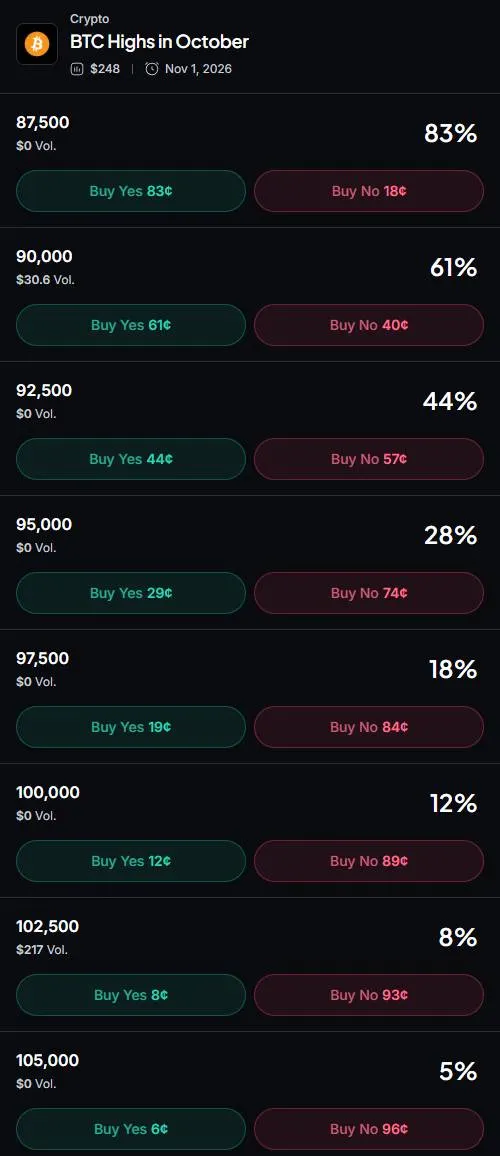
    Myriad: How high will Bitcoin go? Click to make your prediction.
    Myriad: How high will Bitcoin go? Click to make your prediction.

    Metaplanet points in the filing to “a previously published issuer credit rating of an overseas peer company” as the precedent, saying it showed that an issuer refusing or reluctant to sell its Bitcoin may find the asset given little weight in a credit assessment. It did not name the company. S&P assigned Strategy a B- issuer credit rating in October 2025, the first awarded to a Bitcoin treasury company, citing low dollar liquidity among its concerns and warning that a downturn could force sales at depressed prices.

    Strategy has since moved further than that. It approved a Digital Credit Capital Framework in June permitting sales of up to $1.25 billion to fund its cash reserve, dividends and buybacks, and had sold 6,948 BTC for about $432.5 million by August. The firm’s Chair, Michael Saylor, has recast his position as never being “a net seller” of Bitcoin rather than never selling. It has since resumed Bitcoin purchases, surpassing its previous record holdings late last month.

    The intent differs, with Strategy selling Bitcoin to meet obligations, while Metaplanet sold to prove it could, held the cash, then bought back more than it had sold. It came at a cost, with Metaplanet selling at an average of ¥12.47 million per BTC and buying back at ¥13.63 million, roughly 9% higher, so the net 1,000 BTC cost ¥25.2 billion against repurchases priced near ¥13.6 million each.

    BitcoinBTC · USD

    $85,649+1.91%

    Sep 28Sep 30Oct 2Oct 4Oct 5

    $86.8k$85.5k$84.2k$83.0k

    24h HighHigh$86,949

    24h LowLow$85,010

    VolVol$1.5B

    Market projectionsOdds by Myriad

    →

    Because the coins sold had been bought above the sale price, the disposal produced a capital loss for U.S. purposes, and the company estimates a deferred tax asset of about $97 million at subsidiaries of its U.S. holding company. The figure is preliminary and unaudited, and may not be recognized at all. Since Metaplanet carries Bitcoin at fair value, the loss does not create a new accounting loss.

    The company says it now intends to pursue a credit rating, and that its Bitcoin Income Generation business has booked revenue for eight consecutive quarters. Gerovich said the holdings make Metaplanet the second-largest listed Bitcoin treasury company in the world, and that the strategy “was never simply to accumulate Bitcoin.”

    He also announced a Net Interest Income Strategy, which he said is “designed to create recurring income streams and lower our effective cost of capital.” It sits alongside a pending Superplanet transaction and the build-out of Metaplanet Securities, in what he described as a unified push toward a Bitcoin-based financial institution.

    The quarter also marks a further slowdown in accumulation. Metaplanet added 2,823 BTC in the second quarter, itself a cooling from earlier in the year; the third quarter’s net addition was roughly a third of that.

    Daily Debrief Newsletter

    Start every day with the top news stories right now, plus original features, a podcast, videos and more.

  • Hollywood Unions Warn of 25-Year Decline in U.S. Production Market Share

    Hollywood Unions Warn of 25-Year Decline in U.S. Production Market Share

    A coalition of Hollywood unions issued a report on Monday warning that the U.S. has lost significant market share in film and TV production over the last 25 years.

    The report found that studios spent 74% of their film production budgets in the U.S. 25 years ago, but that the figure has since declined to 42%. On the TV side, the figure has fallen from 94% to 64%.

    The unions — including IATSE, the Directors Guild of America and SAG-AFTRA — published the report as Congress is considering whether to offer a 20%-30% production incentive to revive the domestic film and TV industry. Supporters have argued that the U.S. needs to counter generous incentives offered by Canada, the U.K., and other countries, and that state-based subsidies are inadequate.

    Members of Congress have focused on the sharp downturn in domestic production jobs since the end of Peak TV in 2022. But the union report, prepared by EY, takes a longer-term view, showing that the globalization of production has been underway since the turn of the millennium.

    The report acknowledges that production has grown considerably over that period — so the U.S. is taking a smaller piece of a much larger pie.

    The study looks only at films with budgets of $5 million or more, in 2025 dollars, and TV episodes costing at least $1 million, for those 40 minutes or shorter, and at least $1.7 million for episodes longer than 40 minutes.

    In film, the report found that overall production spending by major studios rose from $3 billion to $7 billion annually in the last 25 years. And in TV, spending exploded from $933 million to $8.4 billion over the same span. The report acknowledges that the TV landscape has changed so dramatically over the past two decades that it is hard to draw clear comparisons.

    “The rise of streaming fundamentally altered production scale, budgets, season lengths, and release models, creating discontinuities in what constitutes a comparable television series across periods,” the authors wrote.

    The report is also limited in that it does not attempt to explain why production has shifted overseas — only to quantify the shift.

    The report finds that big-budget films account for much of the exodus. For the 25 most expensive films, the U.S. market share declined from 74% to 34% over the 25-year span. Those 25 films represented a quarter of all films produced by the major studios, but half of the crew and two-thirds of the budgets.

    “This highlights that production budgets are heavily concentrated within a small subset of films,” the report notes. “Patterns observed within this group generally reflect the broader analysis trends, albeit with a somewhat larger decline.”

    The report argues that if U.S. market share had held constant over the last 25 years, an additional $4 billion would be spent each year on TV and film production in the U.S.

    The Motion Picture Association issued its own report last month, arguing that a federal incentive would generate an additional $22 billion in annual domestic production spending by 2035. The MPA report did not attempt to measure the historical trend in market share, but did warn that market share will decline in the future if Congress does not act.

    The unions are set to hold a rally with Sen. Adam Schiff and many Democratic members of the California Congressional delegation on Tuesday in Glendale. Schiff and others last month introduced a federal credit that would combine with state-based subsidies to create the world’s most generous incentive regime.

    With support from President Trump, who came out in favor of the idea in August, backers are hoping to pass the incentive into law by the end of the year.

  • Solana ETF inflows collapsed 99% but SOL holds firm: what are bulls seeing

    ETF inflows drop nearly 99%

    Solana-focused ETFs recorded $2.43 million in net inflows last week, according to CoinGlass data.

    That compares with $188.22 million the previous week—a decline of approximately 98.7%. Although the funds extended their positive streak to 14 consecutive weeks, the latest total shows a substantial reduction in fresh allocations.

    The distinction is important: demand slowed sharply, but the funds did not experience a net weekly withdrawal.

    The figures suggest ETF buying offered much less support than during the preceding week. Whether that represents a temporary pause or a more persistent slowdown will depend on subsequent flows.

    ETF activity also captures only one channel of $SOL investment. It does not provide a complete measure of buying and selling across exchanges, decentralized markets, and other investment vehicles.

    Solana’s network continued showing signs of active usage despite softer ETF inflows.

    According to SolanaFloor, the network’s decentralized exchange volume on Sunday exceeded the combined volume of Ethereum mainnet, Ethereum Layer-2 networks and Hyperliquid.

    The comparison highlights strong activity during that session, although one day’s performance does not establish a lasting lead.

    The platform also cites more than $4.4 billion in tokenized-stock trading volume on Solana. That points to growing activity around blockchain-based exposure to traditional equities.

    The supplied figures do not specify the measurement period for that total. It should therefore be distinguished from the Sunday DEX comparison rather than treated as a daily reading.

    Together, the reports support a picture of continued ecosystem participation, even as investment through ETFs moderates.

    Solana technical forecast: Triangle pattern keeps breakout levels in focus

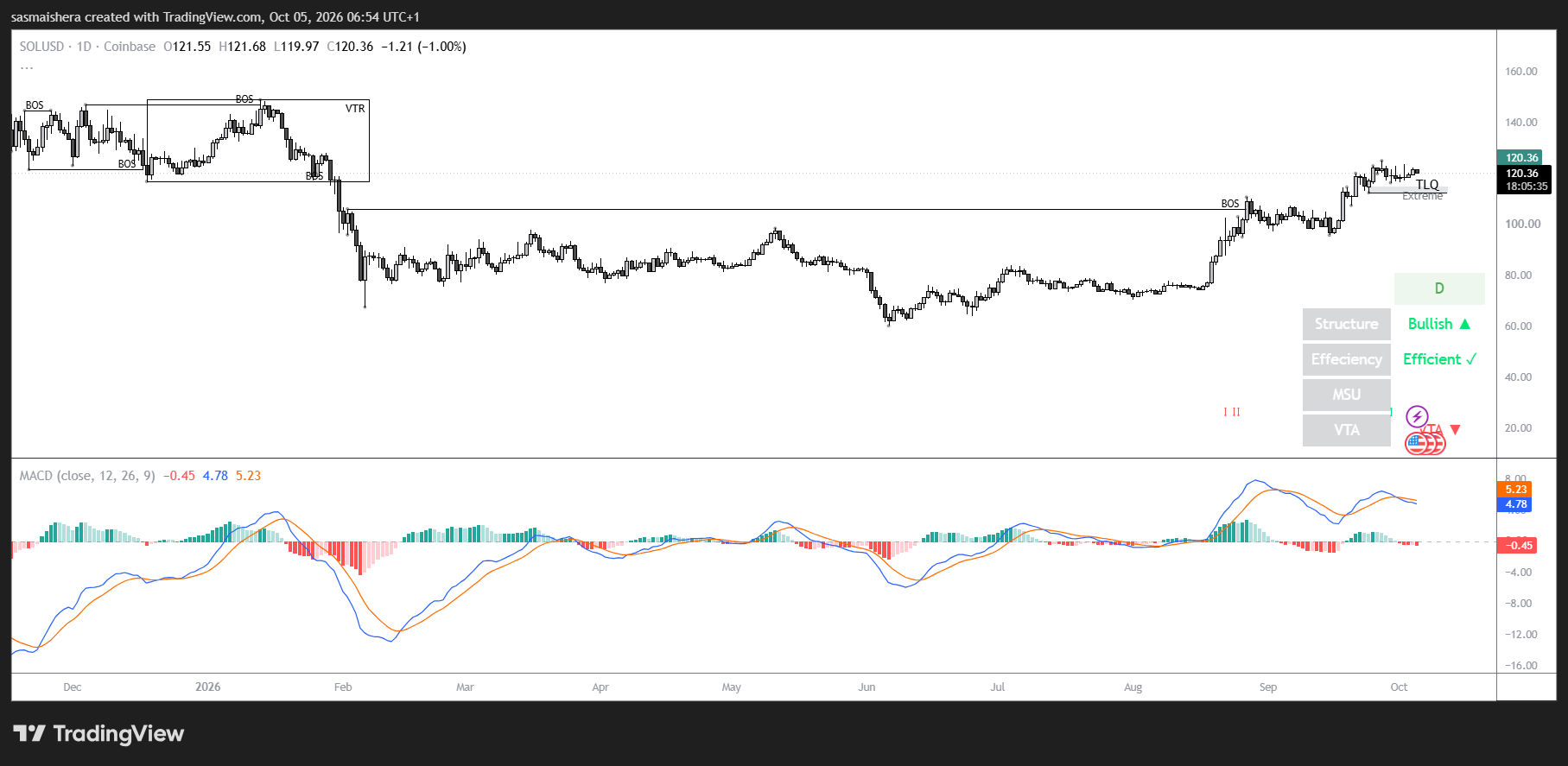
    On the four-hour and daily charts, $SOL remains above its 50-, 100-, and 200-period exponential moving averages, positioned around $119.24, $116.43, and $110.44.

    A rising support trendline near $119.16 and overhead resistance around $123 form the triangle. This narrowing structure suggests price is consolidating between nearby buying and selling levels.

    The pattern alone does not determine which direction the eventual breakout will take.

    Daily momentum remains constructive. The Relative Strength Index is near 54, while the Moving Average Convergence Divergence indicator is mildly positive.

    Those readings favor a modest bullish bias rather than an especially strong momentum surge.

    The immediate upside hurdle is the resistance trendline around $123, followed by September’s high at $124.95.

    A confirmed move above both levels would strengthen the case for extending the recovery. The Fibonacci projection places the next potential target at $132.87.

    That target remains conditional on a successful breakout. A brief move above resistance followed by a reversal would provide weaker confirmation than sustained trading above the cluster.

    Initial support is concentrated between approximately $118.71 and $119.25.

    That area combines a Fibonacci level, the rising trendline, and the 50-period EMA. Holding it would help preserve the short-term recovery structure.

    A decisive break below the cluster would bring the 100-period EMA near $116.43 into focus. The 200-period EMA around $110.44 sits further below.

    For now, $SOL’s technical bias remains mildly bullish, but its next move depends on whether buyers defend nearby support and generate enough demand to overcome resistance.

  • “What the Hell Else Can I Do?”—Cardano Founder Defends ADA Progress

    “What the Hell Else Can I Do?”—Cardano Founder Defends ADA Progress

    Hoskinson rejected that argument, noting that $NIGHT itself was issued on Cardano and asking why a project built from the Cardano ecosystem should be viewed as harmful to it.

    The stupidity is strong here. Apparently, launching a project on Cardano is bad for Cardano. Tell me where is night the issued. What was the first CNA to be listed on Binance? What wallets do people use to manage their night?

    If this is how Cardano treats the people building on… https://t.co/j2x0TvJl63

    — Charles Hoskinson (@IOHK_Charles) October 3, 2026

    Another critic went further, comparing Hoskinson to a “used car salesman” and pointing to what he described as weak liquidity, stablecoins, and DEX volume.

    He also accused Hoskinson of blaming $ADA holders rather than developers when the ecosystem struggles.

    Charles starting to sound like a used car salesman. If the cars broken, it’s your problem. Low liquidity, no stablecoins, no DEX volume. $ADA holders are aways the issue with him never the DEVs. We’ve been taken for a ride full circle. Most people just want their money back.

    — Kash_the_Kreator (@Nikkash4) October 4, 2026

    Hoskinson Points to RealFi, Midnight and New Integrations

    Hoskinson responded with a list of projects that have moved forward this year.

    Explain what I should do differently. We just launched RealFI; Pogun is on the way; we launched Midnight; and now we have Midnight. city. We did the Pentad that brought LayerZero, Fireblock, Pyth, Circle, and other integrations to Cardano. We have Draper and Alphagrowth. All…

    — Charles Hoskinson (@IOHK_Charles) October 4, 2026

    RealFi went live on Cardano mainnet on Oct. 1, following months of public testing. Midnight, meanwhile, launched its network in March, while $NIGHT had already launched as a Cardano Native Asset in December 2025.

    Midnight.city is also operating in open beta as an AI-focused application tied to the wider Midnight ecosystem.

    He also mentioned Pogun, a Bitcoin-focused DeFi project covering credit, yield and bridging. Its 12.29 million $ADA treasury request failed to secure enough support in September, although Hoskinson has continued to say the project is moving ahead.

    Then there is the Pentad’s infrastructure push. USDCx and Pyth have gone live, LayerZero is being rolled out in phases, and Fireblocks announced plans to add full support for Cardano Native Tokens.

    Cardano Now Has to Turn Development Into Usage

    This is where the criticism becomes measurable.

    Cardano currently has about $68.3 million in DeFi TVL and $67.2 million in stablecoins, so the claim that it has “no stablecoins” or DEX activity is not literally accurate. DEXs processed about $4.05 million over 24 hours and $41 million over seven days, with weekly volume up 133%. The network also recorded roughly 18,964 active addresses and 34,905 transactions over 24 hours.

    Those numbers show activity, but they also provide the benchmark against which Hoskinson’s recent launches can now be judged.

    The Crypto Basic previously reported that Hoskinson believes RealFi could become a major driver of Cardano TVL and eventually help push it toward $1 billion. With RealFi only reaching mainnet this week, that thesis has now moved from development promises to something that can be measured against actual deposits and usage.

  • Standard Chartered Draws Attention to Four Altcoins! Price Targets Revealed! Here Are the Details

    Standard Chartered Draws Attention to Four Altcoins! Price Targets Revealed! Here Are the Details

    Speaking to Milk Road Crypto, Geoffrey Kendrick stated that he believes a new era will begin in the crypto market as traditional finance moves onto blockchain networks.

    Kendrick stated that the tokenization trend is not a temporary phenomenon and has now become permanent, adding that four altcoins in particular could significantly benefit from this transformation: $UNI, $MORPHO, $AAVE, and $ARB.

    According to Kendrick’s assessment, institutional investors moving their real-world assets onto the blockchain could accelerate the growth of the DeFi ecosystem.

    At this point, the bank had previously predicted that the total value of tokenized assets on-chain could reach $4 trillion by the end of 2028. Of this, $2 trillion is expected to come from stablecoins and $2 trillion from real-world assets.

    Uniswap Has a $100 Target!

    The bank had previously stated a $100 target for $UNI in its analyses. However, Kendrick believes that even the previously announced $100 target for Uniswap by 2030 may be too low. According to the analyst, the platform’s strong liquidity network and the redirection of transaction fees to the token buyback and burning mechanism could support $UNI’s appreciation in value.

    Aave and Morpho Take Center Stage!

    Kendrick considers Aave one of the leaders in the on-chain banking system and projects a target of $3,500 for $AAVE by the end of 2030. For Morpho, he set a target of $60. According to the analyst, unlike Aave, Morpho has growth potential, particularly in the on-chain asset management sector.

    Arbitrum May Be the Biggest Bet!

    Among the four projects, one of Kendrick’s most ambitious predictions came for Arbitrum. The analyst believes $ARB could reach $10 by 2030. He bases this prediction on Robinhood Chain’s use of Arbitrum technology and the revenue it generates for Arbitrum.

    *This is not investment advice.

  • The mental health of young men is declining. Experts warn it could get worse

    On the surface, Nick Cholmsky looked like a thriving teenager. 

    Growing up in Ottawa, he says he was athletic and heavily involved in basketball, had friends and a close relationship with his family. 

    But underneath all that he says he was deeply depressed. The symptoms began in middle school and became much worse by Grade 11.

    At 16, he had begun entertaining suicidal thoughts.

    A young man in a red shirt.
    Nick Cholmsky, who grew up in Ottawa, experienced depression as a teen. He says online messaging encourages boys and men to stay silent about their psychological struggles. (CBC)

    Even as his depression and anxiety grew stronger, Cholmsky believed he couldn’t say anything, because “being a man” meant pushing negative thoughts down, and that any sign of weakness would cause him shame. 

    “Looking back, so much of that [congenial attitude] was for sure just a performance, me acting the way I thought I was supposed to act as a man,” said Cholmsky, now 21. 

    There’s a common problem everywhere and it’s how men and boys are feeling. And they are not feeling great.– Federal Health Minister Marjorie Michel 

    Earlier this year, the federal government reported on a wide range of data showing that the mental health of young men has deteriorated since 2012. Between 2012 and 2022, the number of men aged 15 to 24 who self-reported mood disorders increased from 11 per cent to 16 per cent, while self-reported generalized anxiety disorders increased from four per cent to 10 per cent.

    Those who reported their mental health as “very good” or  “excellent” plummeted from 70 per cent to 52 per cent in that same time period.

    A separate report shows that men are three times as likely as women to commit suicide and that it’s the second-leading cause of death in boys aged 15 to 34 (after unintentional injuries).

    “There’s a common problem everywhere and it’s how men and boys are feeling. And they are not feeling great,” federal Health Minister Marjorie Michel told CBC News. 

    “There is a lot of anxiety [about] their role as men and boys.”

    Social media use, gambling major issues

    Research implicates a variety of factors in men’s depression, most prominently social isolation, social media use and online sports betting.

    Data from the Canadian Medical Association Journal shows a huge rise in young men calling helplines with gambling addictions. (Health Canada reports men are three times more likely than women to have a gambling problem.)

    Canada legalized single-event sports betting in 2021. In 2022, Ontario became the first province to allow private companies to operate alongside government-regulated industry.

    A separate report released this month by the Institute for Clinical Evaluation Sciences (ICES) showed that since 2022, emergency room visits for gambling disorders had doubled — largely with young men showing up in a psychological crisis, such as suicidal ideation or psychosis, as a result of gambling losses. 

    “The gambling stats didn’t surprise me at all when I heard them,” said Cholmsky. “I saw kids in middle school gambling.”

    WATCH | Investor and podcast Scott Galloway on male potential:

    Scott Galloway on male potential

    U.S. investor and podcaster Scott Galloway talks to CBC News about the impacts of the manosphere and the loss of ‘off-ramps to the middle class,’ and how young men are being impacted.

    Whether the stress is the result of gambling or something else, Cholmsky says online messaging encourages boys and men to stay silent.

    “When I was going through some of my worst mental health times, I was online a lot and it was really the height of Andrew Tate,” Cholmsky said.

    The U.S.-born Tate is one of the best-known influencers in the manosphere, famous for espousing strict rules for being an alpha male, such as maximizing fitness, maintaining control over relationships and emotions and making as much money as possible.

    He retains a large following despite being in U.S. detention on multiple criminal charges, including sex trafficking.

    “[Tate’s] message, and a lot of that manosphere messaging for boys, is ‘be a man, be tough, make lots of money,’” Cholmsky said.

    There are also trends like “looksmaxxing.” Influencer Braden Peters, also known as Clavicular, has amassed a huge following telling young boys sometimes to smash their own faces with hammers to be more conventionally beautiful. His content has more than 40 million likes. Peters was charged with rape last month.

    Experts warn dangerous role models like this can have real-world impacts. 

    “The manosphere is radicalizing young boys who don’t know where they fit  — and that should concern us all,” said John Oliffe, Canada research chair in men’s health promotion at the University of British Columbia. 

    Oliffe says this was “amplified” by the earliest parts of the COVID-19 pandemic when global lockdowns increased isolation and the loss of social connection. Vulnerable teenagers often found themselves lost online. 

    “There continues to be a whole world of pain in some of that unregulated content,” Oliffe said. 

    A man with grey hair in a button-down shirt.
    John Oliffe, Canada research chair in men’s health promotion at the University of British Columbia, says the radicalizing effects of the manosphere should worry us all. (Nav Rahi/CBC)

    Adam Kunder, a 33-year-old former firefighter who lives in Toronto, says he also felt he needed to keep his problems quiet. He suffered mental health issues and hit “rock bottom” before beginning to find help in the summer of 2024.

    “As a man, you think you are supposed to be strong, push any bad feelings down, suppress depression or sadness or fear,” he said.

    Kunder says he has lost multiple friends to suicide and says you never would have known they were suffering.

    Gender roles and ‘toxic masculinity’

    Kunder said the world is changing in ways that are becoming confusing for many men.

    The emphasis on women’s parity in the labour force and society, as well as a greater acceptance of non-traditional gender identities, has upended expectations.

    “At one point we knew we were supposed to be the provider and protector, and the idea of ‘toxic masculinity’ wasn’t a thing,” he said. “I think men are really trying to figure out what it means to be a man in today’s world.”

    WATCH | Why manosphere influencers appeal to young men:

    Why ‘manosphere’ influencers are appealing to young men

    Critic Amil Niazi joins Commotion with Elamin Abdelmahmoud to discuss Louis Theroux: Inside the Manosphere, a documentary about the online world of toxic masculinity, and examine the rising popularity of “manosphere” influencers among young men.

    Oliffe pointed to other troubling patterns for young men. 

    “There are increasing lower rates of boys heading to universities, and very serious challenges in male-dominated industries such as construction, that as a society, we should not ignore.”

    Oliffe said that while the trades offer good careers, they often see high rates of substance use and mental health issues, as the necessary physical labour and harsh working environments can “heighten these risks.” 

    Oliffe said that in the last decade, there has been “low government investment in men’s mental health.” 

    “I think the theme of silence is a very regrettable period in history, where on one side we talked about equity and inclusion, and then in effect ostracized 50 per cent of the population,” Oliffe said.

    Health Minister Michel said that when she brought this issue to the federal cabinet, she was met with some resistance. Some colleagues told her it took “courage” to broach the mental health of boys and men, given it could even be politically risky to talk publicly about the issue. 

    “I said ‘courage’? This is not courage. We are ministers of health, it is our job to take care of the entire population,” she said. 

    “Men don’t know how to ask for help. And when they are struggling, they don’t know how to express it.” 

    Government strategy to come by early 2027

    The federal government will soon launch its first-ever mental health strategy for boys and men.

    The agency told CBC that some of what they hope to invest in will be “mentorship, peer support, sport and recreation,” while “promoting healthy relationships, positive social norms and safer online environments.”

    A young man in a green shirt.
    Toronto resident Adam Kunder says he feels it’s his duty ‘to show up for men who are suffering and to hear them out and just let them know it’s all OK.’ (CBC)

    For Robert Whitley, a men’s health expert and professor of psychiatry at McGill University in Montreal, part of the problem is the way society now views masculinity. 

    “Traditional masculinity has been denigrated in the popular mind whether it’s through the media, through influencers, through commentators,” he said. “The problem sometimes is a lack of masculinity.” 

    He says there’s a need for positive male role models.

    “I’ve said many times before, it’s not a crisis of masculinity, there’s a crisis of mentorship,” said Whitley.

    For example, data from Statistics Canada shows only 25 per cent of teachers across elementary and high school systems in Canada are men. And at the organizations that step in to fill the mentorship gap — like the Big Brothers and Big Sisters of Canada — 70 per cent of volunteers are women. 

    “We’re getting young men who are getting to the age of 18, 19, 20, who have never had a male role model in their lives,” Whitley said.

    Kunder and Cholmsky both say their mental health began to recover after they started asking for help, and they’re now working to be role models for other young men. 

    “I feel like it’s my duty in a way to show up for men who are suffering and to hear them out and just let them know it’s all OK,” said Kunder, who coaches and works with other men.

    Last month in Ottawa, Cholmsky was awarded top 21 under 21 for his work in mental health advocacy and challenging “harmful stereotypes around masculinity and mental health.” 

    “We all need to be doing our part to talk about this stuff,” he said.