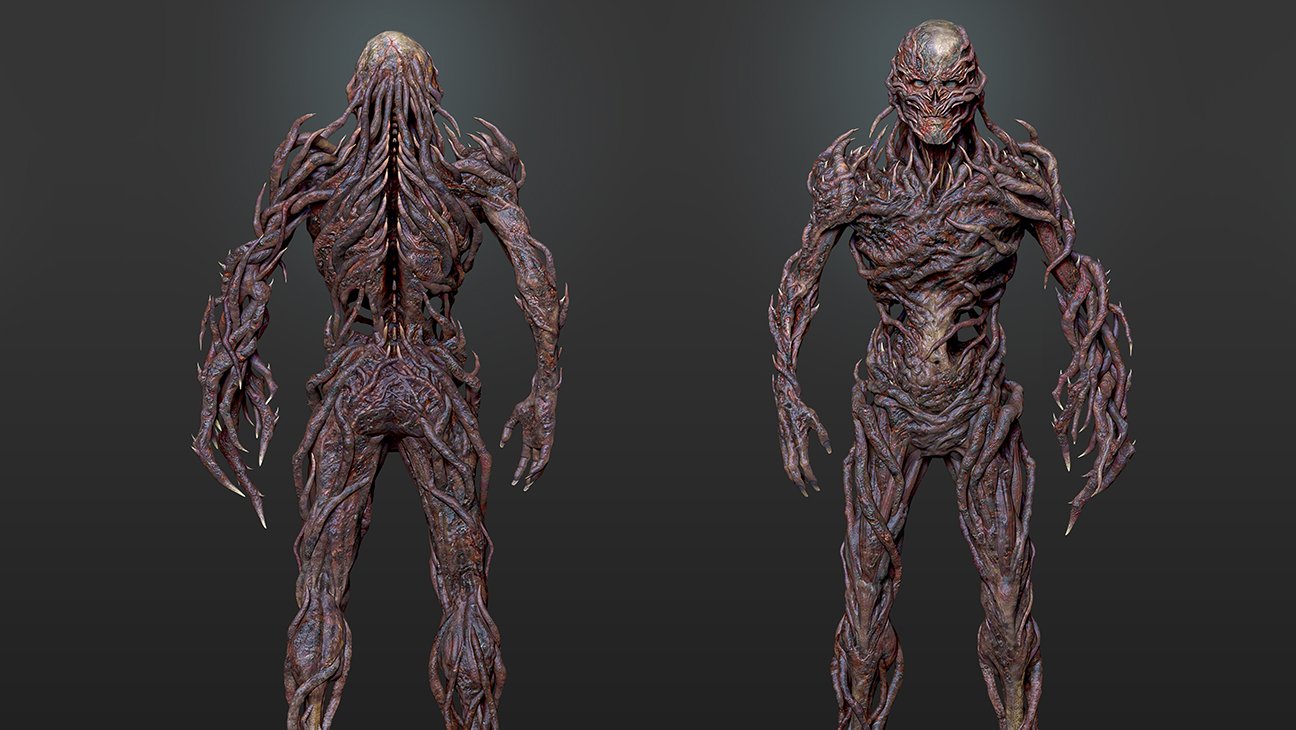
When Stranger Things creators Matt and Ross Duffer said they wanted the fifth and final season of the Netflix sci-fi drama to be a “mega movie,” the VFX team knew they would have their work cut out for them.
The coming-of-age series requires “way more shots than are normally done on a two-hour feature,” VFX supervisor Betsy Paterson tells THR, noting that the show’s overall budget was expanded for the final season. This allowed the crew to execute an epic conclusion to the series’ decade-long run that saw the beloved Hawkins gang unite for a final showdown to take down Vecna (Jamie Campbell Bower).
However, before the VFX team could tackle the monsters, they had to make the otherworldly dimensions that the series is known for seem realistic. The team relied heavily on practical effects, which were later punched up with visual effects. Paterson notes it’s important to the Duffer brothers to have sets that feel as tactile as possible, so “no matter how crazy this stuff gets, you are really seeing it from the perspective of these kids who are in the real world,” she says. “We’re always building things for the actors to interact with.”
Two examples are the wall in the interdimensional wormhole known as the Upside Down that serves as a portal between Earth and the alternate realm of the Abyss, and the liquefying room inside the Hawkins National Lab where Nancy (Natalia Dyer) and Jonathan (Charlie Heaton) are trapped.
“We built a big chunk of that membrane wall for Hopper [David Harbour] and Eleven [Millie Bobby Brown] to climb on,” Paterson explains. “The goo in the melting room was real goo wherever it touches anything or the actors.”
When it came to the Upside Down, the VFX team fortunately already had an established look from the previous four seasons to build upon. They couldn’t say the same about the Abyss, aka Dimension X, however, which was introduced in the final season and had to be designed from scratch.
“There was some talk about possibly filming it in the real desert,” Paterson says of the new alternate world. “In the end, the production logistics were too much, but that gave us a base of a look for it. We scanned and took as many reference photos as we could so that the rocks and the geography looked like a real place and not just a kind of mystery CG world.”

What Millie Bobby Brown’s Eleven sees before VFX are added for the series’ final showdown The full scale of the Mind Flayer in the last battle was brought to life postproduction. The cast filming a scene in what would be the new alternate world, the Abyss. The Hawkins gang looking out into the CG-fabricated universe, created in post.
Courtesy of Netflix
As fans know, no world in Stranger Things is ever void, as there are always monsters lurking nearby, namely Vecna. While the resident villain’s appearance in season five led to social media jokes about him being on Ozempic, Paterson clarifies that Vecna’s slimmer physique has to do with how he rebuilt himself after almost being destroyed by Eleven in season four.
Unlike previous seasons in which Bower wore full practical prosthetics, this time around the team relied more heavily on digital effects to accomplish his new look. “He is now much more monster than human, and he has caused that to happen. He created himself, really. So that’s what we’re seeing with all the vines and the way they move — you can see the blood going through them,” Paterson explains. “It’s an immediate signifier of how much more powerful he is now.”
That power was fully shown when it was revealed that Vecna was working as one entity with another massive monster, the Mind Flayer, whose scale was fully witnessed in the final battle against Eleven and the Hawkins gang.
“They wanted him as big as we could possibly get, but at a certain point you can’t film it. And it’s just so ridiculous that he would even notice the kids, much less get defeated by them,” Paterson notes of the cosmic CGI creature. “We went back and forth on that quite a bit and, after lots of motion tests and animation tests by Weta FX, we ended up where we landed with the size.”
Looking at the season as a whole, it’s easy to assume all the monsters and alternate worlds would be the most difficult to pull off. But for Paterson, the most challenging scene was the opening sequence with a young Will Byers, played by Noah Schnapp, who was only 11 years old when Stranger Things debuted in 2016.
“I felt so much pressure in that scene because we all know what he looked like,” Paterson admits. “He’s not in season one that much because he gets kidnapped, so we didn’t have a huge library of footage of him at that age. Weta was able to take every bit that we could find: outtakes, every press photograph, walking on the red carpet. They used all of it to build a young Will that looked like Noah.”
With the help of Schnapp
and Luke Kokotek, a young stand-in actor, the VFX team was able to replace Kokotek’s face so he would appear as season one Will.
The scene serves as an emblem of the show’s 10-year journey. And with everything coming to a literal end in season five as the Upside Down — which has been a central part of the show throughout its run — gets destroyed behind Eleven in the finale, the VFX team had to leave audiences with a memorable last impression.
“When you see Hawkins High being destroyed and the Wheeler house, normally we try not to put too much detail into shots that are only going to be seen once, but it was worth it for that scene,” Paterson says. “It was a lot of fun going frame by frame and spotting all the little stuff that they built just to have it be destroyed.”
This story first appeared in an August stand-alone issue of The Hollywood Reporter magazine. To receive the magazine, click here to subscribe.
Leave a Reply