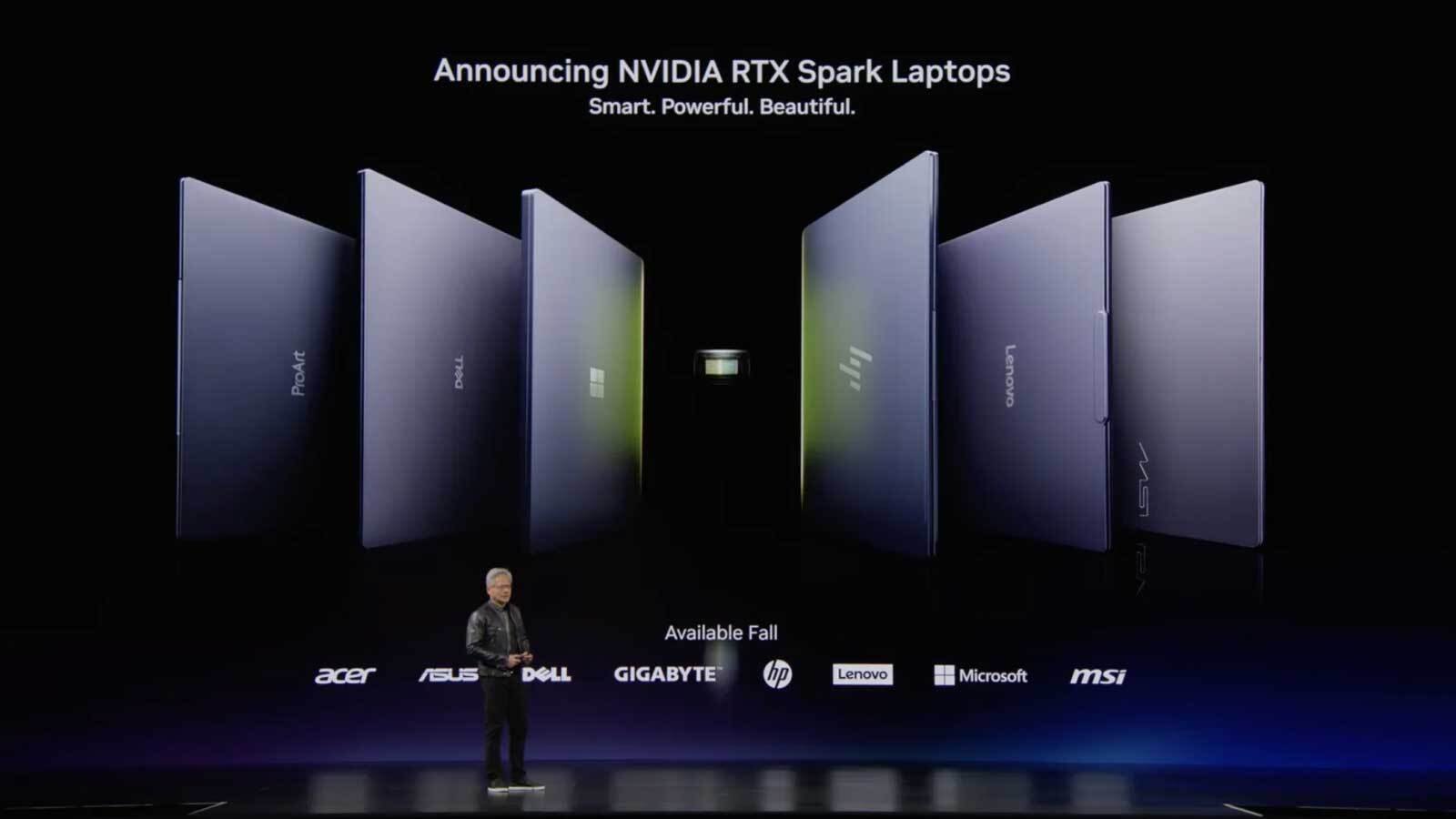
Modders have managed to get Nvidia’s RTX Spark driver working on alternative Arm platforms, enabling Nvidia desktop GPUs to run on Windows on Arm systems, Windows Latest reports.
Windows on Arm is mostly limited to laptops equipped with Qualcomm’s Snapdragon SoCs and does not support Nvidia desktop GPUs. Nvidia’s RTX Spark offers a more graphically capable Windows on Arm experience, but at a high cost and with a developer focus. But with its driver release, modders have opened up support and compatibility to a wider array of hardware.
By extracting the ARM64 Nvidia driver from RTX Spark software, a developer named VoidTech got it working on the Kunpen 920 server processor. It’s based on the same architecture as the Snapdragon X Elite, and features 24 cores running at 2,600MHz each. Its performance is roughly around that of Apple’s A15 mobile chips, or an Intel Core i5-1235U. Hardly a powerhouse.
But still, it’s a desktop chip running Windows on Arm and, in this particular test, it also ran an RTX 4060 GPU. It’s part of the Huawei Qingyun W510 ARM workstation system, and uses 32GB of DDR4-2933 memory.
Performance in game tests wasn’t great, though the CPU is likely a major factor. In the Black Myth: Wukong benchmark, this system managed an average of 21 frames per second, but with lows of 3fps at times.
VoidTech estimates that around 25% of the CPU’s performance was consumed by the x86-to-Arm translation layer, which makes these kinds of setups viable. That, combined with the RTX 4060’s relative entry-level performance, means it’s no surprise that gaming wasn’t amazing. But it’s an early proof of concept. With better drivers and hardware, it seems possible that you could game on a Windows on Arm desktop with discrete Nvidia graphics before long.
VoidTech believes this method would work with RTX 20, 30, and 50 GPUs as well, so we may see an RTX 5090 version of this test down the line.
Recommended by Our Editors
In the meantime, VideoCardz reports that another user got a Radxa Orion O6 workstation working with this same driver configuration, pairing an eight-core Arm CPU with an Nvidia RTX 2080 Ti. No performance results were published, but I have to imagine it was worse.
Classic Windows on Arm issues are likely to slow adoption of this new way to play, though. Anti-cheat software still struggles with the translation layer, breaking a number of experiences, and the motherboard’s network interface didn’t work because it didn’t have Windows drivers.
The graphics card’s video output didn’t work properly, either, forcing VoidTech to stream it to another desktop to record it. Lots of work still to be done.
About Our Expert

Jon Martindale
Contributor
Experience
Jon Martindale is a tech journalist from the UK, with 20 years of experience covering all manner of PC components and associated gadgets. He’s written for a range of publications, including ExtremeTech, Digital Trends, Forbes, U.S. News & World Report, and Lifewire, among others. When not writing, he’s a big board gamer and reader, with a particular habit of speed-reading through long manga sagas.
Jon covers the latest PC components, as well as how-to guides on everything from how to take a screenshot to how to set up your cryptocurrency wallet. He particularly enjoys the battles between the top tech giants in CPUs and GPUs, and tries his best not to take sides.
Jon’s gaming PC is built around the iconic 7950X3D CPU, with a 7900XTX backing it up. That’s all the power he needs to play lightweight indie and casual games, as well as more demanding sim titles like Kerbal Space Program. He uses a pair of Jabra Active 8 earbuds and a SteelSeries Arctis Pro wireless headset, and types all day on a Logitech G915 mechanical keyboard.
Leave a Reply