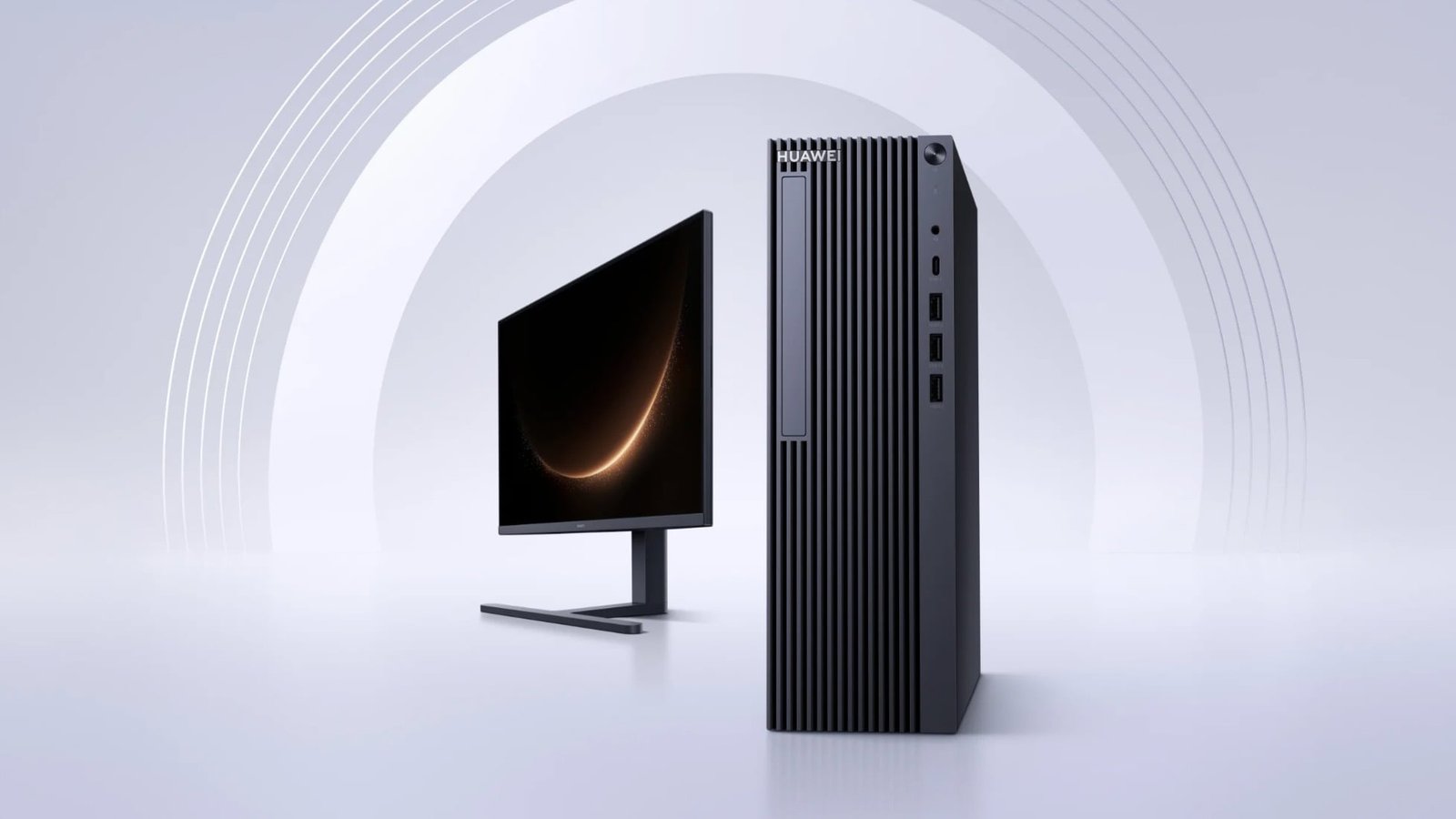
Chinese vendor Huawei has developed a desktop PC made entirely from domestic components, two years after the US blocked the company from buying certain Intel and Qualcomm chips.
The Qingyun HM650, which runs Huawei’s HarmonyOS, is the “industry’s first desktop PC to achieve a 100% localization rate,” the company says. The product website includes a certificate from a Chinese testing company verifying the 100% domestic claim, which covers the chip, memory, storage, power supply, and Wi-Fi.

(Credit: Huawei)
Specifically, the PC features Huawei’s homegrown Kirin X90 chips, which are reportedly based on the Arm architecture. Huawei introduced the HM650 last week at the HarmonyOS Office Industry Summit, with the PC’s starting price at 6,899 yuan (US$1,018) for an 8-core CPU, 16GB of RAM, and 512GB of storage, according to local Chinese media reports. The 10-core version starts at 7,199 yuan ($1,078).
Although China has long assembled laptops and PC components, including motherboards and graphics cards, the country’s tech industry has historically relied on US companies such as Intel, AMD, and Nvidia for CPUs and GPUs, as well as Microsoft for the Windows operating system. The US itself dealt a blow to Huawei’s laptop and PC business when the White House in 2024 revoked licenses from Intel and Qualcomm to export certain processors to the Chinese tech company. In 2019, Google also had to restrict Huawei’s access to Android.

(Credit: Huawei)
Despite the restrictions, Huawei has spent years investing in its own chipmaking and software capabilities, including HarmonyOS, which has served as its alternative to Android and now to Windows. The company hasn’t posted official clock speeds or benchmarks for the new desktop PC, making it unclear how it performs, but the Qingyun HM650 might not bode well for Intel, AMD, and Microsoft over the long term.
Recommended by Our Editors
The Qingyun HM650 appears geared toward enterprises rather than consumers, so it could appeal to the Chinese government, which has long backed efforts to develop domestic alternatives. Huawei also says the PC boasts its own AI assistant.
About Our Expert

Michael Kan
Principal Reporter
Experience
I’ve been a journalist for over 15 years. I got my start as a schools and cities reporter in Kansas City and joined PCMag in 2017, where I cover satellite internet services, cybersecurity, PC hardware, and more. I’m currently based in San Francisco, but previously spent over five years in China, covering the country’s technology sector.
Since 2020, I’ve covered the launch and explosive growth of SpaceX’s Starlink satellite internet service, writing 600+ stories on availability and feature launches, but also the regulatory battles over the expansion of satellite constellations, fights with rival providers like AST SpaceMobile and Amazon, and the effort to expand into satellite-based mobile service. I’ve combed through FCC filings for the latest news and driven to remote corners of California to test Starlink’s cellular service.
I also cover cyber threats, from ransomware gangs to the emergence of AI-based malware. In 2024 and 2025, the FTC forced Avast to pay consumers $16.5 million for secretly harvesting and selling their personal information to third-party clients, as revealed in my joint investigation with Motherboard.
I also cover the PC graphics card market. Pandemic-era shortages led me to camp out in front of a Best Buy to get an RTX 3000. I’m now following how the AI-driven memory shortage is impacting the entire consumer electronics market. I’m always eager to learn more, so please jump in the comments with feedback and send me tips.
Leave a Reply