Category: News

  • What to know about California’s new ultra-processed foods label law

    California Gov. Gavin Newsom signed a bill on Tuesday that would allow food companies to put a non-ultra-processed food (UPF) label on their products.

    The law creates the first seal in the U.S. that would appear on products as long as they meet standards for not being ultra-processed, according to California lawmaker Jesse Gabriel, who sponsored the bill.

    Modeled after the “USDA Organic” label — which appears on products that meet federal standards set by the U.S. Department of Agriculture — California’s process would be overseen by the California Department of Public Health.

    Food manufacturers would apply to accredited certification agents to use a “California Certified” seal on their packaging. Products would have to be recertified every three years.

    The law also requires grocery stores in California with gross sales of more than $10 million to prominently display products with the seal in a “designated high-traffic area.”

    The state’s definition of UPFs includes food and beverages that contain a “specified substance” — such as colors or stabilizers — and either high amounts of saturated fat, sodium or added sugar or a nonnutritive sweetener.

    Governor Gavin Newsom is pictured during a recorded interview with AFP in the Manhattan borough of New York City on September 23, 2026.

    Charly Triballeau/AFP via Getty Images

    “We should be about healthcare, not sick-care, recognizing that preventing illnesses is far preferable to finding — and affording — treatments,” Newsom said in a statement. “It’s why California is focused on making whole, healthy foods as accessible as possible, why we’re making healthier choices easier. California has never been afraid to challenge the status quo, and we’ll keep innovating, trying new things, and clearing the way for the rest of the country to follow.”

    Several consumer groups celebrated the new law, including the nonprofit activist organization Environmental Working Group.

    “Today California raised the bar for what we consider healthy food,” Bernadette Del Chiaro, EWG senior vice president for California, said in a statement. “Consumers deserve labels they can trust, and with Gov. Newsom’s signature, families now have a simple way to tell which foods are closer to what comes from a kitchen rather than a factory.”

    The law is in line with policies that have been touted by Health Secretary Robert F. Kennedy Jr. For years, Kennedy has criticized the U.S. food industry and the proliferation of ultra-processed foods, blaming them as one reason for the rise of chronic diseases in the U.S.

    “Hundreds of these chemicals are now banned in Europe, but they’re ubiquitous in American processed foods,” Kennedy said during a September 2024 roundtable discussion on health led by Sen. Ron Johnson, R-Wisc. “We are literally poisoning our children systematically for profit.”

    Some research has shown that highly processed foods can be detrimental to health. A 2022 joint study by the Centers for Disease Control and Prevention and the University of São Paolo in Brazil found that people who consumed more calories from ultra-processed foods may have an increase in cardiovascular disease.

    Earlier this year, Kennedy announced new dietary guidelines that encouraged Americans to limit highly processed foods and reduce refined carbohydrates.

    For the first time, the federal Dietary Guidelines explicitly warned Americans against certain highly processed foods and suggested avoiding “packaged, prepared, ready-to-eat, or other foods that are salty or sweet” and “sugar-sweetened beverages, such as soda, fruit drinks, and energy drinks.”

    “These new guidelines will revolutionize our nation’s food culture and make America healthier again,” Kennedy said during a press conference at the White House at the time.
  • Christa Pike unconscious, on ventilator after botched execution: Lawyers

    Christa Pike unconscious, on ventilator after botched execution: Lawyers

    The Tennessee woman’s legal team says doctors are working to clear doses of the drug pentobarbital from her system.

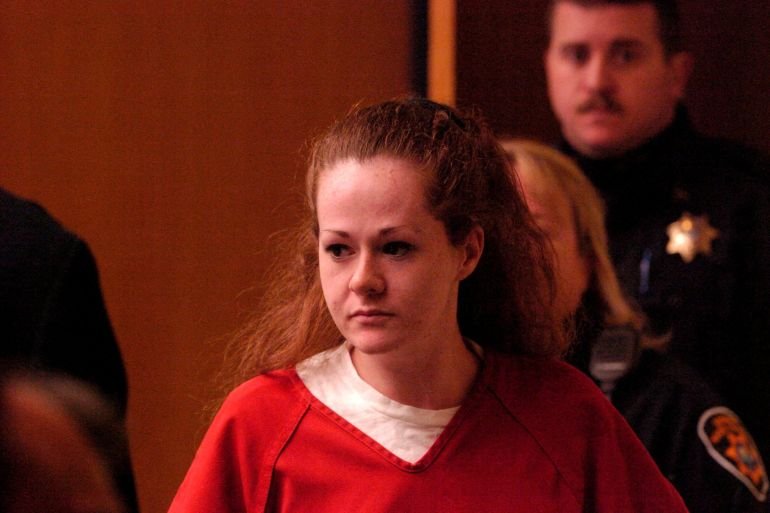
    Christa Pike has been placed on a ventilator and intubated after surviving a failed execution attempt, according to a court filing from her lawyers.

    The Tennessee woman, they wrote on Friday, “remains critically ill” and is unconscious while receiving treatment at a hospital in Nashville.

    Recommended Stories

    list of 3 itemsend of list

    According to the filing, medical staff are working to save Pike’s life and clear her system of the two doses of the drug pentobarbital, which the US state uses to execute prisoners.

    “Upon arrival, both of her arms were swollen, burned, and blistered,” Pike’s lawyers wrote about the drug’s effects on her body.

    The filing, which was part of an emergency request by Pike’s lawyers to preserve state records related to her execution, marks the most detailed update on Pike’s condition after she was transported by ambulance to hospital from a Tennessee prison on Wednesday, following the botched attempt.

    Pike’s lawyers argued that problems with the IV lines caused the pentobarbital to flow into her body instead of her bloodstream.

    “Apparently at no point did any member of the execution team realise that the IV lines were not correctly placed or that the veins had blown and that the pentobarbital was, in whole or in part, entering Ms Pike’s body,” they wrote.

    The lawyers allege prison staff prepared “a backup set of syringes” and “administered another lethal dose of pentobarbital”.

    Pike, who was sentenced to death at 18 after she was found guilty of torturing and murdering another young woman in 1995, would have been the first woman in more than 200 years to be executed in Tennessee. She was also the only woman on the state’s death row.

    Pike’s lawyers have called for her sentence to be commuted to life in prison after she endured what they called “chemical torture”.

    Tennessee’s Governor Bill Lee has suspended all executions for the rest of the year while the state investigates what happened.


  • DOJ Argues CNN & Other Outlets Can Be Banned From White House If Trump Determines They Didn’t Meet “Minimum Requirements Of Professionalism”

    DOJ Argues CNN & Other Outlets Can Be Banned From White House If Trump Determines They Didn’t Meet “Minimum Requirements Of Professionalism”

    The Justice Department argued that Donald Trump can legally ban CNN, MS NOW and Politico from the White House because he determined that they didn’t meet the “minimum requirements of professionalism.”

    Last month, a federal judge granted the three outlets a temporary restraining order that forced the White House to reinstate dozens of their reporters’ hard passes. The outlets are now asking the judge to extend that 14-day order for a longer term via a preliminary injunction, claiming that Trump’s ban is a violation of their First and Fifth amendment rights.

    U.S. District Judge Timothy Kelly, a Trump appointee, has said that he is bound by the precedent set in In a 1977 D.C. Circuit opinion, Sherrill vs. Knight, in which the judges ruled that “the protection afforded newsgathering under the First Amendment guarantee of freedom of the press requires that this access not be denied arbitrarily or for less than compelling reasons.”

    In a court filing on Friday, the DOJ claimed that the Sherrill case still would allow for the president to restrict the three outlets from accessing the White House grounds because the White House has a “compelling interest.”

    The DOJ lawyers claimed that the Sherrill decision does not “prevent the President from concluding that bona fide journalists would identify sources instead of relying on anonymous sources, commit to factual accuracy, and provide the White House an opportunity to comment, rather than ‘perform their duties in a way that … interfere[s] with the White House’s daily operations.’ …At a bare minimum, it is a significant violation of decorum to publish classified and sensitive national security information.”

    The news outlets’ legal team has rejected that assertion, writing in a filing earlier this week that Trump’s “statements also make clear he implemented the ban to coerce more favorable coverage from CNN, MS NOW, and Politico, and to deter other journalists and news organizations from newsgathering and reporting that the President might view as negative. And his administration has continued to retaliate against Plaintiffs even after the temporary restraining order, only underscoring that Defendants’ motive is to punish and chill journalism they dislike.”

    Even as access to the White House grounds has been reinstated, the White House has continued to restrict CNN from coverage of TV pool assignments, including travel with Trump on Air Force One.

    The outlets’ lawyers, led by Theodore Boutrous Jr., also noted that Trump and other White House officials “overlooked that the First Amendment protects reporting on matters affecting national security.”

    Kelly has set a hearing for Thursday on the news outlets’ motion for a preliminary injunction.

    In granting a TRO, Kelly concluded that the White House failed to provide due process to the news outlets.

    The DOJ has pointed to letters sent to the outlets as evidence that they were given due process. But those letters were sent on Sept. 22, four days after Trump’s ban was started.

    The judge also has noted that some of the objectionable stories cited by the DOJ do not have to do with national security. Kelly wrote in his order that “even the justifications provided to Plaintiffs after this case was filed are ambiguous about the true purpose of the revocations: while Defendants’ letters to Plaintiffs mention national security concerns, they purport to identify reporting that ‘threatened national security and/or spread falsehoods’ leaving open the possibility that all the stories fall into the later bucket, rather than the former.”

  • Latin America sees China as more positive global influence than US: Poll

    Latin America sees China as more positive global influence than US: Poll

    Annual Latinobarometro survey finds views of China’s influence improving as perceptions of US influence worsen.

    China is perceived more positively as a global influence than the United States in Latin America, according to a new regional survey, in a first since the poll began in 1995.

    The 2026 Latinobarometro survey published on Friday found that 65 percent of respondents in 17 countries saw China as a positive influence. That was compared with 57 percent who said the same of the US.

    Recommended Stories

    list of 3 itemsend of list

    Support for China has risen sharply since 2020, when 48 percent of respondents viewed its influence positively. The figure for the US has fallen from 60 percent over the same period.

    Costa Rica and the Dominican Republic were the only countries surveyed where respondents viewed US influence more positively than China’s.

    Latinobarometro, a Chile-based nonprofit organisation, conducts annual surveys across the region on issues including democracy, the economy, security and migration.

    The findings come during US President Donald Trump’s second term, as his administration has sought to strengthen Washington’s influence in Latin America, particularly through exercising more military might.

    That has included conducting strikes on alleged drug smuggling boats in the region, which rights groups have decried as extrajudicial killings, and abducting Venezuela’s then-leader Nicolas Maduro in Brazil.

    Trump has described his approach as the “Donroe Doctrine”.

    Despite the findings on global influence, the US remained more popular than China when respondents were asked about their overall views of the two countries.

    Some 63 percent of respondents said they had a favourable opinion of the US, compared with 58 percent for China. The US figure was down from 73 percent in 2024.

    The survey also asked respondents about the US military capture of Maduro.

    A majority in all but one country, Argentina, approved of Maduro’s capture by US forces.

    Views were more divided over what the operation meant for Venezuela, with 35 percent saying removing Maduro had benefitted the country and 28 percent saying it had harmed it.

    Venezuelans were among the populations most likely to view US influence positively, according to the survey.

    The 2026 survey was based on about 19,200 face-to-face interviews conducted in 17 countries between May 7 and June 17, with a margin of error of 1 percent.

  • DOJ Argues CNN & Other Outlets Can Be Banned From White House If Trump Determines They Didn’t Meet “Minimum Requirements Of Professionalism”

    DOJ Argues CNN & Other Outlets Can Be Banned From White House If Trump Determines They Didn’t Meet “Minimum Requirements Of Professionalism”

    The Justice Department argued that Donald Trump can legally ban CNN, MS NOW and Politico from the White House because he determined that they didn’t meet the “minimum requirements of professionalism.”

    Last month, a federal judge granted the three outlets a temporary restraining order that forced the White House to reinstate dozens of their reporters’ hard passes. The outlets are now asking the judge to extend that 14-day order for a longer term via a preliminary injunction, claiming that Trump’s ban is a violation of their First and Fifth amendment rights.

    U.S. District Judge Timothy Kelly, a Trump appointee, has said that he is bound by the precedent set in In a 1977 D.C. Circuit opinion, Sherrill vs. Knight, in which the judges ruled that “the protection afforded newsgathering under the First Amendment guarantee of freedom of the press requires that this access not be denied arbitrarily or for less than compelling reasons.”

    In a court filing on Friday, the DOJ claimed that the Sherrill case still would allow for the president to restrict the three outlets from accessing the White House grounds because the White House has a “compelling interest.”

    The DOJ lawyers claimed that the Sherrill decision does not “prevent the President from concluding that bona fide journalists would identify sources instead of relying on anonymous sources, commit to factual accuracy, and provide the White House an opportunity to comment, rather than ‘perform their duties in a way that … interfere[s] with the White House’s daily operations.’ …At a bare minimum, it is a significant violation of decorum to publish classified and sensitive national security information.”

    The news outlets’ legal team has rejected that assertion, writing in a filing earlier this week that Trump’s “statements also make clear he implemented the ban to coerce more favorable coverage from CNN, MS NOW, and Politico, and to deter other journalists and news organizations from newsgathering and reporting that the President might view as negative. And his administration has continued to retaliate against Plaintiffs even after the temporary restraining order, only underscoring that Defendants’ motive is to punish and chill journalism they dislike.”

    Even as access to the White House grounds has been reinstated, the White House has continued to restrict CNN from coverage of TV pool assignments, including travel with Trump on Air Force One.

    The outlets’ lawyers, led by Theodore Boutrous Jr., also noted that Trump and other White House officials “overlooked that the First Amendment protects reporting on matters affecting national security.”

    Kelly has set a hearing for Thursday on the news outlets’ motion for a preliminary injunction.

    In granting a TRO, Kelly concluded that the White House failed to provide due process to the news outlets.

    The DOJ has pointed to letters sent to the outlets as evidence that they were given due process. But those letters were sent on Sept. 22, four days after Trump’s ban was started.

    The judge also has noted that some of the objectionable stories cited by the DOJ do not have to do with national security. Kelly wrote in his order that “even the justifications provided to Plaintiffs after this case was filed are ambiguous about the true purpose of the revocations: while Defendants’ letters to Plaintiffs mention national security concerns, they purport to identify reporting that ‘threatened national security and/or spread falsehoods’ leaving open the possibility that all the stories fall into the later bucket, rather than the former.”

  • ‘I want the truth’: NY governor appoints prosecutor in Cornell rape case

    ‘I want the truth’: NY governor appoints prosecutor in Cornell rape case

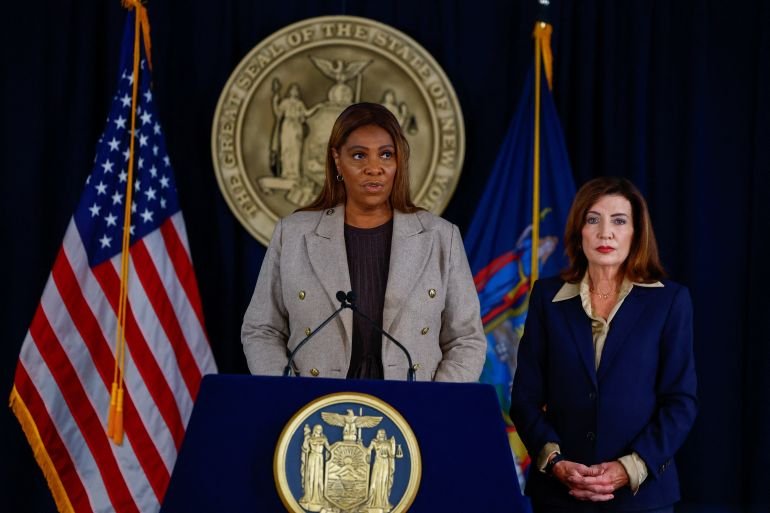
    New York Governor Kathy Hochul has appointed state Attorney General Letitia James as a special prosecutor to investigate an alleged gang rape at Cornell University, saying newly released information had undermined her confidence in the local prosecutor’s handling of the case.

    In a news conference on Friday, Hochul said that the woman who reported the alleged assault had been failed by institutions responsible for protecting her, including Cornell University Police and the Tompkins County district attorney’s office.

    Recommended Stories

    list of 1 itemend of list

    “In what world does the district attorney not even interview her, or anyone else involved, or even request the full transcript?” Hochul asked at the news conference. “And I want the truth. I think every parent in this state, every New Yorker wants the truth in this case.”

    Hochul signed an executive order on Thursday requiring the attorney general to investigate the alleged October 2024 assault. If warranted, evidence will be presented to a grand jury and the case prosecuted.

    The order states the Tompkins County district attorney declined to prosecute the case in November 2024 without speaking to Jane Doe and relied, at least in part, on information from a Cornell police statement that omitted her assertion that she had been sexually assaulted.

    On Friday in a post on social media, United States President Donald Trump decried Hochul’s decision to have James, who he claimed was “corrupt”, oversee the “highly controversial” case.

    The appointment of James means the state attorney general’s office, rather than the county district attorney, will now control the criminal investigation.

    ITHACA, NEW YORK - SEPTEMBER 30: Students walk past Cornell Police headquarters on the Cornell University campus on September 30, 2026, in Ithaca, New York. The New York state attorney general has announced a review of the university’s initial response to allegations by a former Cornell student that she was raped at a campus fraternity in 2024. The student, who is being identified only as Jane Doe, has alleged she was drugged and gang-raped inside the Chi Phi fraternity house on October 19, 2024. Spencer Platt/Getty Images/AFP (Photo by SPENCER PLATT / GETTY IMAGES NORTH AMERICA / Getty Images via AFP)
    The New York state attorney general has announced a review of the university’s initial response to allegations by a former Cornell student that she was raped at a campus fraternity in 2024 [File: Spencer Platt/AFP]

    Questions over the 2024 investigation

    Prosecutors initially closed the case without criminal charges in 2024. Tompkins County District Attorney Matthew Van Houten reopened the investigation on Monday, after Jane Doe filed a civil lawsuit accusing seven members of the Chi Phi fraternity of sexually assaulting her.

    Van Houten has defended his original decision, saying in a September 28 statement that prosecutors reviewed a six-page sworn statement the woman gave Cornell police in November 2024.

    He said the statement did not allege that she had been drugged against her will, and described her participation in sexual conduct as voluntary and consensual. He said multiple prosecutors and investigators reviewed the statement and concluded that, as presented, the facts did not establish a crime under New York law.

    The governor, however, said the full account given to police was not conveyed to prosecutors. She cited reports that Jane Doe told investigators she was “100% confident” she had been raped.

    Cornell has said its police department provided prosecutors with the evidence it had gathered, including a Snapchat screenshot, and that the university separately investigated the allegations through its disciplinary process. Cornell said sanctions imposed after that process included expulsions and suspensions.

    Cornell has also said it is conducting an independent review of how it handled the allegations.

    The Cornell case has renewed debate over New York’s definition of incapacity to consent. Under current state law, a person is considered “mentally incapacitated” when drugs or alcohol are given to someone without consent.

    A state bill introduced in June would extend the provision to cases in which a victim voluntarily consumed alcohol or drugs but became so intoxicated that they were temporarily unable to control their conduct, if the accused knew or reasonably should have known of the victim’s condition.

    The legislation has gained renewed attention following the Cornell allegations. Lawmakers said on Thursday that the case highlighted what they described as a gap in the state’s current law.

    “If someone is too intoxicated to consent, it should not matter whether they chose to use drugs or alcohol,” Hochul said at Friday’s news conference. “Voluntary intoxication is not a licence for sexual assault or gang rape, period.”

    Lindsey Boylan, a New York City Council candidate and the first woman to accuse former Governor Andrew Cuomo of sexual harassment publicly, said Hochul should use the moment to push for broader legislative change.

    “I expect to see her follow through with not just supporting the independent investigation, but also changing the state laws,” Boylan said. “That is what I’m expecting her to do now, and I think that is what every survivor is expecting her to do now.”

  • California leads lawsuit against Trump fuel efficiency standards rollback

    California leads lawsuit against Trump fuel efficiency standards rollback

    Lawsuit alleges NHTSA contravenes its congressional mandate to set fuel-economy standards at ‘maximum feasible’ .

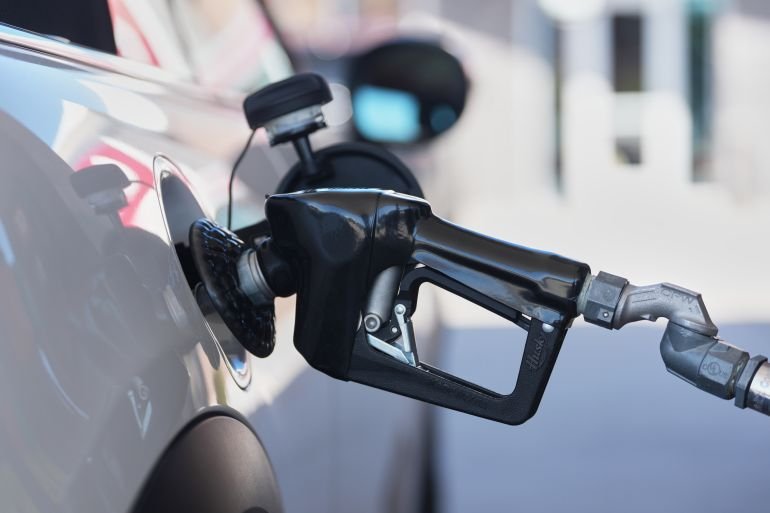
    Twenty-six states, including California and New York, have filed a lawsuit against United States President Donald Trump’s administration after the US Department of Transportation lowered fuel economy standards for petrol-powered vehicles.

    The lawsuit, filed on Friday, challenges the Department of Transportation’s rollback of fuel economy standards to a fleet average fuel economy of 34.9 miles (56km) per gallon (3.78 litres) by model year 2031. Under the administration of former President Joe Biden, fuel economy standards were set at 50.4 miles (81km) per gallon by model year 2031.

    Recommended Stories

    list of 4 itemsend of list

    California Attorney General Rob Bonta, who is leading the lawsuit, argued that the Trump administration improperly changed how federal regulators calculate fuel economy standards.

    The National Highway Traffic Safety Administration (NHTSA) bases standards on technological improvements that could make petrol-powered vehicles more efficient. To do that, it first models the current fleet’s performance and then considers what additional actions manufacturers could take to improve their fuel economy in future model years above that.

    In past standards, including during the first Trump administration, NHTSA’s baseline fleet included the millions of electric vehicles that already run on US roads.

    Bonta said the Transportation Department change ignores the existing slate of EVs, which makes it easier to justify weaker standards for petrol-powered vehicles, and called the approach “flawed” and “dramatically distorted”.

    The lawsuit also alleges that NHTSA’s new rule is contrary to law and that NHTSA contravenes its mandate from Congress to set fuel-economy standards at their “maximum feasible” level.

    The Transportation Department has said the change could save American taxpayers $138bn over the next five years.

    “The president started a war that has created volatility in oil markets, disrupted global energy supplies, and left families and businesses paying the price at the pump. Yet, the Trump administration is attempting to gut fuel economy standards and force Americans to spend billions more on gas while poisoning the air in our communities,” Attorney General Bonta said in a statement.

    The rollback was applauded by car makers.

    “We welcome the Administration’s efforts to reset the CAFE [Corporate Average Fuel Economy] regulations to more achievable targets that are better aligned with market realities,” said Shane Karr, senior vice president of public affairs at Stellantis North America.

    Second lawsuit

    The litigation by the states came in tandem with a second lawsuit filed on Friday by progressive and climate groups, including the Environmental Defense Fund and Public Citizen.

    “Trump’s lawless push to roll back key safeguards on fuel economy will pollute our air, and line the pockets of oil and auto CEOs. We are confident of stopping Trump’s CAFE standards rollback,” Robert Weissman, co-president of Public Citizen said in a statement announcing the lawsuit, which was filed in a federal court in Washington DC.

    Auto stocks were trending downward throughout the day, with Ford, General Motors and Toyota closing down around 1 percent. Stellantis fell more than 6 percent amid reports of slumping sales.

  • Iraq grants Iranian airlines 40 daily Najaf flights after US exemption

    Iraq grants Iranian airlines 40 daily Najaf flights after US exemption

    Mahan Air is excluded from the agreement as Baghdad says Washington granted its request for a waiver.

    Iraq has agreed to let Iranian airlines, except Mahan Air, operate up to 40 flights a day to and from Najaf International Airport, saying the United States granted an exemption from its sanctions.

    Prime Minister Ali al-Zaidi’s office announced the agreement on Friday, a day after Tehran urged Baghdad to lift restrictions that it said hurt pilgrims, patients, students and business.

    Recommended Stories

    list of 2 itemsend of list

    The deal eases the links between the two Shia-majority neighbours since Washington sanctioned Iran’s aviation sector last month.

    Al-Zaidi welcomed the “positive response shown by the US government to Iraq’s efforts and its cooperation in granting the necessary exemption”, the statement from his office said.

    “Air travel does not merely represent transportation between two airports, but rather a bridge of communication between peoples,” it added.

    Separately, Iraq’s Foreign Minister Fuad Hussein said the return of flights supports an Iraqi-US partnership premised on mutual respect.

    Hussein also welcomed what he described as US understanding of the importance of respecting religious freedom and facilitating access for visitors to holy sites.

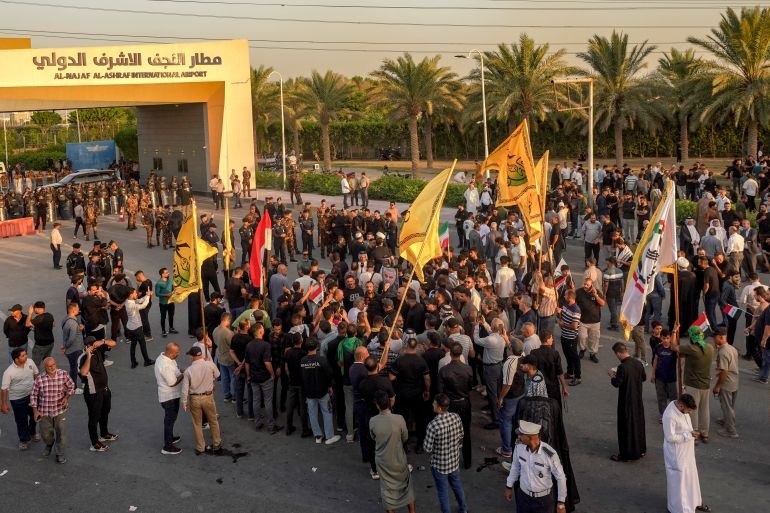
    Security personnel stand guard as demonstrators gather outside the Al-Najaf Al-Ashraf International Airport in Najaf on September 28, 2026, demanding the facility to be reopened for flights from Iran.
    Security personnel stand guard as demonstrators gather outside the Al-Najaf Al-Ashraf International Airport in Najaf, demanding the facility to be reopened for flights from Iran [AFP]

    Flights suspended

    The US Treasury announced sanctions on September 8 against 36 entities linked to Iran’s aviation sector.

    Foreign ground-handling companies then refused to service Iranian aircraft for fear of falling foul of US sanctions, and flights stopped at four Iraqi airports.

    Soon after, Iraq’s government held direct talks with Washington, seeking an exemption.

    Iraq’s ambassador to Tehran, Yasser al-Hajjaj, told Iran’s IRNA news agency that Baghdad had not ordered the halt in flights. The suspension also led to demonstrations outside Najaf airport and in Nasiriya, Karbala and Amarah, according to Iran’s Press TV.

    Najaf is the main destination for Iranian flights in Iraq. Flights to and from the city carry Iraqi Shia Muslim pilgrims to Iran’s holy cities or Iranians visiting sacred sites in Iraq.

    Iran’s ambassador to Baghdad, Mohammad Kazem al-Sadegh, told the Iranian news agency ISNA that there were “roughly 25 daily flights from Iran to Najaf and about 15 flights to Baghdad” before the ban.

    “Around 12,000 to 13,000 people travel between Iran and Iraq and vice versa on Iranian airlines, which is not a small number,” he added.

    In a statement shared on Thursday, Iran’s Foreign Ministry said that Washington’s “illegal and inhumane” extraterritorial enforcement of sanctions was disrupting Iran’s trade and air transport.

    Restrictions remain

    Flights between Najaf and Iran restarted late on Monday, according to the Iraqi News Agency.

    However, flights with Iran are still suspended at Baghdad, Erbil and Sulaimaniyah airports, forcing passengers into land journeys of at least 12 hours and disrupting pilgrim traffic.

    Al Jazeera has not verified the exemption with representatives in Washington.

  • DOJ Argues CNN & Other Outlets Can Be Banned From White House If Trump Determines They Didn’t Meet “Minimum Requirements Of Professionalism”

    DOJ Argues CNN & Other Outlets Can Be Banned From White House If Trump Determines They Didn’t Meet “Minimum Requirements Of Professionalism”

    The Justice Department argued that Donald Trump can legally ban CNN, MS NOW and Politico from the White House because he determined that they didn’t meet the “minimum requirements of professionalism.”

    Last month, a federal judge granted the three outlets a temporary restraining order that forced the White House to reinstate dozens of their reporters’ hard passes. The outlets are now asking the judge to extend that 14-day order for a longer term via a preliminary injunction, claiming that Trump’s ban is a violation of their First and Fifth amendment rights.

    U.S. District Judge Timothy Kelly, a Trump appointee, has said that he is bound by the precedent set in In a 1977 D.C. Circuit opinion, Sherrill vs. Knight, in which the judges ruled that “the protection afforded newsgathering under the First Amendment guarantee of freedom of the press requires that this access not be denied arbitrarily or for less than compelling reasons.”

    In a court filing on Friday, the DOJ claimed that the Sherrill case still would allow for the president to restrict the three outlets from accessing the White House grounds because the White House has a “compelling interest.”

    The DOJ lawyers claimed that the Sherrill decision does not “prevent the President from concluding that bona fide journalists would identify sources instead of relying on anonymous sources, commit to factual accuracy, and provide the White House an opportunity to comment, rather than ‘perform their duties in a way that … interfere[s] with the White House’s daily operations.’ …At a bare minimum, it is a significant violation of decorum to publish classified and sensitive national security information.”

    The news outlets’ legal team has rejected that assertion, writing in a filing earlier this week that Trump’s “statements also make clear he implemented the ban to coerce more favorable coverage from CNN, MS NOW, and Politico, and to deter other journalists and news organizations from newsgathering and reporting that the President might view as negative. And his administration has continued to retaliate against Plaintiffs even after the temporary restraining order, only underscoring that Defendants’ motive is to punish and chill journalism they dislike.”

    Even as access to the White House grounds has been reinstated, the White House has continued to restrict CNN from coverage of TV pool assignments, including travel with Trump on Air Force One.

    The outlets’ lawyers, led by Theodore Boutrous Jr., also noted that Trump and other White House officials “overlooked that the First Amendment protects reporting on matters affecting national security.”

    Kelly has set a hearing for Thursday on the news outlets’ motion for a preliminary injunction.

    In granting a TRO, Kelly concluded that the White House failed to provide due process to the news outlets.

    The DOJ has pointed to letters sent to the outlets as evidence that they were given due process. But those letters were sent on Sept. 22, four days after Trump’s ban was started.

    The judge also has noted that some of the objectionable stories cited by the DOJ do not have to do with national security. Kelly wrote in his order that “even the justifications provided to Plaintiffs after this case was filed are ambiguous about the true purpose of the revocations: while Defendants’ letters to Plaintiffs mention national security concerns, they purport to identify reporting that ‘threatened national security and/or spread falsehoods’ leaving open the possibility that all the stories fall into the later bucket, rather than the former.”

  • Pentagon’s new Office of Religious Affairs under Hegseth: What we know

    Pentagon’s new Office of Religious Affairs under Hegseth: What we know

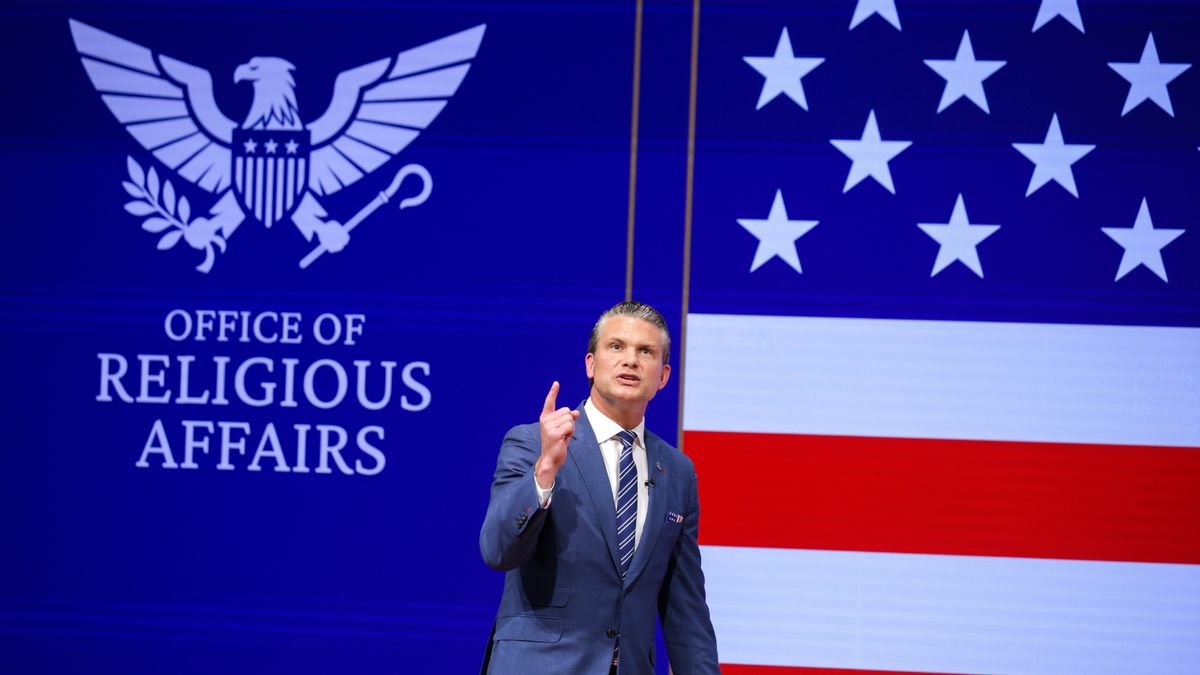
    • U.S. Secretary of Defense Pete Hegseth announced the creation of an Office of Religious Affairs at the Department of Defense on Sept. 30, 2026, during a speech he called the “State of the Force” address.
    • Hegseth suggested the Office of Religious Affairs would address urgent spiritual needs among the troops, which he said had long been neglected. He said the office would report directly to him and that budgets would be guaranteed both for chaplaincy and infrastructure, such as “base chapels.”
    • Hegseth said that “less than 5% of our force identifies as non-religious,” without citing his source for the number. A 2019 congressional report found that while 2.3% of the force identified as agnostic or atheist, the affiliation of 24.4% of active duty personnel fell under “Other/Unclassified/Unknown.”
    • Snopes will update this report if, or when, additional information surfaces. We have reached out to the DOD to ask what concrete actions the office will take. We also reached out to the American Humanist Association and are waiting for responses.

    In October 2026, a rumor spread that U.S. Secretary of Defense Pete Hegseth had announced the creation of an Office of Religious Affairs at the Pentagon.

    The claim spread on social media, including X. One X post included a video of Hegseth speaking on a stage with a U.S. flag background (archived):

    “Today, at my direction, I am establishing the Office of Religious Affairs,” Hegseth says in the video. “Starting today, and for secretaries of war after me, the Office of Religious Affairs will report straight to the top. No staff filters. No bureaucratic dilution. A direct line to the secretary.”

    Meanwhile, several Snopes readers searched the website seeking more information about the supposed Office of Religious Affairs.

    It is true that on Sept. 30, 2026, Hegseth gave a speech he called the “State of the Force” address. In this speech, he said he had ordered the creation of an office dedicated to religious affairs, which Department of Defense spokesperson Sean Parnell confirmed in an X post (archived):

    We reached out to the DOD seeking more details about the initiative and will update this story if we learn more.

    Here’s what we know about the new DOD office so far:

    Office of Religious Affairs

    In his speech, Hegseth said the initiative would address what he described as long-neglected spiritual needs among the troops (starting around the 50:25 mark of the DOD’s recording of the speech):

    After describing how significant the loss of a religious community could be for military personnel assigned to a new location or deployed abroad, Hegseth said that “political correctness and secular humanism” had allowed budgets for religious support to dwindle and infrastructure such as “base chapels” to go into disarray.

    Religious diversity in the force

    Hegseth said that “less than 5% of our force identifies as non-religious,” without citing his source for the number. A 2019 congressional report found that while 2.3% of the force identified as agnostic or atheist, the affiliation of 24.4% of active duty personnel fell under “Other/Unclassified/Unknown” (PDF Page 51). 

    Meanwhile, the Military Association of Atheists and Freethinkers, an organization that advocates for nonreligious military members but is not associated with the DOD, said 2.05% of the force identified as “Humanists” in 2018 (Humanism is a non-theistic belief; Humanists believe in a moral and ethical code without believing in God). That report also said the chaplaincy did not represent the religious diversity of the military, with an overrepresentation of evangelistic Christians, when only 13.31% of the troops identified as such.

    We reached out to the MAAF for comment on the creation of the office. A spokesperson told us the group was in the process of dissolving and directed us to the American Humanist Association, a nonprofit that advocates for secular humanism. We will update this story if the AHA returns our request for a statement on the possible impact of the creation of the office on nonreligious service members.

    In May 2026, the DOD released a list of recognized religions in a memorandum signed by Undersecretary of Defense for Personnel and Readiness Anthony Tata. The memo included 31 religions, down from 211, according to Military.com, the news outlet dedicated to reporting on the U.S. Military. Twenty-two of those 31 were Christian denominations.

    Hegseth then announced the creation of the Office of Religious Affairs, designed to report directly to him in the Pentagon organizational chart. In his announcement, he said (around 52:32 of the video embedded above):

    This won’t be a paper pushing shop. It will have real teeth. It will protect budgets, demand infrastructure, and strengthen religious support. The experts, our chaplains, will finally have an advocate at the highest levels. Policy and resources will serve the mission, not smother the mission. 

    ‘Spiritual readiness’ and ‘spiritual resilience’

    A memo issued on the same day confirmed the creation of the office. It read, in part:

    The Department of War is committed to fulfilling its duty to support the Department’s Service members, their families, and the Department’s civilian personnel in the free exercise of religion as protected by the Constitution of the United States and applicable Federal law. While the Department accomplishes this mission primarily through the chaplaincies of the Military Departments established under title 10, U.S. Code, the establishment of the ORA will ensure resources are adequately provided and, where necessary, policy is properly aligned to prioritize the free exercise of religion and the spiritual readiness across the Total Force.

    Still, Hegseth’s memo said, this effort to support the spirituality of military personnel should not “be construed to compel religious participation or to diminish the free exercise rights of any Service member, civilian employee, or family member of any faith or no faith.” 

    The memo also said the new office had 90 days to present a plan of action to rebuild the spiritual force of the military:

    Within 90 days of the date of this memorandum, the Secretaries of the Military Departments, in coordination with their respective Chiefs of Chaplains, will submit to the Director a comprehensive baseline report of all unfunded and underfunded religious affairs requirements, including, but not limited to, delivery ofreligious ministry, facilities and infrastructure, logistics, chaplain-led programs, chapel youth programs, faith-based homeschool support for military families, programs related to suicide reduction, and contracted services from faith-based non-Federal entities; research, technology, and analytical tools to support spiritual fitness, spiritual readiness, and spiritual resilience; chaplain in-service procurement programs, chaplain and religious support team training and education. 

    For further reading, Snopes examined another announcement Hegseth made that day, the launch of “Project Meridian,” set to study the “future of warfare.”