Category: News

  • Trump order fast-tracks logging on federal lands, but posts exaggerate scale

    Trump order fast-tracks logging on federal lands, but posts exaggerate scale

    Claim:

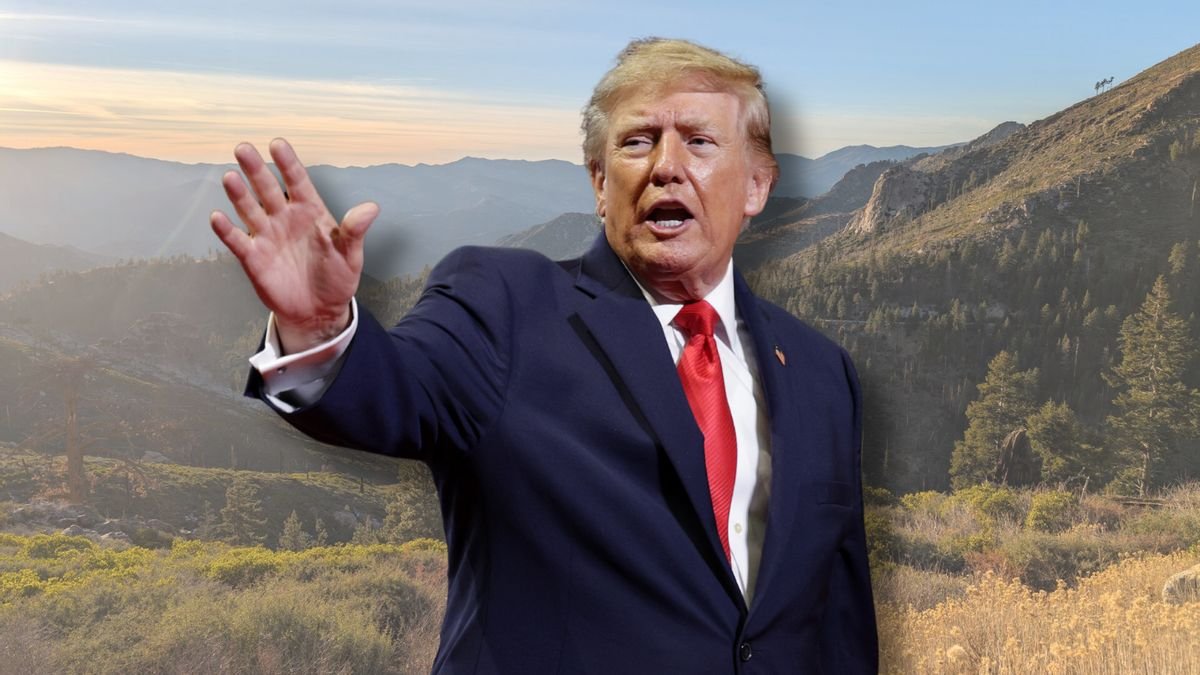
    U.S. President Donald Trump signed an executive order that would open up 59% of national forestland to logging.

    Rating:

    Mixture

    What’s True

    Trump signed an executive order allowing federal permitting agencies to ignore environmental protection laws in an effort to increase domestic timber and lumber production. The executive order also calls for expanding domestic logging production on federal lands. Following that executive order, Agriculture Secretary Brooke Rollins announced that the USDA would attempt to roll back the Roadless Rule, which, at its height, prohibited logging on approximately 59 million acres of land.

    What’s False

    The order and proposed repeal of the Roadless Rule would not open 59% of national forests to logging. Rather, by Snopes’ calculations, it would allow logging on an additional 24% of national forestland.

    In October, posts on social media suggested that U.S. President Donald Trump signed an “emergency order” opening up 59% of U.S. national forests for logging. Snopes readers wrote in asking whether the rumor was accurate.

    The claim resembled one we fact-checked in March 2025. Then, we investigated a Trump executive order that social media posters claimed would result in 280 million acres of forest being clear-cut. We found the claim to be a mixture of true and exaggerated information.

    We came to the same conclusion on this new variant. While the claim is based partly in truth (the referenced “emergency order” is the same executive order we investigated in 2025), it also exaggerates the facts. We therefore rate it a mixture of true and false.

    Here’s a breakdown:

    The order is real

    On March 1, 2025, Trump signed an executive order aimed at fast-tracking logging on federal lands. The order, titled “Immediate Expansion of American Timber Production,” directed the Forest Service and the Bureau of Land Management, two of the largest caretakers of federal lands, to update guidelines in order to “facilitate increased timber production,” among other things.

    Trump’s executive order specifically asked those agencies to investigate and implement ways to increase both the speed and quantity of timber produced by cutting environmental regulations. 

    It asked the Fish and Wildlife Service to streamline approvals for forestry projects that could potentially be halted by the Endangered Species Act within 60 days of the order. It also asked the Agriculture and Interior departments (which control the Forest Service and BLM, respectively) to exempt “timber thinning” and “timber salvage activities” from the National Environmental Policy Act. That act, signed into law by President Richard Nixon in 1970, requires the federal government to consider the environmental effects of its proposed actions through environmental impact statements.

    The executive order also encouraged the Agriculture and Interior departments to use the emergency regulations of the Endangered Species Act “to the maximum extent permissible under applicable law.” Those regulations allow the act to be bypassed in situations where time is of the essence, such as “acts of God, disasters, casualties, national defense or security emergencies.” (Trump’s executive order was issued alongside another order declaring that importing timber and lumber poses a risk to national security.) Under the emergency regulations, the Fish and Wildlife Service provides “strictly advisory” recommendations for how to protect endangered species that can be “implemented at the discretion of the emergency response personnel.”

    In other words, the executive order would allow the logging industry to bypass environmental restrictions found in the Endangered Species Act and National Environmental Policy Act.

    The acreage

    The Forest Service manages 193 million acres of land across the country (about 188 million acres of national forest). Unlike national parks, national forests were established with the purpose of permitting logging and resource exploitation as well as wildlife conservation and recreation.

    If the 59% claim were accurate, then using the 188 million total acres figure from the Forest Service we would expect to find that the order opened up about 110 million acres for logging. But this wasn’t the case. 

    The Forest Service deems just 49 million acres of its land “suitable for timber management,” far less than the 110 million acres suggested by the claim.

    Social media posts said NPR was the source of that figure, yet when we searched NPR’s archive for stories suggesting that either 110 million acres or 59% of national forests would be opened up to logging, we found no results.

    The Roadless Rule

    Instead, we found that the posts appeared to misinterpret or misrepresent NPR’s reporting regarding a real policy change implemented by Agriculture Secretary Brooke Rollins, who was tasked with carrying out the 2025 executive order. 

    According to an August 2026 news release, Rollins announced that the USDA would roll back the 2001 Roadless Rule, a policy that prohibits the construction of new roads on national forestland. Because roads are required to transport the raw materials, the Roadless Rule effectively places a limit on the number of timber and mining operations on national forestland. The news release noted the USDA would take public comment on the proposed change until Sept. 21, just before the claim began spreading. 

    When the Roadless Rule was first implemented, it applied to “nearly 60 million acres” of land, according to the Forest Service. We suspect this was the origin of social media users’ claim that Trump’s executive order would open up 59% of national forests to logging. Various sources, including NPR, reported 58 million to 59 million acres would be opened up. People may have mistaken the acreage for a percentage. 

    Even then, the social media posts dwelled on the wrong acreage figure, because the Roadless Rule no longer covers the original acreage. Colorado and Idaho enacted state-level Roadless Rules offering higher levels of protection for some land, and those stricter protections effectively supersede the federal rule. According to the Forest Service, taking those restrictions into account means the federal Roadless Rule now applies to only around 45 million acres of forest. 

    Using the correct, up-to-date acreage, Snopes calculated the rule’s recision would open up approximately 24% of Forest Service land for logging. (We were unable to determine how much of that land is actually suitable for the purpose, however.) 

    Rollins’ repeal is supported by the logging industry and several Republican governors, who claim it will prevent wildfires by allowing humans to more directly access and manage remote forestland.

    The repeal is opposed by several groups, according to reports from Pew, NPR and Cal Matters. Environmental groups cite scientific research showing 80% of wildfires are caused by human activity, and therefore more human access would increase, not decrease, fire risk. This is backed up by the Forest Service’s own environmental analysis on the repeal, according to Pew. Meanwhile, tribal nations claim the repeal undermines tribal sovereignty, and a spending watchdog notes that the Forest Service already has a $6 billion backlog in road maintenance. Repealing the Roadless Rule would only make that worse.

    (In fact, during an phone interview for a different story on the Forest Service, Associate Chief Chris French told Snopes the maintenance backlog has been around for decades, and was part of why the rule was implemented in 2001. That detail didn’t make it into the final story.)

    A bipartisan group of 164 senators and representatives wrote a letter to Rollins and Forest Service Chief Tom Schultz in September pointing out all of those factors and noting that the Roadless Rule has immense public support.

    The USDA is expected to make its final decision on the repeal in early 2027.

    Sources

    “A Historical Perspective.” U.S. Forest Service, https://www.fs.usda.gov/forestmanagement/aboutus/histperspective.shtml.

    “Addressing the Threat to National Security from Imports of Timber, Lumber.” The White House, 2 Mar. 2025, https://www.whitehouse.gov/presidential-actions/2025/03/addressing-the-threat-to-national-security-from-imports-of-timber-lumber/.

    Clear-Cutting | Definition, Effects, Arguments For, & Facts | Britannica. https://www.britannica.com/topic/clear-cutting. Accessed 4 Mar. 2025.

    Einhorn, Catrin. “Could Trump Use the ‘God Squad’ to Override Environmental Law?” The New York Times, 28 Jan. 2025. NYTimes.com, https://www.nytimes.com/2025/01/28/climate/trump-endangered-species-god-squad.html.

    Emergency Endangered Species Act Consultations for National Defense | U.S. Fish & Wildlife Service. https://www.fws.gov/node/265135. Accessed 4 Mar. 2025.

    ESA Section 7 Consultation | U.S. Fish & Wildlife Service. https://www.fws.gov/service/esa-section-7-consultation. Accessed 4 Mar. 2025.

    “Fact Sheet: President Donald J. Trump Addresses the Threat to National Security from Imports of Timber, Lumber, and Their Derivative Products.” The White House, 1 Mar. 2025, https://www.whitehouse.gov/fact-sheets/2025/03/fact-sheet-president-donald-j-trump-addresses-the-threat-to-national-security-from-imports-of-timber-lumber-and-their-derivative-products/.

    “Fact Sheet: President Donald J. Trump Rapidly Expands Timber Production.” The White House, 1 Mar. 2025, https://www.whitehouse.gov/fact-sheets/2025/03/fact-sheet-president-donald-j-trump-rapidly-expands-timber-production/.

    “Forests and Woodlands.” Bureau of Land Management, https://www.blm.gov/programs/natural-resources/forests-and-woodlands. Accessed 4 Mar. 2025.

    Friedman, Lisa. “Trump Moves to Increase Logging in National Forests.” The New York Times, 2 Mar. 2025, https://www.nytimes.com/2025/03/02/climate/trump-logging-national-forests.html.

    “Immediate Expansion of American Timber Production.” The White House, 2 Mar. 2025, https://www.whitehouse.gov/presidential-actions/2025/03/immediate-expansion-of-american-timber-production/.

    NEPA | National Environmental Policy Act – Categorical Exclusions. https://ceq.doe.gov/nepa-practice/categorical-exclusions.html. Accessed 4 Mar. 2025.

    US EPA, OP. What Is the National Environmental Policy Act? 31 July 2013, https://www.epa.gov/nepa/what-national-environmental-policy-act.

    B, et al. “Trump Administration Moves to Open Untouched National Forests to Logging.” NPR, 18 Aug. 2026. Environment. NPR, https://www.npr.org/2026/08/18/nx-s1-5936495/trump-administration-moves-to-open-untouched-national-forests-to-logging.

    Balch, Jennifer K., et al. “Human-Started Wildfires Expand the Fire Niche across the United States.” Proceedings of the National Academy of Sciences, vol. 114, no. 11, Mar. 2017, pp. 2946–51. DOI.org (Crossref), https://doi.org/10.1073/pnas.1617394114.

    Becker, Rachel. “Trump Wants More Roads and Logging in California Forests. Here’s the Wildfire Risk.” CalMatters, 18 Aug. 2026. California Wildfires. calmatters.org, https://calmatters.org/environment/wildfires/2026/08/trump-california-forests-logging-roads/.

    Earth.Org. “Trump Opens Up 59 Million Acres of National Forest to Logging.” Earth.Org, 25 June 2025, https://earth.org/trump-to-open-up-59-million-acres-of-national-forest-to-logging-mining/.

    Izzo, Jack. “The Trump Administration Is Shaking up Forest Service. We Broke down What’s Changing.” Snopes, 1 May 2026, https://www.snopes.com//news/2026/05/01/trump-forest-service-restructure/.

    ———. “Yes, Trump Signed Executive Order to Fast-Track Logging on Federal Land.” Snopes, 5 Mar. 2025, https://www.snopes.com//fact-check/trump-clear-cutting-national-forests/.

    K, et al. “Here’s Why Trump’s Promised Logging Boom Faces Headwinds.” NPR, 13 Oct. 2025. National. NPR, https://www.npr.org/2025/10/13/nx-s1-5528947/heres-why-trumps-promised-logging-boom-faces-headwinds.

    ———. “Trump to Rescind ‘Roadless Rule’ Protecting 58 Million Acres of Forest Land.” NPR, 23 June 2025. National. NPR, https://www.npr.org/2025/06/23/g-s1-74136/trump-to-rescind-roadless-rule-which-protects-58-million-acres-of-forest-land.

    NCAI and TWS Condemn the Administration’s Proposal to Rescind the Roadless Rule | The Wilderness Society. https://www.wilderness.org/articles/press-release/ncai-and-tws-condemn-administrations-proposal-rescind-roadless-rule. Accessed 13 Oct. 2026.

    “Roadless Areas.” US Forest Service, 5 Mar. 2025, https://www.fs.usda.gov/managing-land/planning/roadless.

    TCS Comments to Forest Service on the Proposed Roadless Rule Repeal – Taxpayers for Common Sense. 7 Oct. 2026, https://www.taxpayer.net/energy-natural-resources/tcs-comments-to-forest-service-on-the-proposed-roadless-rule-repeal/.
  • Denmark pushes back as Trump touts Greenland oil and mineral deals

    Denmark pushes back as Trump touts Greenland oil and mineral deals

    Recent US-Greenland-Denmark agreement excludes mining or drilling rights while reinforcing Greenland’s sovereignty.

    Denmark has demanded that US resource exploration in Greenland respect the island’s laws amid President Donald Trump’s claim that oil, gas and mineral extraction will soon begin there.

    The Danish Foreign Ministry reaffirmed on Wednesday that last month’s agreement between Denmark, Greenland and the US did not alter the rules for extraction.

    Recommended Stories

    list of 3 itemsend of list

    The agreement “does not grant investors from the US any preferential treatment” over investors from other NATO and EU countries when it comes to access to natural resources in Greenland, the ministry said.

    In a post on Truth Social, US President Trump called the semi-autonomous Danish territory “our new and beautiful Greenland”.

    “Massive Oil, Gas, and Mineral Exploration is getting ready to begin,” he wrote, without providing details.

    What the deal covers

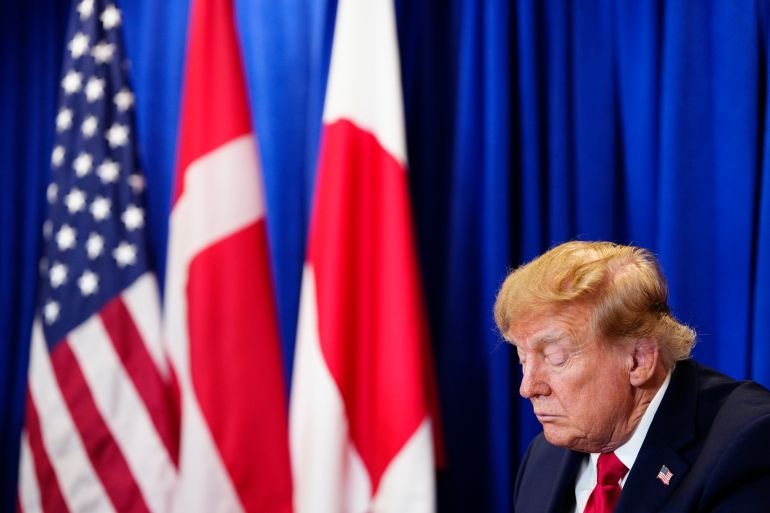
    Trump, Danish Prime Minister Mette Frederiksen and Greenland’s Prime Minister Jens-Frederik Nielsen signed the 10-page agreement on the sidelines of the United Nations General Assembly in New York on September 22, ending months of tensions over Trump’s threats to control Greenland.

    The deal allows the US to “modernise and expand” its activities at the Pituffik Space Base, a remote US military installation in northwest Greenland.

    It also paved the way for two new military bases and Trump’s “Golden Dome” missile defence system, while reaffirming Danish sovereignty and Greenlanders’ right to self-determination.

    It did not allocate any rights for mining or drilling.

    Greenland’s ban

    Greenland banned uranium mining and all future oil exploration in 2021.

    Its government is reviewing whether a Texas firm, Greenland Energy, can use permits that predate the ban.

    The company said in August it planned to drill for oil in 2027 at an untested basin on Greenland’s east coast, although it lacked its own permit.

    Danish security policy adviser Jacob Kaarsbo said Trump’s comments could signal that his desire to control Greenland remains unchanged.

    “It is extremely dangerous to view this agreement between the Trump administration and Denmark as something that has altered Trump’s intentions,” he said.

    Mikkel Olesen, a senior researcher at the Danish Institute for International Studies, told Al Jazeera that details regarding mining and exploration rights remained unclear and that information coming mostly from the US side should be taken “with a grain of salt”.

    Richard Weitz, a fellow at the NATO Defense College in Rome, said Trump “backed down and settled for less” than he sought, but still “got pretty much everything he wanted, except formal annexation”.

  • Trump suggests those who leak government information should ‘be shot’

    Trump suggests those who leak government information should ‘be shot’

    The US president has long been unhappy with inside information about his administration being leaked to the media.

    United States President Donald Trump has suggested that those who leak information to the news media should be shot as punishment.

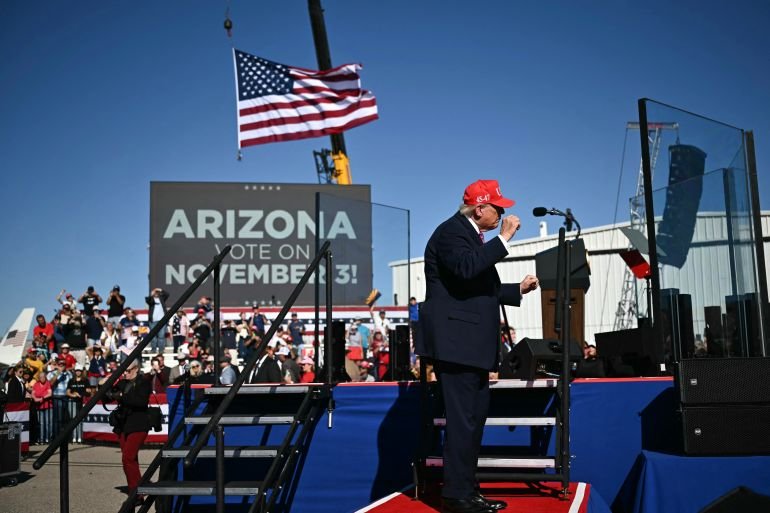
    Trump made the remarks at a campaign rally in Bullhead City, Arizona, as he urged supporters to vote in the November 3 midterm elections.

    Recommended Stories

    list of 3 itemsend of list

    “In my opinion, leakers should be shot,” Trump told the crowd. “In the old days, we used to shoot leakers, you know, when they leak what time you’re going to attack a country.”

    Trump made the statement in an apparent reference to Operation Midnight Hammer, which saw the US launch a surprise attack on Iran in June 2025 during the 12-day war between Israel and Iran.

    In the aftermath of the attack, several media outlets published findings from a preliminary report by the US Defense Intelligence Agency.

    That report – which had not yet been released to the public – indicated that Iran was able to move some of its enriched uranium away from the sites the US had bombed.

    It also suggested that the extent of the damage to Iran’s nuclear facilities was more modest than what Trump had asserted.

    Trump, however, appeared to signal that the timing of the US attacks was among the leaked information. He accused the news media of putting military members in danger, calling out The New York Times and CNN in particular.

    “They leaked the time we were leaving, the time we were arriving,” Trump said, claiming he had to reschedule the bombing campaign two days later as a result.

    “Somebody leaked. Some sleaze-bag, they ought to go to jail or be shot. For the rest of their life, they should be in jail.”

    Trump has long had an adversarial relationship with the news media, and he has previously called for harsh punishment against any official who passes on confidential information to news outlets.

    After parts of the Defense Intelligence Agency report became public, he blamed lawmakers in the Democratic Party for its release.

    “The Democrats are the ones who leaked the information on the PERFECT FLIGHT to the Nuclear Sites in Iran,” Trump wrote on social media at the time. “They should be prosecuted!”

    Under Trump, the White House has taken aggressive action to track down the source of leaks.

    Staff in his administration, as well as officers in the military, have also been asked to take polygraph tests.

    Journalists at several news outlets, including The New York Times, The Washington Post and The Wall Street Journal, have also received subpoenas aimed at determining the sources of internal information made public.

    The newspapers had reported on stories such as a botched Navy SEALs raid in North Korea and how Trump ignored internal Pentagon warnings against launching the Iran war.

    Last year, the Department of Defense demanded that journalists who wished to access the Pentagon sign an agreement not to publish unauthorised material.

    Much of the Pentagon press corps refused to agree, and a federal court struck down many of the new demands made on journalists at the department.

    Trump has long raged against leakers, going back to his first term as president from 2017 to 2021.

    Former White House official Alyssa Farah Griffin told a podcast in 2024 that Trump had called for leakers to be executed, after media outlets reported that he had taken shelter in a White House bunker during racial justice protests in 2020.

    Trump appeared to reprise that sentiment in his speech to Arizona voters on Wednesday, less than three weeks before the November 3 midterms.

    “Leakers should be dealt with very, very strongly,” Trump said. “To me, they are the scum of the earth.”

  • What to know about lung adenocarcinoma following Pope Leo’s diagnosis

    Pope Leo XIV was diagnosed with lung adenocarcinoma, one of the most common types of lung cancer, the Vatican said this week.

    The 71-year-old pontiff underwent surgery on Tuesday to have the lower lobe of his right lung removed. Doctors described it as a “successful” operation.

    The Vatican said earlier this week that Pope Leo’s recovery is expected to take about a week.

    Here’s what you need to know about lung adenocarcinoma, including how it’s diagnosed and what treatment options are available.

    Pope Leo XIV arrives for his weekly general audience in St. Peter’s Square, at the Vatican, Oct. 7, 2026.

    Andrew Medichini/AP Photo

    What is lung adenocarcinoma?

    Lung adenocarcinoma is the most common type of non-small cell lung cancer, accounting for roughly 40% of all lung cancer cases, according to the Lung Cancer Foundation of America (LCFA).

    The broader category of non-small cell lung cancer comprises roughly 80% to 85% of all lung cancers, according to the American Cancer Society (ACS).

    Lung adenocarcinoma begins in cells in the lung that make mucus, called epithelial cells, which line the surface of the lungs, the ACS says.

    It is more likely than other lung cancers to be found before it has spread because it grows more slowly, the LCFA notes.

    Microscope pathology of adenonocarcinoma in the tissue of a human lung.

    David A Litman/Adobe Stock

    Who is at risk?

    Cigarette smoking is the primary risk factor for lung adenocarcinoma. However, it is also the most common lung cancer in people who have never smoked. 

    The LCFA says lung adenocarcinoma is the most common type of lung cancer in women, with studies showing it is more frequently found in women than men.

    Although lung cancer is generally considered a disease among people who are older, lung adenocarcinoma is more likely to occur in younger people than other types of lung cancer. 

    How is it diagnosed?

    After a doctor performs a physical exam, including personal and family heath history, a number of diagnostic tests may be performed.

    Patients may undergo one or more imaging tests to screen for abnormal lung masses including a chest X-ray, a CT scan, a PET scan or an MRI scan.

    They may also undergo a biopsy, during which a small sample of lung tissue is removed and examined by a pathologist.

    “Based on the clinical staging, what the PET scan and other tests show, a stage is determined, and that will determine the most important thing: what the appropriate treatment for that person is going to be,” Dr. Inderpal Sarkaria, a professor in the department of cardiovascular and thoracic surgery at UT Southwestern Medical Center, told ABC News.

    What treatments are available?

    Treatment depends on the type of lung cancer and how far it has spread. Additional testing will be performed to determine staging and tumor features including genetic mutations, which guide treatment decisions.

    Treatment may involve surgery, chemotherapy, radiation therapy, targeted therapy or a combination of these options. 

    “If it’s a small tumor — isolated in a lung, no evidence of lymph nodes being involved, and a patient that can tolerate the operation, which many can — then an operation to remove the tumor is absolutely appropriate,” Sarkaria said.

    PHOTO: Doctors Reviewing Ai Assisted Chest Scan for Diagnostic Analysis

    Stock photo of doctors reviewing a chest X-ray.

    Adobe Stock

    For more advanced stages, further treatment may be needed.

    “Depending on the stage that’s determined, any number of things might be appropriate, including chemotherapy, more commonly now immunotherapy, drugs that bolster the immune system to attack the tumors,” he continued.

    If part of surgery involves lymph nodes, doctors will determine if additional chemotherapy or immunotherapy — or, less commonly, radiation — may be needed, Sarkaria added.

    What is the 5-year survival rate?

    Five-year survival rates — the percentage of those who lived five years after they were diagnosed with or started treatment for a disease — “depends on the stage at which it’s picked up,” Dr. Hiren Mehta, an interventional pulmonologist at University of Florida Health, told ABC News. “The earlier [the] stage, the better the prognosis.”

    The 5-year relative survival rate for non-small cell lung cancer is 67% if the cancer has not spread outside of the lung, according to the ACS.

    For the regional stage, meaning the cancer has spread to nearby structures or lymph nodes, the 5-year relative survival rate is 40%. If the cancer has spread to other parts of the body, the rate is 12%, the ACS says.

    How to lower risk

    Many lung cancer patients don’t have symptoms when the cancer is in its early stages. Mehta said that if patients wait to go to the doctor only when they have symptoms, the cancer may be in later stages and harder to treat.

    The U.S. Preventive Services Task Force currently recommends yearly lung cancer screening with a low-dose CT scan for those between ages 50 and 80 who smoke currently, have a 20 pack-year or more smoking history or have quit within the past 15 years.

    “If you do smoke or have smoked, talk to your doctor and see if you are eligible for lung cancer screening,” Mehta said. “Although the common association of lung cancer is with somebody who has smoked in the past, 20 to 30% of lung cancers can happen in some patients who have never smoked … and so if you have never smoked in [your] lifetime, that doesn’t mean you are immune to lung cancer.”

    He warned that people should stay vigilant.

    “It’s an ongoing discussion with your doctor and make sure that you talk to your doctor about your risks other than smoking,” he said.

    ABC News’ Dr. Jennifer Miao contributed to this report.

  • ICE rejects recommendation for body cameras that automatically record

    ICE rejects recommendation for body cameras that automatically record

    The immigration agency has rejected a report from a government watchdog, making suggestions for improved body camera policy.

    Immigration and Customs Enforcement (ICE), a United States agency that has taken a central role in President Donald Trump’s mass deportation campaign, has rejected a government report calling for its agents to wear body cameras that automatically activate.

    On Wednesday, the Government Accountability Office, a nonpartisan agency that provides research to Congress, released a report recommending an update to ICE guidelines for camera usage.

    Recommended Stories

    list of 3 itemsend of list

    It suggested that “automated camera activation” would be helpful in situations where “unexpected and unplanned incidents, unrelated to sensitive operations, result in use of force by or against personnel”.

    “Given the important role of body-worn cameras in law enforcement activities, we maintain that additional controls are needed to help ensure that ICE personnel capture footage in accordance with policy,” the report said.

    Automatic activation, it added, would address difficulties ICE agents face in manually turning on their cameras during enforcement operations.

    But ICE has rejected the recommendation for automatic activation, which could be triggered by an agent pulling a gun or turning on a car siren. The agency cited privacy concerns.

    But the Trump administration faces public pressure to improve transparency during its immigration raids.

    Agents from ICE and other agencies such as Customs and Border Protection (CBP) have faced accusations of excessive force and civil liberties violations.

    In January, two US citizens – Renee Good and Alex Pretti – were shot to death in separate shootings in Minneapolis, Minnesota, during immigration operations.

    The New York Times estimated in July that immigration agents had opened fire on at least 25 people since the start of Trump’s second term. A CBS News review updated this week counts at least 30 shootings, with nine people killed and 13 others wounded.

    ICE has often blamed such incidents on aggression against its agents, and it has argued that its officers have opened fire to defend themselves from danger.

    But in several cases, that rationale has come under scrutiny.

    Critics argued that video footage in Good’s fatal shooting disproved government statements alleging that she had weaponised her vehicle against agents. Her car, according to observers, appeared to be turning away from agents, not towards them.

    In another case, ICE agent Christian Castro was accused of making false statements about a shooting that resulted in injury to Julio Cesar Sosa-Celis, a Venezuelan man living in Minneapolis.

    Castro faces federal charges for allegedly lying about being attacked with a snow shovel and broom before the shooting, after video footage contradicted his account. Castro pleaded not guilty last month.

    More recently, on October 8, immigration agents shot a man named Oscar Belgal in New York City while his five-year-old son was in the backseat of his car. ICE stated that Belgal appeared to be “going towards officers” in his car when they opened fire.

    On Tuesday, a judge rejected the government’s effort to have Belgal deported.

    Activists say better recording procedures for body camera footage could help clarify what happened in such incidents.

    But the Trump administration has largely refused to implement reforms to ICE protocol.

    Earlier this year, Democrats in Congress delayed funding for the Department of Homeland Security, which oversees ICE, on the basis that significant changes needed to be made to reduce incidents of excessive force.

    The department said on Wednesday that automatically recording cameras could result in “the unauthorised recording of sensitive interactions with informants or victims”.

    The agency added that all ICE offices had received body cameras as of August 5, but that training in their use was still ongoing and would be finished “soon”.

  • Maricopa County didn’t apologize to Trump after uncovering fraud in 2020 election, despite claims

    Maricopa County didn’t apologize to Trump after uncovering fraud in 2020 election, despite claims

    Claim:

    Maricopa County Elections in Arizona issued an apology to U.S. President Donald Trump after officials presented evidence showing state leaders ordered thousands of Trump voters’ ballots in the 2020 election to be destroyed and also to count immigrants’ illegally cast votes for Joe Biden.

    Rating:

    False

    Ahead of the 2026 mideterm elections, people shared a purported “breaking” rumor alleging that Maricopa County Elections in Arizona issued an apology to President Donald Trump after officials made a striking discovery regarding the 2020 election results. The final tally showed Trump losing Arizona to former President Joe Biden by just under 11,000 votes.

    According to the rumor, officials presented evidence that Gov. Katie Hobbs, a Democrat who in 2020 was Arizona’s secretary of state, and former Arizona House Speaker Rusty Bowers, a Republican, ordered the destruction of tens of thousands of Trump voters’ ballots and also to count of tens of thousands of votes that immigrants lacking permanent legal status illegally cast to help elect Biden.

    Snopes readers asked about this matter via email and searches.

    This rumor was false. Searches for proof failed to find any credible sources reporting about Maricopa County Elections issuing an apology to Trump about large-scale voter fraud in the 2020 election. Instead, those queries indicated the original post came from a user who has shared similar misinformation before, including a false rumor about Georgia’s 2020 election results.

    People sharing this story copied and pasted the same text, which touched on Trump’s false, oft-repeated claim that officials engaged in massive election fraud in 2020 — supposedly resulting in a “stolen election.” The Associated Press extensively investigated Trump’s claims involving battleground states and found no evidence of any large-scale fraud.

    We emailed Maricopa County Elections to ask if the office could confirm that it did not issue an apology to Trump. We also emailed the White House to ask about this rumor and will update this article if we receive any further information.

    Researching the rumor

    Searches of Bing, DuckDuckGo, Google and Yahoo for keywords related to the rumor failed to locate any news media outlets credibly reporting about Maricopa County Elections issuing an apology to Trump — including from conservative publications and outlets supporting the Trump administration.

    Instead, the searches found numerous social media users reposting the claim, for example on Facebook (archived), Gettr (archived) and X (archived). That “breaking” rumor read as follows:

    🚨#BREAKING: The Maricopa County Board of Elections has issued an apology to President Trump, claiming that local officials presented evidence that then Secretary of State (now Governor) Katie Hobbs and then Speaker of the Arizona House Rusty Bowers personally ordered them to destroy tens of thousands of mail-in ballots for President Trump and to count tens of thousands cast by illegal aliens for Joe Biden in Arizona’s largest county during the 2020 election.

    This is described as outcome-determinative fraud by those entrusted to conduct, oversee, and certify the vote; Hobbs and Bowers are alleged to have been paid by at least three hostile foreign governments, the George Soros Open Society Foundation, and the DNC in exchange for rigging the 2020 election in Arizona.

    Simply put, there is now irrefutable and indisputable proof that President Trump won the state in that stolen election, spoken by the very people who counted the ballots.

    LOCK THESE TREASONOUS CROOKS UP NOW! 💪🏻🔥🇺🇸

    The posts improperly labeled the county’s elections body, officially named Maricopa County Elections, as the “Maricopa County Board of Elections.” The body’s website displays a footer reading, “Elections in Maricopa County are overseen by both the County Board of Supervisors and the County Recorder.”

    Apparent origins of rumor

    Searches of X for the above posts’ copied-and-pasted text indicated a user named Joshua Hall (@JoshHall2024) first posted the rumor (archived) on March 19. Hall’s post also began with the word “breaking.” We found the claim was neither breaking nor true, whether in March or this month.

    (@JoshHall2024 via X)

    According to Hall’s own posts, he appeared to be the same Joshua Hall that a judge sentenced to 20 months in prison for, as the Justice Department announced, “making threats to kill a member of the United States Congress” — fomer Rep. Eric Swalwell, D-Calif. — and “impersonating family members of the then-President of the United States on social media to fraudulently raise funds for a fictitious political organization.”

    Trump has at least once shared a screenshot on Truth Social (archived) of one of Hall’s X posts from December (archived) promoting a false claim about Georgia twice tallying hundreds of thousands of votes. That post said the state owed Trump an apology.

    In March, Hall posted a newer iteration of the Georgia rumor (archived) similar to the one about Arizona, falsely claiming the Fulton County Board of Elections said it owed Trump an apology.

    We privately messaged Hall to ask for evidence to support the rumor and have not received a response. He has not made any new X posts since July; he reportedly faces charges including stalking and witness intimidation, and jail records in Cumberland County, Pennsylvania, show a man with the same name in custody.

    ‘Unsupported by factual evidence’

    In early March — just days before Hall’s X post about Maricopa County — the FBI reportedly subpoenaed 2020 elections records to continue investigating Trump’s unfounded claims of fraud.

    Arizona Attorney General Kris Mayes, a Democrat, issued a statement in response, repeating details of elections officials’ exhaustive investigations and calling the claims “unsupported by factual evidence”:

    The 2020 General Election in Arizona has been exhaustively reviewed. Multiple audits, court proceedings, and independent investigations — including those pursued by members of the same political party of the President — found no evidence of fraud sufficient to alter the outcome. These findings are not in dispute by any credible authority. The election results were certified, litigated, and affirmed.

    In fact, under the direction of my predecessor, Attorney General Mark Brnovich, agents and support staff of the Arizona Attorney General’s Office spent over 10,000 hours investigating voting irregularities and alleged instances of illegal voting by high-profile election deniers. Complaints and allegations submitted to the Arizona Attorney General’s Office by members of the public were also unsupported by factual evidence.

    On Oct. 5, Trump criticized Maricopa County elections officials for sending out more than 3,000 ballots six days early. The Maricopa County Recorder’s Office issued a statement saying that an election services company mistakenly mailed the ballots early, that the error “affected only the timing of the mailing” and that “the correct ballots were mailed to the correct voters.”

    For further reading, we previously reported about a rumor claiming officials found 712,152 new votes for Trump in Arizona for the 2020 election.

    Sources

    “Arizona: 11 Electoral Votes.” Washington Post, Election 2020, 2020, https://www.washingtonpost.com/elections/election-results/arizona-2020/.

    Cassidy, Christina A. “Far Too Little Vote Fraud to Tip Election to Trump, AP Finds.” The Associated Press, 14 Dec. 2021, https://apnews.com/article/voter-fraud-election-2020-joe-biden-donald-trump-7fcb6f134e528fee8237c7601db3328f.

    Goudsward, Andrew. “FBI Examines Arizona Election Records in Widening Probe of Trump Vote Fraud Claims.” Reuters, 9 Mar. 2026, https://www.reuters.com/legal/government/fbi-examines-arizona-election-records-widening-probe-trump-vote-fraud-claims-2026-03-09/.

    Kelety, Josh. “Trump Criticizes Election Officials in Arizona’s Maricopa County over Error Affecting 3,000 Ballots.” The Associated Press, 5 Oct. 2026, https://apnews.com/article/trump-arizona-maricopa-county-mail-ballots-voting-fcbd40f8b0c0b778f50409bc994d4225.

    Maricopa County Elections. https://elections.maricopa.gov/.

    Mayes, Kris. “Attorney General Mayes Issues Statement on Federal Grand Jury Subpoena for 2020 Election Materials | Attorney General’s Office.” Arizona Attorney General’s Office, 9 Mar. 2026, https://www.azag.gov/press-release/attorney-general-mayes-issues-statement-federal-grand-jury-subpoena-2020-election.

    “Meet Katie.” Katie Hobbs for Governor, https://katiehobbs.org/meet-katie/.

    “Pennsylvania Man Sentenced To Prison For Threatening To Kill United States Congressman And Perpetrating Online Fraud Scheme.” U.S. Justice Department, 19 Dec. 2022, https://www.justice.gov/usao-sdny/pr/pennsylvania-man-sentenced-prison-threatening-kill-united-states-congressman-and.

    Pikora, Jillian. “Convicted Trump Scammer Josh Hall Arrested In New Case.” The Daily Voice, 19 Jan. 2026, https://dailyvoice.com/article/convicted-trump-scammer-josh-hall-arrested-in-new-case/.

    “Russell Bowers.” Ballotpedia, https://ballotpedia.org/Russell_Bowers.

    “STATEMENT ON RUNBECK EARLY BALLOT PRE-MAILING.” Maricopa County Recorder’s Office, 4 Oct. 2026, https://recorder.maricopa.gov/news/RESmailing.html.

  • Families of Trinidadian men killed in US boat strike demand accountability

    Families of Trinidadian men killed in US boat strike demand accountability

    The families of two missing men from the Caribbean country of Trinidad and Tobago have marked the one-year anniversary of their disappearance by calling for accountability from the United States.

    Since September last year, the US military has undertaken a campaign of attacking small boats in the Caribbean Sea and eastern Pacific Ocean, on the basis that they were transporting “narco-terrorists”.

    Recommended Stories

    list of 3 itemsend of list

    But critics have called the boat strikes an illegal campaign of extrajudicial killings.

    On Wednesday, the families of Chad Joseph and Rishi Samaroo issued a statement remembering the two men, who they said were killed in one of the US boat strikes on October 14, 2025.

    The families are currently pursuing a wrongful death lawsuit in the state of Massachusetts, supported by the American Civil Liberties Union (ACLU). They have argued that Joseph and Samaroo were fishermen and farm workers, not drug-traffickers.

    “The last year has been devastating without Chad in our lives. Chad was the heart of our family. He was loving, generous and caring and always there for us. We all miss him terribly,” said Joseph’s mother, Lenore Burnley.

    “A year later, we are still grieving and seeking justice for his death. We will always mourn losing Chad but hope that this lawsuit will be a step towards justice for him and the family.”

    Four other people were killed in the attack on October 14, 2025, when a missile struck a vessel returning to Trinidad and Tobago from nearby Venezuela.

    The families have said Samaroo and Joseph had been working in Venezuela to support their families.

    Both men called their families two days before embarking on the trip home to the islands. They were never heard from again.

    The boat strike campaign, launched under US President Donald Trump, has killed at least 239 people since September 2025.

    But the US government has provided little evidence to prove its claims that those on board were trafficking drugs. It has also not publicly identified the victims.

    In several cases — from Colombia to Ecuador to Trinidad and Tobago — relatives have stepped forward to say that their loved ones were among those killed, and that they were fishermen with no connection to the drug trade.

    Separately, the family of Colombian fisherman Alejandro Carranza has filed a complaint with the Inter-American Commission on Human Rights, accusing the Trump administration of violating his right to life when it allegedly bombed his boat on September 15, 2025.

    Samaroo and Joseph’s lawsuit was filed in January and is being heard by a US federal court in the city of Boston, Massachusetts.

    “Not a day goes by when our family doesn’t think about our brother Rishi,” said Sallycar Korasingh, Samaroo’s youngest sister.

    “Rishi was a good person, loved by his family and community. The last year without him in our lives has been heartbreaking. My brother and family deserve justice. We will continue fighting for answers and the accountability we deserve.”

    Legal scholars have noted that, even if those killed were involved in criminal activity, the strikes would still amount to extrajudicial killings.

    Under international law, it is generally illegal to use military force for civilian law enforcement. Drug trafficking is not considered an act of war, but rather a civilian crime.

    “For a year now, our clients have had to live without their loved ones and without justice in the name of President Trump’s lawless killing campaign,” said Jeff Stein, staff attorney with ACLU’s National Security Project.

    The group is representing the families in their lawsuit, along with the Center for Constitutional Rights.

    “These illegal strikes at sea have devastated countless families, terrified communities, and made us all less safe,” Stein said. “We won’t stop fighting for accountability. We urge leaders in both Congress and the executive branch to finally end this illegal campaign before anyone else is killed.”

  • Musk says US military controls Starlink’s limits after Ukraine outcry

    Musk says US military controls Starlink’s limits after Ukraine outcry

    Ukrainian officials have accused SpaceX of throttling Starlink satellite services, disrupting its ability to carry out military operations and leaving Kyiv vulnerable to deadly attacks.

    An adviser to President Volodymyr Zelenskyy said that without warning, services had been limited for terminals travelling over 100mph overnight on Wednesday – effectively limiting Ukraine’s ability to launch drones, which use satellite internet to pilot the craft.

    Recommended Stories

    list of 4 itemsend of list

    Elon Musk, the CEO of SpaceX, which operates Starlink and its military version, Starshield, has since claimed on X that the United States government and military control all Starshield speeds.

    “Any limits on speed or usage are decided by the US military and ultimately [President of the United States],” wrote Musk, a major US defence contractor and former top adviser to US President Donald Trump, after receiving criticism for the disruptions.

    The White House has not confirmed or denied Musk’s assertion. The Pentagon did not immediately respond to Al Jazeera’s request for comment.

    Writing on Telegram, Ukrainian defence technology adviser Serhii Beskrestnov said Ukraine was “deprived of one of the few chances to defend itself from Shahed drones”.

    He added that frontline logistics and long-distance missions were also disrupted.

    Asked about the restriction on the military version of Starlink, Zelenskyy told Piers Morgan Uncensored it was “a big mistake” that “will bring a lot of human losses”.

    US Senator Jeanne Shaheen, a member of the armed services and foreign relations committees, wrote on X: “These restrictions on Ukraine’s access to Starshield must stop immediately. Lives are at stake.

    “The Pentagon is also required to notify Congress if it pauses or downgrades intelligence sharing with Ukraine. If that happens, Secretary of War [Pete Hegseth] must provide that immediately.”

    The suggestion that Musk’s company had throttled Starlink services drew the ire of Poland, which pays for Ukrainian Starlink subscriptions on Kyiv’s behalf.

    “Hey Elon Musk, big man, are you playing politics with your products again?” wrote Radoslaw Sikorski, Poland’s foreign minister. “As your European customers, we are watching you.”

    The “big man” gibe refers to a public dispute on social media between Musk, Sikorski and United States Secretary of State Marco Rubio in 2025, when the SpaceX boss told Sikorski to “be quiet, small man” on his X platform.

    Starlink is a sensitive topic between Sikorski and Musk. The two previously clashed over the technology after the trillionaire said Ukraine’s “entire frontline could collapse” if he switched off Starlink.

    Following the dispute in 2025, Musk said “no matter how much I disagree with the Ukraine policy, Starlink will never turn off its terminals.”

    At the time he added, “We would never do such a thing or use it as a bargaining chip.”

    ‘Cannot be a coincidence’

    The slowdown comes after Russian ballistic missiles struck Kyiv for the second night in a row, killing at least nine people and damaging electricity and heating infrastructure. Zelenskyy said Ukraine did not receive its usual warnings from Western allies for a second day, without specifying which partners.

    Sources have told Reuters and other media that the US has threatened to cut off intelligence for early warning of missile strikes on Ukraine, pressing Kyiv to suspend attacks on Russian oil refineries.

    Trump said on Tuesday the US has not stopped sharing intelligence.

    Beskrestnov warned that the slowdown “cannot be a coincidence” after Trump struck a deal with President Vladimir Putin to import Russian diesel – despite international sanctions to isolate Moscow.

    Speaking to AFP, another Ukrainian official accused Washington of throttling Starlink and helping Russia.

    On Saturday, Trump suggested Zelenskyy had not done enough to end the war with Russia, blaming him for high diesel prices in the US.

    Last week, Trump lifted sanctions on Russian diesel under pressure to curb fuel prices that have soared since the US war with Iran began as the midterms rapidly approach. He told Kyiv to stop attacking Russian refineries and urged Ukrainians to replace Zelenskyy.

    “It’s painful when President Trump chooses one side, not our side,” Zelenskyy said in the interview with Morgan.

    The Ukrainian leader explained he was fine with Trump being in the middle between Ukraine and Russia, but “if you are in the middle, you have to stay in the middle.”

  • US lifts sanctions on Venezuela’s top legislator

    US lifts sanctions on Venezuela’s top legislator

    Jorge Rodriguez has been removed from OFAC’s sanctions list in latest US push for oil control and bilateral diplomacy.

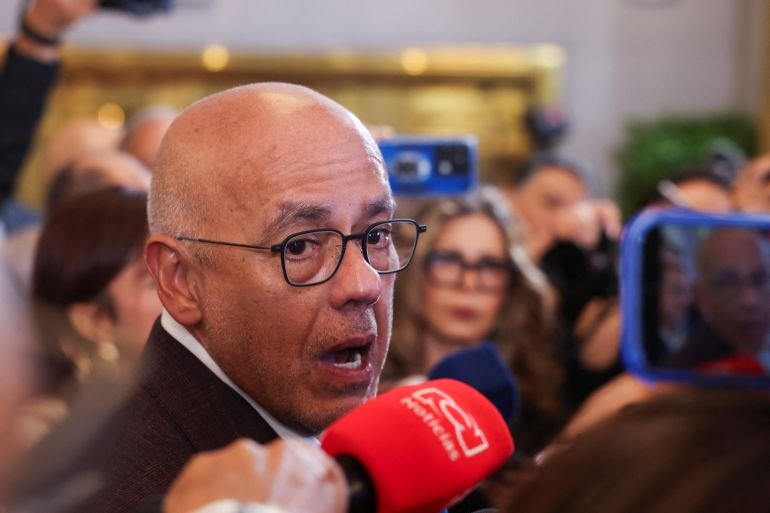
    The United States Department of the Treasury has lifted sanctions on the head of Venezuela’s National Assembly, Jorge Rodriguez, brother of the country’s interim President, Delcy Rodriguez.

    The move by US Treasury’s Office of Foreign Assets Control (OFAC) comes amid major US-Venezuela energy pacts and other talks with the Latin American country’s government.

    Recommended Stories

    list of 3 itemsend of list

    The delisting notice was posted on the federal agency’s website on Wednesday, officially removing Jorge Rodriguez’s name from OFAC’s Specially Designated Nationals (SDN) blacklist.

    The top lawmaker in the country, Jorge Rodriguez has held the position of National Assembly president since 2021. He was reappointed in January, weeks after the abduction of former President Nicolas Maduro by the US government. He served as vice president under Venezuela’s late President Hugo Chavez, among other posts.

    Jorge and Delcy Rodriguez had been sanctioned under US President Donald Trump’s first administration due to their ministerial roles under Maduro, who now faces several federal charges, including a sweeping superseding indictment adding torture to his other alleged crimes.

    In 2018, the State Department said that Jorge Rodriguez was given prominent government positions by Maduro “to help him maintain power and solidify his authoritarian rule”.

    A source familiar with the matter told Al Jazeera that the decision to lift sanctions on Jorge Rodriguez is part of Washington’s wider diplomatic recognition of the interim Venezuelan government, and Trump’s three-phase plan for Venezuela’s stabilisation and political transition.

    During a press briefing at the US State Department on Friday, Secretary of State Marco Rubio told reporters that the next round of negotiations on Venezuela’s future was scheduled to begin on Wednesday. He also urged all Venezuelan opposition factions to join US-backed political talks with the interim president.

    Earlier this year, the US Treasury dropped sanctions against Delcy Rodriguez and later lifted the restrictions on Venezuela’s central bank and its state-owned national airline, signalling Washington’s pivot from economic warfare to backroom bargaining. She has largely complied with Trump’s demands for Caracas to open up its energy industry to American companies.

    As interim president, Delcy Rodriguez has promised to hold elections – including in her recent remarks at the United Nations General Assembly – but no firm date has been set. Opposition leader and Nobel Peace Prize winner Maria Corina Machado has demanded they take place by July.

    Jorge Rodriguez has shepherded several major reforms through the ruling party-controlled legislature since his sister took power, including a law that facilitated the entry of more foreign oil companies, a similar law for the mining sector and an effort to allow private investment for the country’s battered power grid.

    Since Maduro’s ouster, Caracas and Washington have cut a deal giving the US access to 17 Venezuelan oil fields, while international energy firms have separately committed to expanding projects in the Latin American country. In August, Trump announced a plan to secure direct US access to a large share of Venezuela’s vast oil to refill the US Strategic Petroleum Reserve.

  • Infantino faces FIFA rebels in Zurich after failed World Cup stake sale

    Infantino faces FIFA rebels in Zurich after failed World Cup stake sale

    Gianni ⁠Infantino faces the football leaders who ⁠want him gone on Thursday in his first meeting with FIFA’s top brass since his plan to sell a stake in FIFA tournaments, including the World Cup, collapsed.

    Infantino has faced calls to resign from the leaders of three regional football confederations – UEFA (Europe), AFC (Asia) ⁠and CONCACAF (North and Central America and the Caribbean) – and their representatives will be present in Zurich for a FIFA Council meeting.

    Recommended Stories

    list of 4 itemsend of list

    They will be joined by their counterparts from Africa, South America and Oceania.

    On the agenda will be a discussion of the failed FIFA Forward Enterprise (FFE) scheme, which Infantino was forced to abandon ⁠within days of announcing it in July.

    Under the plan, Infantino proposed selling a minority stake in a FIFA commercial subsidiary to private investors, with a company launched by Joshua Kushner, the brother of Donald Trump’s son-in-law Jared Kushner, identified as the proposed lead investor.

    The 37-member council will also address FIFA’s governance, with some of the sport’s most powerful figures determined to limit Infantino’s powers if they cannot force him out of office.

    Infantino, 56, will stand for re-election in March 2027, with a ‌November 18 deadline looming for potential candidates to submit their nominations.

    Last week, former Switzerland and Tottenham Hotspur defender Ramon Vega announced that he intended to stand, but he has not confirmed whether he has the backing of the five national associations required to enter the race.

    The FFE plan exposed a split in world football, with Aleksander Ceferin, Salman Al Khalifa and Victor Montagliani – the presidents respectively of UEFA, AFC and CONCACAF – saying it was time for a change at the top of FIFA.

    However, Infantino has been canvassing support as he bids to remain in power and received a standing ovation when he met African football leaders last week in Cape Verde.

    He is also expected to be backed by South America at next year’s election ⁠in Rabat, Morocco. Despite the AFC’s criticism of his leadership, many countries within Asia, including a bloc of Arab nations, ⁠have offered their support.

    FIFA Peace Prize to Trump in spotlight

    People familiar with the matter told the Reuters news agency that although the chances of finding someone to replace Infantino were remote, his opponents were determined to leave him more isolated and curb his powers.

    In addition to reviewing FFE, council members are expected to discuss FIFA’s financial reserves and how much money it can release to member associations, as well as its ⁠disciplinary procedures, governance framework and Peace Prize, which was controversially awarded to US President Donald Trump last year.

    Last month, UEFA and CONCACAF called on FIFA to release $10m to each of its 211 member associations, countering Infantino’s FFE proposal ⁠under which associations could receive $20m in development funding and potentially access a further $20m.

    Emanuel Medeiros, ⁠founder and Global CEO of Sport Integrity Global Alliance, a pressure group for better governance in sport, said FIFA needed to have a “frank discussion” in Zurich.

    “The eyes of the world are on them,” he said. “The world of football expects to see a council that takes this unique opportunity to establish a genuinely independent, comprehensive and transparent governance review … We certainly wish to see a new ‌impetus, a new dynamic.”

    However, lawyer and politician Miguel Maduro, who was chairman of the FIFA Governance Committee in 2016 before being sacked by Infantino, said he would be surprised if anything meaningful came of Thursday’s meeting.

    “They may announce the setting up of a working group or even an independent review of FIFA ‌governance, ‌but the credibility of either exercise will be very limited in the light of FIFA’s track record,” he said.

    “Such an exercise, if not genuinely independent and enforceable, might be more of the same: a window dressing exercise simply aimed at reducing public pressure and to state they have now addressed whatever problems they had.”

    FIFA to offer members $6.35bn development fund windfall

    FIFA is also planning to set up a $6.35bn development fund for the next four years, the AFP news agency learned Wednesday from a source close to the matter.

    The plan is due to be approved at its Council meeting on Thursday.

    To finance this development fund for the 2026-2030 period, which would allow money to be distributed to FIFA’s 211 federations as well as to the regional confederations, it would draw in part on its financial reserves after a commercially successful 2026 World Cup.

    The plan, first revealed by The Associated Press, would allow for the payment of $25m to each of its 211 member federations.

    This is far more than the $10m called for by two of Infantino’s chief critics, Aleksander Ceferin, the boss of the European confederation UEFA, and Victor Montagliani, the head of CONCACAF, the confederation of North and Central America and the Caribbean.

    Thursday’s gathering is the first such meeting since April 28, and comes amid a crisis in the governance of world football, following Infantino’s announcement earlier this year of his desire to open FIFA’s premium competitions, such as the World Cup, to private investors.

    That plan was ultimately abandoned in the face of widespread criticism from the football world, with a rebellion led by UEFA, CONCACAF, and the Asian Football Confederation (AFC).

    At the end of September, Infantino launched a consultation process with the federations to reform how the global body operates, announcing that the first proposals could be examined as early as Thursday’s meeting.

    The 56-year-old, who has headed FIFA since 2016, is running for re-election in March 2027.

    His opponents have so far failed to agree on a candidate.

    Ceferin has chosen to stand for a new term at the helm of UEFA and, according to several media outlets, Montagliani is expected to do the same at CONCACAF.

    The deadline for submitting candidacies is November 18.