Category: Entertainment

  • ‘I Rarely Wake Up Dreaming’ Review: An Affecting Trans Relationship Drama Brings Fresh Perspective to the War in Ukraine

    ‘I Rarely Wake Up Dreaming’ Review: An Affecting Trans Relationship Drama Brings Fresh Perspective to the War in Ukraine

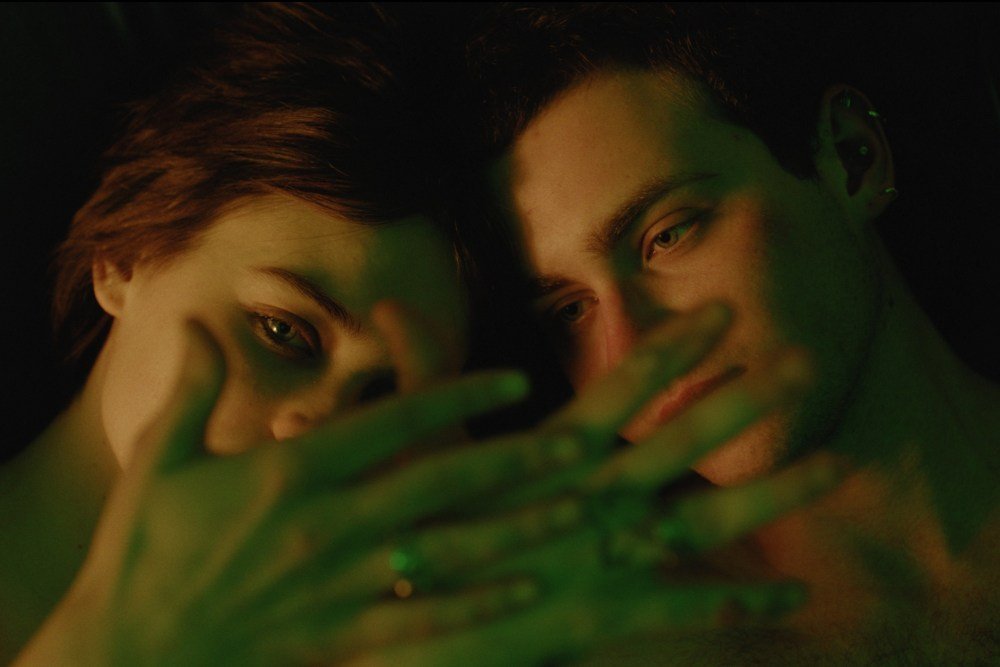
    Russia’s 2022 invasion of Ukraine has prompted a wealth of urgent nonfiction filmmaking documenting the harsh realities of life under siege, but comparatively little dramatic storytelling — a space that the new German-Ukrainian production “I Rarely Wake Up Dreaming” occupies with bold formal imagination and a commitment to illuminating lives neglected in wider views of the conflict. A timely collaboration between German director Isabelle Stever and her wife, Ukrainian screenwriter Anna Melikova, the film is an intimate, bracingly intersectional relationship drama centered on a queer Kyiv couple whose attempts to flee to safety are complicated by local prejudice: a reminder that selective discrimination can still endure within a collectively persecuted population.

    Premiering in the main competition at Locarno, this is a warmer, more humane work than Stever’s last film, the coolly provocative 2022 incest drama “Grand Jeté.” If that film could travel, even securing U.S. distribution with Altered Innocence, there’s no reason to think “I Rarely Wake Up Dreaming” — with its topical subject matter and emotional accessibility, plus the imprimatur of producer Tom Tykwer — won’t gain wider exposure still. Paris-based outfit Outplay Films, which specializes in LGBTQ-themed titles, picked up the film for international sales shortly before its Locarno premiere; queer-oriented distributors and programmers will take particular interest in a work that would stand out for its candid depiction of transgender marriage even without its complicating wartime context.

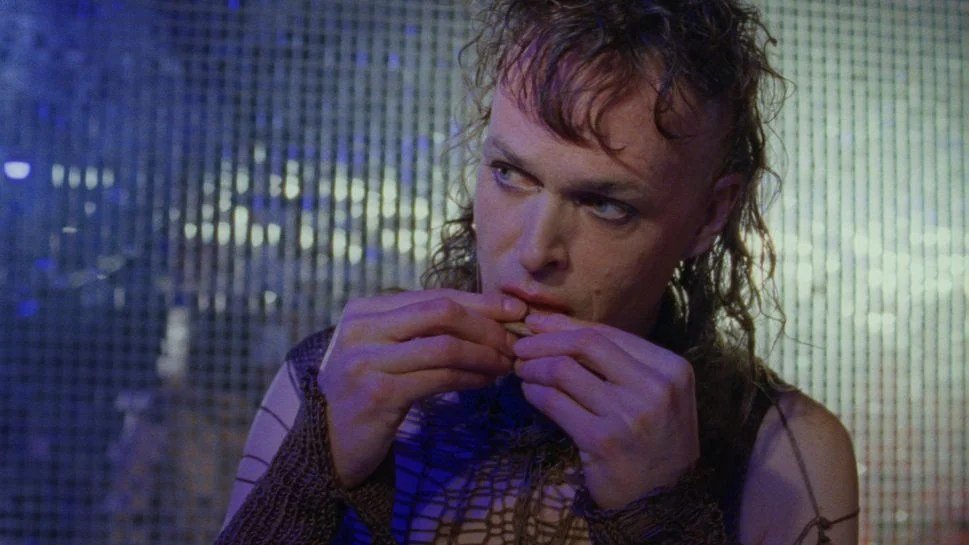
    What Stever’s latest shares with “Grand Jeté” is a crisp aesthetic rigor that some viewers may find distancing despite the immediacy of the drama, though it has ample sensory rewards. The director and DP Volodymyr Usyk (who shot the celebrated 2024 wartime doc “Songs of Slow Burning Earth”) rarely permit us a close, unobstructed view of their principal characters, Olya (Tania Myronyshena) and Oleh (Markus Bright), often shooting them from afar in slivered, reflective surfaces, over another person’s shoulder or through staggered doorways. Actually seeing these lives takes patience and some concentration; in the unforgiving world of the film, many choose not to.

    It opens on a conversation — viewed through a boxy apartment window at night, and later revisited on the other side of the glass — that finds Olya and Oleh’s longtime relationship at breaking point. “I entered a heterosexual relationship against my will,” Olya seethes to her partner. “You promised me you’d stay the same person.” Gradually, their history emerges: They met and got together as women in Kyiv’s small but throbbing queer scene, before Oleh came out as a trans man.

    That hasn’t weakened their bond; indeed, Olya even proposed marriage to him, to the surprise and delight of her conservative suburban family, who take it as given that their new in-law is cisgender. (Children are expected in short order; Olya tends to swerve the subject.) But Oleh’s transition did more or less coincide with the Russian invasion, which has severely hindered his ability to live freely and openly at a time when men are expected to serve their country in the armed forces.

    Medical certification of Oleh’s gender dysphoria cuts little ice with the military, who exercise institutional transphobia while taking him at his word regarding his identity. The couple’s plans to cross the border are thus mired in an absurdist tangle of administrative contradictions, and through the prism of Oleh’s impossible bind — in the eyes of the law, he’s at once recognized and rejected as the man he’s fought to be — Melikova’s script thoughtfully addresses how masculinity is defined and confined in the national psyche.

    Both non-professionals who bring a degree of lived experience to their characterizations, Myronyshena and Bright underplay effectively, communicating through finely expressive gestures and mirrored body language, and bringing an in-the-moment rawness to their frankly intimate, occasionally confrontational dialogue. “I Rarely Wake Up Dreaming” isn’t fashioned as a performance showcase, however: The actors often feel another dynamic element in Stever’s complex mise-en-scène, sometimes tellingly cramped in Usyk’s tight, stylized compositions, or muted in Andreas Hildebrandt’s hauntingly sparse sound design, which is given no score to contend with. There are passages of bravura technique here: One dazzling tracking shot spans the crowded, kinetic turmoil of the border in wartime, flooded with the red and blue lights of state authorities — visually redolent of neon-streaked queer club nights from the couple’s recent past, but a whole life away.

    A third-act development that again redefines the couple’s place in heteronormative society is somewhat rushed, leaning too heavily into melodrama to be wholly convincing. But it’s moving just the same, underlining the filmmakers’ interest in unorthodox found-family structures, and their foregrounding of minorities whose rights are often the first to be disregarded in times of national crisis. As the conflict in Ukraine trudges on, Stever’s stark, surprising film is a reminder that we’ve barely skimmed the surface of the country’s war stories.
  • Satyajit Ray’s ‘Goopy Gyne Bagha Byne’ Making to be Chronicled in Srijit Mukherji’s ‘Maharaja Tomare Selam’

    Satyajit Ray’s ‘Goopy Gyne Bagha Byne’ Making to be Chronicled in Srijit Mukherji’s ‘Maharaja Tomare Selam’

    Indian National Award-winning filmmaker Srijit Mukherji is bringing to screen the making of Satyajit Ray‘s “Goopy Gyne Bagha Byne,” one of Indian cinema’s most celebrated classics, in a new film titled “Maharaja Tomare Selam.”

    Jeetu Kamal, Ritwik Bhowmik, Rudranil Ghosh, Satakshi Nandy, Sairity Banerjee and Arijit Dutta star in the film, produced by Hoichoi Studios and Friends Communication in association with Piyali Films Pvt. Ltd, the original producer of “Goopy Gyne Bagha Byne.”

    “Maharaja Tomare Selam,” which is also the title of a song in “Goopy Gyne Bagha Byne,” centers on Ray himself – the pressures he faced and the choices he made against the backdrop of a politically charged Kolkata – as he willed “Goopy Gyne Bagha Byne” into existence. Principal photography will commence in January 2027.

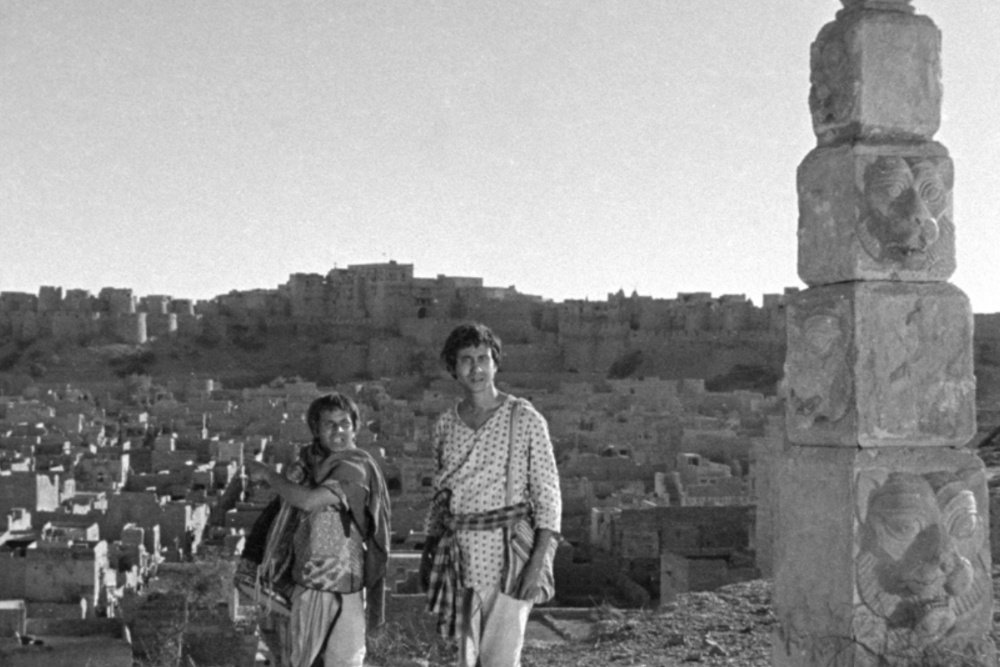
    Released on May 8, 1969, “Goopy Gyne Bagha Byne” followed two inept village musicians, played by Tapen Chatterjee and Rabi Ghosh, who are banished from their homes and granted magical powers by the King of Ghosts, which they use to avert a war between two rival kingdoms. Beneath the fantasy, the film carried social and political undertones around class and the role of art, a thread Ray sharpened into direct satire of authoritarian rule with his 1980 sequel, “Hirak Rajar Deshe.” His son, Sandip Ray, closed out the trilogy with “Goopy Bagha Phire Elo” in 1992.

    Ray built a body of work over more than three decades that includes “Pather Panchali” and “Charulata” among its landmarks. In 1992, weeks before his death, he received an honorary Academy Award for lifetime achievement, becoming the first Indian filmmaker so honored.

    “I am just trying to tell the incredible true story of how one of the greatest classics of Indian cinema, ‘Goopy Gyne Bagha Byne,’ was conceived and made,” Mukherji said.

    Mukherji’s own credits include “Chotushkone,” for which he won the Indian National Film Award for best director, along with “Jaatishwar” and “Baishe Srabon.” He is known for his engagement with Bengali culture and storytelling, and with “Maharaja Tomare Selam,” he takes on a pivotal episode in the country’s film history.

    “Maharaja Tomare Selam” joins a run of Bengali films that have turned the camera on Ray’s own legacy. Anik Dutta’s “Aparajito” dramatized the making of “Pather Panchali,” with Kamal playing a character modeled on Ray, while Kaushik Ganguly’s “Apur Panchali” traced the later life of Subir Banerjee, the child actor who played Apu in that film. Mukherji’s debut feature “Autograph” is an homage to Ray’s “Nayak.”

  • ‘Ketticè’ Review: An Amusing, Original Portrait of Adolescent Ennui Against a Backdrop of Adult Cluelessness

    ‘Ketticè’ Review: An Amusing, Original Portrait of Adolescent Ennui Against a Backdrop of Adult Cluelessness

    Monica Bellucci’s sneer is a thing of wonder, so why have so few directors used it properly? When allowed full rein to her sense of irony, as given her by Giovanni Tortorici in “Ketticè,” Bellucci has few equals in her ability to project self-aware drama queen with just the right dose of camp icon. Hers is a supporting role, as the quasi-caricatured bourgeois mother of a far more authentically drawn teenager, but the young writer-director deliberately sets genuine adolescent nihilism off against the stereotyped adult world, rejuvenating a time-tested formula with the story of an aimless rich kid that feels anything but aimless.

    As proven with his terrific debut “Diciannove,” Tortorici masters the directionless depths of the under-20 set, and while some may protest the shallow depiction of working-class kids as opposed to their better-off peers, few will gainsay his thoroughgoing feel for character and mood as conveyed via camera angles and space.

    The evocative voice of Lebanese singer Oumeima El Khalil accompanies a panoramic view of Palermo, her song’s dissociation from the locale and its simultaneous, unexpected suitability working in ways akin to the soundtracks of Luca Guadagnino, Tortorici’s mentor and producer. It’s 2012, Facebook is as indispensable as an iPhone 5, and Giulio (Salvatore Gallina) is on the verge of failing most of his subjects. In the first of several amusing slow-mo pans, the camera moves from fed-up teacher (Davide Cirri) across to bored witless students, continuing its sluggish progress outside the building and into the carpark, resisting normal speed until Giulio starts the ignition and “You Spin Me Right Round” pours forth from the radio.

    This kind of playful yet expressive use of visual language is what makes “Ketticè” such a fun watch: When Giulio gets in his car right after kissing his girlfriend Elena (Ida Poerio), the camera sits on the floor to make the 16-year-old look like a big man, but after receiving a break-up text, the viewpoint switches to eye-level and returns him to normal teen-size. Not that he’s heartbroken, though the new angle makes it easier to see how he forces out a tear, takes a selfie, and posts it on Facebook.
     
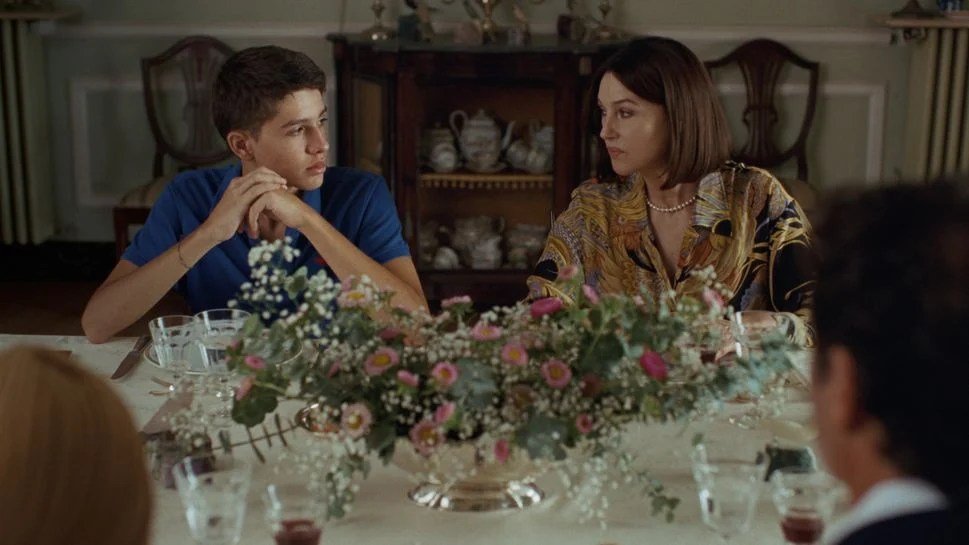
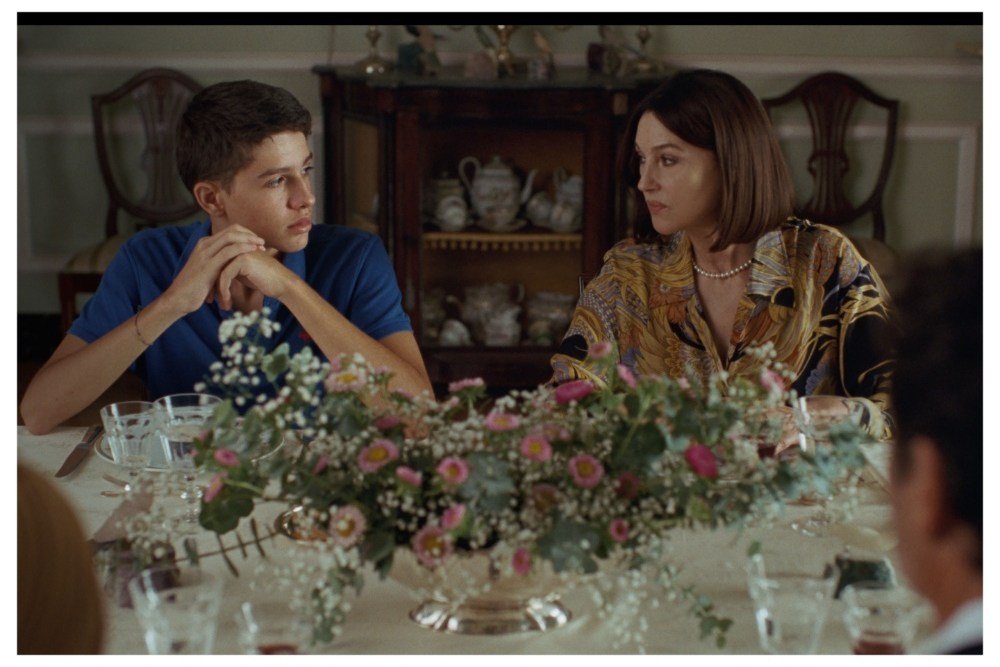
    The only real hardship Giulio faces is figuring out what he wants to do when he grows up. He lives with his parents, Vittoria (Bellucci) and Antonio (Tommaso Cristiano Wirz), in the family’s historic palazzo, and attends a private school where small classes make for tight-knit camaraderie but don’t guarantee that any learning sinks in. Neither do his grandmother’s attempts to impart culture, observed in a hilarious dinner table scene during which Vittoria launches acidic barbs at her impervious mother-in-law (Stefania Raffadali) while passive Antonio lets it all wash over him.
     
    As bored at home as he is in school, Giulio becomes fascinated by Ketty, aka Ketticè (Rachele Testagrossa), a girl from the wrong side of the tracks with a reputation for provoking catfights. Confident, street-smart and far removed from his world of privilege, Ketty knows where to score the best weed in town, and thanks to Giulio’s generous allowance, the two head to Palermo’s Bonagia district where he drops €20 a day buying smokes from a guy dealing in a square presided over by a statue of Padre Pio. It’s hard to say whether Giulio becomes more dependent on the pot or the feeling of very mild danger he gets from hanging out with a girl whose hard-edged reputation is an attention magnet, but either way, everyone’s beginning to notice.

    There’s an obvious contrast between Giulio’s world and Ketty’s. In his circle, where it’s not unusual for a 14-year-old to have their own car, the antics of the lower classes are a spectator sport, shared across Facebook posts and then forgotten. They’re protected by their parents’ money, whereas Ketty has no prospects apart from more bitch-slap fights with girls whose cheap makeup and nail extensions are their most distinguishing features. Whether deliberate or not, scenes with Ketty’s regular crowd have a built-in sniggering element not felt with the private school kids who don’t need to posture or defend themselves. We certainly laugh with Vittoria’s exasperated outbursts, but Bellucci’s deliciously ironic flamboyance means we don’t laugh at her in the way we do when Ketty’s hard-ass rivals seek revenge.

    All too often when directors seek to get inside an adolescent’s world, the results unintentionally highlight the psychological distance between filmmaker and subject, but both here and in “Diciannove,” Tortorici understands that endless ennui isn’t the same thing as permanent emptiness, and angst isn’t the most interesting thing about a teen. Clearly he listens: to his actors (many of whom are first-timers), to younger generations around him, to the honest memories of his own youth. “Ketticè” shows how he’s also confidently playing more with the grammar of cinema, putting it to use according to character and mood, and in so doing solidifying the promise of his debut.
      

  • ‘Asphalt Guerrilla’ Blends Fact, Fiction, AI and a Story About Filmmaking to Hold Up a Mirror to Our Time

    ‘Asphalt Guerrilla’ Blends Fact, Fiction, AI and a Story About Filmmaking to Hold Up a Mirror to Our Time

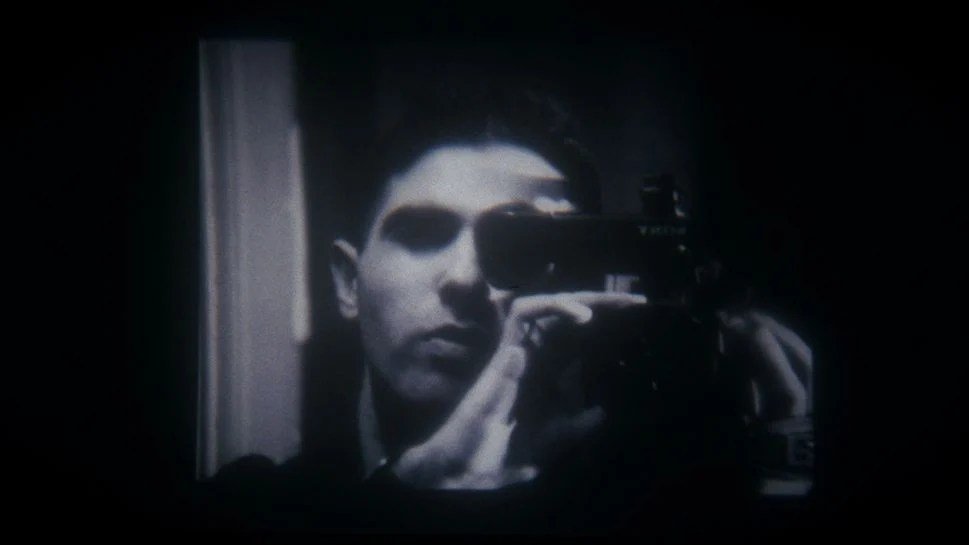
    Real history, fiction and AI blend together for a look at a former radical far-left underground armed organization in Portugal in the new film from auteur Edgar Pêra (Telepathic Letters, Manual of Evasion LX94), Asphalt Guerrilla (Guerrilha no Asfalto). The movie marks the Portuguese writer-director’s return to the Locarno Film Festival in Switzerland, where it will world premiere in the Out of Competition program during its 79th edition on Monday, Aug. 10.

    The militant group that the film revisits is the FP-25, short for Forças Populares 25 de Abril, or Popular Forces 25th of April, which was active between 1980 and 1987. It carried out dozens of bombings, shootings and bank robberies. The film is based on the eponymous book by Manuel Ricardo de Sousa, a member who ended up being lynched by a mob in the aftermath of a bank robbery.

    But there is also a meta level to the movie. “It’s also about trying to make a film that ought to be shot in a guerrilla mode, with no compromises with the system,” notes the Locarno website.

    A synopsis teases the mind-bending quality of the movie by describing it as “a fictional film rooted in reality about a utopian time in Portuguese democracy.” And it continues: “Set in the early ’80s, it begins with a quiet student who becomes involved in a radical organization and ends up being shot and lynched by the mob in the aftermath of a bank robbery. Throughout the film, we witness the sometimes comical, sometimes tragic problems of these ‘asphalt guerrillas’ fighting against the system; at the same time, the director of the film quits the organization in order to fight to make films in a guerrilla mode.”

    ‘Asphalt Guerrilla,’ courtesy of Bando à Parte

    Pêra wrote the screenplay with Rodrigo Areias, and the voices of Pêra and Albano Jerónimo feature in Asphalt Guerrilla. Jorge Quintela is the cinematographer, while João Mora is the editor. The cast features Miguel Moreira, Maria Leite, Ivo Arroja, Jerónimo, Bernardo Santo Tirso and Luke Eberl.

    Pêra talked to THR about Asphalt Guerrilla, what inspired it and what it says about his latest take on the use of AI in filmmaking.

    “There are many films in this film,” Pêra highlights. “The very beginning was this book, which I read in the ’90s and basically shows a very amateurish group of guerrilla men or terrorists, depending on your point of view, but it gradually transforms into a film about my own guerrilla [film] scene, mainly because my friend and producer Rodrigo Areias made me do it.”

    Indeed, Pêra started making an underground name for himself in the mid-1980s with his avant-garde style as a “neuro-punk” filmmaker associated with DIY counterculture and the Portuguese music scene.

    “I would never pitch a film about me, including an autobiography, but I really understood that Rodrigo proposed it,” he tells THR. “I told him that I wanted the film to be about the future, not about the past, not about the ’80s and the problems we had back then in Portugal, but about this society and the state of cinema.”

    If you are watching the film and can’t quite tell which parts are real and which ones are fictional, Pêra won’t mind. “This fusion, or blur, of fiction and reality is something that I like, but it’s also something that I must fight against,” he explains. “So the film is also a mirror of what’s happening, where you sometimes don’t really know what’s real.”

    ‘Asphalt Guerrilla,’ courtesy of Bando à Parte

    Does he really feel like a film guerilla? “Actually, when I was in my 30s, there was this producer who called me the Sniper,” Pêra tells THR. “I think he said that with respect. I think I have that respect from other filmmakers of my country because I never tried to do anything that was not myself.”

    As the filmmaker did in his 2024 Locarno film Telepathic Letters (Cartas Telepáticas), Asphalt Guerrilla uses AI images. “I always try to leave some clues for what is AI-made,” he highlights. “But there are moments where, to show the danger of AI, you have to behave like a dangerous AI, which is why this film has moments [referencing] what worries me most, news becoming fabricated. And actually, the worst part is that AI also gets the most fun part of creating, such as [people] asking AI to write prompts.” Concludes Pêra: “So I try to fight all of that and create my own prompts and create my own algorithm. If you leave things to the YouTube algorithm, you know what you get.”

    Added the auteur: “You have to make at least a playlist so that you’re not invaded by this ultra commercial thing. That’s my fight inside of AI to create some images that are original in the way that they are recombinations of things that already exist. That’s what every artist does.”

    How does that fit into Pêra’s early neuro-punk days? “I was always interested in the effects of cinema on the minds of people and how the mind works,” he tells THR. “Neuro-punk was meant to say that we have to fight things with ideas, not with violence. So, cameras are weapons. Make films, not violence.”

    ‘Asphalt Guerrilla,’ courtesy of Bando à Parte

    The auteur didn’t necessarily know how timely his film would feel in a time full of wars, a rise in political and other radicalism and, of course, AI when he first started conceiving it. “I think it’s not a coincidence. It’s a synchronicity,” he offers. “But even when we think times are okay, we have lots of things that worry us. Now, we are in the worst of times, as they say. But even in the best of times, there’s still exploitation, people dying and all that. So yes, I think it’s a timely moment to go to the roots of the problems and not only focus on radicalism. I think radicalism is a symptom; it’s not the problem.”

    He sees the underlying issue this way: “Radicalism is a symptom of the decay of our system. I’m not an expert, but I feel that it’s not the radicalist we have to fight because that means [we are] becoming another radical. So that’s a trap. Instead, let’s talk about what makes our planet worse.”

    Pêra is working on another movie, which will keep speaking out about worries he has. It’s called The Spiral of Fear, and it’s about “big tech and what media says about the masters and all that.”

  • No, Brian Eno Is Not Behind the Film Soundtrack for ‘At Night.’ Experimental Musician Elvin Brandhi Is.

    No, Brian Eno Is Not Behind the Film Soundtrack for ‘At Night.’ Experimental Musician Elvin Brandhi Is.

    In At Night, British filmmaker and artist Beatrice Gibson’s first feature-length film, the nightly sights and sounds of Paris interweave with the stories and conversations of six women – from hopes, dreams and sexual desires to worries about the future.

    Rhythm and mood are key elements that make the experimental and “autofictional” movie, which world-premieres on Saturday, Aug. 8, in the Filmmakers of the Present competition program of the 79th edition of the Locarno Film Festival, a special kind of cinematic ride. Just ask Locarno’s artistic director, Giona A. Nazzaro. In a chat with THR, he described the movie as “this nocturnal, ambient film where you can almost hear music that makes you think of Brian Eno. If At Night were a record, it could be music for lonely people at night.”

    Written and directed by Gibson, At Night features cinematography by her long-time collaborator Ben Rivers and editing by Liyo Gong. But the music doesn’t come courtesy of Brian Eno. No, it is the creation of Elvin Brandhi.

    If you don’t follow experimental music, here are some basics to know about her. Elvin Brandhi is the pseudonym of Freya Edmondes, an improvising voice and sound artist who was born in Wales, but has become a citizen of the world. Her music features unusual beats created from field recordings, her own voice, tape, vinyl and instruments. She is also part of all sorts of music collaborations, including father/daughter “noise-improv berserkers” Yeah You, Pollution Opera with Nadah El Shazly, the duo Avril Spleen with Joseph Jadam, the band PFL with Peter Kutin and Lukas König, and the project Bahk with Daniel Blumberg.

    At Night, which features an array of Gibson’s non-professional actor friends and influences as they discuss and explore such topics as sexuality, money, motherhood and mental health, is the musical artist’s first-ever feature film soundtrack. And it seems fitting that she collaborated with Gibson on this film that press notes call “a love letter to friendships, relationships, and the quiet yet poignant stories women share together but rarely to an audience.”

    Brandhi took time out of her busy schedule to talk to THR about the creation of the soundtrack for At Night, her other music work and whether we may be able to hear more from her on future cinematic journeys.

    The artist confirms that the work on At Night marks a new step for her. “It’s the first time I’ve done a soundtrack for a feature film,” she tells THR. “I did a couple of short films with friends, and I make my own music video-type thing. So I consider myself more of an audiovisual artist. I think in both realms, but this was obviously very different. I’ve worked with Daniel Blumberg a little bit, hanging out with him a lot in the process of The Brutalist and then the Anne Lee film, [The Testament of Ann Lee]. I was doing quite a lot of vocal stuff, also with [avant-garde improvisational vocalists] Phil Minton and Maggie Nicols. And Daniel has been creating this nice bridge between the experimental scene in London and Hollywood cinema.” 

    ‘At Night,’ courtesy of Night Films

    Courtesy of Night Films Ltd.

    So, this must be a good time for Brandhi to get her first feature film soundtrack under her belt, you may wonder. “It was probably helpful for me to get involved in the experience of how to make a soundtrack,” she confirms, but notes that it required a different focus from her usual work. “It was quite a unique experience, and I had to adjust a little bit how I think about composing. A lot of my music is quite in your face and trying to be as present as possible. But with a soundtrack, you have to almost make it sneak in from the sides, or be somehow invisible, coming out of the background.” 

    Given that Brandhi works a lot with field recordings, how did the Paris setting of At Night play to her passions? “What was really nice about this film was that the metro is such a big center of the narrative, and that’s already quite a noisy place,” she tells THR. “It has a lot of the kind of frequencies and ambient noise and things that I might feel like field recording and be inspired by anyway. So it was this perfect entry point for coming into that film world.”

    Gibson and Brandhi have all sorts of connections but made their acquaintance by coincidence. “I met Beatrice for the first time at [the experimental music festival] Borealis [in Bergen, Norway], but only very briefly,” the music artist recalls. “We were in the same taxi going somewhere, and I was playing, and she was screening something. I think she knew of my music, and then a common friend, Leonardo Ruvolo, from Alcamo in Sicily, put us in contact because I also did his residency, and she’s living in Palermo [in Sicily] now, so there were various coincidences.”

    And the women quickly got along. “When we started working together, we became very good friends immediately,” Brandhi shares. “And working on At Night was a very intimate and special process.”

    But what was this process like, and how early did Brandhi start crafting music for the film? “Beatrice wanted to have as much sound as possible before even starting to shoot. So I did get sent a first draft of the script, but that did get changed as the film went through different shifts,” she recalls. “We spent a week going through ideas before any shoot. I sent her some drafts of things that might work. And she had one reference of a song that she really liked, which was actually from a collaboration I have that is called Insin [with Palestinian producer/MC Bashar Suleiman]. The track is called ‘Kidney Spears,’ which is a little bit more dreamy. I’m also singing in that. So I tried to send her other things within that kind of dynamic.”

    When Gibson started shooting in Paris, Brandhi also came to the French capital. “I was taking some recordings when they were going into the metro,” the musician tells THR. “And there was originally even a scene of me performing in Paris in the film.”

    ‘At Night,’ courtesy of Night Films

    Courtesy of Night Films Ltd.

    All in all, the soundtrack came together in an ongoing collaboration. “There were some core themes that we developed, and then little bits that needed a very specific kind of mood or dynamic,” she says. The collaboration also included editor Liyo Gong. “She is really amazing,” says Brandhi. “She’s also a DJ, so she has a very strong sense of the musicality in film and in how she edits.”

    Crystabel Riley also contributed, drum sounds, to the soundtrack. “I asked her if she would contribute some drumming that I could weave into different parts of it,” Brandhi recalls. “She was actually involved in the film, doing some of the makeup, because she’s a makeup artist as well as a musician.”

    Fans of the artist’s work may get to hear more from her in feature movies in the future. “I definitely would like to,” Brandhi tells THR. “I would be really up for it; it was really interesting entering the story and composing from a different perspective.” She adds: “I saw her playing live for the first time last year, and I was just so blown away because she’s such an incredible performer, and her stage energy is so engaging. There’s this warmth and tension as well. It feels very urgent. I was just watching her and felt the state of mind of the women in the film echoing in her performance.”

    Concludes Brandhi: “It was really special for me and Bea that she was part of it.”

    The creative mentions that she has also worked with video herself, and being involved with At Night inspired her to return to more of it. “In the lockdown, I did a lot more filming and editing stuff, so I feel that this soundtrack world is also a nice potential way to get back into the editing of my own film material,” she shares.

    Not that Brandhi doesn’t have all sorts of music stuff in the works. Including an album with Berlin-based Kenyan musician KMRU under their name A|||oy, which will be released on KMRU’s label offnot. “He is associated a bit more with ambient music. But we have so much in common and are both fans of each other’s music, even though it might seem like we have quite contrasting dynamics,” she tells THR. “There’s a strong similarity in the way we work with field recordings and sounds, textures and spaces.” Concludes Brandhi: “We’ve been collaborating for three years now, and we have an album coming out that we made between a couple of residencies, one at [Swedish electroacoustic music and sound art center] EMS in Stockholm, and then one in [Max Richter and his partner Yulia Mahr’s] Richter Mahr studio in Oxfordshire. We just listened to the test pressing, and it was really exciting. We’re both singing, and it’s completely different from both of our works.”

  • Monica Bellucci Plays a Mother Who Yells and Is the “Victim of a Social Role” in Luca Guadagnino-Produced ‘Ketticè’

    Monica Bellucci Plays a Mother Who Yells and Is the “Victim of a Social Role” in Luca Guadagnino-Produced ‘Ketticè’

    An Italian film, whose cast features Monica Bellucci and whose list of producers includes Luca Guadagnino, took the spotlight at the 79th edition of the Locarno Film Festival on Saturday. Its title: Ketticè.

    The coming-of-age drama is the sophomore feature of former Guadagnino assistant Giovanni Tortorici (Diciannove), who wrote and directed it, and stars Salvatore Gallina and Rachele Testagrossa.

    Set in Palermo, Sicily, in 2012, the era of media mogul-turned-populist politician Silvio Berlusconi, the movie revolves around Giulio, a listless and dissatisfied 16-year-old who drifts through his days without any enthusiasm for school and no real future prospects. “His encounter with Ketty, a more self-assured peer, offers him an escape from the monotony,” reads a synopsis. “The two form an exclusive friendship, a shared refuge in their search for freedom, far from the judgmental gaze of the adult world.”

    With cinematography by Camilla Cattabriga and editing by Marco Costa, the film has been boarded by PiperPlay to handle international sales.

    The film’s title refers to Ketty’s nickname in the Sicilian dialect. Bellucci plays Giulio’s mother in an aristocratic Sicilian family that leaves her feeling oppressed.

    During a press conference with the three stars and Tortorici, Bellucci shared about her character: “It was interesting to play a different role because this wife and mother tells us about the frustration behind the entire perfection of society. … She is the victim of a social role [she must play]. So she tries to counterbalance this frustration by eating up snacks. There [is a] scene where she’s sleeping in front of the TV, and she has plenty of snacks.”

    The star also addressed how body and voice are key to her role. “This is a woman who forgot about her femininity. She doesn’t take care of herself,” Bellucci explained. “And when she talks, she yells.”

    That keeps the relationship with her son on the edge throughout much of the movie. “She creates this constant tension with her son,” Bellucci offered. “There is a mutual humiliation that [shows] a true impossibility of exchange between generations. You see a generation of adults who can no longer understand the youth. And we are talking about 2012. Imagine how it is now!”

    Tortorici was asked about a scene in which a girl expresses admiration for former Italian fascist dictator Benito Mussolini. “I remember I had a girlfriend who would say such things,” the writer-director explained. “So I think this would represent a youth culture, which is a bit absurd. I mean, the girl I knew was refined and educated, and then she would admire Mussolini. It’s a reference to my own biography, but I think it was very symptomatic and significant, and it was representing that age of Berlusconi.”

    Bellucci lauded the director and the young stars of Ketticè who were discovery via an extensive street casting process. “It’s been a wonderful experience being on this set,” she shared. “Giovanni Tortorici is a young director who knows exactly what he wants, and he’s very self-confident, determined, and he made a very personal and really unique film. … This film confirms his talent as an auteur. And these two teenagers are fantastic. They’re awesome. They are so natural and so spontaneous.”

  • Stanley Tucci on Why His Emmy-Nominated ‘Tucci In Italy’ Is Moving to the United Kingdom Next Season

    Stanley Tucci on Why His Emmy-Nominated ‘Tucci In Italy’ Is Moving to the United Kingdom Next Season

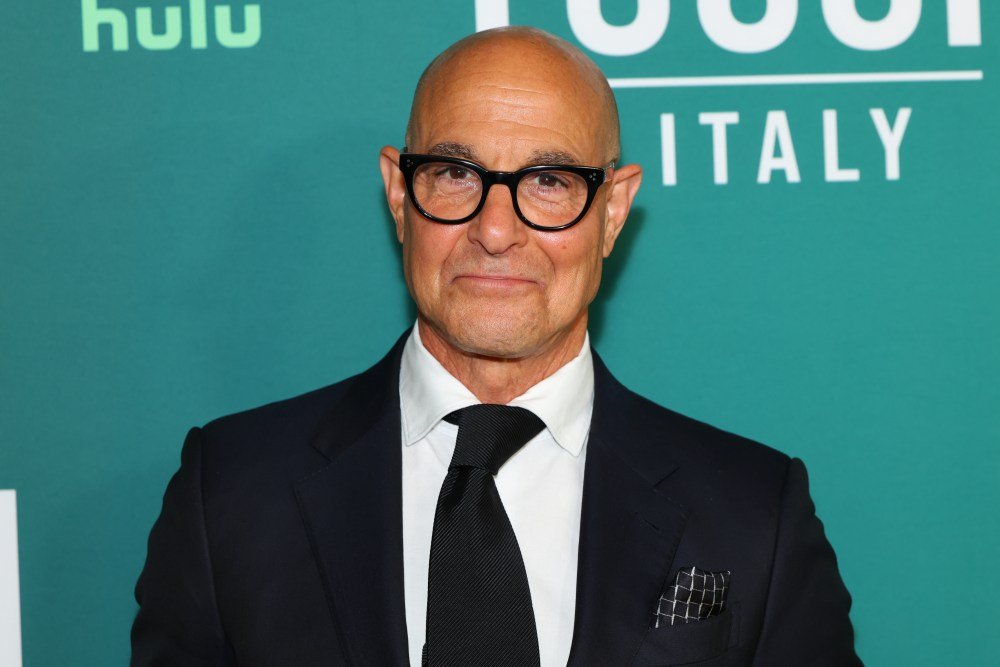
    Italy remains Stanley Tucci‘s first love. But a man can travel, right? After winning three Emmys for CNN’s “Stanley Tucci: Searching for Italy,” followed by two nominations (including this year) for Nat Geo’s “Tucci in Italy,” the star is on the move. Tucci tells Variety‘s Awards Circuit Podcast that he’s currently filming his new season in the United Kingdom, where he lives full time.

    “I wanted to do the U.K. because I just feel like there’s so much here,” he says. “I’ve been here for almost 15 years now, and London was just voted the best food destination in the world. But I’m not just talking about fancy restaurants and all that. I’m talking about the U.K. as a whole. I think that the produce that’s here — the seafood that’s here, the meat that’s here, the devoted people like these fishermen or lobstermen, or a guy who raises pigs that will be like the best pork you’ll ever eat — that kind of stuff is amazing. And then, really amazing chefs that are devoted to farm to table or farm to fork, I guess is the new expression.”

    Having now done travel shows for a while, Tucci says he considers it “a great honor to meet so many of these people, because they’re just extraordinary. Their devotion to what they do. Amazing chefs and home cooks alike, farmers, cheese makers. I mean, their whole life is invested into this one thing. This singular focus is really so impressive to me.”

    Tucci is once again nominated as executive producer and host of “Tucci in Italy,” nominated for outstanding hosted nonfiction series or special. He talks to the Awards Circuit Podcast about what it was like to become a host, the skills he has developed in interviewing everyday people, and whether he’s OK with us calling him “The Tooch.” He also takes our 10 Questions quiz, and looks back at his first time in the pages of Variety.

    But first, on the Roundtable, Gold Derby editor-in-chief Debra Birnbaum joins us to give her takes on the Emmy race, including how “Widow’s Bay” has become the comedy front-runner. Listen below!

    “Tucci in Italy” comes at an interesting time for Tucci, who remains busy in front of the camera as well — including this year’s “The Devil Wears Prada 2.” “I’m really happy about having a lot to do, and yet at the same time, at the age of almost 66, I think, ‘how long can I do this?’” he says. “There’s a part of me that wants to spend more time at home, and so I’m trying to orchestrate things so that I can do that without compromising my career. Because there are still things I want to do, stories I want to tell, movies I want to make, plays I want to direct. It’s finding that correct balance.”

    Hosting a travel show didn’t seem like part of the plan, but Tucci notes that he first came up with the idea of traveling through Italy and breaking it down by region about 20 years ago.

    “I’d never seen a show like that,” he says. “I brought it up to a few people, and everyone looked at me like I was crazy. And then six or seven years ago, CNN came to me and said, ‘Do you have any ideas for a show?’ And I did. I had two other ideas: One was about refugees and food, and the other was about cancer, finding a balance between standard of care and alternative treatments. No one seemed very keen on either of those. So, and then I said, ‘Oh, I want to go through Italy and break it down region by region.’ And they went, ‘OK!’”

    So here’s the big question: What’s the most underrated region of Italy that we should check out? “I think Le Marche is a really beautiful region, which is right next to Tuscany. I shouldn’t even be saying this because I know that people will go to it. But it’s a really beautiful region, and it’s not packed with a huge number of tourists. The seaside is really pretty. The food is absolutely wonderful, and it’s not crazy expensive. But it’s gorgeous.”

    As for hosting, Tucci says there was a learning curve at first. “I was very nervous when I first did it. I thought, ‘What am I doing? I don’t know how to do this.’ I know how to memorize lines, or I know how to improvise, but with an actor, not with a normal person. But now I’m much better at it, and I feel more comfortable.”

    The secret, he says, is to listen. “If you’re not listening in the scene and responding truthfully, it’s not going to work,” he says.

    For Tucci’s first time in Variety, it was Oct. 6, 1982, in a review of Broadway’s “The Queen and the Rebels.” Tucci was listed as one of the travelers/soldiers, alongside his pal Campbell Scott.

    “I had just graduated from college,” he says. “I felt very lucky. I grew up with Campbell, and his mom was doing the play, and she cast us. He had one more year of university to do, I think. We were doing the play in the summer, so it was amazing for me. I understudied a role, and we were cast as extras for all practical purposes, and it was great because it got me my equity card and health insurance. That made a big difference. I was paid $550 a week, and I was in heaven. I thought this is the greatest thing ever. I got an agent, so I had all those things right out of college, SUNY Purchase. That’s a huge thing for an actor starting their career.”

    10 QUESTIONS WITH STANLEY TUCCI:

    1. Childhood nickname: “Tooch.”

    2. Something you loved as a kid but can’t believe you were into it now: “Velveeta.”

    3. Go-to karaoke or sing-in-the-shower song: “You don’t want to hear me sing. If you’ll notice in those reviews you spoke of, there’s not a single musical in them, and in a 40-45 year long career, and there’s not a musical. But I sing in the shower, thinking I’m brilliant. Something like ‘Our Love is Here to Stay,’ which is a song that I always sang to my kids when they go to sleep.”

    4. Give me an alternate title for your show: “Oh God, you don’t know how long it took us to come up with the simplest title in the book. ‘Tucci Eats Italy’? Just bad.”

    5. What’s your secret talent?: “I would say drawing and painting.”

    6. Favorite ice cream flavor: “I don’t really eat ice cream. If I had to say, it would be chocolate. It’s so boring. I’m so sorry.”

    7. The one item you couldn’t live without: “A knife that I have. That sounds scary, doesn’t it? But no, it’s a chef’s knife.”

    8. What TV show in all of history do you wish you were a cast member of?: “Wild Wild West.”

    9. Fictional character you most admire: “I really loved doing ‘Captain America.’ I did it like 15,16, years ago, and it was one of the best work experiences I’ve ever had. And I absolutely loved playing that role, even though when I was sent the script, it said, ‘German scientist in his 70s,’ and I was 50. I was like, ‘Oh man, come on!’ But it was so well written, and I just loved it. I just watched it again with my kids the other day.”

    10. Your favorite piece of advice: “My acting teacher George Morrison, who passed away a number of years ago, said, ‘go beyond what’s comfortable.’ And the second one is that ‘the undoing of something is as important as the doing of it.’ That was from my father who told me that. And Alberto Giacometti.”

    Variety’s “Awards Circuit” podcast, hosted by Clayton Davis, Jazz Tangcay, Emily Longeretta and Michael Schneider, who also produces, is your one-stop source for lively conversations about the best in film and television. Each episode, “Awards Circuit” features interviews with top film and TV talent and creatives, discussions and debates about awards races and industry headlines, and much more. Subscribe via Apple Podcasts, Stitcher, Spotify or anywhere you download podcasts.

  • Dwayne Johnson Addresses ‘Moana’ Mixed Reviews After Film Underperformed at Box Office

    Dwayne Johnson Addresses ‘Moana’ Mixed Reviews After Film Underperformed at Box Office

    Dwayne Johnson is speaking out on Disney‘s live-action Moana not exactly being a hit with critics.

    Johnson, who voiced Maui in the original 2016 animated film Moana and its 2024 follow-up, recently spoke to People magazine about how the movie’s early reviews started positively before the reception shifted.

    “Our first two reviews came out. I’ll never forget it… They were amazing. I was like, wow,” the actor recalled, before adding that then “it went another way — as sometimes happens. That’s just the way it goes because we’re in this business.”

    The Hollywood Reporter’s chief film critic, David Rooney, did, however, give the film a favorable review, calling it “one of Disney’s better live-action remakes.” He added, “The new Moana is a captivating family entertainment that deserves to find an audience.”

    The live-action Moana, released in theaters last month, earned a 31 percent critics score on Rotten Tomatoes, while its audience score was significantly higher at 88 percent.

    The Smashing Machine star added that he and his wife, Lauren Hashian, had many conversations about the response. “The challenge was, OK, let’s remember, though, what’s going to be beyond this opening weekend. Let’s remember what’s happening right now and the noise that’s happening right now,” he said.

    “If you love it, great. If you don’t, no problem,” the Jumanji actor said. But what meant the most to him was that “the culture really stood up,” as Johnson is of Samoan heritage.

    “Because of me and our kids who can now look at the big screen and go, ‘That’s us for the first time on a big screen. That’s us up there. How cool is that?’,” he said.

    Catherine Laga’aia starred in the title role, taking over from Auliʻi Cravalho, who voiced the character in the animated films. Johnson reprised his role as Maui in the live-action adaptation.

    The film, though, didn’t make waves at the box office, grossing $264 million worldwide against a reported $250 million production budget. 

  • Behind the Scenes of Obama’s Acting Cameo in ‘Life, Larry’: Blaming Larry David for His Tan Suit Debacle, Improvising Lines and Ranting About Ketchup

    Behind the Scenes of Obama’s Acting Cameo in ‘Life, Larry’: Blaming Larry David for His Tan Suit Debacle, Improvising Lines and Ranting About Ketchup

    In his HBO sketch series “Life, Larry and the Pursuit of Unhappiness,” Larry David travels throughout history, inserting his stubborn and curmudgeonly self into America’s most pivotal moments. “Lawrence,” as he’s often called, fights in the trenches of World War I, heckles George Washington during his Farewell Address and defends Rosa Parks on a Montgomery bus (for all the wrong reasons, of course).

    The show is produced by Barack Obama through his and Michelle Obama’s Higher Ground banner. So it’s only right that, in the series finale, Obama stepped in to reexamine the most historically important moment in his presidency. Not the killing of Osama bin Laden, the Iran Nuclear Deal or the legalization of same-sex marriage. No, something far more momentous and presidency-defining: the time he ignited a media firestorm by wearing a tan-colored suit to a 2014 press conference about ISIS. (The sartorial choice, which has its own Wikipedia page, saw Obama lambasted as “unpresidential,” was criticized by news outlets ranging from the New York Times to GQ to Fox News.)

    Obama appeared in the first episode of “Life, Larry” to help introduce the show. But when David and co-creator Jeff Schaffer told the former president they wanted him to act in a sketch, he and Higher Ground executive producer Ethan Lewis came up with the idea to relitigate the tan suit debacle. “From the very beginning, my dream was to close the book on the tan suit once and for all,” Lewis says.

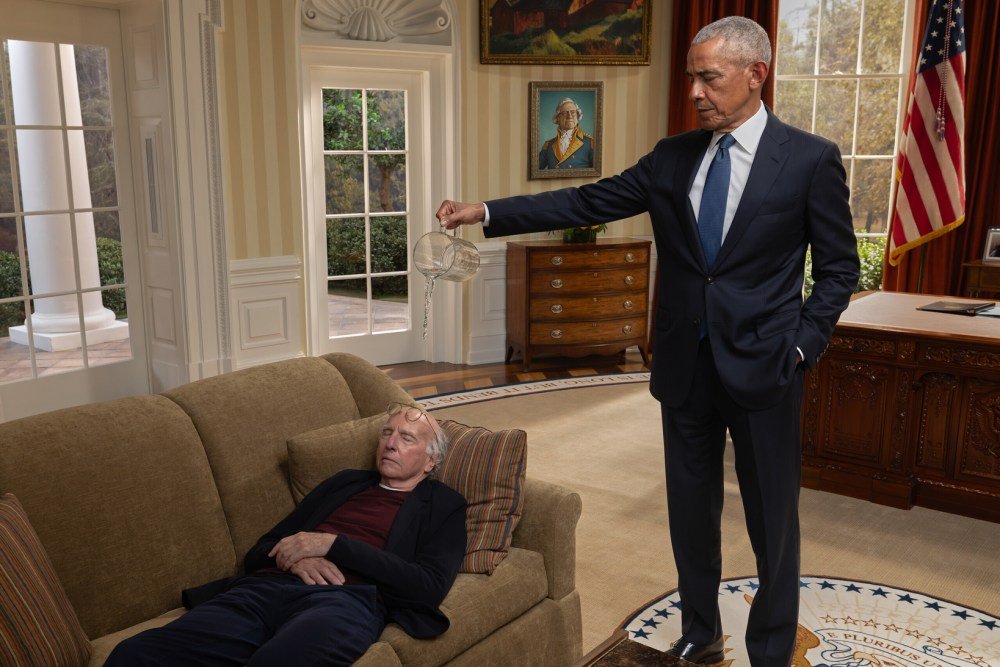
    Schaffer and David then devised a “Curb Your Enthusiasm”-like revisionist history in which David (appearing to play himself) is the one to blame for the fashion crime. In the sketch, Obama is preparing for the press conference while a mango smoothie sits on the Resolute Desk. When David asks for a sip, Obama turns him down to avoid “old lips” on his straw. When the president finally leaves the Oval Office, David goes to steal a sip of the smoothie, and he ends up spilling it all over the navy blue suit Obama planned to wear. When POTUS returns, David frantically tries to divert his attention away from the mess. “I think you should wear the tan suit to the press conference,” he says, insisting it’s “casual Friday.”

    Obama obliges, and tries on the lighter suit, causing David to deliver his classic, “prettay good… prettay… prettay… prettay… prettay good.” He assures Obama, “People are going to be talking about this for a long, long time.”

    Art Streiber / HBO

    Schaffer tells Variety that directing Obama was “one of the coolest things I’ve ever gotten the chance to do.” “It’s so cool being around him. You feel smarter and better, somehow, by just being in the area,” Schaffer says. “He had some great improv stuff. His comic timing was impeccable. He was a good actor, not just as a former president, but, like, as an actor.”

    Schaffer, who has worked with David since the “Seinfeld” days, was amused by watching Obama give the septuagenarian comedian notes. “The funny thing was watching him go, ‘Larry, you’re coming in late!’ He was the president, so he’s used to telling people what to do. Larry was in the odd position of being told what to do, which never happens on a Larry set.”

    The most nerve-wracking part of directing a former president?

    “The first thing was: What do I call this man?” Schaffer says. “I’m directing and things are moving fast, and I have to remember, ‘Sir, let’s do that one more time.’ Or, ‘Hold on, Mr. President.’ I didn’t want to screw things up and go, ‘Hey, Barack.’”

    The Oval Office stage was crafted by the Obamas’ interior designer Michael S. Smith, who led the 2010 makeover of the real White House room. Smith perfected the layout and furniture of the space, so much so that when Obama walked in, he said, “This is unbelievable. It looks just like it was when I was here,” Schaffer remembers. The attention to detail extended even to Obama’s on-screen aide, played by his real-life Director of Oval Office Operations Brian Mosteller.

    According to Schaffer, just as surreal as directing the former president was chatting with him during the downtime of the four-hour shoot. “You’re just sitting in the Oval Office with President Obama, hearing him talk about stuff,” he says. “He’s got some funny theories.” He relays one of Obama’s most memorable takes: “No one should be using ketchup after age 12. That’s a child’s condiment. It’s just sugar. Use mustard! Use an adult condiment!”

    Lewis, who joined Higher Ground in 2022 and serves as its head of non-fiction and sports, concurs: “The banter was phenomenal. Being a fly on the wall in that room was incredible.”

    Despite Schaffer’s praise of his acting chops, Lewis doesn’t think the ex-POTUS will be rushing to add more credits to his IMDb page. “President Obama doesn’t have a great desire to make that career pivot, but it was very fun [to watch him act] and I’m glad it worked out for the show,” Lewis says.

    “Life, Larry and the Pursuit of Unhappiness” was billed as a seven-episode limited series celebrating the 250th anniversary of America. Still, Lewis and Schaffer would love to extend the show. “I think it’s done well, and we all have a lot of fun making it,” Lewis says. “Ultimately, that’ll land at the feet of Larry and HBO to keep going, but I’d love to do it.”

    Though, for Obama’s own good, perhaps he should spend some time away from David. “The president said, ‘I have fun being annoyed by Larry, and when we get together, I realize I start sounding like him,’” Schaffer says. “Larry is sucking him into his black hole of negativity.”

  • Spencer Pratt Joins the Chat on the Federal Film and Television Tax Incentive

    Spencer Pratt Joins the Chat on the Federal Film and Television Tax Incentive

    The federal film and television tax credit has a new lobbyist, it seems.

    Reality TV star and former L.A. mayoral candidate Spencer Pratt on Friday posted on social media that he had recently met President Donald Trump to advocate for the tax incentive. This legislative effort has been stop-and-start for well over a year.

    “Working with the President on a 25% FEDERAL film tax credit to bring back Hollywood,” the former The Hills star said, sharing images of himself and the president speaking at the Trump National Golf Course Los Angeles. After making a few accusations about California’s film commissioner and Attorney General Rob Bonta, he added, “The adults in the room are actually trying to repatriate the most quintessential American industry. I’m committed to saving Hollywood, and I’m very grateful for the President’s remarkable generosity and focus on this issue.”

    The Hollywood Reporter has reached out to the White House for comment. A representative for Pratt declined to comment further.

    A large coalition of industry advocates and organizations, from the Motion Picture Association to industry unions to President Trump’s “special ambassador” to Hollywood Jon Voight, has long been championing the idea of a stackable incentive for films and TV series produced in the U.S. Several sources in this cohort reached on Friday said they didn’t believe Pratt was working in coalition with the larger group.

    The idea has bipartisan support, as THR previously wrote, with Rep. Laura Friedman of California and Rep. Brian Jack of Georgia emerging as key backers of the potential legislation in the House. Sen. Adam Schiff has long been a proponent in the Senate. It’s unclear, however, whether Pratt is advocating for the same kind of credit as they are.

    After becoming an outspoken critic of politicians’ responses to the 2025 Palisades Fire, Pratt ran for L.A. mayor earlier in the year on a populist platform, gaining the support of President Trump along the way. After his defeat, Pratt has emerged as a vocal detractor of a lawsuit from 12 state attorneys general aiming to block the $111 billion Paramount-Warner Bros. Discovery merger.

    He has claimed that California Gov. Gavin Newsom and attorney general Bonta are attempting to “cripple two of the greatest film studios of all time over politics.” (Newsom has not weighed in on the suit publicly yet, though a Wall Street Journal report in early August suggested he was concerned about the impact on state employment if the merger were blocked.)

    Now, it appears, the TV personality has turned his attention to legislative efforts to boost the entertainment industry. Said Pratt in his social media post, “He [Trump] is very passionate about revitalizing the entertainment industry and we will not let Canada, or the U.K. or Budapest steal our lunch anymore.”

    Pratt’s advocacy for a federal tax credit arrives after Paramount Skydance head David Ellison made headlines for traveling to Washington to lobby Republicans on the idea.

    Can the involvement of Pratt, a registered Republican, and other conservatives finally enthuse the president on the long-gestating idea? Only time will tell. In the meantime, below Pratt’s post on Instagram, White House press secretary Karoline Leavitt posted two raising hands emojis.