Category: Entertainment

  • BBC Studios Chiefs on Mega-Mergers, Own M&A, Trump Tariffs, U.S. Streaming Growth, and the ‘Bluey’ Movie

    BBC Studios Chiefs on Mega-Mergers, Own M&A, Trump Tariffs, U.S. Streaming Growth, and the ‘Bluey’ Movie

    BBC Studios CEO Tom Fussell and Zai Bennett, CEO and chief creative officer of BBC Studios Productions, discussed tariff talk by U.S. President Donald Trump, mega-consolidation, including the planned Netflix-Warner Bros. Discovery deal, the growth of the company’s U.S. streaming business, and the Bluey movie.

    They spoke to the press on the first day of the 50th annual BBC Studios Showcase in London. BBC Studios, the commercial arm of British broadcaster BBC, is known for such hit franchises as animated powerhouse Bluey, Tom Hiddleston drama The Night Manager, legal drama The Split and its upcoming spin-off The Split Up, and such natural science hits as Walking With Dinosaurs, and it recently unveiled new shows to mark broadcaster and naturalist David Attenborough’s 100th birthday on May 8.

    “We have seen no impact” from Trump tariff talk, Fussell said when asked about any possible fallout, also lauding the continuing popularity of BBC News in the U.S. He didn’t discuss Trump’s lawsuit against BBC News, simply touting the resilience of the BBC brand and saying “we are not seeing any changes.”

    Asked about Netflix-WBD, he said “we are well diversified, and obviously, you can only control what you can control, so you focus on your priorities, and our priority is carrying the transformation and the growth in the areas we’ve got.” He emphasized though that “no doubt, … people have talked about challenging markets and the rest of it, and our view going forward is that the market growth is not going to be anything like what it had been in the [past] five years.”

    Continued Fussell: “And when you start seeing rumors upon rumors about takeovers and consolidation, that normally is testament to the fact there aren’t huge amounts of growth in the market, because everyone’s looking for … synergies. But we know what we’re doing. We know where we want to be investing in our global expansion of our studio.”

    In that context, he also highlighted that BBC Studios was “a growing business that’s transforming,” with revenue up 55.7 percent over the last four years.

    Following TV market challenges, Bennett on Monday suggested that “there are definitely green shoots of recovery,” sharing that “Paramount is back in the market, spending money,” among other things. But he reiterated that things are “definitely not” expected to return to the highs of the past five years but play out in a “new normal” range.

    Fussell suggested though that he felt the business would be “talking about striving again,” from scripted to unscripted and, vitally, kids programming.

    Mentioning the 2019 BBC Studios deal with what was then Discovery to take full control of UKTV’s entertainment channels, including Dave, Gold, and Drama, as well as a 2024 deal with ITV that gave the company full control of streamer BritBox International, Fussell also signaled that BBC Studios could also strike more acquisitions of its own. He said it would “carry on investing organically and maybe inorganically.”

    Bennett, who started his role in late 2024, similarly noted that BBC Studios Productions is seeing “solid organic growth and investment” and “looking for inorganic growth in some territories,” mentioning the rest of Europe, the Middle East and Africa as one possible region for deals.

    Fussell added that there “are opportunities for inorganic growth in streaming across the genres,” adding: “I think we have a right, as the home of British streaming, to grow that even further.” But he emphasized that “these opportunities take time,” concluding: “We are very judicious with how we spend that investment.”

    Fussell on Monday also touted the success of streaming services BritBox and BBC Select, which focuses on documentaries, in North America. “Last week was the fifth birthday of BBC Select, and BBC Select is now the third-largest factual SVOD in the States, and we’re really proud of that,” he said. He also touted the growth of BritBox and its launch of a premium tier.

    Among content trends, Bennett was asked about the growth of microdramas, saying that “we’re looking at that right now.” He added: “We’re certainly experimenting.”

    Questioned about audience and buyer appetite, he sees for escapist content versus programming dealing with the world’s cultural and political divisions, Bennett said BBC Studios Productions looks at market needs and is “leaning into specificity and Britishness” more than anything else.

    Current and old content favorites also drew reporter questions on Monday. Could motoring show Top Gear return to U.K. screens? Replied Bennett: “Never say never.”

    Of course, the upcoming Bluey: The Movie was also a talking point. Fussell shared that he just visited creator Joe Brumm in his studio in Brisbane, calling the experience “an absolute pleasure,” and saying that the work on the film was going well. But “I can’t say anything” more, he emphasized. And Bennett shared: “We’ve seen bits of it, and it looks amazing.”

  • How the Tourette’s Fallout Unfolded at the BAFTA Film Awards: From Pre-Show Warnings to a “Throw-Away Apology”

    How the Tourette’s Fallout Unfolded at the BAFTA Film Awards: From Pre-Show Warnings to a “Throw-Away Apology”

    The BBC has apologized for “strong and offensive language” at the 2026 BAFTA Film Awards after a racial slur was not cut from its final broadcast.

    A Tourette’s campaigner, John Davidson, was heard cursing throughout the show — including shouting the N-word as Sinners duo Michael B. Jordan and Delroy Lindo presented the best visual effects award to Avatar: Fire and Ash, which prompted gasps across the audience and made for a definitively uncomfortable atmosphere inside London’s Royal Festival Hall.

    Davidson is the inspiration behind Kirk Jones’ critically-acclaimed film I Swear, following a man’s struggle growing up with Tourette’s syndrome. The condition is characterized by sudden, involuntary, and repetitive movements or sounds. These are often referred to as “tics,” and can manifest as outbursts such as loud swearing.

    The incident has resulted in widespread debate among the film community and online, as questions are put to BAFTA and the BBC, who chose not to cut the swearing and racial slur, despite the show being aired on a two-hour delay. The broadcaster and the British Academy have so far not responded to repeated requests for comment from The Hollywood Reporter about this.

    A BBC spokesperson told ITV News on Monday morning: “Some viewers may have heard strong and offensive language during the BAFTA Film Awards 2026. This arose from involuntary verbal tics associated with Tourette’s Syndrome, and was not intentional. We apologise for any offence caused by the language heard.” As of midday London time on Monday, the BAFTA Film Awards has been removed from the BBC’s streaming service, iPlayer.

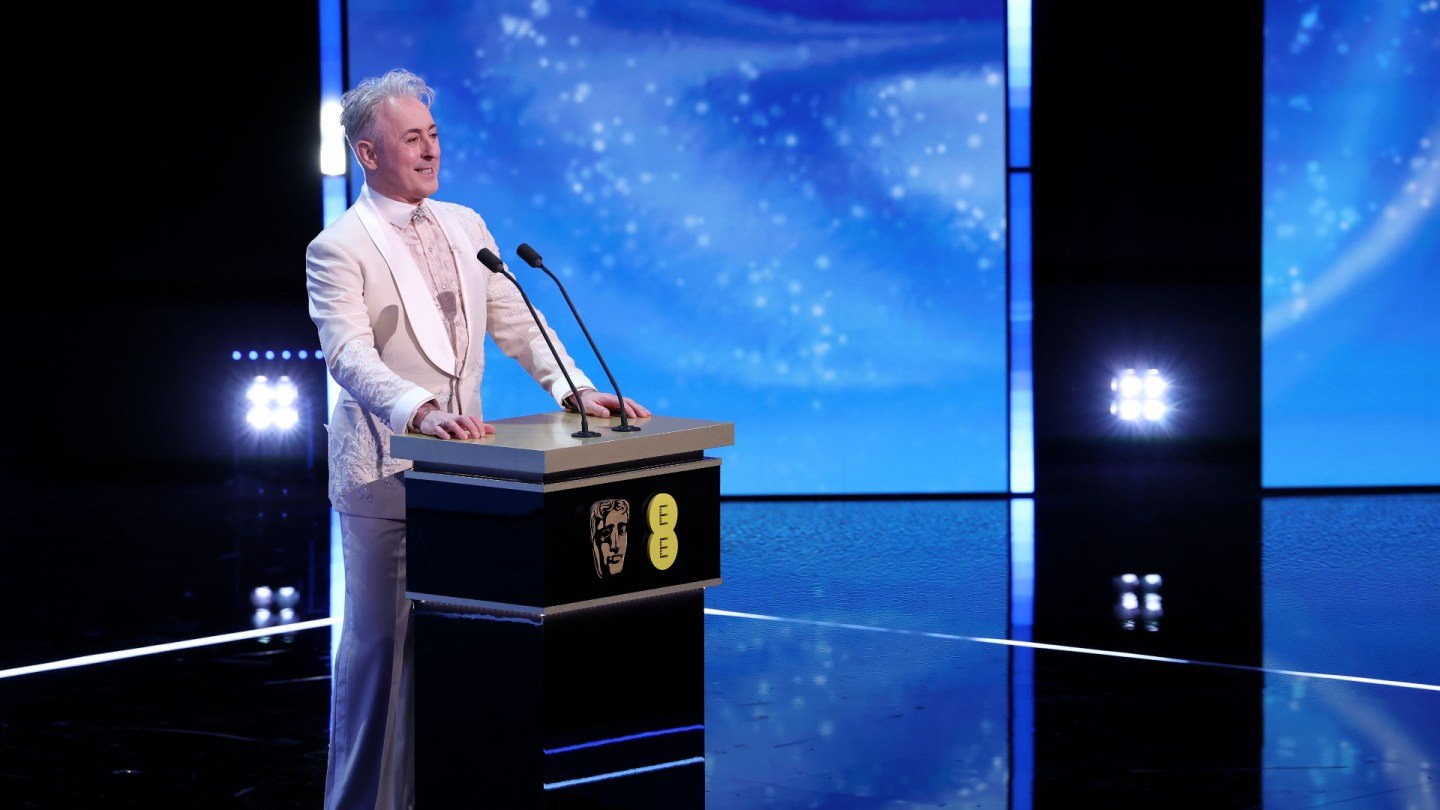
    Host Alan Cumming interrupted his monologues several times across the show to remind viewers: “Tourette’s syndrome is a disability and the tics you’ve heard tonight are involuntary, which means the person who has Tourette’s Syndrome has no control over their language. We apologize if you are offended tonight.”

    Davidson was warmly welcomed by a floor manager before the awards show began, and attendees were informed that “John has Tourette’s Syndrome, so please be aware you might hear some involuntary noises or movements during the ceremony,” as the housekeeping rules were laid out. A source informed THR that this was the moment presenters were warned about Davidson’s tics, minutes prior to the ceremony kicking off. He left the room around 25 minutes into the show (of his own accord, THR understands), shortly after his outburst during Jordan and Lindo’s presentation. Other outbursts came before this, including “Bullshit!” when people were asked not to curse, and “Shut the fuck up,” when BAFTA chair Sara Putt made her introductory remarks.

    The consensus on the night differed according to who you were talking to, but almost everyone agreed that both the Black attendees at the BAFTA Film Awards and the Tourette’s community have been failed by the handling of this situation. While many of the Brits maintained that Tourette’s is a serious, misunderstood condition, those from across the pond were seemingly less tolerant of the outbursts. What it has underlined is necessary questions about industry ableism, and the duty of care toward award show guests and audiences watching at home.

    Sinners’ production designer Hannah Beachler said “the situation is almost impossible” in a post on social media after the show. “I keep trying to write about what happened at the BAFTAs, and I can’t find the words,” she wrote on X. “The situation is almost impossible, but it happened 3 times that night, and one of the three times was directed at myself on the way to dinner after the show,” she said about Davidson’s tics. “I understand and deeply know why this is an impossible situation. I know we must handle this with grace and continue to push through. But what made the situation worse was the throw-away apology of ‘if you were offended.’”

    Aramayo’s shock win for his performance in I Swear — over Timothee Chalamet for Marty Supreme — gave the actor an opportunity to bring further awareness to the condition. While picking up an earlier prize, the EE BAFTA Rising Star Award, Aramayo told the crowd: “John Davidson is the most remarkable man I ever met. He’s so forthcoming with education and he believes there should be still so much more we need to learn about Tourette’s.”

    “For people living with Tourette’s,” he said, “it’s us around them who help them define what their experience is. So, to quote the film, they need support and understanding.”

    Social media has, unsurprisingly, only fanned the flames. Some have said Tourette’s is “debilitating,” with one person commenting: “Tourette’s making you shout really offensive things seems to have surprised people who have no idea what Tourette’s actually is.” Others have not been so understanding. Jamie Foxx, for example, commented on an Instagram post that Davidson’s outburst was “unacceptable” and “he meant that shit,” which users have criticized as a misunderstanding of what Tourette’s is.

  • BBC Removes BAFTA Film Awards From iPlayer After Leaving N-Word Outburst in Tape-Delayed Broadcast

    BBC Removes BAFTA Film Awards From iPlayer After Leaving N-Word Outburst in Tape-Delayed Broadcast

    The BBC has removed the BAFTA Film Awards from being available to stream on iPlayer after not cutting a racial slur from its tape-delayed broadcast on Sunday night.

    The outburst came from John Davidson, a Tourette syndrome campaigner who was seated in the audience during the ceremony and is himself the subject of the biopic “I Swear.” Davidson’s condition causes him to produce involuntary vocal tics, one of which — the N-word — occurred as actors Michael B. Jordan and Delroy Lindo took the stage to hand out the prize for best visual effects, ultimately won by “Avatar: Fire and Ash.”

    Although the remark was barely audible amid the noise of the ceremony, it was picked up in the BBC’s coverage. What drew particular scrutiny was the fact that the broadcast operated on a two-hour tape delay before airing on BBC One and iPlayer — a buffer that editors would ordinarily use to catch and remove exactly this kind of material.

    The corporation issued an apology on Sunday night, with a spokesperson stating: “Some viewers may have heard strong and offensive language during the BAFTA Film Awards 2026. This arose from involuntary verbal tics associated with Tourette syndrome, and was not intentional. We apologize for any offense caused by the language heard.”

    Last summer, the BBC faced a major controversy after airing a Glastonbury Festival performance by punk rap duo Bob Vylan, during which the band led the crowd in a “Death to the IDF” chant on a live iPlayer stream. The footage remained online for more than five hours before being pulled. The fallout prompted U.K. Prime Minister Keir Starmer to demand answers from the BBC, and the corporation subsequently revised its livestreaming protocols in response.

  • BBC Greenlights Three New Dramas, Including Tudor-Set ‘1536,’ ‘Shy & Lola’ With Hayley Squires, Bel Powley

    The BBC has unveiled three new dramas coming to our screens in due course, including Shy & Lola with Hayley Squires and Bel Powley.

    Shy & Lola, a new six-part drama for BBC iPlayer and BBC One, is written by award-winning screenwriter and novelist Amanda Coe (Apple Tree Yard, The Trial of Christine Keeler) and produced by multi-BAFTA and Emmy award-winning Clerkenwell Films (Baby Reindeer, The Death of Bunny Munro, The End of the F***ing World), part of BBC Studios.

    The darkly comic story follows Shy and Lola, two very different women who are forced to become allies when a murder entangles them in the criminal underworld operating in Shy’s small coastal town in the North of England. Squires (The Night ManagerI, Daniel Blake) stars as Shy, a cleaner scraping by and dreaming of a new life in Portugal, with Powley (A Small Light, The Diary of a Teenage Girl) playing Lola, an ex-model-turned-grifter who arrives in town with trouble at her heels.

    Filming on the show, based on the French television drama Cheyenne and Lola, will begin this spring in and around the U.K. cities of Hull and Leeds.

    Also announced on Monday is D-Notice from writers and executive producers Adam Patterson and Declan Lawn. The six-part British political thriller is set in the world of investigative journalism. Patterson and Lawn are said to “have some experience of” the D-notice mechanism, which allows the government to advise journalists about national security. Now, they’ve come up with a drama that looks at how truth and power speak to one another. It is their third project for the BBC, following The Salisbury Poisonings and Blue Lights, and their first commission from production company Hot Sauce Pictures, backed by Sony Pictures Television.

    The BBC has also commissioned 1536, a new drama series for BBC iPlayer and BBC One, based on Ava Pickett’s play of the same name. The eight-part show written by Pickett from Drama Republic (Riot Women, One Day) is set in the heart of Tudor England against the backdrop of Anne Boleyn’s arrest and weaves royal scandal with rural struggle.

    1536 centers around Anna, Mariella, and Jane: three young women gossiping, arguing, and dreaming in an Essex village, desperately waiting for their lives to start. When the news reaches them that King Henry VIII has had his Queen, Anne Boleyn, arrested, the three of them never suspect that this act will change their lives forever.

    Pickett said: “1536 is something I am immensely proud of and I feel so lucky and privileged to have the chance to bring Anna, Jane and Mariella to a wider audience and to build out their lives even more. In a world where every decision made in the corridors of power ricochets through all of our lives, this story feels more relevant than ever. I’m so grateful to Lindsay Salt for being such a champion of it from the start.”

    Lindsay Salt, Director of BBC Drama, added: “From the moment we saw Ava’s play we knew that we had to have the TV version on the BBC. Visceral, funny, provocative, timely and full of courage, this is a piece of work like no other. Ava is an exceptional voice, so we feel very lucky to be working with her and the brilliant team at Drama Republic to bring three iconic female characters to the screen.”

    Executive producers are Jude Liknaitzky, Roanna Benn, Rebecca de Souza, Chloe Beeson and Pickett. The series was commissioned by Salt.

  • BBC Studios Chiefs on Mega-Mergers, Own M&A, Trump Tariffs, U.S. Streaming Growth, and the ‘Bluey’ Movie

    BBC Studios Chiefs on Mega-Mergers, Own M&A, Trump Tariffs, U.S. Streaming Growth, and the ‘Bluey’ Movie

    BBC Studios CEO Tom Fussell and Zai Bennett, CEO and chief creative officer of BBC Studios Productions, discussed tariff talk by U.S. President Donald Trump, mega-consolidation, including the planned Netflix-Warner Bros. Discovery deal, the growth of the company’s U.S. streaming business, and the Bluey movie.

    They spoke to the press on the first day of the 50th annual BBC Studios Showcase in London. BBC Studios, the commercial arm of British broadcaster BBC, is known for such hit franchises as animated powerhouse Bluey, Tom Hiddleston drama The Night Manager, legal drama The Split and its upcoming spin-off The Split Up, and such natural science hits as Walking With Dinosaurs, and it recently unveiled new shows to mark broadcaster and naturalist David Attenborough’s 100th birthday on May 8.

    “We have seen no impact” from Trump tariff talk, Fussell said when asked about any possible fallout, also lauding the continuing popularity of BBC News in the U.S. He didn’t discuss Trump’s lawsuit against BBC News, simply touting the resilience of the BBC brand and saying “we are not seeing any changes.”

    Asked about Netflix-WBD, he said “we are well diversified, and obviously, you can only control what you can control, so you focus on your priorities, and our priority is carrying the transformation and the growth in the areas we’ve got.” He emphasized though that “no doubt, … people have talked about challenging markets and the rest of it, and our view going forward is that the market growth is not going to be anything like what it had been in the [past] five years.”

    Continued Fussell: “And when you start seeing rumors upon rumors about takeovers and consolidation, that normally is testament to the fact there aren’t huge amounts of growth in the market, because everyone’s looking for … synergies. But we know what we’re doing. We know where we want to be investing in our global expansion of our studio.”

    In that context, he also highlighted that BBC Studios was “a growing business that’s transforming,” with revenue up 55.7 percent over the last four years.

    Following TV market challenges, Bennett on Monday suggested that “there are definitely green shoots of recovery,” sharing that “Paramount is back in the market, spending money,” among other things. But he reiterated that things are “definitely not” expected to return to the highs of the past five years but play out in a “new normal” range.

    Fussell suggested though that he felt the business would be “talking about striving again,” from scripted to unscripted and, vitally, kids programming.

    Mentioning the 2019 BBC Studios deal with what was then Discovery to take full control of UKTV’s entertainment channels, including Dave, Gold, and Drama, as well as a 2024 deal with ITV that gave the company full control of streamer BritBox International, Fussell also signaled that BBC Studios could also strike more acquisitions of its own. He said it would “carry on investing organically and maybe inorganically.”

    Bennett, who started his role in late 2024, similarly noted that BBC Studios Productions is seeing “solid organic growth and investment” and “looking for inorganic growth in some territories,” mentioning the rest of Europe, the Middle East and Africa as one possible region for deals.

    Fussell added that there “are opportunities for inorganic growth in streaming across the genres,” adding: “I think we have a right, as the home of British streaming, to grow that even further.” But he emphasized that “these opportunities take time,” concluding: “We are very judicious with how we spend that investment.”

    Fussell on Monday also touted the success of streaming services BritBox and BBC Select, which focuses on documentaries, in North America. “Last week was the fifth birthday of BBC Select, and BBC Select is now the third-largest factual SVOD in the States, and we’re really proud of that,” he said. He also touted the growth of BritBox and its launch of a premium tier.

    Among content trends, Bennett was asked about the growth of microdramas, saying that “we’re looking at that right now.” He added: “We’re certainly experimenting.”

    Questioned about audience and buyer appetite, he sees for escapist content versus programming dealing with the world’s cultural and political divisions, Bennett said BBC Studios Productions looks at market needs and is “leaning into specificity and Britishness” more than anything else.

    Current and old content favorites also drew reporter questions on Monday. Could motoring show Top Gear return to U.K. screens? Replied Bennett: “Never say never.”

    Of course, the upcoming Bluey: The Movie was also a talking point. Fussell shared that he just visited creator Joe Brumm in his studio in Brisbane, calling the experience “an absolute pleasure,” and saying that the work on the film was going well. But “I can’t say anything” more, he emphasized. And Bennett shared: “We’ve seen bits of it, and it looks amazing.”

  • Japan Exports Hit Formats But Imports Few, WIT Says at Mip London

    Japan Exports Hit Formats But Imports Few, WIT Says at Mip London

    Japan remains one of the world’s most insular television format markets, exporting globally successful unscripted hits while importing almost no foreign concepts, according to data presented by Virginia Mouseler, CEO of The WIT, during the “Fresh TV: Japan” session at Mip London.

    Using the company’s real-time tracking database, Mouseler said Japan currently ranks as the world’s seventh-largest exporter of formats, “at the same level as South Korea,” even as it adapts very little international IP.

    WIT’s Top Formats tool showed Japanese-origin “Dragon’s Den” continuing to rank among the most widely adapted unscripted formats globally over the past year, alongside international hits including “The Floor,” “The A Talks” and “The Traitors.”

    Among Japanese formats themselves, the most adapted unscripted titles over the past 12 months include “Dragon’s Den,” “LOL,” “Freeze” and the long-running game show “Run for Money,” highlighting the export strength of high-concept entertainment formats built around simple game mechanics.

    At the same time, Japan remains highly resistant to importing foreign formats. According to WIT data, only two international formats were adapted locally over the past year, compared with none the year before.

    One of those imports was the South Korean relationship competition “Wedding Wars,” based on CJ ENM’s “Wedding Fighters,” which premiered on streaming platform Abema in April. The other was a reboot of “Who Wants to Be a Millionaire,” returning to Japanese television 26 years after its first local version.

    Mouseler noted that Japan has “a long, long tradition of importing no formats,” with the country currently ranking 15th globally as a format importer.

    Much local activity instead revolves around revivals and reinventions of homegrown IP, including the recent reboot of the classic game show “Challenges on Fire,” which returned three decades after its original run.

    The presentation also highlighted a new generation of Japanese entertainment formats centered on visually driven physical mechanics and social-strategy gameplay, including hybrid deduction formats, endurance-based competition shows such as “Cash or Splash,” and Nippon TV’s rotating-stage challenge format “Turn” (“Mawase”), underscoring Japan’s continued focus on highly visual, easily exportable game concepts.

  • ‘Sinners’ Production Designer Hannah Beachler Says Alan Cumming’s ‘Throw-Away Apology’ Over N-Word Slur During BAFTAs ‘Made It Worse’

    ‘Sinners’ Production Designer Hannah Beachler Says Alan Cumming’s ‘Throw-Away Apology’ Over N-Word Slur During BAFTAs ‘Made It Worse’

    “Sinners” production designer Hannah Beachler has said that Alan Cumming’s “throw away apology” over the N-word being shouted during the BAFTA Film Awards made the situation “worse.”

    “I keep trying to write about what happened at the BAFTAs, and I can’t find the words,” Beachler, who was nominated for an award, posted on X after the ceremony. “The situation is almost impossible, but it happened 3 times that night, and one of the three times was directed at myself on the way to dinner after the show.”

    She continued: “And a third time at a Black woman. I understand and deeply know why this is an impossible situation. I know we must handle this with grace and continue to push through. But what made the situation worse was the throw away apology of ‘if you were offended’ at the end of the show. Of course we were offended…but our frequency, our spiritual vibration is tuned to a higher level than what happened. I am not steal [sic], this did not bounce off of me, but I exist above it. It can’t take away from who I am as an artist.”

    Beachler was understood to be referring to a number of outbursts by Tourette’s campaigner John Davidson, whose life inspired the BAFTA-nominated biopic “I Swear.”

    As well as shouting out the word “fuck” multiple times during speeches, including “shut the fuck up” during BAFTA chair Sara Putt’s introduction to the ceremony, he was also heard shouting the n-word when Michael B. Jordan and Delroy Lindo presented “Avatar: Fire and Ash” with the award for best visual effects.

    BAFTAs host Alan Cumming made two statements about Davidson’s outburst during the ceremony, the first explaining that the “strong language in the background” can be a symptom of Tourette’s for some people and thanking the audience for their “understanding and helping create a respectful space for everyone.”

    He later added: “Tourette’s Syndrome is a disability and the tics you’ve heard tonight are involuntary, which means the person who has Tourette’s Syndrome has no control over their language. We apologize if you are offended tonight.”

    Despite the ceremony airing with a two-hour delay on BBC One in the U.K. and E! in the U.S., the slur was not cut from the broadcast.

    “I Swear” went on to win a number of awards during the evening, including one for actor Robert Aramayo who beat out Jordan as well as Leonardo DiCaprio and Ethan Hawke to take home the leading man statue for his portrayal of Davidson, who was diagnosed with Tourette’s at the age of 25 after years of outbursts.

    Before the ceremony began a floor manager, who addressed the audience to issue a number of notices regarding things such as fire safety protocol, flagged that Davidson was in the audience and that he has “Tourette’s Syndrome so please be aware you might hear some involuntary noises or movements during the ceremony.”

  • ‘Free Palestine’ Cut From BBC Broadcast of ‘My Father’s Shadow’ Director Akinola Davies Jr.’s BAFTAs Speech

    ‘Free Palestine’ Cut From BBC Broadcast of ‘My Father’s Shadow’ Director Akinola Davies Jr.’s BAFTAs Speech

    After winning the BAFTA Film Award for outstanding debut by a British writer, director or producer, “My Father’s Shadow” helmer Akinola Davies Jr. ended his speech by saying “free Palestine.” However, these words were then cut from his speech when the ceremony aired two hours later on the BBC.

    Towards the end of Davies Jr.’s speech during the taping of the awards — and in one of the only politically-charged moments of the show — he said: “To the economic migrant, the conflict migrant, those under occupation, dictatorship, persecution and those experiencing genocide, you matter and your stories matter more than ever. Your dreams are an act of resistance. To those watching at home, archive your loved ones, archive your stories yesterday, today and forever. For Nigeria, for London, Congo, Sudan, free Palestine. Thank you.”

    But this part was entirely cut from the show’s broadcast on BBC One and iPlayer, with only the first section of Davies Jr.’s speech — in which he thanks his family and brother and co-screenwriter Wale Davies — making it to air. “My Father’s Shadow,” which was submitted as the U.K.’s official Oscar entry for best international feature, follows two brothers who attend a family reunion in Lagos during the 1993 Nigerian election and witness their father’s daily struggles.

    Representatives for the BBC and Davies Jr. did not immediately respond to Variety‘s request for comment.

    There are always cuts made to the BBC broadcast of the awards as the ceremony is edited from three hours down to two, but Davies Jr.’s “free Palestine” not airing sparked particular outrage as several outbursts during the taping — including the N-word — did.

    Tourette’s advocate John Davidson — who inspired “I Swear,” which won star Robert Aramayo the best actor BAFTA — was in attendance at the ceremony, and the audience was warned of potential outbursts including strong language. However, when Michael B. Jordan and Delroy Lindo took the stage to present the first award for special visual effects, he shouted the N-word, causing controversy.

    BAFTAs host Alan Cumming addressed this during the ceremony, saying: “You may have noticed some strong language in the background. This can be part of how Tourette’s syndrome shows up for some people as the film explores that experience. Thanks for your understanding and helping create a respectful space for everyone.”

    In a second statement later on, Cumming added that “Tourette’s Syndrome is a disability and the tics you’ve heard tonight are involuntary, which means the person who has Tourette’s Syndrome has no control over their language. We apologize if you are offended tonight.”

    However, the moment — and the BBC’s decision to keep the N-word in the tape-delayed broadcast — resulted in widespread debate on social media, with disability advocates reminding viewers that Davidson has no control over the remarks, while others still deemed the airing of the racial slur unacceptable.

  • K-Drama Boom in Europe Moves Into Adaptation Phase, Mip London Panel Says

    K-Drama Boom in Europe Moves Into Adaptation Phase, Mip London Panel Says

    The rapid rise of Korean drama in Europe is entering a new phase, shifting from streaming success toward local adaptation and co-development, executives said during a Mip London session examining the genre’s growing regional impact.

    Speaking at “The Rise of K-Drama in Europe,” Jinhee Lee, marketing manager at CJ ENM, said Korean series have seen “a very clear rise, not just in global visibility, but in actual regional performance, as a strong and sustained engagement within individual markets as well.”

    Joining Lee on the panel were Diane Min, head of Europe sales at CJ ENM, and Claire Takami Siljedahl, development producer at Fifth Season U.K., the international studio jointly owned by Korea’s CJ ENM, Japan’s Toho Co. and U.S. investment firm Neuberger Berman.

    As an example of the genre’s momentum, Lee cited CJ ENM drama “Bon Appetit, Your Majesty,” which ranked in Netflix’s Top 10 across more than 10 European territories and remained in the chart for up to seven consecutive weeks in countries including Portugal, Romania and Greece.

    Min said the global success of “Squid Game” in 2021 “literally changed everything,” helping make Korean dramas more accessible to audiences worldwide. She noted that a total of 210 Korean dramas from multiple broadcasters and studios have reached Netflix’s Top 10 chart over the past five years.

    Europe has become a key expansion territory, Min said, with more than 30 Korean drama titles now available on Prime Video in the U.K., while CJ ENM has also launched Korean series on major French broadcasters.

    Siljedahl said the appeal of Korean dramas lies in their originality and genre blending. “The concepts are so original… a lot of genre mashups, which is really exciting,” she said, noting that many story ideas feel unlike those typically developed in Western markets.

    She also pointed to adaptation challenges, including cultural differences and tonal adjustments. Attitudes to sex, heightened emotional storytelling and culturally specific elements often require modification to resonate with U.K. audiences while preserving the original feel of the IP, she said.

    The session highlighted titles gaining traction in Europe, including “Lovely Runner,” which has expanded on Prime Video into multiple territories, and the upcoming CJ ENM series “The Legend of Kitchen Soldier,” a military-set drama with a cooking twist that will premiere at Series Mania.

    Panelists said adaptation activity is accelerating as producers seek to translate Korean IP into English-language versions. Siljedahl noted that Fifth Season is currently developing multiple remakes and has selected the erotic revenge thriller “Eve” for adaptation in part because of its strong local and global performance.

    Min said CJ ENM’s strategy now extends beyond distribution toward producing Korean stories in multiple languages through partnerships with international companies.

    Looking ahead, panelists said the next stage of K-drama growth in Europe will be driven by closer collaboration between Korean producers and international companies. As Siljedahl said, “there are lots of exciting ways to work together,” including developing original concepts designed for global audiences from the outset.

  • BBC Greenlights Three New Dramas, Including Tudor-Set ‘1536,’ ‘Shy & Lola’ With Hayley Squires, Bel Powley

    The BBC has unveiled three new dramas coming to our screens in due course, including Shy & Lola with Hayley Squires and Bel Powley.

    Shy & Lola, a new six-part drama for BBC iPlayer and BBC One, is written by award-winning screenwriter and novelist Amanda Coe (Apple Tree Yard, The Trial of Christine Keeler) and produced by multi-BAFTA and Emmy award-winning Clerkenwell Films (Baby Reindeer, The Death of Bunny Munro, The End of the F***ing World), part of BBC Studios.

    The darkly comic story follows Shy and Lola, two very different women who are forced to become allies when a murder entangles them in the criminal underworld operating in Shy’s small coastal town in the North of England. Squires (The Night ManagerI, Daniel Blake) stars as Shy, a cleaner scraping by and dreaming of a new life in Portugal, with Powley (A Small Light, The Diary of a Teenage Girl) playing Lola, an ex-model-turned-grifter who arrives in town with trouble at her heels.

    Filming on the show, based on the French television drama Cheyenne and Lola, will begin this spring in and around the U.K. cities of Hull and Leeds.

    Also announced on Monday is D-Notice from writers and executive producers Adam Patterson and Declan Lawn. The six-part British political thriller is set in the world of investigative journalism. Patterson and Lawn are said to “have some experience of” the D-notice mechanism, which allows the government to advise journalists about national security. Now, they’ve come up with a drama that looks at how truth and power speak to one another. It is their third project for the BBC, following The Salisbury Poisonings and Blue Lights, and their first commission from production company Hot Sauce Pictures, backed by Sony Pictures Television.

    The BBC has also commissioned 1536, a new drama series for BBC iPlayer and BBC One, based on Ava Pickett’s play of the same name. The eight-part show written by Pickett from Drama Republic (Riot Women, One Day) is set in the heart of Tudor England against the backdrop of Anne Boleyn’s arrest and weaves royal scandal with rural struggle.

    1536 centers around Anna, Mariella, and Jane: three young women gossiping, arguing, and dreaming in an Essex village, desperately waiting for their lives to start. When the news reaches them that King Henry VIII has had his Queen, Anne Boleyn, arrested, the three of them never suspect that this act will change their lives forever.

    Pickett said: “1536 is something I am immensely proud of and I feel so lucky and privileged to have the chance to bring Anna, Jane and Mariella to a wider audience and to build out their lives even more. In a world where every decision made in the corridors of power ricochets through all of our lives, this story feels more relevant than ever. I’m so grateful to Lindsay Salt for being such a champion of it from the start.”

    Lindsay Salt, Director of BBC Drama, added: “From the moment we saw Ava’s play we knew that we had to have the TV version on the BBC. Visceral, funny, provocative, timely and full of courage, this is a piece of work like no other. Ava is an exceptional voice, so we feel very lucky to be working with her and the brilliant team at Drama Republic to bring three iconic female characters to the screen.”

    Executive producers are Jude Liknaitzky, Roanna Benn, Rebecca de Souza, Chloe Beeson and Pickett. The series was commissioned by Salt.