“Shielded wallets that use Zakura Common, and full nodes like Zakura itself, all benefit,” Zcash cofounder Sean Bowe said in an X post.
Read more: Inside Zcash’s new node that targets Visa-scale privacy at 50,000 transactions per second
The changes do not require an upgrade to Zcash itself. Wallet developers can adopt the open-source libraries on the network as it exists today. At the same time, Zakura has already moved to the new stack in version 1.3.0 and Vizor Wallet is among the first to pick it up.
Zcash’s scaling problem is not only about how quickly the blockchain can produce blocks. When Zakura launched in July, its developers laid out a goal of eventually supporting more than 50,000 private transactions per second, roughly the scale of major card networks. They additionally put today’s wallet software at a ceiling of about one transaction per second.
CoinDesk reported at the time that the plan involved attacking several bottlenecks at once, including how quickly nodes check transactions to how much data wallets have to download.
However, the new cryptography stack attacks another one: how long the user’s own device spends constructing the private payment in the first place.
Wallets should also sync faster under the new libraries, Zakura said, while full nodes benefit from quicker transaction checks and fewer orphaned blocks. The team said its software can already handle the 25-second block times proposed for Zcash’s next major upgrade, NU7.
On Friday, Warsh said inflation data “are more concerning” than trends in the labor market, adding that inflation is unlikely to return to target on its own. He pointed to PCE inflation, the Fed’s preferred gauge, standing at 3.7%, calling that level concerning relative to the central bank’s 2% target.
He also noted that over the past year, more than half of goods and services tracked by the government saw price increases of 3% or higher, well above the roughly one-third that saw comparable increases in the two decades before the pandemic. The remarks were quickly read as hawkish, or pro-rate-hike, sending social media abuzz with expectations of a 25-basis-point hike in September. The benchmark borrowing cost currently sits in a range of 3.5% to 3.75%.
BTC fell 3% to under $77,000 the same day, marking its first notable pullback following a steep rally from roughly $63,000 to over $80,000 earlier this month. Gold fell too, while the Dollar Index and Treasury yields both rose.
Bianco isn’t alone in downplaying rate-hike fears. Firms including ABN AMRO Investment Solutions and Brandywine Global Investment Management are similarly skeptical.
Robin Brooks, senior fellow at the Brookings Institution and former chief economist at the IIF, said that a potential rate hike would be aimed at calming Treasury-market jitters rather than delivering outright policy tightening. Such a move could signal that the Fed remains credible on inflation, reducing the extra premium investors demand to hold long-dated bonds and thereby capping the rise in yields.
Michael Saylor, founder of Strategy, a company known for its institutional investments in Bitcoin, signaled that his firm might buy Bitcoin again. Saylor attracted market attention by simply sharing the phrase “We’re ₿ack” on his social media account.
The use of the Bitcoin symbol in the post was interpreted as an indication that Strategy, led by Saylor, was preparing to make a new $BTC purchase. However, Saylor did not directly confirm in his post that the company would be making a new purchase, nor did he provide any information regarding the amount of Bitcoin planned to be acquired.
Strategy is among the leading companies that place Bitcoin at the center of their institutional treasury strategy. Through its regular $BTC purchases, the company has long been one of the largest institutional Bitcoin holders in the cryptocurrency market. Therefore, Saylor’s Bitcoin-themed posts could raise expectations for the company’s new purchases.
Strategy’s Bitcoin purchases are generally closely watched in the crypto market. The company’s large-scale purchases are seen as an indicator of institutional demand for Bitcoin, and news of these purchases can also influence market sentiment.
Saylor’s latest post therefore quickly became a topic of discussion among cryptocurrency investors. The phrase “We’re ₿ack,” being linked to similar messages used in the company’s previous Bitcoin purchase announcements, fueled speculation about a possible new acquisition.
However, Strategy has not yet made an official announcement regarding a Bitcoin purchase. If the company does make a new purchase, the size of the transaction and the financing method will be details that investors will be particularly interested in.
Strategy’s continued Bitcoin accumulation policy could lead to a further increase in the amount of $BTC on the company’s balance sheet. On the other hand, fluctuations in the Bitcoin price continue to have a significant impact on the company’s financial performance.
Market participants are awaiting an official statement from Strategy following Saylor’s post, and the question is whether the company will make a new Bitcoin purchase in the coming days.
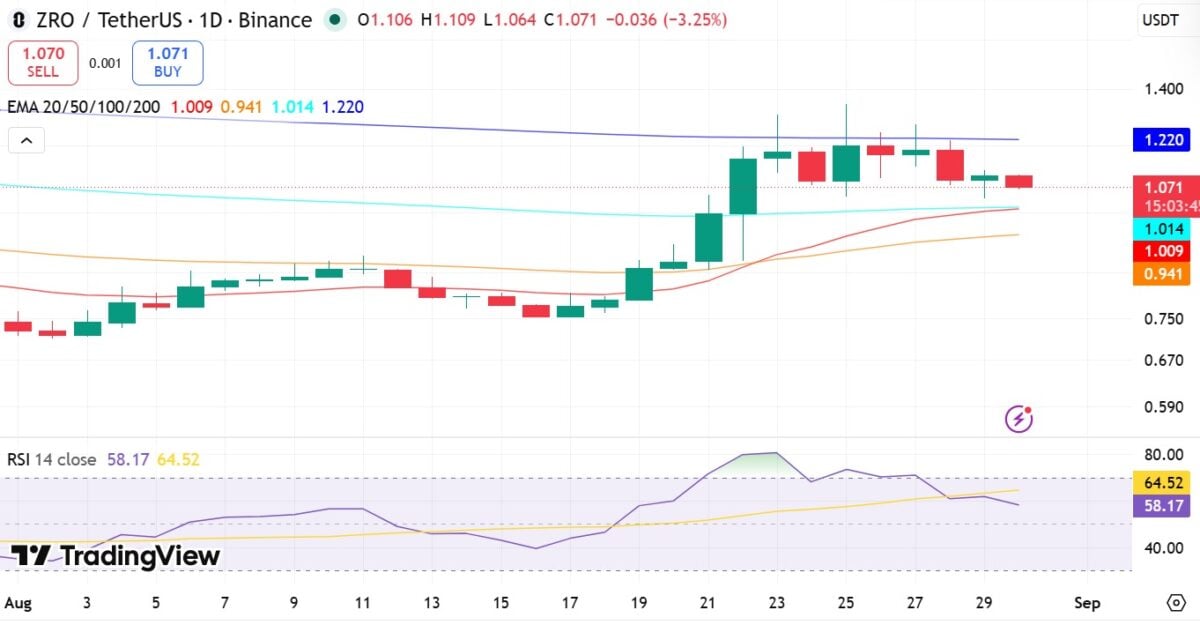
After facing rejection at $1.30 days ago, LayerZero has faced strong downward pressure. In fact, $ZRO dropped below the long-term moving average 200-day EMA, hitting a low of $1.04.
At press time, LayerZero was trading around $1.80, up 1.48% on the daily charts. Over the same period, the altcoin’s trading volume plunged 35% to $38 million.
Amid these losses, LayerZero [$ZRO] has underperformed all other major crypto assets. According to CMC data, $ZRO is the worst performing asset among top 100 tokens , plunging 13% on weekly charts.
Selini Capital deposits 2 million $ZRO worth $2.18 million
Interestingly, even with the market leaning to the downside, institutional investors have increased spending substantially. Nazoku reported that Selini Capital deposited 2 million $ZRO worth $2.18 million to Binance.
2d ago, Selini Capital received 2.1 million $ZRO from the multisig wallet 0x907. This multisig wallet had received 8.5 million $ZRO from LayerZero two years ago.
These deposits to exchanges could mean several things. Firstly, Nazoku observed that the deposit could mean that these tokens finished the lock up period and deposited to Binance to sell.
So far, the wall has deposited well over 4 million $ZRO to exchanges to sell and still holds another 4 million tokens.
Can LayerZero whales come to the rescue?
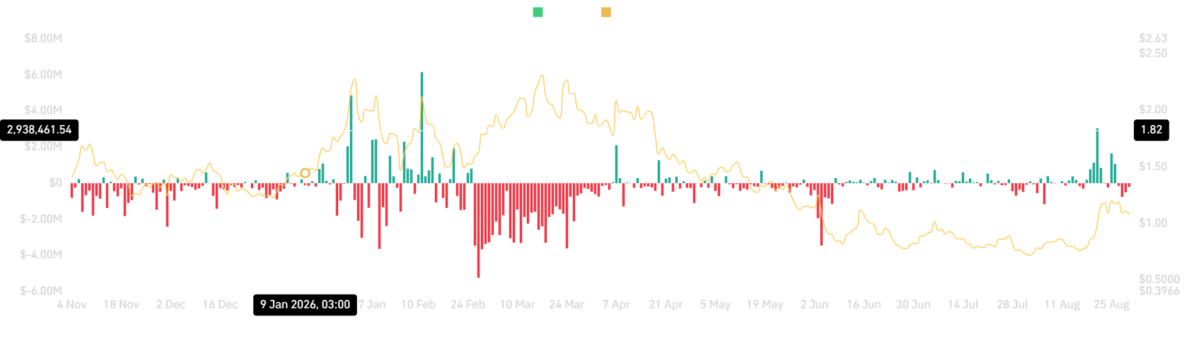
Interestingly, although LayerZero has seen some losses, traders on the spot are holding firmly. According to Coinglass data, Spot netflow has remained positive for four consecutive days.
Source: CoinGlass
At press time, Netflow was around -$203k, suggesting more $ZRO have left exchanges the past 24 hours. However, most of those buys came from whales.
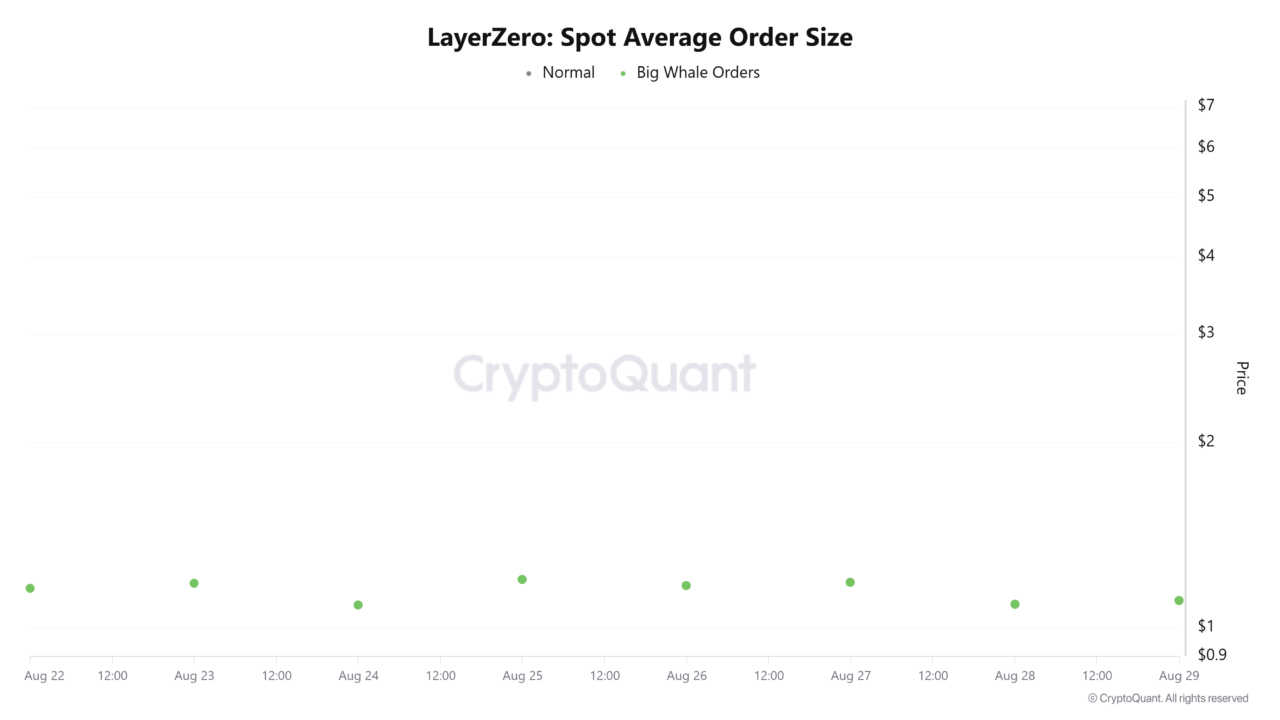
In fact, Spot Average Order Size data from CryptoQuant showed big whale orders emerging between $1.1 and $1.0, making these price levels key whale zones.
Source: CryptoQuant
With the Spot netflow holding negative while whale orders are visible, it suggests these whales have been mostly accumulating. Historically, when whale demand holds steady, it has strengthened market structure, clearing a way for some gains.
Can $1 support hold?
$ZRO is currently facing intense bearish pressure. In fact, the altcoin’s Relative Strength Index (RSI) formed a bearish crossover and fell to 58.
While RSI made a bearish move, it still holds within bullish zone , suggesting that bears are yet to fully retake the market. If the pressure persist, the RSI will drop below 50, thus confirming this bearish trend.
Source: TradingView
Currently, LayerZero is testing the $1 support level, and trend continuation will see this level lost. In doing so, the altcoin will likely drop to EMA20 around $0.94.
To invalidate this bearish outlook, LayerZero must close above its long-term moving average around $1.2.
Final Summary
Selini Capital deposited 2 million $ZRO worth $2.18 million to Binance.
LayerZero dropped 13% on weekly charts becoming worst performing token among top 100 on CMC, as bears eye a drop below $1.
Geopolitical stress is back in the market, lifting oil higher. Still, bitcoin $BTC$77,528.67 is trading steadily during Asian hours, showing resilience and outperforming gold and stocks, a recurring theme through August.
Oil prices rose on both sides of the Atlantic after the U.S. attacked an Iranian island in the Strait of Hormuz, a major oil tanker route that has been disrupted since the conflict began six months ago. The attack drew retaliatory action from Iran.
WTI crude futures jumped nearly 2% to $85.10, with Brent rising 1.9% to $92.39, according to TradingView. Gold fell 0.8% to $4,418 per ounce, and futures tied to the Nasdaq slipped 0.5% alongside losses in Asian equity markets.
Bitcoin, however, traded near $77,580, largely unchanged since midnight UTC, according to CoinDesk. $BTC’s price has surged 23% this month versus gold’s 9% gain and the Nasdaq’s 4% rise. Other major tokens, however, traded slightly lower. Payments-focused $XRP ($XRP) fell by 0.8% with solana (SOL) down 0.6%.
Bitcoin’s continued outperformance could be linked to strong inflows into spot ETFs and hopes for aggressive intervention by the Fed in the wake of the Treasury’s bond buyback program.
Cronos stopped its entire blockchain on Sunday after an attacker exploited Tectonic, its biggest lending platform, in an attack estimated at roughly $75 million.
Cronos is a blockchain launched by Crypto.com in 2021 and closely tied to the exchange, which uses it to run cheaper transactions for its own products. Its CRO token is the one Crypto.com holds up as the centre of its ecosystem, and the chain hosts a small set of lending and trading apps, of which Tectonic is the largest.
Tectonic lets users deposit crypto and borrow other assets against it, much like putting up a house as collateral for a loan.
One of the assets it accepted as collateral was TONIC, its own token, which had about $1.34 million of liquidity and roughly $11,000 of daily trading volume. Tectonic’s own documentation warns that low-liquidity assets can be particularly susceptible to price manipulation.
That appears to have provided the opening, blockchain data shows, as an attacker pushed TONIC’s price up roughly 100-fold in about 20 minutes, deposited the suddenly much more valuable tokens into Tectonic and borrowed real assets against them.
Why Steak ‘n Shake Now Calls Itself a Bitcoin Company
A burger chain founded in 1934 has redefined itself around bitcoin, Steak ‘n Shake shared Aug. 30 on X, more than 15 months after it began letting customers pay in the cryptocurrency at its restaurants. The declaration follows an Aug. 7 filing in which its parent company put a number on the chain’s sales growth.
“From the moment we started accepting bitcoin payments, Steak n Shake has produced the best same-store sales in the fast food industry,” the company summarized. “Bitcoiners continue to help our business. We have never seen an allegiance as strong as Bitcoin holders. The increased business and savings have helped us reinvest in food quality.”
The restaurant chain remarked:
“Steak n Shake is a Bitcoin company.”
Biglari Holdings Inc. (NYSE: BH), which owns the chain, reported a 13.8% same-store sales increase for domestic company-operated and franchise-partner-operated restaurants in the second quarter of 2026.
How Bitcoin Moved From the Register to the Balance Sheet
Payments came first, when Steak ‘n Shake started taking bitcoin in May 2025 over the Bitcoin Lightning Network, a second layer that settles small transfers faster and more cheaply than the base blockchain.
Those cheaper transactions sit behind the operating savings the chain describes. Rather than cashing out the proceeds, Steak ‘n Shake routes customer bitcoin payments into a Strategic Bitcoin Reserve instead of treating the cryptocurrency as a checkout feature.
Steak ‘n Shake then increased its bitcoin exposure twice in January, first by $10 million and then by $5 million in notional value. Separately, Steak ‘n Shake partnered with Fold on its employee bitcoin bonus program.
What Bitcoin Pays Workers and Diners
Hourly employees at company-operated restaurants have earned a bitcoin bonus on top of wages since March 1, set at 21 cents for every hour worked and payable after a two-year vesting period.
Customers got their own entry point on Oct. 31, 2025, when Fold Holdings, Inc. (Nasdaq: FLD) and Steak ‘n Shake launched a limited-time $5 bitcoin promotion at roughly 400 U.S. locations. Diners who bought a Bitcoin Steakburger or Bitcoin Meal uploaded the receipt for a code redeemable through the Fold app.
The company posted pretax operating earnings of $6.3 million for the second quarter, against $3.7 million a year earlier, across insurance and reinsurance, licensing and media, restaurants, and oil and gas. Across the first six months of 2026, those earnings came to $2.1 million, down from $13.7 million in the same stretch of 2025.
Lookonchain reported on Aug. 29 that 15 newly created wallets linked by the tracker to the GOLD token team sold 224.5 million tokens for 3,178 $SOL, worth about $330,000. The sale reportedly generated a profit of roughly $312,000. The original data post is available on X.
The Data Point
The report gives a narrow snapshot rather than a promise about future prices. Its figures describe the wallets, products or market segment identified in the post, and the timing matters because crypto activity can change quickly. For the Aster move, the reported return was unrealized. For the GOLD sale, the wallet attribution came from on-chain tracking. For the $SOL withdrawals, the transactions show movement from named exchanges but do not reveal the owners’ plans. For the ETF, exchange-balance and volume items, the figures are measurements from the named data providers, not official statements from every market participant.
Why It Matters
These developments matter because they show how trading activity, custody decisions and liquidity can affect digital-asset markets. A new perpetual listing can attract leverage as well as attention. A coordinated-looking token sale can raise questions about concentration and disclosure. Large withdrawals may reduce immediately visible exchange balances, but they do not automatically indicate accumulation. ETF inflows can broaden regulated access, while exchange outflows can reflect many motives, including self-custody, staking or transfers between venues. Volume dominance likewise measures participation, not the quality or durability of the assets being traded.
What the Report Does Not Show
The posts do not establish that any reported move will continue. They also do not, by themselves, prove intent, ownership or a completed change in market structure. Readers should distinguish realized gains from unrealized positions, observed transfers from wallet labels and>Next Indicators
Follow-up evidence will include whether the activity persists after the initial move, whether additional wallets or filings clarify attribution, and whether liquidity remains available across venues. In the ETF and exchange-balance cases, subsequent daily flows will show whether the reported direction was temporary or part of a longer trend. Until that evidence arrives, the developments remain dated market observations. BlockchainReporter will continue to separate sourced on-chain data from interpretation and avoid turning a single reading into a forecast. Context is available in earlier market coverage.
Interactive Map Tracks Crypto Holders Across the US
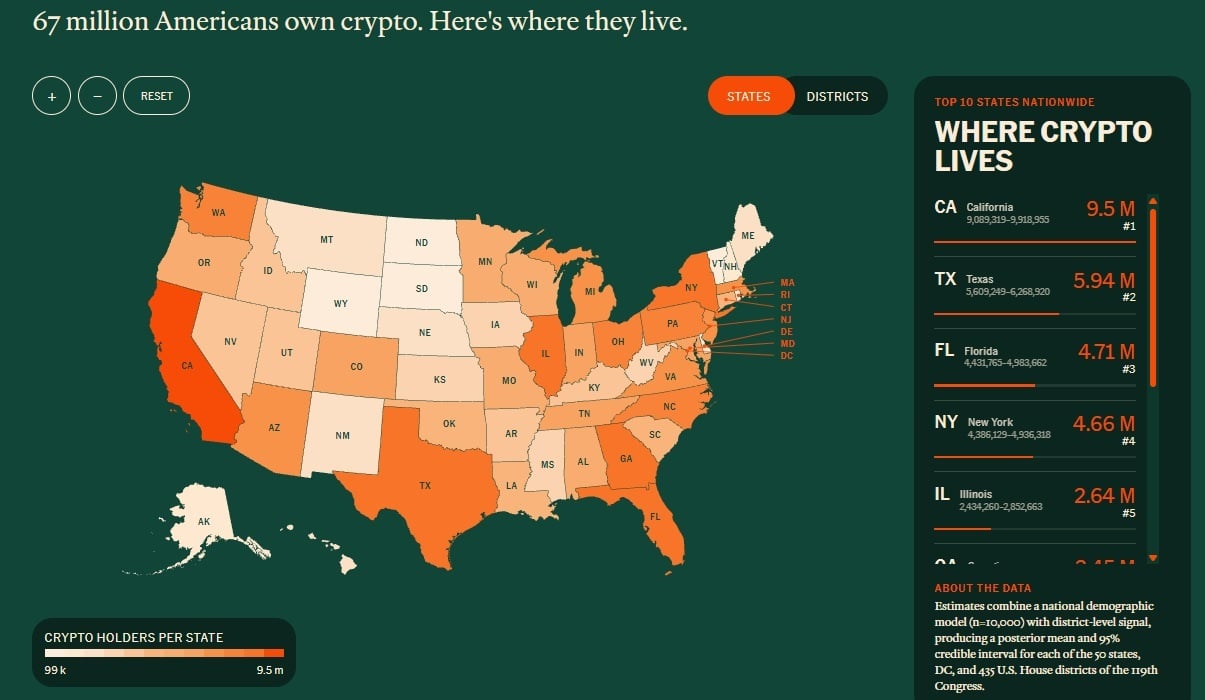
An interactive map estimates where 67 million American crypto holders live, providing figures for all 50 states, Washington, D.C., and the 435 U.S. House districts in the 119th Congress. The National Cryptocurrency Association (NCA), a nonprofit crypto education organization, displays the data through a map hub with state and district views, allowing users to explore individual geographic areas.
Ripple Chief Legal Officer and NCA President Stuart Alderoty highlighted the maps in an Aug. 24 post on X, stating:
“67 million Americans hold crypto. 232,000 American jobs are supported by the industry. The National Cryptocurrency Association built two maps so you can see the data by state and district.”
California leads the state estimates with approximately 9.5 million crypto holders, followed by Texas with 5.94 million, Florida with 4.71 million, New York with 4.66 million, and Illinois with 2.64 million. The underlying 2026 State of Crypto Holders Report found that roughly one in four American adults owns cryptocurrency.
Regionally, the state-level distribution broadly tracks the U.S. population. The South accounts for 38% of holders, while the West represents 27%. The Midwest and Northeast each account for 18%, indicating that ownership is spread across the country rather than concentrated exclusively around major technology and financial centers.
The National Cryptocurrency Association’s interactive map estimates crypto ownership by state, with California leading at 9.5 million holders, followed by Texas, Florida, New York, and Illinois. Source: NCA.
Figures Reflect Modeled Estimates, Not Verified Counts
The map’s figures are statistical estimates rather than exact counts of identified crypto owners. Its methodology combines a national demographic model based on a sample of 10,000 U.S. crypto holders with district-level signals to produce a posterior mean and 95% credible interval for every covered geographic area.
A posterior mean is the model’s central estimate after the available evidence is incorporated. The credible interval represents the range within which the model calculates that the actual figure is likely to fall. California’s estimate, for example, ranges from approximately 9.09 million to 9.92 million holders.
The broader ownership estimate came from an online survey conducted by The Harris Poll for NCA between Feb. 12 and March 3. Researchers weighted the survey findings behind the 67 million estimate and extrapolated them to the broader U.S. crypto-owning population. The sample data is accurate to within 0.7 percentage points at a 95% confidence level.
Separate research offers a narrower comparison focused specifically on bitcoin. A July study estimated that 49.6 million Americans hold bitcoin, representing 18.6% of the adult population. The NCA figure covers cryptocurrency generally, while the bitcoin estimate measures ownership of a single digital asset.
Crypto ownership may include assets held through software wallets, hardware devices, or accounts controlled by centralized platforms. A broader explanation of how to create a crypto wallet outlines the different arrangements holders can use to store and access their digital assets.
Crypto Supports Nearly 232,000 American Jobs
A separate NCA dataset measures the crypto industry’s economic footprint across individual states. Nationwide totals include 231,845 crypto-supported jobs, $55.4 billion in economic activity, and $30.8 billion in worker income, according to the Pragmatic Policy Group analysis of crypto employment commissioned by the association.
The employment figure comprises about 34,000 direct positions at crypto companies, 75,000 indirect jobs at suppliers, and 123,000 induced jobs supported by worker spending. The analysis calculates that each direct crypto position supports roughly six other roles across industries such as professional services, health care, insurance, food service, and logistics.
NCA launched in March 2025 with a $50 million grant from Ripple to support cryptocurrency education and public awareness. At the time, Alderoty described the association’s purpose as providing Americans with facts, resources, tools, and support for engaging with crypto.
On the employment map, California also leads with approximately 57,600 crypto-supported jobs, $16.9 billion in economic impact, and $7.7 billion in worker income. New York follows with 53,800 jobs, while Texas supports 26,500, Washington accounts for 15,100, and North Carolina has approximately 9,500.
In the cryptocurrency markets, Bitcoin’s ($BTC) recent surge from around $63,500 to over $80,000 is said to have been supported by strong spot demand rather than leveraged trading.
According to an assessment published by QCP Capital, Bitcoin’s current market structure appears healthier than previous speculative rallies. The company states that approximately $2.8 billion in net inflows occurred into spot Bitcoin ETFs during $BTC’s rise from $63,500.
In contrast, the amount of open positions in Bitcoin futures markets decreased from approximately 646,000 $BTC in mid-August to 588,000 $BTC. The fact that funding rates have remained at relatively low levels also indicates that the price increase is not driven by aggressively leveraged long positions.
QCP stated that these data show that spot purchases and the closing of short positions were particularly prominent in the rally. This could indicate a more sustainable market structure for Bitcoin due to the limited accumulation of excessive leverage.
On the macro front, the Fed and the US Treasury are being closely watched.
Despite the positive technical structure in the Bitcoin market, the macroeconomic outlook remains uncertain. While core PCE inflation in July remained at 3.3% year-on-year, markets are pricing in a 35% probability of the Federal Reserve raising interest rates by 25 basis points at its September meeting.
On the other hand, the expansion of the US Treasury’s repurchase program to support liquidity in long-term bonds is among the factors supporting risky assets.
The Treasury announced that, starting September 9th, it will increase the upper limit for per-repurchase operations of 10- to 30-year bonds from $2 billion to at least $4 billion. Following this announcement, long-term bond yields fell, the dollar index weakened, while gold and Bitcoin prices rose.
QCP also noted that Nvidia’s strong balance sheet contributed to risk appetite in global markets.
However, it is noted that the US Treasury’s bond repurchase program is not quantitative easing (QE). The program aims to improve liquidity conditions in the long-term bond market, not to directly determine bond yields, and does not create a QE-like expansion in central bank reserves.
According to QCP’s assessment, the key question for Bitcoin in the short term will be whether strong spot demand will continue.