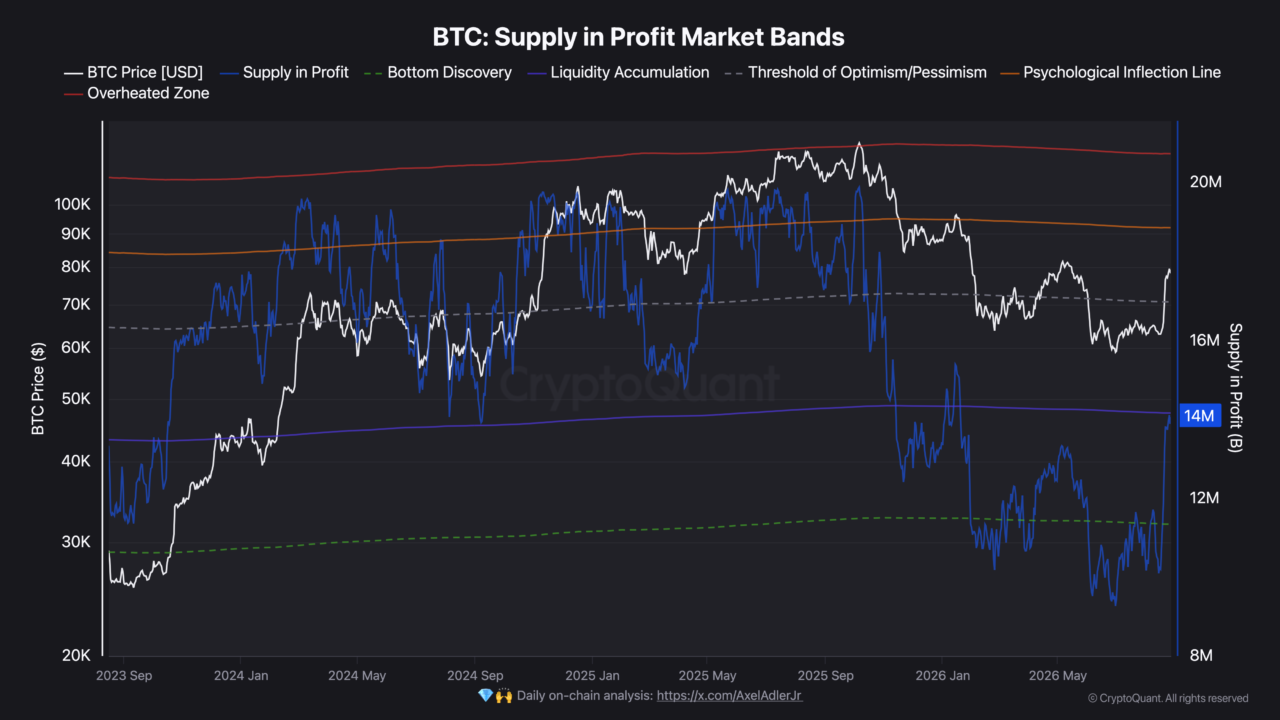
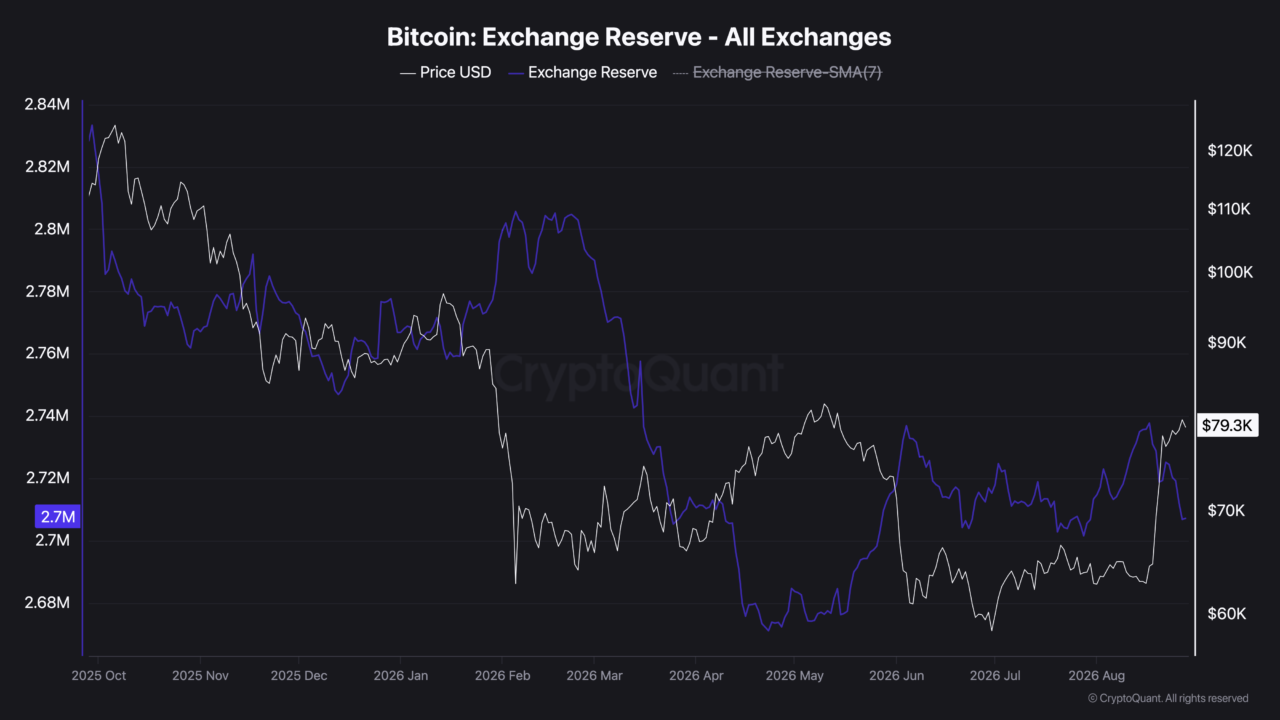
Bitcoin ($BTC) has experienced a correction of over 50% since peaking around $126,000 in October 2025.
During the current correction, Bitcoin fell to levels around $60,000, but is now trying to hold above $70,000.
While technically the bear market is still ongoing, investors are trying to catch the bottom for Bitcoin.
While there are various predictions for the bottom at this point, one CryptoQuant analyst said it could take two months for $BTC to reach its bottom.
CryptoQuant analyst Maartunn, in a statement from his X account, predicted that if Bitcoin follows its historical pattern, a potential bottom will occur in approximately two months.
The analyst based this prediction on the historical four-year halving pattern. According to the analyst, 703 days have passed since the last Bitcoin halving.
Historically, the market bottom typically begins to form around the 777th day after the halving, but the analyst suggested this could happen in about two months.
According to the analyst, if the four-year pattern in Bitcoin remains intact, a definitive bottom could occur in late May 2026.
In line with this analysis, CryptoQuant stated in its February analysis that Bitcoin had not yet fully surrendered and that on-chain indicators were still in a bearish phase. At that point, analysts drew attention to the price support levels that had been reached, pointing to $55,000 as the ultimate bottom for $BTC.
The New York Stock Exchange (ICE) is teaming up with tokenization specialist Securitize to help design the infrastructure behind tokenized securities trading, according to a Tuesday press release shared with CoinDesk.
Securitize is aiming to go public this year via a SPAC deal with Cantor Equitize Partners (CEPT). CEPT shares are higher by 6% premarket. ICE shares are flat.
The two firms signed a memorandum of understanding to build NYSE’s planned Digital Trading Platform. Securitize will serve as a design partner, focusing on how transfer agents — the entities that track ownership and handle corporate actions — operate when securities are issued and settled on blockchain rails.
Securitize, backed by large asset managers like BlackRock and Ark Invest and registered with the SEC as a transfer agent, is expected to be among the first firms eligible to mint tokenized versions of stocks and ETFs on the platform, subject to regulatory approvals.
The firm’s broker-dealer arm could also take part in trading, giving it a foothold across both issuance and market activity.
The move comes as traditional exchange behemoths like NYSE and Nasdaq are doubling down on tokenization efforts to bring blockchain rails into stock trading. That tech would enable around-the-clock trading and near-instant settlements, similar to crypto markets.
Recently, NYSE-parent Intercontinental Exchange invested in crypto exchange OKX to develop tokenized stocks and derivatives products. Rival exchange Nasdaq obtained regulatory approval for its tokenized stock trading framework and has tapped Kraken to distribute stock tokens globally.
“As we explore how tokenization can enhance capital markets, it is critical that new infrastructure is developed in a way that preserves the trust, transparency, and protections investors expect,” NYSE Group President Lynn Martin said.
Read more: Here is why Nasdaq and owner of NYSE are putting the $126 trillion equity market on blockchain
Tron (TRX) founder Justin Sun, who is close to US President Donald Trump and is one of the biggest investors in the TRUMP token, and his team have made a new move.
Tron DAO announced it has expanded its AI and stablecoin funding to $1 billion.
Tron DAO announced in a post from its X account that it has increased its AI and cryptocurrency fund, which it first launched in 2023, from $100 million to $1 billion.
According to the announcement, the fund will invest in four areas: “1) AI agent identity projects, 2) Stablecoin-based payment projects, 3) Tokenization of real-world assets (RWA), and 4) Developer tools for autonomous financial systems.”
“TRON announced it is increasing its AI funding from $100 million to $1 billion. The fund will aim to invest in and acquire early-stage companies that are building the foundational infrastructure for an agent-based economy.”
The expanded fund, now at $1 billion, will focus on investing in projects that use artificial intelligence to improve blockchain scalability, security, and user experience. TRON’s initiative reflects the growing trend of leveraging AI capabilities within the crypto industry and demonstrates its ambition to be a leader in this field.
Tron is also just one of many cryptocurrency-based ecosystems aiming to invest in AI and target an agent-based payment economy, while Solana and Base are also taking steps to expand into this space.
Tron founder Justin Sun had previously stated in an interview that many use cases for AI agents involve small and frequent operations, and that these “require fast and inexpensive networks.”
Bitcoin climbed above $71,000 today, offering bulls their first glimpse of relief since February’s collapse.
At the same time, the price move has formed the same compressive wedge pattern that preceded Bitcoin crashes in October 2025 and January 2026.
On Myriad, traders are calling it a toss up on whether Bitcoin pumps to $84K or dumps to $55K first.
After a brutal February that took Bitcoin from the mid-$90,000s all the way down to a $59,000 low, the market finally has something to feel decent about. BTC is up roughly 4.65% today, trading around $71,013 and shaking off some of the fear that dominated the last several weeks.
The problem is, in doing so, Bitcoin has drawn an all too familiar pattern on its charts—and one that suggests a price crash could be in the cards.
The broader market, meanwhile, is still anticipating hard times. Stocks sunk to four-month lows after news of a delay to potential U.S.-Iran military strikes, pushing crypto alongside equities in a mild risk-on move. WTI crude dropped sharply, and the crypto market is once again in “extreme fear” territory, based on the Crypto Fear and Greed Index.
Despite this, some Bitcoin bulls believe this is a good time to buy, considering the last time Bitcoin had a similar spike was at the beginning of the month. So who’s right? Here’s what the charts say:
Bitcoin (BTC) price: by the numbers
Bitcoin is, indeed, having a nice start to the week: a 4.6% spike, going from $67,844 to a daily high of $71,811, before settling around its current price of $70,985. This movement is trying to break past the resistance of the average price of Bitcoin in the last 200 days, which is a real test of trend strength.
Bitcoin price data. Image: Tradingview
Dig deeper and the picture gets more nuanced. The ADX—the Average Directional Index, which measures how strong any trend actually is—sits at 19.1. That’s below 25, the threshold traders use to confirm a trend has real legs. At 19.1, it’s a sign of a weakening trend, which means bears are struggling to maintain the broader crash’s momentum.
The exponential moving averages, or EMAs, tell a similar story. The 50-day exponential moving average is still trading below the 200-day, which traders would interpret as the clearest signal of a bearish trend. Exponential moving averages smooth out price action over time to help identify where the price of an asset finds support or resistance. When the short-term average sits below the long-term one, it usually means the prevailing direction is still down, even during bounces.
The Relative Strength Index, or RSI, at 51.5 is also neutral. It is not screaming buy or sell, which makes sense. Bitcoin is in that in-between zone where it’s too early to celebrate and too soon to panic (again).
The Squeeze Momentum Indicator is on, with momentum reading a modest 0.26. This number tracks when a market is coiling up energy before a big move—like a spring being compressed or prices stabilizing after a major trend. It’s on right now, meaning the spring is loading. But with momentum still low, we haven’t seen a direction yet.
Fool me once…
Here’s what makes this moment more than a run-of-the-mill bounce: The chart is drawing a pattern it has now drawn twice before—and both times, it ended badly.
Bitcoin price data. Image: Tradingview
There’s a blue descending resistance line running from Bitcoin’s October 2025 peak, around $125,000, all the way down through the current price level. This is the roof. Bitcoin keeps trying to push up and the line keeps capping it. (That’s why it’s called a resistance.)
Below price action, there are three green dotted ascending lines, running parallel to each other. These are the supports. After each major crash, Bitcoin compresses: It bounces off the ascending green floor, climbs toward the blue ceiling line, and the range gets tighter and tighter until something breaks and the price crashes.
It happened after the October 2025 crash. Bitcoin recovered into that same wedge structure, touched resistance, and then broke down hard one month later.
It happened again after the January 2026 crash. Same wedge, same compression. Then the February 2026 wipeout to $59,000.
And right now Bitcoin is forming the exact same structure. The ascending support line is acting as the floor once more. The descending blue line is sitting just overhead, roughly around $70,000 depending on when it arrives. If the pattern holds, a third rejection somewhere in April or May 2026 would be on the table.
Bitcoin price data. Image: Tradingview
On Myriad, a prediction market built by Decrypt’s parent company Dastan, the question on everyone’s mind is framed plainly: “BTC next move: Pump to $84K or Dump to $55K?”
Right now, traders are placing 51.4% odds on the bullish outcome. But that’s not a ringing endorsement of Bitcoin’s health—it’s a toss up, and likely a reflection of how extreme the $55K scenario feels.
Most traders probably can’t stomach betting on a number that low, not because they’re convinced BTC is going up, but because the downside seems too painful to price in. The gap between bulls and bears is tight and follows the market sentiment.
The one thing that could change the story
There is a scenario, though, where everything flips. If Bitcoin can break through that descending blue resistance with a strong, high-volume candle—not just touch it, but close decisively above it—followed by a series of candlesticks closing on top of the broken resistance, that would be a real signal. It would suggest the pattern has finally been broken, and that the market may have actually found a bottom around the $59,000–$64,000 range from early March.
If it respects its current support, the $80K zone becomes the next technical milestone to conquer.
That would be the kind of move that forces even skeptics to reconsider. Resistance lines that get convincingly broken tend to flip into support. (That’s just how these market dynamics work.)
But right now? The pattern is intact. Bitcoin may look nice in the short term. The immediate indicators look neutral instead of heavily bearish, the daily candle is green, and the shorts are hurting a little. None of that is reason to ignore what three data points of the same setup are telling us.
For bulls, the champagne will likely have to wait.
Disclaimer
The views and opinions expressed by the author are for informational purposes only and do not constitute financial, investment, or other advice.
Daily Debrief Newsletter
Start every day with the top news stories right now, plus original features, a podcast, videos and more.
Polymarket and Kalshi both made new moves to try and curb insider trading on their prediction market platforms.
Polymarket has introduced new integrity rules across its platform, clarifying the types of behaviors that are prohibited.
Meanwhile, Kalshi has created new policies and implemented preemptive screening to block individuals from certain markets.
Prediction markets Polymarket and Kalshi are taking steps to remove insider trading from their platforms, announcing updates to rules and tooling, respectively, on Monday as scrutiny continues to build on prediction markets and their offerings.
For Polymarket, Monday’s steps included updating integrity rules and clarifying types of insider trading conduct, like trading on insider information or illegal tips, which are prohibited behaviors on the firm’s DeFi platform and its CFTC-regulated U.S. platform.
“These rule enhancements make our expectations abundantly clear for every participant across both platforms and highlight the compliance infrastructure we have already built,” Polymarket Chief Legal Officer Neal Kumar said in a statement.
“As Polymarket continues to scale,” he added, “we will build on our foundation with clear communication to Polymarket’s users to ensure our markets do what they do best—surface truth.”
The rules, and examples of prohibited behavior—like a coach trading on a sports contract using inside knowledge about a star player’s availability, or an ensemble performer buying shares in a market about which songs will be played at an event—can be found on the site’s market integrity page, accessible via its footer.
Polymarket said it uses a “multi-layered monitoring system” to detect potential violations of its insider trading rules on its DeFi platform, or its international version. On the U.S. side, it works with partners and a real-time control desk to “identify unusual or disruptive trading activity.”
It also recently announced that it’s working with Peter Thiel’s Palantir to create “systems for surveilling sports-focused prediction markets.”
Monday’s advances from Kalshi take a more proactive approach to squashing insider trading on the platform, like in the example of a coach trading on a sporting event they are tied to.
The firm announced it has established a new policy disallowing members connected to college or professional sports—like coaches or players—from trading markets “associated with the sports they are involved with.” A Kalshi representative confirmed to Decrypt that athletes and others in the sports industry can trade in markets related to other sports that they are not involved in.
The firm is also implementing preemptive screening for both athletic parties and politicians using screening lists it has developed, which will allow it to block trades before they even occur.
“These efforts, which have been in the works for months, proactively address the CFTC’s guidance and Congressional bill proposals to prevent insider trading,” the firm wrote.
Insider trading allegations on prediction markets have drawn considerable attention and scrutiny this year, highlighted by anonymous traders winning major sums in markets related to subjects like government actions.
For example, one trader won more than $436,000 on the January ousting of Venezuelan President Nicolás Maduro, leading New York representative Ritchie Torres to draft a bill that would keep federal employees from using prediction markets when they have relevant inside information.
Two weeks prior to that, two Israelis were arrested in the country and charged with using classified information to make bets about military operations on Polymarket.
Potential violations of the insider trading rules on Polymarket can be reported to the platform via Discord or email, its updated rules say. Details on how the investigations unfold from there, or how many reports are being made are not immediately clear. Kalshi has also implemented whistleblower functionality directly into its market pages, allowing individuals to flag potential insider trading behaviors.
Representatives for Polymarket did not immediately respond to Decrypt’s request for comment.
Editor’s note: This story was updated after publication to include an additional detail confirmed by Kalshi.
Daily Debrief Newsletter
Start every day with the top news stories right now, plus original features, a podcast, videos and more.
Bitcoin recently found support at a key onchain metric — the average realized price for a specific year — in this case the 2023 cost basis.
The 2023 average realized price currently sits around $63,700. During the local bottom in early February, when bitcoin dropped roughly 50% from its October all-time high, to roughly $60,000, price effectively tested and held this level as support.
This behavior mirrors the previous cycle. In early 2023, as the bull run began, bitcoin experienced several small corrections and repeatedly used the 2023 realized price as support. This can be observed in March, July, and September 2023, when price consolidated in the $20,000 to $26,000 range.
Looking at newer cohorts, the 2026 average realized price started the year near $90,000 and has since declined to around $77,000. With bitcoin currently trading just above $70,000, the average 2026 buyer is underwater. Notably, this cohort’s cost basis has also fallen below both the 2024 cohort at $81,500 and the 2025 cohort at $96,400.
Zooming out further, the aggregate realized price, which represents the average cost basis of all coins in circulation, is currently around $54,360. Historically, bitcoin has traded below this level in every major bear market, including 2011, 2015, 2019, and 2022.
So far in this cycle, bitcoin’s lowest price has been around $60,000. If that level fails, it becomes the next key support to watch, with the realized price at $54,000 acting as a deeper historical floor.
Another platform is shutting down in the cryptocurrency market. The latest news comes from the DeFi space.
The company that founded decentralized finance (DeFi) giant Balancer has announced its closure. Balancer co-founder Fernando Martinelli stated that Balancer Labs, the institutional organization that developed and funded the DeFi protocol, will be shutting down.
This decision comes approximately five months after a v2 vulnerability in November 2025 resulted in the theft of around $110 million worth of cryptocurrency (including osETH, WETH, and wstETH).
Martinelli stated, “The November 3, 2025 v2 attack created real and ongoing legal risks.” The co-founder emphasized that the v2 vulnerability attack led to ongoing legal risks and harmed the future development of the protocol because maintaining a corporate structure responsible for past security incidents became unsustainable without a revenue stream.
Martinelli stated, “BLabs, as a corporate entity, has become more of a liability than an asset for the future of the protocol, and without any revenue stream, it is not sustainable in its current form.”
However, Martinelli said the protocol would continue operating even after being restructured with a leaner economic model.
At this point, Martinelli added that he supports the ongoing token economic restructuring proposal, which includes reducing BAL emissions to zero, shutting down the BAL system, directing 100% of protocol fees to the DAO treasury, reducing the V3 protocol fee share to 25% to attract liquidity, and providing exit liquidity to holders through BAL buybacks.
A $90K global contest is rewarding AI influencers.
Human judges behind top virtual stars are now part of the evaluation panel.
An exploding $46B virtual influencer market fuels high-stakes talent hunt
OpenArt and Fanvue want to find the world’s best AI personality, and they’re putting $90,000 on the table to do it.
The AI Personality of the Year 2026 is a four-week global challenge, open now through April 19, where creators design and launch original AI influencers competing across five tracks: Entertainer, Lifestyle Influencer, Comedian, Fitness, and Anime/Cartoon/Fantasy.
Weekly winners pocket $200 cash and a platform shoutout, but there’s a much bigger prize waiting for the ultimate victor. The grand prize winner takes home $6,000 in cash plus $2,000 in paid promotion, priority placement on Fanvue, and enrollment in both organizers’ affiliate programs.
Track finalists take home prizes too, ranging from $5,000 cash and $1,000 in promotional exposure for the winner down to $1,000 in cash for the third-place finalist in each category. Fan-voted prizes—Most Viral Video and Audience Choice—add $1,000 each to the pool. Add it all up and the total stretches past $90,000.
To enter, you must build your character on OpenArt, launch a public TikTok or Instagram account for it, post at least four times during the challenge window, and tag @OpenArt_AI, @Fanvue, and #AIPersonality2026. That’s simple enough on paper, but likely competitive in practice, given that ElevenLabs is the founding sponsor and the ambassador lineup includes some of the most-followed AI personalities on the internet right now.
The judging panel is 100% human—which is refreshing, for a change. When Miss AI ran its beauty pageant in 2024, two of its four judges were AI-generated influencers themselves. Here, the 11-member panel includes a 13-time Emmy-winning comedy writer, a PR industry co-founder, and a marketing agency executive.
But “all human” doesn’t mean these judges are just spectators to this world. Several of them built the virtual personalities that people are already following. Diana Núñez Morales, the architect behind Aitana—the Barcelona-based AI model who earns up to €10,000 a month in brand deals and was itself a judge in the Miss AI 2024 pagant—is on the panel.
So is Cameron Wilson, creator of Shudu, widely recognized as the world’s first digital supermodel; and Christopher “Topher” Townsend, who built Solomon Ray. The people scoring your entry created some of the most successful AI personalities in existence. They’ll know exactly what they’re looking at.
The virtual influencer market was valued at roughly $6 billion in 2024 and is projected to hit nearly $46 billion by 2030. As Decrypt reported, AI companions and personas have grown so convincing that telling them apart from real humans “often feels impossible”—and that was over a year ago. They’ve only gotten more realistic since then. Today, there are countless Instagram accounts dedicated to expose influencers that go viral without disclosing their AI nature.
OpenArt’s suite covers character creation, image generation, video, and ElevenLabs-powered audio, all in one place. Tutorials on how to build and monetize AI influencers are flooding YouTube, TikTok, and creator newsletters.
Judging criteria for the competition covers quality, inspiration, brand appeal, and social clout through a points-based system. It’s not just about how photorealistic your character looks—it’s about whether the audience actually shows up.
The challenge kicked off Monday, with final winners announced in May. The virtual influencer economy now has an official talent search. The next Aitana might already be queuing up their first post.
Daily Debrief Newsletter
Start every day with the top news stories right now, plus original features, a podcast, videos and more.
South Korea’s leading cryptocurrency exchanges, Upbit, Bithumb, and Coinone, announced that they have lifted their previous delisting order for IoTeX ($IOTX). This development is seen as a significant step towards restoring confidence in the project.
The exchanges stated that the factors that led to $IOTX being placed on the watchlist have been resolved following a comprehensive review process. The review included direct communication with the project team and a detailed assessment of the past security incident and the response to it.
Authorities emphasized that the technical reports and improvement steps submitted by the IoTeX team were deemed sufficient, concluding that there were no longer any risk factors that would prevent the asset from being traded.
As is known, a crypto asset being placed on the delist watchlist means that risks have been identified in various criteria such as security, transparency, project development, and market performance. During this process, projects are expected to address these shortcomings.
Experts say that $IOTX’s delisting is a positive signal for investor confidence and could set an important precedent for projects in similar situations. However, investors are warned that risks in crypto assets persist and developments should be closely monitored.