Category: Business

  • First Sora, Now Sexy Chat? OpenAI Cancels Erotic ChatGPT Mode

    First Sora, Now Sexy Chat? OpenAI Cancels Erotic ChatGPT Mode

    In brief

    • OpenAI has reportedly halted plans to release an adult mode in ChatGPT.
    • The move follows earlier promises to allow verified adults access to more content features.
    • The reported move comes the same week that OpenAI canceled its Sora text-to-video generator.

    OpenAI has shelved plans to launch its previously announced erotic chatbot, according to a report, apparently backing away from a controversial expansion of ChatGPT that would have allowed adult users to generate sexual content.

    The reversal, first reported by the Financial Times on Thursday, follows internal concerns about the societal impact of sexualized artificial intelligence. In January, members of OpenAI’s Expert Council on Well-Being and AI reportedly warned that erotic chat features could foster unhealthy emotional dependency among users, and risk turning the chatbot into what one member described as a “sexy suicide coach.”

    OpenAI declined Decrypt’s request to comment on the status of the erotic mode, and the firm has yet to post about its fate.

    The decision to cancel what was reportedly to be called “Citron mode” comes two days after OpenAI canceled its Sora text-to-video model, as the company moves to focus development on a unified AI platform rather than a collection of specialized tools.

    The move marks a departure from the direction outlined by CEO Sam Altman as recently as October. At the time, Altman said OpenAI planned to allow verified adults to access romantic and erotic content once a robust age-verification system was in place.

    Altman described the idea as part of a broader effort to treat adult users with greater autonomy while maintaining safeguards for minors. By December, however, the timeline was pushed to 2026 as the company continued to refine its age-estimation technology.

    While OpenAI may be getting out of the adult chatbot business before it ever really got into it, AI models do not necessarily need an “erotic mode” for users to form connections with them.

    When OpenAI deprecated GPT-4o last summer, users flooded social media with calls to restore the model after saying they had formed personal and emotional relationships with the chatbot, reflecting a broader debate around erotic chatbots and how people interact with AI.

    In June, research published by researchers at Waseda University in Tokyo said 75% of participants reported turning to AI systems for emotional advice.

    At the same time, AI developers are facing growing scrutiny as lawsuits test whether conversational AI systems are responsible for reinforcing delusional beliefs or harmful behavior among vulnerable users.

    Daily Debrief Newsletter

    Start every day with the top news stories right now, plus original features, a podcast, videos and more.

  • Trump Policy Has Crypto Privacy Developers in a ‘Very Bad State’, Says Coin Center

    Trump Policy Has Crypto Privacy Developers in a ‘Very Bad State’, Says Coin Center

    For over a year now, the White House has made strong efforts to court the crypto industry, rolling out permissive regulations that have turbocharged the sector’s integration with the U.S. economy.  

    But there’s one issue that still keeps some crypto industry leaders up at night, despite the Donald Trump administration’s many promises on the subject: protections for software developers. 

    Last year, the Trump Justice Department made multiple commitments to stop prosecuting the developers of crypto privacy software—the types of tools used to keep crypto transactions anonymous. And yet, months later, federal prosecutors sent two Bitcoin developers to prison for creating such software—and took another Ethereum developer to trial for creating similar tools. 

    The Ethereum developer, Roman Storm, was convicted on one charge and acquitted on two others. But earlier this month, the Trump DOJ filed to try him on those two charges again. 

    Those developments had crypto privacy advocates in a grim enough mood. But on Wednesday, a federal judge in Texas handed down a decision that some feel could bode even more poorly. The judge dismissed a lawsuit against the DOJ brought by a software developer, Michael Lewellen, who said he feared being prosecuted by the U.S. government for creating his own privacy tool. The judge ruled that because the Trump DOJ has said it doesn’t plan to prosecute crypto developers, the man had no standing to claim “a credible threat of prosecution.”

    The ruling has Peter Van Valkenburgh, executive director of the crypto advocacy group Coin Center, very worried. By making statements in support of software developers, but still going after some of them anyway, the Trump DOJ appears to have now stuck policy leaders like him between a rock and a hard place.

    “They can effectively go after developers when they want to go after them, and then claim to be pro-developer when they want to claim to be pro-developer,” Van Valkenburgh, who leads Washington’s longest running crypto policy think tank, told Decrypt. Coin Center was financially supporting Lewellen’s lawsuit.

    In yesterday’s ruling, Judge Reed O’Connor determined that the “core conduct” of the crypto developers thus far prosecuted by the Trump DOJ was money laundering—whereas, in yesterday’s case, plaintiff Michael Lewellen asserted he planned to run a proper, upstanding business. Because Lewellen had no intention to launder money, he should not fear an impending prosecution, O’Connor decided. 

    That particular conclusion particularly irked Van Valkenburgh, who maintains crypto developers—including those targeted by the Trump DOJ—should not be responsible for policing who ends up using their software. 

    “Michael wants to build good tools that can be used for privacy,” he said. “It is very plausible that those tools will be used for money laundering, and that then somebody will come and prosecute him.”

    Prosecutions against the developers of crypto privacy tools didn’t start under Trump. They trace back to the Joe Biden administration, which was roundly criticized by industry leaders for numerous crypto-skeptical policies. But while the current White House has taken a far friendlier tack towards digital assets, and even—theoretically—software developers, Van Valkenburgh worries the DOJ’s apparent lack of consistency on the issue might have put his priorities in a worse spot. 

    “Short term, pragmatically, maybe developers are a little safer now,” he said. “But that very same deprioritization is now making it harder for someone like Michael Llewellyn to get binding legal clarity.”

    “That’s a very bad state of the world right now,” Van Valkenburgh said.

    Daily Debrief Newsletter

    Start every day with the top news stories right now, plus original features, a podcast, videos and more.

  • CoinDesk 20 performance update: AAVE drops 3.2% as nearly all constituents decline

    CoinDesk 20 performance update: AAVE drops 3.2% as nearly all constituents decline

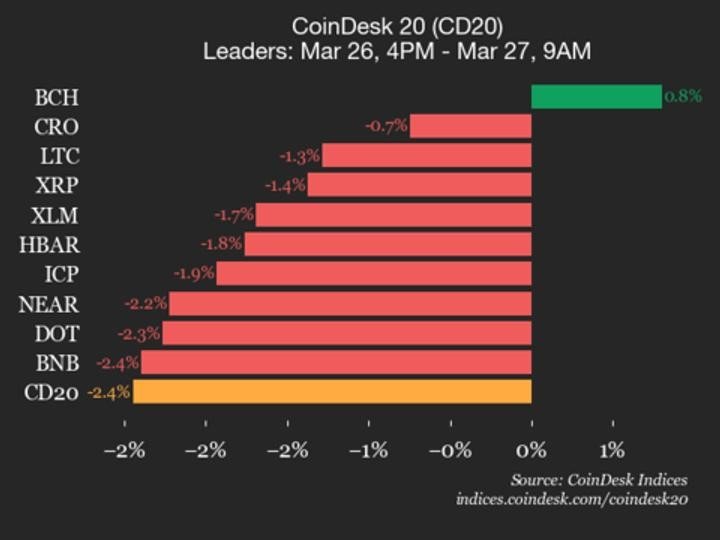
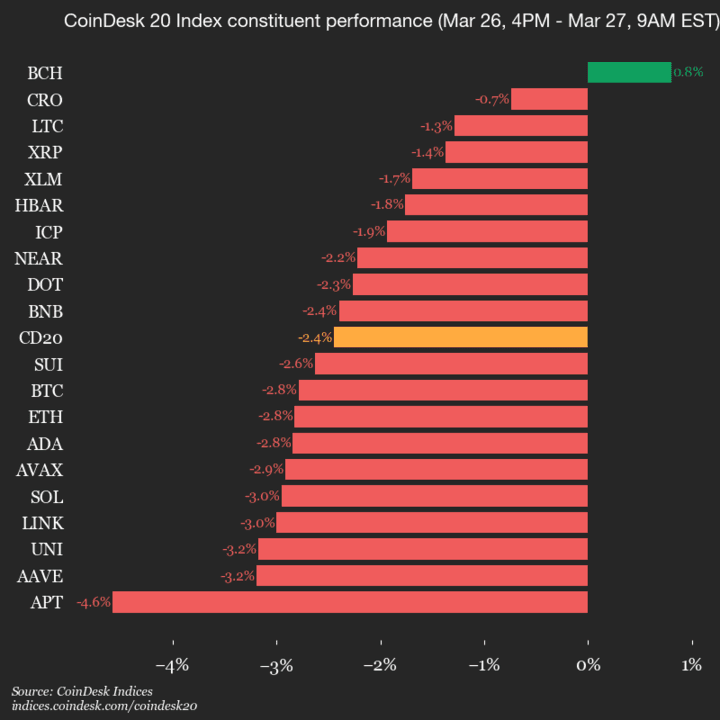
    CoinDesk Indices presents its daily market update, highlighting the performance of leaders and laggards in the CoinDesk 20 Index.

    The CoinDesk 20 is currently trading at 1912.59, down 2.4% (-47.98) since 4 p.m. ET on Thursday.

    One of 20 assets is trading higher.

    Leaders: BCH (+0.8%) and CRO (-0.7%).

    Laggards: APT (-4.6%) and AAVE (-3.2%).

    The CoinDesk 20 is a broad-based index traded on multiple platforms in several regions globally.

  • Investor Who Bought Bitcoin at a Low Price 13 Years Ago Transfers 500 BTC to Binance! Here Are the Details

    Investor Who Bought Bitcoin at a Low Price 13 Years Ago Transfers 500 BTC to Binance! Here Are the Details

    Another notable “whale” activity has emerged in the cryptocurrency market. According to onchain analysis, a former investor who bought Bitcoin at a low price approximately 13 years ago is continuing to divest some of their assets. It has been reported that this investor has transferred a portion of their Bitcoin holdings back to the Binance exchange.

    This “early whale” first purchased 5,000 $BTC approximately 13 years ago at an average price of $332 per $BTC. In his latest transaction, the investor transferred 500 $BTC to Binance. At current prices, this amount is estimated to be worth approximately $33.28 million.

    It is stated that the same whale has been selling gradually since November 2024, sending a total of 4,000 $BTC to the exchange. The total value of these transfers is estimated to be approximately $365 million, with an average selling price of $91,258. Thus, it is calculated that the investor has made a total profit of approximately $363 million.

    According to the data, the address in question still holds 1,000 $BTC. The current market value of this amount is approximately $66.62 million.

    Experts note that such large-scale transfers can create selling pressure on the market, but also reflect the tendency of long-term investors to take profits. Whale movements continue to be closely monitored by investors, especially in terms of market direction.

    *This is not investment advice.

  • Venture Firm Founder Offers Bounty to Help Recover $42 Million in Stolen Bitcoin, Crypto

    Venture Firm Founder Offers Bounty to Help Recover $42 Million in Stolen Bitcoin, Crypto

    In brief

    • Bo Shen, founder of Fenbushi Capital, is offering a 10-20% bounty to those who can help him recover a portion of $42 million that was stolen from him in 2022.
    • The theft was allegedly due to a compromised seed phrase, leading to the loss of around $38 million in stablecoins in addition to Bitcoin and Ethereum.
    • The venture founder believes new on-chain tooling and AI can help crack the case.

    Bo Shen, the founder of crypto venture firm Fenbushi, is offering a bounty of 10-20% to any individuals able to help him recover a portion of the $42 million in Bitcoin, Ethereum, and stablecoins stolen from his personal wallet in 2022. 

    The malicious actor made off with crypto assets now valued around $42 million, highlighted by $38 million in Circle’s dollar-backed stablecoin USDC, but also 1,607 Ethereum, nearly $720,000 in Tether’s stablecoin USDT, and 4.13 Bitcoin. 

    “Three years have passed. The investigation has never stopped,” said Shen in a post on X. “Our team has continued to gather critical evidence and leads. The flow of the stolen assets is becoming increasingly clear,” he added while making a public bounty offer. 

    “Any individual or organization that makes a substantive contribution to asset recovery—regardless of identity, background, or method—will receive 10%–20% of the total recovered amount, based on the level of contribution,” he added.

    About $1.2 million of the funds have been frozen to date thanks to help from notable on-chain analyst Taylor Monahan and pseudonymous sleuth ZachXBT. 

    Now, though, Shen thinks the advances in on-chain tooling and artificial intelligence (AI) can help do even more in the case. 

    “This is not just about recovering assets,” he said. “It is about opening a real case to the community, inviting collaboration, and seeing how far the tools of the AI era can push what was once impossible.” 

    The theft from Shen’s personal wallet took place in November 2022, allegedly as a result of a compromise of his seed phrase, the 12 or 24 word phrase that unlocks a wallet’s private key,  according to analysis by blockchain security firm SlowMist.

    Shortly after the theft, it was reported to local law enforcement, according to Shen, with the FBI and lawyers also involved. 

    Established in 2015, Shen’s Fenbushi Capital says it has more than $1.6 billion in assets under management. Its portfolio includes major crypto firms like exchange Bybit and stablecoin issuer Circle, alongside holdings of Ethereum and Zcash

    Daily Debrief Newsletter

    Start every day with the top news stories right now, plus original features, a podcast, videos and more.

  • Wikipedia Bans AI-Generated Text in Articles Under New Editing Policy

    Wikipedia Bans AI-Generated Text in Articles Under New Editing Policy

    In brief

    • Wikipedia now prohibits editors from using large language models to generate or rewrite article content.
    • The policy still allows limited AI-assisted copyediting if editors review the changes and no new content is introduced.
    • The rule reflects growing concerns about hallucinations, fabricated sources, and accuracy in AI-generated text.

    Wikipedia editors have moved to restrict how artificial intelligence can be used on the platform, in a recent policy update banning the use of large language models to write or rewrite articles.

    The new guideline reflects growing concern within the Wikipedia community that AI-generated text can conflict with the platform’s standards, particularly around verifiability and reliable sourcing.

    “Text generated by large language models often violates several of Wikipedia’s core content policies,” the policy update reads. “For this reason, the use of LLMs to generate or rewrite article content is prohibited, save for the exceptions given below.”

    The policy still allows limited use of AI tools, including suggesting basic copy edits to an editor’s own writing, provided the system does not introduce new information. However, editors are advised to review those suggestions carefully.

    While the new policy does not mention penalties for using AI-generated content, according to Wikipedia’s guidelines around disclosure, repeating misuse forms a “pattern of disruptive editing,” and may lead to a block or ban. Wikipedia does give editors a path to reinstate their accounts following an appeal process.

    “Blocks can be reversed with the agreement of the blocking admin, an override by other admins in the case that the block was clearly unjustifiable, or (in very rare cases) on appeal to the Arbitration Committee,” Wikipedia said.

    “The Wikimedia Foundation does not determine editorial policies and guidelines on Wikipedia; volunteer editors do,” a Wikimedia Foundation spokesperson told Decrypt. “Wikipedia’s strength has been and always will be its human-centered, volunteer-driven model.”

    According to Emily M. Bender, a professor of linguistics at the University of Washington, some uses of language models in editing tools may be reasonable, but drawing a clear boundary between editing and generating text can be difficult.

    “So one of the things that you can do with a language model is build a very good spell checker, for example,” Bender told Decrypt. “I think it’s reasonable to say it’s fine to run a spell checker over edits. And if you are doing the next level up, a grammar checker, that can also be fine.”

    Bender said the challenge comes when systems move beyond correcting grammar and begin altering or generating content, noting that large language models lack the kind of accountability that human contributors bring to collaborative knowledge projects.

    “Using large language models to produce synthetic text, it is a fundamental property of these systems that there is no accountability, no connection to what someone believes or stands behind,” she said. “When we speak, we speak based on what we believe and what we are accountable for, not based on some objective notion of truth. And that’s not there for large language models.”

    Bender said widespread use of AI-generated edits could also affect the site’s reputation.

    “If people are instead taking shortcuts and making something that looks like a Wikipedia edit or article and putting it there, then that degrades the overall value and reputation of the site,” she said.

    Joseph Reagle, associate professor of communication studies at Northeastern University, who studies Wikipedia’s culture and governance, said the community’s response reflects longstanding concerns about accuracy and sourcing.

    “Wikipedia is wary of AI generated prose,” Reagle told Decrypt. “They take the accurate characterizations of what reliable sources state about a topic seriously. AI has had serious limitations on that front, such as ‘hallucinated’ claims and fabricated sources.”

    Reagle said Wikipedia’s core policies also shape how editors view AI tools, noting that many large language models have been trained on Wikipedia content. In October, the Wikimedia Foundation said human visits to Wikipedia fell about 8% year over year as search engines and chatbots increasingly provide answers directly on their platforms, rather than sending users to the site.

    In January, the Wikimedia Foundation announced agreements with AI companies, including Microsoft, Google, Amazon, and Meta, allowing them to use Wikipedia material through its Enterprise product, a commercial service designed for large-scale reuse of its content.

    “While the use of Wikipedia content is permitted by Wikipedia’s licenses, there’s still some antipathy among Wikipedians about services that appropriate the content of communities and then place unwanted demands on those communities to deal with the consequent glut of AI slop,” Reagle said.

    Despite the prohibition on using LLMs, Wikipedia does permit AI tools to translate articles from other language editions into English, provided editors verify the original text. The policy also warns editors not to rely on writing style alone to identify AI-generated content and instead focus on whether the material complies with Wikipedia’s core policies and the contributor’s editing history.

    “Some editors may have similar writing styles to LLMs,” the update says. “More evidence than just stylistic or linguistic signs is needed to justify sanctions, and it is best to consider the text’s compliance with core content policies and recent edits by the editor in question.”

    Editor’s note: This article was updated after publication to include comment from the Wikipedia Foundation.

    Daily Debrief Newsletter

    Start every day with the top news stories right now, plus original features, a podcast, videos and more.

  • Analysts Say It Could Take 300 Days for Bitcoin to Return to Its Previous Peak! Here’s Why

    Analysts Say It Could Take 300 Days for Bitcoin to Return to Its Previous Peak! Here’s Why

    A noteworthy analysis regarding the recovery process in cryptocurrency markets has been published. Data and analysis platform Ecoinometrics revealed that declines in Bitcoin price are directly related to the recovery period.

    According to an analysis shared by the platform via X, the deeper the decline in Bitcoin, the longer it takes to return to its previous peak levels. The analysis suggests that each additional 10% increase in the rate of decline adds an average of 80 days to the recovery period.

    Calculations based on this model predict that, given Bitcoin’s current low level, it could take approximately 300 days for it to reach its previous all-time high again.

    Ecoinometrics specifically emphasized that this data is not a direct price prediction, but merely a timing indicator based on historical trends. Analysts suggest that investors should consider such data in conjunction with broader market dynamics rather than in isolation.

    According to the data, Bitcoin has fallen by approximately 45 percent from its peak of $126,000 reached in October 2025, dropping to around $68,900 as of March 27. This decline indicates that volatility persists in the markets and that the recovery process may take time.

    Experts point out that both macroeconomic conditions and investor demand need to be supportive for Bitcoin to re-enter a strong upward trend.

    *This is not investment advice.

  • Bitcoin macro risks spike as Ukraine throws a spanner in Trump’s plan to stabilize oil markets

    Ukraine has complicated President Donald Trump’s efforts to stabilize oil markets amid the Iran war, amplifying risks for financial markets, including cryptocurrencies.

    For nearly a month, markets have been gripped by a single concern: the Iran war. Disruptions in the Strait of Hormuz – a critical oil chokepoint – have driven prices sharply higher, stoking fears of sticky inflation, a risk-off shift, and renewed Fed rate hikes.

    To cool things down, the Trump administration quickly lifted sanctions on Russian crude for the short term, opening the tap to compensate for oil supply disruptions caused by the Iran war.

    It came across as a solid plan to stabilize energy markets until Ukraine blew it up.
    This week, Ukraine launched drone strikes on ports and refiners in Russia’s Leningrad, leading to what one observer described as “the most serious threat” to the country’s oil exports since Putin’s full-scale invasion of Ukraine in 2022.

    The damage is significant, with roughly 40% of Russia’s oil export capacity offline. Oilprice.com editor Michael Kern described it as “a logistics problem first – and a supply problem second,” underscoring that moving oil to buyers is now as difficult as producing it.

    “In conjunction with the war in the Middle East and de facto closure of the Strait of Hormuz and subsequent oil/LNG production outages, the Russian disruption adds a fresh element to already sky-high oil prices,” Kern noted.

    In other words, oil prices may remain elevated longer than initially expected. For risk assets, including bitcoin and other cryptocurrencies, that’s an issue because higher sticky energy prices could lead to sticky inflation, potentially putting pressure on global central banks to raise borrowing costs and drain liquidity.

    Traders are already prepping for a potential Fed rate hike in the short term. According to Bloomberg, flows in the options market tied to overnight interest rates indicate traders are wagering on a rate increase within two weeks.

    Taken together, these factors suggest bitcoin’s recent resilience may face tests, with the $65,000–$75,000 range vulnerable to a downside break.

    At press time, bitcoin traded near $68,500, down nearly 2% over the past 24 hours, according to CoinDesk data. WTI oil, which slipped nearly 10% to $83.95 per barrel on Monday, has since bounced back to $93.50. Brent crude is once again trading above the $100 mark.

  • Kraken’s Fed Master Account Faces Scrutiny as Lawmaker Questions Its Legal Foundation

    Kraken’s Fed Master Account Faces Scrutiny as Lawmaker Questions Its Legal Foundation

    WASHINGTON, D.C. – In a significant development for cryptocurrency regulation, a prominent U.S. lawmaker has raised serious questions about the legal foundation of Kraken’s Federal Reserve master account, potentially challenging the crypto exchange’s direct access to the nation’s central banking system. Representative Maxine Waters, the ranking Democrat on the House Financial Services Committee, has formally questioned the Federal Reserve Bank of Kansas City about its approval of what it terms a “limited master account” for the digital asset platform. This inquiry comes at a crucial moment for cryptocurrency integration into traditional finance, highlighting ongoing tensions between innovation and regulatory oversight.

    Kraken’s Federal Reserve Master Account Faces Legal Scrutiny

    According to documents obtained by financial news outlets, Representative Waters sent a detailed letter to the Federal Reserve Bank of Kansas City requesting clarification about Kraken’s banking arrangement. The letter specifically challenges the legal basis for what the Fed calls a “limited master account,” a designation that allows Kraken to directly utilize Federal Reserve payment services without traditional banking intermediaries. Waters argues in her correspondence that no such category as a “limited account” exists within established law or official guidance from the Federal Reserve Board of Governors. Consequently, she has requested comprehensive information about the conditions and approval process for Kraken’s special status.

    The Federal Reserve master account system represents the backbone of the United States payment infrastructure. Financial institutions with these accounts gain direct access to Federal Reserve services including:

    • Real-time payment processing through Fedwire Funds Service
    • Securities settlement capabilities
    • Automated Clearing House (ACH) transaction access
    • Direct reserve account maintenance

    Traditionally, only depository institutions like banks and credit unions have qualified for these accounts. However, the emergence of novel financial entities has prompted regulatory adaptation. The Kansas City Fed’s approval for Kraken represents a notable exception to historical precedent, potentially setting important precedents for other cryptocurrency exchanges seeking similar access.

    Understanding Federal Reserve Master Accounts

    Federal Reserve master accounts serve as fundamental components of the U.S. financial system. These accounts enable institutions to hold reserves directly with the Federal Reserve, facilitating interbank transactions and monetary policy implementation. The significance of Kraken obtaining such access cannot be overstated, as it represents a major step toward cryptocurrency integration with traditional finance infrastructure. Master account holders bypass correspondent banking relationships, potentially reducing transaction costs and settlement times significantly.

    The Federal Reserve has historically maintained strict criteria for master account eligibility. According to Federal Reserve regulations, eligible institutions typically include:

    Kraken’s situation represents a departure from these traditional categories. The exchange operates under state money transmitter licenses rather than federal banking charters, creating regulatory ambiguity that Waters’ letter seeks to address. This development follows years of cryptocurrency exchanges seeking banking relationships amid increasing regulatory scrutiny of the digital asset sector.

    Regulatory Context and Historical Precedent

    The Federal Reserve Act provides the statutory framework for master account access, but interpretation has evolved alongside financial innovation. In 2021, the Federal Reserve clarified its approach to novel institution applications through official guidance. However, the concept of a “limited master account” remains undefined in published regulations, creating the legal uncertainty that Waters highlights. Previous non-bank entities have occasionally obtained restricted access, but cryptocurrency exchanges represent a particularly complex category due to their unique risk profiles and regulatory status.

    Legal experts note that Waters’ inquiry touches on fundamental questions about financial system access. “The Federal Reserve’s payment systems represent critical national infrastructure,” explains financial regulation professor David Carlson. “Determining which entities can directly access these systems involves balancing innovation with systemic risk management. The lack of clear statutory guidance for novel institutions like cryptocurrency exchanges creates regulatory ambiguity that lawmakers are now addressing.”

    Political Implications and Regulatory Future

    Representative Waters’ position as ranking Democrat on the House Financial Services Committee gives her inquiry particular significance. Political observers note she is considered a leading candidate to return as committee chair if Democrats regain House majority in upcoming elections. This potential leadership role amplifies the importance of her current regulatory questions. Waters has historically taken a cautious approach toward cryptocurrency regulation, emphasizing consumer protection and systemic stability concerns.

    The timing of this inquiry coincides with broader cryptocurrency regulatory developments. Multiple federal agencies are currently developing comprehensive frameworks for digital asset oversight. The Securities and Exchange Commission, Commodity Futures Trading Commission, and Treasury Department have all increased their focus on cryptocurrency markets. Additionally, Congress is considering several bills that would establish clearer regulatory parameters for digital assets and their service providers.

    Industry representatives have responded cautiously to Waters’ inquiry. “Direct access to Federal Reserve services represents an important milestone for cryptocurrency integration,” states Blockchain Association CEO Kristin Smith. “However, this access must come with appropriate regulatory clarity and oversight. We welcome congressional interest in ensuring the regulatory framework evolves alongside technological innovation.”

    Potential Impacts on Cryptocurrency Industry

    The outcome of Waters’ inquiry could significantly affect cryptocurrency exchange operations. If the Federal Reserve cannot adequately justify its “limited master account” categorization, Kraken might face modified access conditions. Furthermore, other cryptocurrency exchanges seeking similar arrangements could encounter increased scrutiny. The inquiry also highlights broader questions about how novel financial institutions should integrate with traditional banking infrastructure.

    Market analysts suggest several potential consequences:

    • Increased regulatory clarity for cryptocurrency banking relationships
    • Potential standardization of master account categories for non-bank entities
    • Possible congressional action to amend Federal Reserve Act provisions
    • Enhanced scrutiny of all non-traditional financial institution applications

    The Federal Reserve Bank of Kansas City now faces pressure to provide detailed justification for its decision. Federal Reserve regulations typically allow individual Reserve Banks discretion in master account approvals, but congressional oversight represents a significant check on this authority. The Kansas City Fed’s response to Waters’ inquiry will likely establish important precedents for how Federal Reserve districts handle similar applications moving forward.

    Conclusion

    Representative Maxine Waters’ inquiry into Kraken’s Federal Reserve master account highlights ongoing tensions between financial innovation and regulatory oversight. The legality of Kraken’s banking access remains uncertain as lawmakers question the Federal Reserve’s categorization approach. This development represents a critical moment for cryptocurrency regulation, potentially influencing how digital asset exchanges integrate with traditional financial infrastructure. As regulatory frameworks continue evolving, clarity around Federal Reserve master account access will significantly shape the cryptocurrency industry’s future development and integration with the broader financial system.

    FAQs

    Q1: What is a Federal Reserve master account?
    A Federal Reserve master account allows financial institutions to hold reserves directly with the Federal Reserve and access its payment systems. These accounts enable direct interbank transactions and are typically reserved for depository institutions like banks and credit unions.

    Q2: Why is Representative Waters questioning Kraken’s master account?
    Representative Waters questions the legal basis for what the Federal Reserve calls a “limited master account” for Kraken. She argues this category doesn’t exist in law or Federal Reserve guidance, creating regulatory ambiguity about cryptocurrency exchange access to central banking services.

    Q3: What distinguishes a “limited master account” from a regular master account?
    The Federal Reserve hasn’t publicly defined “limited master account” parameters. Typically, master accounts provide full access to Federal Reserve services, while limited versions might restrict certain functions. However, without official definitions, the distinction remains unclear.

    Q4: How could this inquiry affect other cryptocurrency exchanges?
    If the Federal Reserve cannot adequately justify Kraken’s arrangement, other exchanges seeking similar access might face increased scrutiny. The inquiry could prompt clearer standards for cryptocurrency exchange banking relationships with the Federal Reserve system.

    Q5: What happens if the Federal Reserve cannot provide satisfactory answers?
    Unsatisfactory responses could lead to congressional hearings, potential legislation, or revised Federal Reserve guidance. Representative Waters could use her committee position to pursue more formal oversight of Federal Reserve decisions regarding non-traditional financial institutions.

    Disclaimer: The information provided is not trading advice, Bitcoinworld.co.in holds no liability for any investments made based on the information provided on this page. We strongly recommend independent research and/or consultation with a qualified professional before making any investment decisions.


  • Toncoin Faces Crucial At The $1 Range, Will It Hold Or Break?

    Toncoin Faces Crucial At The $1 Range, Will It Hold Or Break?

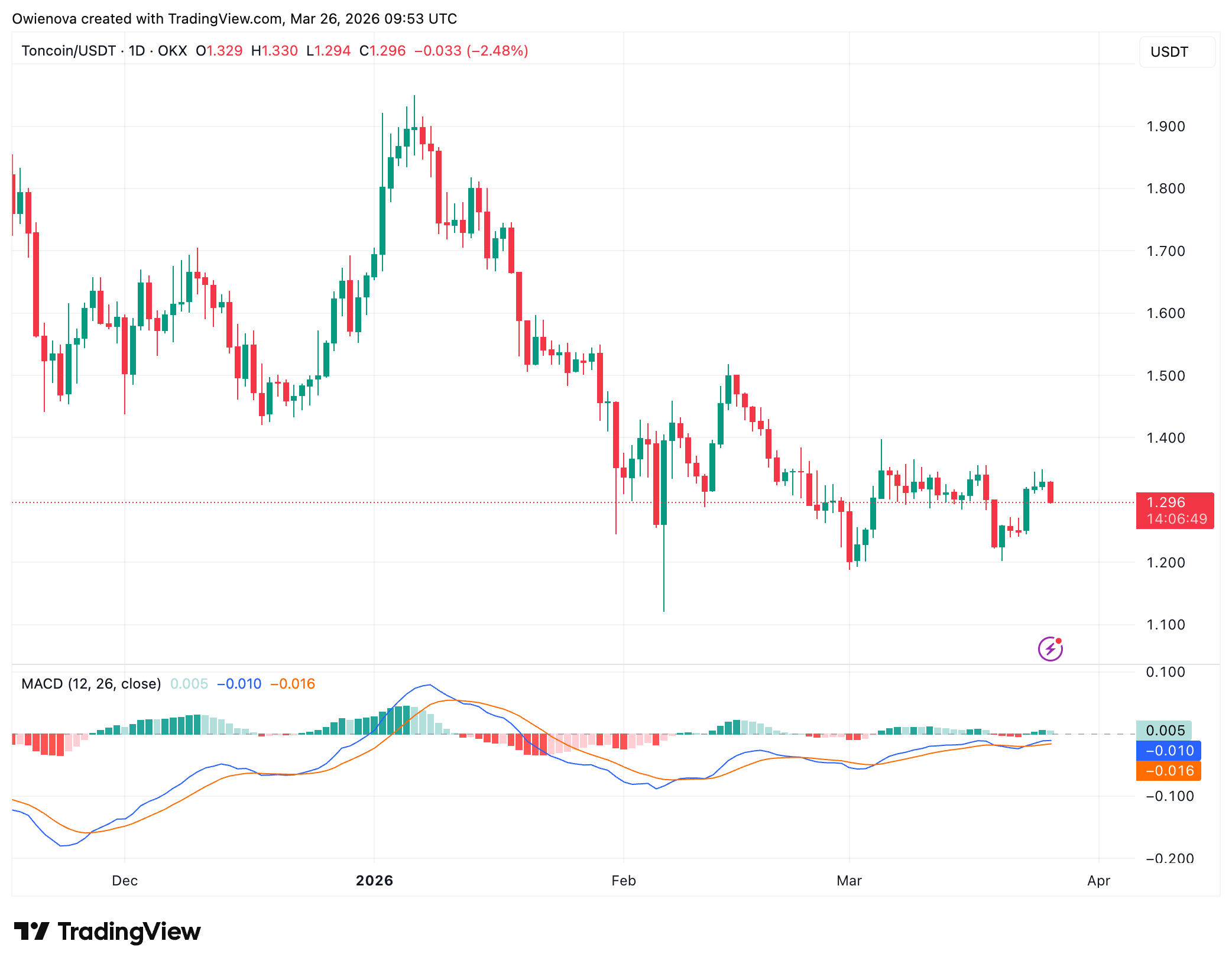
    Toncoin is at a critical juncture as it tests the $1 range, a key level that has anchored its trading for weeks. How it reacts here could determine whether the range holds or breaks, setting the stage for either a bullish flip or an accelerated drop. With strong fundamentals in play but the chart still in control, traders are watching closely for the decisive signal.

    Range Flip Or Breakdown: What $BTC Pair Tells Us About Toncoin

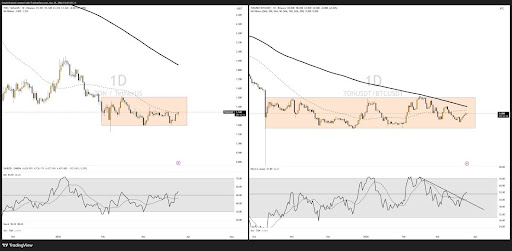
    Charting the $TON/$BTC and $TON/$USDT daily pairs, analyst Umair Crypto points out that Toncoin is at a critical juncture. On the $BTC pair, the RSI has broken above its trendline, signaling early bullish momentum. However, the 200 SMA on this pair remains the key level to watch, as it will determine whether the $1 support on the $USDT pair holds or if the range flips higher.

    The $BTC pair has been consolidating within a range for 166 days, and the recent RSI trendline breakout above 50 hints that bullish pressure is building. Meanwhile, on the $USDT pair, price is attempting to recover the 50 SMA, showing early signs of strength, though confirmation is still needed.

    From here, two scenarios are possible. If the $BTC pair closes convincingly above the 200 SMA, it would likely trigger a range flip on Toncoin’s $USDT pair to the upside. Conversely, if the $BTC pair gets rejected at the 200 SMA, the range may break down, putting Toncoin at risk of forming a lower low below $1. Such a breakdown would shift the market structure into bearish territory and could accelerate selling pressure, making $1 a crucial level to watch.

    $1 Support: More Than Just A Psychological Level

    The analyst stressed that the $1 level is far more than a psychological benchmark; it is a critical structural support that anchors the entire $TON/$USDT range. If this level fails, the decline could accelerate sharply, making it a key inflection point for traders and investors alike. Holding above $1 is essential to maintain the current range and prevent a potential breakdown that could trigger further selling pressure.

    Even with strong fundamental catalysts, the market has remained largely unresponsive. AlphaTON Capital Corp recently launched a $100 million treasury strategy, while $TON Wallet officially expanded into the US market, both moves signaling growing institutional adoption.

    At this critical juncture, the $BTC pair’s 200 SMA is shaping up as the ultimate deciding factor. A decisive close above this level could reinforce $1 as strong support and pave the way for a bullish range flip. Conversely, rejection at the 200 SMA could tip the market into bearish territory, signaling that structural weakness now overrides fundamental optimism.

    Featured image from Adobe Stock, chart from Tradingview.com