Category: Business

  • Donald Trump and His Team Sold a Large Amount of the TRUMP Memecoin

    Donald Trump and His Team Sold a Large Amount of the TRUMP Memecoin

    Allegations of selling the $TRUMP token, believed to be linked to US President Donald Trump, increased downward pressure on the market. According to on-chain analysis, a significant amount of token movement occurred from addresses alleged to belong to the Trump team.

    According to the data, it is estimated that the Trump team sold over $16.06 million worth of $TRUMP tokens in total. Analysis shows that in the last two hours, 5.48 million $TRUMP tokens were deposited into the OKX exchange from a BitGo escrow address. This represents approximately a $15 million token transfer.

    Upon investigation of the funds’ source, it was determined that these assets originated approximately two months ago from an address associated with team shares known as the “Trump Team Allocation.” It is stated that this address transferred 18.14 million tokens to the exchange at that time, an amount worth approximately $81.64 million.

    Related News Jordi Visser, a 30-Year Veteran Analyst: “Bitcoin Will Set a New Record This Year, But the Situation Is Different for Altcoins”

    These market developments appear to have put pressure on the $TRUMP token price. The token is currently trading at $2.86, having lost 9.4% of its value on a weekly basis. With a market capitalization of approximately $666.7 million, the token has also shown a downward trend in the last 24 hours.

    *This is not investment advice.

  • New Ethereum project aims to fix network fragmentation and improve user experience

    New Ethereum project aims to fix network fragmentation and improve user experience

    A group of Ethereum projects have announced a new effort aimed at fixing a growing problem in Ethereum: its ecosystem is becoming too fragmented.

    Revealed at the EthCC conference in Cannes, the project — called the “Ethereum Economic Zone” (EEZ) — is designed to make Ethereum’s many add-on networks (known as layer 2s, or L2s) work together more seamlessly.

    The framework is being developed by Gnosis, Zisk and the Ethereum Foundation. Gnosis is a longtime Ethereum infrastructure developer, while Zisk focuses on zero-knowledge proving technology.

    It comes as Ethereum for years relied on L2 networks to scale, though these networks often operate like separate islands. Users have to move assets between them using bridges, which can be slow, costly and risky, while developers often have to rebuild the same tools on each network.

    The EEZ aims to change that by making all these networks feel like one unified system. In simple terms, it would allow apps and transactions on different Ethereum networks to interact instantly — without needing bridges — while still relying on Ethereum’s core security.

    The announcement comes as Ethereum’s long-term reliance on L2 scaling has faced renewed debate. Ethereum co-founder Vitalik Buterin has recently suggested the ecosystem may need to rethink parts of its L2-heavy roadmap, particularly as fragmentation and user experience issues persist. The EEZ appears to directly address those concerns by trying to unify liquidity, infrastructure and user flows across networks, rather than adding more isolated chains

    The idea is to create shared liquidity (so funds can move freely), simpler infrastructure for developers, and a smoother experience for users. The system would also continue to use ETH as its main token for fees, rather than introducing new ones.

    The project is being developed openly with input from the wider Ethereum community.

    “Ethereum doesn’t have a scaling problem. It has a fragmentation problem. Every new L2 is a silo that makes it harder to seamlessly extend and drive value back to the Ethereum mainnet,” said Friederike Ernst, co-founder of Gnosis, in a press release shared with CoinDesk. “The EEZ is designed to do the opposite.”

    Read more: From ‘Ethereum’s sidekick’ to standalone stars: How Vitalik Buterin’s latest pivot is forcing Layer 2s to grow up

  • France’s largest bank to debut Bitcoin, Ether ETNs for French retail clients tomorrow

    France’s largest bank to debut Bitcoin, Ether ETNs for French retail clients tomorrow

    France’s largest lender BNP Paribas is bringing six new crypto exchange-traded notes (ETNs) tied to Bitcoin and Ethereum to its exchange platform in France, starting tomorrow March 30, according to a recent announcement.

    Exchange-traded notes (ETNs) are tradeable debt products that give investors exposure to the underlying markets through index tracking. They provide liquid and diversified exposure without direct ownership, though investors face issuer credit risk and potential market losses.

    Offered under MiFID II, which is designed to boost transparency standardize market operations, and protect investors, the ETNs let millions of individual investors and private banking clients get indirect exposure to crypto assets without purchasing or holding the underlying coins directly.

    At launch, the products, issued by vetted asset managers, will be available to various client segments, with a phased international rollout to follow.

    As one of the early movers of blockchain and crypto, BNP Paribas has tested blockchain use cases in areas such as trade finance and securities settlement, formed partnerships with fintech and blockchain firms, and shown interest in developing digital asset services for institutional clients.

    The group has also supported ongoing research into how these innovations could reshape financial markets.

    BNP Paribas is part of Qivalis, a consortium of major European banks working to develop a euro-pegged stablecoin for institutional and crypto use. The initiative is targeting a late-2026 launch under MiCA rules.

    BNP Paribas pilots tokenized money market fund on Ethereum

    BNP Paribas recently piloted the tokenization of a money market fund share class on public Ethereum infrastructure.

    Built on a permissioned model, the initiative restricts access to eligible participants while remaining compliant with regulatory standards. The intra-group experiment aims to evaluate new operational workflows and explore how tokenisation could improve fund issuance and distribution.

    French retail investment

    France’s retail investment base has grown meaningfully in recent years. Roughly 2.5 million French retail investors participated in stock-market trading during 2025, with an estimated 1.6 million new entrants joining the country’s equity markets over the preceding three years.

    If even a fraction of the roughly €2 trillion in liquid savings held by French households rotates toward these newinstruments, the capital implications for Bitcoin and Ethereum order books could be significant.

  • Expert Analyst: “Bitcoin’s Key Resistance Level Is $72,500; Selling Pressure May Persist”

    A noteworthy analysis regarding Bitcoin’s price outlook in the cryptocurrency market has been shared. According to analysts, Bitcoin is facing strong resistance at the $72,500 level, and the likelihood of continued selling pressure in the coming months is high.

    Darkfost, an analyst at the crypto analysis platform CryptoQuant, stated that Bitcoin has not yet crossed a significant threshold when considering its long-term supply dynamics. According to the analyst, excluding the supply that has been dormant for over 7 years and any lost Bitcoins more accurately reflects the actual circulating supply in the market. Following this correction, Bitcoin’s current price is estimated to be around $72,500, a level currently acting as strong resistance.

    Related News Jordi Visser, a 30-Year Veteran Analyst: “Bitcoin Will Set a New Record This Year, But the Situation Is Different for Altcoins”

    Darkfost noted that Bitcoin has been trading below this level for about two months, pointing to similar behavior in past bear markets. According to them, in previous cycles, BTC remained below this cost floor for 6 to 10 months and struggled to regain that level.

    The analysis argued that if historical trends repeat themselves, Bitcoin could remain under pressure in the coming period, and the price could continue to consolidate below the $72,500 level.

    *This is not investment advice.

  • XRP tests $1.33 as rising leverage and weak price action create unstable setup

    XRP tests $1.33 as rising leverage and weak price action create unstable setup

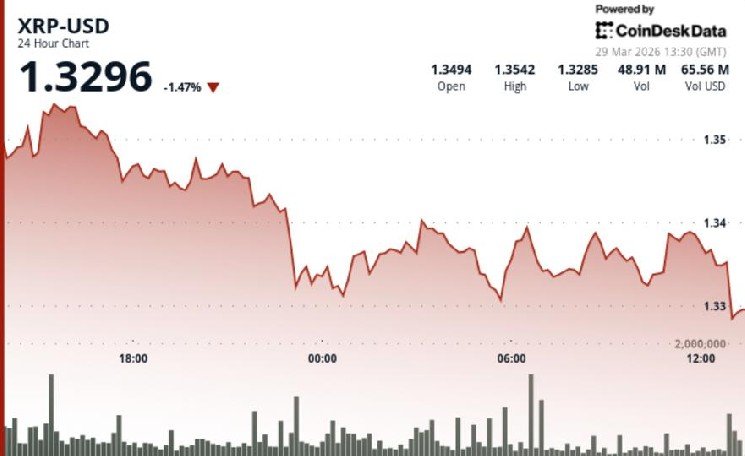
    $XRP is holding near $1.33, but the setup is getting fragile. Price isn’t collapsing, but it’s not recovering either — and that kind of drift lower, paired with rising leverage, usually doesn’t resolve quietly.

    News Background

    • $XRP slipped slightly over 24 hours, staying pinned near $1.33
    • Funding rates jumped sharply while long liquidations picked up, signaling aggressive positioning
    • Large volume spikes earlier in the session failed to translate into sustained upside

    Price Action Summary

    • Price briefly pushed higher but was rejected near $1.35-$1.36
    • The market has since rotated lower into support around $1.33
    • Structure shows lower highs, even as support continues to hold
    • Momentum has clearly slowed rather than reversed

    Technical Analysis

    • This is a classic tension setup: positioning is increasing, but price isn’t following
    • Rising funding rates suggest traders are leaning bullish, yet repeated rejections show sellers still control the tape
    • The failed follow-through after high-volume moves is the key signal — demand isn’t strong enough yet
    • That mismatch often leads to sharper moves once one side gets forced out

    What traders should watch

    • $1.33 is the immediate line — a break likely accelerates toward $1.30
    • On the upside, reclaiming $1.35-$1.36 is needed to shift momentum
    • The bigger tell is positioning: if leverage keeps building without price moving higher, downside risk increases
  • Bittensor ecosystem tokens’ value hit $1.5 billion as Jensen Huang endorsement supports TAO rally

    Bittensor ecosystem tokens’ value hit $1.5 billion as Jensen Huang endorsement supports TAO rally

    Bittensor’s $TAO has rallied 90% so far this month, and the tokens in its ecosystem are running up even harder.

    The network’s subnet token category reached a combined market cap of $1.47 billion on Monday, with $118 million in 24-hour trading volume, according to CoinGecko data.

    The surge follows $TAO‘s own run from $180 to above $332 in March, but the subnet tokens are where the real action is. Templar, the token for Subnet 3, gained 444% in 30 days. OMEGA Labs rose 440%. Level 114 added 280%. BitQuant gained 230%. Even the larger subnet tokens posted significant returns, with Chutes up 54% and Targon gaining 166%.

    Bittensor is a decentralized network that creates marketplaces for artificial intelligence. Instead of one company building and controlling AI models, Bittensor incentivizes a global network of participants to contribute computing power, data, and machine learning models in exchange for $TAO, the network’s native token.

    The network is divided into specialized sub-networks called subnets, each focused on a different AI task, from training language models to running compute infrastructure to cybersecurity analysis. There are currently 128 active subnets, each with its own token whose value is tied directly to the amount of $TAO staked into it.

    Several catalysts contributed to these moves of the Bittensor’s ecosystem tokens.

    Subnet 3 produced Covenant-72B, a large language model trained permissionlessly across Bittensor’s decentralized network by over 70 contributors using commodity internet hardware.

    The model was trained on 1.1 trillion tokens and achieved a 67.1 MMLU score, confirmed in a March 2026 arXiv paper. That puts it in competitive range with Meta’s Llama 2 70B, a model built by one of the most well-resourced AI labs in the world. (MMLU, or Massive Multitask Language Understanding, is a standardized test for AI models that scores them across 57 academic subjects.)

    Subnet 3, called Templar, is Bittensor’s decentralized AI training network. Miners contribute GPU compute power and compete to produce useful training gradients for large language models, while validators evaluate the quality of their contributions and distribute $TAO rewards accordingly.

    Think of it as a way to train AI models the same way bitcoin mines blocks, with distributed participants around the world contributing hardware and getting paid for useful work.

    Elsewhere, Nvidia CEO Jensen Huang and investor Chamath Palihapitiya endorsed Bittensor’s approach on the All-In Podcast on March 20, framing decentralized AI training as complementary to proprietary models. Coming from the CEO whose blog post earlier this month briefly helped reverse a tech stock selloff, the endorsement carried weight beyond the usual crypto echo chamber.

    How subnet tokens work

    The subnet token mechanics explain why the gains are so outsized relative to $TAO itself.

    Since Bittensor launched dynamic $TAO in February 2025, each subnet operates its own automated market maker with a native token whose valuation is determined by the $TAO staked into that subnet’s reserves. When $TAO appreciates, every subnet’s reserve becomes more valuable, inflating token prices and attracting more stakers. The relationship is reflexive and amplifies moves in both directions.

    With $TAO at roughly $3 billion in market cap and individual subnet tokens ranging from $1 million to $137 million, the subnet tokens function as leveraged bets on the parent protocol.

    The network plans to expand from 128 to 256 active subnets later this year, which would bring a new wave of token launches.

    A potential regulatory decision on converting the Grayscale $TAO Trust into a spot ETF could provide institutional access by late 2026. And Digital Currency Group subsidiary Yuma is already contributing to 14 different subnets, suggesting the smart money is treating this as infrastructure rather than speculation.

    Whether the subnet rally sustains depends on whether Bittensor keeps producing competitive AI models or whether Covenant-72B was a one-off that got lucky timing with a Huang endorsement.


  • Countdown for Bitcoin and Altcoins Has Begun: Google Has Given Until 2029 to Address the Quantum Threat

    Technology giant Google has made a noteworthy statement regarding the risks that quantum computers pose to current cryptography systems.

    The company announced that authentication systems should transition to post-quantum cryptography (PQC) by 2029. This statement has reignited a significant debate, particularly regarding the future of blockchain networks like Bitcoin and Ethereum.

    In December 2024, after Google introduced its “Willow” quantum chip, the general consensus in the cryptocurrency sector was that the threat was still far off. At the time, it was thought that the system, which only had 105 physical qubits, would need millions of qubits to break existing encryption methods.

    However, the picture has changed somewhat in the last 16 months. Google is now providing a more concrete timeline, citing advances in quantum hardware, error correction technologies, and computational capacity. The company’s security engineering team stated that quantum computers pose a serious threat, particularly to digital signatures and encryption systems.

    These risks are not just theoretical. Android 17 is beginning to integrate post-quantum signature protection, the Chrome browser supports post-quantum key exchange, and Google Cloud offers PQC solutions to enterprise customers.

    Related News Jordi Visser, a 30-Year Veteran Analyst: “Bitcoin Will Set a New Record This Year, But the Situation Is Different for Altcoins”

    The Bitcoin network uses the SHA-256 algorithm for mining and the ECDSA algorithm for signing transactions. ECDSA, in particular, stands out as a structure that can be broken by quantum computers.

    A sufficiently powerful quantum computer could derive private keys from public keys using Shor’s algorithm. This could theoretically lead to the theft of Bitcoins whose public keys are visible on blockchains.

    In the past, it was calculated that millions of physical qubits would be needed for this scenario to occur. However, Google’s advancements in error correction and its 2029 target suggest that this process could progress faster than expected.

    On the other hand, some experts argue that quantum risk is exaggerated in the short term. According to CoinShares data, only about 10,200 $BTC are seriously at risk. A larger risk group of approximately 1.6 million $BTC is distributed across numerous wallets, making attacks practically more difficult.

    *This is not investment advice.

  • Ethereum Loses Key Support as Failed Breakout Signals Near-Term Caution for ETH Traders

    Ethereum Loses Key Support as Failed Breakout Signals Near-Term Caution for ETH Traders

    Ethereum ($ETH) continues to trade in a highly volatile environment along with the rest of the crypto market. Recently $ETH had an attempt to begin regaining bullish momentum after briefly returning to a major support area; however, it subsequently fell through that level again. Traders and analysts alike are questioning where $ETH will go next after this latest move. Daan Crypto Trades brought this “failed break above” to light, indicating that trading interest has now been neutralized until all prices return to defined target zones.

    Technical Breakdown – The Battle for $2,100

    Ethereum’s recent decline below $2100 is viewed by technical analysts as a bearish signal with multiple points of failure resulting from failed attempts to hold average prices above that mark. Historically, the $2100 price level has functioned as both a psychological barrier and a technical role in establishing market direction. The lack of consolidation above this price range ultimately caused an increase in selling pressure, pushing the price of $ETH back towards a region of previous consolidation.

    Recent charts printed in the marketplace indicate that the price movement of $ETH indicates that it is in “no-man’s land”. For investors that invest based on momentum, $ETH is not investable at this time until it either regains the $2,100 level or continues to drop in value to “test previous lows”. This evidence of caution gives insight into the larger market – the wait-and-see mentality of investors is currently the prevailing method of investing.

    Institutional Sentiment and Ecosystem Growth

    The price performance of Ethereum now appears to be quite erratic, but Ethereum itself is continuing to develop. The recent Dencun upgrade has enabled many transactions to be done for less cost on Layer 2 networks, allowing many more decentralized applications to continue to be built. However, the price action of Ethereum does not appear to represent these technical developments.

    In addition, anticipation for Ethereum ETFs is a mixed bag for investors. Increased institutional interest is offset by continued regulatory uncertainty in the US, thus adding to recent downward pressure on the price of Ethereum. According to CoinDesk’s recent report, continued scrutiny by the SEC over how they will classify Ethereum has cooled off the immediate enthusiasm related to ETF’s, which played a key role in driving Bitcoin prices higher.

    The Web3 Pivot – Integration Over Speculation

    Ethereum will remain a foundational layer of the growing Web3 economy notwithstanding volatility in price. Moving away from financial speculation, the focus is on functional utility within both the gaming and lifestyle industries. The switch to functional usage is key to holding Ethereum’s value over time, because it creates a natural demand for $ETH.

    Conclusion

    Ethereum has reached a critical junction in its trading journey. The drop below its dominant support level has thrown short term bullish sentiment off. However, Ethereum’s long-term value proposition continues to be derived from its position as the leader of the intelligent contract (smart contract) market. As a result, all traders should be watching the $2,100 resistance level closely; if Ethereum closes above that price level two or more days consecutively, this may indicate the triggering of an upcoming bullish rally.

    A continuation of the current price levels may see a retest of $1,800/yearly lows and provide long-term investors with an attractive buying opportunity. Patience will be the key to success when trading $ETH for the time being.

  • This Week in Crypto Law (Mar. 22, 2026)

    This Week in Crypto Law (Mar. 22, 2026)

    Law and Ledger is a news segment focusing on crypto legal news, brought to you by Kelman Law – A law firm focused on digital asset commerce.

    This Week in Crypto Law

    The opinion editorial below was written by Alex Forehand and Michael Handelsman for Kelman.Law.

    This week in crypto law highlighted a growing reality: legal and regulatory uncertainty is no longer just a compliance issue. Rather, it is actively shaping markets, business decisions, and global policy. From stalled U.S. legislation impacting price forecasts to aggressive enforcement actions abroad, the legal landscape continues to define the trajectory of digital assets.

    Legal Gridlock Hits Crypto Market Forecasts

    Citigroup lowered its 12-month price targets for Bitcoin and Ether, citing stalled U.S. crypto legislation as a key risk factor. The revision reflects a broader shift: regulatory uncertainty is now directly influencing market sentiment and institutional outlooks. Legal clarity is increasingly tied to valuation. Without a clear U.S. framework, institutional adoption may slow, putting downward pressure on digital asset prices. For more information, click here.

    Kraken Pauses IPO Amid Regulatory Uncertainty

    Kraken has reportedly paused its anticipated IPO, underscoring how regulatory headwinds continue to shape strategic decisions—even for established exchanges. The move reflects concerns around timing, compliance risk, and investor appetite in an uncertain legal environment. Public listings require heightened disclosure and regulatory scrutiny. For crypto firms, unresolved legal questions can delay or derail access to public capital markets. For more, click here.

    Vietnam Moves Toward Controlled Crypto Legalization

    Vietnam is advancing a proposal to legalize domestic crypto exchanges while restricting access to offshore platforms. Under the plan, firms would compete for licenses to operate locally, while foreign exchanges could face limitations or outright bans. This reflects a growing global trend toward jurisdiction-based regulation—encouraging domestic oversight while limiting cross-border crypto activity. For more, click here.

    Stablecoin Yield Ban Gains Traction in U.S. Senate

    A new draft of the “Clarity Act” in the United States Senate could prohibit yield or rewards on stablecoins. The proposal is driven in part by concerns from traditional banks that yield-bearing stablecoins could siphon deposits from the financial system. If enacted, the rule would significantly reshape the competitive dynamics between stablecoins and traditional banking products, potentially limiting a key driver of user adoption. For more, click here.

    UK Targets Crypto in Political Donations

    The United Kingdom is moving to ban cryptocurrency donations to political parties, citing risks related to foreign influence and transparency. The proposal would restrict anonymous digital asset contributions and impose stricter oversight on political funding. This marks a notable shift in how governments view crypto—not just as a financial tool, but as a potential national security concern in democratic processes. For more, click here.

    Australia Fines Binance for Investor Protection Failures

    Binance’s Australian derivatives arm was fined $6.9 million after a court found it misclassified retail investors as wholesale clients. The misclassification exposed users to higher-risk products without appropriate safeguards, resulting in significant losses. The ruling underscores intensifying global enforcement around investor protection and compliance, particularly in derivatives trading. For more, click here.

    Staying informed and compliant in this evolving landscape is more critical than ever. Whether you are an investor, entrepreneur, or business involved in cryptocurrency, our team is here to help. We provide the legal counsel needed to navigate these exciting developments. If you believe we can assist, schedule a consultation here.

    This Week in Crypto Archive:

    • This Week in Crypto Law (Mar. 15, 2026)
    • This Week In Crypto Law (Mar. 8, 2026)
    • This Week in Crypto Law (Mar. 1, 2026)
  • Onyx Protocol Announces Goliath Mainnet Launch, Bridging DeFi-TradFI Gap and Empowering Financial Institutions

    Onyx Protocol Announces Goliath Mainnet Launch, Bridging DeFi-TradFI Gap and Empowering Financial Institutions

    Onyx Protocol, a decentralized platform that enables peer-to-peer lending and borrowing of different digital assets, today announced the official launch of its Goliath mainnet. Based on its social media post shared today, Onyx announced that Goliath, a new Layer-1 blockchain network that aims to offer secure and seamless infrastructure for banks and financial service providers, is now live.

    Onyx Protocol is a DeFi platform built on the Ethereum blockchain, which offers efficient and secure lending and borrowing solutions to users. Powered by its decentralized infrastructure and native token, $XCN (Onyxcoin), Onyx enables both retail customers and institutional clients to lend, borrow, and offer DeFi liquidity in an immutable, secure, and transparent manner.

    We’re thrilled to announce that the Goliath mainnet is now live and seamlessly integrated into the @Onyx App alongside native #$XCN Ethereum ERC-20 support.

    Access Goliath bridging, $XCN liquid staking, and swaps now at https://t.co/QrIvGjwUnF 👈https://t.co/gKDolqmrbn pic.twitter.com/jac928TSmw

    — Onyx (@Onyx) March 28, 2026

    Why Onyx Rolls Out Goliath Blockchain

    Onyx has positioned itself at the frontline of DeFi, addressing one of decentralized finance’s longstanding challenges: capital inaccessibility for mainstream utility. Capital inefficiency has hindered the potential of several traditional DeFi lending platforms, limiting the way they offer collateral and digital assets to users. Often, such networks suffer from hindrances such as centralization, fragmented liquidity, and narrow token support.

    Onyx Protocol resolves the above challenges by operating a completely decentralized, multi-token liquidity platform that offers comprehensive access to cross-chain capital, ensuring effective utilization of crypto assets. Today, Onyx announced its network development by rolling out a new Layer-1 blockchain, popularly known as Goliath, focusing on catering to the needs of financial institutions. According to the announcement made today, the Goliath mainnet uses a PoS (proof-of-stake) consensus model to offer transaction speeds similar to high executions processed by networks such as Visa that deliver 24,000 transactions per second.

    Further revelations by Onyx show that Goliath operates an independent Layer-1 blockchain built on the $XCN Ledger, but remains interoperable with various financial networks.

    Advancing The Future Of TradFI-DeFi Connection

    After years of thorough development, testing, and community building since 2024, the launch of the Goliath mainnet marks a transition from testnet to a completely operational chain that unlocks seamless DeFi liquidity for banks and financial institutions, providing them with unmatched speed, security, and scalability.

    Today, the majority of Layer-1 blockchain networks were designed to fulfill the demands for general utility open platforms for digital assets and applications. Goliath takes a different approach, specifically tailored for banks, financial institutions, fintech platforms, and real-world financial market infrastructure.

    This means higher executions as institutions require network reliability with predictable uptime, robust security, high-speed processing, and infrastructure that scales under pressure. Goliath aligns its blockchain network with those expectations, offering 24,000 transactions per second, placing it at par with Visa’s global payment network.