Category: Business

  • XRP Price Breakout in Doubt as Network Activity Plummets 52%

    XRP Price Breakout in Doubt as Network Activity Plummets 52%

    Although $XRP had shown bigger price moves earlier this week, it has closed the week trading in the deep red territory, and its network activity has slowed down significantly.

    While $XRP has begun to show signs of a mild price recovery, its network activity is yet to follow the trend as data from crypto analytics platform CryptoQuant shows that only 451 $XRP has been burned as fees over the last day.

    This marks a massive decline of over 52% from the 942 $XRP burned as fees in the previous day as the asset’s network usage plummets significantly.

    $XRP breakout in April?

    Following the recent unstable price action, uncertainty concerning $XRP’s potential price move has continued to grow, driving bearish sentiment that has triggered the massive drop in network usage.

    However, $XRP is beginning to show signs of a potential price breakout after flipping positive in the last few hours, showing a mild daily price increase of about 0.85%.

    Market watchers are hopeful that the mild price resurgence could mark the beginning of a major price rebound for $XRP. They expect that it could possibly push $XRP to reclaim its long-lost $2.5 mark as the next month provides an extremely bullish outlook per historical data.

    Historical data on $XRP’s previous price moves shows that April has been the asset’s strongest month, year upon year, delivering an average return of 24.8%.

    While $XRP is currently trading at $1.34 amid the prolonged volatility and cautious sentiment, demand is returning to the market as its exchange reserves across firms like Binance and others have continued to drop massively.

  • Binance Australia Hit With $6.9M Fine After Investors Lose Millions on Derivatives

    Binance Australia Hit With $6.9M Fine After Investors Lose Millions on Derivatives

    In brief

    • A federal court ordered Binance Australia Derivatives to pay a $6.9 million USD penalty for allowing misclassified users to access high-risk products.
    • A total of 524 retail investors were incorrectly classified as wholesale clients between July 2022 and April 2023, resulting in about $6 million in trading losses
    • Binance admitted allowing clients unlimited attempts at a multiple-choice quiz to qualify as sophisticated investors.

    Australia’s Federal Court has ordered Oztures Trading Pty Ltd, trading as Binance Australia Derivatives, to pay an AUD $10 million (about $6.9 million USD) penalty after the exchange admitted to exposing 524 retail investors to high-risk crypto derivative products without required consumer protections.

    The misclassification occurred between July 2022 and April 2023, with Binance admitting to failures in client onboarding that allowed retail clients to make unlimited attempts at a multiple-choice quiz until they achieved a passing score to qualify as sophisticated investors, according to ASIC’s announcement.

    The misclassified client group incurred AUD $8.66 million (about $6 million) in trading losses and paid AUD $3.89 million ($2.67 million) in fees. Of the 524 misclassified clients, 460 were incorrectly classified as meeting the Sophisticated Investor Test, 33 as meeting the Individual Wealth Test, 26 as professional investors, 4 as Related Body Corporate, and 1 as meeting the Large Business Test.

    In one example, Binance assessed an individual as a professional investor based solely on their claim to be an “exempt public authority,” without adequate verification.

    “Binance failed to set up basic compliance checks and incorrectly approved hundreds of applications for complex, wholesale investor products,” ASIC Chair Joe Longo said, in a statement. “Binance’s shortcomings left more than 85% of their Australian customer base exposed to high-risk products they should have never been able to access, and without important consumer protections or rights, costing retail investors millions.”

    Justice Moshinsky also ordered Binance to contribute to ASIC’s costs, with the penalty coming on top of approximately AUD $13.1 million in compensation already paid to affected clients in 2023.

    “The issue was self-identified, reported to ASIC, and fully remediated in 2023, with approximately AUD 13 million compensated to affected users. Oztures ceased its derivatives business and voluntarily gave back its AFSL in 2023,” a Binance spokesperson told Decrypt. “Binance Australia is committed to offering users in Australia innovative, compliant, and trusted products, while helping advance the responsible growth of the country’s blockchain and digital asset ecosystem.”

    Editor’s note: This story was updated to include comment from Binance.

    Daily Debrief Newsletter

    Start every day with the top news stories right now, plus original features, a podcast, videos and more.

  • Robert Kiyosaki Highlights Bitcoin Strategy as He Flags Incoming Market Crash Risk

    Robert Kiyosaki Highlights Bitcoin Strategy as He Flags Incoming Market Crash Risk

    Rising concerns over a potential market downturn are reshaping investment strategies, as Robert Kiyosaki highlights a long-term approach focused on assets outside traditional financial systems while positioning for opportunities during a potential crash.

    Kiyosaki Outlines Plan to Get Richer During Market Crash

    Market uncertainty surrounding a potential economic downturn and market crash is leading investors to reconsider portfolio strategies, as Rich Dad Poor Dad author Robert Kiyosaki outlined his approach on X on March 27. He referenced writings by Edgar Cayce and Nostradamus in discussions of financial turmoil while stressing a move toward nontraditional assets.

    Kiyosaki described a long-standing strategy focused on accumulating and holding assets that cannot be created by monetary authorities. He explained: “Those who have followed me for years already know I do not invest in stocks such as the S&P 500, U.S. bonds, mutual funds, ETFs, or save cash. I do not invest in anything the government, banks, or Wall Street prints.” He further emphasized his positioning around a potential crisis and crash scenario, stating:

    “I love oil… real estate, golf, silver, bitcoin, ethereum, and food production.”

    “I planned to get richer in a crash,” the acclaimed author stated.

    References to Edgar Cayce and Nostradamus are frequently cited in discussions about economic downturns, though their writings do not provide precise modern forecasts. Cayce is associated with anticipating the 1929 crash, while Nostradamus described broad financial distress rather than specific market events.

    Activity in late 2025 reflected a tactical shift in capital allocation, when Kiyosaki disclosed selling approximately $2.25 million worth of bitcoin in November last year, at roughly $90,000 per coin, from an original purchase price near $6,000. He indicated the move was intended to generate additional cash flow, redirecting proceeds into two surgical centers and a billboard business, which he estimated could produce $27,500 in monthly tax-free income.

    Kiyosaki Continues Accumulating Bitcoin and Real Assets

    Recent posts this week indicate a return to accumulation, with the investor stating he is buying rather than selling ahead of a potential 2026 crash. He noted that he continues to hold his initial bitcoin and is adding to crypto holdings using income generated from oil production, cattle operations, and publishing activities.

    The author also detailed his global business operations, including book publishing, distributing the Cashflow board game in more than 50 languages, cattle ventures, oil production in Texas and North Dakota, and managing 1,500 rental units acquired through debt. He stressed:

    “I save real gold, silver, bitcoin, and ethereum.”

    Additional remarks reinforced his preference for tangible and decentralized holdings during periods of financial instability. “Like many of you, I had no money to start with… But just bought small assets, held for years and almost never sold,” Kiyosaki noted. He added: “Most of you know I bought my first 6 bitcoin for $600, all the money I had and did not eat for days.” He reiterated: “I like real. I hate fake.”

    FAQ 🧭

    • Why is Robert Kiyosaki avoiding traditional assets?
      He believes assets tied to central banks lose value during currency expansion.
    • What assets does Kiyosaki prioritize?
      He focuses on real estate, oil, metals, and cryptocurrencies like bitcoin and ethereum.
    • How does his strategy handle economic downturn risk?
      It relies on tangible production and long-term holding rather than market timing.
    • What is the key principle behind his investment approach?
      He emphasizes simplicity and accumulation of assets he considers real and scarce.
  • Why Crypto-Backed Mortgages Matter for Expanding Access to Homeownership

    Why Crypto-Backed Mortgages Matter for Expanding Access to Homeownership

    Crypto-backed mortgages gain traction as housing costs strain affordability, positioning digital assets as an alternative pathway to unlock homeownership while reshaping how lenders assess wealth and borrower eligibility.

    Housing Affordability Pressures Drive Crypto Mortgage Innovation

    Growing barriers to homeownership are prompting financial firms to redefine how wealth is evaluated, with Coinbase partnering with Better Home & Finance Holding Company to enable crypto-backed mortgages supported by Fannie Mae that allow borrowers to use bitcoin or $USDC instead of cash for down payments.

    Access constraints stem from structural shifts in housing affordability and borrower qualification standards. According to the NAHB/Wells Fargo Cost of Housing Index (CHI) released in March 2026, a typical family earning the national median income of $104,200 needed 34% of their income to cover the total mortgage payment on a median-priced new home in Q4 2025. For lower-income households earning 50% of the median, these costs reached 67% of their earnings, a level the Department of Housing and Urban Development (HUD) classifies as a severe cost burden. Coinbase stated:

    “This first-of-its-kind mortgage product, offered by Better and powered by Coinbase, expands access to homeownership.”

    Crypto Assets Challenge Traditional Mortgage Barriers

    Traditional lending models prioritize income history, credit profiles, and liquid savings, limiting eligibility to individuals with established capital. Coinbase explained: “Prospective homeowners will soon be able to use bitcoin or $USDC in their Coinbase accounts to fund their cash down payments.”

    For the mortgage product offered by Better and powered by Coinbase, collateral requirements introduce defined thresholds, where bitcoin-backed loans require at least 250% of the fiat down payment value, while $USDC-backed loans require 125%, meaning a $250,000 BTC pledge or $125,000 in $USDC can unlock a $100,000 down payment loan.

    Forced liquidation introduces tradeoffs, including forfeiting potential price appreciation and triggering tax liabilities, which can discourage participation in the housing market. Crypto-backed structures alter that dynamic by converting digital holdings into usable collateral, allowing borrowers to secure financing without selling assets.

    Coinbase concluded:

    “This is a major step forward for crypto’s real-world utility, with this new offering providing the unique benefit of added stability and government backing.”

    By linking crypto collateral to mortgages supported by Fannie Mae, the model expands eligibility beyond conventional profiles while integrating digital assets into regulated housing finance systems.

    FAQ 🧭

    • How do crypto-backed mortgages impact housing demand?
      They may expand buyer pools by unlocking liquidity from digital assets without requiring liquidation.
    • What risks should investors consider in crypto mortgage models?
      Volatility in collateral value and regulatory shifts could affect loan stability and adoption.
    • Why are firms like Coinbase entering mortgage markets?
      They aim to extend crypto utility into real-world finance and capture new lending revenue streams.
    • Could crypto collateral change traditional credit evaluation?
      Yes, it introduces alternative wealth metrics that may reduce reliance on income and credit history.
  • Binance OTC Volume Jumps to 25% of 2025 in Early 2026

    Binance OTC Volume Jumps to 25% of 2025 in Early 2026

    Over-the-counter (OTC) trading on Binance has started 2026 with strong momentum. In just January and February, the platform has already reached 25% of its total OTC volume from all of 2025. This sharp rise points to growing interest from large investors. These traders prefer private deals over public exchanges.

    As a result, OTC desks are seeing more activity than before. While this trend suggests the market is entering a new phase. Institutional players are stepping in with bigger trades and longer-term plans.

    Institutional Demand Drives Growth

    According to Binance CEO Richard Teng, demand for deep liquidity is rising fast. He noted that institutions want smooth execution for large trades. They also want to avoid moving prices too much. OTC trading helps solve this problem. It allows buyers and sellers to trade directly.

    In just two months of 2026, we’ve already hit 25% of last year’s total OTC volume.

    The institutional demand for deep liquidity and trusted execution is stronger than ever.https://t.co/qFxZtwj1LV

    — Richard Teng (@_RichardTeng) March 28, 2026

    This reduces slippage and keeps trades more stable. With this, more funds and large investors are choosing OTC desks. They see them as safer and more efficient for big transactions.

    Bitcoin and Stablecoins Take the Lead

    Bitcoin played a major role in Binance’s growth. Its share in OTC trades jumped sharply. In January, it made up just 4.91% of volume. By February, it surged to 45.81%. This shows that institutions are actively building Bitcoin positions. Many see current price levels as a good entry point.

    At the same time, stablecoin-to-crypto trades also increased. These trades more than doubled in one month. Their share rose from 21.43% to 48.95%. This shift highlights a clear trend. Traders are using stablecoins more often to move into crypto positions. It also shows growing trust in stablecoin liquidity.

    Large Trades Show Market Strength

    One standout trade shows how strong Binance OTC execution has become. A $105 million conversion from WBETH to ETH was completed in just two hours. Even more impressive, the trade had very low slippage. It was about 75% better than what regular order books would offer.

    This kind of efficiency attracts big players. It shows that large trades can happen smoothly without major price impact. As a result, OTC desks are becoming key tools for institutions entering crypto markets.

    What This Means for the Market?

    The rapid growth in OTC volume signals a bigger shift. The crypto market is becoming more mature. It is no longer driven only by retail traders. Instead, institutions are now playing a larger role. They bring bigger capital and longer-term strategies.

    Moreover, rising OTC activity on Binance often points to accumulation phases. Large players quietly build positions before major price moves. For now, the data suggests confidence is growing. Institutions are not waiting on the sidelines anymore. They are actively entering the market. But doing it quietly through OTC channels. If this trend continues, it could support stronger price stability. As it may also set the stage for the next major market move.

  • Could You Still Retire with 1,000 XRP Amid Recent Price Crash?

    Discussions around retiring with a 1,000 $XRP investment have re-emerged despite the ongoing market-wide downturn.

    $XRP’s recent price struggles have dampened optimism among investors, particularly those hoping to retire from their $XRP holdings. With the token down 63% from its peak, most investors are focused on recovering losses rather than making profits, as the market faces one of its weakest periods in years.

    Despite this, Jake Claver maintains a long-term bullish outlook, recently arguing that patience and consistent accumulation could still pay off. In his most recent commentary, the $XRP community voice assessed the possibility of retiring with 1,000 $XRP.

    Key Points

    • $XRP currently trades at $1.32, marking a 63% drop from its $3.6 all-time high in July 2025 and a 27.7% decline in Q1 2026.
    • The token would need a 172% increase to return to its previous peak for all existing investors to break even.
    • Jake Claver believes long-term holders who have accumulated $XRP over five to eight years may still see rewards, though newer investors may need more time.
    • He projects that $XRP could reach $1,000 by 2027, depending on several factors, despite his initial 2025 timeline failing to play out.
    • At $1,000 per $XRP, 1,000 tokens would equal $1 million, but Claver believes most investors may need 10,000 tokens to actually retire comfortably.

    $XRP Suffers Market Downturn

    Claver, who serves as the CEO of Digital Ascension Group, made the latest comments during a video presentation amid $XRP’s current turbulence. For context, $XRP is still struggling through a market downturn that has weakened investor confidence.

    Right now, $XRP trades at $1.32, which marks a sharp 63% drop from its all-time high of $3.6 reached in July 2025.

    The token has also fallen 27.7% in Q1 2026 alone, putting it on track for its worst first quarter since 2018, when it dropped 74.81% after reaching a peak. To return to the $3.6 level, $XRP would need to rise by 172%, which would allow all existing investors to recover their losses.

    New $XRP Investors May Need More Patience

    Despite the current situation, Jake Claver still believes in the long-term potential of $XRP. He suggests that even holding 1,000 $XRP could still help investors push toward future financial success.

    He explained that people with less than 1,000 $XRP cannot prepare in the same way as wealthier investors who keep their holdings in cold wallets. To him, those with smaller amounts should stay patient and avoid making rushed decisions.

    He pointed out that many long-term holders have stayed in the market for five to eight years, regularly adding to their holdings through dollar-cost averaging, and putting themselves in a better position over time.

    New Investors Seeing Losses

    Claver then argued that newer investors who bought at higher prices can still do well, but they should expect to wait longer before seeing meaningful returns, especially compared to those who started earlier.

    For context, $XRP has fallen about 53.5% since the downtrend began in Q4 2025, dealing a massive blow to new investors. Specifically, someone who bought 1,000 $XRP in October 2025 at $2.84, spending $2,840, would now have holdings worth $1,320 at the current price of $1.32, indicating a loss of $1,520.

    Claver believes that such investments can still recover over time, but he clarified that this recovery may take a while and will require patience.

    Could You Retire with 1,000 $XRP?

    Claver then presented a very optimistic outlook where $XRP reaches $1,000 per token. In this case, 1,000 $XRP would be worth $1 million, which could change many people’s lives. However, he pointed out that $1 million may not be enough to retire comfortably today, especially for younger people.

    According to him, someone in their 70s might still need around $3 million to $5 million to cover living costs, especially if they live another 20 to 30 years. He added that while being a millionaire meant a lot in the 1990s, today it does not carry the same financial strength.

    As a result, Claver suggested that a more comfortable retirement today may require around $10 million. Based on this suggestion, investors would need to hold 10,000 $XRP if the price reaches $1,000 per token, giving a total value of $10 million.

    New Projected Timeline for $XRP to Hit $1,000

    Claver believes $XRP could reach $1,000 by the end of 2027, and possibly even sooner, such as in 2026, depending on factors like derivatives markets and wider adoption.

    Notably, this comes after he earlier predicted that $XRP would hit $1,000 by the end of 2025, even when it was trading around $2, which meant it would have needed a rise of about 49,900%. The prediction did not come true, as the price dropped instead. He later explained that the expected events that could have supported that rise did not happen.

    In his recent commentary, he noted that if someone holds 10,000 $XRP at $1,000 each, the total $10 million could generate about 5% yearly returns, which equals $500,000 per year. He believes this level of income would allow most people to live comfortably in many parts of the United States.

    However, he noted that expensive areas like California, New York, Las Vegas, and Miami may still require more income, while places like Dallas would allow a more comfortable lifestyle at that level.


  • Lummis says CLARITY Act will deliver ‘strongest’ developer protections

    Lummis says CLARITY Act will deliver ‘strongest’ developer protections

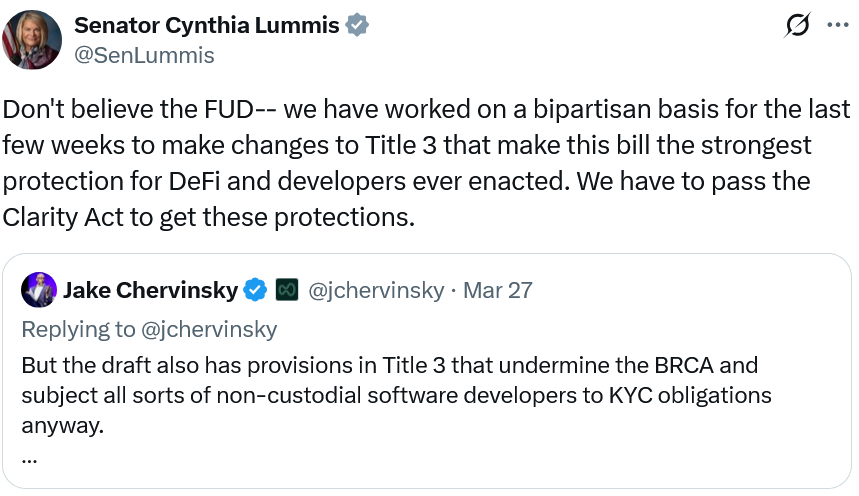
    US Senator Cynthia Lummis has dismissed claims that the Digital Asset Market Clarity Act fails to protect decentralized finance innovators from legal repercussions, rebutting that recent changes to the draft will make it the “strongest protection for DeFi and developers ever enacted.”

    Her comments on Friday came in direct response to crypto lawyer Jake Chervinsky, who argued that Title 3 of the current draft undermines the Blockchain Regulatory Certainty Act — another crypto bill focused on developer protections — by subjecting non-custodial software developers to know-your-customer obligations.

    “Don’t believe the FUD,” Lummis said, adding, “We have worked on a bipartisan basis for the last few weeks to make changes to Title 3 that make this bill the strongest protection for DeFi and developers ever enacted. We have to pass the Clarity Act to get these protections.”

    The latest changes to the CLARITY Act have not been publicly released.

    Source: Cynthia Lummis

    Chervinsky said these DeFi protection provisions have been overshadowed by intense focus on stablecoin rewards provisions in the CLARITY Act.

    His biggest issue with the Senate Banking Committee’s latest CLARITY Act draft is that Title 3’s money transmitter definitions could still expose many non-custodial DeFi builders to liability.

    This is despite the CLARITY Act incorporating the BRCA in section 604, which clarifies that non-controlling developers and providers of non-custodial software are not to be treated as financial institutions subject to Bank Secrecy Act KYC obligations.

    “The biggest challenge is ensuring non-custodial software developers aren’t misclassified as money transmitters,” Chervinsky argued.

    “That’s non-negotiable for DeFi, and it’s still unsettled.”

    His concerns come amid several high-profile prosecutions and convictions of developers in the US in recent months, including Tornado Cash co-founder, Roman Storm, who was convicted in August 2025 of conspiracy to operate an unlicensed money transmitting business

    Related: Delaware eyes stablecoin licensing framework under banking laws

    US lawmakers have said the CLARITY Act is moving closer toward a Senate Banking Committee markup expected in April after recent bipartisan progress on stablecoin rewards provisions.

    Passage of the CLARITY Act is necessary to ensure DeFi developers are afforded legal protections under the BRCA, Lummis noted.

    Magazine: Are DeFi devs liable for the illegal activity of others on their platforms?

  • Ripple turns to AI to stress-test the XRP Ledger as institutional use cases scale

    Ripple turns to AI to stress-test the XRP Ledger as institutional use cases scale

    Ripple is overhauling how it secures the $XRP Ledger, and AI is at the center of the effort.

    Its engineering team outlined a new AI-driven security strategy for the $XRP Ledger in a detailed post earlier this week, one that integrates machine learning tools across the protocol’s entire development lifecycle.

    The strategy includes AI-assisted code scanning on every pull request, automated adversarial testing guided by threat models, and a dedicated AI-assisted red team that continuously analyzes the codebase and how features interact in real-world scenarios.

    A newly-created ‘red team’ has already identified more than 10 bugs, with low-severity issues disclosed publicly so far and the remainder being prioritized and fixed. The team uses fuzzing and automated adversarial testing to simulate attacker behavior at scale, surfacing vulnerabilities earlier and with greater coverage than traditional auditing approaches.

    “AI allows us to shift from reactive debugging to proactive, systematic discovery of vulnerabilities, strengthening the ledger faster and with greater confidence than ever before,” Ripple wrote.

    The initiative comes as the XRPL handles an increasingly complex workload. The ledger has been operating continuously since 2012, processing over 100 million ledgers and facilitating more than 3 billion transactions.

    A codebase of that age naturally reflects “design decisions made in earlier phases of the network, assumptions that held at smaller scale, and patterns that predate modern tooling.” The AI tools are designed to systematically find the edge cases and hidden failure modes that accumulate in any long-running production system.

    The strategy is built across six pillars. Beyond the AI-assisted scanning and red team, Ripple is modernizing the XRPL codebase itself to address structural issues like limited type safety and inconsistent interaction patterns between features.

    The company is expanding security collaboration with XRPL Commons, the XRPL Foundation, independent researchers, and validator operators. Standards for protocol amendments are being raised, with multiple independent security audits now required for significant changes alongside expanded bug bounties and adversarial testing environments.

    And the next XRPL release will be dedicated entirely to bug fixes and improvements without new features, a signal that the engineering team is treating the hardening effort as a near-term priority.

    The timing aligns with Ripple’s expanding institutional footprint.

    The company is currently running a pilot under the Monetary Authority of Singapore’s BLOOM initiative, expanding Ripple Payments globally, pursuing an Australian financial services license, and pushing adoption of its RLUSD stablecoin.

    A ledger targeting tokenized real-world assets, central bank-backed trade finance, and enterprise payment flows needs security infrastructure that scales alongside the use cases it supports.

    The approach connects to a broader industry trend. Ethereum launched a dedicated post-quantum security hub this week backed by eight years of research and 10-plus client teams shipping weekly devnets. Google set a 2029 deadline for migrating its authentication services to quantum-resistant cryptography. Across both traditional tech and crypto, the emphasis is shifting from reactive patching to proactive, AI-augmented security engineering.

    Meanwhile, the Ripple engineering team plans to publish security criteria for new amendments in collaboration with the XRPL Foundation and share findings transparently with the community in the coming weeks.

  • Bitcoin Dips Under $67K as Geopolitical Uncertainty, Treasury Yields Spook Traders

    Bitcoin Dips Under $67K as Geopolitical Uncertainty, Treasury Yields Spook Traders

    In brief

    • Bitcoin dropped under $67,000 as Middle East tensions and rising yields pressured risk assets.
    • Over $1.33 billion was liquidated this week, with heavy leveraged positions stacked between $70,000 to $75,000.
    • Experts expect choppy near-term action with potential relief rally contingent on easing macro pressures.

    Bitcoin and the broader crypto market continue to stack losses this week as March comes to a close, with experts anticipating rangebound price action and increased volatility in the near term.

    The leading crypto dropped to lows of $66,400 Friday, Bitcoin’s lowest level since March 9. It is currently trading at $66,633, down 3.9% in the past 24 hours and 5.6% on the week, according to CoinGecko data.

    Bitcoin’s drop this week is primarily driven by macroeconomic risk-off conditions resulting from the geopolitics, involving the Middle East war, Andri Fauzan Adziima, research lead at cryptocurrency exchange Bitrue, told Decrypt.

    The ripple effects of this war have raised oil prices, leading to fears of sticky inflation. Though Bitcoin continues to outperform gold and the U.S. stock market since the war began on February 28, it dropped over 6% from over $75,000 to below $70,000 as the U.S. Federal Reserve kept the interest rates steady last week.

    “Like all other macro assets, Bitcoin is trading to geopolitical headlines,” Thahbib Rahman, research analyst at crypto research platform Block Scholes, told Decrypt. “Trump’s uncertain tone yesterday around the likelihood of a ceasefire coincided with Bitcoin falling to $67,000.”

    In addition to geopolitical pressure, 10-year U.S. Treasury yields rose for four consecutive weeks in response to the confusing mixed messages around the U.S.-Iran war.

    The U.S. dollar index rose 0.57% this week to 100.148, continuing to weigh down on risk assets, including Bitcoin.

    Despite Bitcoin’s relatively tiny range, extending from $72,000 to $66,200, over $1.33 billion has been liquidated this week, CoinGlass data show. That reflects “heavy leveraged positions stacked above current levels, especially $70,000 to $72,000, and up to $73,000 to $75,000, with thinner liquidity on the downside, Adziima said.

    Users of Myriad, a prediction market owned by Decrypt’s parent company Dastan, turned bearish on Bitcoin’s outlook, putting a 56% chance on its next move taking it to $55,000, up 10% on the day.

    Experts continue to expect heightened volatility and a potential choppy price action in the near term, with a potential relief rally in the mid-term, contingent on easing macro and geopolitical pressures.

    “Thin weekend volume raises odds of a quick liquidity sweep lower toward $67,000 to $68,000 support first,” Adziima explained.

    From a macro perspective, Myriad users assign a 66% chance that oil’s next move could see it rally to $120, underscoring the uncertain geopolitical landscape.

    Daily Debrief Newsletter

    Start every day with the top news stories right now, plus original features, a podcast, videos and more.

  • Morning Minute: Fannie Mae Accepts Crypto for Mortgages

    Morning Minute: Fannie Mae Accepts Crypto for Mortgages

    Morning Minute is a daily newsletter written by Tyler Warner. The analysis and opinions expressed are his own and do not necessarily reflect those of Decrypt. And check out our new daily news show covering all of the top stories in 5 minutes or less, downloadable on Apple Pod or Spotify.

    GM!

    Today’s top news:

    • Crypto majors fall hard overnight on escalating war+oil concerns; BTC -4% at $66.6k
    • Fannie Mae to accept crypto collateral for mortgages w/ help from Coinbase
    • Mara sold $1.1B in Bitcoin as it pivots to AI, still holds $2.75B worth
    • Tether selects KPMG for its first official audit
    • Strategy CEO reveals that retail investors prefer STRC over MSTR

    🌎 Bitcoin Falls Ahead of Iran War “Final Blow”

    BTC fell below $67,000 overnight after Axios reported the Pentagon is actively preparing plans for a “final blow” in Iran, including ground forces and a massive bombing campaign.

    Trump posted on Truth Social that he’s extending the military pause to 10 days, citing ongoing diplomatic talks that are “going very well,” which led to a brief rebound in prices before the deeper selloff overnight.

    Now the week closes with three convergent events in a 24-hour window: a $15B options expiry on Deribit Friday morning at 8am UTC, PCE inflation data, and the expiration of Trump’s original diplomatic window.

    It’s going to be a rocky Friday.

    Key Details:

    • Bitcoin dipped to $67K Friday morning, with ETH sub-$2k; Oil +3% to $97
    • Trump posted on Truth Social extending the strike pause to 10 days, citing an Iranian government request and talks “going very well”
    • $15B in BTC options expire Friday at 8am UTC on Deribit, along with PCE data

    🏠 Fannie Mae Just Accepted Crypto as Mortgage Collateral

    The $12 trillion US residential mortgage market just formally recognized Bitcoin as a legitimate asset.

    Coinbase and Better Home & Finance launched the first Fannie Mae-conforming mortgage that lets borrowers pledge BTC or USDC as down payment collateral instead of selling.

    The primary mortgage is a standard conforming loan with all of Fannie Mae’s usual protections. Where crypto comes in is via a separate, overcollateralized loan that covers the down payment. And it has no margin calls and no forced selling on price drops.

    Here’s an example of how it works: On a $500,000 home requiring a $100,000 down payment, the buyer can pledge $250,000 in BTC to Coinbase Prime custody, receive a $100,000 loan against that collateral, use it as the down payment on a conventional $400,000 Fannie Mae mortgage. Note that the interest rates are 0.5% to 1% higher than standard.

    The Bitcoin stays intact (no sale, no taxable event) and is returned once the loan is repaid or refinanced.

    Liquidation triggers only on a 60-day payment delinquency, same as any mortgage.

    Key Details:

    • Coinbase and Better launched the first Fannie Mae-conforming crypto-backed mortgage; borrowers pledge BTC or USDC as collateral for a separate down payment loan without selling their assets
    • The structure: two loans: a standard Fannie Mae primary mortgage plus a separate overcollateralized crypto-backed loan to fund the down payment; Fannie buys the primary loan just like any conforming mortgage
    • No margin calls: if BTC drops, mortgage terms are unchanged; liquidation only triggers on 60-day payment delinquency, same as conventional mortgages
    • Rates run 0.5-1.5% higher than a standard 30-year; cold wallets excluded; collateral must be held on a US-regulated exchange (Coinbase)
    • Better CEO Vishal Garg estimates the company missed “$40 billion more of consumer demand over the past few years” without this product; 41% of American families lack the cash for a down payment despite holding other assets

    ⛏️ MARA Sold $1.1B in Bitcoin

    Bitcoin miner turned AI infrastructure player MARA sold 15,133 BTC between March 4 and March 25 for approximately $1.1B.

    The company used those proceeds to buy back roughly $1B of its own convertible notes at a 9% discount, capturing approximately $88 million in value in the process.

    The concerns here from Bitcoin enthusiasts are twofold:

    • Mara has another $2.75B in Bitcoin (38,689 BTC), still the second-largest public corporate Bitcoin holder behind Strategy’s 762,099 BTC.
    • Many other miners have also pivoted to AI data centers and infra strategies over the last year – and they may become sellers as well

    Key Details:

    • MARA sold 15,133 BTC between March 4 and March 25 for ~$1.1B; proceeds used to retire ~$1B in convertible notes
    • BTC holdings drop from 53,822 to ~38,689 BTC; MARA remains the second-largest public corporate holder behind Strategy
    • MARA stock jumped 10% in premarket Thursday

    🔒 Crypto Got Its Green Light, Privacy Developers Did Not

    Coin Center says crypto privacy tool developers are in a “very bad state” despite the most pro-crypto administration in US history.

    The DOJ continues to actively prosecute Tornado Cash developer Roman Storm and the Samourai Wallet developers as unlicensed money transmitters, despite the Trump administration dropping enforcement actions against exchanges and rolling back Biden-era crypto policy across the board.

    The House version of the Clarity Act included explicit developer protections that would have prevented exactly this. The Senate let them die.

    If the Clarity Act passes without those developer shields, the message to anyone building privacy infrastructure in the US is clear: proceed at your own risk.

    Key Details:

    • Coin Center says crypto privacy developers are in a “very bad state” despite the most pro-crypto administration in US history
    • DOJ continues prosecuting Tornado Cash developer Roman Storm and Samourai Wallet developers as unlicensed money transmitters — cases that predate Trump but have not been dropped
    • Coin Center’s argument: treating software publication as financial crime creates chilling uncertainty for US open-source development and drives builders offshore

    ₿ Retail Is Choosing STRC Over MSTR

    Strategy’s CEO revealed Thursday that retail investors own 80% of STRC versus 40% of MSTR common stock.

    At a $5B market cap, that’s $4 billion of retail capital in the 11.5% annual dividend product engineered to trade near its $100 par value. Strategy has raised $1.5B via STRC just this month.

    The product is available on Robinhood, Kraken, and Webull, common platforms for retail investors. Benchmark-StoneX analyst Mark Palmer said this makes sense from a risk-adjusted lens because Institutions tend to prefer MSTR’s liquidity and asymmetric upside, while retail investors are accustomed to thinking about yield.

    STRC fits that mental model. And notably, the product is starting to show up on other Bitcoin treasury firms’ balance sheets as a reserve asset – so it’s not just a consumer product.

    Key Details:

      • Strategy CEO revealed 80% of STRC is owned by retail vs. 40% of MSTR; at $5B market cap, retail holds ~$4B in the dividend product
      • MSTR is down 56% over the past six months to $134; STRC holds near $100 par and pays 11.5% annually (~$0.9583/share monthly)
      • Strategy has raised $1.5B+ via STRC this month alone – its fastest issuance pace since the product’s $2.5B public debut last July

    🌎 Macro Crypto and Markets

    • Crypto majors are red again as war, energy concerns escalate; BTC -4% at $66.6k; ETH -4% at $1,990; SOL -5% at $83; HYPE -2% at $38.40
    • M (+4%), STABLE (+4%) and CC (+4%) led top movers
    • Oil +3% at $97; Gold -1% at $4,410
    • David Sacks stepped down as White House AI and crypto czar after hitting the 130-day limit for special government employees; he will stay involved as co-chair of the Science Council alongside Zuckerberg, Huang, and Andreessen
    • Tether named KPMG as the auditor for its first-ever full independent audit of USDT’s $184B in reserves; the company also engaged PwC to prep its internal systems for the processOKX said it won’t rush a US IPO, with CMO Haider Rafique telling the Digital Asset Summit “we will go public when we have confidence that we can give back shareholder value”

    Corporate Treasuries & ETFs

    Meme Coin Tracker

    • Meme majors were mostly red; DOGE -2%, SHIB -3%, PEPE -4%, TRUMP -4%, PENGU -5%, SPX -4%, FARTCOIN -3%
    • Either (+72%), Hachi (+50%) and Wojak (+20%) led top movers

    💰 Token, Airdrop & Protocol Tracker

    • X Money hired Benji Taylor as its new crypto-savvy design lead, former CPO at Aave Labs and design head at Coinbase’s Base
    • Ripple is rolling out AI-assisted red team security testing across the XRP Ledger

    🚚 What is happening in NFTs?

    • NFT leaders were mostly red; Punks -1% at 29 ETH, Pudgy -1% at 4.1 ETH, BAYC even at 5.25 ETH; Hypurr’s even at 409 HYPE
    • Pixel Pups (+35%) led notable movers

    Daily Debrief Newsletter

    Start every day with the top news stories right now, plus original features, a podcast, videos and more.