Category: Business

  • Galaxy Commits Up to $5 Million to Prepare Bitcoin for Quantum Threat

    Galaxy Commits Up to $5 Million to Prepare Bitcoin for Quantum Threat

    In brief

    • Galaxy Digital launched a Bitcoin Quantum Readiness Initiative built on three pillars: up to $5 million in developer grants for post-quantum solutions, a research program through Galaxy Research, and a Quantum Advisory Council of academic experts.
    • The effort targets “Q-Day,” when a quantum computer could use Shor’s algorithm to forge Bitcoin signatures and drain vulnerable wallets.
    • Momentum is building industry-wide: Project Eleven projects a cryptographically relevant quantum computer by 2030-2033, Coinbase’s advisory council is urging developers to start migration work now, and Trump signed executive orders moving the federal post-quantum deadline to December 2031.

    Galaxy Digital on Tuesday launched a Bitcoin Quantum Readiness Initiative, pledging up to $5 million in developer grants, a research program, and a new advisory council to help harden the network against the eventual arrival of powerful quantum computers.

    The Nasdaq-listed firm said the multi-pillar effort will fund work on post-quantum cryptographic solutions, publish analysis through Galaxy Research, and convene a Quantum Advisory Council whose inaugural members include University of Calgary professor Barry Sanders, MIT Sea Grant Knauss Fellow Damien Bérubé, and Boston University computer science professor Eran Tromer. Galaxy said it expects to begin accepting grant applications immediately.

    “As leaders in the digital assets space, we believe it’s important that we help be part of the solution to any potential threat quantum computing poses to Bitcoin,” said Mike Novogratz, founder and CEO of Galaxy.

    The initiative targets what researchers call “Q-Day,” the point at which a quantum machine could break the elliptic curve cryptography securing Bitcoin. Using Shor’s algorithm, an attacker could derive a private key from an exposed public key, forge a signature and drain a wallet, with nothing on-chain flagging the transaction as fraudulent.

    Old and reused addresses are most at risk. Defenses under discussion include migrating funds to quantum-resistant addresses and adopting new signature schemes through proposals such as BIP-360 and BIP-361, though such upgrades could take years given Bitcoin’s decentralized governance.

    The launch lands amid an accelerating warning cycle. A May report from quantum security firm Project Eleven concluded that a cryptographically relevant quantum computer is more likely than not to exist by 2033 and potentially as early as 2030, estimating roughly 6.9 million Bitcoin sit in quantum-exposed addresses.

    In June, Coinbase’s quantum advisory council urged developers to begin migration work rather than debate timing, pegging vulnerable supply at about 7 million BTC. That same month, President Donald Trump signed two executive orders advancing U.S. quantum capabilities and moving the federal deadline for post-quantum cryptography to December 2031.

    More recently, Project Eleven on July 16 unveiled a technique to let users prove wallet ownership after Q-Day by verifying control of a parent key rather than a signature. “This gives them a fallback: prove ownership through derivation, not signature, even after that window closes,” CEO Alex Pruden wrote.

    Galaxy said preparing Bitcoin for quantum computing will require coordinated effort across the ecosystem.

    “There’s a gap between the quantum computing world, which is moving fast, and the Bitcoin development world, which is just beginning to engage with post-quantum cryptography in earnest,” Galaxy Research head Alex Thorn said in a statement. “Galaxy’s role is to bridge that gap through research that makes the threat legible to investors and policymakers, as well as grants that fund the developers doing the hardest technical work.”

    Daily Debrief Newsletter

    Start every day with the top news stories right now, plus original features, a podcast, videos and more.


  • Hyperscale Data Adds 51.5 Bitcoin to Corporate Treasury, Total Holdings Reach 1,087 BTC

    Hyperscale Data Adds 51.5 Bitcoin to Corporate Treasury, Total Holdings Reach 1,087 BTC

    Hyperscale Data, a Nasdaq-listed company that operates a Bitcoin treasury and AI data center business, has acquired an additional 51.5 Bitcoin through its subsidiary Ault Capital Group. The purchase, completed last week, brings the firm’s total Bitcoin holdings to 1,087.4527 $BTC, valued at approximately $70.3 million based on current market prices.

    Strategic Expansion of Digital Asset Reserves

    The acquisition continues Hyperscale Data’s strategy of building a substantial Bitcoin reserve alongside its core AI data center operations. The company has been steadily increasing its digital asset holdings over the past year, positioning itself among publicly traded firms with significant corporate Bitcoin treasuries. This approach mirrors a broader trend among some technology and financial companies that view Bitcoin as a strategic reserve asset and a hedge against inflation.

    Hyperscale Data’s subsidiary, Ault Capital Group, executed the purchase. The company has not disclosed the average purchase price or the specific exchange used for the transaction. However, the timing of the buy aligns with recent market fluctuations, suggesting the company may have capitalized on price dips to accumulate more Bitcoin at a lower average cost.

    Corporate Bitcoin Treasury: A Growing Trend

    Hyperscale Data is part of a select group of publicly traded companies that hold Bitcoin on their balance sheets. While MicroStrategy remains the largest corporate Bitcoin holder, other firms like Tesla, Coinbase, and Block have also allocated portions of their cash reserves to the cryptocurrency. The strategy has drawn both praise from Bitcoin advocates and scrutiny from traditional investors concerned about volatility.

    For Hyperscale Data, the Bitcoin treasury is intertwined with its AI data center business. The company operates facilities that support high-performance computing for artificial intelligence workloads, and it has explored using Bitcoin mining operations to optimize energy usage and generate additional revenue streams. This dual focus on AI infrastructure and digital assets creates a unique business model that appeals to investors interested in both sectors.

    Market Implications and Investor Considerations

    The announcement comes at a time when Bitcoin prices have shown resilience, trading in a range that has encouraged corporate accumulation. For Hyperscale Data shareholders, the increased Bitcoin exposure means the company’s stock price is now more closely correlated with cryptocurrency market movements. This can amplify both gains and losses, depending on market conditions.

    Analysts note that corporate Bitcoin treasuries require careful risk management. Companies must account for potential price drops, regulatory changes, and accounting treatment of digital assets. Hyperscale Data has not indicated any plans to sell its Bitcoin holdings in the near term, suggesting a long-term conviction in the asset’s value proposition.

    Conclusion

    Hyperscale Data’s latest Bitcoin purchase reinforces its commitment to a digital asset-heavy corporate strategy. With over 1,087 $BTC now on its balance sheet, the company continues to distinguish itself in the public markets as a hybrid AI infrastructure and cryptocurrency treasury firm. Investors and industry observers will be watching to see whether this approach yields sustained returns or introduces additional volatility to the company’s financial profile.

    FAQs

    Q1: Why is Hyperscale Data buying Bitcoin?
    A1: Hyperscale Data views Bitcoin as a strategic reserve asset and a hedge against inflation. The company also operates AI data centers and sees synergies between cryptocurrency mining and high-performance computing infrastructure.

    Q2: How much Bitcoin does Hyperscale Data now hold?
    A2: After the latest purchase of 51.5 $BTC, Hyperscale Data holds a total of 1,087.4527 Bitcoin, worth approximately $70.3 million at current market prices.

    Q3: Is this a common strategy among publicly traded companies?
    A3: A small but growing number of public companies, including MicroStrategy, Tesla, and Block, have added Bitcoin to their balance sheets. The strategy remains controversial due to Bitcoin’s price volatility and regulatory uncertainties.

    Related Reading

    • Bitcoin Rally Draws Broader Institutional, Whale, and Options Market Participation
    • Spot CVD Chart Analysis: Understanding Order Flow and Volume Heatmap for $BTC/USDT
    • Metaplanet’s Largest Shareholder Boosts Voting Stake to 10.63% as Bitcoin Holdings Reach 43,000 $BTC
    • LD Capital’s Jack Yi: Bitcoin Must Clear $68K; Calls Market Bottom ‘Impossible to Pinpoint’
    • XRP Whale Deposits to Binance Drop to Two-Month Low, Signaling Easing Sell Pressure
  • Blockchain.com invests in OpenWorld to expand RWA tokenization and institutional services

    Blockchain.com invests in OpenWorld to expand RWA tokenization and institutional services

    Blockchain infrastructure firm OpenWorld has teamed up with Blockchain.com to expand its real-world asset tokenization ecosystem through institutional trading, liquidity, and distribution support, according to a Tuesday statement.

    The partnership also includes a strategic investment from Blockchain.com as the companies work together on RWA initiatives and digital asset infrastructure.

    “We’ve made a deliberate decision to build OpenWorld’s infrastructure layer alongside best-in-class institutional counterparties,” Matthew Shaw, CEO and co-founder of OpenWorld stated. “Blockchain.com brings the execution depth, product breadth, and regulatory infrastructure that our clients and pipeline demand.”

    Through the multi-year collaboration, Blockchain.com will provide execution capabilities and institutional market infrastructure to support OpenWorld’s token issuance, treasury management, and advisory activities.

    The companies aim to build a more integrated platform for institutions seeking to issue and manage tokenized assets.

    OpenWorld and Blockchain.com said the partnership reflects growing institutional interest in RWA tokenization, as investors increasingly look for onchain access to traditional asset classes.

    “Partnering with OpenWorld is a natural step forward for our institutional business,” Al Turnbull, Managing Director, Institutional Client Services at Blockchain.com, noted. “OpenWorld has built a powerful foundation for token launches and real-world asset tokenization. By connecting our networks, we are delivering a seamless, secure pipeline for institutions looking to launch tokens and manage digital assets at scale.”

    The companies plan to pursue joint go-to-market initiatives and expand adoption of tokenized assets across institutional and private markets.

  • Russia’s State Duma passes major bill regulating crypto market with transition period until 2027

    Russia’s State Duma passes major bill regulating crypto market with transition period until 2027

    Russia’s parliament has adopted a major crypto regulation bill that creates the country’s first comprehensive framework for digital currency circulation.

    The legislation establishes rules covering crypto exchanges, brokers, custodians, and other market participants while defining how individuals and businesses can buy, store, and trade digital assets.

    Under the new framework, crypto use will be permitted through licensed intermediaries, but digital assets cannot be used to pay for goods and services within Russia. The law allows a wider use of crypto in foreign economic activities as the government seeks to support cross-border transactions.

    The main provisions are scheduled to take effect in September 2026, with a transition period lasting until July 2027.

    Regulators will also continue developing related rules covering crypto taxation, liability for violations, and measures against fraudulent transactions.

    This is a developing story.

  • Worldcoin’s WLD Jumps 8% on Grayscale ETF Filing

    Worldcoin’s WLD Jumps 8% on Grayscale ETF Filing

    In brief

    • Grayscale has filed with the SEC to launch the first U.S. ETF tied to Worldcoin, the biometric crypto project co-founded by OpenAI’s Sam Altman.
    • The Grayscale Worldcoin ETF would hold WLD and trade on Nasdaq under the ticker GWLD, with BitGo as custodian and BNY Mellon as transfer agent.
    • WLD rose around 8% on the news, though it remains down about 5.5% on the week.

    Worldcoin’s WLD token jumped after asset manager Grayscale filed to launch the first US exchange-traded fund tied to the biometric crypto project, moving to bring Sam Altman’s eye-scanning venture a step closer to Wall Street.

    WLD climbed about 8% over 24 hours following the filing to an intraday high of $0.387, trimming a rough week that still left it down around 5.5% over the past seven days, per CoinGecko data.

    On Monday, Grayscale filed an S-1 registration statement for the Grayscale Worldcoin ETF, a “passive” vehicle that would hold WLD—the native token of the World Network—and track its price through the CoinDesk Worldcoin Benchmark Rate, according to the filing.

    If approved, the fund would list on Nasdaq under the ticker GWLD using the exchange’s generic listing standards for commodity-based trusts—meaning it could launch without a separate SEC rule change once WLD meets Nasdaq’s eligibility criteria. BitGo Bank & Trust would custody the tokens, while the Bank of New York Mellon would serve as transfer agent and administrator, the filing shows. WLD is the 55th-largest cryptocurrency, with a market capitalization of around $1.4 billion, according to CoinGecko.

    Sam Altman’s eye-scanning project

    Worldcoin—rebranded simply “World” in 2024—was co-founded by OpenAI CEO Sam Altman to build a global “proof of personhood” system. It uses a spherical device called the Orb to scan people’s irises, issuing a unique “World ID” meant to prove someone is a real human rather than an AI bot, and hands WLD tokens to verified users. The project has drawn regulatory scrutiny over its biometric data collection in the EU and in countries including Brazil and Kenya.

    The ETF filing is the latest sign of institutional appetite for the token. Last year, Nasdaq-listed Eightco built the first corporate treasury around WLD, amassing one of the largest disclosed stakes in the cryptocurrency.

    Grayscale’s ETF expansion

    The filing continues Grayscale’s drive to broaden its crypto ETF lineup. The firm converted its flagship Bitcoin trust into an ETF after a landmark court win over the SEC, later launched an Ethereum fund, and has filed for or rolled out products tied to Dogecoin, Solana, XRP, Litecoin and Chainlink, among others.

    For now, the filing is only a first step: the fund can’t trade until the registration takes effect and WLD clears Nasdaq’s listing bar. But if it does, it would give everyday investors their first way to hold Worldcoin through a U.S. brokerage account.

    Daily Debrief Newsletter

    Start every day with the top news stories right now, plus original features, a podcast, videos and more.

  • XRP jumps 4% as traders watch ‘triangle breakout’ toward $1.35

    XRP jumps 4% as traders watch ‘triangle breakout’ toward $1.35

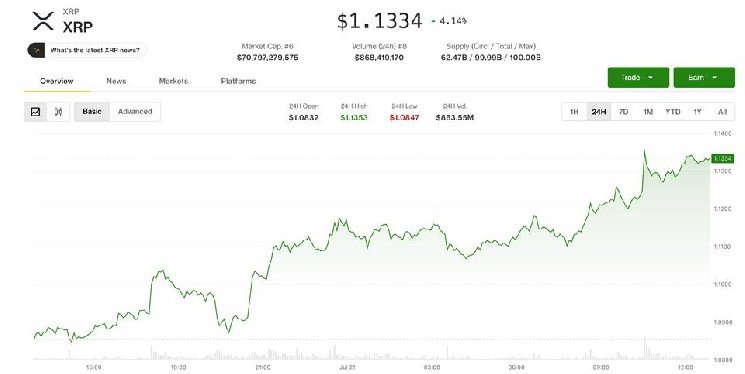
    • Volume increased during the breakout attempt, with CoinGecko showing 24-hour trading volume of about $1.27 billion.

    • $XRP held above the $1.08-$1.10 area through the session, keeping the short-term recovery structure intact.

    Technical Analysis

    • The key short-term level is $1.13. A sustained break above it would confirm the triangle breakout watched by traders and bring $1.35 into focus.

    • The hourly structure has tightened into a symmetrical triangle, with price compressing between lower highs and higher lows before the latest push higher.

    • The daily chart remains more cautious. $XRP is still trading inside a descending channel, with the 100-day and 200-day moving averages above price and sloping lower.

    • The $1.24-$1.28 area remains the bigger resistance zone because it lines up with the channel’s upper boundary and major moving averages.

    • Support remains strongest around $1.02-$1.06, where buyers have repeatedly stepped in over recent weeks.

    What traders should watch

    • $1.13 is the immediate breakout level. Holding above it would strengthen the short-term bullish setup.

    • $1.14 is the next nearby level after marking the top of the latest 24-hour range.

    • $1.24-$1.28 is the major resistance zone that $XRP needs to clear before the daily chart turns meaningfully stronger.

    • $1.02-$1.06 remains the key demand zone. Losing it would expose $0.88-$0.92.

  • On-Chain Analytics Company Swissblock Announces: ‘Bitcoin May Be Entering a New Uptrend!’ Here Are the Details

    On-Chain Analytics Company Swissblock Announces: ‘Bitcoin May Be Entering a New Uptrend!’ Here Are the Details

    On-chain analytics company Swissblock announced that Bitcoin (BTC) has emerged from its capitulation phase following recent sharp sell-offs and is beginning to regain upward momentum.

    According to the company’s assessment, while signs of recovery are beginning to appear in the market, current data is not yet at a level to confirm a strong and lasting trend reversal.

    An analysis shared by Swissblock states that Bitcoin has entered a “transitional phase” again. Analysts note that selling pressure has significantly decreased and upward momentum is beginning to re-emerge, highlighting that the market is at a critical juncture. Accordingly, the current process could signal the beginning of a new uptrend, or it could be a temporary recovery phase before the continuation of a bear market.

    A capitulation period is defined as a time when investors engage in heavy selling and a significant portion of market participants close their positions at a loss. While Bitcoin has historically shown strong recoveries following such periods, it cannot be said that every capitulation directly triggers a new bull market. Therefore, analysts emphasize the need to carefully monitor current data.

    According to Swissblock, recent price movements and on-chain indicators reveal that the negative market sentiment is weakening. In particular, the improvement in investor behavior and the decrease in selling pressure suggest that Bitcoin is beginning to regain strength. However, the company notes that it is still too early to say whether this outlook has turned into a permanent uptrend.

    Experts say that both macroeconomic developments and institutional investor flows will be decisive in determining Bitcoin’s direction in the coming weeks. If upward momentum continues to strengthen and technical indicators support it, the current transition period could lay the foundation for a new bull trend.

    However, it is assessed that if momentum weakens, Bitcoin may face renewed selling pressure and the bear market may continue. Therefore, investors are advised to follow on-chain data and market dynamics together, rather than just short-term price movements.

    *This is not investment advice.

  • Bitcoin Exchange Binance Announces It Will Deliste Seven Spot Trading Pairs from Its Platform!

    Bitcoin Exchange Binance Announces It Will Deliste Seven Spot Trading Pairs from Its Platform!

    Binance, one of the world’s largest cryptocurrency exchanges, announced that it has decided to delist certain trading pairs as part of its periodic reviews aimed at maintaining the quality of spot market transactions and providing users with a more efficient trading environment. The exchange stated that following recent evaluations based on various criteria such as low liquidity and trading volume, seven spot trading pairs will be delisted.

    According to a statement by Binance, trading on the ACX/$USDC, $ALGO/$BTC, CVC/$USDC, $LPT/$USDC, ONG/$BTC, $RVN/$USDC, and $XRP/BNB trading pairs will be suspended as of July 24, 2026, at 06:00. These trading pairs will no longer be available on the Binance Spot platform after that date.

    The exchange emphasized that the removal of certain trading pairs does not mean that the related crypto assets have been completely delisted. Users will continue to be able to buy and sell assets such as ACX, $ALGO, CVC, $LPT, ONG, $RVN, and $XRP through other trading pairs that remain supported on Binance Spot. Therefore, only specific pairs will be removed, and the general trading access of the tokens on the platform will continue.

    Binance also announced that its Spot Trading Bots service, which operates based on the trading pairs to be removed, will be terminated on the same date and time. In this context, investors using automated trading strategies are advised to update or cancel their bots in advance to prevent potential losses.

    Cryptocurrency exchanges periodically review and remove trading pairs with low trading volume or insufficient liquidity from their platforms. This practice is said to aim at improving market efficiency, enhancing price formation, and protecting the user experience.

    Experts emphasize that investors should closely monitor such announcements, and point out that users of automated trading systems, in particular, should check their open orders and bot settings for the pairs being delisted. Binance is expected to continue similar periodic reviews in the future.

    *This is not investment advice.

  • Bitcoin Whale That Accumulated for Six Years Moves $52.2M to Cumberland in Potential Sell Signal

    Bitcoin Whale That Accumulated for Six Years Moves $52.2M to Cumberland in Potential Sell Signal

    A Bitcoin wallet that had been steadily accumulating the cryptocurrency over the past six years moved 800 $BTC, valued at approximately $52.2 million, to Cumberland, a prominent crypto market maker and over-the-counter (OTC) trading platform, according to onchain analytics firm Onchain Lens. The transfer occurred about one hour ago and is typically interpreted as a potential selling activity.

    Whale Activity and Market Implications

    Onchain Lens reported that the whale externally moved a total of 2,000 $BTC worth about $130 million today. This includes the transfer to Cumberland and an additional 1,200 $BTC, worth roughly $78.3 million, sent to a new address. The movement of such a significant amount of Bitcoin from a long-term holder to a trading platform often signals an intention to sell, which could influence market sentiment in the short term.

    Understanding the Accumulation Pattern

    This particular wallet had been accumulating Bitcoin consistently for six years, a strategy often associated with patient, long-term investors. The decision to move a portion of these holdings to Cumberland, a platform known for facilitating large block trades, suggests the whale may be looking to realize gains or rebalance their portfolio. The simultaneous transfer of a larger amount to a new address also indicates that the whale is not liquidating entirely, but rather managing their exposure.

    Why This Matters to the Market

    Whale transactions, especially from long-term holders, are closely watched by traders and analysts because they can precede price movements. Cumberland’s role as an OTC desk means the sale could occur off-exchange, reducing direct market impact, but the overall signal of distribution can still weigh on sentiment. This event adds to a broader narrative of long-term holders taking profits after Bitcoin’s significant rally from its 2022 lows.

    Conclusion

    The transfer of 800 $BTC to Cumberland by a six-year accumulator is a notable onchain event that warrants attention. While not a definitive sell signal, the pattern of moving coins to a trading venue suggests potential distribution. Investors should monitor further movements from this wallet and broader market reactions.

    FAQs

    Q1: What is Cumberland and why does this transfer matter?
    Cumberland is a major cryptocurrency market maker and OTC trading desk. Transfers to such platforms are often seen as a precursor to selling, as they provide liquidity for large block trades without causing immediate slippage on public exchanges.

    Q2: How much Bitcoin did the whale move in total today?
    According to Onchain Lens, the whale moved a total of 2,000 $BTC, valued at approximately $130 million. This includes 800 $BTC to Cumberland and 1,200 $BTC to a new address.

    Q3: Does this mean the whale is selling all their Bitcoin?
    Not necessarily. Moving coins to a new address while also sending a portion to Cumberland suggests a strategic rebalancing rather than a full exit. The whale may be taking partial profits while retaining a core position.

  • Spot Ethereum ETFs Extend Inflow Streak With $38M on July 20, Led by BlackRock

    Spot Ethereum ETFs Extend Inflow Streak With $38M on July 20, Led by BlackRock

    U.S. spot Ethereum exchange-traded funds recorded $38 million in net inflows on July 20, according to data from Farside Investors, extending a positive streak to a second consecutive trading day after a period of mixed activity.

    Breakdown of July 20 Inflows

    The inflows were led by BlackRock’s iShares Ethereum Trust (ETHA), which attracted $34.3 million. Fidelity’s Ethereum Fund (FETH) added $2.8 million, while the 21Shares Core Ethereum ETF contributed $0.9 million. The remaining spot $ETH ETFs saw no net inflows or outflows for the day.

    This marks the second straight session of positive flows following last Friday’s modest gains, suggesting a cautious but steady return of institutional interest after weeks of volatile trading in the broader crypto market.

    Context and Market Implications

    The two-day inflow streak comes amid a period of relatively subdued Ethereum price action, with $ETH trading in a narrow range between $3,400 and $3,500. Analysts point to the inflows as a signal that institutional investors are gradually allocating to Ethereum exposure through regulated fund structures, even as retail sentiment remains mixed.

    Since their launch in late May 2024, spot Ethereum ETFs have experienced uneven demand compared to their Bitcoin counterparts. However, recent data indicates a potential shift: cumulative net inflows across all spot $ETH ETFs have now surpassed $1.5 billion, according to Farside Investors.

    Why This Matters for Investors

    Sustained inflows into spot Ethereum ETFs are viewed as a barometer of institutional confidence in $ETH as an asset class. Unlike direct cryptocurrency holdings, these ETFs offer exposure through traditional brokerage accounts, making them accessible to a broader range of investors, including pension funds and endowments.

    The concentration of inflows in BlackRock’s and Fidelity’s products also underscores the importance of brand trust and fee structures in the competitive ETF landscape. Both funds offer among the lowest expense ratios in the category.

    Conclusion

    While two days of inflows do not constitute a trend, the $38 million figure on July 20 provides a constructive data point for the Ethereum ETF market. Investors and analysts will be watching closely to see if the momentum can be sustained through the end of the month, particularly as the broader macroeconomic environment — including potential Federal Reserve rate decisions — continues to influence risk appetite.

    FAQs

    Q1: What are spot Ethereum ETFs?
    Spot Ethereum ETFs are exchange-traded funds that hold actual Ether ($ETH) rather than futures contracts. They allow investors to gain exposure to Ethereum’s price movements through a traditional stock exchange, without needing to directly buy or store cryptocurrency.

    Q2: Why are inflows into spot $ETH ETFs significant?
    Inflows indicate that investors are actively buying shares, which typically reflects positive sentiment and demand for Ethereum exposure through regulated products. Sustained inflows can support the price of $ETH and signal growing institutional adoption.

    Q3: How do spot $ETH ETF inflows compare to Bitcoin ETF inflows?
    Bitcoin spot ETFs, launched in January 2024, have seen significantly larger cumulative inflows — exceeding $15 billion as of mid-2024. Ethereum ETFs have attracted a smaller share, partly due to lower institutional familiarity and different market dynamics, but recent data suggests a gradual increase in interest.