Category: Business

  • Negative Funding Rates Hit Yearly High as Bitcoin Tests $76K

    Negative Funding Rates Hit Yearly High as Bitcoin Tests $76K

    In brief

    • Bitcoin funding rates have remained negative for over a month even as BTC touched $76,000, signaling heavy bearish positioning.
    • A potential uptrend could see Bitcoin revisit $125,000 in 30-60 days, Decrypt was told.
    • Despite bullish catalysts, analysts remain cautious, highlighting $80,000 as a key trigger level; failure risks a double-digit sell-off similar to that seen in May 2022.

    Bitcoin’s recent rally toward $76,000 faces a dilemma, leaving investors split on its near-term outlook.

    Funding rates for Bitcoin—a fee paid by derivatives traders to maintain the alignment between spot and futures prices—have remained negative for over a month and hit the highest level this year, according to Coinglass data.

    Negative funding rates indicate investors are shorting the recent rally with the expectation of a reversal.

    The divergence between bearish derivatives positioning and bullish spot catalysts sets up a potential short squeeze—or a bull trap—depending on which side breaks first.

    “Funding rates this negative tell you the market is heavily short,” Daniel Reis-Faria, CEO of ZeroStack, told Decrypt.

    The derivatives data directly contrasts with Bitcoin’s recent uptick, which was in part driven by bullish catalysts such as sustained ETF inflows, regulatory development surrounding the CLARITY Act, and the two-week ceasefire between the U.S. and Iran, Decrypt previously reported.

    “For a squeeze to gain real momentum, Bitcoin would need to break and hold above $80,000,” Illia Otychenko, lead analyst at crypto exchange CEX.IO, told Decrypt.

    Such a move could trigger “cascading liquidations of short positions and accelerate the rally,” Otychenko said.

    Reis-Faria’s bullish forecast involves Bitcoin pushing close to “$125,000 in the next 30 to 60 days,” adding that a short squeeze would help this case.

    Bitcoin is currently trading at around $75,580, up 1.2% in the past 24 hours after having reached an intraday high of $76,114, according to CoinGecko data.

    Short squeeze or bull trap?

    At this stage, a short squeeze isn’t guaranteed.

    Options data reveal the 7- and 30-day 25-delta skew hovers between -2% to -4%, according to Deribit, suggesting that investors are paying a premium for downside protection via bearish bets.

    Additionally, the 0.72 put/call ratio is climbing, also reflecting growing demand for downside protection. “The pattern closely resembles late May 2022, when a similar squeeze setup instead preceded a double-digit sell-off,” Otychenko said.

    Despite the demand from ETF investors and improving geopolitical outlook, there is a “real risk this setup turns into a bull trap rather than a breakout,” he warned.

    Experts who spoke to Decrypt also maintained a similar outlook, adding that the geopolitical risks haven’t subsided but merely paused. A resumption of the U.S.-Iran war could further push oil prices higher, awakening inflation concerns and subsequently reducing risk appetite, keeping Bitcoin and the broader financial markets capped.

    On prediction market Myriad, owned by Decrypt‘s parent company Dastan, users are increasingly optimistic on Bitcoin’s prospects. They now place a 67% chance on its next move taking it to $84,000 rather than $55,000, up from 54% at the start of the week. Myriad users are similarly positive about the geopolitical situation, putting a 66% chance on the number of ships transiting the Strait of Hormuz averaging more than 15 before May, up from 49% on Monday.

    Daily Debrief Newsletter

    Start every day with the top news stories right now, plus original features, a podcast, videos and more.
  • Analyst Says “Onchain Data is Giving a Signal!”, Warns About XRP!

    Analyst Says “Onchain Data is Giving a Signal!”, Warns About XRP!

    Bitcoin (BTC) surged above $77,000 following news from the US-Iran front. While the price subsequently fell back to around $76,000, one analyst suggests a significant rise in $XRP is possible.

    Darkfost, a CryptoQuant analyst, stated that the funding rate for $XRP is negative.

    The analyst noted that the funding rate for $XRP perpetual futures on Binance has remained consistently negative this year, indicating an extreme bearish trend.

    This indicates that $XRP investors on Binance are gradually shifting towards a general bearish sentiment and are now approaching a market-wide consensus.

    The analyst also noted that the $XRP correction is currently around -60%, with investors continuing to position themselves for further declines rather than expecting a recovery.

    “Historically, these kinds of extreme emotional dynamics haven’t always been well-timed signals for following consensus.”

    He recalled that after a similar situation was last observed, $XRP triggered a strong upward momentum, rising from approximately $1.6 to $3.6, showing an increase of about 127%.

    However, the analyst noted that the overall market environment remains challenging, especially for altcoins, and therefore caution should be exercised in position strategies.

    *This is not investment advice.

  • HOT MOMENTS: Bitcoin Soars Following Donald Trump’s Comments

    HOT MOMENTS: Bitcoin Soars Following Donald Trump’s Comments

    A critical development regarding the Strait of Hormuz has occurred within the ongoing negotiations between the US and Iran.

    According to reports in the US press, the Iranian government announced that the Strait of Hormuz will remain “fully open” to all commercial vessels during the ceasefire. This step is considered an important signal regarding the security of global energy and trade flows.

    US President Donald Trump announced that Iran had pledged not to close the waterway again. However, Trump emphasized that the US naval blockade in the region would continue until a comprehensive agreement is reached. The Washington administration appears inclined to maintain military and strategic pressure while awaiting a final agreement.

    Related News Analysis Company Claims “Bullish Signs” May Have Begun to Emerge in an Altcoin That Has Been Stagnant for a Long Time

    While progress has been reported in negotiations between the parties, there are hopes that an agreement could be reached by the end of the week. However, disagreements on critical issues are said to persist. It is claimed that the US is considering releasing approximately $20 billion worth of Iranian assets as part of the negotiations, while the Trump administration maintains that they plan to take over Iran’s enriched uranium and that “no money transfers will take place” in this process.

    Meanwhile, on the Lebanese front, another aspect of the tension in the region, the 10-day ceasefire is reportedly being largely maintained. Israel has stated it will not withdraw from southern Lebanon, while Iranian-backed Hezbollah has indicated it will only abide by the ceasefire if Israeli attacks cease completely. This delicate balance in Lebanon remains a crucial bargaining chip in the comprehensive peace talks with Iran.

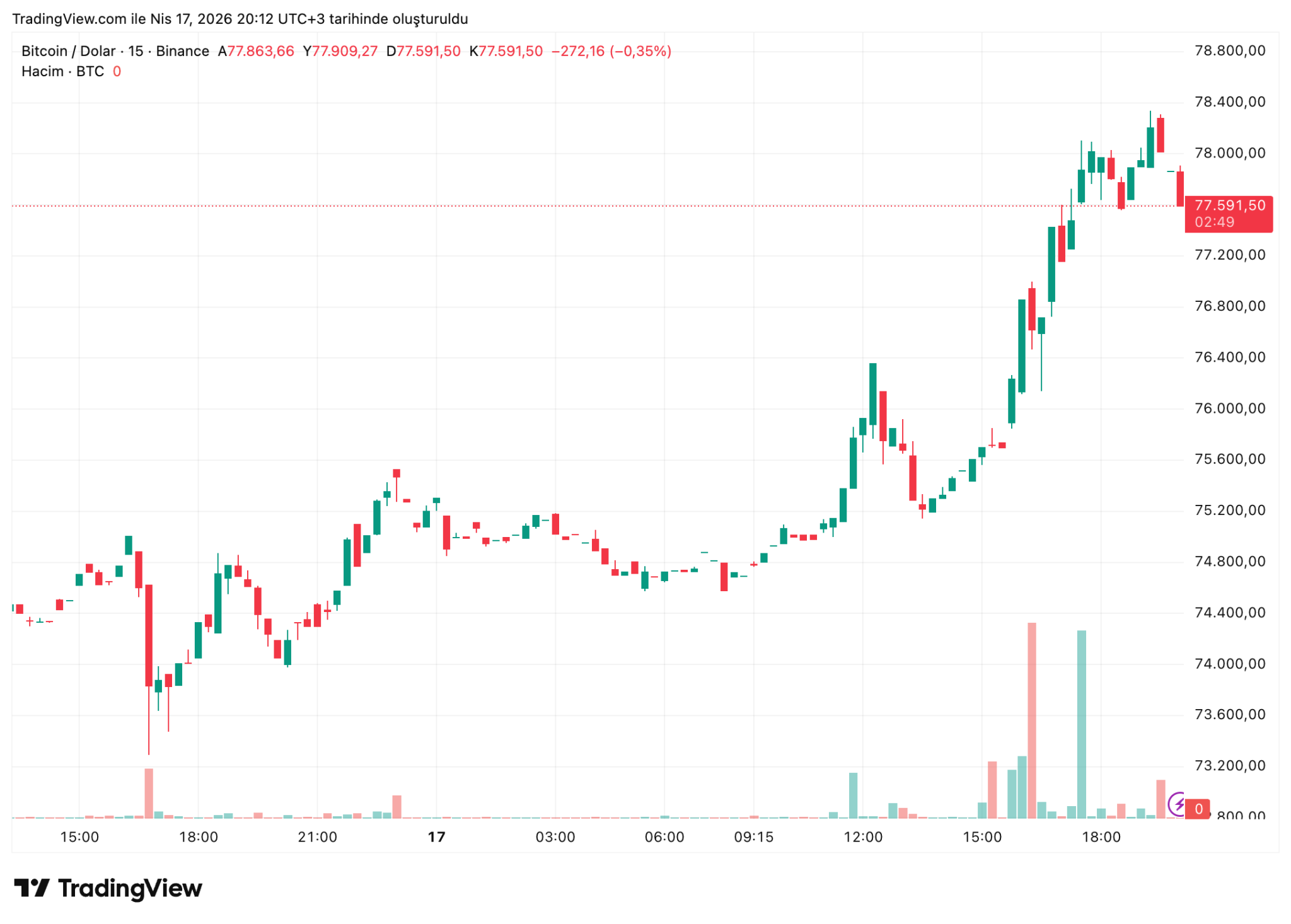
    Following these developments, the price of Bitcoin experienced a significant increase.

    A chart showing the recent rise in BTC price.

    *This is not investment advice.

  • Sanctioned Russia-linked Grinex halts operations after large-scale crypto hack

    Sanctioned Russia-linked Grinex halts operations after large-scale crypto hack

    Grinex, a sanctioned Russia‑linked crypto exchange, announced Thursday it had been targeted in a large-scale cyberattack that led to the theft of more than one billion rubles (approximately $13.7 million) from user accounts. The company claimed the incident may have been linked to foreign intelligence agencies.

    In an official statement, the exchange stated that technical evidence points to an unusually high level of sophistication, suggesting access to capabilities typically limited to state-backed entities. Early assessments indicate the attack was organized to inflict direct damage on Russia’s financial system.

    Grinex has faced ongoing challenges since its inception, including sanctions, targeted wallet monitoring, and blocked transactions aimed at limiting crypto transfers beyond the CIS, according to the exchange.

    The breach is described as a new phase of destabilization involving coordinated cyber theft targeting Russian users.

    As a result, Grinex has suspended its services and provided all collected information to law enforcement. Relevant authorities have been alerted and a criminal investigation is now underway.

    The Garantex backstory

    To understand why Grinex matters at all, it is important to first consider the background of Garantex. That exchange, sanctioned by OFAC in April 2022, became one of the most active conduits for Russian sanctions evasion and ransomware laundering over its six-year run.

    From 2019 through its disruption by international law enforcement in March 2025, Garantex processed $96 billion in transactions. When authorities shut it down, they froze $26 million in assets, a rounding error relative to the volume that had already flowed through.

    Following the takedown of Garantex by global law enforcement, investigators from TRM Labs reported that a new exchange, Grinex, had been identified as a likely successor.

    TRM Labs’ analysis shows that Garantex had been heavily involved in sanctions evasion and illicit finance, processing massive transaction volumes despite OFAC restrictions. Prior to its shutdown, it began transferring assets into A7A5, a ruble-linked stablecoin used across the Ethereum and TRON networks, which may have been designed to help preserve liquidity and bypass enforcement actions.

    In the aftermath, Grinex was promoted by Garantex-linked Telegram communities and showed strong operational similarities, including interface design and user migration patterns.

  • The Translation Layer: Why AI Is Necessary to Scale Decentralized Finance

    The Translation Layer: Why AI Is Necessary to Scale Decentralized Finance

    The emergence of artificial intelligence (AI) agents in decentralized finance signals a transition into an autopilot era. Jacob C. of Coinfello argues that these agents fundamentally enhance how users interface with complex smart contracts.

    Key Takeaways:

    • AI agents like Coinfello automate DeFi tasks once reserved for hedge funds to manage 24/7 market risks.
    • Jacob C. warns that the “translation layer” must solve oracle and agency risks for DeFi to scale safely.
    • By 2030, Jacob C. predicts dapps will decline as AI agents become the primary way to use smart contracts.

    The Shift to Autonomous Finance

    The shift from manual interaction to artificial intelligence (AI) agents in decentralized finance (DeFi) represents the autopilot era of crypto. In the past, DeFi required users to be glued to screens, monitoring gas fees, slippage, and liquidation risks. Today, autonomous agents are taking over the heavy lifting, providing continuous monitoring that was previously available only to institutional hedge funds.

    In some cases, agents can automatically pull liquidity out of a pool if they detect a rug pull pattern or if a stablecoin starts to de-peg. According to Jacob C., the co-founder and CEO of Coinfello, AI agents are also enhancing the way DeFi users interact with smart contracts.

    “Before AI agents, users were required to trust a centralized intermediary website (the dapp) which pointed at the smart contract,” Jacob C. said. “They had to trust the website to honestly convey what a smart contract does, to legitimately point at the correct smart contract, and to not be hacked by a malicious third party.”

    AI agents like Coinfello, Jacob C. argues, are eliminating this risk by interfacing directly with smart contracts, reading them, and explaining their risks to users. In other words, AI agents act as a translation layer that could prove vital if DeFi is to scale to levels that seem impossible now.

    Nevertheless, while AI agents undeniably enhance efficiency and streamline complex workflows, they also expose systems to new vulnerabilities—most notably oracle dependency, where external data sources can distort outcomes, and a subtle erosion of human agency, as decision-making authority shifts from individuals to algorithms. The Coinfello CEO concurs, warning that users still need to be able to verify or audit an agent before completely surrendering control or access to their funds.

    “Most of the AI agents that we see on the market today require users to transfer funds into a wallet fully controlled by the AI agent, and to trust that the agent will not make mistakes or will not be malicious,” the CEO said.

    bn_article_selector]

    To get around this problem, Jacob C. said his platform uses what he called “ liquidity sandboxing,” a concept he says enables users to approve individual permissions to the AI agent that limit which tokens the agent can access. The Coinfello team believes this approach “creates guardrails that fundamentally solve the dangers of securely using AI agents.”

    Regarding the prospects of DeFi in the age of AI agents, Jacob C. foresees these agents automating actions that a user otherwise would not have time to monitor, such as dollar-cost averaging or executing personally defined trading strategies. By 2030, he predicts decentralized applications ( dApps) will decline to the point where they are no longer the primary way people use smart contracts.

  • Charles Schwab Weighs Prediction Markets Move as Bitcoin, Ethereum Trading Nears

    Charles Schwab Weighs Prediction Markets Move as Bitcoin, Ethereum Trading Nears

    In brief

    • Charles Schwab President and CEO Rick Wurster indicated that America’s largest discount brokerage will likely support prediction markets.
    • However, he said that the company plans to steer clear of topics that touch pop culture, politics, and sports in favor of wagers tied to financial events.
    • Separately, the company said that it is rolling out access to Bitcoin and Ethereum trading in the coming weeks.

    America’s largest discount brokerage is eyeing prediction markets, but Charles Schwab President and CEO Rick Wurster sees a big distinction between speculation on Taylor Swift’s love life and the latest inflation numbers.

    “At some point, we will likely have prediction markets,” Wurster said during the company’s first-quarter earnings call on Thursday, describing wagers on financial events as distinct from topics like sports, politics, and pop culture.

    With $11.8 trillion in total client assets, Charles Schwab’s support of prediction markets would serve as the latest sign that Wall Street giants are embracing technology historically viewed as a fringe playground or regulatory gray area. However, Wurster indicated that Charles Schwab isn’t among firms racing to bring products associated with the sector to market.

    “It’s not at the top of our clients’ list,” he said. “And if you look at the stats on the success of gamblers, they’re not strong and people generally lose money.”

    The assessment comes as exchange operators like Cboe Global Markets prepare to debut event contracts tied to financial events, mirroring platforms like Polymarket and Kalshi while using traditional financial rails. And last month, Nasdaq filed with the SEC to offer options contracts for yes-or-no bets on whether a specified event happens.

    “That’s something certainly we will take a hard look at and then will be quite straightforward for us to offer,” Wurster said. “When we do, we’ll stay away from gambling.”

    Whether it’s Robinhood or Coinbase, prediction markets have emerged as core offerings for platforms aimed at retail investors through integrations with Kalshi. Last week, sports wagers accounted for 78% of the platform’s volume at $2.7 billion, according to a Dune dashboard.

    Asked whether Charles Schwab’s prediction market offering would tap Polymarket or Kalshi, a spokesperson told Decrypt the company—which notched a record 9.9 million trades in the first quarter—doesn’t have anything to share beyond Wurster’s comments at this time.

    As Robinhood and Coinbase have expanded their offerings, so too has Charles Schwab, which said Thursday that it plans to roll out access to trading Bitcoin and Ethereum in the coming weeks. At a rate of 0.75% per trade, the firm said in an announcement that its fees are “among the lowest in the industry.”

    The discount brokerage said it plans to grow its crypto offering over time by adding a suite of features Robinhood and Coinbase users are already familiar with. That includes the ability to deposit and withdraw digital assets, as well as an expansion of the tokens it supports.

    Daily Debrief Newsletter

    Start every day with the top news stories right now, plus original features, a podcast, videos and more.
  • Stack BTC CEO Steps Down as Farage-Linked Bitcoin Venture Reshuffles Leadership

    Stack BTC CEO Steps Down as Farage-Linked Bitcoin Venture Reshuffles Leadership

    In brief

    • Stack BTC CEO Jai Patel has exited the Bitcoin treasury firm’s board, with David Galan taking over as chief executive.
    • Reform UK leader Nigel Farage has invested around $291,000 in the firm.
    • The Liberal Democrats have called for an FCA inquiry into Farage’s promotion of Stack BTC.

    Stack BTC has replaced its chief executive after completing a shift in strategy, marking a fresh attempt to stabilise the UK Bitcoin-focused investment vehicle and bolster investor confidence. The company said on Wednesday that Jai Patel, who founded the business in its earlier form, had stepped down from the board with immediate effect.

    Announcing the change in a tweet, the firm said that incoming chief executive David Galan brings a mix of dealmaking, financial and operational experience suited to its approach.

    “Stack BTC isn’t a fund. It isn’t a single-thesis bet. It acquires cash-generative operating businesses and uses that engine to accumulate Bitcoin,” it said.

    “Executing that model at scale requires someone who understands the numbers, can close deals, and can manage institutional capital relationships, all at once. David does.”

    The company holds just over 68 BTC, valued at $4.76 million in current market prices. It reported an average entry price of about $70,000 per Bitcoin and said the position is up 2.7%.

    The leadership switch comes as cryptocurrency businesses become increasingly entangled with UK political figures, with Reform UK leader Nigel Farage among the most prominent political advocates of the sector. He announced his backing of the company in early March.

    From Kasei Holdings to Stack BTC

    Stack BTC relaunched in March with investment from Farage and former Conservative chancellor Kwasi Kwarteng, recasting itself as a Bitcoin treasury company. Its strategy centres on buying profitable operating businesses and using their cash flows to build a growing Bitcoin reserve.

    The business originated as Kasei Holdings. It was established in 2021 before changing its name to Kasei Digital Assets and then finally StackBitcointreasury.

    Since rebranding, the company has sought to present itself as a more focused vehicle. Patel remains a shareholder, while Galan—who has a background in property and corporate finance—has been tasked with delivering the revised model.

    Farage invested £215,000 ($291,000) in the relaunched company and also took part in a £260,000 ($352,000) fundraising round earlier this year. The value of his holding has risen alongside movements in the Bitcoin price.

    Some industry figures have expressed doubts about the venture’s positioning. Speaking to The Guardian, Ian Taylor of CryptoUK called the project a “PR branding exercise,” arguing that investors should “be doing their due diligence on the financials, the quality and experience of the management.”

    Earlier this week, the Liberal Democrats called for an FCA inquiry into a promotional video released by Stack featuring Farage. Party leader Daisy Cooper said the regulator “must investigate whether Farage’s plans to cash in on crypto could potentially amount to market abuse and a conflict of interest,” accusing him of “using the Donald Trump playbook to put his own financial interests above the public good.”

    Speaking to the BBC, a spokesperson for Farage stated that the video, which announced Slack’s purchase of £2 million in Bitcoin, was a “photo call,” and that the Reform UK leader “bought the crypto on behalf of Stack and not personally.”

    Reform UK and crypto

    Reform UK has embraced cryptocurrency more openly than other major parties, previously accepting digital asset donations and promoting pro-crypto policies.

    Campaigners and politicians have argued that crypto-based donations could obscure the origin of funds or enable foreign influence in UK elections. The government has responded by introducing a temporary ban on such donations following a review into electoral risks, with further rules expected.

    Farage and his supporters have pushed back, arguing that digital assets can be accommodated within existing frameworks and warning that tighter controls could disadvantage newer political entrants.

    Stack BTC and Nigel Farage have both been approached for comment.

    Daily Debrief Newsletter

    Start every day with the top news stories right now, plus original features, a podcast, videos and more.

  • PEPE Price Leads Meme Coin Surge as Capital Rotates to Risk Assets

    PEPE Price Leads Meme Coin Surge as Capital Rotates to Risk Assets

    Pepe coin, the frog-themed meme cryptocurrency jumped over 8% during Thursday’s U.S. market hours to hit $0.000004 high. This upswing follows the broader recovery in the meme coin market as capital rotates to higher-risk assets, supported by stable market sentiment. However, a stagnant trend in $PEPE’s open interest indicator suggests a lack of speculative force in the market. Can $PEPE price manage to reclaim the $0.000005 barrier?

    Meme Coin Market Climbs 12% Amid Risk-On Sentiment Shift

    In the last 24-hours, the meme coin sector witnessed a significant surge of over 12% to reach a market cap of $39.8 billion, according to Coingecko data. The buying pressure followed a sudden capital rotation to these volatile assets, as the escalation of the middle-east war has triggered a risk on sentiment.

    Hopes for an extended U.S.–Iran ceasefire has stabilized markets, with Bitcoin reclaiming the $75,000 mark. The Fear and Greed Index of the cryptocurrency was at 56 as of April 16, 2026, which is squarely in the neutral zone. It is a level of equilibrium in the market sentiment and investors are not really scared or greedy.

    Meme coins saw noticeable price increases during the day. $PEPE price climbed 9% to $0.000004, leading the segment. DOGEgained 3.07%, reaching $0.09601, while SHIB rose 3.41% to $0.00000606. These stable conditions showed positive price action in the meme sector in general.

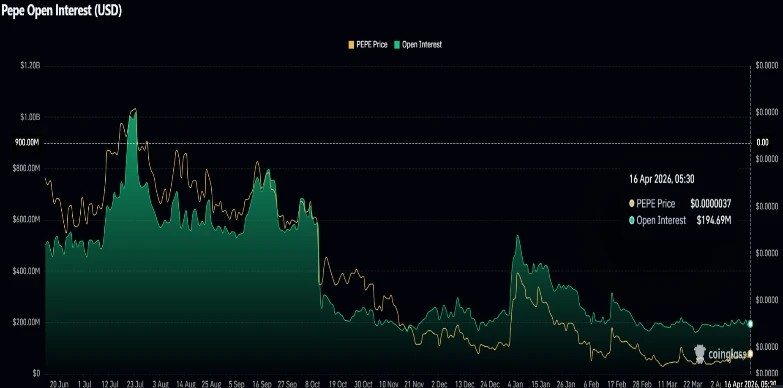
    However, the Pepe Open Interest (OI), projecting the outstanding value of outstanding futures and options contracts, averages around $194 million on Thursday. According to coinglass, the OI value has remained stagnant since early February, indicating a wait-and-see approach from institutions and traders. It suggests that while existing positions aren’t being aggressively closed, no significant “new money” is entering the market to drive a decisive trend.

    Pepe Price Give Major Breakout From Seven-Months Correction

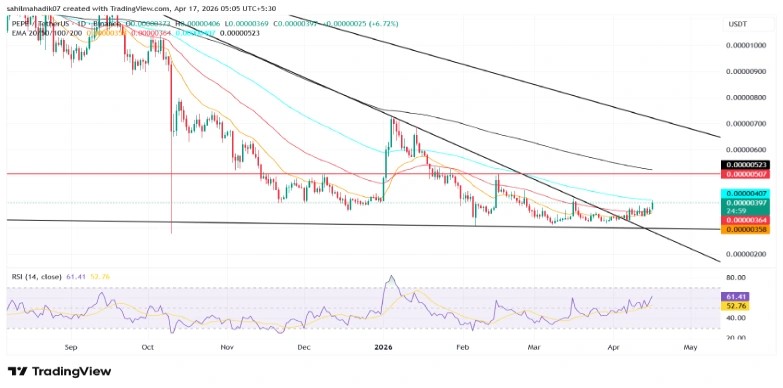
    Over the past two weeks, the Pepe price has witnessed a slow yet steady recovery from $0.00000317 to current trading price of $0.000004, registering a 25.5% increase.

    Amid this upswing, the coin price breach a long-coming resistance trendline in the daily chart which carried a sharp steady downtrend since July 2025. Thus, this breakout signals an initial change in market sentiment, and bolsters buyers for a potential recovery.

    The momentum indicator RSI surged to 67% further reinforces the recovery opportunity for the asset, suggesting a 28% rally before the price challenges the $0.000005 resistance.

    $PEPE/USDT -1d Chart

    However, the aforementioned resistance, backed by the 200-day exponential moving average, creates a stiff supply zone against Pepe price recovery. If the sellers continue to defend these resistances, the coin price may enter a prolonged consolidation below the level.

  • Grayscale Predicts Elon Musk’s X Could Use Crypto to Power Next Wave of Financial Ecosystems

    Grayscale Predicts Elon Musk’s X Could Use Crypto to Power Next Wave of Financial Ecosystems

    Grayscale forecasts crypto will underpin the next wave of consumer finance as platforms evolve into unified ecosystems. Elon Musk’s X is positioned to benefit, with smart cashtags and planned payments signaling growing momentum for deeper digital asset integration.

    Key Takeaways:

    • Grayscale predicts crypto will anchor future consumer finance platforms.
    • X is advancing cashtags to integrate trading within social activity.
    • Platforms like Telegram and Coinbase are accelerating crypto competition.

    X Smart Cashtags Drive Financial Ecosystem Expansion

    Crypto integration is increasingly shaping the future of multifunctional consumer platforms, signaling a shift toward more unified financial ecosystems. Elon Musk’s X sits at the center of that transition, according to digital asset manager Grayscale Investments’ April 16 analysis. Head of Research Zach Pandl examined the platform’s expanding capabilities, with a focus on smart cashtags and their potential role in broadening financial services within social apps.

    Pandl explained how the feature could connect social activity with investing, stating:

    “We believe that crypto will play a central role in this evolution.”

    The remark refers to X’s shift from a content platform toward a more integrated financial ecosystem. Smart cashtags let users interact with asset tickers such as bitcoin directly within posts, linking conversation with execution. Price data and charts are available in the U.S. and Canada on iPhone, while trading is available in Canada through Wealthsimple.

    Musk stated on social media platform X on March 10: “X Money early public access will launch next month.” The post points to near-term plans for the rollout of a payments layer tied to the broader ecosystem. However, Musk has not disclosed what X Money will include, nor has he confirmed any crypto or stablecoin integration, even as speculation around its potential features continues to build.

    Crypto Competition Intensifies Across Consumer Platforms

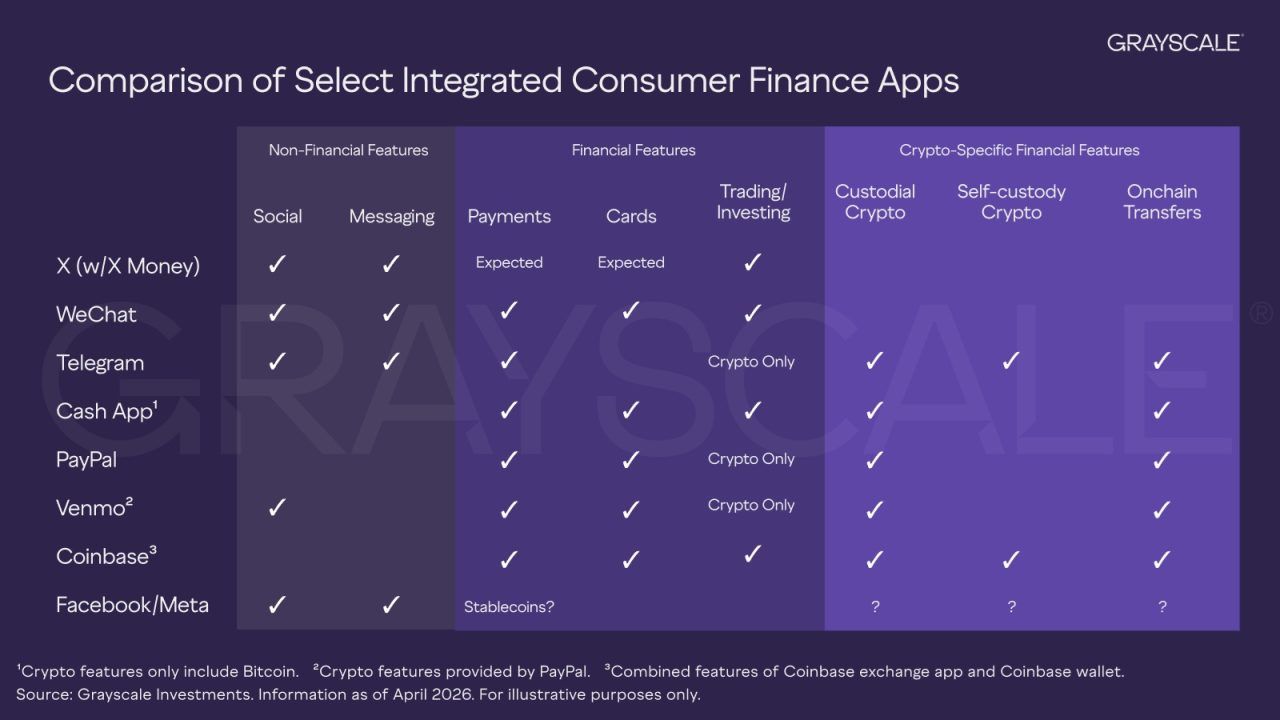
    A comparison chart accompanying the analysis shows how major platforms are converging across social, financial, and crypto functions. X currently offers social and messaging tools, while payments and cards are expected, alongside trading functionality.

    Wechat remains the most comprehensive model, combining payments, cards, and investing within a single ecosystem. Telegram stands out through embedded self-custody wallets and on-chain transfers. Cash App, Paypal, and Venmo support payments and crypto exposure, although mostly within custodial frameworks. Coinbase offers a full crypto stack, including trading, custody, and blockchain transfers. Grayscale highlighted this broader shift, stating: “ crypto is emerging as one of the core technologies in the evolving landscape for consumer apps beyond X.” Those distinctions show how blockchain capabilities are becoming increasingly central to platform competition.

    “We believe that crypto infrastructure will play a central role in the evolving landscape of consumer finance apps, and that such evolution will continue to fuel demand for both corporate blockchain adoption and crypto tokens,” Grayscale concluded. The outlook suggests digital assets could become a foundational layer in next-generation financial services as firms race to consolidate payments, trading, and social engagement within unified ecosystems. The crypto asset manager added:

    “Although X Money will start with traditional fiat/bank-based infrastructure, an eventual move toward deeper crypto integrations seems inevitable, in our view.”

  • Bitcoin Exchange Binance Announces It Will List This Altcoin on Its Futures Trading Platform! Here Are the Details

    Bitcoin Exchange Binance Announces It Will List This Altcoin on Its Futures Trading Platform! Here Are the Details

    Binance Futures, one of the world’s largest crypto derivatives platforms, has announced a new step to expand its trading options. According to the announcement, the platform will make the USDⓈ-margined GENIUSUSDT perpetual futures contract available to users starting April 16, 2026, at 06:30 AM.

    The newly listed contract will offer investors leverage of up to 20x. The underlying asset will be the $GENIUS token. The project, described as “Genius Terminal,” stands out as a dedicated on-chain terminal solution.

    The GENIUSUSDT contract will use $USDT as the settlement asset. The minimum transaction amount is set at 1 $GENIUS, while the minimum denomination is 5 $USDT. The tick size (price increment) is announced as 0.0001. The platform will also limit the funding rate to between +2% and -2%, and funding payments will be made every four hours.

    The contract will offer 24/7 trading, like other Binance Futures products, and will support Multi-Assets Mode. This will allow users to develop more flexible trading strategies by using different assets as collateral.

    Binance states that with the launch of new products, it aims to improve the user experience and offer greater diversity to investors. However, experts warn investors to be cautious, noting that while high leverage trading can increase potential gains, it can also increase risks.

    *This is not investment advice.