Category: Business

  • Canton (CC) Price Falls 4% After Delay in Upbit Listing

    Canton (CC) Price Falls 4% After Delay in Upbit Listing

    On Tuesday, the Canton (CC) price fell by around 4% over the last 24 hours despite its listing on one of South Korea’s major cryptocurrency exchanges, Upbit.

    Despite the drop in the price, the daily trading volume of Canton has witnessed a spike of around 345% on a daily chart, which shows growing trading activity on the network. At the time of writing, the cryptocurrency is trading at around $0.1463, down 3.9% on the daily chart, according to CoinMarketCap.

    South Korea’s Biggest Exchange Prepares to List Canton

    On April 14, South Korea’s biggest cryptocurrency exchange, Upbit, officially announced the listing of Canton (CC) on its KRW, $BTC, and USDT trading pairs. While the deposits and withdrawals were planned on April 14, Upbit has declared that it has postponed the launch, saying that extra checks were needed during testing.

    After this development, the CC price has witnessed some small movements. The listing on Upbit will help it to bring more Korean buyers and gain higher liquidity once trading starts. This listing announcement has soared the token’s price above $0.1601.

    The drop in the Canton price is coming amid the bullish momentum in the crypto market, in which the Bitcoin ($BTC) price soared above $75,000 after seeing major liquidation in the short positions. Institutional investors have started injecting money via major exchanges again after witnessing a rally in the last few days.

    While there is still a tense situation in the Middle East, in the last few days, there have been some developments, which investors are seeing as a sign of de-escalation in the war between the U.S. and Iran.

    However, Canton is facing its own selling pressure as some investors have started booking profits after recent major developments, such as listings.
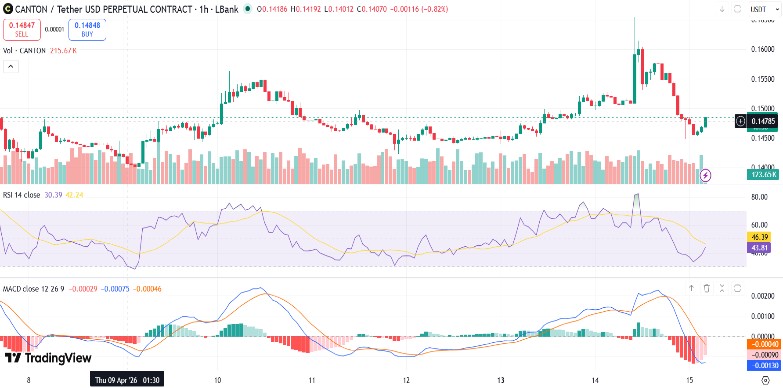
    At present, the price chart of Canton is developing a descending channel pattern in the last few days. In this pattern, both the top line and the bottom line are moving in a downward direction. The price is currently stuck between them until it finally breaks out in one direction.

    In the last few days, the cryptocurrency has retested various lower highs, which means that every time the price tries to go up, it fails to reach the previous high levels.

    Technical indicators are suggesting that the cryptocurrency is currently in the balance zone. The 14-day Relative Strength Index is revolving around 47, which tells that the cryptocurrency is currently in the neutral zone without any sign of being in the overbought and oversold zone.

    The 50-day moving average is very close to the current price level. Because of this, it is difficult to trace its direction at the moment. However, the positive momentum in the overall crypto market is suggesting that if buyers start to accumulate CC tokens, then it might see some recovery. As of now, traders are seeing the $0.14 as the major support level.

    Canton (CC) Gets Recognition as Grayscale Adds It to the List of Consideration

    Recently, Grayscale has revealed the addition of Canton to its official list of assets under consideration for the second quarter of 2026. This recognition from the world’s biggest has sparked euphoria in its community. It has now been added to the smart contracts platform category alongside other tokens such as Celo and Toncoin.

    “Assets Currently in the Grayscale Product Suite lists digital assets held by a Grayscale product as of April 10, 2026, either as part of a single-asset product or a multi-asset product,” stated in the official announcement.

    The addition of the CC in this list clearly says that Grayscale’s research team is actively assessing CC as a future investment product, such as a trust and exchange-traded funds (ETFs). This comes after Grayscale announced the launch of a new exchange-traded fund (ETF) that is focused on Avalanche (AVAX) in March.

  • 21Shares Files Updated Hyperliquid ETF Application With Ticker $THYP: SEC

    21Shares filed an updated application for a Hyperliquid ETF to be listed in the United States under the ticker $THYP, according to a filing update posted Tuesday. The submission appears to incorporate feedback from the SEC, with fee information not yet disclosed in the filing.

    The updated filing moves the Hyperliquid ETF product closer to regulatory approval and potential US market launch. 21Shares, a digital asset investment products provider, has been pursuing approval for crypto and blockchain-focused exchange-traded products.

    Sources: JSeyff on X

    This article was generated automatically by The Defiant’s AI news system from publicly available sources.

  • Fake Ledger App Steals Millions in Bitcoin, Crypto From Holders—Including Musician G. Love

    Fake Ledger App Steals Millions in Bitcoin, Crypto From Holders—Including Musician G. Love

    In brief

    • A fake Ledger Live application in the Mac App Store swiped crypto from more than 50 users, according to analysis from ZachXBT.
    • More than $9.5 million in crypto funds like Bitcoin, Solana, and XRP were stolen in total, the blockchain sleuth said.
    • Musician G. Love was among the victims, losing more than $400,000 in Bitcoin to the scheme.

    A fake Mac app impersonating Ledger’s self-custody software led to the loss of more than $9.5 million in crypto assets from over 50 total users in the last week, according to a new investigation from pseudonymous on-chain sleuth, ZachXBT.

    The application, which pretended to be the Ledger Live app from which users can manage assets held by Ledger hardware devices, impacted victims from April 7 until April 13, when it was removed from the Apple App Store. 

    “Stolen funds were laundered via 150+ KuCoin deposit addresses tied to AudiA6, a centralized mixing service that charges high fees to launder illicit funds,” ZachXBT posted in a message to his Telegram channel.

    According to his analysis, at least three victims lost more than $1.95 million apiece, with one wallet being drained of $3.27 million USDT. Swiped assets included Bitcoin, Solana, XRP, USDT, and others.

    Musician G. Love—aka Garrett Dutton, frontman of the long-running rock band G. Love & Special Sauce—was among the victims impacted by the fake app, losing 5.92 BTC valued around $447,000. He shared his story on X over the weekend.

    “I had a really tough day today. I lost my retirement fund in a hack/scam when I switched my Ledger over to my new computer and by accident downloaded a malicious Ledger app from the Apple Store,” he posted on X on April 11. “All my BTC gone in an instant.” 

    The fake app would remain in the App Store for nearly two more days, according to ZachXBT’s analysis. A representative for Apple did not immediately respond to Decrypt’s request for comment. 

    Upon noting that the stolen funds had been traced to KuCoin, the exchange’s support team responded to the musician, indicating that they had frozen a suspicious account related to the funds. 

    “Please note that while we may assist [in] freezing the suspicious account upon receipt of relevant information or a credible complaint, such actions are still subject to due legal documents and processes to ensure compliance,” it posted on X

    The exchange has reportedly been dealing with an increase in illicit activity on its platform, according to ZachXBT. Last month, it was barred from offering access to U.S. users unless it registered as a foreign board of trade. Last year, KuCoin was hit with a $14 million fine, the largest ever anti-money laundering fine in Canadian history, by the nation’s financial regulator. 

    Fake applications and websites are among the most common phishing vectors for Ledger users, according to the firm’s dedicated phishing campaign page, along with fake calls, emails, and letters.The U.S. Attorney’s Office for the District of Connecticut recently recovered $600,000 worth of crypto assets that had been part of a fraud scheme using fake letters purported to be from Ledger. 

    A representative for Ledger did not immediately respond to Decrypt’s request for comment and it has not issued a public statement about the recent phishing campaign. 

    Daily Debrief Newsletter

    Start every day with the top news stories right now, plus original features, a podcast, videos and more.

  • Goldman Sachs Files to Launch Bitcoin Income ETF Tied to Options

    Goldman Sachs Files to Launch Bitcoin Income ETF Tied to Options

    In brief

    • Goldman Sachs filed an application for an ETF that generates income by selling options tied to those that track the digital asset’s spot price
    • Under normal circumstances, the fund would allocate 80% of its net assets to investments that provide Bitcoin exposure, including spot ETFs.
    • In January, BlackRock filed for a similar ETF that uses an options strategy to generate premium income for investors beyond spot price gains.

    Goldman Sachs filed an application for an exchange-traded fund on Tuesday that seeks to generate income for investors by selling options tied to Bitcoin’s price, underscoring the Wall Street giant’s incremental approach toward the digital assets space.

    The Goldman Sachs Bitcoin Premium ETF would allocate at least 80% of its assets to investments that provide exposure to Bitcoin, including ETFs that track the digital asset’s spot price as well as derivatives tied to those products.

    To generate income for investors, the fund would sell options tied to Bitcoin ETFs, generating returns from the premium that investors pay to gain leveraged exposure to Bitcoin.

    With Goldman Sachs managing $3.65 trillion in assets (AUM), the filing represents a new entry into “the Bitcoin ETF game,” according to Bloomberg Senior ETF Analyst Eric Balchunas, who expressed a sense of shock on X at the investment bank’s latest filing.

    The analyst noted that Goldman’s fund is based around a subsidiary located in the Cayman Islands, allowing it to manage regulatory limitations associated with holding commodities. That stands in contrast with a similar ETF that BlackRock has filed for, he said.

    “Goldman may sense [an opportunity] to leap frog them,” Balchunas added, suggesting that the ETF could debut first due to its regulatory structure. “Anyway, I can’t say I saw this coming.”

    In January, BlackRock filed an SEC registration for an iShares Bitcoin Premium Income ETF that generates income through call options. The fund, if approved by the SEC, would compete with other Bitcoin covered-call ETFs like NEOS’ BTCI, which has $1 billion in AUM.

    Because BlackRock’s Bitcoin premium income ETF is actively managed, the product is set to have a higher expense ratio than its flagship offering tracking Bitcoin’s spot price.

    Since BlackRock’s spot Bitcoin ETF debuted in 2024, the product has generated $63.8 billion worth of net inflows, according to crypto data provider CoinGlass. Meanwhile, Morgan Stanley last week debuted its own spot Bitcoin ETF, which has taken in roughly $68 million.

    In February, Goldman Sachs CEO David Solomon revealed that “very little, but some” Bitcoin, describing himself as less of an investor and more of an observer of the largest digital asset.

    Daily Debrief Newsletter

    Start every day with the top news stories right now, plus original features, a podcast, videos and more.

  • Crypto Market Sees $1.1 Billion Inflows As Institutional Interest Picks Up

    Crypto Market Sees $1.1 Billion Inflows As Institutional Interest Picks Up

    Morgan Stanley’s freshly launched Bitcoin exchange-traded fund pulled in nearly $62 million within its first week of trading — a debut that landed in the middle of the strongest week for crypto investment products in three months.

    Macro Shifts Fuel The Comeback

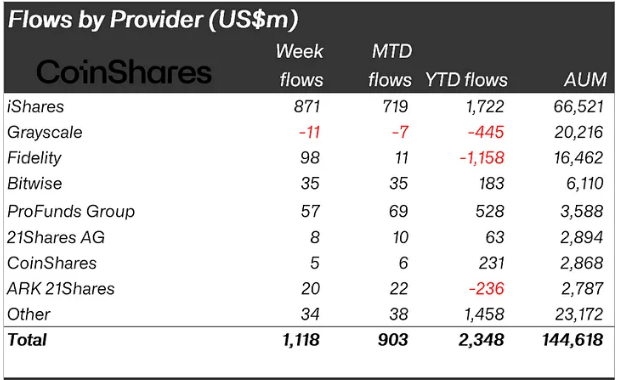
    That broader rebound was driven by more than one firm’s market entry. Crypto funds globally attracted $1.1 billion in net inflows for the week ending April 11, according to asset manager CoinShares.

    The turnaround came after five straight weeks of outflows that drained roughly $4 billion from the market and left investor sentiment battered heading into April.

    CoinShares head of research James Butterfill pointed to two specific triggers: early ceasefire signals out of Iran and a softer-than-expected US inflation reading. Both helped ease nerves that had kept institutional money on the sidelines.

    Source: Coinshares

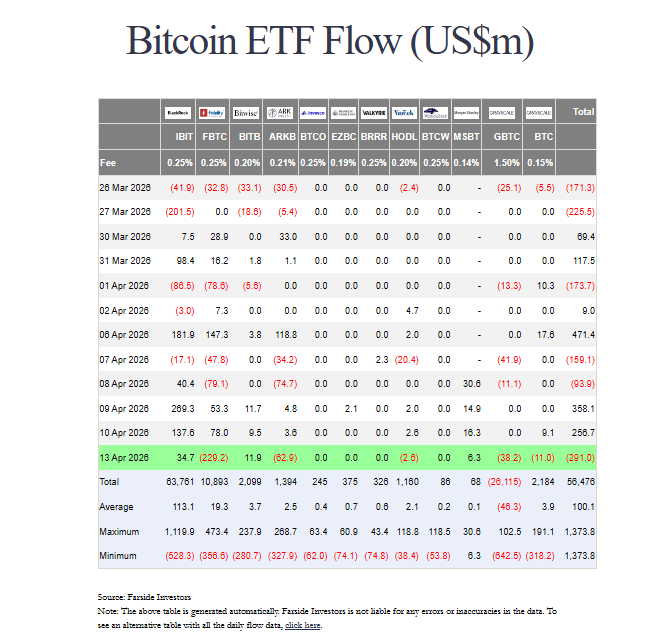
    US investors led the charge. Based on CoinShares data, American buyers accounted for $1.06 billion — about 95% of total global flows for the week. US spot Bitcoin ETFs absorbed the largest share, pulling in $833 million, per data from Farside Investors.

    Bitcoin And Ethereum Both Draw Fresh Money

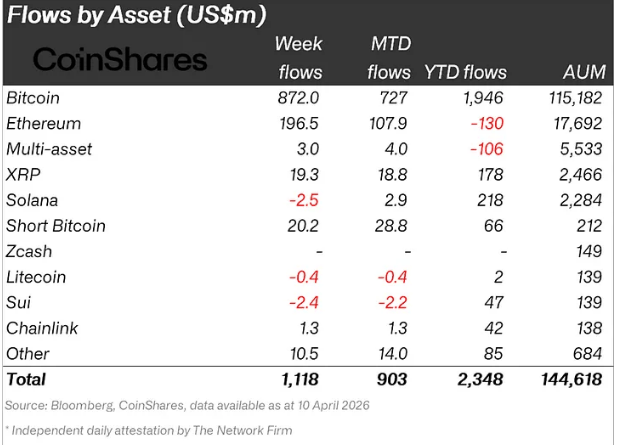
    Bitcoin funds worldwide attracted $871 million. Ethereum, which had recorded outflows for three consecutive weeks before this, saw $196.5 million flow back in. Weekly trading volumes climbed 13% to $21 billion, though that number still sits well below the year-to-date average of $31 billion, reports indicate.

    Source: Farside Investors

    The positioning among big investors told an interesting story. At the same time institutions were buying into Bitcoin and Ethereum, short-Bitcoin products — funds that profit when Bitcoin’s price falls — recorded $20 million in inflows.

    That was the highest single-week total for those products since November 2024. Money was moving in, but some of it was being used as a safety net.

    Source: Coinshares

    $XRP funds, which had briefly outpaced Bitcoin the previous week with nearly $120 million in inflows, cooled significantly. Reports show $XRP investment products brought in a little over $19 million during the same period.

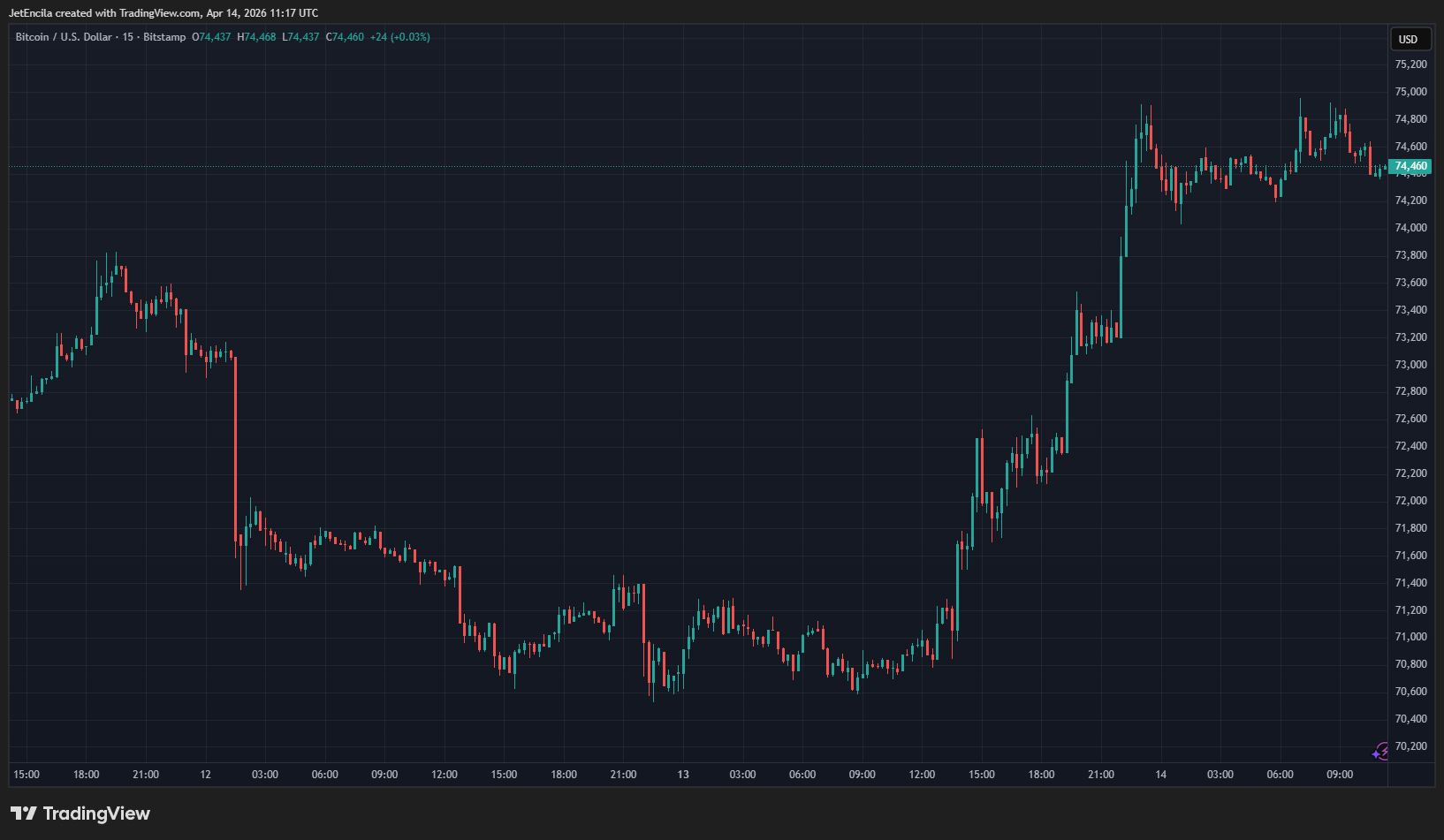
    Bitcoin is now trading at $74,460. Chart: TradingView

    Morgan Stanley Moves Deeper Into Crypto

    Beyond the weekly numbers, Morgan Stanley’s expanding footprint in the space drew attention. The bank has already filed for Ethereum and Solana ETFs following its Bitcoin fund launch.

    According to reports, Morgan Stanley executive Amy Oldenburg said the firm also plans to roll out crypto services including a tokenized money market fund and tax-harvesting options for clients.

    Year-to-date, Bitcoin ETF inflows have reached just under $2 billion — about 82% of all crypto ETP inflows recorded in 2026. Ethereum remains in the red for the year, sitting at $130 million in cumulative outflows despite last week’s recovery.

    Total assets under management across crypto investment products climbed back to levels not seen since early February.

    Featured image from Pexels, chart from TradingView

  • New Pro-DeFi Policies Show the SEC Isn’t Waiting for Congress to Act on Crypto

    New Pro-DeFi Policies Show the SEC Isn’t Waiting for Congress to Act on Crypto

    In brief

    • The SEC issued a new policy letting certain DeFi interfaces avoid broker-dealer registration.
    • The move was praised by industry leaders as a major victory for decentralized finance.
    • It indicates the SEC is barreling forward on crypto even as the Senate’s Clarity Act remains in limbo.

    The SEC unveiled a new policy Monday exempting certain decentralized finance interfaces from key registration requirements—a proactive move that indicates the regulator is moving full-steam ahead on its crypto agenda, with or without Congress.

    The new policy, laid out today in an SEC staff statement, allows user interfaces for DeFi tools to forego registration as broker-dealers, so long as they meet certain requirements. User interfaces, as defined by the SEC, are services, created by crypto companies, that make it easier for self-custodial wallet holders to complete on-chain transactions.

    Prior to President Donald Trump’s return to power, the SEC viewed such interfaces as squarely under the agency’s purview, given they technically involved a crypto company playing some role in connecting independent DeFi users to a marketplace. Crypto industry leaders have long argued such interfaces should not be considered akin to hands-on, traditional Wall Street brokers like Charles Schwab.

    Now, crypto leaders have appeared to have gotten their wish. Should a user interface adhere to a list of requirements, the SEC has said it will not obligate the companies behind those interfaces to register with the agency—even when the interfaces engage with securities.

    To qualify, an interface must not handle or hold user funds; arrange financing; solicit users to engage in any specific crypto transactions; or pressure users to choose one transaction path over another. It must also give users multiple options for executing transactions and list the options by objective criteria such as price, and charge users only flat rates or fixed rates for assisting with transactions, among other requirements.

    “Crypto is forcing the Commission to confront its inner demons that have driven it toward ever more expansive readings of the securities laws,” SEC commissioner Hester Peirce, a noted crypto advocate, said Monday of the staff statement. “Recent history is littered with a patchwork of no-action letters and enforcement actions that have contorted the term ‘broker’ beyond recognition.”

    Decentralized finance leaders hailed the announcement as a major step forward for the sector.

    “Tough day for the gatekeepers and the moat protectors,” Amanda Tuminelli, executive director of the DeFi Education Fund, said Monday. “Good day for builders.”

    “This is an incredible moment,” Matt Corva, general counsel at Ethereum software giant Consensys, proclaimed. (Disclaimer: Consensys is one of many investors in an editorially independent Decrypt.)

    “If decentralized applications meet their promise,” he continued, “you can pencil this down as the day centralized intermediaries were dealt a critical blow by allowing fair competition against them.”

    Miles Jennings, the head of Andreessen Horowitz’s crypto arm, dubbed the SEC statement a “huge win for DeFi.”

    Other industry leaders noted the SEC’s statement shows the agency is moving ahead with the key pillars of its crypto agenda despite having not yet received specific guidance from Congress on the subject.

    Though SEC Chair Paul Atkins has repeatedly voiced his support for the Senate’s pending crypto market structure bill, he has also said he does not need the legislation to pass in order to realize his aggressively pro-crypto agenda. 

    The Senate bill, dubbed the Clarity Act, has remained in limbo for months, hung up on several thorny issues. Backers of the bill have warned in recent days that, with November’s midterms fast approaching, the legislation may not become law if it doesn’t pass imminently.

    Daily Debrief Newsletter

    Start every day with the top news stories right now, plus original features, a podcast, videos and more.

  • MiniMax Drops State-of-the-Art AI Agent Model—Then Quietly Changes the License

    MiniMax Drops State-of-the-Art AI Agent Model—Then Quietly Changes the License

    In brief

    • The new MiniMax M2.7 matches top closed models in benchmarks.
    • The model underwent a quite license shift to restrict commercial use post-release.
    • The move was justified as a way to prevent service providers from “nerfing” the model when offering it to developers.

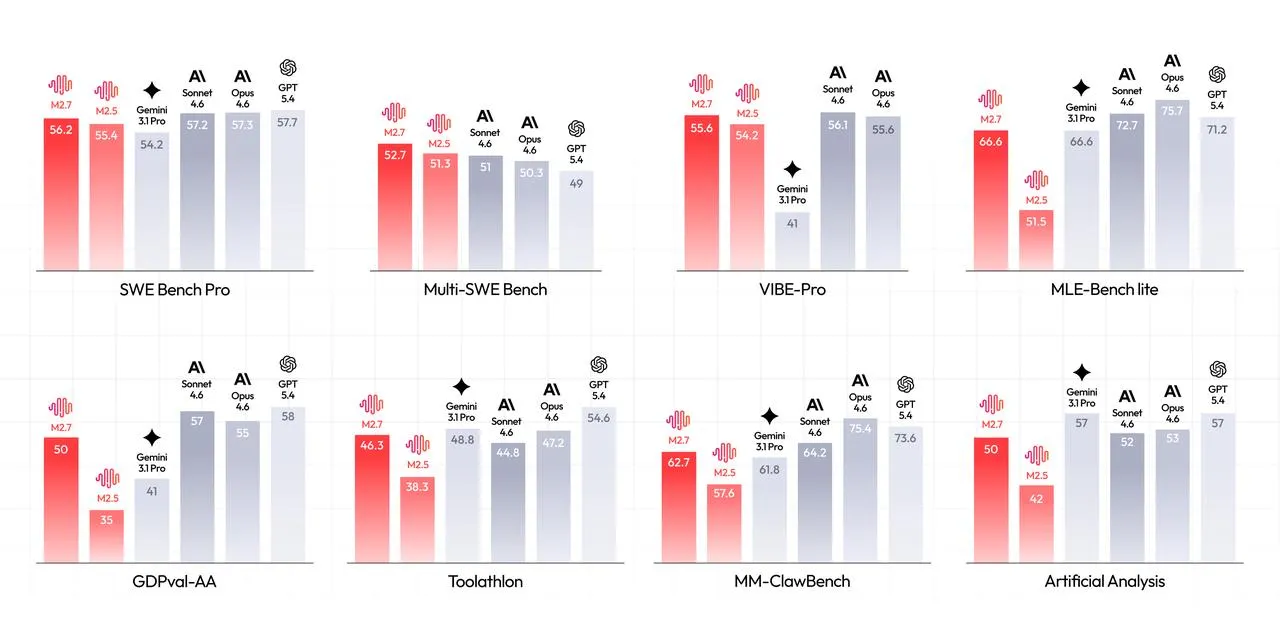
    MiniMax M2.7 is here, the weights are on Hugging Face, and it’s legitimately competing with the best closed models out right now.

    The numbers: 56.22% on SWE-Pro (a benchmark for software engineering tasks), nearly matching Claude Opus 4.6; 57.0% on Terminal Bench 2. An ELO of 1495 on GDPval-AA (a benchmark for real-world knowledge work tasks across jobs). For context: This is the highest among open-weight models, only slightly below Opus 4.6, Sonnet 4.6, and GPT-5.4.

    Minimax benchmarks
    Image: Minimax

    It’s a 230B-parameter Mixture of Experts model with only 10B active per inference pass, so you get frontier-level output without paying frontier-level compute. MiniMax said it was the first model to participate in its own development—an internal version ran 100+ autonomous rounds of self-optimization, rewrote its own scaffold, and came out 30% better. No human in the loop.

    Then the license changed, and the community lost it

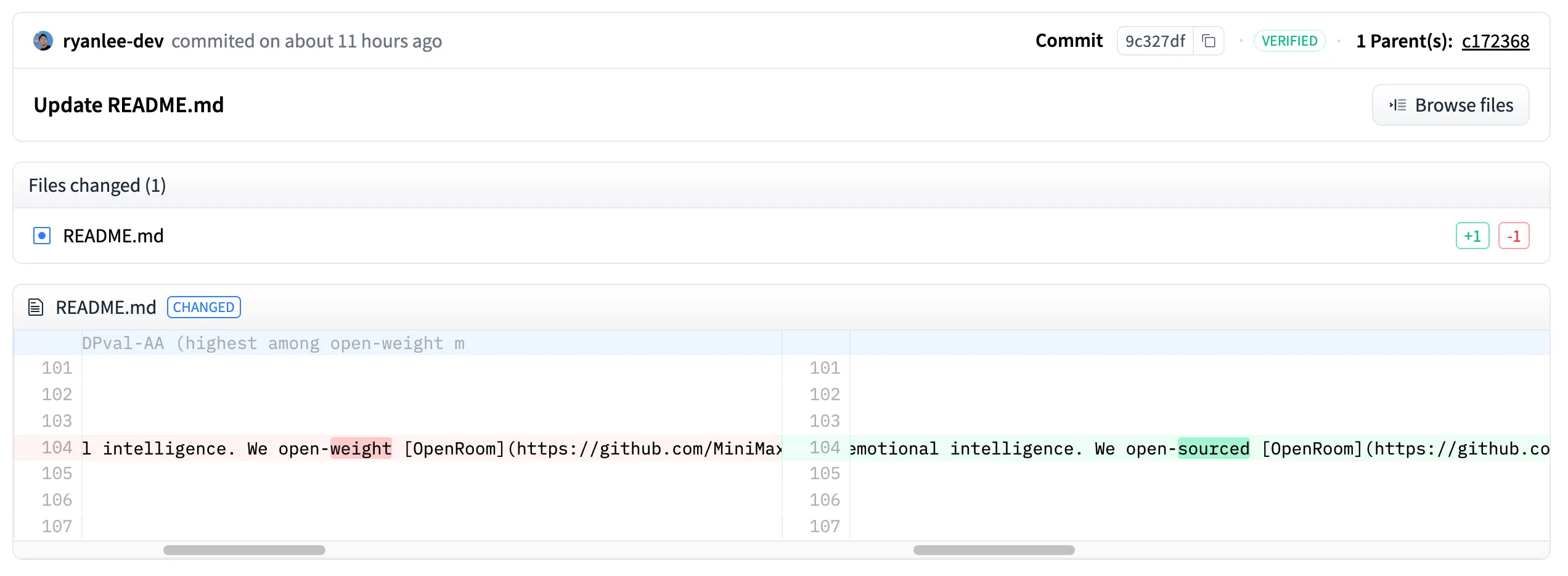
    But shortly after the weights dropped, the Chinese AI lab MiniMax quietly updated the terms: commercial use now requires written authorization from MiniMax.

    Non-commercial use stays free and unrestricted. Research, personal projects, fine-tuning for your own setup—none of that changed. But if you’re running a hosted service or building a commercial product, you’re in “needs authorization” territory now.

    Hacker News and a Hugging Face discussion thread filled up fast with developers calling it out. The specific friction point is this: MiniMax is labeling the license “MIT-style,” but MIT permits commercial use by definition. Calling it “Modified-MIT” while restricting commercial use is, to put it charitably, confusing.

    Ryan Lee, MiniMax’s Head of Developer Relations, posted a detailed response rather than the usual corporate non-answer. His explanation: bad-faith hosting providers had been deploying degraded versions of previous MiniMax models—wrong templates, aggressive quantization, sometimes not even MiniMax’s actual model—then letting users walk away thinking MiniMax ships mediocre work.

    “They walk away thinking MiniMax is mid,” Lee wrote. “We get the reputational bill, the user gets a bad experience, and the serious hosting providers who do the work properly get drowned out in the noise.”

    “A fully permissive license meant we had no way to push back on any of that,” he added. “If the license has edge cases that hurt legitimate community use, tell us. We’d rather fix the text than defend it.”

    This fits a wider pattern. MiniMax built its developer reputation on fully open releases—M2 under MIT in October 2025, M2.5 under the same terms in February 2026. M2.7 is the first break from that streak, and it came just months after the company listed on the Hong Kong Stock Exchange in January 2026, raising around $620M with Alibaba and Abu Dhabi’s sovereign wealth fund among its backers.

    Other Chinese companies, which dominate the open-source space, are also testing the waters of close-sourcing AI. Alibaba’s Qwen team reportedly shifted toward proprietary development after senior leadership departures, according to the Financial Times, Xiaomi also released its new MiMo v2 models under a close source license. The shorthand that Chinese labs are open and U.S. labs are closed no longer holds.

    For those interested in using it commercially, Lee says the authorization process will be fast and reasonable.

    Daily Debrief Newsletter

    Start every day with the top news stories right now, plus original features, a podcast, videos and more.

  • Bitcoin (BTC) is Rising, But It Will Be Temporary! Analyst Reveals the Level He Expects for the Real Bottom!

    Bitcoin (BTC) is Rising, But It Will Be Temporary! Analyst Reveals the Level He Expects for the Real Bottom!

    As tensions between the US and Iran in the Middle East continue unabated, Bitcoin ($BTC) remains strong.

    Bitcoin, although it fell to the $70,000 level after the first talks between the US and Iran over the weekend ended without a result, has risen again to the $74,000 level.

    This rise was influenced by news that a second round of talks between the two countries would begin and by growing expectations that the Bank of Japan would not raise interest rates this month.

    While Bitcoin is trying to remain strong amidst recent developments, some analysts predict that $BTC could fall to $50,000 before experiencing a sustainable recovery.

    At this point, LVRG Research Director Nick Ruck predicts that the $50,000 level could be the last major buying opportunity before a real recovery begins.

    Ruck stated that Bitcoin’s price falling to these levels would represent a healthy cycle reset, given the broader economic pressures and weak capital flows into cryptocurrencies.

    Ruck also stated that Bitcoin has fallen by approximately 40% from its recent all-time high, with significant participation from institutional investors, a smaller drop than in previous bear markets. In this context, Ruck noted that the current bear market has its own unique macro-structural characteristics, arguing that for these reasons, a drop of more than 60% might not occur in this cycle.

    Aside from Nick Ruck, Bitcoin investor and analyst Ivan Liljeqvist also stated that Bitcoin has not yet reached its bottom.

    “I don’t think we’ve hit the bottom yet, and I don’t think $60,000 is the bottom. The trend is still downward. There’s no bullish momentum right now.”

    *This is not investment advice.

  • Visa throws its weight behind Stripe’s Tempo blockchain

    Visa throws its weight behind Stripe’s Tempo blockchain

    Visa (V) has made its first foray into running blockchain infrastructure, the company said on Tuesday, operating as an “anchor validator” node on the Stripe-backed Tempo blockchain.

    Visa, a long-time collaborator of the payments services provider, configured and managed the validator node entirely in-house, following six months of joint work with Tempo’s engineering team to integrate the card giant’s infrastructure directly into the blockchain, according to a press release.

    Visa plans to run nodes on some other blockchains following the Tempo integration. The card network had previously said it will join the Canton Network, where there are plans to serve as a “Super Validator.”

    For the past seven years or so, Visa’s blockchain engineers have been “living and breathing stablecoins,” said the head of Visa’s crypto team, Cuy Sheffield. Now the focus is on supporting the evolution of new payment flows such as machine-to-machine commerce using AI agents, he added.

    “We’ve been an early design partner, working very closely with the Tempo team, looking at designing infrastructure that can support many types of new payment flows, and particularly agentic payment flows,” Sheffield said in an interview with CoinDesk.

    Tempo, which is also backed by crypto investment firm Paradigm, went live last month with Machine Payments Protocol (MPP), a protocol that lets software and AI agents pay for services autonomously.

    “Visa is a big part of MPP,” Sheffield said. “We added the MPP card spec. We announced Visa CLI, which is a wallet that is built on top of MPP where agents can use a Visa card to be able to spend. So we’ve been deeply involved in the Tempo and the MPP ecosystem, and now we’re running the underlying infrastructure on Tempo.”

    There’s no doubting Stripe’s conviction when it comes to assembling an end-to-end blockchain-based system for stablecoin payments. But, taking a step back, some people might question how open and decentralized such a system is.

    Sheffield, in response, said Visa is simply being pragmatic, looking for products that can drive payment volume.

    “Our view has always been that decentralization is a spectrum,” Sheffield said. “There are many use cases where decentralization for the sake of decentralization doesn’t solve a problem. I think we’re now entering a phase in the crypto industry where decentralization is not the primary value prop. It’s whether a new payment infrastructure is fast, efficient, programmable and can outperform some existing payment infrastructure for certain use cases.”

    Stripe moved into the stablecoin industry when it acquired stablecoin specialist Bridge for $1.1 billion in 2024. Earlier this year, Mastercard made a similar move, buying stablecoin firm BVNK for $1.8 billion.

    Asked if Visa had any plans to offer its own stablecoin, Sheffield said:

    “It’s so early and the rules haven’t even been fully written yet. We spent a bunch of time with the OCC (Office of the Comptroller of the Currency) and others,” he said. “I think there are many different roles that Visa can play, but everything we do, we want to make sure that we’re doing it in partnership with our clients and our network.”