Category: Business

  • What Are Tokenized Stocks? The $9 Billion Trend Explained

    What Are Tokenized Stocks? The $9 Billion Trend Explained

    Imagine buying a slice of Apple stock at 3 a.m. on a Sunday, settling in seconds, from a crypto wallet, with no broker involved. That is the promise of tokenized stocks, and it stopped being theoretical this year: on-chain transfer volume for tokenized equities reached $9.22 billion in a single month. This guide explains what tokenized stocks actually are, how they work, who is building them, what you really own when you buy one, and the risks that most coverage skips.

    What are tokenized stocks?

    A tokenized stock is a blockchain-based token that represents ownership or economic exposure to a real company’s shares. Instead of your Apple or Tesla position living only in a broker’s database, a token representing it lives on a blockchain, where it can be transferred, traded, or used in other applications around the clock.

    The key word is “represents.” In most current models, an authorized issuer buys and holds the actual shares with a regulated custodian, then issues tokens backed one-to-one against them. The token tracks the share’s value and, depending on the product, may pass through dividends. You are typically holding a claim on a share rather than the registered share itself, which is the single most important distinction to understand before buying one.

    Why anyone bothers: the actual advantages

    Traditional stock markets run on infrastructure built decades ago, with fixed hours and multi-day settlement. Tokenization targets exactly those limits.

    Trading never closes. Blockchains do not have opening bells. Tokenized equities can trade on weekends and overnight, which matters enormously for investors outside US time zones who currently trade American stocks at inconvenient hours or not at all.

    Settlement is near-instant. Traditional equity settlement takes a business day or more. On-chain settlement happens in seconds, freeing capital and removing counterparty risk in the gap.

    Fractional access is native. Tokens divide easily, so a $500 share can be bought in tiny increments without a broker building that feature.

    Global reach. Someone in a country with limited access to US brokerage accounts can, in principle, hold exposure to US equities through a wallet.

    Composability. This is the crypto-native advantage: a tokenized stock can be used inside decentralized finance applications, for example as collateral, in ways a brokerage position cannot.

    How big is this actually?

    Big enough to stop being a curiosity. Monthly on-chain transfer volume for tokenized stocks reached $9.22 billion in June 2026 (live RWA data on rwa.xyz), a sharp increase that reflects real usage rather than pilot projects.

    The activity is heavily concentrated on Solana, which handles roughly 95% of global tokenized equity trading volume, with single-day records around $644 million. The trend reached a symbolic milestone when Securitize, a tokenization firm, tokenized $295 million of its own stock on Solana on the day of its NYSE debut, the largest issuer-sponsored tokenized stock at launch.

    Institutional infrastructure is following. Moody’s launched credit ratings for tokenized assets, South Korea has explored tokenizing government bonds and state assets, and traditional finance firms have been building settlement rails on public blockchains. Ripple and BCG have projected the broader tokenized real-world asset market could exceed $19 trillion across blockchains by 2033, a forecast worth treating as directional rather than precise.

    What you actually own (read this part twice)

    This is where enthusiasm meets fine print, and it deserves plain language.

    In most tokenized stock products, you do not become a shareholder of record. You typically hold a token issued by a company, backed by shares that company or its custodian holds. That usually means no voting rights, dividend treatment that depends on the specific product, and, critically, a dependency on the issuer remaining solvent and honest.

    Compare that with a normal brokerage account, where you are a beneficial owner with regulatory protections, insurance schemes in many jurisdictions, and a clear legal claim. Tokenized stocks trade convenience for a different, generally thinner, set of protections. That is a legitimate trade for some investors, but it is a trade, not a free upgrade.

    The risks

    Issuer and custody risk. Your token is only as good as the entity holding the underlying shares. If that issuer fails or the backing is not what it claims, the token’s value is at risk regardless of what the real stock does.

    Regulatory uncertainty. Rules for tokenized securities are still forming in most jurisdictions. Products can be restricted, geo-blocked, or forced to change structure. Availability to US retail investors in particular is limited and shifting.

    Liquidity gaps. Headline volume is concentrated in a handful of popular names. A thinly traded tokenized stock can have wide spreads and poor exits, especially during volatility.

    Price tracking can break. In stressed markets, a token’s price can drift from the underlying share, particularly when traditional markets are closed and there is no way to arbitrage the gap efficiently.

    Smart contract risk. These are blockchain products, and blockchain products can have code vulnerabilities, as DeFi’s history shows.

    Corporate actions get messy. Splits, mergers, and special dividends are straightforward in traditional markets and genuinely complicated to represent on-chain.

    Who is building tokenized stocks

    The ecosystem splits roughly into three groups. Tokenization specialists like Securitize handle issuance and compliance infrastructure. Blockchains compete to host the activity, with Solana currently dominant on volume thanks to low fees and fast settlement, while Ethereum hosts much of the broader real-world asset market. And trading venues, both crypto exchanges and emerging on-chain platforms, provide the access layer.

    An interesting wrinkle: because Solana’s fees are so low, billions in tokenized stock volume generate relatively little direct fee revenue for the network. Hosting the boom and monetizing it are not the same thing, which is a genuine open question for the chains involved.

    Is this the future of stock trading?

    The honest answer is that it is a real trend with real limits. The advantages, continuous trading, instant settlement, global access, are genuine and solve actual problems that traditional market infrastructure has not. Institutional adoption is no longer speculative: rating agencies, governments, and NYSE-listed firms are participating.

    But the ownership structure is weaker than direct share ownership, regulation is unsettled, and most volume today comes from crypto-native traders rather than mainstream investors. The likely path is not tokenized stocks replacing brokerages, but traditional finance gradually adopting blockchain settlement underneath products that look familiar to investors. Tokenization is more likely to become invisible plumbing than a consumer revolution.

    Bottom line

    Tokenized stocks are blockchain tokens representing real company shares, offering round-the-clock trading, near-instant settlement, fractional ownership, and global access. The trend became substantial in 2026, with $9.22 billion in monthly on-chain volume and Solana handling around 95% of it, alongside serious institutional participation.

    The catch is what you own: usually a claim backed by an issuer rather than a registered share, with fewer protections than a brokerage account and unsettled regulation around it. Tokenized stocks are a genuine infrastructure advance worth understanding, and a product category that demands you read the specific terms before buying, not just the pitch.

    This is not investment advice. Tokenized assets carry issuer, regulatory, and liquidity risks in addition to normal market risk. Always do your own research.


  • Flock Cameras Face Growing Backlash as Privacy Concerns Reach Capitol Hill

    Flock Cameras Face Growing Backlash as Privacy Concerns Reach Capitol Hill

    In brief

    • Rep. Thomas Massie plans legislation that would withhold federal funding from agencies deploying Flock cameras.
    • Local governments from California to Indiana have suspended, canceled, or reconsidered Flock deployments following public opposition.
    • Flock CEO Garrett Langley recently apologized for referring to anti-surveillance activists as “terrorists.”

    Public opposition to Flock Safety’s automated license plate reader cameras is spreading from city council meetings to Capitol Hill as lawmakers prepare legislation targeting federal funding for agencies that deploy the technology while communities across the country reconsider its use.

    The protests come amid mounting evidence that Flock’s technology has been used in ways critics say extend well beyond its stated purpose of investigating crimes and locating missing people.

    A recent report by The Institute for Justice identified over two dozen cases nationwide in which officers resigned or were arrested for allegedly using automated license plate reader systems to stalk current or former romantic partners.

    In February, Milwaukee prosecutors charged an officer accused of using the system to track a romantic partner and her former partner. In July, an internal affairs detective who investigated that case was arrested after authorities alleged he also used Flock to track people for personal reasons.

    Privacy advocates also cite broader uses of the technology. The Electronic Frontier Foundation says agencies searched license plate databases during protests, including the No Kings protests in 2025. That same year, the group reported that Texas deputies queried Flock data during an abortion investigation that authorities initially described as a missing-person case.

    Opposition has also moved beyond public meetings. During June and July, activists across the country spray-painted, taped over, disabled and destroyed Flock cameras in protest of automated surveillance. The Guardian identified at least 33 incidents across 23 states. Online communities have shared camera maps, tips for avoiding the devices and methods for obstructing them, while several people now face criminal charges after allegedly destroying multiple cameras.

    Founded in 2017, Atlanta-based Flock Safety sells internet-connected license plate reader cameras that automatically photograph passing vehicles, read license plates, and use computer vision to identify characteristics such as a vehicle’s make, model, color, decals, roof racks, and other distinguishing features. Participating law enforcement agencies can search the database during criminal investigations, receive alerts when vehicles linked to cases pass a camera, recover stolen vehicles, and locate missing people.

    Flock says its cameras do not use facial recognition and typically retain data for 30 days unless local laws require a different retention period. CEO Garrett Langley said the company takes privacy concerns seriously and believes many critics reconsider their views once they understand how the technology works.

    “Once they understand what the technology actually does, not what it might do in 50 years, not what someone thinks it could do, but what it actually does day in and day out, it takes a picture of a car. Most people go, ‘This makes a lot of sense. I want my kids to be safe,’” Langley told ABC7.

    In a post on X on Saturday, Kentucky Congressman Thomas Massie said that he plans to introduce legislation that would withhold federal funding from municipalities and law enforcement agencies that deploy automated license plate reader systems, including Flock cameras.

    The proposal follows a series of disputes over Flock cameras across the United States.

    In St. Petersburg, Florida, 77-year-old Carl Gunn has drawn attention by staging solo protests beneath Flock cameras, holding a sign that blocks their view.

    “This is just another thing to take our information and to spy on us,” Gunn told news outlet Creative Loafing Tampa Bay. “I have a constitutional right to my privacy. I’m a law-abiding citizen, and I don’t need anyone sticking their nose in my business. And if they do, I’m going to chop it off.”

    In Fresno, California, residents packed a community forum to urge city officials to remove Flock cameras, arguing the technology allows broad government surveillance. Police defended the system, saying it helped investigators solve homicide and shooting cases and emphasizing that it does not use facial recognition.

    “We have to find a balance between safety and liberty,” Fresno Police Chief Mindy Casto reportedly said.

    However, not all law enforcement agencies are on board with using Flock cameras and are re-evaluating their use of the technology. On Thursday, the Los Angeles Police Department suspended its partnership with Flock over concerns involving privacy, data sharing, security, and contract terms. Monroe County, Indiana, also voted to end its contract a year early, despite commissioners acknowledging the cameras had helped solve serious crimes. Earlier in July, Leon County, Florida, delayed funding for additional Flock cameras after residents questioned how the data is collected, stored, and shared.

    The scrutiny has prompted a response from the company. Earlier this month, Langley apologized for previously describing anti-Flock activists as a “terroristic organization,” saying the comments were a mistake and that the company has spent more time listening to critics while trying to balance public safety and privacy.

    “My comments were a mistake, and I apologize,” he told Forbes. “There are groups today that have real valid criticisms of the business, and I think what’s changed for us is, as we’ve listened to them and heard them out, what we’re trying to do is find this balance. We believe in a world where we can have safety and privacy.”

    Daily Debrief Newsletter

    Start every day with the top news stories right now, plus original features, a podcast, videos and more.

  • Crypto entering biggest consolidation phase in history, says ARK analyst

    Crypto entering biggest consolidation phase in history, says ARK analyst

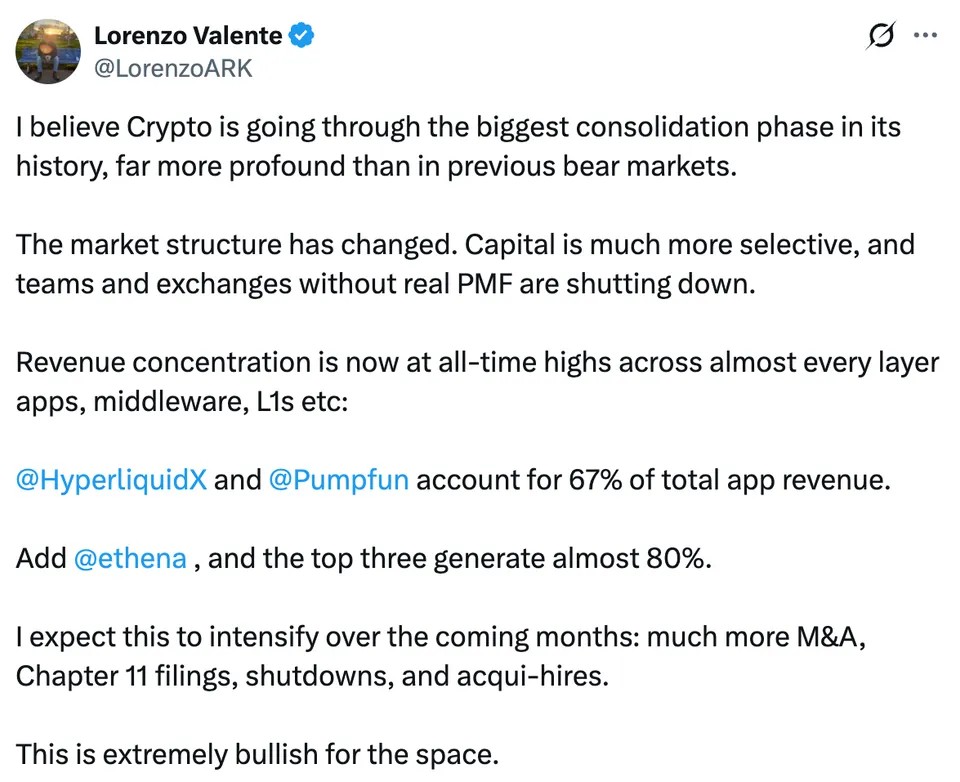
    An ARK Invest analyst says the cryptocurrency industry is entering what he describes as its biggest consolidation phase yet, with revenue increasingly concentrated among a handful of dominant protocols.

    In a Wednesday post on X, Lorenzo Valente, a research associate at ARK Invest, said investors have become increasingly selective, making it harder for crypto projects and exchanges without strong product-market fit to attract capital. As weaker projects struggle or shut down, revenue is becoming concentrated among a small number of dominant protocols, he said.

    As evidence, Valente said perpetual futures exchange Hyperliquid and memecoin launchpad Pump.fun account for roughly 67% of total crypto application revenue. Including synthetic dollar protocol Ethena raises the top three’s combined share to nearly 80%, highlighting what he described as record-high revenue concentration across the sector.

    Source: Lorenzo Valente

    Valente added that he expects the trend to accelerate in the coming months, leading to more mergers and acquisitions, Chapter 11 bankruptcies, project shutdowns and acqui-hires. Despite the shakeout, he described the consolidation as “extremely bullish” for the crypto industry.

    Related: ARK pushes back against a16z’s ‘TradFi wants blockchain, not DeFi’ claim

    Exchange closures add to consolidation narrative

    The comments come as several crypto exchanges have announced plans to wind down operations in recent days, underscoring mounting pressures across parts of the industry.

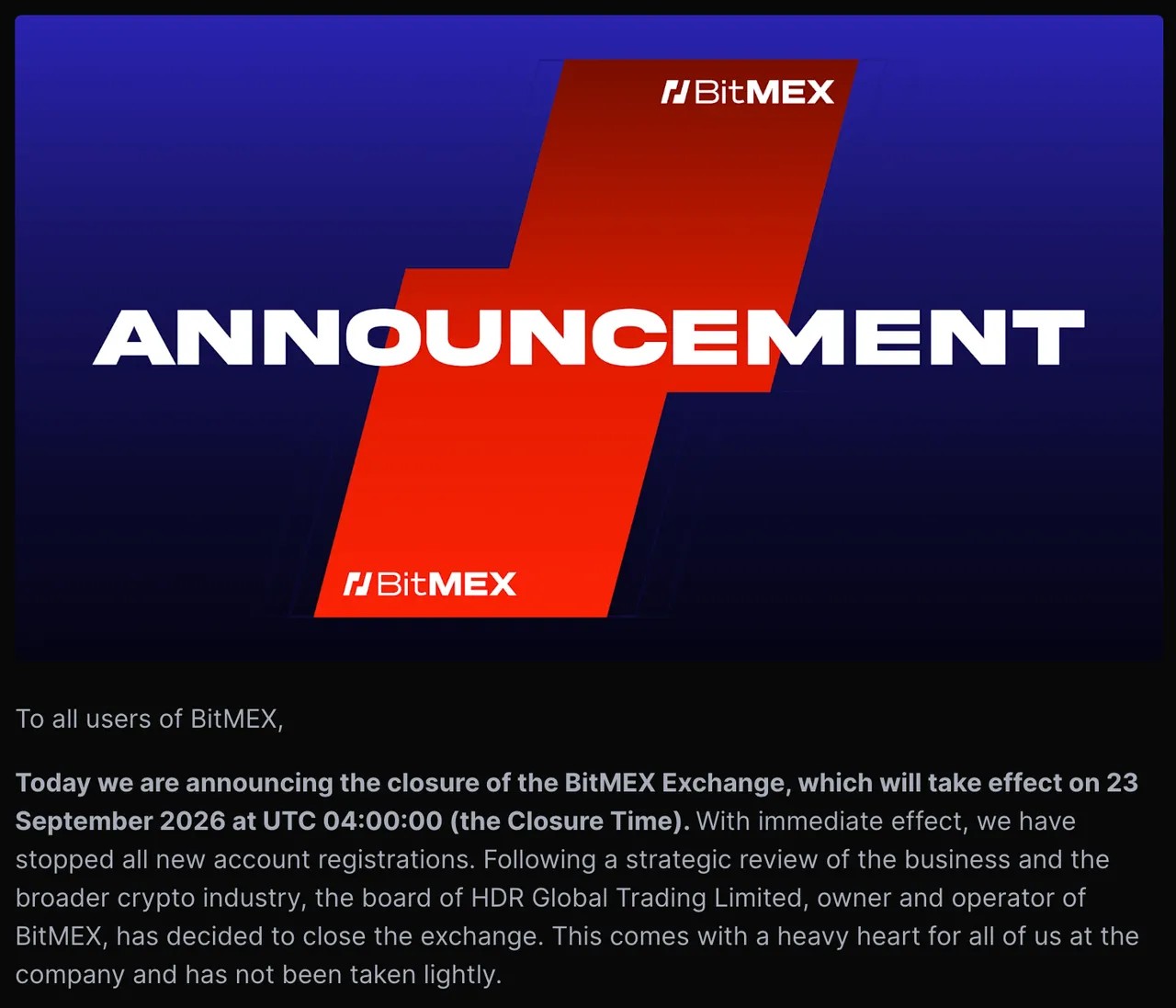
    Last week, BitMEX announced it would shut down its exchange in September after a strategic review by owner HDR Global Trading. The exchange had recently accelerated the delisting of trading pairs and derivative contracts, citing insufficient trading interest.

    Days later, BitMart announced it would end trading services on Aug. 26 before winding down operations entirely in January 2027. The exchange said the decision followed a review of its operating conditions, market environment and future strategic direction.

    Consolidation has also come through acquisitions. Earlier this month, Bybit launched a locally operated exchange in Indonesia after acquiring a majority stake in local digital asset firm NOBI, expanding its presence in one of Asia’s largest crypto markets.

    Source: BitMEX

    Magazine: The 100x obsession: Fundamentals grow in importance as crypto matures

  • Binance.US plans CFTC application in prediction market expansion

    Binance.US plans CFTC application in prediction market expansion

    Binance.US plans to apply for a designated contract market license from the Commodity Futures Trading Commission next month as the exchange prepares to expand into prediction markets.

    Chief executive Stephen Gregory disclosed the plan Wednesday during the Rare Evo conference in Las Vegas, according to Bloomberg, citing a Binance.US spokesperson.

    Receiving designated contract market status would allow Binance.US to operate a derivatives exchange under CFTC oversight and potentially list event contracts for retail customers.

    A designated contract market is a federally regulated exchange that can offer futures, options, and other derivative contracts. Applicants must satisfy CFTC requirements covering market surveillance, customer protection, financial resources, and safeguards against manipulation.

    Binance.US has not yet appeared on the CFTC’s public list of pending designated contract market applications, consistent with Gregory’s statement that the filing is planned for next month. Approval is not guaranteed and the company has not disclosed a timeline for launching any products.

    The planned application advances a broader comeback strategy centered on lower trading fees and an expansion beyond spot crypto trading.

    Gregory previously said the exchange was exploring retail derivatives and event based products as it attempts to regain market share lost during several years of regulatory uncertainty.

    At its peak in 2022, Binance.US controlled roughly 20% of the US crypto exchange market, according to CoinDesk Indices data. Its share has since fallen to nearly zero.

    Binance.US operates separately from the larger global Binance exchange, although the businesses share branding and beneficial ownership.

    The US company lost substantial trading activity following regulatory actions involving the broader Binance organization. The global exchange reached a $4.3 billion settlement with US authorities in 2023 over violations related to sanctions and money transmission rules.

    The prediction market sector has expanded rapidly as financial and crypto companies compete to offer event contracts tied to sports, elections, economic data, and other outcomes.

    However, the industry remains subject to legal and regulatory disputes. State authorities, consumer groups, and traditional gaming operators have challenged whether certain event contracts should be treated as federally regulated derivatives or gambling products governed by state law.

    The CFTC has also reminded designated markets that event contracts must comply with existing product submission, market integrity, and anti manipulation requirements.

  • Fed holds rates steady, extending pause as markets await Kevin Warsh’s policy roadmap

    Fed holds rates steady, extending pause as markets await Kevin Warsh’s policy roadmap

    The Federal Reserve left its benchmark fed funds rate range unchanged at 3.50%-3.75% on Wednesday, extending its pause for a sixth consecutive meeting as policymakers continue to grapple with stubborn inflation.

    The decision came after one of the most uncertain pre-meeting setups in years. Futures markets had assigned roughly a 65% probability to a hold and 35% odds of a quarter-point increase, according to CME FedWatch data.

    It was an unusual setup, as for years, the Fed had typically tried to communicate to markets the direction it was going to take on policy

    Attention now turns to Chair Kevin Warsh’s post-meeting press conference. Warsh has been openly critical of the Fed’s traditional use of forward guidance and the quarterly “dot plot,” and investors will be watching closely for signs that the central bank’s communication strategy is changing under his leadership.

  • Ethereum Price Stalls as Fed Rate Decision Looms

    Ethereum Price Stalls as Fed Rate Decision Looms

    In brief

    • Ethereum fell 1.53% to $1,890 on Wednesday, pulling back from a session high of $1,926 as traders froze ahead of the Federal Reserve’s rate decision.
    • Spot ETH ETFs attracted $14.53 million in inflows today, capping three straight weeks of net positive flows totaling $71.17 million in the seven days ending July 28.
    • The “death cross” remains in place, but charts point to growing trend strength.

    The whole crypto market is in a holding pattern, eagerly awaiting the Federal Reserve’s next move.

    Bitcoin is hovering near $64,000 while the Fear & Greed Index sits at 29—deep in “fear” territory. All eyes are on the Federal Reserve, which is expected to hold rates at 3.50–3.75%, but could rattle risk assets with a hawkish tone from Fed Chair Kevin Warsh. Equity markets are similarly cautious.

    Ethereum, the second largest digital asset by market cap, opened Wednesday at $1,919.80, tagged a session high of $1,926.10, and has since slipped to $1,890.60—down 1.53% on the day. The move is a modest setback after a sharp recovery from 2026 lows reached earlier this month.

    That bounce has been quietly supported by institutional flows: According to SosoValue, ETH has registered three consecutive weeks of net inflows, the strongest run since April.

    The death cross—where the 50-day EMA (exponential moving average of the last 50 days) trades below the 200-day—is still firmly in place, keeping the structural bias bearish. EMAs show where average price has been over different time periods; when the shorter-term average crosses below the longer one, it’s a classic signal that the medium-term trend remains down. Until that flips, the burden of proof is on bulls.

    What has changed is the Average Directional Index, or ADX, which now reads 23.2 with buying pressure (DI+) outpacing selling pressure (DI–). ADX measures trend strength regardless of direction; readings above 20 suggest something real may be forming. Right now, bulls are technically “winning” the internal tug-of-war—just not convincingly enough to confirm a real trend yet.

    The Relative Strength Index, or RSI, sits at 54.7—neutral territory showing a small buying interest. RSI measures whether an asset is overbought or oversold on a scale of 0 to 100; readings between 40 and 60 give no strong directional signal. The Squeeze Momentum Indicator has just released after a period of compression, with momentum reading 0.71 positive—a slight lean toward the upside, but one that needs a catalyst to follow through.

    The Fibonacci retracement for ETH’s recent leg—measured from the $1,846 low to the $1,980 top—puts the golden zone (the highest probability of market cooldown) between $1,897 and $1,913. Price is sitting just below it, making this the critical near-term pivot: resistance on the way up, and the threshold bulls need to reclaim to keep the recovery thesis credible.

    On Myriad, the prediction market operated by Decrypt‘s parent company Dastan, traders remain broadly biased toward a dump to $1,500 before any rally to $3,000.

    Sentiment peaked at 83% in favor of the dump in mid-June when ETH was near $1,682, according to Decrypt. The recovery since then has trimmed those odds—but with ETH sitting 58% below $3,000 and just 21% above $1,500, the math still leans bearish.

    Why the bullish case could work

    A Fed hold paired with a softer-than-expected tone from Warsh could be the macro unlock. ETF inflows are real and sustained. If ETH closes above $1,913 today or in the next session, it reclaims the golden zone and puts $1,944 in play—the 23.6% Fibonacci extension.

    Beyond that, $1,980 marks the top of the current Fib leg and the next serious ceiling.

    Why the bearish case is more likely

    A hawkish Fed or any rate-hike signal sends ETH straight back to test the $1,874–$1,846 support band. The death cross isn’t flipping soon—the 200-day EMA is sitting near $2,174, still well above current price. ADX at 23.2 hasn’t yet crossed the 25 threshold needed to confirm a genuine trend, but with the Fed as the wild card, direction is a coin flip.

    Most of the chart’s story still points south until ETH clears $1,980 convincingly.

    Disclaimer

    The views and opinions expressed by the author are for informational purposes only and do not constitute financial, investment, or other advice.

    Daily Debrief Newsletter

    Start every day with the top news stories right now, plus original features, a podcast, videos and more.

  • As crypto perpetual futures boom, Ethereum’s role is shifting

    As crypto perpetual futures boom, Ethereum’s role is shifting

    For years, Ethereum has been synonymous with decentralized finance. It pioneered onchain financial tools like lending protocols and tokenized assets, which today underpin much of the crypto economy. But one of crypto’s fastest-growing sectors, perpetual futures, or “perps”, has largely flourished elsewhere.

    Ask traders where onchain perpetuals live today, and the answer is more likely to be Hyperliquid or Solana than Ethereum. That is because perpetuals demand something Ethereum’s base layer was never designed to optimize for: extremely fast, low-cost, high-frequency trading.

    “Perps require frequent transactions, fast execution, and deep liquidity,” said AJ Warner, chief strategy officer at Offchain Labs, the main developer firm behind the layer-2 Arbitrum. “That makes them a natural use case for the Arbitrum platform.”

    The distinction has become increasingly important as decentralized perpetual exchanges mature from crypto-native products into markets attracting institutional attention.

    Why Ethereum L1 fell behind

    Perpetuals are one of the most demanding applications in crypto. Their exchanges require thousands of rapid-fire updates, liquidations, funding payments, and order executions, all without interruption.

    “Perps onchain are really hard,” said Brian Smith of the Jito Foundation. “It’s not just the average performance that matters, it’s the 99.99% success rate. If your perps platform goes down, that’s existential risk.”

    Ethereum’s security-first architecture made it an ideal settlement layer, but historically, its block times and gas costs made it an expensive place to run latency-sensitive trading applications.

    When decentralized perps exchange GMX launched on Arbitrum in 2021,, it helped establish a template that many others would follow. “Ethereum mainnet fees were prohibitively expensive, which naturally attracted perps builders to Arbitrum,” Warner said. Offchain Labs then leaned into that momentum, actively prioritizing perpetuals as a strategic category.

    “By prioritizing the vertical, we were able to attract a concentration of builders and capital to the ecosystem.” Today, much of Ethereum’s perpetual trading activity lives not on the Ethereum mainnet, but on layer-2 networks like Arbitrum and, increasingly, Base.

    Ethereum’s layer-2 ecosystem has become something of a compromise: preserving Ethereum’s security while dramatically improving trading performance. Networks like Arbitrum and Base have reduced block times while also becoming an increasingly attractive trading destination because of their growing user base and liquidity.

    Chris Boulous of Dromos Labs, the main developer firm behind Aerodrome, a decentralized exchange that lives on the Base network, argued that technical performance is only part of the story.

    “Trading is effectively a network-effects business,” he said. “You have to build where the liquidity and users currently exist.” That dynamic has become self-reinforcing: protocols launch where traders already are, liquidity providers follow the traders, and then new applications build around existing liquidity. It’s one reason Boulous sees Aerodrome as complementary to perpetual exchanges rather than competitive with them.

    “You can kind of think of perps as a customer of spot exchanges,” Boulous said. Spot exchanges provide pricing, liquidity and hedging opportunities that perpetual markets depend on. “Spot and perps are two sides of the same liquidity coin.”

    Why Solana and Hyperliquid surged

    Still, Ethereum’s layer-2 ecosystem isn’t the only place where developers can build high-performance trading infrastructure. Hyperliquid built an application-specific chain optimized almost entirely for perpetual trading. Solana, meanwhile, combined low fees with a large base of retail traders already actively trading memecoins and other speculative assets.

    According to Smith of Jito, that user base matters as much as the technology. “The most important ingredient for any exchange platform, but especially perps, is retail organic flow,” he said. “Solana is the king of retail trading activity.”

    Smith also argues Ethereum faces an additional challenge: fragmentation. “You need to be able to trade everything in a single spot,” he said. “What Ethereum is suffering from is a level of fragmentation.”

    Ethereum’s scaling strategy largely relied on layer-2 networks like Arbitrum and Base to handle high-volume activity. While that approach dramatically reduced costs and improved performance, it also dispersed users and liquidity across multiple ecosystems. Traders often need to bridge assets between networks, making the experience less seamless than on single-chain ecosystems such as Solana. Earlier this year, Ethereum co-founder Vitalik Buterin acknowledged that the original layer-2 roadmap vision “no longer makes sense” as layer 2s have decentralized more slowly than expected and Ethereum’s base layer has itself become more scalable.

    Not everyone sees that fragmentation as a fatal flaw, however. Some Ethereum proponents argue the focus on execution misses the network’s longer-term role in the onchain financial stack. Matthieu Saint Olive, a staff product manager at MetaMask, argues the framing itself misses what’s happening. “I’d push back gently on the premise that it’s a competition in the first place,” he told CoinDesk.

    Purpose-built trading chains may ultimately win on execution speed, but they still require somewhere to source collateral, liquidity, stablecoins, and settlement. “Ethereum’s role is the settlement and collateral base where the deepest liquidity, the widest range of assets, the stablecoins, and the most mature DeFi primitives live.”

    Several leading perpetual trading platforms either operate directly on Ethereum layer 2s or remain closely connected to Ethereum’s ecosystem for collateral, settlement, and developer tooling. “L2s are how Ethereum scales into use cases like active trading without giving up the thing that makes the base layer valuable,” Saint Olive said.

    The institutional question

    As institutions begin paying closer attention to onchain derivatives, the conversation is shifting from whether decentralized perpetuals can work to whether they can compete with traditional infrastructure. “It comes down to execution, custody, and predictability, not ideology,” Saint Olive said.

    Institutions, Warner of Offchain Labs argued, still need deeper liquidity, more efficient capital usage, and better execution before deploying significant trading volume onchain. “Capital is still fragmented across venues,” Warner said. “Institutions will want better access to credit, cross-margining, and the ability to trade across venues without leaving large amounts of capital idle.”

    For Boulous, the next milestone is straightforward: “You have to be able to do things onchain that you can’t do, or can’t do as cheaply, in traditional markets.”

    While much of today’s decentralized perpetual volume still revolves around crypto assets, market participants increasingly see the infrastructure supporting perps as the foundation for broader capital markets. Saint Olive believes perpetuals are already demonstrating what programmable markets can become.

    “Perps are the leading indicator, the first place you can watch traditional financial activity genuinely migrate onchain,” Saint Olive said.

    That may also explain why Ethereum’s role in the market is evolving rather than diminishing.

    Solana and purpose-built chains like Hyperliquid have established themselves as the venues where traders execute high-speed transactions. Ethereum, meanwhile, is increasingly positioning itself as the settlement and collateral layer that underpins those markets through its layer-2 ecosystem and broader DeFi infrastructure.

    Whether that division of labor persists will depend on how quickly Ethereum can solve some of the challenges its critics point to: fragmented liquidity across layer 2s, better interoperability between networks, and a smoother user experience. If it can, proponents argue Ethereum doesn’t necessarily need to become the fastest place to trade perpetuals. It simply needs to remain the deepest and most trusted place to settle them.

    Read more: Perpetual futures could become crypto’s next ETF moment

  • Solana Policy Institute Calls on U.S. Senate to Pass CLARITY Act for Crypto Legal Certainty

    Solana Policy Institute Calls on U.S. Senate to Pass CLARITY Act for Crypto Legal Certainty

    The Solana Policy Institute (SPI) has formally urged the U.S. Senate to pass the CLARITY Act, a bill aimed at providing legal certainty for digital asset developers, institutions, and consumers. In a letter addressed to Senate Republican Leader John Thune and Democratic Leader Chuck Schumer, SPI argued that the time to act is now, warning that delays could erode American competitiveness in the global blockchain industry.

    What the CLARITY Act Proposes

    The CLARITY Act, whose full name is the Clarifying Lawful Overseas Use of Data Act, is designed to establish clear jurisdictional rules for digital assets and blockchain-based transactions. The bill seeks to resolve ongoing regulatory ambiguity that has left many U.S.-based crypto firms uncertain about compliance requirements. SPI emphasized that the legislation would give developers and institutions the legal confidence needed to innovate and scale within the United States.

    Why the Senate Letter Matters

    The letter from SPI, reported by The Block, comes at a critical juncture for U.S. crypto policy. The industry has faced a patchwork of state-level regulations and conflicting federal guidance, which many argue has driven talent and capital overseas. SPI’s direct appeal to Senate leadership signals that the Solana ecosystem views the CLARITY Act as a foundational piece of legislation that could unlock broader adoption and investment.

    Broader Implications for the Crypto Industry

    If passed, the CLARITY Act could serve as a model for future digital asset regulation. It would not only clarify legal boundaries but also potentially reduce litigation risks for companies operating across state lines. For consumers, clearer rules could mean better protections and more transparent markets. However, the bill’s path through the Senate remains uncertain, with competing priorities and differing views on crypto regulation among lawmakers.

    Conclusion

    The Solana Policy Institute’s call for swift passage of the CLARITY Act reflects a growing sense of urgency within the blockchain industry. As other nations advance their own regulatory frameworks, the U.S. risks falling behind without decisive action. The Senate’s response to this appeal will be closely watched by developers, investors, and policymakers alike.

    FAQs

    Q1: What is the CLARITY Act?
    The CLARITY Act is a proposed U.S. federal law that aims to clarify legal jurisdiction and regulatory rules for digital assets and blockchain transactions, reducing uncertainty for developers and institutions.

    Q2: Why did the Solana Policy Institute send a letter to Senate leaders?
    SPI urged Senate Republican Leader John Thune and Democratic Leader Chuck Schumer to pass the CLARITY Act, arguing that legal certainty is essential for the U.S. to remain competitive in the global crypto industry.

    Q3: What impact could the CLARITY Act have on the crypto market?
    The bill could reduce regulatory risk, encourage innovation, attract investment, and provide clearer consumer protections, potentially boosting the U.S. digital asset ecosystem.

    Related Reading

    • SEC Commissioner Peirce’s Remarks on Crypto Vaults Signal Move Toward Formal DeFi Regulation, Sentora CLO Says
    • White House Crypto Official Says BRCA Amendment Conflicts With Administration Policy
    • BNY Mellon Brings Blockchain-Based Transfer Agency to $8.6 Trillion Fund Services Unit
    • Grayscale: Hyperliquid’s HYPE Token Remains Undervalued Compared to Fintech Peers
    • CES Organizer Pushes Senate to Advance CLARITY Act for Blockchain Regulation
  • Gate US joins BitGo off-exchange settlement network

    Gate US joins BitGo off-exchange settlement network

    Gate US joined BitGo’s Go Network Off-Exchange Settlement service on July 28, giving eligible institutional clients access to the exchange’s U.S. liquidity while their assets remain in custody at BitGo Bank & Trust, National Association.

    The integration extends a broader partnership announced five days earlier. Gate US said BitGo would provide institutional custody, wallet management and risk-control technology as the exchange expands its U.S. business. Neither company disclosed financial terms, expected trading volume or a separate rollout schedule for the OES connection.

    Gate US clients can trade without pre-funding the exchange

    Under the arrangement, an institution allocates part of its balance held at BitGo Bank & Trust for trading on Gate US. BitGo then projects the available balance to the exchange for order execution, while the underlying assets remain in segregated custody until settlement.

    .@GateUS_Official is now part of BitGo’s Go Network Off-Exchange Settlement.

    How it works 👇

    🏛️Assets stay in segregated, regulated custody at BitGo Bank & Trust throughout the trading lifecycle

    💸Clients pledge cash, crypto, and select tokenized real-world assets, then… pic.twitter.com/OosXz3rB4N

    — BitGo (@BitGo) July 28, 2026

    Completed trades settle through Go Network rather than requiring customers to transfer assets into a conventional exchange wallet before each transaction. BitGo’s technical documentation says Go Network settlements occur off-chain while assets remain in its cold-storage system.

    Gate US Chief Operating Officer Laura Liu said the connection gives clients a framework built around regulated custody. Her description of the service as a “secure and efficient path” is a company claim. The firms have not published performance data comparing settlement speed, failure rates or costs with ordinary exchange deposits.

    BitGo separates custody from trade execution

    BitGo Bank & Trust provides custody and settlement, while Gate US continues to operate the market and execute orders. BitGo’s disclosures identify the subsidiary as a national trust bank chartered and regulated by the Office of the Comptroller of the Currency.

    The OCC’s corporate applications database shows that BitGo’s conversion from a South Dakota trust company became effective on Dec. 12, 2025. The charter authorizes fiduciary and custodial services but does not make digital assets eligible for federal deposit insurance.

    The model resembles traditional-market structures where a custodian holds assets while another venue executes trades. As crypto.news previously reported, OKX US added BitGo OES for institutional clients in April. In related coverage, Binance connected to Anchorage Digital’s Atlas platform under a similar structure.

    Off-exchange settlement reduces but does not remove risk

    Keeping assets away from an exchange can reduce exposure if the venue experiences insolvency, withdrawal restrictions or a custody breach. However, BitGo’s annual SEC filing says its OES services still create operational, regulatory and counterparty risks.

    BitGo lists possible trade-data errors, delayed asset transfers, insider misconduct, cyber incidents, technology disruptions and reconciliation failures. It also warns that a participating exchange or its clients could fail to meet obligations or provide inaccurate transaction data.

    Those disclosures qualify broader claims that off-exchange custody eliminates counterparty exposure. Settlement still depends on BitGo’s systems, Gate US’s execution records and enforceable agreements between the parties. The announcement did not specify supported assets, margin arrangements, settlement frequency, default procedures or separate OES fees.

    Gate US said in July that it held 36 state money-transmitter licences and served 47 U.S. jurisdictions. Its legal page states that cryptocurrency accounts are not protected by the Federal Deposit Insurance Corporation or Securities Investor Protection Corporation.

    Gate US expands BitGo’s institutional venue network

    BitGo now lists Gate US alongside Crossover Markets CROSSx, Deribit through Copper ClearLoop, Finery Markets, Gate Global, HTX, INX, KuCoin, OKX US and STS Digital. Clients may trade directly with connected venues or use BitGo Prime for aggregated access to exchanges, market makers and over-the-counter liquidity providers.

    BitGo calls the expanding system its “Global Liquidity Layer.” That remains a strategic description rather than a regulated market category. Its value will depend on institutional adoption, reliable settlement and the amount of usable liquidity available through each connected venue.

    The next measurable updates will be the start of client activity, the assets supported on Gate US and any disclosed settlement or volume data. The companies have not announced deadlines for those disclosures. No verified market-price reaction was directly attributable to the integration.

  • AI Book Burning? Companies Are Destroying Millions of Books to Feed Chatbots

    AI Book Burning? Companies Are Destroying Millions of Books to Feed Chatbots

    In brief

    • AI companies are anonymously buying physical books in bulk and destroying them after scanning them for AI training.
    • Booksellers say demand for obscure and out-of-print titles has surged, raising fears that rare books are disappearing.
    • A federal judge ruled that destructive scanning of legally purchased books can qualify as fair use, even as separate copyright litigation continues.

    Like a scene out of the classic dystopian novel “Fahrenheit 451,” some AI companies aren’t just reading books—they’re destroying them.

    As developers race to build more powerful AI models, and lawsuits over copyright mount, a cottage industry has sprung up to supply them with millions of physical books that are stripped apart, scanned into training datasets, and discarded.

    First reported by 404 Media, AI companies are using intermediaries to acquire books at industrial scale anonymously. Companies specializing in bulk sourcing advertise their ability to locate hundreds of thousands of titles while promising confidentiality for AI clients, reflecting the sensitivity surrounding the practice.

    Critics say the buying spree is driven by AI companies racing to preserve human-authored knowledge before it is diluted by AI-generated text, often called “AI slop.” Books published before the rise of generative AI in 2023 are especially valuable because they provide high-quality training data written entirely by humans.

    The surge in demand is already reshaping the used-book market. One unnamed bookseller told 404 Media that weekly sales climbed from roughly 20 books to several hundred after AI buyers entered the market. While the increase has been profitable, he said he worries uncommon and out-of-print books are being permanently lost after they are scanned and destroyed.

    “It benefits me financially as well as by clearing out old inventory that is otherwise unlikely to sell,” the bookseller told 404 Media. “I’ve been well suited for these sales with inventory from overseas and foreign language books. On the other hand, I don’t like the end-use, and I don’t like that uncommon books are being pulped.”

    The practice mirrors Anthropic’s “Project Panama,” which digitized millions of books through destructive scanning.

    Last summer, in the copyright lawsuit Bartz v. Anthropic PBC, a federal judge in San Francisco ruled that scanning legally purchased physical books into digital copies, even when the originals were destroyed, constituted transformative fair use. Federal judges later issued similar fair use rulings in separate copyright cases involving OpenAI and Meta.

    However, in a separate case, a federal judge in the same district this week approved a $1.5 billion copyright settlement requiring Anthropic to pay thousands of authors about $3,000 per book after the company used pirated copies of their works to train Claude.

    In response to the growing backlash, AI developers, including Elon Musk, have spoken out against the practice and said companies should maintain the books being scanned.

    “I’ve asked the SpaceXAI team to preserve any rare books in a library and scan them the hard way vs just cutting off the spine and scanning,” Musk wrote on X.

    Daily Debrief Newsletter

    Start every day with the top news stories right now, plus original features, a podcast, videos and more.