Despite the US Federal Reserve keeping interest rates unchanged, its continued “hawkish” stance on monetary policy could continue to put pressure on cryptocurrency markets. Expert analyses suggest that the messages conveyed by the Fed after its July 29th interest rate decision could limit the short-term performance of risky assets, particularly Bitcoin.
At its latest meeting, the Fed kept its policy interest rate unchanged, maintaining its firm stance on combating inflation. This approach indicates that the central bank is unwilling to allow inflation to rise above its target level, even at the cost of slowing economic growth. The analysis states that this scenario is among the most unfavorable macroeconomic environments for crypto assets in the current market cycle.
It was noted that tight monetary policy could reduce liquidity in the financial system and limit investors’ risk appetite. Specifically, it was stated that cryptocurrency positions financed through leveraged transactions or low-cost funding strategies would face higher costs, potentially putting downward pressure on Bitcoin.
Institutional investors may also adopt a more defensive strategy in their portfolios if hawkish Fed rhetoric continues. This could increase selling pressure on risky asset classes such as stocks and cryptocurrencies. It is noted that if the shift towards safer investment instruments like bonds and cash accelerates, capital inflows into crypto markets may slow down.
However, the analyses also noted that Bitcoin has so far demonstrated relative resilience in the face of a hawkish monetary policy environment. It was stated that the digital asset has maintained strong support levels despite significant recent macroeconomic developments, while markets continue to closely monitor the Fed’s future actions.
However, experts warn that new and unexpectedly harsh tightening messages from the Fed could create new volatility in the markets. In such a scenario, Bitcoin and other crypto assets could face additional price pressure in the short term.
Ask most people how a crypto price gets set and they will describe spot trading: buyers and sellers meet on an exchange, and the last trade prints the price. But that has not been how it actually works for years as far as bitcoin, ether and the broader crypto markets are concerned.
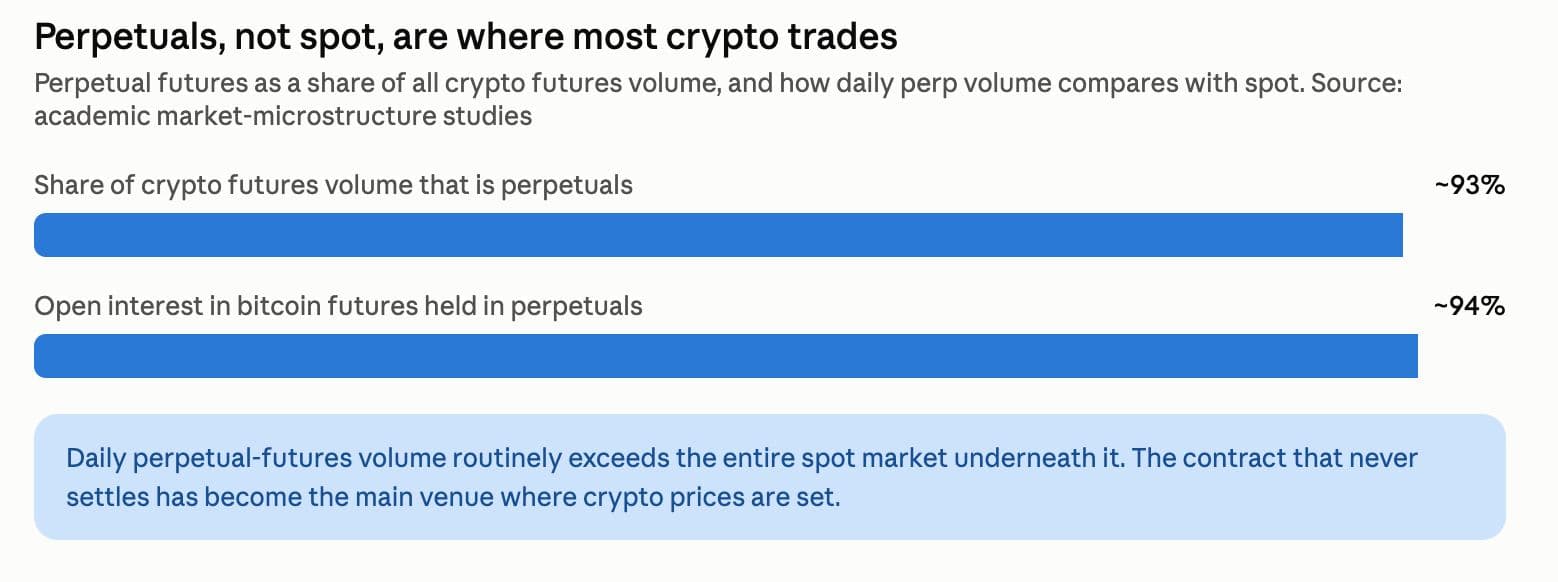
Perpetual futures, also called perpetual swaps or “perps” for short, are leverage-friendly contracts that never expire, and they now account for roughly 93% of all crypto futures volume, with daily perp volume routinely running larger than the spot market underneath it.
A traditional futures contract has a settlement date, which is when it comes due and its price is forced to meet the spot price of the thing it tracks, also called the underlying. But a perpetual has no such date and can be held indefinitely (by paying a cost known as ‘funding rate,’ which varies daily).
A body of market-microstructure work has asked which venue “discovers” a bitcoin price first, meaning where new information enters the market before it shows up anywhere else. The answer has repeatedly come back pointing at derivatives.
A study in the Journal of Financial Markets by Carol Alexander and co-authors found that perpetual swaps on unregulated venues were the strongest instruments for bitcoin price discovery, with regulated futures and U.S. spot exchanges reacting to, rather than leading, those moves.
Other work has identified Binance’s perpetual market as the primary source of price formation across the fragmented crypto landscape.
The evidence is not conclusive, however, and some studies find spot still leads at certain frequencies or during stress. But the direction of the literature over the past few years has been toward the derivatives market as the place where the price is made.
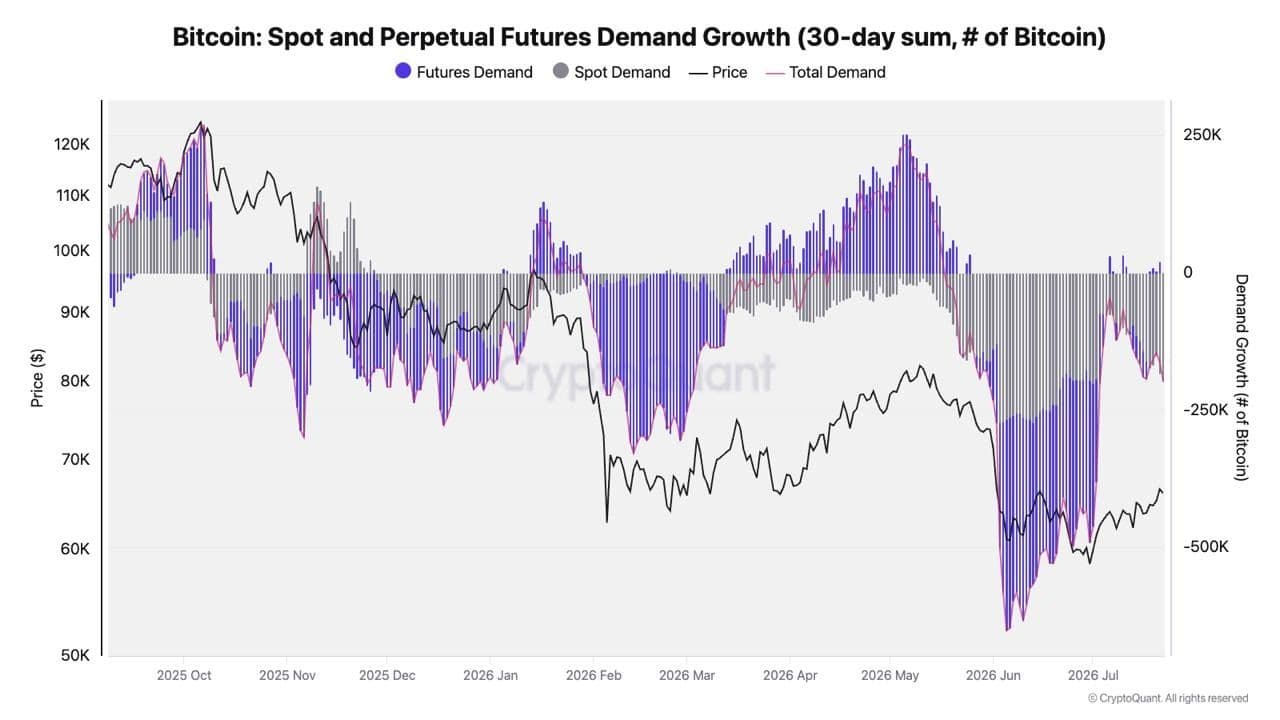
“Historically, we have seen perps leading mostly during bear market price rallies,” Julio Moreno, head of research at CryptoQuant, told CoinDesk. “For example, Bitcoin perps demand growth (blue bars in the chart) led the price rallies of January 2026, and April-May 2026.”
“In these periods, spot demand was contracting, while perps demand expanded, thus the perpetual futures market was leading prices despite demand contracting on the spot market,” he said.
Which brings us back to the funding rate. Because a perpetual contract never settles, nothing forces its price back toward spot the way an expiry date does for a traditional future. Instead, every few hours, whichever side of the trade is crowded pays the other.
When the perp trades above spot, traders who are long (or betting on higher prices) pay those who are short (betting on lower prices), which nudges the contract back toward the underlying price.
The funding rate is both the tether that keeps the contract anchored and a live readout of sentiment, which is why some traders watch it as closely as price.
“We actually surveyed more than 100 of our traders,” Hong Yea, co-founder at onchain trading platform Grvt, told CoinDesk. “The traders who actually rely on us to hold real conviction positions want predictability there, not another data point to interpret.”
“If you’re holding a directional position for weeks, funding isn’t telling you something new about the market, it’s just eating into your PnL while you wait to be right. That’s the honest way our users describe it to us, not, ‘what is the market telling me,” Yea added.
The SpaceX use case
None of this requires a spot market to exist. And for about three weeks in May and June, one of the most-watched markets in the world was for a company that had never sold a public share was running on crypto rails.
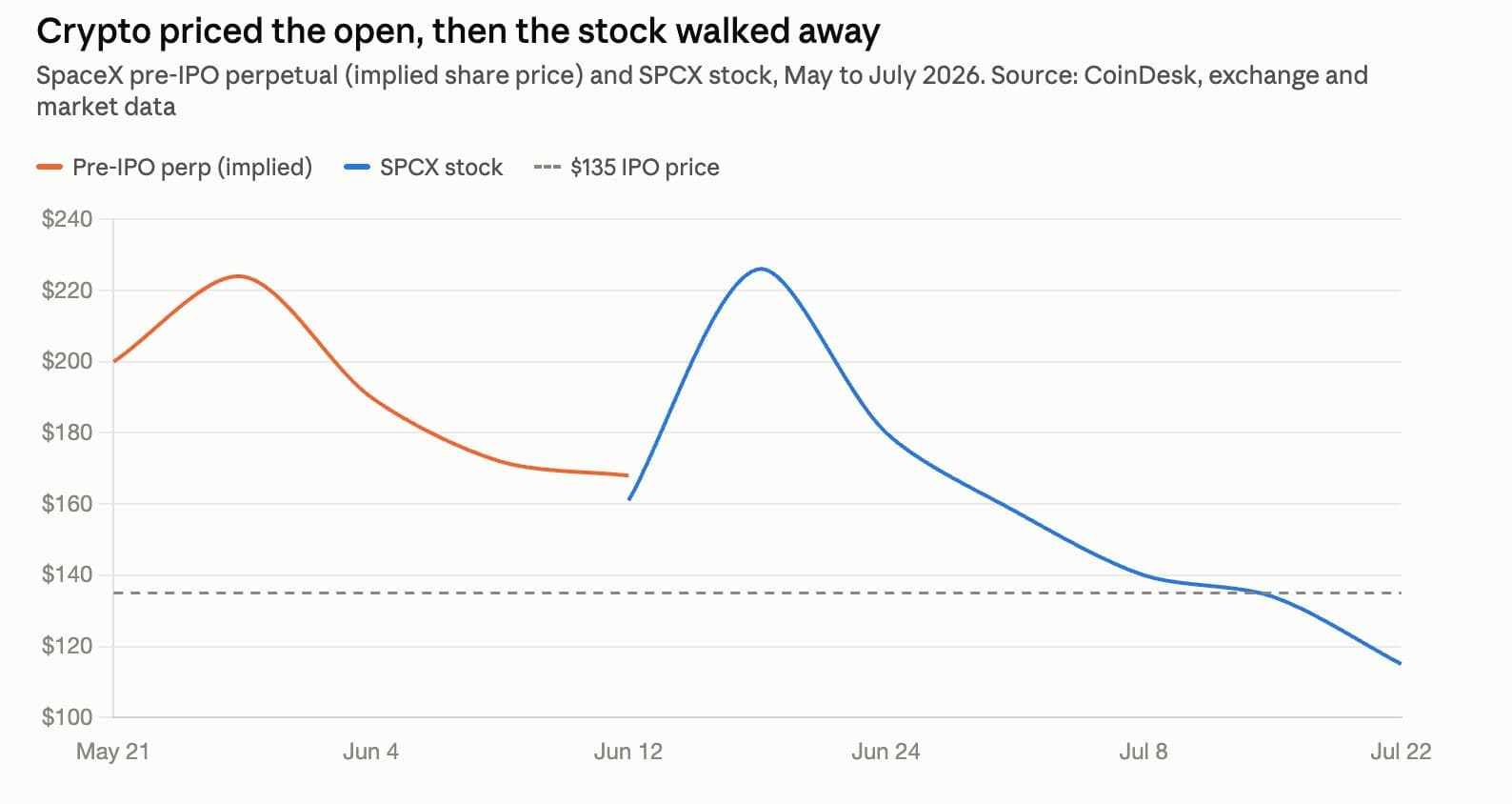
Elon Musk-owned SpaceX priced its record $75 billion initial public offering at $135 a share and began trading on the Nasdaq on June 12. Well before that, traders on Binance, Coinbase, Hyperliquid and others were already buying and selling exposure to the company through pre-IPO perpetual futures, or contracts structured to track an implied valuation rather than a share price.
The first mover was Hyperliquid, the onchain derivatives exchange, where a synthetic SpaceX perpetual went live on May 18. Binance opened its own SpaceX market on May 21, Coinbase followed on June 4, and BitMEX, Bitget and OKX later added contracts of their own.
The striking part is how right they were at the one moment their accuracy could be tested. On the night before SpaceX listed, perpetuals on Hyperliquid and Binance were quoting the equivalent of roughly $170 a share, well above the $135 the underwriters had set.
The next day SPCX opened, ran to an intraday high above $176, and closed its first session at $161, up 19%. The stock printed almost exactly where the perps had it, and a market dominated by leverage-seeking retail traders had read first-day demand more accurately than the banks that spent months building the offering price.
That gap was also where the money was. The perpetual market was pricing SpaceX well above the $135 IPO price, so traders could buy the contract before listing and bet the two would meet. Every one of these contracts was built to automatically switch over to SpaceX’s real share price the moment the stock began trading, so any gap between the perp and the eventual opening price would close on its own. With the IPO already four times oversubscribed, the direction was rarely in doubt, and the pre-listing window was the only place to make the trade.
Then reality caught up with the market that had predicted it. SPCX has fallen more than 40% from its June peak, dropping from the $135 IPO price to about $115 as of publication.
The reason is one the perp could never have priced — supply. Only a sliver of SpaceX’s shares were sold at the IPO, and starting around August 6, roughly 900 million locked-up insider shares become eligible to sell.
What SpaceX showed in the extreme is what the research says is already true in ordinary crypto trading — the derivatives market is increasingly where price gets discovered. Spot follows.
Perps are excellent at pricing demand and blind to supply, which is worth remembering every time a bitcoin rally or a flush starts in the funding rate before it reaches spot.
Aave, a leading lending protocol in the decentralized finance (DeFi) sector, has announced a comprehensive restructuring process aimed at improving the platform’s efficiency. Aave founder Stani Kulechov stated that the protocol will gradually phase out assets with low usage rates and scale back its operations on some blockchain networks.
According to the announcement, Aave plans to gradually end support for 50 reserve assets on its own network that are not seeing sufficient usage. In addition, support will be phased out for 25 reserve assets on the Sonic, Scroll, zkSync, Metis, Soneium, and Aptos networks. Thus, a total of 75 reserve assets with low usage rates will be affected by the restructuring process.
Aave management stated that this step aims to ensure more efficient use of platform resources and to focus on assets that users show strong interest in. The protocol, which has expanded to different blockchain networks in recent years, had begun supporting numerous digital assets. However, due to some reserves failing to reach the expected transaction volume and user demand, the decision was made to simplify the system.
According to the data released, the restructuring process will affect approximately $98.1 million in reserve assets and $15.6 million in loan positions. Aave stated that support will be phased out gradually and necessary transition plans will be implemented to minimize customer inconvenience during this process.
Experts point out that it is common practice in the industry for DeFi protocols to occasionally remove assets with low liquidity or insufficient usage from the system. Such decisions can help platforms reduce maintenance costs while improving security and operational efficiency.
Aave is among the world’s largest decentralized finance protocols in terms of total locked assets (TVL) and offers lending and borrowing services to its users across different blockchain networks. Analysts believe that the restructuring decision may lead to liquidity shifts in affected reserve assets in the short term, but in the long term, it could support Aave’s goal of creating a more efficient and sustainable ecosystem.
During the company’s second-quarter earnings call, Tenev said that while the Trump administration has been “great” for the industry, regulatory stability is necessary.
“We want the foundation of the industry in the U.S. to be durable,” Tenev added. “We don’t want the floor to be shifting out from under us every four, eight years, and new rules to be put in place.”
The top executive viewed the Clarity Act as an “important step” in this direction and could boost many of the company’s offerings currently under development, .
Record Revenue But Crypto Share Shrinks
Robinhood beat , with quarterly revenue clocking a record $1.3 billion.
Transaction-based revenues surged 44% year-over-year to $776 million, driven by equities, options and prediction markets. However, cryptocurrency revenue plunged 38%, adding to another quarter of decline.
Robinhood has expanded beyond asset trading in recent years by launching offerings centered around blockchain, tokenized assets and prediction markets.
Its prediction market revenue has exploded tenfold year-over-year to $156 million, while the number of contracts traded soared to a record 13.6 billion.
Price Action: Robinhood shares fell 1.01% in after-hours trading after closing 3.15% lower at $89.84 during Tuesday’s regular trading session. Year-to-date, the stock has plunged 15.43%.
Benzinga’s Edge Stock Rankings indicate that HOOD stock maintains a stronger price trend over the medium term, while underperforming in the short and long terms.
Photo courtesy: Thrive Studios ID / Shutterstock.com
Crypto’s largest tokens were close to unchanged on Thursday as the semiconductor selloff that has driven markets for two weeks showed its first real sign of easing.
Ether traded at about $1,905 and bitcoin at $64,100, both flat on the day, with $XRP at $1.07, solana at $74, $BNB at $572 and TRON at 33 cents. Hyperliquid’s $HYPE slipped to $54. Volumes were modest, with roughly $28 billion changing hands in bitcoin and $10 billion in ether.
Electronics giant Samsung said chip profit rose more than 250-fold on AI memory shortages, and the Kospi swung between a 6% gain and a 2% loss before settling, after a stretch that took the index down more than 40% from its June peak.
Samsung’s reaction is the tell on how high the bar has become. Profit up 250-fold moved the shares 2%. SK Hynix reported profit up 557% on Wednesday and fell 17%. Results are not the problem, expectations are.
U.S. earnings split overnight. Microsoft gained nearly 9% in extended trading on its fastest cloud growth in four years, while Meta fell 8% on a weak revenue forecast. Nasdaq 100 futures rose 1% after the index entered a technical correction on Wednesday.
The Crypto Fear and Greed Index, a key indicator measuring investor sentiment in cryptocurrency markets, remained at 35 points, suggesting a continued cautious outlook in the markets. Calculated by CoinMarketCap, the index showed no change compared to the previous day, revealing that investor risk appetite remains low.
The index indicates “excessive fear” in the market as it approaches zero, and “excessive greed” as it approaches 100. The current level of 35 points is in the “fear” zone, indicating that investors continue to act cautiously due to uncertainty and that market confidence has not yet fully recovered.
CoinMarketCap considers a variety of data points related to the cryptocurrency market when creating its index. The calculation takes into account indicators such as price movements of the top 10 cryptocurrencies by market capitalization, market volatility, put/call ratios in derivative markets, stablecoin supply ratio (SSR), and user search data on the CoinMarketCap platform. This allows the index to reflect not only price changes but also investor behavior and market trends.
Recently, global macroeconomic uncertainties, expectations regarding central bank monetary policies, and volatile price movements in crypto assets have been cited as the main factors limiting investors’ willingness to take risks. The fact that the index has remained at the same level for several days also indicates that the market is struggling to determine a new direction.
Analysts note that the Fear and Greed Index alone is not sufficient for making investment decisions, but it is considered an important indicator for understanding market psychology. Historically, periods when the index fell to very low levels sometimes presented buying opportunities, while excessively high levels increased the risk of profit taking.
Online brokerage Robinhood posted record second-quarter revenue and earnings, though cryptocurrency transaction revenue fell 38% from a year earlier.
According to the company’s earnings report on Wednesday, revenue increased 32% year over year to $1.31 billion, while its net income rose 48% to $573 million.
The company reported that cryptocurrency transaction revenue fell to $100 million from about $160 million a year earlier. Separately, it recorded $40 billion in crypto trading volume during the quarter, including $18 billion on the Robinhood app and $22 billion from Bitstamp, the crypto exchange it acquired in June 2025.
During the quarter, Robinhood continued expanding its digital asset business, launching the public mainnet of Robinhood Chain, introducing tokenized US stocks to eligible users in more than 120 countries and debuting its first decentralized lending product, Robinhood Earn.
The company also completed its acquisition of Canadian crypto platform WonderFi, said it plans to expand its crypto offerings in the United Kingdom and reported that nearly 100,000 customer accounts are now enrolled in Agentic Trading, representing more than $100 million in assets under custody.
The price of Robinhood shares were down 3.15% on Wednesday ahead of the company’s earnings release, according to Yahoo Finance data.
Magazine: Bitcoin price wedged into ‘most divided’ FOMC as Iran war spikes oil prices 8%
Microsoft is rolling out a new OneDrive Photos app to some Windows 11 PCs.
The app indexes local photo libraries and adds AI-powered search and optional facial grouping.
The rollout follows Microsoft’s broader push to integrate AI features into Windows.
Some Windows 11 users are discovering a new Microsoft app they never installed. Called OneDrive Photos, it automatically indexes local images and offers AI-powered search and optional facial grouping.
The rollout, first spotted by industry publication Windows Latest, comes via Windows Update or updates to the existing OneDrive client rather than as a separate download.
According to Windows Latest, OneDrive Photos can detect and display images stored locally on a PC even if the user is not signed into a Microsoft account. After signing in, the app enables AI-powered search that can locate photos using natural-language queries and optical character recognition.
The app also includes an optional People feature that groups similar faces, which are visible only to the user, aren’t shared with third parties, and can be deleted by disabling the feature. However, Windows Latest noted that the feature requires users to opt in because facial data may be considered biometric information in some jurisdictions.
The news comes two years after Microsoft was forced to overhaul its AI-powered Recall feature following a privacy backlash that prompted the company to make the screenshotting tool opt in by default.
More recently, in May, Google began downloading its roughly 4GB Gemini Nano AI model to eligible Chrome installations through browser updates to power on-device AI features, adding to concerns about AI capabilities arriving through routine software updates.
According to Windows Latest, OneDrive Photos is tied to the existing OneDrive client and cannot currently be removed on its own. Users who want to uninstall the app must remove OneDrive entirely from Windows.
Microsoft did not immediately respond to a request for comment by Decrypt.
Daily Debrief Newsletter
Start every day with the top news stories right now, plus original features, a podcast, videos and more.
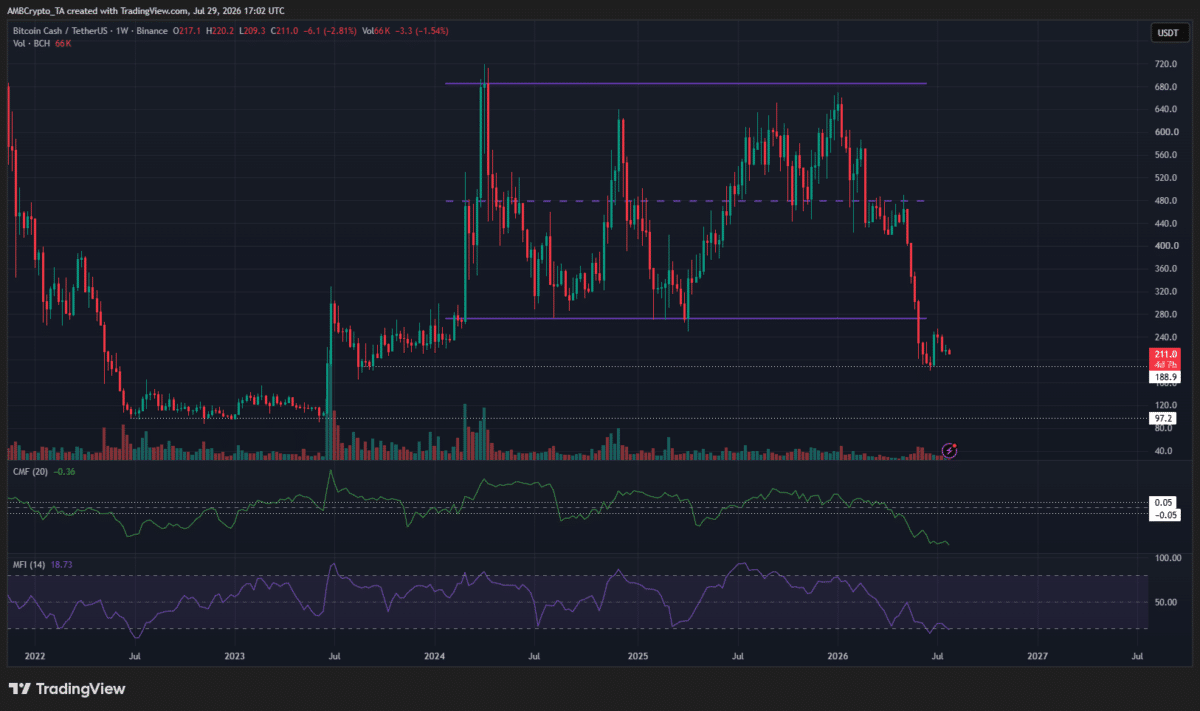
Bitcoin Cash [$BCH] fell below a range that it had traded within for over two years. The critical support level at $272 was shattered by the selling pressure in May. A test of the $188 long-term support yielded a bounce to $240, which has begun to reverse since the end of June.
The altcoin’s relative strength against Bitcoin [BTC] evaporated in May. In that month, $BCH had shed nearly 42%, a sizeable decline that continued into June.
With Bitcoin struggling to climb back above $67k, and the market maintaining a bearish bias, here’s what Bitcoin Cash investors need to watch out for.
Will Bitcoin Cash bulls sink or swim at $200?
Source: $BCH/$USDT on TradingView
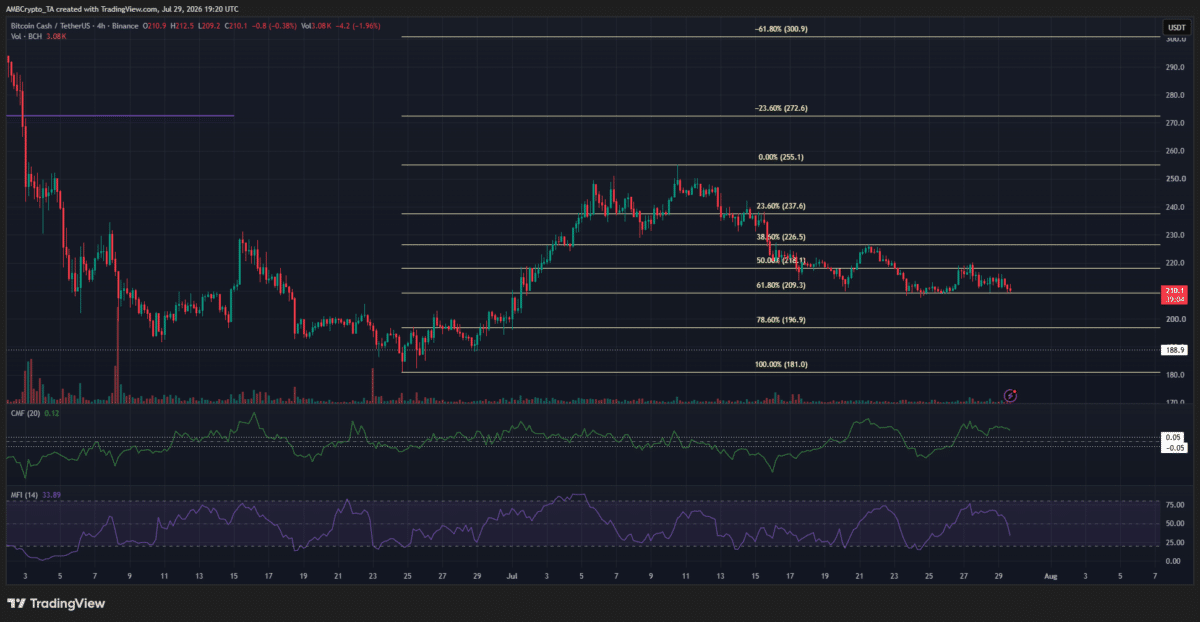
As covered earlier, the downward momentum picked up in May. The MFI raced from 49.8 in the second week of May to 14.64 by the third week of June. Similarly, the CMF also slid below -0.05 to indicate incessant selling underway.
In August 2023, the swing low at $165.4 had been the one that propelled the Bitcoin Cash uptrend up to $719. Therefore, this swing low is the one that must be breached to flip the weekly swing structure bearishly.
It appeared likely that this bearish scenario would soon unfold.
The 4-hour chart had a bullish swing structure. The CMF was at +0.12, showing buying pressure was dominant. Yet, the token was in a retracement phase. Over the past week, the buyers have desperately defended the $209.3 support.
A drop toward $196.9 would not be a buying opportunity, given the higher timeframe downtrend.
Source: CoinGlass
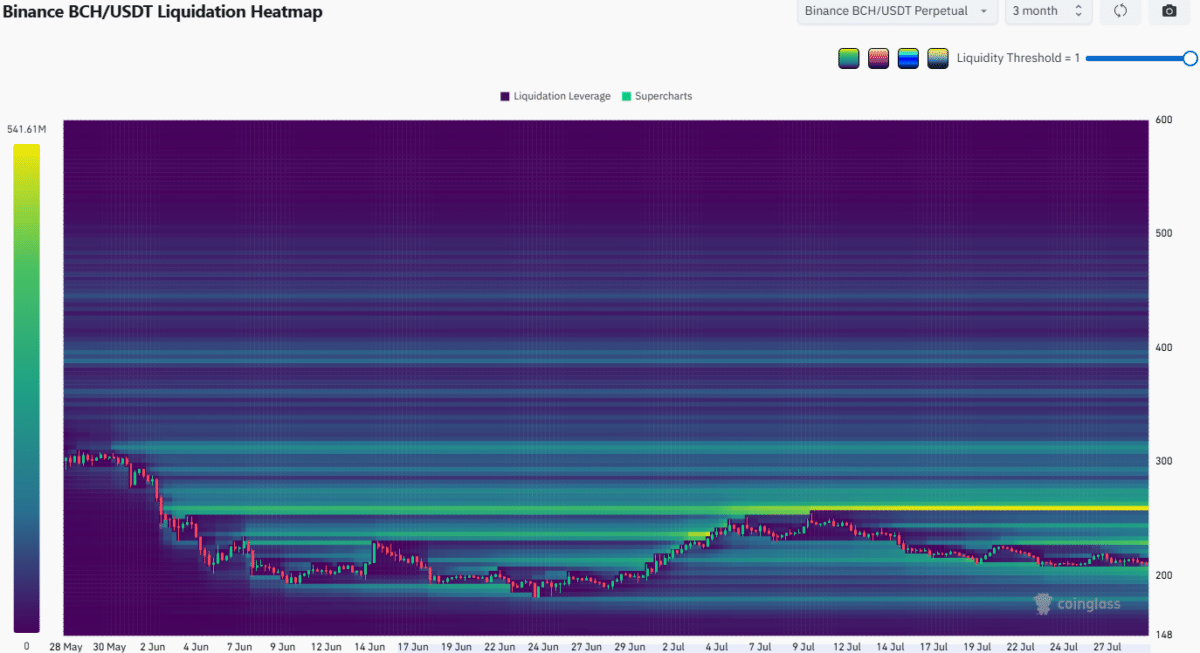
The rally toward $255 likely came as a liquidity hunt. There still is a pocket of unswept short liquidations around $260. The rally earlier this month peaked at $255 and has retraced since then.
In the short-term, despite the H4 chart’s structure, a bounce up to $227 and $243 were possible. It was more likely that prices would continue below $200, due to the bearish momentum seen since May.
Final Summary
The Bitcoin Cash range of over two years was shattered by the strength of selling in May and early June.
The long-term bearish momentum is likely to continue and push $BCH below $200.
Kalshi’s fight to keep its sports prediction contracts under federal protection just hit a major roadblock. A Wisconsin federal judge has refused to block state gambling laws against Kalshi and four other major prediction platforms, rejecting the CFTC’s push for exclusive federal control.
Wisconsin Court Rejects CFTC’s Emergency Push
On July 29, 2026, U.S. District Judge William Griesbach denied the CFTC’s request for a preliminary injunction against Wisconsin. The regulator wanted the court to stop the state from enforcing its gambling laws against prediction platforms offering sports event contracts.
The CFTC argued that federally regulated prediction markets fall under its exclusive jurisdiction. However, the court rejected that argument at this stage, finding that registration with the CFTC does not automatically shield these platforms from state gambling laws.
The court also rejected motions from Kalshi and Crypto.com to intervene in the CFTC’s case.
Judge Says CFTC Rules May Not Override States
The decision centers on preemption, or whether federal law overrides state law. Judge Griesbach found that the Commodity Exchange Act does not automatically cancel Wisconsin’s gambling rules.
The court also indicated that the plain language of Wisconsin’s gambling laws could cover sports-related event contracts.
That creates a key problem for Kalshi and other prediction markets. While these platforms describe their contracts as financial products, state regulators argue that contracts tied to sports outcomes are effectively sports bets.
The judge also found that the CFTC had not shown enough “irreparable harm” to justify blocking Wisconsin from enforcing its laws.
Five Prediction Markets Are Already Facing Wisconsin Lawsuits
The ruling follows Wisconsin’s April lawsuits against Kalshi, Polymarket, Crypto.com, Robinhood and Coinbase. The state claims the platforms offered sports contracts without the required gaming licenses, violating Wisconsin gambling laws under Chapter 945.
The CFTC responded by suing Wisconsin, arguing that states cannot interfere with federally regulated derivatives markets.
That broader fight has now created a major regulatory clash between Washington and state authorities.
Where The Wisconsin Sports Case Is Heading Next
The Wisconsin decision adds to an increasingly divided legal landscape. The 3rd Circuit in New Jersey has ruled in favor of Kalshi’s position that federal law can preempt state restrictions.
For now, the Wisconsin cases are expected to return to state court. Legal expert Daniel Wallach said Wisconsin judges could issue preliminary injunctions preventing prediction platforms from offering sports contracts in the state.
BREAKING: CFTC loses BIG in Wisconsin, as federal court denies its motion for preliminary injunction and holds that sports-event contracts are not “swaps,” and, that even if they satisfied definition, CFTC is unlikely to prevail on its argument that the CEA preempts state law. pic.twitter.com/a9vf8HfKIc
— Daniel Wallach (@WALLACHLEGAL) July 29, 2026
Kalshi and the CFTC are also expected to appeal the decision to the 7th Circuit, setting up another major test of who ultimately controls America’s fast-growing prediction market industry.