Category: Business

  • Bitcoin Rebound Stalls at $65K as Stocks Fall and Gold Rises

    Bitcoin Rebound Stalls at $65K as Stocks Fall and Gold Rises

    In brief

    • Bitcoin slipped to nearly $65,000, recently trading near half its all-time high of $126,080.
    • CoreWeave stock dropped more than 20% after Macquarie slashed its price target to $90.
    • Block Inc. bucked the trend, surging 14% after announcing a 40% staff cut due to AI.

    After peaking above $69,000 on Wednesday and suggesting a potential rebound for the leading cryptocurrency, Bitcoin dropped more than 3% on Friday to nearly $65,000 as stocks dipped and gold enjoyed a 1.4% bump.

    The S&P 500 has fallen 0.7% and the Nasdaq has slipped 1.15% since the New York opening bell on Friday.

    At the time of writing, Bitcoin was changing hands for $65,222 and has lost 3.5% compared to the same time last week, according to crypto price aggregator CoinGecko.

    The world’s largest cryptocurrency by market capitalization has been trading for nearly half its all-time high price of $126,080 for the better part of the past week.

    Bitcoin had a bumpy week, starting with a sell-off Monday. There was more turbulence mid-week as President Donald Trump’s 10% global tariff went into effect, but a brief window of relief as Nvidia’s earnings steadied tech stocks and crypto markets alike.

    “After reaching the $70K psychological level, upside momentum faded,” analysts at Tokyo-based crypto exchange Bitbank wrote in a note shared with Decrypt. “Since Thursday, in the absence of fresh catalysts, BTC has traded in a narrow range in the mid-to-high $60K area.”

    Other major cryptocurrencies have fallen in line with Bitcoin, with Ethereum dropping more than 5% on the day to $1,918, while XRP is down about 4% to $1.35 and Solana has dipped over 5% to $81.50.

    The price of gold, however, has ticked up to $5,268 as investors seek safe haven assets. Meanwhile, crypto stocks have taken a beating, with some falling much harder than indices indicate.

    CoreWeave (CRWV), a Bitcoin mining firm turned AI-native cloud computing provider, had dropped 21% to $76.92 at the time of writing.

    On Friday morning, analysts at Macquarie dropped their price target for the firm. They explained in a note shared with Decrypt that the company missed on its earnings and needs substantial investment before it can bring additional compute resources online.

    “Execution at this scale could be choppy,” they added, dropping their price target for the stock from $115 to $90.

    Ethereum treasury giant BitMine Immersion Technologies has seen its shares drop 7.3% in the past day, falling to $18.95. The company holds 4.42 million ETH that’s worth approximately $8.2 billion at the time of writing. And its Ethereum treasury competitor, Sharplink, has seen its shares drop 6.7% to $6.73. SBET currently holds over 863,000 ETH, which is worth approximately $1.6 billion at current prices.

    Meanwhile, Jack Dorsey’s payments processor, Block Inc., has seen its shares buck the crypto stock trend. Block, which trades under XYZ, has gained nearly 15% since the opening bell after the company announced that it has cut 40% of its staff in a pivot to rely more on AI.

    Daily Debrief Newsletter

    Start every day with the top news stories right now, plus original features, a podcast, videos and more.


  • Big Bull Michael Saylor Releases the Anticipated Bitcoin Update

    Big Bull Michael Saylor Releases the Anticipated Bitcoin Update

    Michael Saylor sparked renewed speculation in the markets by sharing a new Bitcoin ($BTC) update.

    Saylor’s post, which used the phrase “The Turn of the Century,” was interpreted as a sign that his company might be preparing to increase its Bitcoin holdings. In previous instances, Saylor has typically made similar posts a day before an official purchase announcement.

    Strategy, founded by Saylor, currently holds a total of 717,722 $BTC. The total value of the company’s Bitcoin reserves is approximately $48.19 billion. With an average purchase cost of $76,020 and the current price around $67,170, the company’s position appears to be in an unrealized loss of approximately 11.68%. This indicates a paper loss of approximately $6.37 billion.

    The performance data from the past year reveals a striking picture. While technology giants like Alphabet and NVIDIA recorded strong gains, Bitcoin lost approximately 28.7% of its value during the same period. Strategy shares, however, underperformed both Bitcoin and major technology stocks, falling by 49.3%. This is due to the company’s balance sheet being heavily dependent on Bitcoin price movements.

    *This is not investment advice.

  • Magic Eden Pulls Plug on Bitcoin and Ethereum Support, Doubles Down on Solana

    Magic Eden Pulls Plug on Bitcoin and Ethereum Support, Doubles Down on Solana

    In brief

    • Magic Eden’s multi-chain approach is coming to an end.
    • The NFT marketplace will stop supporting assets tied to Bitcoin and Ethereum.
    • The company is leaning into an iGaming platform.

    Magic Eden co-founder and CEO Jack Lu disclosed on Friday that the NFT marketplace and token trading platform is ending support for Ethereum-compatible and Bitcoin-based assets.

    In less than two weeks, Magic Eden users will no longer be able to trade assets associated with the networks on its platform, Lu said on X. That includes assets minted on Ethereum scaling networks like Polygon and Base, as well as Bitcoin Ordinals and Runes meme coins.

    Magic Eden’s self-custodial wallet will see similar changes, Lu said, with plans to no longer support the assets at the beginning of April. He said the marketplace will continue to support those within Solana’s ecosystem, where the NFT marketplace debuted in 2021.

    The move, which was first reported by Blockspace Media, marks a significant shift in Magic Eden’s approach to user adoption. The company had previously become the largest NFT marketplace by trading volume by pioneering a multi-chain approach, while cornering the once-hot market for Bitcoin-based Ordinals years ago.

    Magic Eden signaled last year that it was building beyond the ever-cooling market for digital collectibles by acquiring Slingshot Finance, a mobile-first crypto trading application. At the time, efforts to break into the market for meme coin trading were poised across multiple chains.

    In January, Lu unveiled Dicey, saying that the crypto casino and sportsbook would position the company to capitalize on a “speculation supercycle.” On Friday, Lu said that the company is continuing to orient itself around  “the massive opportunity in iGaming.”

    As part of the shift, Lu said that the company will no longer conduct NFT buybacks. Meanwhile, the firm will seek to refine how its ME token is used across products, Lu said.

    Magic Eden’s ME token, which can be used to earn rewards and participate in the project’s governance, changed hands around 12 cents on Friday, according to CoinGecko. The token’s value has plummeted 97% from a peak of $5.63 after its debut in December 2024.

    Since its debut, Magic Eden has raised $140 million in total funding, according to Crunchbase. That includes a $130 million Series B funding round in 2022, which valued the firm at a whopping $1.6 billion, and was co-led by venture capital firms Greylock and Electric Capital.

    Magic Eden was among earliest adopters of Ordinals and Runes, racing to support the assets that resemble NFTs and meme coins on Bitcoin before most top-tier exchanges. The company continued to solidify its lead with Ordinals and Runes, even as those markets cooled.

    Last month, Magic Eden generated $576 million in trading volume across digital collectibles, according to a Dune dashboard. Although that activity was mostly centered around NFTs on Solana, $121,000 in trading volume came from Bitcoin-based assets over the period.

    It appears that some projects are ready to take up the mantle as far as Bitcoin-based assets go. Taproots Wizards co-founder Udi Wertheimer said on X earlier this month that a dedicated marketplace for the Ordinals-focused project is “coming soon.”

    Daily Debrief Newsletter

    Start every day with the top news stories right now, plus original features, a podcast, videos and more.
  • Claims Spread That X Banned Cryptocurrency Ads: Here’s the Truth

    Claims Spread That X Banned Cryptocurrency Ads: Here’s the Truth

    Claims that social media platform X has included the cryptocurrency sector among the banned industries under its Paid Collaboration Policy have been found to be untrue.

    It has been confirmed that reports circulating within the community that the crypto sector was banned from promotion as of March 1st are not based on any new regulations.

    According to web-archive records, the cryptocurrency sector has been among the “industries ineligible for paid partnership promotion” since at least June 2024. This indicates that the ban is not a new decision.

    Comparing the 2024 policy text with the current most up-to-date version, there is no change regarding the cryptocurrency sector’s inclusion in the prohibited category. However, some technical and administrative updates are noteworthy:

    • Previously, paid content required the use of the “#ad (Advertisement)” tag, but the new text now mandates that the content be explicitly labeled as “Ad” or “Content Promotion”.
    • While notifications were previously sent via email, the new regulation stipulates that this should be done through a form.
    • A provision has been added to the current policy text stating that exceptions may be granted in certain circumstances.

    Posts circulating within the crypto community claiming that X has “declared the crypto sector a new off-limits industry with its latest policy” are considered misinformation in light of archival records. The crypto sector has been among the industries ineligible for paid collaboration promotions since June 2024.

    *This is not investment advice.

  • Strategy lifts STRC dividend to 11.5% as MSTR extends monthly losing streak to 8

    Strategy lifts STRC dividend to 11.5% as MSTR extends monthly losing streak to 8

    Leading bitcoin BTC$67,086.98 treasury company Strategy has again raised the dividend on its STRC (“Stretch”) preferred series.

    Led by Executive Chairman Michael Saylor, the firm lifted the annualized payout by 25 basis points to 11.5%.

    While STRC to this point has performed as hoped by the company — continuing to trade in a tight range close to $100 — Strategy’s common stock, MSTR, has floundered alongside the price of bitcoin.

    MSTR closed February with its eighth consecutive monthly decline, falling 14% as bitcoin tumbled nearly 20%.

    Stretch is meant for steady income

    Strategy describes STRC as a short-duration, high-yield savings account. This latest dividend increase marks the seventh since STRC began trading in July 2025.

    A perpetual preferred stock that pays monthly cash distributions, the STRC dividend rate is set each month to help the shares trade close to their $100 par value and to limit price volatility. STRC closed at $100 on Friday but had traded somewhat below that level during part of February’s brutal month for crypto, necessitating the payout boost.

  • Tokenized gold leads ‘100% of weekend price discovery’ while CME futures are closed

    Tokenized gold leads ‘100% of weekend price discovery’ while CME futures are closed

    Gold pricing shifts onto blockchain networks once US futures markets close for the weekend, according to Iggy Ioppe, former chief investment officer at Credit Suisse and now chief investment officer (CIO) at liquidity infrastructure firm Theo.

    CME gold futures stop trading at 5:00 pm ET on Friday and reopen at 6:00 pm ET on Sunday. During that interval, regulated futures markets are inactive and most remaining activity occurs through private over-the-counter deals in Asia that are not publicly reported. As a result, tokenized gold assets such as PAX Gold ($PAXG) and Tether Gold (XAUt) become the only continuously available trading venues.

    “In terms of publicly visible price formation, onchain markets are responsible for virtually 100% of weekend price discovery,” Ioppe told Cointelegraph.

    He added that when futures trading resumes, prices often align with movements that already occurred on blockchain markets. “We are seeing weekend moves reflected when CME reopens,” he said.

    Related: Bitcoin price slump versus gold’s gains highlights evolving crypto market

    Tokenized gold market cap jumps to $4.4 billion

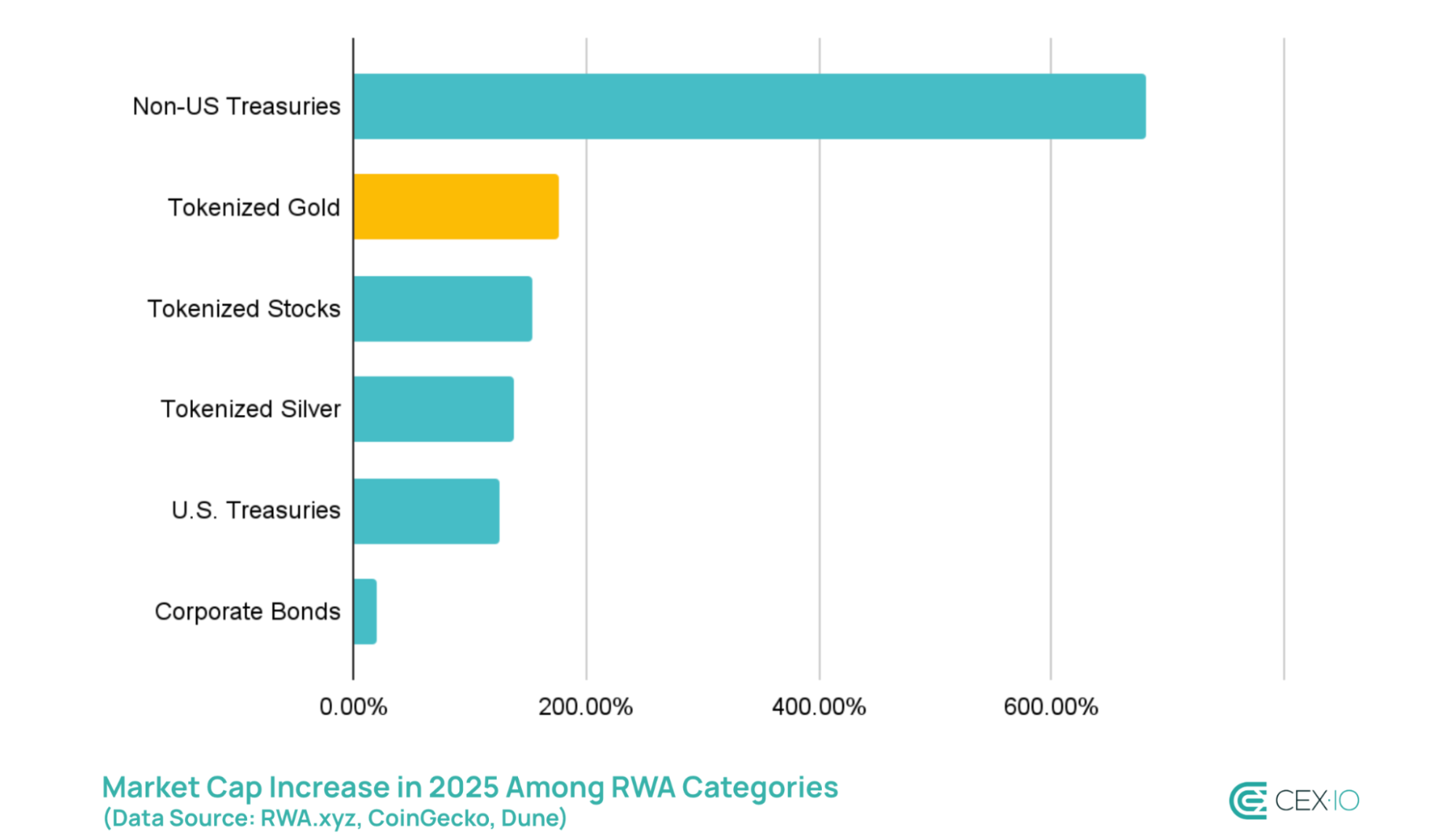
    The shift comes amid rising trading volume for tokenized gold. As Cointelegraph reported, tokenized gold expanded rapidly over the past year, adding nearly $2.8 billion in value and growing from about $1.6 billion to $4.4 billion in market capitalization.

    The sector’s market cap rose 177%, far outpacing the broader gold market and most major spot gold ETFs, while the number of holders nearly tripled with more than 115,000 new wallets. The growth represented roughly a quarter of all net inflows into the real-world asset (RWA) sector and exceeded the combined expansion of tokenized stocks, corporate bonds and non-US Treasurys.

    Tokenized gold market cap rises. Source: Cex.io

    Trading activity also surged, with tokenized gold recording about $178 billion in 2025 volume and peaking above $126 billion in the fourth quarter. That level would make it the second-largest gold investment product globally by trading volume after SPDR Gold Shares.

    Ioppe said that market makers and cross-venue liquidity providers dominate participation, arbitraging price differences between digital and traditional markets. Crypto-native macro traders also play a major role, using tokenized gold not only for exposure to bullion prices but also for collateral, hedging and yield strategies during periods of geopolitical or macroeconomic uncertainty.

    “Some institutions are monitoring weekend onchain gold markets, particularly macro and cross-asset desks that track gap risk ahead of the CME reopen,” he said, noting that most institutions treat the signal as informational rather than a basis for active positioning.

    Related: Middle East tensions boost gold as investors seek safe havens

    24/7 tokenized gold trading lets investors manage risk

    Tokenized gold markets allow for continuous trading, which offers a practical risk management advantage. If a geopolitical event occurs while futures markets are closed, traditional participants cannot adjust positions. Tokenized markets allow immediate rebalancing.

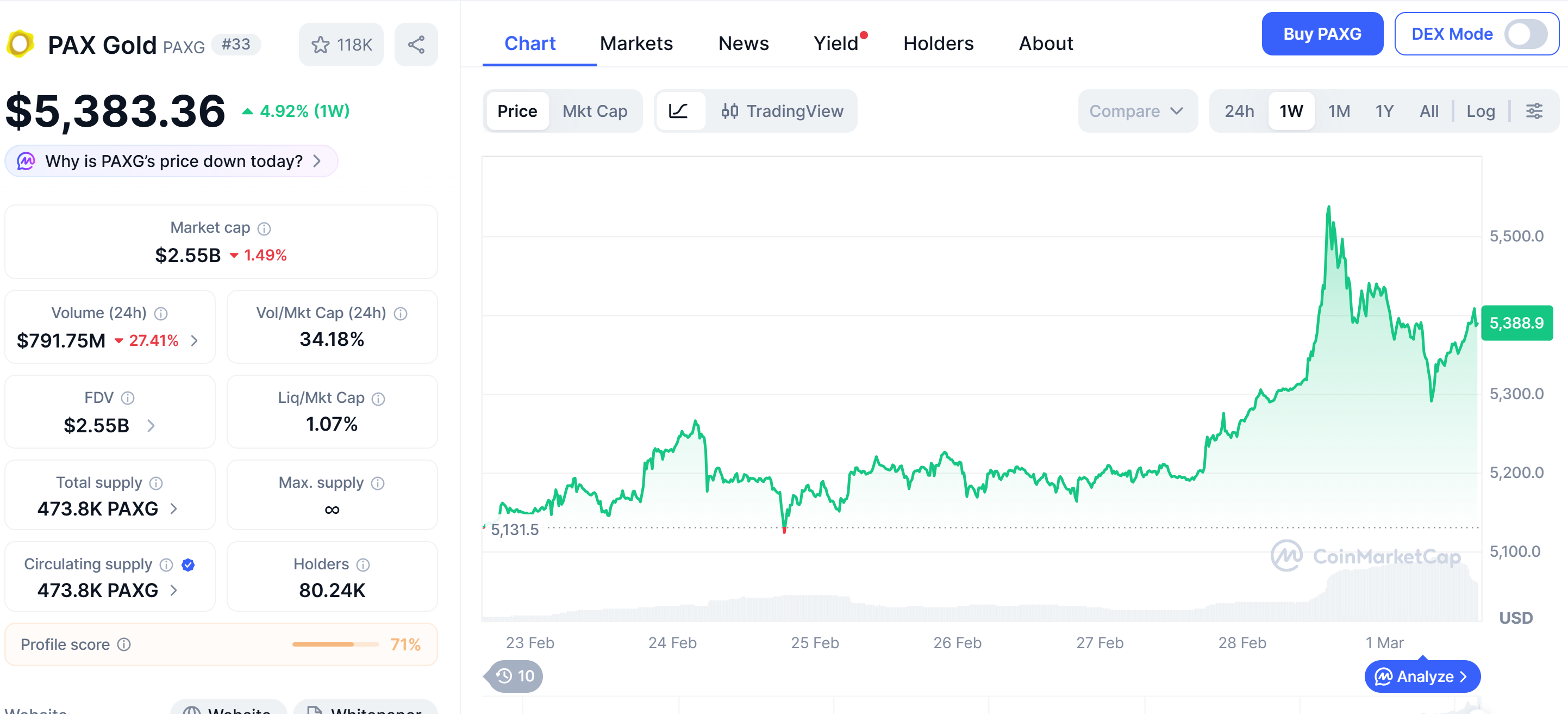
    On Saturday, tokenized gold rallied as geopolitical tensions escalated following US and Israeli strikes on Iran, with investors moving into XAUT and $PAXG while Bitcoin (BTC) and Ether (ETH) fell. XAUT briefly climbed above $5,450 and $PAXG neared $5,536 during the day before trimming gains, according to data from CoinMarketCap.

    $PAXG surges on Saturday. Source: CoinMarketCap

    However, Ioppe said adoption still faces obstacles. Liquidity remains smaller than in futures or exchange-traded funds (ETFs), making large trades harder to execute without moving prices. “Regulatory clarity is improving, but fragmentation across jurisdictions slows institutional deployment. Custody, accounting, and capital rules still vary widely,” he said.

    For now, tokenized gold is expected to operate alongside traditional products rather than replace them. “The most likely near-term evolution is that of tokenized and traditional markets existing in parallel, each serving a different function,” Ioppe concluded.

    Magazine: Bitcoin’s ‘biggest bull catalyst’ would be Saylor’s liquidation — Santiment founder

  • Why is Hyperliquid Price Rallying Amid the US-Iran War

    Hyperliquid emerged as a rare winner amid the sudden escalation of military hostilities in the Middle East between the US, Israel, and Iran.

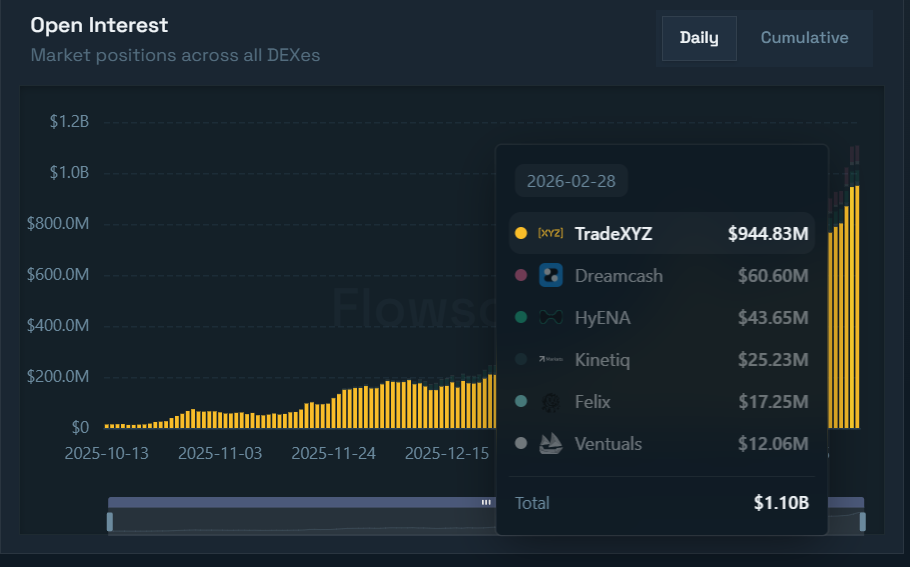
    This weekend, the exchange saw a surge in commodities-focused derivatives trading, with open interest for these assets reaching an all-time high of more than $1.1 billion.

    Hyperliquid Rallies 13% as US and Iran Tensions Roil Markets

    The uptrend can be attributed to traders seeking to hedge geopolitical risks while traditional financial markets were closed for the weekend.

    As a result, market participants pivoted to the blockchain-based platform to trade synthetic perpetual futures contracts tied to oil, gold, silver, and US equities.

    This continuous trading was facilitated by HyperLiquid Improvement Proposal 3, or HIP-3, an upgrade implemented last year.

    HIP-3 allows developers to deploy permissionless perpetual futures markets for any asset with a reliable public price feed, provided the creator stakes 500,000 of the platform’s native $HYPE tokens.

    Driven by the weekend volatility, HIP-3’s open interest eclipsed its previous record of $1.06 billion.

    Hyperliquid's HIP-3 Platform's Open Interest.

    Hyperliquid’s HIP-3 Platform’s Open Interest. Source: Flowscan

    Overall, the broader Hyperliquid platform has accumulated nearly $5.5 billion in total open interest, securing an estimated $1.06 million in protocol earnings over a 24-hour period, according to data from DeFiLlama.

    Additionally, data provider Messari reported that HIP-3 markets have generated $4.4 billion in weekend trading volume in February alone.

    Hyperliquid’s HIP-3 markets have seen $4.4B in weekend-traded volume so far in February while the CME and Nasdaq are closed. https://t.co/tiurdKNhSK pic.twitter.com/pdoOYjrwfk

    — misery (@zcb_spec) February 28, 2026

    The platform’s ability to capture traditional market volume drew the attention of prominent industry figures. Arthur Hayes, co-founder of the crypto exchange BitMEX, highlighted the structural shift on the social media platform X.

    “Where price discovery happens when TradExchanges sleep…It’s the weekend, [stuff’s] going down, TradExchanges are closed, but Hyperliquid is open for business,” Hayes wrote.

    However, the platform’s lack of compliance guardrails could introduce substantial legal hurdles in the future.

    Offering synthetic US equities to retail investors without “know your customer” (KYC) protocols or a registered broker-dealer license poses significant regulatory risks.

    These practices could draw future scrutiny from the Securities and Exchange Commission and the Commodity Futures Trading Commission

    Despite this looming threat, the platform’s native token responded positively to the weekend influx.

    BeInCrypto data show that $HYPE’s price rose 13% over the last 24 hours, trading above $30 as of press time. Notably, this makes it the best-performing asset among the top 20 cryptocurrencies by market capitalization.

    The post Why is Hyperliquid Price Rallying Amid the US-Iran War appeared first on BeInCrypto.

  • Ethereum Tokens Swiped, Returned After South Korean Tax Service Publishes Wallet Seed Phrases

    Ethereum Tokens Swiped, Returned After South Korean Tax Service Publishes Wallet Seed Phrases

    In brief

    • The South Korean National Tax Service (NTS) shared seed phrases from seized crypto wallets in a press release.
    • The contents of the wallets—valued around $4.8 million at face value—were then swiped, but returned.
    • The token was highly illiquid, and the perpetrator would not have been able to get anywhere near the face value.

    The first rule of self-custodying crypto is that you do not tell anyone your seed phrase—a set of 12 or 24 words that unlocks the private key to the wallet, therefore enabling control of the digital assets inside.

    South Korea’s National Tax Service (NTS) broke that rule in a very public fashion this week, publishing a photo of hand-written seed phrases in a press release and enabling an unidentified actor to make off with tokens valued at $4.8 million at face value, according to a local news report from Maeli Business Newspaper. But the highly illiquid tokens have since been returned.

    The incident occurred after the NTS completed a search and seizure of high-value tax delinquents and subsequently photographed some of its haul to share in a press release. In that release, one individual’s lot, labeled as “Case 3,” included multiple Ledger hardware devices and their respective seed phrases, according to the report. 

    “This is like advertising to open your wallet and take your money,” Professor Cho Jae-woo of Hansung University told the publication.

    Upon publication of the release, an individual did just that, pulling contents from at least three wallets into an Ethereum address ending in “86c12” before transferring them again. 

    On-chain data shows that three distinct addresses holding a total of 4 million Pre-Retogeum (PRTG)—valued at $4.8 million based on the token’s current price—were funded with a negligible amount of Ethereum to cover transaction fees before the user transferred their respective PRTG tokens to “86c12.”

    The three addresses, which have not made any transactions since January 2023, held 40% of the total supply of the PRTG token—a defunct Ethereum-based token that boasts only 1,500 holders and 1,600 transfers all-time. 

    While initial reports noted the token’s $4.8 million face value, if the thief tried to sell these tokens, they would have not been able to recoup anywhere near that amount given very limited liquidity. The token lists no trading pairs on decentralized exchanges, and is only listed on one centralized exchange—MEXC—where it registered 24-hour volumes of only $332. 

    According to CoinGecko, the exchange’s liquidity for the PRTG-USDT trading pair is so small that only $59 in volume would send the price down 2%. For comparison, to move Bitcoin down 2% down on MEXC, a trader would need to sell around $2.6 million worth of the top crypto coin.

    Perhaps that understanding is why on Friday morning, about 20 hours after initially moving the PRTG tokens, an address tied to the original “86c12” address transferred all the tokens back to their original wallets

    The hiccup is just the latest in a string of apparent crypto blunders for officials in South Korea. Earlier this week, it was discovered that $1.4 million in BTC went missing four years ago thanks to police not adhering to proper crypto custody guidelines. 

    Plus, South Korean regulators have come under fire after not finding an internal flaw in crypto exchange Bithumb’s system, which led to the firm erroneously distributing $43 billion worth of Bitcoin to users earlier this month rather than sending them small amounts of South Korean won.

    Daily Debrief Newsletter

    Start every day with the top news stories right now, plus original features, a podcast, videos and more.
  • Trump Media Weighs Truth Social Spinoff Following Bitcoin, Crypto ETF Moves

    Trump Media Weighs Truth Social Spinoff Following Bitcoin, Crypto ETF Moves

    In brief

    • Trump Media and Technology Group (DJT) is considering spinning off its social media platform, Truth Social.
    • Shares of the new entity would be provided to DJT holders prior to the firm’s planned merger with TAE Technologies.
    • Details about the impact to the firm’s Bitcoin holdings or crypto initiatives remain unclear.

    Trump Media and Technology Group (DJT) is considering spinning off Truth Social—its free speech-focused social media platform championed by President Donald Trump—into its own public entity, the firm announced on Friday. 

    The move would see Truth Social and other Trump Media businesses become SpinCo, which would then merge with Texas Ventures III. However, some assets and businesses would remain with the Trump Media, though the firm did not indicate which.

    Shares of the new entity would be provided to DJT shareholders prior to the firm’s announced merger with TAE Technologies, a power fusion firm that is still in a pending merger with the Trump Media.

    “The contemplated transaction is intended to create shareholder value through the creation of pure play companies, each with distinct strategies,” the firm’s announcement reads. 

    The news did not immediately register any positive impacts for DJT shareholders though. Shares in the firm are down around 2.10% today as broader markets decline. It has now fallen around 40% in the last six months, recently changing hands around $10.73. 

    While the comment above might suggest that Trump Media’s crypto initiatives would remain alongside Truth Social, details about its crypto-related plans were not immediately clear. A representative for the firm did not immediately respond to Decrypt’s request for comment. 

    Last year the firm sought to “protect itself from discrimination from financial institutions” by adding $2 billion in Bitcoin and Bitcoin-related securities to its balance sheet. 

    It also filed for a Bitcoin ETF last June and later a crypto blue chip ETF, which includes other tokens like Ethereum, Solana (SOL) and Ripple-linked XRP. 

    The firm signaled its intent to bolster its crypto ETF offerings earlier this year, filing for a joint Truth Social-branded Bitcoin and Ethereum ETF, as well as one centered on the Crypto.com-linked token, CRO.

    It is also working with Crypto.com on a digital token that would be airdropped to Trump Media shareholders as it seeks to adopt crypto rails across its business. The deadline for broker participants to provide information on shareholders passed earlier this month, though the token has not yet been distributed.

    Daily Debrief Newsletter

    Start every day with the top news stories right now, plus original features, a podcast, videos and more.

  • Bitcoin Derivatives Market Undergoes Panic Selling Amid Escalating Geopolitical Tensions

    Bitcoin Derivatives Market Undergoes Panic Selling Amid Escalating Geopolitical Tensions

    The Bitcoin ($BTC) ecosystems going through a turbulent phase amid the growing panic selling. In this respect, the surging tensions between the U.S. and Iran have raised the selling volume of the Bitcoin ($BTC) derivatives to nearly $1.8B just in 1 hour. As per the data from CryptoQuant, this signifies aggressive sell orders across the market. So, such a sudden liquidation wave reflects the significant role of geopolitical instability in shaping the outlook of the digital asset landscape.

    Panic selling accelerates across derivatives amid rising tensions between the U.S. and Iran

    “Within a single hour this morning, sell volume surged by approximately $1.8B, reflecting aggressive market sell orders hitting the books.” – By @Darkfost_Coc pic.twitter.com/17ohsNw3Yh

    — CryptoQuant.com (@cryptoquant_com) February 28, 2026

    Bitcoin Derivatives Sector Experiences Sheer Dip from 30% to 18% as U.S.-Iran Conflict Worsens

    The on-chain data suggests that the Bitcoin ($BTC) derivatives sell volume has hit the staggering $1.8 mark within one hour. This sheer rise in selling pressure shows a huge impact on trader behavior within the crypto markets. Hence, the derivatives pressure index has reportedly witnessed a sharp decline from thirty percent to eighteen percent. This imbalance highlights a clear dominance of the seller in the market while short-term risk aversion is at its peak.

    Aggressive Panic Selling Increases Concerns over Continuation of Downturn

    According to CryptoQuant, the escalation of the U.S.-Iran conflict has fueled fear-led trading behavior. As a result of this, the derivatives markets have plunged into a panic-driven mode. At the same time, Bitcoin’s price has also dropped to nearly $60K, raising concerns among the traders. Keeping this in view, amid the choppy market conditions led by uncertainty, fear, and volatility, $BTC will likely remain down, requiring careful positioning as well as keen sentiment monitoring.