Category: Business

  • Pump.fun expands app beyond native tokens with support for WBTC, USDC and rival launchpads

    Pump.fun expands app beyond native tokens with support for WBTC, USDC and rival launchpads

    Pump.fun, a Solana-based token launchpad, announced a significant expansion of its mobile application today, allowing users to trade assets beyond its native ecosystem for the first time.

    It’s time to bring the Pump fun app to the next level

    For the first time ever, users can trade more than just Pump fun coins

    With support for other launchpads, WBTC, $PUMP, USDC & more, the Pump fun app is more versatile than ever 👇 pic.twitter.com/FkKEwJ8zR8

    — Pump.fun (@Pumpfun) March 2, 2026

    The platform said its app now supports tokens from external launchpads alongside established Solana assets including $PUMP, wrapped Bitcoin and wrapped Ethereum through Wormhole, GIGA, and PENGU.

    The shift transforms the interface from a single-launchpad tool into a multi-asset trading environment.

    The company reported its mobile application has exceeded 1.5 million downloads over the past year. It characterized the update as an effort to minimize user friction by enabling trading and custody of diverse assets within a single platform.

    Promotional material accompanying the announcement displayed mentions of Raydium and Meteora within the interface, suggesting additional protocol integrations may follow.

  • Iran Conflict Not Major Concern For Bitcoin Mining Hashrate, Say Experts

    Iran Conflict Not Major Concern For Bitcoin Mining Hashrate, Say Experts

    In brief

    • Social media rumors argued that massive BTC dumps and hashrate collapse could follow the U.S.-Israel attacks on Iran.
    • Analysts and miners say Iran’s share of global Bitcoin mining is small and the impact limited.
    • War-driven volatility is tied more to price sentiment than supply network risk, they argued.

    The escalating conflict in Iran is unlikely to significantly disrupt the global Bitcoin mining network, industry analysts and operators said, countering circulating rumours on social media platforms suggesting a disastrous hit to hashrate and a flood of Bitcoin sell-offs.

    “I don’t think it’s of any major concern for Bitcoin,” Wolfie Zhao, head of research at TheMinerMag, told Decrypt, dismissing suggestions that conflict-related power outages in Iran would materially affect the network. While individual miners could see disruptions, the scale is not comparable to past global shocks like the 2021 crackdown on mining in China, Zhao added.

    The remarks come amid heightened speculation on social media platforms that the war could force the collapse of Iran’s mining industry, leading to billions of dollars in BTC dumped on markets and hundreds of thousands of rigs going offline.

    Bitcoin dipped and then rebounded over the weekend. But on X, posters warned that disruption to Iran’s power grid could lead to “2-5%” of the global Bitcoin hashrate being impacted, with one tweet on Saturday arguing that “If this regime falls: – Billions in BTC get dumped or lost forever – 5% of global hashrate disappears overnight – 427,000 rigs go dark Get ready for the supply shock.”

    According to data from CoinWarz, Bitcoin’s hashrate was around 986.1876 EH/s on February 28 in the immediate aftermath of the first U.S.-Israeli attacks, and rose to highs of 1.1361 ZH/s on March 1, before dipping to just under 1 ZH/s Tuesday morning.

    On Myriad, a prediction market owned by Decrypt’s parent company Dastan, users place an 51% chance on the Iranian regime falling by October—up almost 20% on the weekend.

    Crypto mining in Iran

    Although it was legalized in 2019, crypto mining in Iran has faced significant structural hurdles for years, including unstable power, high import costs and regulatory complexities that have limited growth.

    Ethan Vera, COO of Luxor Technology, said that even if Iranian mining activity were interrupted, there would be minimal impact on Bitcoin block times or network security. Estimates of Iran’s actual share of global hashrate vary, but most put it in the low single digits. Vera put it at below 1%.

    “If there is an interruption there will be no material impact to block times, and zero impact to the security of the Bitcoin network,” he said.

    He added he believed the industry there was made up of private enterprises mining small scale and legacy Chinese companies operating in the space.

    Iran has built a substantial crypto ecosystem that serves as an alternative financial channel outside the U.S. dollar system, a system that the country is largely locked out of due to international sanctions.

    “Iranian cryptocurrency activity is correlated to political events and conflict at home and abroad,” said Chainalysis in a report in January. It estimated that Iran’s broader crypto economy reached $7.78 billion in 2025, with a sizable portion of activity tied to state-linked entities.

    The conflict has prompted a spike in cryptoasset outflows from Iranian exchanges, with a report from blockchain analytics firm Elliptic finding that outgoing transaction volumes spiked by 700% within minutes of the first U.S.-Israeli attack.

    Daily Debrief Newsletter

    Start every day with the top news stories right now, plus original features, a podcast, videos and more.

  • Nasdaq Wants a Piece of the Prediction Market Biz Too

    Nasdaq Wants a Piece of the Prediction Market Biz Too

    In brief

    • Nasdaq files with the SEC to offer binary “Outcome Related Options” contracts.
    • The move puts Nasdaq in competition with Kalshi, Polymarket, and Crypto.com.
    • Wall Street giants like ICE, CME Group, and Cboe are also entering the space.

    Nasdaq Inc., the parent company of the second-largest stock exchange by market capitalization, wants to roll out its own prediction market offering.

    The company intends to offer options contracts for yes-or-no bets, which would be priced between 1 cent and $1, according to an SEC filing submitted early Monday morning.

    Nasdaq’s so-called Outcome Related Options would let traders take binary positions on whether a specified event happens. Binary options are a simplified version of more traditional option contracts that payout depending on the outcome of a yes-or-no proposition.

    If the requested rule change is approved, this will be Nasdaq’s first foray into the prediction market space—albeit under the regulation of the SEC rather than the Commodities Futures Trading Commission. The company’s would-be competitors, like Kalshi, Polymarket, and Crypto.com, are all regulated by the CFTC through Designated Contract Markets licenses.

    Prediction markets are effectively a form of derivative contracts that allow traders to wager on the outcome of virtually anything—from stock and crypto prices to sports, cultural, and political events. The industry has exploded over the last year, generating billions in trading volume on a weekly basis.

    There’s been ongoing discourse, though, about which federal regulator, the SEC or CFTC, has jurisdiction over prediction market platforms. In February, CFTC Chairman Michael Selig said “see you in court” in response to state attorneys general and gaming commissions who have argued that prediction markets encroach on their regulatory frameworks.

    But there’s also been some mention of the SEC having a role in overseeing prediction markets. SEC Chair Paul Atkins has suggested that some prediction markets could fall under the agency’s jurisdiction.

    “Prediction markets are exactly one thing where there’s overlapping jurisdiction potentially,” Atkins said at the time, in response to a question from Sen. Dave McCormick (R-PA). “That is a huge issue we’re focused on.”

    Other Wall Street giants have already gotten on the field.

    In October 2025, New York Stock Exchange owner Intercontinental Exchange invested up to $2 billion in Polymarket, bringing the company’s valuation to a whopping $9 billion. Although a press release said the investment would be worth “up to $2 billion,” a Polymarket spokesperson told Decrypt that it was accurate to call it a $2 billion investment.

    Derivatives exchange CME Group has teamed up with FanDuel for a prediction market offering. And Cboe, its competitor derivatives exchange operator, has taken a strategy similar to Nasdaq. Last month, the company began talks with brokers to offer yes-or-no contracts, unnamed sources told The Wall Street Journal.

    Daily Debrief Newsletter

    Start every day with the top news stories right now, plus original features, a podcast, videos and more.

  • Iran crypto outflows surge 700% after US-Israel strikes as capital flees offshore

    Iran crypto outflows surge 700% after US-Israel strikes as capital flees offshore

    Crypto analytics firm Elliptic detected a significant spike in digital asset withdrawals from Nobitex, Iran’s dominant crypto exchange serving more than 11 million users, in the immediate aftermath of initial US-Israel military strikes on Iranian territory.

    The London-based blockchain intelligence company said the surge in outflows last Saturday may indicate capital flight. Outgoing transaction volumes spiked by 700% within minutes of the first strikes.

    Elliptic said the data suggests Iranian users converted rials into digital assets and moved funds to external wallets beyond the reach of conventional banking oversight.

    Nobitex handled $7.2B in crypto transactions in 2025, establishing itself as a cornerstone of Iran’s digital asset infrastructure. The platform has faced scrutiny over alleged financial ties to the Islamic Revolutionary Guard Corps.

    In January, Elliptic reported evidence suggesting Iran’s central bank utilized the exchange to prop up the country’s weakening currency.

    Early tracing of recent withdrawals shows funds flowing toward foreign trading platforms that have historically absorbed substantial volumes originating from Iran.

    The pattern mirrors previous episodes this year. The most pronounced earlier spike occurred on January 9, coinciding with mass protests and a government-imposed internet shutdown. Withdrawal activity declined during the blackout but persisted at reduced levels, suggesting some users maintained access to their holdings despite the platform going offline.

    Two subsequent surges aligned with fresh US sanctions announcements targeting Tehran, reinforcing observations that digital assets serve as a potential route around financial restrictions.

  • TD Securities sees NYSE tokenization as institutional turning point

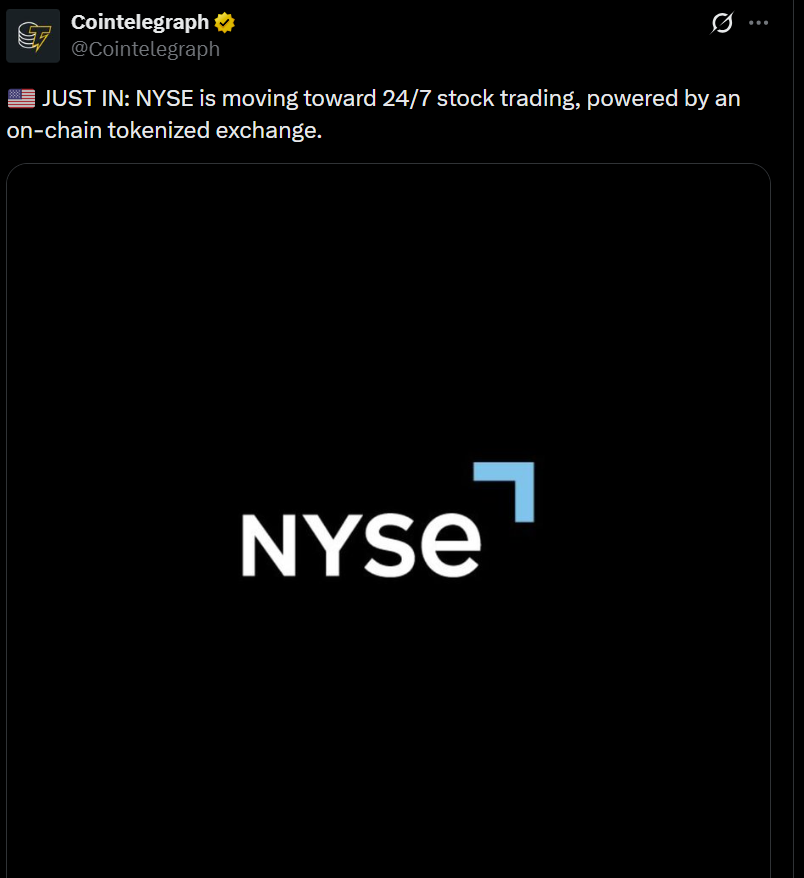
    TD Securities, a major Canadian investment bank with operations across North America, says tokenization may be approaching an institutional turning point following the New York Stock Exchange’s push into tokenized equities.

    In recent commentary, TD Securities Reid Noch, vice president for electronic trading, said tokenization is beginning to carry real implications for market structure, pointing to the NYSE’s proposed tokenized equities alternative trading system (ATS) as a key development.

    The planned platform would enable 24-hour trading and near-instant settlement of tokenized stocks and exchange-traded funds (ETFs), subject to regulatory approval.

    Rather than creating a parallel crypto-native marketplace, the venue is designed to operate within existing US market rules while leveraging blockchain-based settlement infrastructure.

    Source: Cointelegraph

    Noch described the structure as closer to a “2.0” market shift, where custody and settlement would remain anchored to the Depository Trust & Clearing Corporation (DTCC), while trading would comply with National Best Bid and Offer (NBBO) requirements. This means prices must reflect the best available bid and offer across U.S. exchanges to prevent fragmented liquidity.

    Although Noch said early activity is expected to be retail-driven, the broader implications extend well beyond individual traders.

    TD Securities’ institutional focus suggests the company sees potential impact on core market plumbing, including trading hours, collateral management, settlement cycles and liquidity, areas that shape how large financial institutions operate.

    Tokenized equities gain institutional traction

    Tokenization accelerated in 2024, led primarily by private credit and U.S. Treasury products, which have accounted for the bulk of onchain real-world asset (RWA) issuance, according to industry data.

    Despite broader crypto market volatility, capital inflows into tokenized assets have continued, suggesting sustained institutional interest in blockchain-based settlement and ownership models.

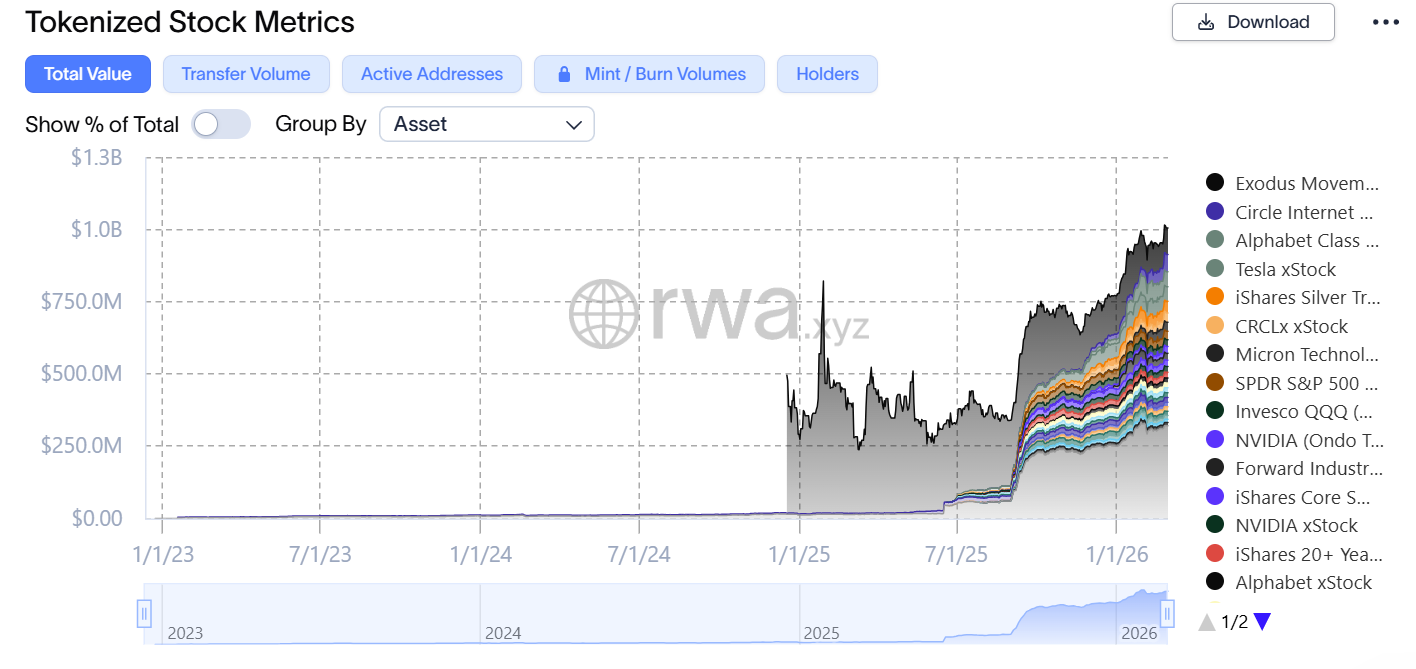
    More recently, tokenized equities have begun gaining traction. Kraken’s xStocks platform has emerged as one of the more visible entrants, reporting more than $25 billion in cumulative trading volume since launching last year.

    The market for tokenized stocks has grown rapidly. Source: RWA.xyz

    Although tokenized equities remain a small fraction of global stock market activity, their growth reflects a broader shift toward bringing traditional financial instruments onchain within regulated frameworks.

  • Battle for Bitcoin’s soul opens as first block supporting ‘clean-up’ proposal is mined

    Battle for Bitcoin’s soul opens as first block supporting ‘clean-up’ proposal is mined

    Bitcoin’s latest governance clash escalated this week as the first block signaling support for a temporary soft fork designed to restrict arbitrary, non-monetary data in the blockchain’s transactions was produced by mining pool Ocean.

    The proposal, formally assigned BIP-110 after evolving from earlier drafts, aims to reinstate strict limits on transaction output sizes and arbitrary data fields for about a year. The idea is to curb what proponents see as “spam” uses of block space for non-financial data. They argue that unchecked data, including large inscriptions and so-called OP_RETURN payloads, threaten the original blockchain’s role as sound monetary infrastructure and burden node operators.

    The community remains deeply divided. Prominent critics, including Blockstream CEO Adam Back, have warned that consensus-level intervention could harm Bitcoin’s credibility and lead to preferential treatment of some transactions in violation of the principle of neutral transaction capacity. He also questioned the level of support for the proposal, which, he said, increased the risk of the blockchain being split.

    Adding fuel to the debate, a developer recently inscribed a 66 KB image in a single transaction on Bitcoin, an apparent pushback against BIP-110’s core claims and a demonstration of how large amounts of data can be encoded even without relying on OP_RETURN.

    OP_RETURN and similar approaches are script instructions used to mark a transaction output as invalid for spending, effectively allowing users to repurpose that space to permanently embed arbitrary data — like text or images — directly into the blockchain

    As the controversy unfolds, it underscores enduring philosophical tensions within Bitcoin. Should network aggressively defend a narrowly defined monetary purpose or maintain maximal neutrality toward arbitrary uses of its base layer?

  • Weekend warriors: How HyperLiquid became retail’s bear market playground

    The crypto bear market has dragged down most major digital assets this year, but $HYPE has moved in the opposite direction. Year to date, the token is up 23.9%, matching gold’s gain over the same period. The S&P 500 is slightly negative, while bitcoin has fallen 23.7% and ether more than 33%.

    The divergence is notable not only because $HYPE is crypto-native, but because it has decoupled from the broader digital asset market. Its performance increasingly reflects the value of the platform behind it rather than the market’s direction.

    HyperLiquid, the decentralized derivatives exchange that underpins $HYPE, is built to monetize activity rather than price appreciation. In bull markets, capital tends to concentrate in spot exposure. In choppier conditions marked by drawdowns and macro shocks, derivatives volume tends to persist. Traders shift from buying to positioning, and the platform collects fees on both sides.

    While trading volume on competitor platforms Aster and Lighter has tumbled in recent months, HyperLiquid’s has increased, rising from $169 billion in December to more than $200 billion for both January and February. Aster, meanwhile, went from $177 billion in December to less than $100 billion in February, with Lighter suffering an even sharper drop, DefiLlama data shows.

    Total volume on HyperLiquid since its inception has now hit a whopping $4 trillion.

    Volatility as a business model

    HyperLiquid’s core product is perpetual futures, which allow traders to go long or short with leverage. When prices grind higher, leverage amplifies upside. When markets slide, shorting and basis trades step in. The exchange collects fees on both sides.

    That structure becomes particularly relevant in a year marked by turbulence across asset classes. Rather than relying on sustained price appreciation, the exchange captures turnover. In sideways or declining markets, traders often increase frequency, hedge exposure, or rotate into relative-value strategies. Activity replaces direction as the primary driver.

    And that business model has yielded positive results. Gross protocol revenue grew by 96% in Q3 of 2025 to $354 million, with the fourth-quarter total hitting $286 million, the majority of which came from perpetual trading fees.

    That revenue comes from a super-lean team of fewer than 15 employees, with half focused on engineering. HyperLiquid founder Jeff Yan has also refused investment from venture capitalists to maintain independence – a bold approach uncommon in the crypto industry.

    Trading beyond market hours

    More recently, HyperLiquid has expanded beyond crypto-native pairs. It now offers synthetic exposure to foreign exchange, commodities and major equity indices. It also provides weekend trading for U.S. equities, an innovation that resonates with retail traders accustomed to crypto’s round-the-clock rhythm.

    For a generation raised on app-based brokerage platforms, the traditional market calendar feels restrictive. As seen over the past weekend, geopolitical escalations often land outside the typical weekday trading window. HyperLiquid’s structure allows traders to react in real time rather than wait for Monday’s open.

    HyperLiquid’s silver market has also been a resounding success with trading volume nearing $750 million over a recent 24-hour trading period despite traditional markets being closed for the majority of Sunday.

    The exchange has also introduced pre-IPO perpetual markets tied to companies such as Anthropic, OpenAI and SpaceX. These instruments are synthetic and do not confer equity ownership, but they offer directional exposure to private companies. In effect, they create a parallel venue for price discovery among retail participants otherwise excluded from late-stage venture valuations.

    The product FTX tried to build

    The model carries echoes of an earlier vision. FTX pitched 24-hour trading, tokenized equities and seamless leverage across asset classes. Its collapse stemmed from custody risk, shoddy balance-sheet practices, and the commingling of funds.

    HyperLiquid operates on a non-custodial framework, with on-chain settlement and transparent vault mechanics. Users interact with smart contracts rather than deposit funds into a centralized entity’s balance sheet. In a post-FTX landscape, that distinction carries weight. Retail traders who absorbed losses from centralized failures remain sensitive to counterparty exposure.

    HyperLiquid delivers many of the features once marketed by FTX, but through infrastructure designed to reduce reliance on a single custodian.

    The exchange also leans into competition and gamification. Leaderboards prominently rank traders by performance, creating protagonists like James Wynn, who lost $100 million on HyperLiquid after engaging in a high-risk long-only trading strategy using leverage when bitcoin was above $100,000.

    The mechanic encourages engagement. Traders can build reputations through short positions, market-neutral strategies or well-timed directional bets, and that creates a buzz on social media – effectively acting as a marketing vehicle even in volatile markets.

    The centralization test

    Claims that HyperLiquid is insulated from bear markets require context. One year ago, the protocol faced a credibility shock that raised questions about decentralization.

    In April 2025, the total value locked in the Hyperliquidity Provider vault fell from $540 million to $150 million within a month. The trigger was a trading episode involving a token called JELLY. A trader opened a large short position on HyperLiquid while simultaneously buying the token on illiquid decentralized exchanges. Thin liquidity distorted price feeds and forced the vault into a toxic position via liquidation.

    As JELLY’s reported price spiked to levels unsupported by deep liquidity, the vault’s unrealized losses mounted. HyperLiquid intervened, force-closing the market and settling JELLY at $0.0095 rather than the roughly $0.50 price being relayed by oracles. The decision protected the vault from substantial losses, but it ignited backlash.

    Critics argued that a protocol marketed as decentralized had exercised discretionary control reminiscent of a centralized exchange. Governance optics deteriorated quickly. Yield on the vault fell sharply, and users withdrew capital.

    Security researchers described the episode as an economic design flaw rather than a smart contract exploit. Jan Philipp Fritsche of Oak Security characterized it as unpriced vega risk, where leveraged exposure to volatile assets drained the risk fund in a predictable manner. The episode underscored that economic vulnerabilities can be as destabilizing as technical bugs.

    HyperLiquid later modified its governance process, shifting asset delistings to an on-chain validator voting mechanism. The change did not eliminate scrutiny, but it addressed one of the central criticisms.

    The vault has since recovered to $380 million in TVL, offering users a 6.93% APR.

    Resilience through activity

    Despite the controversy, trading volume on the exchange remained robust, and with competitors Aster and Lighter losing momentum, HyperLiquid is positioning itself as a mainstay in the ongoing cryptocurrency bear market.

    Risks remain. Regulatory attention could intensify around synthetic exposure to private companies and U.S. equities. Liquidity fragmentation in thinner markets could resurface pricing distortions. Governance mechanisms will continue to be tested under stress.

    Yet $HYPE’s relative strength this year reflects a structural distinction. Rather than functioning as a high-beta bet on digital asset appreciation, it increasingly behaves like a claim on a venue that monetizes volatility.

    In a cycle defined less by sustained rallies and more by sharp swings, that positioning has mattered.

  • Altcoins Outperform Bitcoin With Double-Digit Weekly Gains

    Altcoins Outperform Bitcoin With Double-Digit Weekly Gains

    In brief

    • Polkadot, Near, and Jupiter are among the altcoins that have clocked double-digit gains over the past week.
    • The altcoin rally follows Bitcoin’s 4.7% recovery from a $63,000 low triggered by the U.S.-led attack on Iran.
    • For this rally to transition into a sustained uptrend, experts cited a combination of renewed liquidity and the dissipation of uncertainty due to macro and geopolitical events.

    Altcoins including Near Protocol, Polkadot and Jupiter have posted double-digit gains over the past week, far outpacing Bitcoin as traders rotated into higher-beta assets following the leading crypto’s attempted recovery.

    Near Protocol jumped 19.4% over the past seven days, while Polkadot gained 16.5% and Jupiter climbed 15.8%, according to CoinGecko data.

    Bitcoin, by contrast, is roughly breakeven over the same period, hovering near $66,100 after recovering 4.7% from its February 28 low of $63,176—a drop triggered by escalating Middle East tensions following a U.S.-led attack on Iran.

    The divergence tests whether altcoins can sustain momentum without Bitcoin leading the way. The move reflects technical positioning rather than a fundamental shift in market structure, experts told Decrypt.

    The altcoin rally comes despite fearful sentiment lingering in the crypto ecosystem, with the Crypto Fear & Greed Index hovering around 10—territory signaling “extreme fear.”

    “When the Fear & Greed Index hits extreme lows like 10 or 11, it typically signals that the forced selling phase of a deleveraging event has reached exhaustion,” Lacie Zhang, research analyst at Bitget Wallet, told Decrypt. “Over the past week, as Bitcoin found tentative support near the $63,000–$64,000 range, high-beta altcoins began to bounce simply because they were oversold on a technical basis.”

    “This explosion isn’t a sign of returning confidence but rather a result of thin liquidity and the clearing of over-leveraged short positions,” Zhang added. “In an environment of extreme fear, even a small amount of bottom-fishing by brave dip-buyers can cause outsized percentage gains in alts.”

    The altcoin rally is also a result of “heavily positioned” bearish bets, Rachel Lin, CEO of SynFutures, told Decrypt. “When sentiment is depressed, even modest stabilization in Bitcoin can trigger short covering and rotation into higher beta assets,” she said. “This move appears more technical and liquidity-driven than a reflection of improving fundamentals.”

    Macro pressures

    Lin pointed to Bitcoin’s dip below $66,000 amid escalating Middle East tensions as evidence that crypto remains macro-sensitive. “While selling pressure has eased and dip buyers are active, we have not yet seen consistent safe-haven flows,” she added.

    The SynFutures CEO noted a divergence between retail sentiment and institutional capital allocation, citing “selective allocation into DeFi infrastructures” such as Morpho, which supports certain alt sectors more than the broader market.

    Lin said that for altcoins to sustain momentum, broader macro uncertainty needs to ease alongside improving liquidity conditions with renewed capital inflows—factors that could suggest a potential risk-on scenario and transition the ongoing rally into a sustained uptrend.

    Zhang cautioned that calling this the start of a sustained uptrend remains premature. “While Bitcoin showed resilience by rebounding to the $66,000 to $68,000 zone after the reports involving Iran, the market remains in a state of geopolitical paralysis,” she said. “We are currently seeing a relief rally fueled by short-covering and tactical rotation into beta assets that were hit hardest during the weekend drop.”

    She outlined three pillars needed for a sustained recovery: institutional stabilization, macro clarity, and technical confirmation. “We need to see a return to consistent net inflows in the Spot Bitcoin ETFs,” Zhang said. “The macro overhang must ease, specifically regarding the Fed’s interest rate trajectory and the potential for an energy-driven inflation spike due to Middle East tensions.”

    U.S. spot Bitcoin ETFs posted their first weekly inflow in six weeks, adding $787 million, according to SoSoValue data—further underscoring a long-standing risk-off behavior from crypto investors.

    Though altcoins have popped over the past week, their long-term performance remains deep in the negative. Users on prediction market Myriad, owned by Decrypt‘s parent company Dastan, reflect this pessimism, assigning a 6.4% chance to the likelihood of an “alt season” before April 2026 .

    Daily Debrief Newsletter

    Start every day with the top news stories right now, plus original features, a podcast, videos and more.

  • Morning Minute: Bitcoin Crashes, Rebounds as Iran War Begins

    Morning Minute: Bitcoin Crashes, Rebounds as Iran War Begins

    Morning Minute is a daily newsletter written by Tyler Warner. The analysis and opinions expressed are his own and do not necessarily reflect those of Decrypt. Subscribe to the Morning Minute on Substack.

    GM!

    Today’s top news:

    • Crypto majors dip then rebound amidst Iran War; BTC at $66k
    • HYPE wins the weekend, rallying 20%+ to $30 while HIP-3 sees record OI
    • Bitcoin ETFs saw $787M in net inflows last week
    • US declares Anthropic as supply chain risk after negotiations on how the US could use Claud fell through
    • Paradigm announced a new $1.5B fund focused on AI & Robotics

    🪖 Bitcoin Crashes, Rebounds During Early Hours of Iran War

    Bitcoin was the only large liquid asset that anyone could sell when the bombs started dropping. And it only dropped 3%.

    📌 What Happened

    Early Saturday, US and Israeli forces launched coordinated missile strikes on Iran targeting nuclear, missile, and naval infrastructure.

    President Trump confirmed “major combat operations” and urged Iranians to overthrow the regime.

    Iran retaliated with missiles targeting Israel, Qatar, the UAE, Bahrain, and US bases in Iraq. Israeli Defense Minister Israel Katz declared a nationwide state of emergency.

    Iranian state media later confirmed that Supreme Leader Ayatollah Ali Khamenei was killed in the strikes, along with 40 senior officials.

    Crypto markets absorbed it all in real time.

    BTC dropped from roughly $65,500 to $63,000 within hours. The total crypto market cap fell by $128B with $449M in longs liquidated.

    Then, as Iranian state media confirmed Khamenei’s death, BTC shot back to $68,196 in a major recovery rally.

    As of this morning, it’s back to $66,300.

    Meanwhile, Hyperliquid was the surprising crypto winner of the weekend. Its HIP-3 markets set a new record in open interest, and Hyperliquid was featured in Bloomberg as the primary marketplace for those looking to trade the war.

    The HYPE token rallied from $26 to $32 through weekend trading.

    🗣️ What They’re Saying

    “Bitcoin is the only large liquid asset trading 24/7, so it absorbed all the selling pressure that would normally spread across equities, bonds, and commodities. The real price discovery happens Monday when US equity markets and Bitcoin ETFs reopen.” – Hayden Hughes, Tokenize Capital

    “With a lot of the leverage already cleared out and exhausted sellers, there’s only so much impact macro events can have.” – Justin d’Anethan, Arctic Digital

    “Where price discovery happens when TradExchanges sleep.” – Arthur Hayes, responding to Hyperliquid’s weekend volume surge

    🧠 Why It Matters

    Fear and Greed was sitting at 14. ETF flows had flipped to net sellers in February.

    And then the biggest geopolitical shock in years hits on a Saturday.

    BTC dropped less than 4%. That was the signal.

    Heading into April 2024, when Iran first fired missiles at Israel, BTC dropped about 6%. Then over subsequent months it broke to new all-time highs. The June 2025 strike on Iranian nuclear sites pushed BTC below $100K briefly before it ripped.

    The pattern is consistent: war shocks trigger sell-offs, then the macro digestion reverses them. The question this time is whether the 50%-off ATHs and bear market make it different.

    Two things to monitor: the Strait of Hormuz and the ETF bid.

    If Iran’s IRGC retaliates by threatening the strait, through which about 20% of global oil passes daily, you get an inflation shock that would keep the Fed on hold indefinitely and crush risk assets broadly, crypto included. Goldman Sachs is already predicting Oil will hit $100/barrel if this war goes on for 4 weeks as Trump said it might on Sunday.

    On the other hand, if Khamenei’s death accelerates regime destabilization and traders read it as shortening the conflict, the relief bid continues.

    Monday’s ETF flows will be the first signal.

    The Hyperliquid story is the other one to watch longer term.

    Its HIP-3 open interest (where TradFi assets can be trading around the clock) hit an all-time high above $1.1B. Hyperliquid infrastructure is becoming the 24/7 layer for all asset classes, not just tokens.

    And it was the big winner of the weekend.

    Now we wait for what’s in store this week…

    🌎 Macro Crypto and Markets

    • Crypto majors fell and then rebounded on the initial Iran strike and have levelled off; BTC even at $66.3k; ETH -2% at $1,950; SOL -1% at $84
    • Morpho (+5%), NEAR (+5%) and JUP (+3%) led top movers
    • Oil is up 8% premarket this morning with the Straight of Hormuz closure
    • Gold (+3%) and Silver (+2%) are both rallying amist the war
    • HYPE rallied 13% over the weekend to $31 as Hyperliquid HIP-3 open interest set an all-time high above $1.1B and was featured in a Bloomberg headline about weekend markets
    • The Department of War labeled Anthropic a “supply chain risk” and directed federal agencies to stop using its AI tools after negoations to use Claude for the Iran war fell through
    • Iran’s crypto mining network is being monitored, as the regime operated between 2-5% of global Bitcoin hashrate using subsidized electricity
    • Trump Media is weighing spinning off Truth Social into a separate public entity called SpinCo, which would merge with Texas Ventures III
    • South Korea’s National Tax Service accidentally published unredacted Ledger seed phrases in a press release
    • Minnesota lawmakers are considering a full statewide ban on crypto ATMs via HF 3642, which would make it the first US state to do so.
    • Ripple introduced new funding routes for XRP Ledger development, including a new FinTech Builder Programme and university partnerships

    Corporate Treasuries & ETFs

    Meme Coin Tracker

    • Meme majors were mostly red; DOGE -2%, SHIB -3%, PEPE -2%, TRUMP -1%, PENGU -1%, SPX -4%, FARTCOIN -2%
    • WAR (+150%), Jellybean (+50%), PysopAnime (+30%) and HODL (+50%) led notable movers

    💰 Token, Airdrop & Protocol Tracker

    • One Polymarket trader banked $385K betting on a US-Israel Iran strike date every day since February 8, losing repeatedly until Saturday morning
    • Meanwhile, Kalshi caught heat for not resolving its Khamenei market, leading to several comments on the matter from founder Tarek Mansour
    • Crypto VC Paradigm announced a new $1.5B fund foducsed on AI, robotics and other frontier tech
    • Backpack exchange explained the legal engineering behind its token-to-equity program, stating that the conversion right won’t attach to the token itself, it’ll attach to a VIP program requiring one year of staking and active trading

    🚚 What is happening in NFTs?

    • NFT leaders were mostly flat over the weekend; Punks even at 29.9 ETH, Pudgy +1% at 4.5 ETH, BAYC -1% at 6 ETH; Hypurr’s -2% at 460 HYPE
    • CyberKongz (+36%) led top movers

    Daily Debrief Newsletter

    Start every day with the top news stories right now, plus original features, a podcast, videos and more.

  • As the New Week Begins with US-Iran Tensions, a Critical Report for Bitcoin, Ethereum, and Altcoins Has Been Released! What’s the Current Situation?

    As the New Week Begins with US-Iran Tensions, a Critical Report for Bitcoin, Ethereum, and Altcoins Has Been Released! What’s the Current Situation?

    Bitcoin (BTC) and altcoins started the new week with the US-Iran conflict. Bitcoin fell to $63,000 over the weekend before recovering to around $66,000.

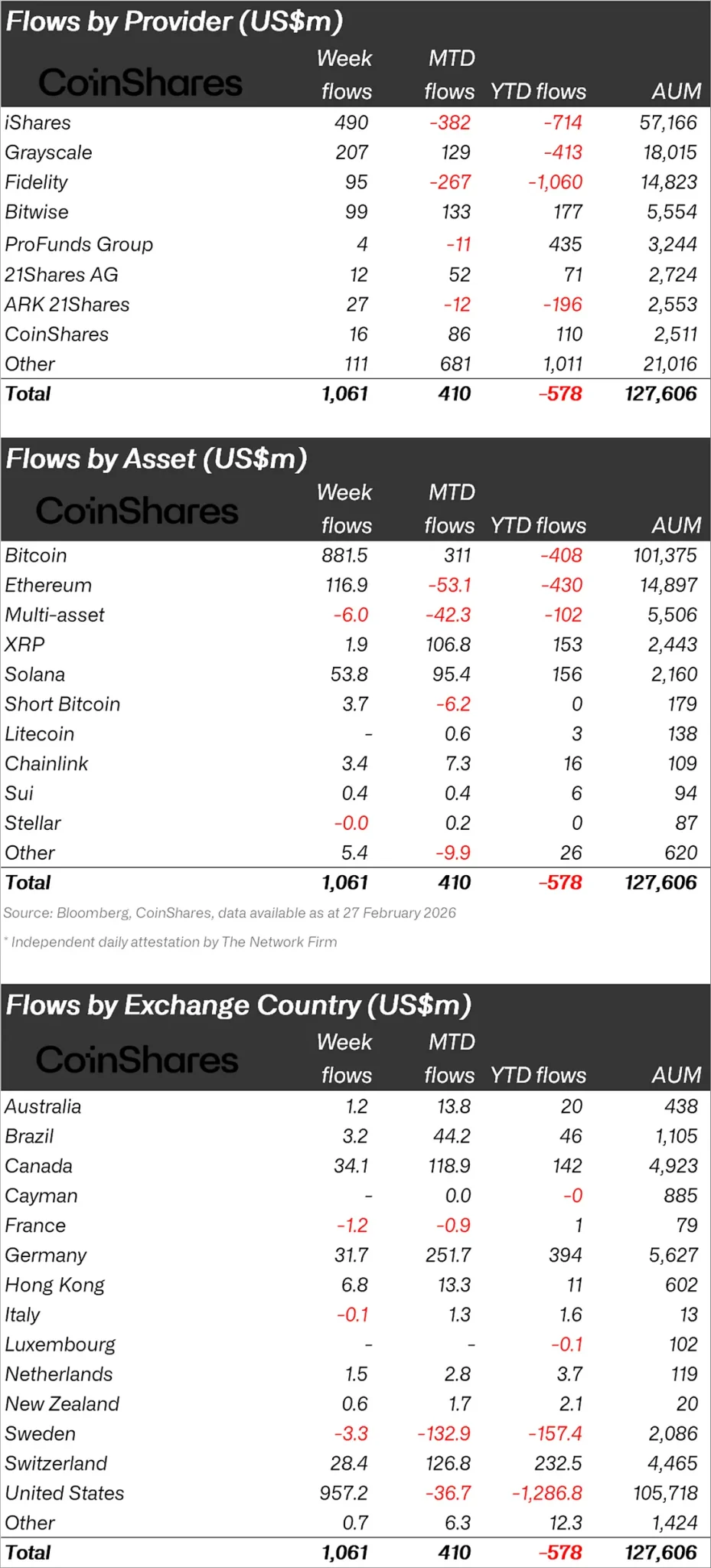
    As market weakness and uncertainty persist, Coinshares released its cryptocurrency report, stating that it experienced $1 billion in inflows last week.

    “Cryptocurrency investment products saw $1 billion in inflows, ending a five-week streak of $4 billion in outflows.”

    “The decline in prices, technical resets, and the regrouping of large investors supported this trend.”

    Bitcoin and Altcoins Relieved!

    Looking at crypto funds individually, it was observed that inflows were mainly in Bitcoin.

    Bitcoin saw inflows worth $881.5 million, while Ethereum (ETH) experienced inflows of $116.9 million.

    Looking at other altcoins, XRP saw inflows of $1.9 million, Solana (SOL) $53.8 million, and Chainlink (LINK) $3.5 million.

    “Bitcoin was the top performing asset with inflows of $881 million.”

    Ethereum also saw inflows totaling $117 million. This was the largest inflow since mid-January.

    Both Ethereum and Bitcoin have remained in a net outflow position since the beginning of the year.

    In contrast, Solana saw inflows of $53.8 million last week and $156 million since the beginning of the year.

    Chainlink saw a small inflow of $3.4 million, with no other significant outflows.

    Looking at regional fund inflows and outflows, the US ranked first with an inflow of $957 million.

    After the US, Canada saw inflows of $34.1 million, Germany $31.7 million, and Switzerland $28.4 million. In contrast, Sweden experienced small outflows of $3.3 million and France $1.2 million.

    *This is not investment advice.