Category: Business

  • Tom Lee’s Bitmine boosts ether holdings to 4.47 million tokens with $98 million ETH purchase

    Tom Lee’s Bitmine boosts ether holdings to 4.47 million tokens with $98 million ETH purchase

    Bitmine Immersion Technologies (BMNR) on Monday reported purchasing nearly 51,000 more $ETH tokens last week, increasing its holdings to 4.474 million.

    “In the midst of this ‘mini crypto winter,’ our focus continues to be on methodically executing our treasury strategy and steadily acquiring $ETH and in turn, optimizing the yield on our $ETH holdings,” said Chairman Tom Lee.

    The company said it now has 3,040,483 $ETH staked, worth about $6 billion at current prices. Lee said annualized staking revenue stands at $172 million. At full scale, staking rewards could reach $253 million annually based on a 2.86% yield over the last seven days, Lee continued.

    The company holds 4,473,587 ether ($ETH), valued at $1,976 per token, along with 195 bitcoin and $868 million in cash, as well as a $200 million stake in Beast Industries and a $14 million investment in Eightco Holdings. Bitmine said its ether position represents 3.71% of Ethereum’s 120.7 million token supply.

    Lee added that the firm is developing its Made in America Validator Network, or MAVAN, a staking platform slated for launch in early 2026. Bitmine said it is working with three staking providers as it builds the network.

  • What the Iran Conflict Means for Bitcoin’s Price

    What the Iran Conflict Means for Bitcoin’s Price

    In brief

    • Bitcoin has steadied after an initial weekend selloff tied to Middle East tensions, holding up better than U.S. equity-index futures.
    • Funding rates in Bitcoin futures have turned sharply negative, signaling crowded short positioning in derivatives markets.
    • Oil and gold have rallied on fears of supply disruption and inflation risk, underscoring a broader risk-off tone across global markets.

    Bitcoin has so far absorbed the latest escalation in the Middle East, following a spike in volatility in U.S. futures on Sunday, as traders continue to parse the impact on global energy markets.

    U.S.-led strikes on Iranian targets have prompted retaliatory missile and drone attacks, raising fears of a wider regional conflict after reports that Ayatollah Ali Khamenei’s 36-year rule as Iran’s supreme leader had ended. 

    Iran has warned of further retaliation, while shipping and aviation disruptions across the Gulf have sharpened concerns that the conflict could extend beyond a limited exchange.

    Bitcoin is down 0.4% on the day to $66,600 after reclaiming ground lost over the weekend, when its price fell to as low as $63,000. The asset is down roughly 2.8% on the week, according to CoinGecko data. 

    The decline was relatively smaller than losses implied by equity-index futures, which were down more than 1% across the Nasdaq, Dow, and S&P 500. Losses in equity-index futures suggests investors are marking down risk broadly in response to overnight macro and geopolitical developments ahead of the U.S. open.

    “Bitcoin’s initial sell-off was almost textbook; markets hate uncertainty more than bad news, and the moment the Iran conflict looked contained, the reflexive bid came back fast,” Ryan McMillin, chief investment officer at Merkle Tree Capital, told Decrypt.

    The expert pointed to a Fear and Greed index reading of 11, alongside Bitcoin futures funding rates swinging to -6%, indicating shorts are paying a significant premium to maintain a bearish bias in a situation not seen since Bitcoin traded at $16,000 back in 2022.

    “The market is mechanically paying you to be long; it’s time to get long, McMillin said.

    Echoing that sentiment, Pratik Kala, head of research at Apollo Crypto, told Decrypt Bitcoin’s price action suggested much of the initial shock had already been reflected. 

    “Bitcoin would’ve sold off by now if it had to—the tape through the event over the weekend was very positive. CME futures have also opened, and if Bitcoin were to dump or follow equities, it would have by now,” Kala said.

    Broader markets have focused on the potential for disruption around the Strait of Hormuz, the narrow shipping lane that carries roughly one-fifth of global oil supply.

    Oil prices have surged sharply on the Iran conflict, with Brent crude jumping roughly 8–10% toward $80 a barrel and U.S. WTI up about 7–8%. 

    “If oil stays elevated, there will be a risk to a higher inflation print, which is negative for risk assets—and Bitcoin,” Kala said. “However, I don’t expect that to be the base case.”

    Kala cited large oil supplies from OPEC countries that could seek to “plug the gap” and President Donald Trump doing “things in his power” to keep prices low, as “he knows that will turn the sentiment of Americans most.”

    Safe-haven gold, meanwhile, has leapt more than 2% to $5,388 per troy ounce. 

    “The ongoing Middle East conflict is set to further fuel gold’s tailwinds, likely triggering a knee-jerk price spike on rising safe haven demand.” Han Tan, chief market analyst at Bybit Learn, told Decrypt.

    “Still, seasoned market watchers would be well aware that geopolitical risk premiums are often faded out swiftly, once market and economic risks are digested and appear to be contained,” he added.

    Daily Debrief Newsletter

    Start every day with the top news stories right now, plus original features, a podcast, videos and more.

  • Hyperliquid’s Token Rises as Weekend Iran Shock Finds Few Open Markets

    Hyperliquid’s Token Rises as Weekend Iran Shock Finds Few Open Markets

    In brief

    • HYPE rose about 6% even as Iran headlines drove weekend volatility.
    • Hyperliquid absorbed early volume as price moves formed before traditional futures reopened.
    • Weekend shocks may turn always-on perps into a repeat venue for early risk pricing and fee growth, Decrypt was told.

    As tensions escalated over Iran-related headlines this weekend, Hyperliquid’s HYPE token rose about 6% as traders turned to the always-on decentralized perpetuals platform to express risk while many traditional markets were closed.

    Bitcoin and other risk assets fell as Iran-related tensions escalated, while oil and gold moved higher amid a broader risk-off shift. Volatility rose, and funding rates turned negative across crypto derivatives markets as traders adjusted positioning.

    Hyperliquid is a decentralized exchange that lets traders buy and sell perpetual futures contracts directly on-chain without using a centralized intermediary.

    Its native token, HYPE, fell to about $26.2 at the end of February, in line with the broader market pullback, before surging to roughly $32 as volatility picked up on Sunday.

    The token is up about 25% year to date, though it remains well below its September peak near $58, per CoinGecko data.

    Trading volume over the last 24 hours for the exchange reached a near one-month high on Saturday, rising to a peak of $200 million before dissipating as traders digested the risk premium to global energy markets.

    Always-on trading

    Hyperliquid was one of the few venues open and liquid as volatility picked up over the weekend, drawing trading activity at a time when equity futures and many centralized crypto platforms were either closed or operating with thinner books.

    “As a decentralized perpetuals platform, it was one of the few venues actually open and liquid when the Iran headlines hit, and in a weekend event where centralized venues are closed off to face thin liquidity,” Ryan McMillin, chief investment officer at Merkle Tree Capital, told Decrypt.

    Geopolitical shocks “make the case for non-custodial, always-on trading infrastructure,” McMillin added, noting how HYPE appears to sit “at an interesting intersection.”

    Hyperliquid’s token “benefits both from volume-driven fee revenue during chaos events and from any broader rotation away from centralised exchange risk,” he said. “It’s worth watching whether weekend crisis volume is becoming a structural tailwind rather than a one-off.”

    For HYPE, this ties geopolitical shocks directly to trading volume and fee activity, supporting the view that off-hours crises may become a repeat source of demand.

    First response

    Decentralized platforms like Hyperliquid’s are increasingly serving as “the first-response venue for geopolitical risk,” Dominick John, analyst at Kronos Research, told Decrypt.

    “Institutions leverage these always-on markets to anticipate moves in conventional venues, using on-chain perpetuals to hedge before broader markets open,” John explained, adding that such a function positions decentralized venues “for early risk pricing.”

    Weekend geopolitical shocks provide decentralized perpetuals exchanges “a structural edge” that captures “risk-driven flow while TradFi sleeps,” he added.

    While platforms like Hyperliquid could serve that purpose, most other perpetual decentralized exchanges, including its own HIP-3 markets, would still need to “achieve much deeper order book liquidity to onboard institutional traders,” Siwon Huh, researcher at Four Pillars, told Decrypt.

    On Hyperliquid, new markets require HYPE to be staked, and much of the platform’s fees go toward HYPE buybacks, meaning volatility and trading growth can directly increase demand for the token, which has also shown lower correlation to Bitcoin than many other altcoins, he explained.

    “For now, they appear to have already established themselves as highly useful exchanges at the retail level,” Huh said, adding that the weekend geopolitical shocks are likely to “capture demand from liquidity providers requiring hedging at a much larger scale.”

    Daily Debrief Newsletter

    Start every day with the top news stories right now, plus original features, a podcast, videos and more.

  • Banking Regulator Floats New Stablecoin Yield Rules—Do They Hurt Coinbase?

    Banking Regulator Floats New Stablecoin Yield Rules—Do They Hurt Coinbase?

    In brief

    • The OCC proposed rules that would restrict certain stablecoin rewards programs under the GENIUS Act.
    • The language could affect Coinbase’s USDC rewards arrangement with Circle, some industry experts said.
    • But the rules are changeable, and not final, and others believe they won’t outlaw top stablecoin rewards programs.

    A key Treasury Department bureau released preliminary rules this week detailing how it will implement the stablecoin-focused GENIUS Act—and industry experts are split about whether the proposal could impact America’s top stablecoin rewards program.

    On Thursday, the Office of the Comptroller of the Currency, the nation’s top banking regulator, released a massive, 376-page proposed rulemaking detailing how it intends to implement the GENIUS Act, which was signed into law by President Donald Trump last summer.

    Among the proposed rules—which are subject to a 60-day public comment period—are multiple sections prohibiting certain types of stablecoin rewards. The prohibitions appear to outlaw certain arrangements between stablecoin issuers and third parties in which the third parties pass yield onto stablecoin holders in connection with their “holding, use, or retention” of the tokens.

    That sounds not so far from the current arrangement between USDC issuer Circle and Coinbase. Both companies share revenue from the yield generated on USDC’s reserves, and Coinbase currently offers users roughly 4% yield, essentially a type of interest payment, on their USDC deposits.

    Multiple crypto policy leaders told Decrypt they think the OCC’s proposed language could impact Coinbase’s current USDC rewards program, but emphasized the complexity of the proposed rule and the possibility that it could be worked around.

    One of the policy leaders said Coinbase was likely always going to need to adjust its USDC rewards program at least somewhat after the implementation of the GENIUS Act. Coinbase did not immediately respond to Decrypt’s request for comment on this story.

    Last year, Coinbase reported $1.3 billion in stablecoin revenue. The company cited its USDC rewards program as its key growth driver in 2025.

    Some crypto executives have denounced the OCC’s proposed rulemaking, deeming it regressive.

    Scott Johnsson, a finance lawyer and crypto-focused venture capitalist, told Decrypt he thinks the language “most likely does” impact Coinbase’s USDC rewards program. But he also expects the rule will be challenged, and changed.

    But others have taken a different tune. Circle’s head of global policy, notably, commended the OCC on its proposed regulations—a sentiment echoed by Circle’s CEO, Jeremy Allaire.

    “This is all part of accelerating U.S. leadership in transforming the economic and financial system and rebuilding it natively on the internet,” Allaire said.

    Perhaps underscoring the possibility that Coinbase and Circle needn’t worry too much about the proposed rules, a banking industry source told Decrypt that the OCC’s announcement does not give them much comfort. The banking lobby has been pushing for months to restrict stablecoin rewards, which it worries could siphon customers away from traditional, low-yield bank accounts. 

    “It really doesn’t solve the problem,” the banking industry source said, alluding to potential loopholes in the OCC’s proposed restrictions. The source emphasized that rulemakings “can always be changed.”

    The banking industry would rather have restrictions on stablecoin yield permanently enshrined in law, the source said. For over a month, banking and crypto representatives have gone back and forth negotiating the issue of stablecoin yield, as part of negotiations on crypto’s stalled market structure bill. The meetings, led by the White House, were intended to arrive at a deal by this weekend—but a deal is unlikely to materialize so soon, Decrypt reported earlier Friday.

    “This doesn’t fix the debate,” Todd Phillips, a law professor at Georgia State focused on bank regulation, said of the OCC’s proposed rules. “This is not going to satisfy the two warring sides.”

    Daily Debrief Newsletter

    Start every day with the top news stories right now, plus original features, a podcast, videos and more.
  • Bitcoin Recovers Following Plunge as US, Israel Begin Bombing Iran

    Bitcoin Recovers Following Plunge as US, Israel Begin Bombing Iran

    The price of Bitcoin rapidly fell overnight as the United States and Israel began joint “major combat operations” in Iran, bombing numerous military targets in what officials said were attempts to end the country’s nuclear and ballistic missile programs, as well as take out key military leaders.

    But while Bitcoin plunged from a price of $65,572 to $63,176 in about an hour overnight following word of the strikes, the leading cryptocurrency has mostly recovered that ground in the hours since.

    It’s currently trading for $65,051, according to data from CoinGecko, still showing an approximately 0.8% loss on the day and 5.2% fall over the last seven days.

    Major altcoins like Ethereum, XRP, and Solana also fell sharply following the overnight attacks, but have similarly made up most of that ground as of this writing, showing daily losses of less than 2% each.

    Crypto liquidations surged overnight amid the rapid market plunge, with CoinGlass showing about $490 million worth of positions liquidated over the past 24 hours, led by Bitcoin and Ethereum longs. Overall, Bitcoin positions make up $196 million worth of the liquidations, with Ethereum following at $132 million.

    At its overnight low, Bitcoin was approximately 50% down from its all-time high mark above $126,000 set last October. The leading cryptocurrency has fallen sharply over the last month, about 23% during that span. Bitcoin started the year at a price around $87,000.

    Crypto prices have historically been impacted by geopolitical turmoil, and this time around is no different. For example, the price of Bitcoin and other assets fell sharply after Russia invaded Ukraine in 2022.

    The overnight strikes led Iran to launch retaliatory attacks against U.S. military assets across the Middle East, while Iran reckons with the fallout from the bombings. News agencies have reported mass civilian casualties in Iran, including a reported 85 deaths after a girls school was struck in the Minah province.

    Users on Myriad—a prediction market operated by Decrypt‘s parent company, Dastan—increasingly believe that the Iranian regime will collapse before October, currently penciling in a 51% chance of that happening. Those odds rose 20% over the last day.

    Daily Debrief Newsletter

    Start every day with the top news stories right now, plus original features, a podcast, videos and more.
  • Iranian crypto outflows jump 700% minutes after U.S.-Israeli airstrikes, Elliptic says

    Iranian crypto outflows jump 700% minutes after U.S.-Israeli airstrikes, Elliptic says

    Crypto outflows from Iran’s largest exchange jumped 700% within minutes of the first U.S.-Israeli airstrikes on Tehran, blockchain analytics firm Elliptic said in a Monday blog post.

    Elliptic said transaction volumes leaving Nobitex spiked almost immediately after the strikes, suggesting a rush to move funds offshore. Initial blockchain tracing indicates the crypto was sent to overseas exchanges that have historically received significant inflows from Iran.

    The activity “potentially represents capital flight from Iran that bypasses the traditional banking system,” according to Dr. Tom Robinson, Elliptic’s co-founder and chief scientist.

    Over the weekend, coordinated U.S. and Israeli airstrikes struck multiple targets in Iran, killing Supreme Leader Ayatollah Ali Khamenei and escalating a wider Middle East conflict. The attacks stoked market volatility as investors priced in potential disruptions to oil supplies through the strategic Strait of Hormuz, sending global crude prices sharply higher and triggering broad sell-offs in equities and safe-haven buying across assets.

    Nobitex allows users to convert Iranian rials into crypto and withdraw funds to external wallets, offering a route around traditional banking channels.

    The exchange processed $7.2 billion in crypto transactions in 2025 and claims more than 11 million users, making it central to Iran’s digital asset ecosystem, Robinson said.

    Elliptic has previously linked the exchange to IRGC-aligned financial activity and reported in January that Iran’s central bank appeared to use Nobitex in efforts to support the weakening rial.

    Iran’s crypto ecosystem

    Previous reports have detailed Iran’s growing use of cryptocurrencies as a hedge against a weakening rial and as a potential workaround to international sanctions, with U.S. authorities probing whether digital-asset platforms have enabled state-linked actors to move funds and access hard currency outside the traditional banking system. Blockchain research cited in those reports estimates that Iran-linked crypto activity has reached into the billions of dollars annually, spanning retail users as well as, according to officials, sanctioned entities.

    Robinson also flagged additional surges in Iranian crypto outflows earlier this year. The largest came on Jan. 9, following widespread anti-regime demonstrations and a subsequent government-imposed internet blackout.

    Two additional surges followed U.S. sanctions announcements targeting Iranian actors, the report said, suggesting crypto may be used to mitigate the impact of sanctions.

    Bitcoin $BTC$65,525.47 and major altcoins dropped sharply in the immediate aftermath of the strikes, with $BTC briefly falling below $64,000 before recovering to the mid-$60,000s, underscoring crypto’s sensitivity to geopolitical tensions. Ether (ETH) and other tokens also declined, though several remained above pre-strike levels, pointing to a relatively swift rebound after the initial sell-off.

    The world’s largest cryptocurrency was over 2% lower at publication time, trading around $65,500. Ether, the second-largest crypto by market cap, was 3.8% lower at around $1,930.

    Read more: Iran crisis puts the regime’s $7.8 billion crypto shadow economy in spotlight

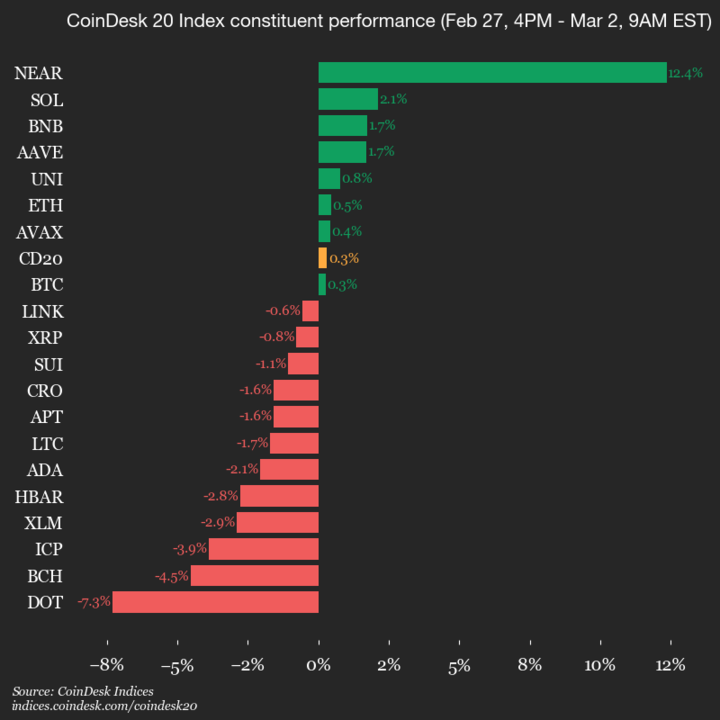
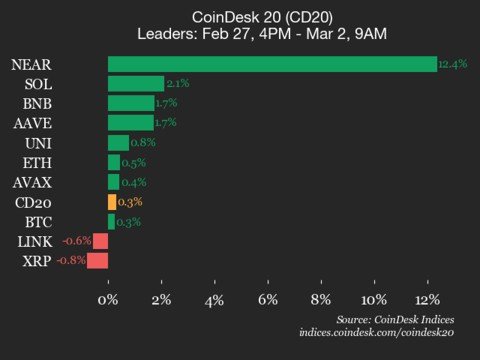
  • CoinDesk 20 performance update: NEAR Protocol (NEAR) jumps 12.4% over weekend

    CoinDesk 20 performance update: NEAR Protocol (NEAR) jumps 12.4% over weekend

    CoinDesk Indices presents its daily market update, highlighting the performance of leaders and laggards in the CoinDesk 20 Index.

    The CoinDesk 20 is currently trading at 1907.12, up 0.3% (+5.99) since 4 p.m. ET on Friday.

    Eight of the 20 assets are trading higher.

    Leaders: NEAR (+12.4%) and SOL (+2.1%).

    Laggards: DOT (-7.3%) and BCH (-4.5%).

    The CoinDesk 20 is a broad-based index traded on multiple platforms in several regions globally.

  • Banking Giant Barclays Mulls Crypto Payments Push: Bloomberg

    Banking Giant Barclays Mulls Crypto Payments Push: Bloomberg

    In brief

    • Barclays has requested information from technology providers regarding a potential push into blockchain, according to Bloomberg.
    • The banking giant is said to be considering tokenized deposits and stablecoin payments.
    • Earlier this year, the firm made an investment in stablecoin settlement firm, Ubyx.

    Publicly traded banking institution Barclays (BCS) is reportedly gathering information for a potential push into blockchain, according to a Friday report from Bloomberg

    Sources familiar with the matter said the firm has requested information from “technology suppliers” while it considers a path forward. Its utilization of blockchain may include tokenized deposits and stablecoins, the report said.

    The U.K.-based banking institution appears to be warming to crypto, investing in stablecoin settlement startup Ubyx after being named as one of a number of leading international banks exploring the joint issuance of a stablecoin last fall. 

    “Specialist technology will play a pivotal role in delivering connectivity and infrastructure to enable regulated financial institutions to interact seamlessly,” Barclays Head of Digital Assets Ryan Hayward said at the time of the Ubyx investment. 

    Now the firm is further investigating those technologies and could ultimately decide on a provider by April, according to Bloomberg. 

    If the firm ultimately decides to offer tokenized deposits or experiment with stablecoins, it would join a list of major banking institutions that have already entered the crypto space. 

    Last year, JPMorgan launched its tokenized deposit token—JPMD—to the Coinbase-incubated Ethereum scaling network, Base, letting institutional clients make payments using a digital representation of their JPMorgan deposits. The firm expanded the token to the Canton Network earlier this year. 

    That decision followed a report that JPMorgan was working on a framework to allow its clients to use Bitcoin and Ethereum as collateral for loans. Plus, publicly traded US Bank began testing its own stablecoin on the Stellar Network, while Citi and Bank of America have registered their own interest as well. 

    Barclays’ potential involvement in the space has not made a splash with shareholders on Friday, as shares in the firm are trading down nearly 4% as the broader market slides. Nevertheless, shares have risen around 54% in the last year of trading.

    Daily Debrief Newsletter

    Start every day with the top news stories right now, plus original features, a podcast, videos and more.

  • Trump Orders Federal Agencies to Dump ‘Woke’ Anthropic AI After Pentagon Dispute

    Trump Orders Federal Agencies to Dump ‘Woke’ Anthropic AI After Pentagon Dispute

    In brief

    • Trump ordered federal agencies to “immediately cease” using Anthropic’s AI technology.
    • The order follows a dispute between Anthropic and the Pentagon over the use of Claude for unrestricted military use.
    • Trump has given agencies six months to phase out Anthropic systems.

    President Donald Trump has directed all U.S. federal agencies to stop using artificial intelligence technology developed by Anthropic, escalating a dispute between the AI company and the Pentagon over how the military uses the technology.

    In a Truth Social post on Friday, Trump said agencies must “immediately cease” using Anthropic products, with a six-month phase-out period for departments that already use the company’s technology.

    “The United States of America will never allow a radical left, woke company to dictate how our great military fights and wins wars!” Trump wrote. “That decision belongs to your commander-in-chief and the tremendous leaders I appoint to run our military.

    The directive follows Anthropic’s refusal on Thursday to remove safeguards preventing Claude from being used for “mass domestic surveillance” or “fully autonomous weapons,” after Pentagon officials demanded contractors allow their systems to be used for “any lawful use.”

    “The left-wing nut jobs at Anthropic have made a disastrous mistake trying to strong-arm the Department of War and force them to obey their terms of service instead of our Constitution,” Trump wrote.

    President Trump called the situation a threat to U.S. troops and national security.

    “Their selfishness is putting American lives at risk, our troops in danger, and our national security in jeopardy,” Trump said.

    Anthropic has resisted Pentagon demands to grant unrestricted military use of its models, while also recently walking back safety language in its Responsible Scaling Policy.

    On Friday, CNBC reported that OpenAI CEO Sam Altman said he is working to “help de-escalate” the situation. De-escalating the tension could be a heavy lift, however.

    In his post, Trump said decisions affecting U.S. military operations must remain under presidential authority rather than “some out-of-control, radical left AI company run by people who have no idea what the real world is all about,” he said.

    “Anthropic better get their act together and be helpful during this phase-out period, or I will use the full power of the presidency to make them comply, with major civil and criminal consequences to follow,” Trump said.

    Defense Secretary Pete Hegseth chimed in on the matter following Trump’s post, offering similar comments regarding the decision and calling Anthropic’s move a “a master class in arrogance and betrayal as well as a textbook case of how not to do business with the United States Government or the Pentagon.”

    “I am directing the Department of War to designate Anthropic a Supply-Chain Risk to National Security,” Hegseth wrote on X. “Effective immediately, no contractor, supplier, or partner that does business with the United States military may conduct any commercial activity with Anthropic. Anthropic will continue to provide the Department of War its services for a period of no more than six months to allow for a seamless transition to a better and more patriotic service.”

    “America’s warfighters will never be held hostage by the ideological whims of Big Tech,” he added. “This decision is final.”

    Following Trump’s announcement, the nonprofit Center for Democracy and Technology commented on the move in a statement sent to Decrypt.

    “The President is wielding the full weight of the federal government to blacklist a company for taking a narrowly-tailored, principled stance to restrict some of the most extreme uses of AI you could imagine—fully autonomous weapons and the mass surveillance of Americans,” said CDT President and CEO Alexandra Givens.

    “This action sets a dangerous precedent. It chills private companies’ ability to engage frankly with the government about appropriate uses of their technology, which is especially important in national security settings that so often have reduced public visibility,” she added. “Retaliating against a company for setting tailored, principled conditions on its product’s use undermines basic market freedoms and makes us all less safe.”

    Editor’s note: This story was updated after publication to include comments from Hegseth and the CDT.

    Daily Debrief Newsletter

    Start every day with the top news stories right now, plus original features, a podcast, videos and more.
  • Option Whales Turn Bullish on Bitcoin (BTC) After Five-Month Decline! This Price is Expected in March!

    Option Whales Turn Bullish on Bitcoin (BTC) After Five-Month Decline! This Price is Expected in March!

    Bitcoin (BTC), which has been fluctuating between $70,000 and $63,000 since February, experienced a sharp drop over the weekend due to the US-Iran conflict, but subsequently recovered.

    While Bitcoin remains around the $66,000 level, Singapore-based cryptocurrency analysis platform QCP Capital has shared its latest analysis for Bitcoin.

    According to QCP analysts, the cryptocurrency market remained within a narrow range amid escalating US-Iran tensions. Following the US attack on Iran, Bitcoin and Ethereum fell to $63,000 and $1,910 respectively before recovering.

    Saturday’s US attack on Iran resulted in the liquidation of approximately $300 million in long positions, but this was subsequently brought under control.

    According to the analysis, options reacted moderately. 1-day implied volatility rose to 93% but then retreated to below 60%.

    In particular, even as the conflict between the US and Iran escalated, option buyers continued to purchase Bitcoin call options with strike prices of $74,000 and $75,000 for the March expiry.

    This suggests that some investors are positioning themselves for a rebound in March after five consecutive months of decline.

    QCP analysts emphasize that the market is currently able to tolerate the fact that the Donald Trump administration has indicated that the military operation against Iran will last “approximately four weeks.”

    *This is not investment advice.