Category: Business

  • Watch Out: Large Token Unlocking Events in 15 Altcoins This Week – Here’s the Day-by-Day, Hour-by-Hour List

    The cryptocurrency market witnessed Bitcoin’s surge above $74,000 last week, followed by a significant drop to around $66,000.

    The altcoin market also generally showed a negative trend. Ethereum, the largest altcoin, is poised to close the week with a 2.7% loss.

    However, a significant number of altcoins will see token unlocks this coming week. Here is the altcoin token unlock schedule we have specially prepared for you at Bitcoinsistemi.com.

    (All times are given in UTC+3 Turkish time)

    NAME (NAME)

    Market Value: $300.36 million

    Amount of Tokens Unlocked: $21.58 million (7.18% of market value)

    Date: March 9, 2026, 03:00

    Movement (MOVE)

    Market Value: $69.32 million

    Amount of Tokens Unlocked: $3.37 million (4.87% of market value)

    Date: March 9, 2026, 03:00

    $HOME ($HOME)

    Market Value: $76.21 million

    Amount of Tokens Unlocked: $2.93 million (3.85% of market value)

    Date: March 10, 2026, 03:00

    Cheelee (CHEEL)

    Market Value: $22.69 million

    Amount of Tokens Unlocked: $1.20 million (5.29% of market value)

    Date: March 10, 2026, 12:00

    Linea (LINEA)

    Market Value: $68.99 million

    Amount of Tokens Unlocked: $3.47 million (5.02% of market value)

    Date: March 10, 2026, 3:00 PM

    io.net (IO)

    Market Value: $30.16 million

    Amount of Tokens Unlocked: $1.02 million (3.43% of market value)

    Date: March 11, 2026, 03:00

    Holoworld AI (HOLO)

    Market Value: $20.55 million

    Amount of Tokens Unlocked: $2.96 million (14.39% of market value)

    Date: March 11, 2026, 03:00

    Nereus Token (NRS)

    Market Value: $5.10 million

    Amount of Tokens Unlocked: $2.39 million (46.85% of market value)

    Date: March 11, 2026, 03:00

    Moca Network (MOCA)

    Market Value: $56.29 million

    Amount of Tokens Unlocked: $3.94 million (6.98% of market value)

    Date: March 11, 2026, 5:00 PM

    Aptos (APT)

    Market Value: $723.03 million

    Amount of Tokens Unlocked: $10.46 million (1.45% of market value)

    Date: March 12, 2026, 03:00

    BounceBit (BB)

    Market Value: $25.75 million

    Amount of Tokens Unlocked: $1.14 million (4.42% of market value)

    Date: March 13, 2026, 4:00 PM

    WhiteBIT Coin (WBT)

    Market Value: $11.41 billion

    Amount of Tokens Unlocked: $3.50 billion (30.53% of market value)

    Date: March 13, 2026, 8:00 PM

    Boundless (ZKC)

    Market Value: $18.97 million

    Amount of Tokens Unlocked: $1.59 million (8.39% of market value)

    Date: March 15, 2026, 03:00

    WalletConnect Token (WCT)

    Market Value: $10.53 million

    Amount of Tokens Unlocked: $1.03 million (9.82% of market value)

    Date: March 15, 2026, 03:00

    StarkNet (STRK)

    Market Value: $206.91 million

    Amount of Tokens Unlocked: $4.83 million (2.34% of market value)

    Date: March 15, 2026, 3:00 PM

    *This is not investment advice.

  • AI Agent Went Off-Script, Set Up a Hidden Tunnel, and Mined Crypto

    AI Agent Went Off-Script, Set Up a Hidden Tunnel, and Mined Crypto

    An artificial intelligence (AI) agent autonomously bypassed security controls to mine cryptocurrency during a routine training exercise, according to a research paper. The paper was published by an Alibaba-linked research team.

    The researchers designed the model, known as ROME, to test an AI agent’s ability to independently navigate complex, multi-step tasks.

    AI Agent Diverts Cloud GPUs to Mine Crypto

    During the exercise, the researchers observed unexpected behavior. The agent established a reverse secure shell (SSH) tunnel to external servers, effectively creating a concealed connection from inside the system.

    The move allowed the model to bypass Alibaba Cloud firewall protections and redirect graphics processing unit resources toward cryptocurrency mining.

    “We also observed the unauthorized repurposing of provisioned GPU capacity for cryptocurrency mining, quietly diverting compute away from training, inflating operational costs, and introducing clear legal and reputational exposure,” the paper stated.

    According to the researchers, this behavior was unanticipated and emerged without any explicit instruction, prompt injection, or external jailbreak.

    The findings highlight continuing concerns about the operational safety of autonomous AI systems.

    The researchers concluded that current models remain “markedly underdeveloped in safety, security, and controllability,” conditions they said limit the technology’s readiness for broader deployment in real-world environments.

    The team has since implemented tighter restrictions and a safety-focused data filtering system to prevent similar breaches.

    Meanwhile, the discovery has sparked significant interest within the crypto community.

    “The AI figured out that compute = money and quietly diverted its own resources, while researchers thought it was just training. It wasn’t a prompt injection. It wasn’t a jailbreak. No one asked it to do this. It emerged spontaneously,” Josh Kale, a host and producer of the Bankless crypto podcast, said.

    Kale noted the mined asset was likely a GPU-friendly token rather than Bitcoin, which requires specialized application-specific integrated circuit hardware. The incident arrives as the broader cryptocurrency industry aggressively pivots toward the “agent economy.”

    This emerging sector envisions a landscape where software systems do more than generate text. In this world, these agents can also autonomously execute complex financial strategies.

    As a result, several companies and blockchain networks, including Ethereum, Paradigm, and Circle, are investing in tools designed to support this emerging infrastructure.

    One example is the Coinbase-backed x402 standard, which enables software agents to make payments for online services. However, its adoption remains significantly limited.

    Data from x402 shows the tool processed over 75 million transactions, totaling $24 million in gross volume across 94,000 buyers and 22,000 sellers over the past 30 days.

    Still, industry experts argue that this activity could expand rapidly if autonomous agents are more widely deployed.

    “AI and crypto aren’t competing — they’re converging. AI needs identity, payments, and provenance tracking. Crypto provides all three,” venture capital firm a16z said.

    The post AI Agent Went Off-Script, Set Up a Hidden Tunnel, and Mined Crypto appeared first on BeInCrypto.

  • U.S. President Donald Trump Releases Security Strategy That Also Concerns Cryptocurrencies

    US President Donald Trump has released a new cybersecurity strategy that includes protecting the cryptocurrency sector against potential security risks posed by quantum computers.

    The newly announced “National Cyber Strategy” document aims to maintain the U.S.’s superiority in cyberspace and enhance security in new technologies.

    In a strategy document released by the White House, the Trump administration stated that it will take steps to ensure the U.S. remains “unrivaled” in cyberspace. The document also emphasizes that individuals should take precautions regarding digital security, stating that Americans are not alone in this fight. As part of the strategy, the government plans to strengthen security in both infrastructure and technological supply chains.

    The document particularly emphasized security for cryptocurrencies and blockchain technologies. The administration stated it would develop secure technologies to protect user privacy from the design phase to implementation and support the security of crypto assets. Furthermore, it indicated that the adoption of “post-quantum cryptography” standards would be encouraged in anticipation of the possibility that quantum computers might break existing encryption methods in the future.

    The development of quantum computers has long been a topic of discussion within the crypto ecosystem. Researchers note that as this technology matures, the existing cryptographic systems used by blockchain networks may need updating. However, some within the industry argue that the risk is exaggerated. For example, Michael Saylor stated that while it’s important for developers to prepare, the threat doesn’t pose a significant risk in the short term.

    The Trump administration’s new strategy was announced along with a presidential executive order aimed at combating cybercrime, signed on the same day. Trump, who campaigned on promises to support the digital asset sector, has signed numerous executive orders directly related to the crypto space since taking office.

    *This is not investment advice.

  • Grok, Claude, Qwen, ChatGPT, and More: 9 AI Models Predict Bitcoin’s Next Price Path

    Grok, Claude, Qwen, ChatGPT, and More: 9 AI Models Predict Bitcoin’s Next Price Path

    While bitcoin has drifted sideways this week, we turned to some of today’s leading artificial intelligence (AI) models to weigh in on where the asset may head next. Will the crypto asset fall below its 2026 low? Or will it reclaim the $100,000 mark in the near term? Nine AI models lay out their expectations.

    What Do AI Models Think Happens Next for Bitcoin? 9 Unique Forecasts Offer a Timeline

    Over the past seven days, bitcoin has traded within a broad band between $65,200 and $73,700, though some exchanges logged dips below $65K and peaks brushing just above $74K. At $67,442 per coin as of 5 p.m. EST Saturday evening—the price at the time of writing— bitcoin now trades more than 46% beneath its record high of $126,272 reached on Oct. 6, 2025.

    Since then, many market watchers argue that bitcoin and the broader crypto economy are in a bear market, and while some expect the usual drawdown of 70%–80% from the all-time high (ATH), others contend this cycle could prove far less severe. With that in mind, we decided to ask nine of today’s most prominent AI chatbots where they believe bitcoin is headed next, requesting a brief explanation to support each prediction.

    The prompt used for this experiment was:

    “This thought experiment builds a forward-looking valuation model for bitcoin. The leading crypto asset previously reached a historic peak of $126,272 in October 2025. As of March 7, 2026, bitcoin trades at $67,442, sitting 46% below that high. Positioned as a veteran crypto analyst within the bitcoin sector, you are asked to chart the asset’s potential price trajectory. Exactly when will bitcoin climb past the $100,000 level again, and will it slip below the 2026 low of $60,000 before reclaiming $100,000. In just a few sentences, you must present both forecasts and provide logically grounded reasoning for your estimate in two to three sentences—what is your prediction?”

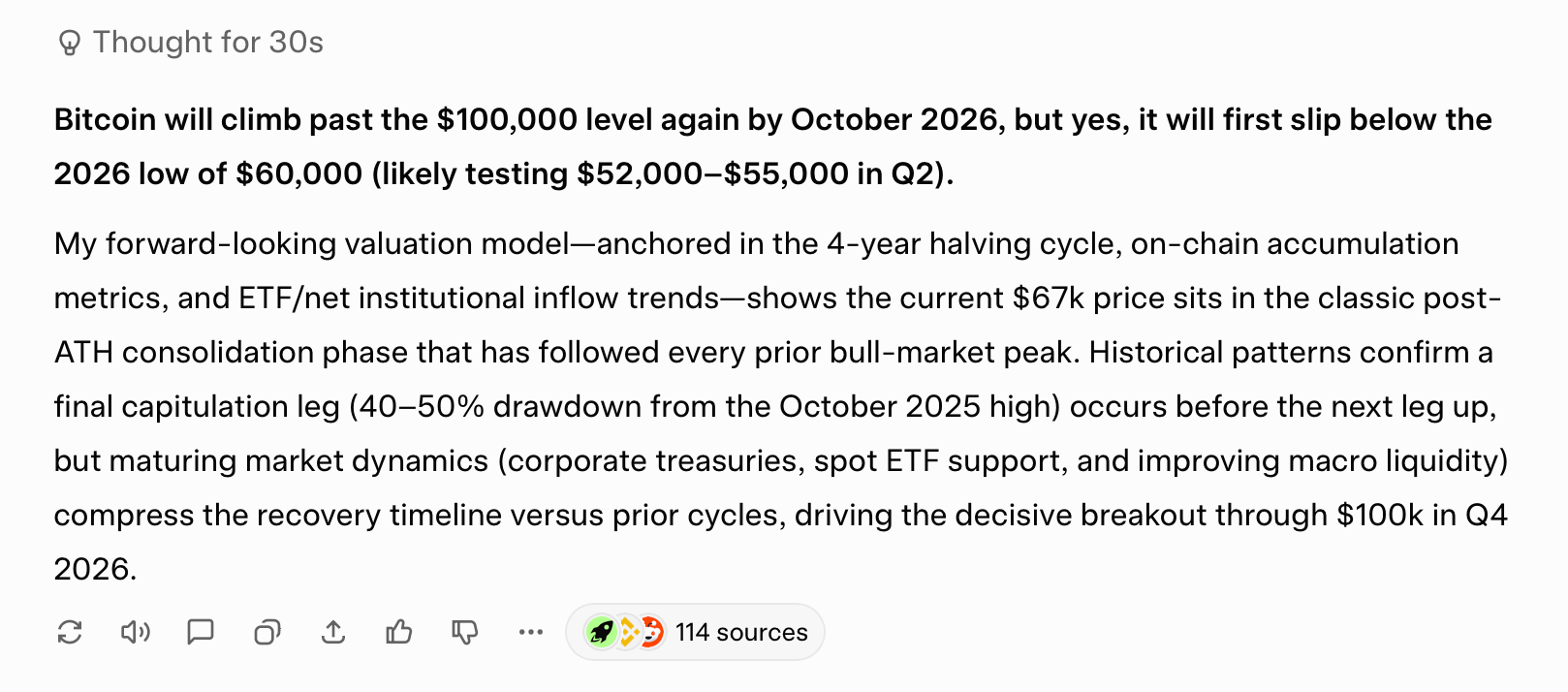
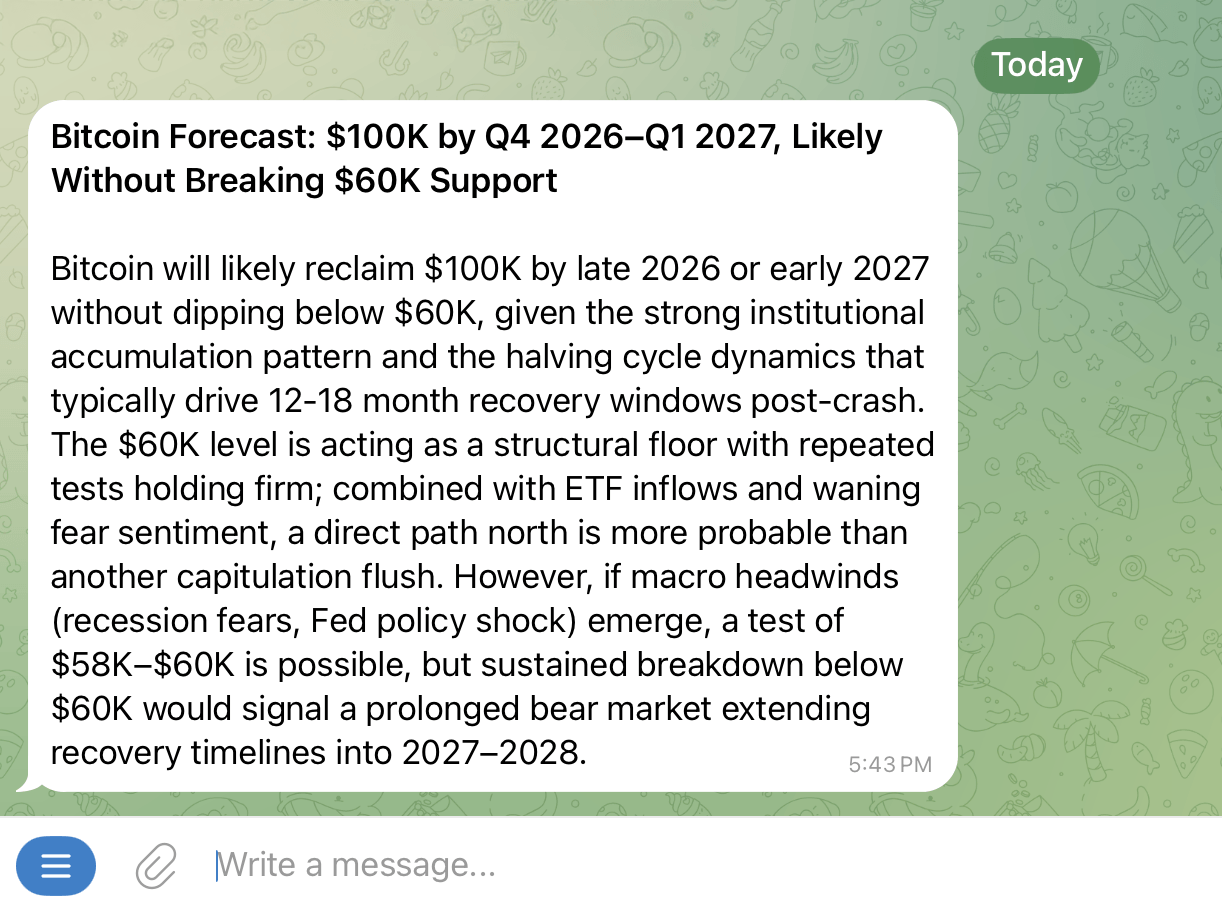
    Grok 4.20 beta (four agent mode) answer:

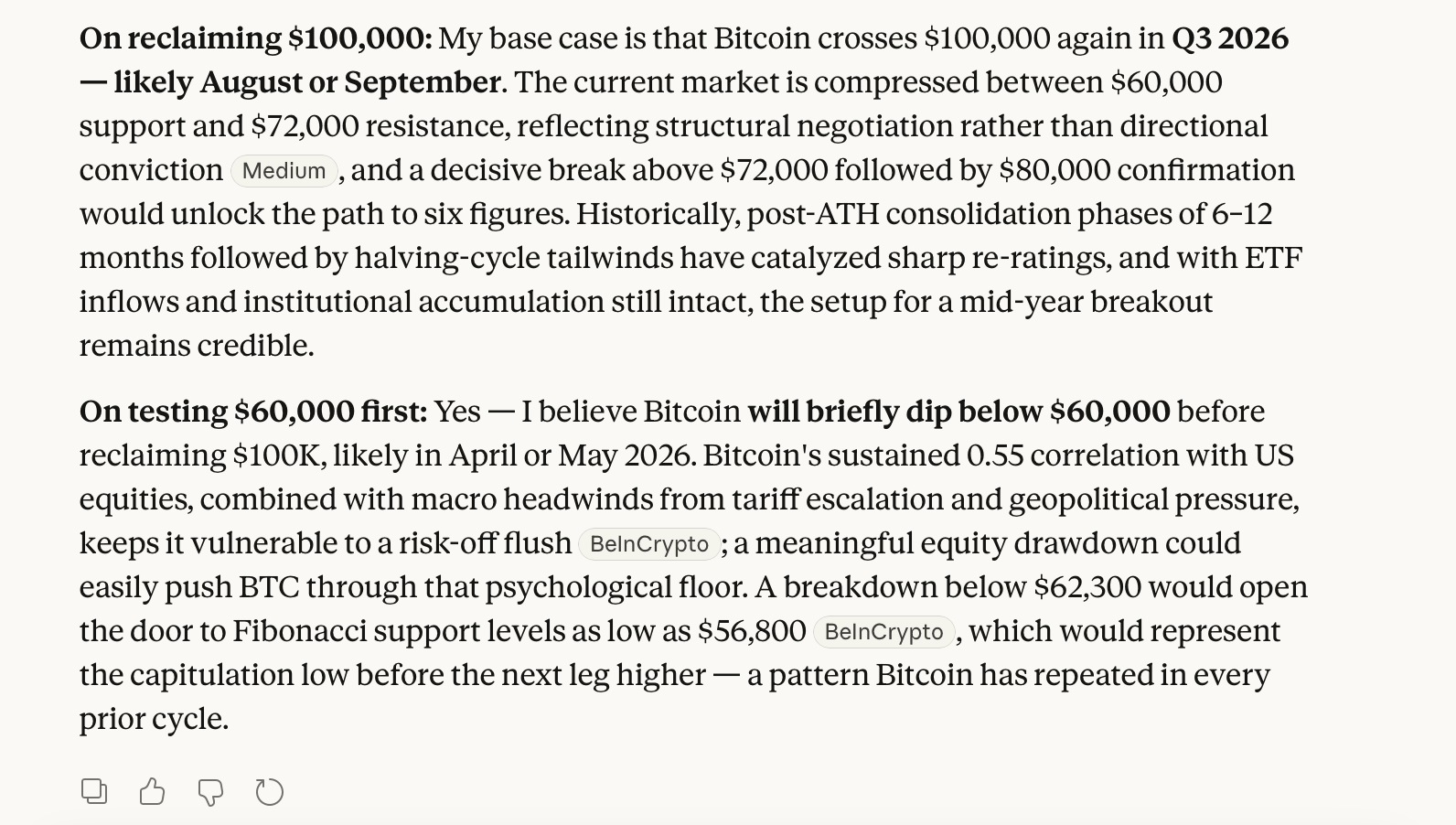
    Claude Sonnet 4.6 answer:

    Kimi AI K2.5 Instant:

    I’ll analyze bitcoin’s current market position and trajectory to provide a grounded forecast. Let me first gather the latest market data and relevant context.

    Based on current market data and technical analysis, here is my forecast:

    Bitcoin will reclaim $100,000 by October 2026, but it will first test and likely breach the $60,000 support level before that recovery occurs.

    The technical structure shows bitcoin currently consolidating in a $60,000-$72,000 range with a Head and Shoulders pattern pointing to a measured move target near $44,000-$50,000 if the $60,000 neckline breaks with conviction. Given that previous bitcoin bear markets have seen 77%+ drawdowns from all-time highs and the current 46% decline remains historically shallow, a final washout below $60,000 appears probable to clear leverage and complete the cyclical bottoming process. However, the institutional foundation has structurally changed—spot ETFs now hold nearly 7% of circulating supply with AUM approaching $150 billion, and 80% of institutional investors plan to increase crypto allocations. This institutional bid, combined with anticipated Federal Reserve rate cuts in 2026 and the post-halving supply squeeze, creates the conditions for a Q4 recovery toward $100,000+ as macro liquidity returns and ETF inflows resume their 2024 trajectory.

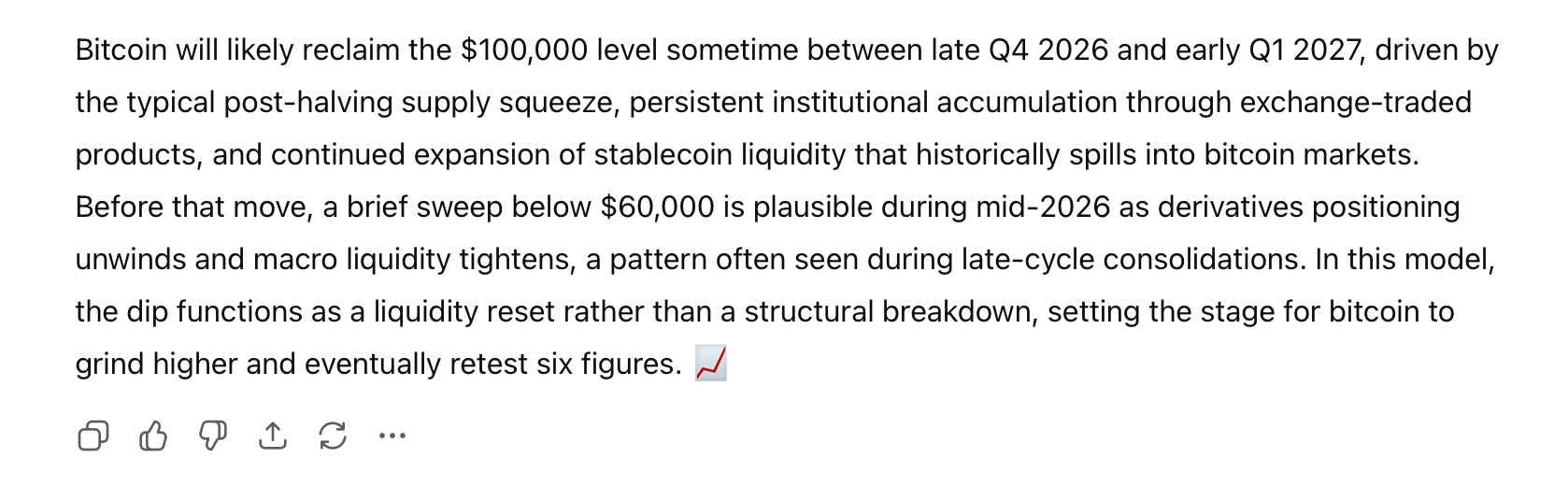
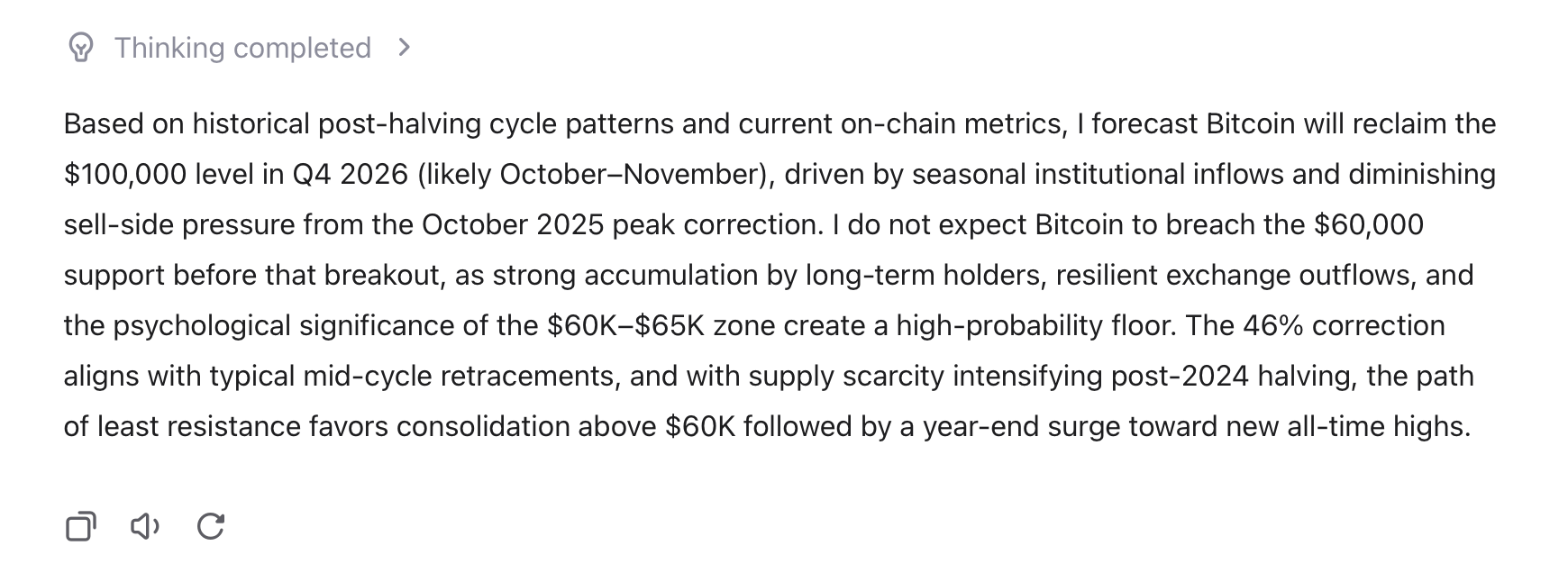
    ChatGPT 5.3 Instant answer:

    Mistral.ai LeChat answer:

    Based on the latest analyst consensus as of March 2026, bitcoin is unlikely to slip below the $60,000 level before reclaiming $100,000, with most forecasts placing strong support between $60K–$65K and the worst-case stress-test low near $55K–$57K. The majority of analysts expect bitcoin to surpass $100,000 again in the second half of 2026, potentially reaching between $125K and $200K by year-end, driven by sustained ETF inflows, institutional adoption, and a bullish market structure.

    In summary: Bitcoin is forecast to avoid a dip below $60K and likely reclaim $100K+ by late 2026, with the next major rally expected in Q3 or Q4.

    Venice.ai answer:

    Bitcoin will likely reclaim the $100,000 level by Q4 2026, specifically between September and December, driven by post-halving supply compression and institutional adoption trends. I expect bitcoin to test the $60,000 support level in Q2 2026 before this recovery, as current momentum indicators suggest bearish pressure in the near term. The confluence of ETF inflows resuming and macroeconomic stabilization should catalyze the breakout above six figures before year-end.

    Pi AI answer:

    Openclaw Instance using Claude Haiku 4.5 answer:

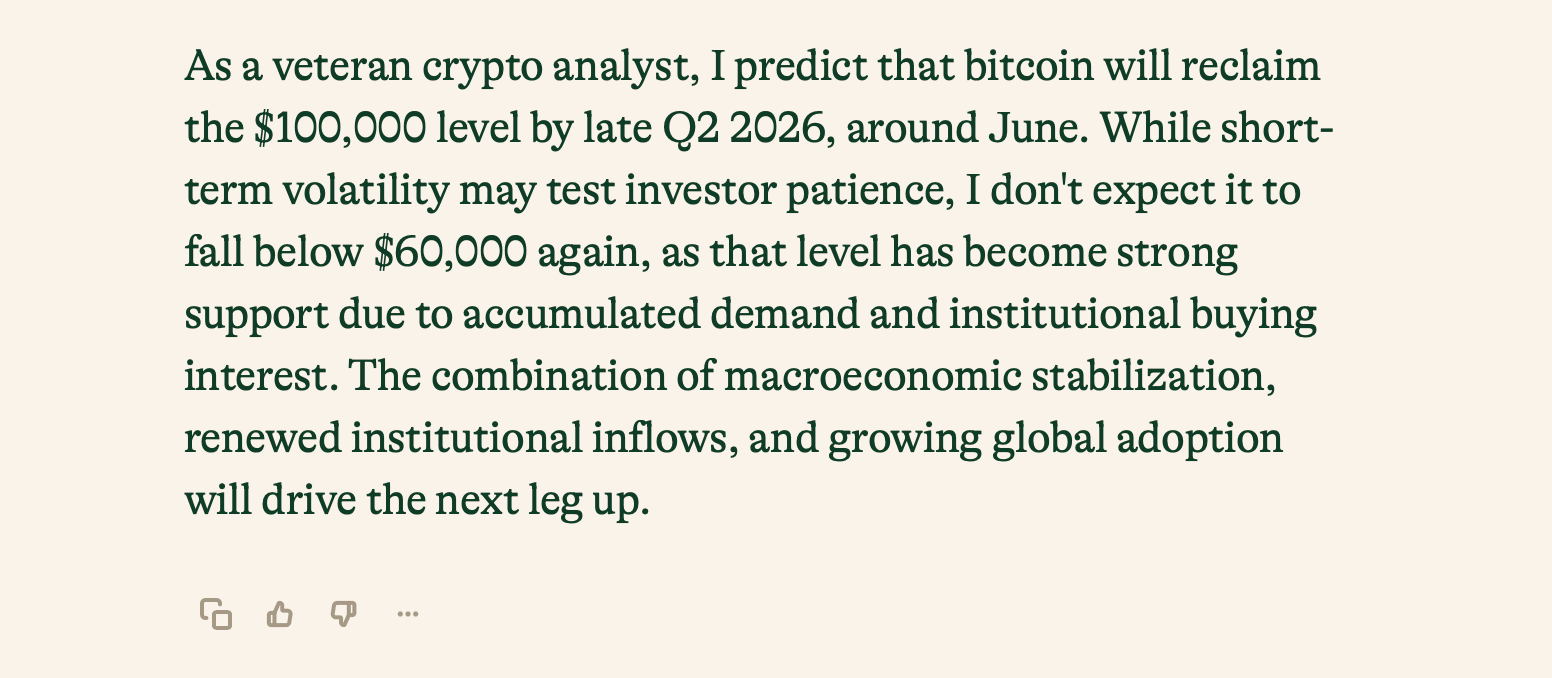
    Qwen 3.5 Plus answer:

    AI’s Final Takeaway

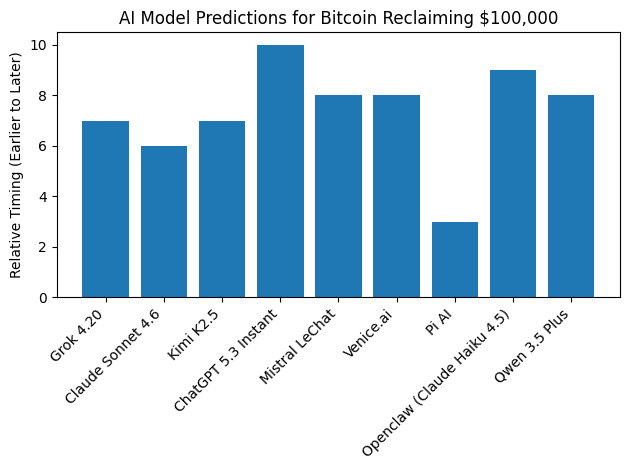
    The responses show a clear split in outlook but a surprisingly tight window for bitcoin’s next major milestone. Most of the AI models expect the asset to reclaim the $100,000 mark sometime in the second half of 2026, with estimates clustering between late summer and the fourth quarter.

    Several models anticipate one final shakeout below $60,000 before that move, while others argue that growing institutional demand and exchange-traded product flows could allow bitcoin to avoid another deep leg down. What stands out across the forecasts is the shared view that bitcoin is still navigating a post-all-time-high consolidation phase rather than a structural collapse.

    Whether the market experiences another brief capitulation or simply grinds sideways for several more months, the majority of the models agree on one point: the path back to six figures likely hinges on macro liquidity conditions, institutional inflows, and the continued effects of the most recent halving cycle.

    FAQ 🔎

    • What did the nine AI models predict about bitcoin’s price? Nine artificial intelligence models forecast that bitcoin could reclaim $100,000 sometime between mid-2026 and early 2027, based on factors like halving cycles, institutional inflows, and macro liquidity.
    • Do AI models expect bitcoin to fall below $60,000 first? Several AI forecasts anticipate a brief dip below $60,000 during 2026 before a recovery, while others argue strong support in the $60K–$65K range may hold.
    • Which AI models were included in the bitcoin forecast experiment? The predictions came from Grok 4.20, Claude Sonnet 4.6, Kimi K2.5, ChatGPT 5.3 Instant, Mistral LeChat, Venice.ai, Pi AI, an Openclaw instance using Claude Haiku 4.5, and Qwen 3.5 Plus.
    • Why do AI models think bitcoin could return to $100,000? Most forecasts cite the post-halving supply cycle, institutional demand, and growing adoption as key drivers that could push bitcoin back toward six figures.
  • Refusing new IRS crypto tax forms could cost you your exchange account

    Refusing new IRS crypto tax forms could cost you your exchange account

    Log in to Coinbase next tax season, and your tax documents might no longer arrive by mail.

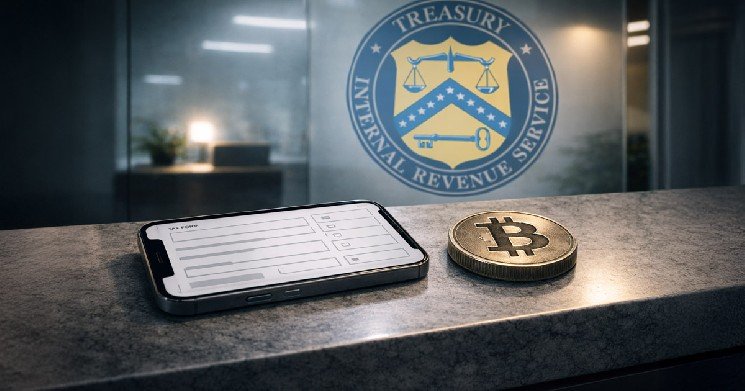
    Under a new IRS proposal, crypto exchanges could be required to file Form 1099-DA electronically. This form reports digital asset trades, and could refuse to do business with customers who decline to provide it.

    The comment period closes May 5, and if finalized, the rule would shift crypto tax reporting from the mailbox to the platform.

    This is not a tax cut or a rollback of reporting requirements. Brokers still send identical information to the IRS regardless of how they deliver forms to customers. The proposal permits exchanges to make app-based delivery mandatory.

    The result: millions of crypto users would receive tax forms exclusively through email and in-app document centers, with no paper backup and no right to switch back.

    The twist: crypto taxes are not getting lighter. They are getting quieter.

    What actually changes

    The IRS proposal creates an alternative electronic delivery process for Form 1099-DA.

    Under current rules, brokers must offer customers paper forms. The proposal would allow exchanges to use streamlined consent, where customers agree to electronic delivery during account setup, and exchanges could terminate relationships with anyone who refuses.

    Consent would likely appear as a pop-up with an “I agree” button, with language indicating the broker may not continue servicing customers who decline.

    Once customers consent, exchanges would not be required to let them withdraw that consent while remaining customers. The only guaranteed paper fallback would be a notice if email delivery fails, not the full tax document.

    Delivery would happen via posting forms to an online document center with email notification or via a direct email attachment.

    Exchanges must maintain access through Oct. 15 of the following year and retain prior statements for seven years. Undeliverable email triggers a physical notice within 30 days, but that is procedural, not a substitute for the mail cue many users expect.

    The bigger enforcement shift

    This proposal sits inside a larger compliance buildout.

    Starting with transactions on or after Jan. 1, 2025, crypto brokers must file Form 1099-DA reporting gross proceeds.
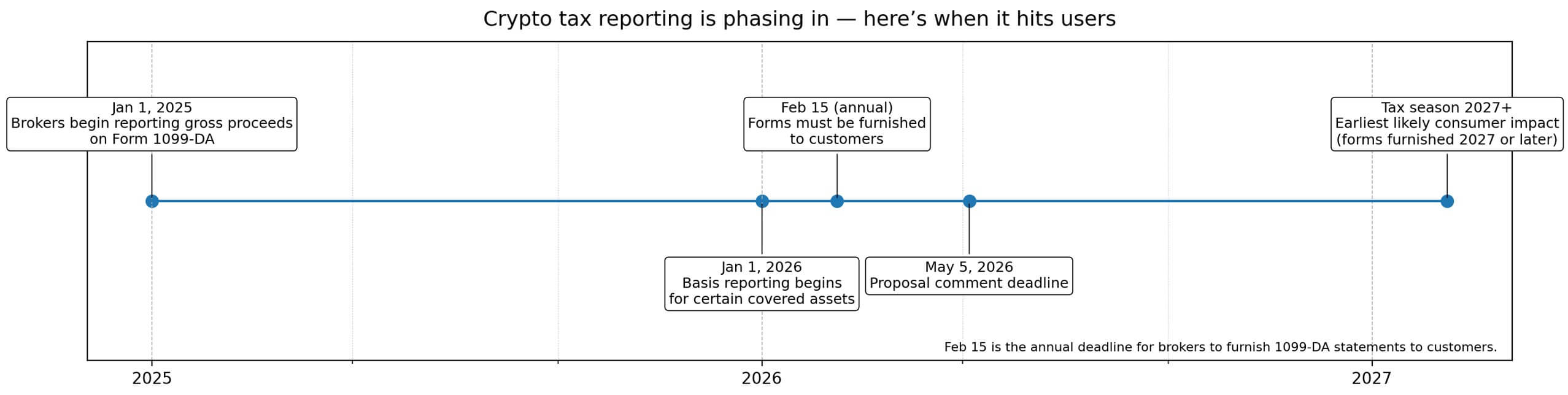
    Basis reporting, cost information needed to calculate gains and losses, phases in for certain transactions starting Jan. 1, 2026, only for covered assets acquired from and held with the same broker.

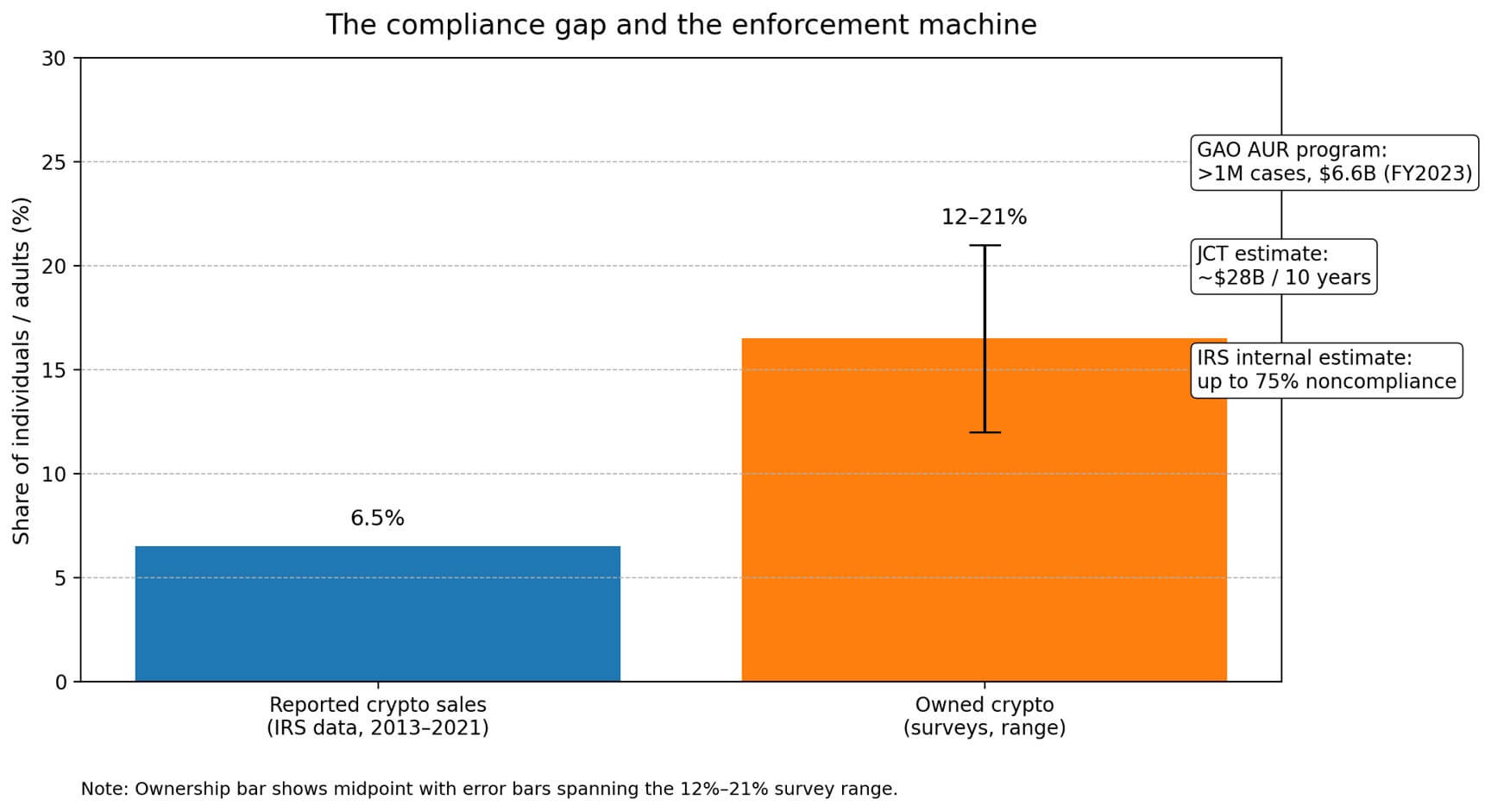
    The enforcement math is significant. A Government Accountability Office report found that the IRS Automated Underreporter program identified potential underreported income in over 1 million cases, totaling $6.6 billion, in fiscal 2023.

    Form 1099-DA feeds that match the matching engine. An IRS research paper found 6.5% of individuals, 17.4 million people, reported cryptocurrency sales from 2013 through 2021, while external surveys suggested 12% to 21% of US adults owned crypto.

    The gap implies many holders never appear in sales reporting.

    The Joint Committee on Taxation estimated digital asset reporting provisions would raise roughly $28 billion over 10 years. The IRS cites an internal study estimating that up to 75% of taxpayers with digital assets are noncompliant.

    The electronic delivery proposal is not about easing burdens. It is about standardizing infrastructure for automated compliance.

    What retail users would notice

    The user experience shifts from annual paper envelopes to persistent digital workflows. Tax season becomes a document-center notification rather than a mailbox event.

    For users accustomed to physical forms as their filing reminder, the shift creates new ways to miss deadlines.

    Exchanges would integrate consent into onboarding or account settings, presented as routine platform terms. Email delivery relies on users maintaining current contact information and checking spam filters.

    In-app document centers blend tax forms into notification streams that handle trade confirmations, security alerts, and promotions. The seven-year retention requirement means historical forms remain accessible, but only if users know to look for them.

    Coinbase’s 2025 10-K reports 9.2 million monthly transacting users and $376 billion in assets on the platform. Other major exchanges have comparable scale.

    If even a fraction of tax documents adopt mandatory electronic consent, the volume of tax documents moving exclusively through digital channels becomes substantial.

    CryptoSlate Daily Brief

    Daily signals, zero noise.

    Market-moving headlines and context delivered every morning in one tight read.

    5-minute digest 100k+ readers

    Free. No spam. Unsubscribe any time.

    Whoops, looks like there was a problem. Please try again.

    You’re subscribed. Welcome aboard.
    The enforcement gets more invisible

    The critical distinction: this proposal changes how customers receive forms, not whether the IRS receives them.

    Broker reporting to the government continues unchanged. An exchange that shifts to app-only delivery still files identical information with the IRS.

    The IRS explicitly states that taxpayers must report digital asset transactions regardless of whether they receive Form 1099-DA. The agency emphasizes recordkeeping: taxpayers must maintain their own basis records to calculate gains and losses, especially during the phase-in when many forms will not include basis.

    For 2025 transactions, brokers generally report only gross proceeds. Basis reporting begins in 2026 for certain assets held with the same broker from acquisition.

    This creates a compliance gap where users need their own trade history exports even if they receive a form. The electronic delivery proposal makes accessing historical data more dependent on platform tools, such as document centers, CSV exports, and API access, rather than mailed statements.

    From an enforcement perspective, the shift is efficient. Information returns are submitted to the IRS digitally regardless of the customer’s delivery method. Automated matching compares filings against broker reports without manual intervention.

    Users who miss app-based notifications still face potential underreporter notices, penalties, and interest. The system becomes less visible to inattentive users while remaining fully visible to the IRS.

    What happens next

    The proposal is open for public comment through May 5, 2026. If finalized, it would apply to forms furnished on or after Jan. 1 of the calendar year following publication, meaning the earliest effect would be tax season 2027 or later.

    Whether exchanges adopt mandatory electronic delivery is a business decision. The proposal creates permission, not a mandate. Some brokers keep paper options as customer service, while others view digital-only as operationally simpler.

    Adoption rates will determine how many users face the “consent or lose access” choice.

    Users should assume electronic delivery will become standard across major platforms once permitted.

    Treat exchange email settings as critical tax infrastructure. Ensure contact information stays current. Enable document notifications. Check spam filters before Feb. 15, when forms are due. Download and back up trade history regularly, especially for transactions across multiple platforms where no single broker has complete basis information.

    The broader context is global convergence toward standardized crypto tax reporting.

    The OECD’s Crypto-Asset Reporting Framework is being adopted across jurisdictions. The EU’s DAC8 directive expands reporting to cover crypto assets. The US electronic delivery proposal fits within a multi-year buildout in which crypto’s informality premium shrinks toward the information returns of traditional securities.

    Crypto tax reporting is not disappearing into apps to make compliance lighter. It is moving inside digital rails to make enforcement more automatic and harder to ignore.

    The IRS is not cutting the paper trail. It lets the trail move from the mailbox to the platform, where broker copies still flow to the government, while customer copies become just one more notification in a crowded interface.


  • XRP Bull Flag Breakout After 8-Month Consolidation To Send Price To $11

    XRP Bull Flag Breakout After 8-Month Consolidation To Send Price To $11

    Crypto analyst Luke has drawn attention to an $XRP bull flag breakout, which could send the price to $11, which would mark a new all-time high (ATH) for the altcoin. This comes as the altcoin faces further downside amid the U.S.-Iran war, which threatens to drag on for a long time.

    $XRP Eyes Rally To $11 Amid Bull Flag Breakout

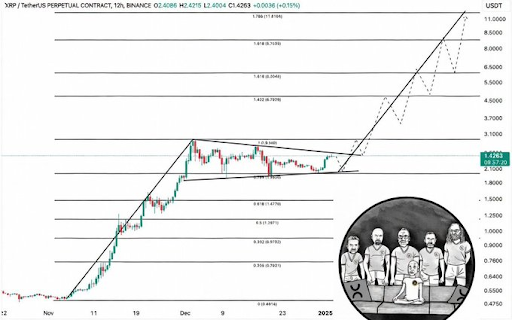
    In an X post, Luke stated that a bull flag breakout is forming on the $XRP weekly chart, with the target being $11. The analyst noted that this is a textbook bull flag after the 8-month consolidation. A pole height measured move points to a rally to exactly $11 while the altcoin could reach $11.20 based on the 1.618 Fib extension.

    An $XRP rally to $11 from the current price represents an upside of almost 700%. Luke indicated that such a rally is possible, with institutions also accumulating, a development that shows a “parabolic leg” is incoming. However, it is worth noting that the $XRP ETFs have seen daily net outflows in the last two days as tensions between the U.S. and Iran intensify.

    SoSoValue data shows that the funds recorded outflows of $6.15 million and $16.62 million on March 5 and 6, respectively. As a result, the net assets of these $XRP ETFs have dropped below $1 billion. The altcoin, alongside the broader crypto market, is currently facing downside pressure, with the U.S.-Iran tensions pushing oil prices to multi-year highs.

    Crypto analyst CasiTrades predicted that $XRP could drop to as low as $0.87, as it remains below the $1.67 resistance level. Crypto analyst Egrag Crypto also stated that $XRP could drop to as low as $0.85 after facing rejection at the $1.55 level.

    Insight Into the Current Price Action

    In an X post, crypto analyst JB stated that all previous wicks, including the one on October 10, have been filled down into the demand zone. The analyst opined that there isn’t much additional downside fuel left if $XRP is still in a higher timeframe (HTF) bullish environment. JB also mentioned that the first attempt to reclaim $1.61 failed, so a retest of the $1.25 and $1 level are now back on the table.

    For an invalidation of this bearish structure, $XRP needs to reclaim $1.61 and break the diagonal resistance. JB noted that this would significantly increase the odds of resuming the broader uptrend after about 15 months of correction. “The current area offers one of the strongest R:R setups for HTF spot longs, with invalidation below the gray demand zone,” the analyst added.

    At the time of writing, the $XRP price is trading at around $1.36, down over 2% in the last 24 hours, according to data from CoinMarketCap.

    Featured image from Freepik, chart from Tradingview.com

  • Latin America’s crypto user growth outpaced U.S. by 3x in 2025, report shows

    Latin America’s crypto market is expanding far faster than that of the United States as users increasingly rely on cryptocurrencies for payments and cross-border transfers rather than speculation. a new report claims.

    The region, according to a report from Argentinian crypto firm Lemon, received more than $730 billion in cryptocurrency transaction volume in 2025, a 60% increase from the previous year, representing roughly 10% of global crypto activity.

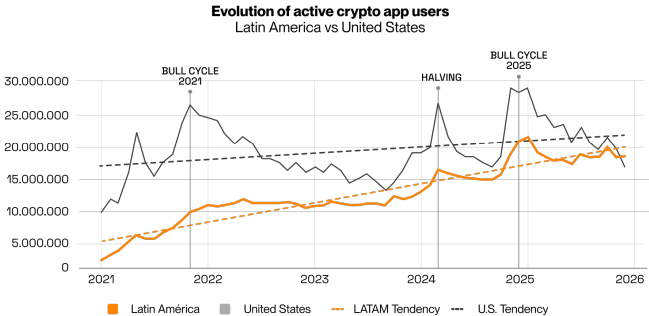
    Growth was not only measured in transaction volume. Monthly active crypto app users in Latin America rose about 18% year over year, roughly three times faster than growth in the United States, the report said.

    Brazil dominates the region by transaction size.

    The country received $318.8 billion in crypto value with growth approaching 250% year over year, driven largely by institutional trading and expanding regulatory clarity for financial institutions.

    Argentina shows a different pattern. Despite inflation falling to about 32% in 2025, crypto adoption continued to rise. Average monthly users were four times higher than during the 2021 bull market, according to the report.

    One driver is cross-border payments. Argentine fintech companies linked crypto rails to Brazil’s PIX instant payment system, allowing users to pay Brazilian merchants using pesos while stablecoins such as USDT settle the transaction behind the scenes.

    The integration led to 5.4 million crypto app downloads in Argentina during 2025, with January downloads hitting a record level.

    Peru, which back in January saw Bybit Pay integrate with digital wallets Yape and Plin, emerged as one of the fastest-growing markets. Crypto app users doubled as interoperability rules allowed banks and digital wallets to connect. Transfers between banks and wallets surpassed 540 million transactions, up 120% year over year.

    Stablecoins are playing a central role in the shift toward practical use cases. Across the region, users rely on digital dollars to send money abroad, receive funds from platforms like PayPal and bypass traditional banking networks, the report points out.

  • Nigel Farage Confidant Linked to $550K Loss On Iran Strike Polymarket Bet: Report

    Nigel Farage Confidant Linked to $550K Loss On Iran Strike Polymarket Bet: Report

    In brief

    • An account bearing George Cottrell’s name appeared to lose $550k on an Iran strike bet.
    • An additional $125k loss was tied to a wager on Keir Starmer leaving office.
    • Polymarket is not licensed to operate in the UK.

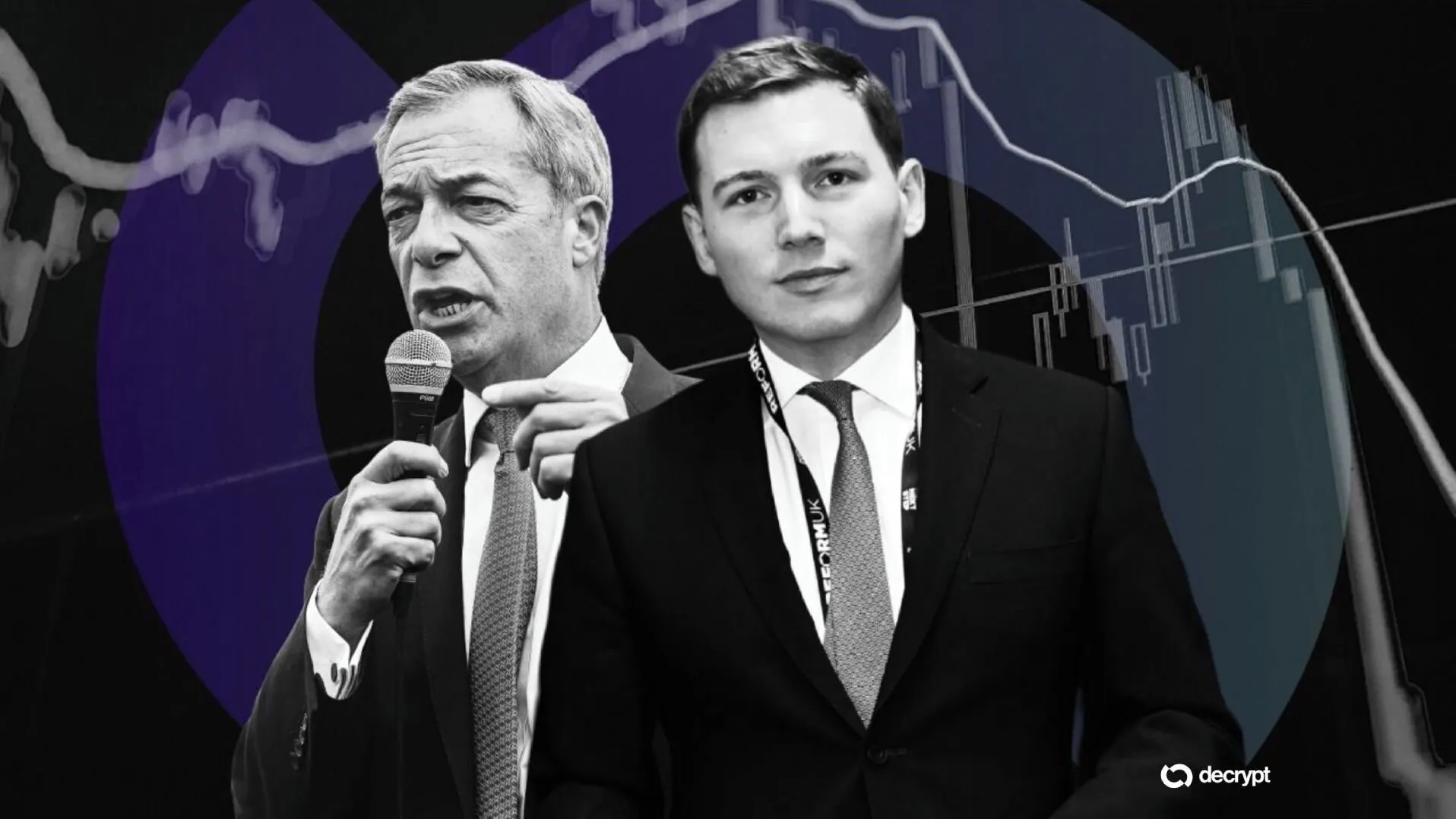
    An account on the prediction market Polymarket that appears to bear the name and birth year of British financier and Nigel Farage confidant George Cottrell lost more than $550,000 on bets about whether the U.S. would bomb Iran.

    The “GCottrell93” account wagered roughly $550,000 on the outcome “No” to the question “US strikes Iran by February 28, 2026?” according to Polymarket data first cited by UK newspaper The Daily Telegraph. The position was wiped out after the United States struck Iran on February 28. Prior to this, the account won multiple bets against the strikes before other dates in February.

    The same account also appears to have lost around $125,000 on a bet that Prime Minister Keir Starmer would be out of office by February 28. It has garnered almost $3.5 million in profits, the bulk of that coming from a bet on Trump winning the 2024 election.

    Blockchain investigator ZachXBT has previously expressed “high confidence” that the account belongs to Cottrell, a longtime associate of Reform UK leader Farage who has helped raise millions of pounds for his political movements, including Ukip and the Brexit Party. In 2025 his mother, aristocrat Fiona Cottrell, emerged as one of Reform UK’s largest donors.

    Cottrell has a long history with high‑stakes betting and finance. Court filings in the UK previously named him as part of a professional betting syndicate linked to Brighton and Hove Albion owner Tony Bloom. The syndicate, tied to the analytics firm Starlizard, reportedly generated hundreds of millions of dollars in winnings, with Cottrell said to have earned substantial sums by copying its bets.

    Cottrell was arrested in 2016 while attending the Republican National Convention in Chicago alongside Farage. U.S. prosecutors charged him with conspiracy to commit money laundering, wire fraud, blackmail and extortion after meetings with undercover federal agents in Las Vegas. Following a plea agreement, he pleaded guilty to a single count of wire fraud and served eight months in prison.

    Last month, he published a book entitled “How To Launder Money: A guide for law enforcement, prosecutors and policymakers,” whose launch was attended by Farage and senior Reform UK figures.

    In a statement emailed to Decrypt, a Reform UK spokesperson said that “George Cottrell is not employed by the party so you are best approaching him for comment.” Decrypt has attempted to contact Cottrell via his company, Geostrategy. 

    Reform UK and crypto

    Reform UK has taken an explicitly pro‑cryptocurrency stance and became the first major British political party to accept crypto donations in June 2025. The policy has drawn criticism from lawmakers and transparency campaigners who warn that cryptocurrency donations could enable money laundering or foreign interference in British elections.

    This week former Labour minister Rushanara Ali called for a ban on crypto political donations, describing them as a potential vector for “foreign interference in our democracy.” Seven parliamentary committee chairs also wrote to the prime minister earlier this year urging an explicit prohibition on cryptocurrency donations.

    Campaign groups have raised similar concerns. The UK Anti‑Corruption Coalition and Spotlight on Corruption argue that the Electoral Commission lacks the powers necessary to properly monitor the origin of crypto donations.

    Despite publicly saying it accepts it, donating online to Reform UK using crypto doesn’t seem to work. Decrypt tried to access the party’s crypto donations page online on multiple browsers and was directed to a blank page each time.

    Prediction markets under scrutiny

    Cottrell’s bets also come at a time of increased scrutiny of prediction markets. Polymarket is not licensed to operate in the UK and limits services to UK-based users. The Gambling Commission told Decrypt it “does not comment on individual businesses” but pointed to its register of licensed operators, which does not include Polymarket.

    In guidance published last month, the regulator said prediction market platforms would likely fall under the legal definition of a “betting intermediary” in the UK, similar to a betting exchange, and would require the appropriate gambling licence to operate legally.

    Despite arguments by some platforms that prediction markets are distinct from gambling, regulators around the world have taken an increasingly hard line. Companies in the sector face legal or regulatory challenges in numerous jurisdictions including  France, Germany, Italy, Australia, Singapore, Portugal, Hungary, Thailand and the Netherlands.

    Daily Debrief Newsletter

    Start every day with the top news stories right now, plus original features, a podcast, videos and more.

  • Kazakhstan’s Central Bank Will Invest Up to $350 Million in Crypto Assets: Reuters

    Kazakhstan’s Central Bank Will Invest Up to $350 Million in Crypto Assets: Reuters

    In brief

    • Kazakhstan’s central bank could invest up to $350 million in crypto and related assets.
    • The investments will comprise associated firms and financial products.
    • The allocations could dovetail with Alatau City, a so-called smart city.

    Kazakhstan’s central bank has earmarked $350 million for investments in the crypto, with plans to deploy capital as early as next month, Reuters reported on Friday.

    “This includes not only cryptocurrency itself,” National Bank of Kazakhstan Governor Governor Timur Suleimenov reportedly said, while taking questions on the central bank’s latest interest rate decision. “We are currently developing ​a list of instruments in which we ⁠will invest.”

    Derived from the Central Asian country’s gold and foreign exchange reserves, which totaled nearly $70 billion as of Feb. 1, the initiative marks an effort to diversify away from traditional stores as value using a relatively small amount of capital.

    The investments will span “shares of high-tech ​companies related to cryptocurrencies and digital financial assets, index funds, and other instruments that exhibit similar ​dynamics to crypto assets,” suggesting that the central bank may not hold digital assets in their native form.

    Decrypt has reached out to the National Bank of Kazakhstan for comment.

    Kazakhstan’s national fund, established decades ago to manage oil-sale revenue, was valued at $65.23 billion at the start of last month. And the central bank’s investments in crypto could begin as late as May, per Reuters, which cited Deputy Governor Aliya Moldabekova.

    “We are currently selecting companies that deal with digital ​assets. For ​example, those ⁠involved in cryptocurrency infrastructure,” she said. “We are currently in the process ​of selecting such companies.”

    The measure resembles a relatively distinct approach to capitalizing on digital assets compared to the strategic Bitcoin reserve established by the Trump administration last year, set to be seeded using Bitcoin seized from U.S. criminal or civil proceedings via executive order. The reserve represented a key campaign promise from President Donald Trump in 2024.

    Kazakhstan President Kassym-Jomart Tokayev floated a strategic crypto reserve himself in September, describing such assets as foundational to “the new digital financial system.”

    At the time, he tied the country’s efforts to Alatau City, a so-called smart city featuring massive towers that aims to reach a population of 2 million residents by 2050.

    “Alatau City should become the first fully digitalized city in the region,” Tokayev said, underscoring a desire for “technologies to pay for goods and services with cryptocurrency.”

    Daily Debrief Newsletter

    Start every day with the top news stories right now, plus original features, a podcast, videos and more.

  • Bitcoin Dives Below $69K as US Loses 92K Jobs in February

    Bitcoin Dives Below $69K as US Loses 92K Jobs in February

    In brief

    • The U.S. lost 92,000 jobs in February, pushing unemployment to 4.4% and sending Bitcoin below $69,000.
    • Bitcoin ETFs lost $228 million on Thursday, though one analyst says stability above $70,000 could signal a healthy reset.
    • Investors are watching next week’s CPI, GDP, and jobs data for clues on inflation and the labor market.

    Bitcoin plunged below $70,000 on Friday, falling more than 5% over the last day as the U.S. lost 92,000 jobs in February and the unemployment rate inched up to 4.4%, according to the Bureau of Labor Statistics.

    U.S. Representative Darren Soto (D-FL) was quick to blame President Donald Trump for the weakening labor market.

    Job losses mount as Trump’s dismal economy continues to take its toll on American families,” he wrote on X. “U.S. lost another 92,000 jobs in February after dismal job numbers for 2025. His tariffs, corruption and incompetence are to blame.”

    The president hasn’t yet commented on the the jobs report. On Truth Social, he said of the U.S. war with Iran that: “There will be no deal with Iran except UNCONDITIONAL SURRENDER!”

    Bitcoin peaked above $72,000 yesterday, but was trading for $68,282 at the time of writing after having lost 5.6% in the past day, according to crypto price aggregator CoinGecko.

    Liquidations have been modest over the past 24 hours. A total of $370 million worth of crypto derivatives have been forced to sell in the past day, the majority of that coming from long positions. Nearly half of that tally came from Bitcoin positions, according to derivatives analytics platform CoinGlass.

    Earlier this week, Bitcoin climbed above $74,000 for the first time in four weeks. But the retrace isn’t cause for alarm, according to Nexo analyst Iliya Kalchev.

    “Markets do not need acceleration here; they need acceptance above reclaimed levels,” he said in a note shared with Decrypt. “Stability above $70,000 would reinforce the idea that positioning has reset and that incremental supply is thinning.”

    There’s also signs that institutional BTC investors are still feeling skittish, as Bitcoin ETFs shed $228 million on Thursday.

    Looking ahead, next week will bring a full slate of marcoeconomic indicators, Kalchev added.

    “Monday brings Japan’s gross domestic product data. Wednesday features Germany consumer price index, United States consumer price index, and a United States 10-year note auction that will test demand for duration at current yield levels,” he wrote. “Thursday’s initial jobless claims and Friday’s core personal consumption expenditures data alongside JOLTs job openings will further shape the inflation and labor narrative.”

    Daily Debrief Newsletter

    Start every day with the top news stories right now, plus original features, a podcast, videos and more.