Category: Business

  • Another Important Milestone for the Cryptocurrency Ecosystem Passed! The 20 Millionth BTC Successfully Minted!

    Another Important Milestone for the Cryptocurrency Ecosystem Passed! The 20 Millionth BTC Successfully Minted!

    The cryptocurrency ecosystem has passed another significant milestone. The 20 millionth unit of Bitcoin, the world’s first and largest cryptocurrency, has been successfully minted. This development is considered a major milestone reached by the Bitcoin network approximately 17 years, 2 months, and 1 week after the first block was created in January 2009.

    The Bitcoin network is built on a system with a total supply limited to 21 million. With the creation of the 20 millionth Bitcoin, the total amount in circulation has reached approximately 95.2% of the theoretical supply. This demonstrates that Bitcoin’s scarcity-based economic model is becoming increasingly evident.

    According to blockchain data shared by the crypto data platform Mempool, the Bitcoin in question was mined in block number 939,999 on the network. This block was produced by the US-based mining pool Foundry USA. This marks another historic milestone in Bitcoin mining.

    Due to Bitcoin’s block production mechanism, the rate at which new coins are mined decreases over time. The halving process, which occurs approximately every four years, reduces the block reward given to miners, thus slowing down the production of new Bitcoins. This mechanism ensures that the total supply of the network increases in a controlled and predictable manner.

    According to experts, mining the remaining approximately 1 million Bitcoins will take a very long time. Under current protocol rules, this amount is expected to gradually enter circulation through mining over the next 114 years.

    Crypto market analysts say that the mining of the 20 millionth Bitcoin once again highlights the digital asset’s limited supply model and creates a psychological threshold that could affect price dynamics in the long term.

    *This is not investment advice.

  • Florida Gov. Ron DeSantis Eyes State Stablecoin Framework Following Senate Passage

    Florida Gov. Ron DeSantis Eyes State Stablecoin Framework Following Senate Passage

    In brief

    • The Florida State Senate passed Senate Bill 314 unanimously on Friday, positioning Florida to join other states with local stablecoin regulations.
    • Florida Governor Ron DeSantis plans to review the legislation in its final form once it’s “delivered to his desk,” a spokesperson told Decrypt.
    • The bill folds stablecoins into Florida’s existing anti-money laundering laws by defining them as a form of “monetary value.”

    Florida moved closer to becoming the latest U.S. state to enact stablecoin rules at the local level, following the State Senate’s passage of Senate Bill 314 on Friday.

    Sam Armes, founder and President of the Florida Blockchain Business Association, described Senate Bill 314’s passage as a historic moment on X. He believes the bill will be signed by Florida Governor Ron DeSantis, a crypto advocate, within the next 30 days.

    A spokesperson for DeSantis told Decrypt that the governor has not yet received the bill from the legislature. “Once delivered to his office, he will review it in its final form,” she added.

    The measure, which passed unanimously on Friday, folds stablecoins into the Sunshine State’s existing regulations by explicitly defining them as a form of “monetary value” under the Florida Control of Money Laundering in Money Services Business Act.

    The legislation meanwhile authorizes the Florida Department of Financial Services to accept approved stablecoins for payments, such as state-issued licenses and taxes, alongside a pilot program to study how the government could utilize stablecoins itself.

    Republican Florida State Senator Colleen Burton told lawmakers that the legislation aims to integrate state oversight with federal guidelines, as established under a dual-track system in the GENIUS Act—a federal framework for stablecoins passed into law last year.

    “It’s important that we do this today,” she said, noting that the bill would allow Florida’s Office of Financial Regulation to become the primary regulator of payment systems using stablecoins.

    In many ways, Florida’s framework for stablecoins mirrors rules pertaining to traditional transactions. That includes requiring so-called money services businesses to maintain records of stablecoin transactions valued at more than $10,000, which is already the case for other digital assets defined as “virtual currencies.”

    In 2019, Texas became the first state to recognize stablecoins as a form of “monetary value” regarding money transmission rules, according to analysis from law firm Paul Hastings. In 2023, additional rules were adopted under that state’s Money Services Modernization Act.

    Daily Debrief Newsletter

    Start every day with the top news stories right now, plus original features, a podcast, videos and more.


  • Kalshi Sued Over Refusing to Pay Out Prediction Market After Iran Leader’s Death

    Kalshi Sued Over Refusing to Pay Out Prediction Market After Iran Leader’s Death

    In brief

    • Kalshi is facing a lawsuit in California over its resolution of a market related to the former Iranian leader.
    • The prediction market opted to utilize a rules provision called the “death carveout,” which effectively resolved and paid the market on its last traded price.
    • Plaintiffs allege the market’s rules were not disclosed prominently enough and are seeking compensation for their positions.

    Popular prediction markets platform Kalshi is facing a class action lawsuit related to its handling of a market on the unseating of Iranian leader Ayatollah Ali Khamenei.  

    Filed in the District Court for the Central District of California, the suit alleges that the platform ran a “predatory scheme to exploit retail consumers” by creating expectations that it would pay out correct predictions, yet failed to do so in its recent “Ali Khamenei out as Supreme Leader?” market. 

    The plaintiffs allege that they expected that in the event of Khameni’s death—which was confirmed by multiple outlets on February 28—holding contracts for Khameni out by March 1 would resolve to “yes,” ultimately paying each share $1 as a correct prediction. 

    Instead, the prediction market utilized a “death carveout provision,” a rules clause which indicated that if the Supreme Leader left office “solely because they have died,” then the market would “resolve based on the last traded price.” In other words, with this clause, the exchange did not pay out “yes” shares at $1.00, as expected by the plaintiffs. 

    “Plaintiffs and the proposed class members—who correctly predicted the outcome—did not receive the amounts they were promised,” the suit reads. “Plaintiffs Risch and Gliksman, like thousands of other consumers who correctly predicted the outcome, received arbitrary amounts unilaterally determined by [Kalshi] that were significantly lower than their respective contract values.” 

    As social media pushback began to build on February 28, the day of Khameni’s death, Kalshi CEO Tarek Monsour took to X to explain his firm’s decisions. 

    “We don’t list markets directly tied to death,” he said. “When there are markets where potential outcomes involve death, we design the rules to prevent people from profiting from death. That is what we did here.” 

    The plaintiffs allege those rules, like the death carveout “upon which defendants relied was not adequately disclosed to plaintiffs or the proposed class members at the time they entered into their trades.” 

    “In these instances, we make the caveat clear in the rules and in the market page, but today is a good learning that we can do more in terms of improving the UX and adding more ways to surface the rules,” said Monsour. 

    As a result, the firm reimbursed all fees and net losses, with Monsour highlighting that “no trader lost money” on the market. 

    Plaintiffs in the case held around $259.84 worth of positions in the market, which ultimately generated more than $54 million in total trading volume. 

    In the suit’s relief requests, plaintiffs and all others similarly situated are requesting compensatory damages representing the full value of “yes” payouts, and “punitive damages in an amount sufficient to punish defendants and deter similar conduct in the future.” 

    “We stand by principle and law,” Mansour posted on X in acknowledgement of the suit, reiterating that the firm didn’t deviate from rules, prevented a market where traders can benefit from a person’s death, and made no money on the market. 

    Kalshi recently raised funds at an $11 billion valuation as prediction markets surge in popularity and trading volumes. (Disclaimer: Decrypt’s parent company, Dastan, operates the prediction market platform Myriad.) 

    Daily Debrief Newsletter

    Start every day with the top news stories right now, plus original features, a podcast, videos and more.

  • Crypto funding up 50% in 12 months as fewer, larger deals dominate

    Crypto funding up 50% in 12 months as fewer, larger deals dominate

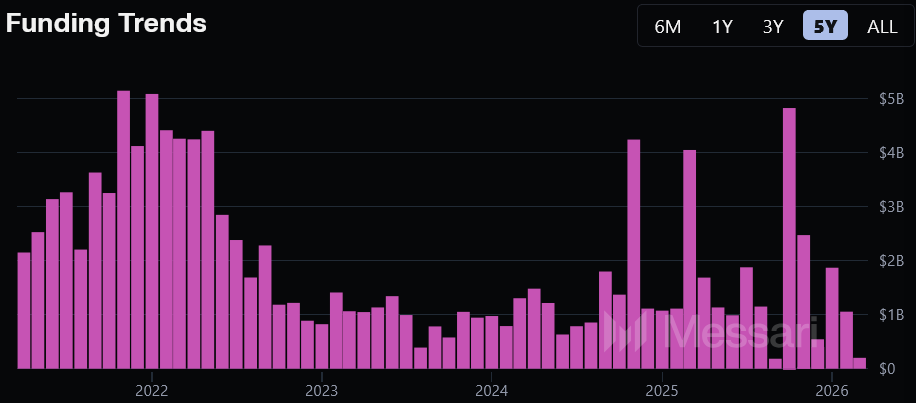
    Crypto fundraising increased by almost 50% year-on-year between March 2025 and March 2026, despite the number of deals dropping 46% as VCs concentrated bets on late-stage and strategic mega-rounds.

    Messari’s crypto fundraising overview shared by the company’s CEO Eric Turner on Sunday shows that the average deal size increased to $34 million in the last 12 months, up 272% from a year earlier. This came as the number of active investors fell 34.5% to 3,225.

    “Capital concentration is heavily skewed by late-stage and strategic mega-rounds,” Messari said, noting that in February, just three fundraising events contributed 44% of the $795 million raised over the last month.

    This included Tether’s $200 million investment into online marketplace Whop; $75 million raised for sports-focused peer-to-peer prediction market Novig in a Series B funding round led by Pantera Capital; and ARQ, a Latin American fintech app focused on stablecoins that secured $70 million in Series B funding on Wednesday, led by Sequoia Capital.

    Monthly change in crypto fundraising over the last five years. Source: Messari

    The $795 million figure marks a 65.3% fall from the previous 30 days.

    Turner noted that, outside of Dragonfly Capital, no major VCs have closed new funding rounds lately, adding that “the industry needs some fresh capital.”

    Meanwhile, Coinbase Ventures, QUBIC Labs, and Somnia have been the most active crypto investors over the past three months, Messari data shows.

    Crypto funding nowhere near 2021-2022 levels

    Monthly crypto fundraising has cooled significantly since its peaks in November 2021 and May 2022, when funding consistently hit $4 billion per month.

    Since then, the $4 billion milestone has been reached only three times. Some investors have started to expand their focus toward the AI and high-performance computing sectors.

    Related: Kalshi, Polymarket eye $20B valuations in potential fundraising: WSJ

    While most crypto fundraising has focused on late-stage activity, Messari noted that early-stage fundraising “remains high in volume but fragmented.”

    Messari pointed out that Interstate’s $1.5 million funding round on Thursday came from more than 15 participants, ranging from firms like Bloccelerate VC to individual angel investors like Sergey Gorbunov.

    Magazine: What’s a ‘Network State’ and are there real-life examples? Big Questions

  • US Treasury Department Changes Its View on Cryptocurrencies: It Both Accepts and Warns!

    According to The Block, the U.S. Treasury Department acknowledged in a 32-page report submitted to Congress this month that while cryptocurrency mixers are an illegal money laundering method, they may also have legitimate privacy use cases.

    The report stated that some users might use mixers to protect sensitive information, such as personal asset information, corporate payment histories, and donation activities, on public blockchains.

    The report states: “Legitimate digital asset users can utilize mixing services to protect their financial privacy when transacting on public blockchains.”

    According to the ministry, if compliant, these services can provide useful data for investigations, including customer identities and off-chain transaction information.

    This situation marks a departure from the institution’s previous stance.

    This is because the US Treasury Department designated international crypto mixing platforms as money laundering hubs in 2023 and imposed sanctions on Tornado Cash in 2022.

    However, the agency stressed that mixers are still being used to launder criminal proceeds, and that this is a fundamental problem. According to Treasury data, North Korean hacker groups stole at least $2.8 billion worth of digital assets between January 2024 and September 2025 using mixers in money laundering processes.

    At this point, the ministry emphasized that those who engage in concealment activities must register with the Financial Crimes Enforcement Network (FinCEN) and as Money Services Enterprises (MSB).

    *This is not investment advice.

  • Top NFT Sales of the Week, Flying Tulip Takes Top Spot

    Top NFT Sales of the Week, Flying Tulip Takes Top Spot

    The $NFT sector has witnessed notable sales over the past 7 days. In this respect, the total $NFT transfers have hit the 591,222 mark, showing a 10.19% rise over the week. As per the data from CryptoSlam, Flying Tulip PUT, $XAI BRC-20 NFTs, and CyrusPosition have gained the top positions among the leading $NFT sales of the past week. The other names on the top-10 list include STRIKE_PERP_POSIT, 0xbb5…, Patrick Mahomes II, 1997 #94 Gengar-Holo PSA 10 Japanese Fossil Pokemon, and more.

    Flying Tulip PUT Claims Top Position among Leading Weekly $NFT Sales with $689,151

    At the top of the list of the top weekly $NFT sales is the Ethereum-based Flying Tulip PUT. Its #8196 $NFT was sold 6 days ago for a staggering $689,151. In addition to this, the Bitcoin blockchain-based $XAI BRC-20 NFTs collection’s $NFT “#13f87c…227i0” has become the 2nd top player among the $NFT sales, with its price reaching $595,716. This $NFT sale also took place six days ago.

    Following that, the BNB Chain-based Cyrus Position $NFT collection has taken the 3rd place among the week’s key sales. Its $NFT “#10002” has generated $64,400 in its sale 6 days ago. Subsequently, the Cardano-based $NFT collection “STRIKE_PERP_POSIT” is the 4th among the top $NFT sales. Its $NFT “#asset1akxe…” was sold three days ago for $51,204.

    Subsequently, the Base blockchain-based $NFT collection “0xbb5…” is the 5th on the list. Specifically, its $NFT “#5800” has earned $14,999 up to 11 hours ago. Additionally, the Panini blockchain-based Patrick Mahomes II collection has generated $10,015 in its $NFT sale that occurred six days ago. Moreover, the Solana-based “1997 #94gengar-Holo PSA….Pokemon” collection’s $NFT “DL4i7…R1jH6” has gained $5,972 in its sale.

    AI Goanna Bottoms List of Week’s Key $NFT Sales by Generating $1,238

    Moving on, CryptoSalm’s list of top weekly $NFT sales adds the Flow blockchain-based NBA Top Shot collection’s “#50706496” $NFT as the 8th name. The $NFT sale resulted in the earning of up to $5,500 3 days back. Additionally, Ronin blockchain-based Axie Infinity collection has made $3,821 via its $NFT “2149.” Furthermore, the Algorand-based AI Goanna $NFT collection’s “#445445646” $NFT was the 10th top $NFT sale of the week, with $1,238 generated through it.

  • Why Crypto Market Is Falling Today (March 8, 2026)

    Why Crypto Market Is Falling Today (March 8, 2026)

    Today, the total crypto market cap dropped, as the global world risk sentiment was weakened by macroeconomic uncertainty and geopolitical tensions. Bitcoin and the other top altcoins dropped with the conventional markets as investors responded to the equity volatility, interest-rate expectations and stronger U.S. dollar.

  • Binance Denies $1.7 Billion in Iran Sanctions Violations Amid US Senate Probe

    Binance Denies $1.7 Billion in Iran Sanctions Violations Amid US Senate Probe

    In brief

    • Binance denied violating Iran sanctions with more than $1.7 billion in transactions in a new letter to Senator Blumenthal.
    • The Senator opened an investigation into the firm following reporting that it had enabled $1.7 billion in transactions and 2,000 Iran-linked accounts on its platform.
    • The exchange previously pleaded guilty to U.S. anti-money laundering laws and violating sanctions in 2023.

    Leading crypto exchange Binance denied violating Iranian sanctions compliance in a letter sent in reply to U.S. Senator Richard Blumenthal (D-Conn), who recently launched a probe into the firm following media reports on purported violations.

    Blumenthal’s probe followed a Wall Street Journal report that alleged that Binance allowed $1.7 billion worth of transactions tied to Iranian entities and sanction-evading trades from Russia to occur on the platform. 

    “Binance takes its legal obligations seriously and shares your interest in the safety of its platform,” the exchange wrote in the letter. “The recent reporting on which your inquiry relies, however, is demonstrably false, unsupported by credible evidence, and defamatory in several material respects.” 

    The alleged infractions identified two Hong Kong-based partners, Hexa Whale and Blessed Trust, that allegedly facilitated sanctions-evading transactions and approximately 2,000 other accounts associated with Iranian entities, according to the Wall Street Journal reporting.

    But according to Binance, after law enforcement requests about those two firms, additional internal investigations led to offboarding of their accounts. 

    “After receiving the requests, Binance investigators initiated a comprehensive review to determine not only Binance’s exposure to the wallets implicated by the outreach, but any other Binance users with such exposure,” the firm said of its investigation into Hexa Whale. It offboarded the account in August 2025, it said. 

    A similar internal investigation followed for Blessed Trust, and once more led to the offboarding of the account in January 2026. 

    “Once again, Binance appropriately investigated and addressed these issues,” the exchange said.”

    In disputing the alleged reporting inaccuracies, Binance also backed its compliance processes, noting that it has “invested hundreds of millions of dollars in compliance infrastructure to build a strong compliance program,” which it said boasts more than 1,500 employees worldwide. 

    “Binance has a rigorous compliance program that is consistently growing stronger. When there is credible risk information, Binance investigates, mitigates, offboards accounts, and reports to appropriate authorities,” it wrote. “With respect to the matters described in the letter, that compliance process was, in fact, effective.” 

    The recent allegations against the firm come after it pleaded guilty to violating U.S. anti-money-laundering laws and sanctions requirements in 2023. At that time it agreed to pay $4.3 billion penalty, and its co-founder and former CEO Changpeng “CZ” Zhao was sentenced to four months in prison for his role.  

    Zhao was pardoned by President Donald Trump last October after serving his sentence in 2024.

    Daily Debrief Newsletter

    Start every day with the top news stories right now, plus original features, a podcast, videos and more.

  • CFO Gets Prison Time After Losing $35 Million of Company Money in Crypto Side Hustle

    CFO Gets Prison Time After Losing $35 Million of Company Money in Crypto Side Hustle

    In brief

    • A Washington man has been jailed for two years for diverting $35 million in company funds to a DeFi platform he operated.
    • Nevin Shetty was found guilty of wire fraud last November for secretly moving the funds to HighTower Treasury.
    • Following the Terra collapse, the value of the funds crashed to near zero, with the impact on Shetty’s employer causing it to lay off 60 people.

    A Washington man has been sentenced to two years in prison after diverting $35 million in funds from his former employer to his own DeFi platform—and losing nearly all of it.

    Nevin Shetty, 42, was found guilty of wire fraud last November for taking and misusing funds from the private software company at which he worked.

    Shetty, who drafted a “conservative” company investment policy, secretly moved $35 million in company funds to his side business HighTower Treasury, after being told in April 2022 that his role as CFO would end due to performance issues. Those funds were then invested in high-yield DeFi lending protocols that promised returns of 20% or more.

    Per the DOJ’s statement, Shetty planned to pay his employer a “comparatively small, fixed amount,” keeping the remainder of the returns for HighTower. Initially, the scheme paid off, earning some $133,000 in its first month for Shetty and his HighTower business partner.

    The wheels came off in May 2022, following the Terra collapse and the subsequent crypto winter, with Shetty’s HighTower crypto investments plummeting in value from $35 million to near zero.

    After confessing to colleagues at his employer, Shetty was fired from the company, which, according to trial judge Tana Lin, suffered “significant and severe effects” as a result of his theft, adding that his actions “almost put the company out of business.”

    Shetty’s two-year prison sentence is significantly lower than the nine years requested by the prosecution, which urged for “stern punishment” to reflect the “web of lies” and impact on the company, which was forced to lay off 60 people in order to adapt to the “massive loss” caused by his fraud.

    Shetty was ordered to pay $35,000,100 and will be placed on supervised release for three years after prison. Judge Lin also imposed a special condition blocking him from serving as an officer or director of a company without prior permission from the probation office.

    Daily Debrief Newsletter

    Start every day with the top news stories right now, plus original features, a podcast, videos and more.
  • South Korean Cryptocurrency Exchanges See Trading Volume Surge in 14 Altcoins – Here’s the List

    South Korean Cryptocurrency Exchanges See Trading Volume Surge in 14 Altcoins – Here’s the List

    Upbit and Bithumb, two of South Korea’s largest cryptocurrency exchanges, have seen significant increases in trading volume for some cryptocurrencies over the past 24 hours.

    When the spot market data from both exchanges are evaluated together, it is evident that there is significant trading activity, particularly in major cryptocurrencies such as $XRP, Bitcoin, and Ethereum, as well as some altcoins with smaller market capitalization.

    According to the data, South Korean investors were particularly active in $XRP transactions. $XRP was among the most prominent assets, with a total trading volume exceeding $130 million across two exchanges. Bitcoin and Ethereum also ranked high on the list with high trading volumes, while lesser-known altcoins like Sign, Kite, and Plume also saw significant trading activity.

    When Upbit and Bithumb data are combined, the top cryptocurrencies and their total trading volumes over the last 24 hours are as follows:

    1. $XRP – $131 million
    2. Bitcoin (BTC) – $105 million
    3. Ethereum (ETH) – $79 million
    4. Tether (USDT) – $85 million
    5. Sign (SIGN) – $61 million
    6. Kite (KITE) – $48 million
    7. Solana (SOL) – $27 million
    8. Plume (PLUME) – $25 million
    9. Dogecoin (DOGE) – $19 million
    10. Akash Network (AKT) – $21 million
    11. Steem (STEEM) – $20 million
    12. Sentient (SENT) – $13 million
    13. ChainBounty (BOUNTY) – $12 million
    14. Adventure Gold (AGLD) – $11 million
    15. Contentos (COS) – $13 million

    *This is not investment advice.