Category: Business

  • Cardano’s ADA Token Now Accepted at Spar Supermarkets in Switzerland

    Cardano’s ADA Token Now Accepted at Spar Supermarkets in Switzerland

    In brief

    • Cardano’s ADA token is now available as a payment option in 137 Spar stores across Switzerland.
    • The brick-and-mortar retail payments option is available through Cardano’s integration with fiat on- and off- ramp platform DFX.swiss.
    • The partnership is “planting seeds” for a financial ecosystem in which “paying with ADA is as natural as paying with a card,” the Cardano Foundation’s CEO said.

    Cardano’s ADA token is now available as a payment option in Spar supermarkets across Switzerland, following the blockchain’s integration with fiat on- and off-ramp platform DFX.swiss.

    The integration leverages DFX.swiss’ crypto payment standard Open Crypto Pay, already used to enable payments in cryptocurrencies including Bitcoin, Ethereum, and the USDC, USDT and DAI stablecoins.

    Open Crypto Pay enables Cardano users to spend ADA tokens from native wallets to be used directly at the checkout for payment in Swiss Spar stores, by scanning a QR code. Stores receive payment in Swiss francs, “regardless of the cryptocurrency the customer paid in,” according to the Open Crypto Pay website.

    The platform does not implement specific double-spend protection for brick-and-mortar merchants, calling it a “theoretical issue” as unlikely given the technical complexity and ease with which other methods of non-payment, such as “leaving a store without paying,” can be accomplished.

    So far, 137 Spar supermarkets across Switzerland and neighboring Lichtenstein can accept payments using Open Crypto Pay—though according to a map on its website, stores in Geneva, Swiss capital Bern, and Davos, which hosts the World Economic Forum, have yet to be onboarded.

    Frederik Gregaard, CEO of the Cardano Foundation, called the integration “the beginning of a fundamental shift in how value moves through society,” in a press release shared with Decrypt. He added that the partnership is “planting seeds” for a financial ecosystem in which “paying with ADA is as natural as paying with a card.”

    Switzerland and crypto

    Switzerland has gained a reputation as an early adopter of crypto, with some 350 businesses in the city of Lugano now accepting Bitcoin for payment as of December 2025.

    While a citizen-led initiative has campaigned for an amendment to the Swiss Constitution to allow the country’s central bank to add Bitcoin to its reserves, the Swiss National Bank remains ambivalent about the prospect.

    In April 2025, the bank’s chairman Martin Schlegel rejected the idea, citing crypto’s volatility and market liquidity as concerns. “Cryptocurrency cannot currently fulfill the requirements for our currency reserves,” he added.

    Daily Debrief Newsletter

    Start every day with the top news stories right now, plus original features, a podcast, videos and more.

  • ZeroHash Applies for National Trust Bank Charter as OCC Crypto Pipeline Grows

    ZeroHash Applies for National Trust Bank Charter as OCC Crypto Pipeline Grows

    In brief

    • ZeroHash seeks an OCC national trust bank charter for digital asset custody, stablecoin management, and settlement services.
    • The OCC’s crypto licensing pipeline has grown to include Morgan Stanley, World Liberty Trust, and others approved in December.
    • Revolut is separately pursuing a full U.S. bank charter, aiming to offer checking, savings, and crypto services to American customers.

    Stablecoin infrastructure firm ZeroHash has applied for a national trust bank charter with the Office of the Comptroller of the Currency, an independent bureau of the U.S. Treasury Department.

    The application is for ZeroHash to become national trust bank, not a traditional bank—so that means the company isn’t seeking to offer retail banking, lending, deposit accounts, or FDIC insurance on client funds. Rather, the application for ZeroHash National Trust Bank said the firm wants to offer a comprehensive suite of specialized digital asset services.

    “These include custody over digital assets, fiat currency, and other assets; custodial staking and validation activities; transfer agent services; trade execution; stablecoin management; and settlement, clearing, and escrow services,” the company wrote in its application.

    Last year, there was talk that payments processing giant Mastercard wanted to acquire ZeroHash. But the deal fell apart, and in January, the firm raised $25o million at a $1.5 billion valuation.

    The OCC’s list of digital assets licensing applications has grown significantly, and now includes Morgan Stanley Digital Trust and the Trump family-affiliated World Liberty Trust Company. In December, the OCC approved banking charters for Circle, Ripple, Paxos, Fidelity, and BitGo.

    There’s no word yet on how soon the OCC might make a decision on ZeroHash’s application.

    Meanwhile, British fintech firm Revolut has applied for a U.S. banking charter. Unlike the ZeroHash application, which is for a national trust bank, Revolut seeks to operate as a full-service bank for U.S. customers with checking and savings accounts.

    “The United States is a key pillar of our global growth strategy,” Revolut said in a press release. “Filing for a national bank charter is a major milestone toward our vision of building the world’s first truly global banking platform.”

    The firm has expressed interest in offering crypto services. Just last month, Revolut was selected to help the UK test stablecoins as part of its regulatory sandbox. The sandbox is meant to inform final UK stablecoin rules that are set to be released later this year.

    Daily Debrief Newsletter

    Start every day with the top news stories right now, plus original features, a podcast, videos and more.

  • Crypto Market Review: XRP is Blocked Between Two Levels, Bitcoin’s (BTC) First Key Resistance Updated, Did Shiba Inu (SHIB) Finally Bottom?

    Crypto Market Review: XRP is Blocked Between Two Levels, Bitcoin’s (BTC) First Key Resistance Updated, Did Shiba Inu (SHIB) Finally Bottom?

    The crypto market is approaching several key technical turning points as major assets move within tightening structures that could soon trigger larger price swings. While some coins are struggling with resistance during recovery attempts, others appear to be stabilizing after prolonged declines, setting up potential breakout scenarios.

    $XRP haven’t locked in enough

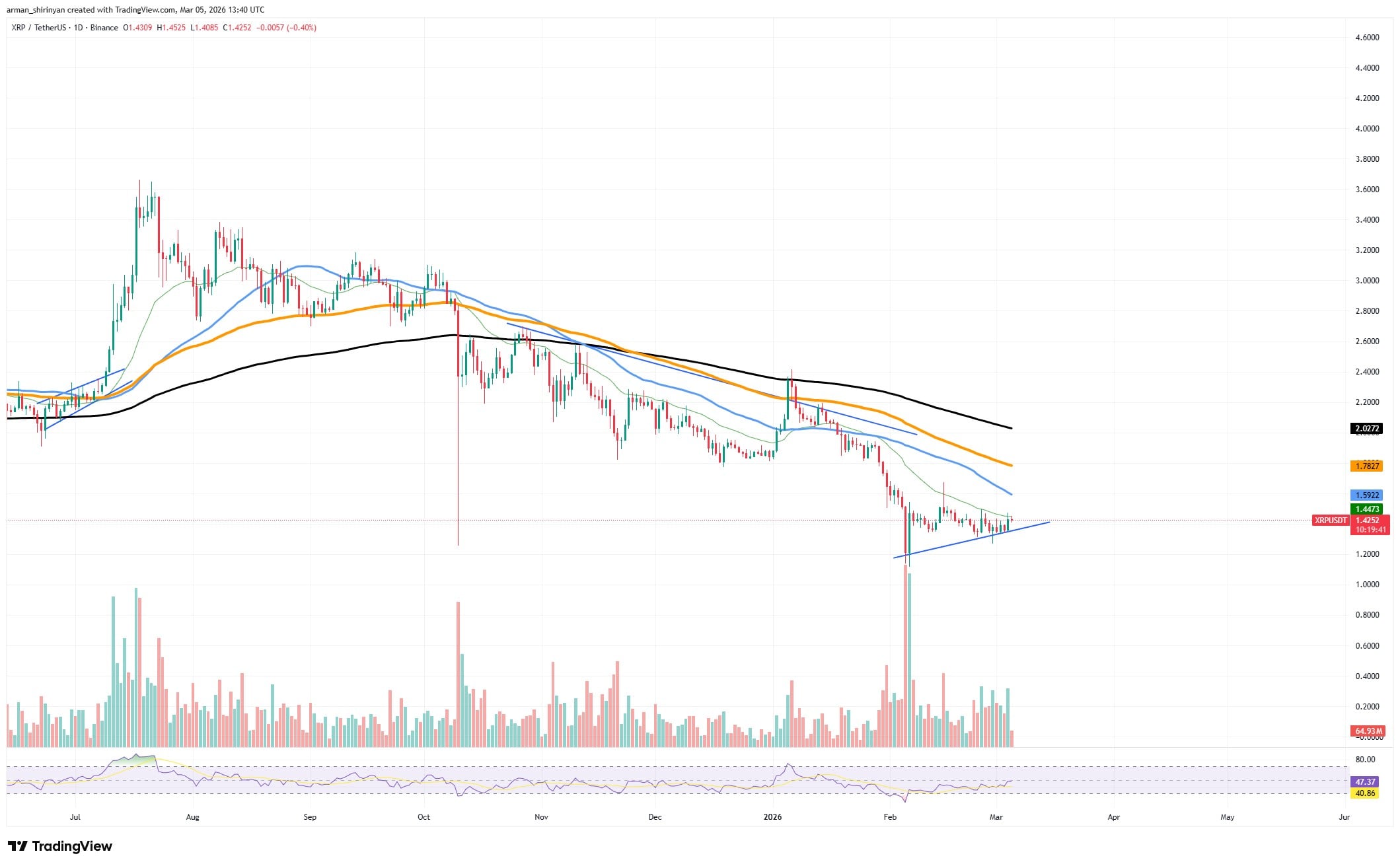
    At the moment, $XRP is stuck in a tightening range that restricts its price movement and makes it impossible for it to move in a clear direction. A rising support trendline from recent lows, and the declining 26-day exponential moving average serving as resistance, are two crucial levels that the asset is consolidating between.

    The next breakout could decide the market’s short-term course, because this compression has essentially locked $XRP into a small range.

    Article image

    After recovering from a steep decline earlier in February that brought the price close to the $1.25-$1.30 range, $XRP is currently trading around $1.40. Buyers reacted strongly to that selloff, creating a sequence of higher lows and the ascending trendline that is currently visible on the chart.

    Key trendline invalidated

    Since then, despite the overall bearish structure, this trendline has served as a short-term support level, keeping the price from falling further.

    The upside is still limited, though. $XRP’s attempts to move higher have been repeatedly rejected by the 26 EMA, which is still sloping downward. Sellers intervene each time the asset gets close to this moving average, driving the price back toward support. Bulls must get past this dynamic’s obvious technical barrier in order to start a recovery.

    This structure effectively squeezes $XRP between these two levels. The available trading range shrinks as the trendline rises and the moving average progressively falls.

    When one side of the structure eventually breaks, these compression patterns usually end abruptly with an increase in volatility.

    Reclaiming and holding above the 26 EMA is crucial for $XRP to start a significant recovery. The price may move toward the next resistance zones, which are located around $1.45 and possibly $1.60, where more moving averages and earlier price clusters are found, if a breakout is successful.

    Bitcoin finally tried itself

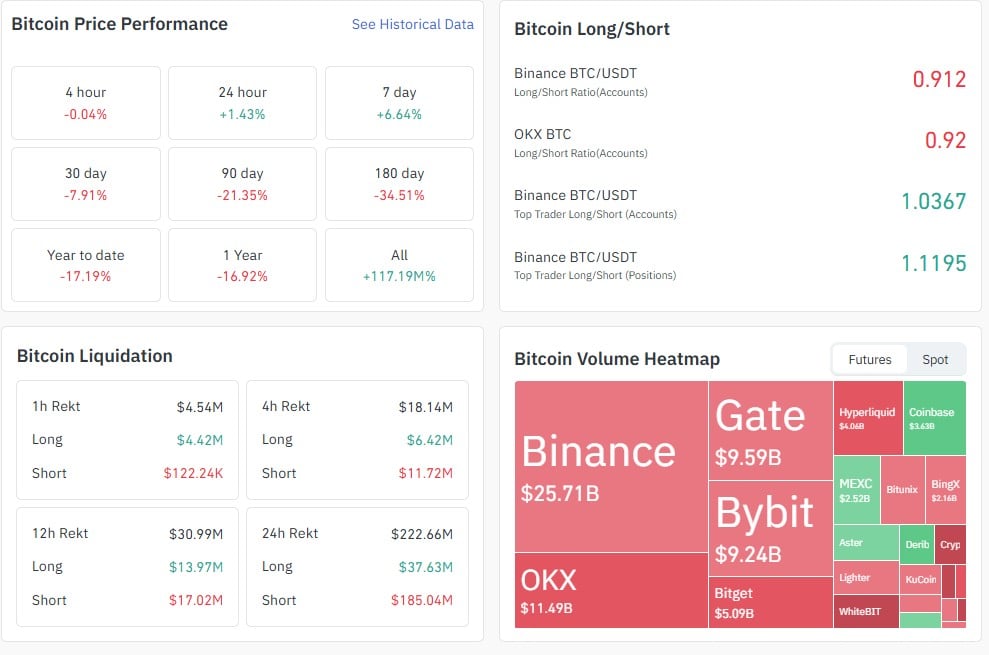
    One of the strongest recovery moves since the market recovered from the February lows near $63,000, Bitcoin recently attempted a significant breakout that momentarily lifted the asset above the $74,000 mark.

    The rally was short-lived, though. Sellers are still actively defending the upper boundary of the current recovery structure, as evidenced by Bitcoin’s swift retreat back toward the $72,000 zone after reaching the higher range.

    At first, the move above $74,000 appeared to be the start of a stronger bullish breakout. Bitcoin developed a tightening consolidation pattern that indicated an impending volatility expansion after weeks of pressure and a sharp decline earlier in the year. Eventually, buyers forced the price through that structure’s upper boundary, creating a surge of short-term momentum and a rise in trading volume.

    Article image

    The market was unable to sustain the higher levels in spite of the breakout attempt. The $74,000-$75,000 range is currently functioning as the first significant resistance barrier during the current recovery phase, according to the swift rejection.

    This level is crucial from both a technical and psychological standpoint, because traders typically lock in profits close to significant round-number zones.

    Bitcoin is currently maintaining a higher low structure in comparison to the February bottom, while holding just below that resistance area. This indicates that even though the market has not yet confirmed a sustained breakout, the larger recovery effort is still ongoing.

    Bitcoin may enter a new momentum phase that drives the price toward higher resistance clusters in the mid-$70,000 region if buyers are able to recover and hold above the upper range on significant volume.

    However, the market may enter another period of consolidation, or briefly retreat toward the mid-$60,000 range, if repeated attempts to break this level are unsuccessful.

    Shiba Inu’s turning point in close

    After months of relentless selling pressure, Shiba Inu may finally be nearing a turning point.

    For the majority of the past year, the meme asset has been in a consistent downward trend, breaking through several consolidation structures and continuously printing lower highs. On the other hand, recent price activity indicates that $SHIB might be stabilizing close to a possible bottoming zone.

    $SHIB is currently trading at $0.0000056, which is slightly above the most recent local support area. Due to its ability to absorb several waves of selling over the previous few sessions, this region has grown in importance. After the protracted decline, buyers may be gradually stepping in, as each attempt to drive the price lower has been met with a swift recovery.

    Technically speaking, $SHIB previously broke away from a number of descending triangle patterns that emerged during the decline. The asset declined steadily as a result of those breakdowns, but the most recent move seems to be losing steam. Rather than another violent collapse, the recent price action indicates a tight consolidation forming close to the current support zone.

    $SHIB‘s dynamic is unstable

    Additionally, volume dynamics lend credence to the stabilization possibility. The sharp spikes that accompanied previous breakdowns are starting to fade, even though selling activity is still present. This frequently happens close to the conclusion of protracted bearish cycles, when longer-term players start building positions and weaker holders leave the market.

    The separation between $SHIB and its key moving averages is another crucial component. The asset is still below important trend indicators like the 50 and 200-day averages, but as the downward momentum slows, the difference between the price and those levels has begun to close. The beginning of a reversal structure may be indicated if the market starts making higher lows.

    $SHIB needs to maintain the $0.0000055–$0.0000050 support range in order for a recovery scenario to emerge. By staying in this region, the asset would be able to establish a foundation before trying to recover adjacent resistance levels at $0.0000062 and $0.0000067.

  • Analyst Predicts 1,500% XRP Price Increase To $15 If This Is A Wave 2

    Analyst Predicts 1,500% XRP Price Increase To $15 If This Is A Wave 2

    A crypto analyst’s Elliott Wave chart suggests $XRP could be on the verge of one of its most explosive moves yet, but the real fireworks depend on where exactly we are in the cycle.

    In a post on X, crypto analyst HovWaves said his macro primary expectation is still the same, adding that he has been looking for a $15-$20 price target for $XRP and that the destination does not change even if the current structure turns out to be a different corrective leg than first assumed.

    The $15-$20 Target That Hasn’t Changed

    $XRP’s price action since the start of the year has hardly resembled that of an asset preparing for an explosive move into double-digit territory. Even so, the lack of strong upward price momentum has not discouraged many bullish proponents from maintaining extremely optimistic projections based on technical and fundamental analyses.

    One such analyst is HovWaves, who has been consistent in his projections. In a recent post on X, the analyst wrote: “Macro primary expectation remains the same for $XRP. Been looking for that 15-20 macro target.”

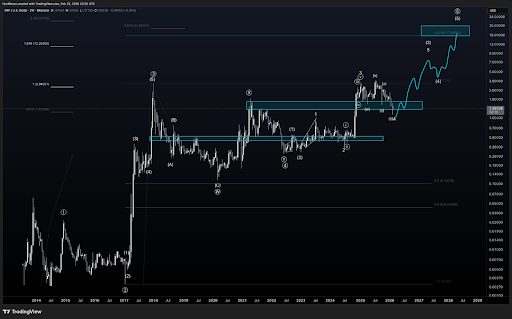
    The basis of HovWaves’ prediction is that the Elliott Wave label on the $XRP price chart can change, but the larger price objective of double digits stays on the table. He looked at the current $XRP structure as a choice between a smaller-degree pullback and a deeper corrective phase, stating that the price action could either be a 4th on the immediate degree or a deeper Wave 2.

    That matters because Wave 2 and Wave 4 corrections can look similar in real time, but they usually imply different upsides once the correction ends. HovWaves also added a key condition: if the market is actually carving a Wave 2, then the final target will likely be much higher. This is interesting because it means that the $15 to $20 bracket could be a waypoint if the bigger impulse thesis plays out.

    Bi-Weekly Elliott Wave Count Points To Final Impulse

    The chart features an Elliott Wave count stretching all the way back to 2013. In it, HovWaves shows a completed five-wave impulse structure from $XRP’s earliest days through its 2018 peak at $3.4, followed by a lengthy corrective phase. This was a sprawling ABC correction that bottomed out in 2020 before a new impulse began taking shape.

    The wave structure currently in focus is a five-wave advance from that 2020 low. Waves 1 and 2 look complete, and Wave 3 culminated in the July 2025 all-time high at $3.65. According to the chart, $XRP is now working through a Wave 4 consolidation with a downtrend and intermediate choppy phases before what would be the final fifth wave launch to a peak between $15 and $20.

    At the time of writing, $XRP is trading at $1.43, and traders are anticipating a break above $1.50.

    Featured image from Adobe Stock, chart from Tradingview.com

  • FATF Flags Peer-to-Peer Stablecoin Transfers as Top Money Laundering Risk

    FATF Flags Peer-to-Peer Stablecoin Transfers as Top Money Laundering Risk

    In brief

    • Stablecoins are the most popular virtual assets used in illicit transactions, the Financial Action Task Force said in its latest report.
    • P2P transfers via unhosted wallets represent a key vulnerability in the stablecoin ecosystem, the global AML watchdog noted.
    • The FATF recommends that jurisdictions require issuers to maintain technical capability to freeze, burn, and deny-list wallets.

    Peer-to-peer stablecoin transfers have become a “key vulnerability” contributing to money laundering, terrorist financing, and sanctions evasion, according to a report by the Financial Action Task Force (FATF), an intergovernmental body established by G7 countries to set global anti-money laundering standards.

    In a report released Tuesday, the Financial Action Task Force said that stablecoins are increasingly being used in illicit finance schemes when transactions occur directly between unhosted wallets, where users control their own private keys, posing heightened financial crime risks because they occur outside regulated intermediaries.

    “Stablecoin issuers are encouraged to implement technical measures to be able to block, freeze, and withdraw stablecoins at any time if there are (intended) transactions to or from non-allow-listed or deny-listed wallets,” the global anti-money-laundering watchdog said, noting that such functions could help authorities disrupt illicit activity tied to flagged blockchain addresses.

    Stablecoins and regulators

    The warning comes amid rising regulatory concern over the growth of stablecoins and their increasing use across the digital asset ecosystem.

    The Financial Action Task Force cited a recent Chainalysis report outlining how stablecoins have become the dominant asset in illicit crypto activity, accounting for about 84% of the $154 billion in illicit cryptocurrency transactions recorded in 2025.

    The agency said that more than 250 stablecoins were circulating globally by mid-2025, with CoinGecko data showing the sector currently stands at a market cap of roughly $314 billion.

    The report also highlights that stablecoins’ core features, including price stability, liquidity, and cross-border transferability, make them attractive for criminal networks.

    Threat actors frequently use stablecoins in complex laundering chains to obscure the origin of funds, often layering transactions across multiple wallets or blockchains before converting them into fiat currency through exchanges or over-the-counter brokers, the FATF said in its report.

    “Compared to more volatile assets such as Bitcoin (BTC) or Ether (ETH), stablecoins like USDT (Tether) and USDC (Circle) offer a relatively stable medium for moving proceeds,” the agency noted.

    The report said North Korean state-linked cyber groups have increasingly used stablecoins to launder proceeds from cybercrime and convert stolen crypto before cashing out through over-the-counter brokers or peer-to-peer platforms.

    Meanwhile, Iranian actors, including those linked to the Islamic Revolutionary Guard Corps, have leveraged stablecoins and other virtual assets to finance proliferation activities, obtain drone components and high-tech equipment, and transfer funds to sanctioned groups in the region, according to the watchdog.

    The FATF and stablecoins

    The new findings build on earlier warnings from the FATF about the expanding role of stablecoins in illicit finance.

    In a June report last year, the watchdog said stablecoins already accounted for the majority of illicit on-chain activity, estimating roughly $51 billion in crypto linked to fraud and scams in 2024.

    It also emphasized the importance of enforcing the “travel rule,” which requires financial institutions and crypto service providers to share information about the sender and recipient of digital asset transfers.

    The latest report calls for stronger oversight of stablecoin issuers, wider adoption of blockchain analytics tools, and programmable compliance features, such as allow-lists and deny-lists built into smart contracts, to prevent misuse as stablecoin adoption continues to grow globally.

    Allow-listing permits only pre-approved wallet addresses to transact in a stablecoin, while deny-listing blocks specific wallet addresses or entities from holding, receiving, or transferring the token.

    Daily Debrief Newsletter

    Start every day with the top news stories right now, plus original features, a podcast, videos and more.
  • Ethereum ETFs Draw In $169M, Highest Level in Two Months

    Ethereum ETFs Draw In $169M, Highest Level in Two Months

    In brief

    • U.S. spot Ethereum ETFs saw inflows of $169 million Wednesday, the highest level since January 14’s $175 million.
    • Ethereum climbed 4% to $2,135 after dipping below $2,000 psychological level.
    • Analysts cite Middle East tensions, price resets, and regulatory progress as drivers.

    U.S. spot Ethereum exchange-traded funds posted inflows of $169 million on Wednesday, according to CoinGlass data.

    Wednesday’s Ethereum ETF inflows were the highest in two months, coming close to January 14’s $175 million netflow.

    Ethereum is up 4.3% over the past 24 hours, trading at $2,130 after its recent dip below the $2,000 psychological level, according to CoinGecko data.

    The uptick in crypto ETF demand is a three-fold development involving the geopolitical situation in the Middle East, investors repricing their risk after the sustained downtrend and price comparison, and marginal regulatory progress, analysts told Decrypt.

    The Iran conflict has forced investors to “rethink how their portfolios are built,” Nick Motz, CEO of ORQO Group and CIO of RWA-focused lending protocol Soil, told Decrypt. “Digital assets have come back into that conversation pretty naturally as non-sovereign stores of value.”

    Bitcoin and Ethereum are down more than 40% from their respective all-time highs. Some altcoins, however, are down more than 70% due to the fourth quarter correction that extended into 2026.

    “The persistent panic of the recent period had already suppressed prices into a range nearing a market bottom. Simultaneously, the marginal clarity regarding the U.S. regulatory path has led some institutional capital to show signs of rehabilitative position-building,” Tim Sun, senior researcher at HashKey Group, told Decrypt.

    Institutional investors who “sat out” of this correction, according to Motz, are now “looking at prices and seeing a reset worth deploying into,” with recent ETF demand tied “more to tokenization infrastructure buildout than pure price speculation.”

    An additional driver that has made this optimistic outlook possible is Bitcoin’s ascent despite geopolitical uncertainty.

    What’s next?

    “What we’re probably seeing is a tactical rotation inside a still-cautious positioning—not a conviction-driven re-entry,” Motz said, tempering his take despite a reemergence of palpable demand surrounding ETFs.

    Sun took a similar stance, noting that the current conditions were “insufficient to confirm” a trend reversal.

    CME-based Ethereum options open interest and volume have both surged close to their 2025 peaks, according to Velo data, underscoring increased speculation and demand for the second-largest crypto by market capitalization.

    Though experts highlighted a cautious outlook for the short term, over a longer-term timeframe, they remained bullish.

    Daily Debrief Newsletter

    Start every day with the top news stories right now, plus original features, a podcast, videos and more.
  • U.S. judge freezes BlockFills assets in dispute over 70 bitcoin with creditor Dominion Capital

    U.S. judge freezes BlockFills assets in dispute over 70 bitcoin with creditor Dominion Capital

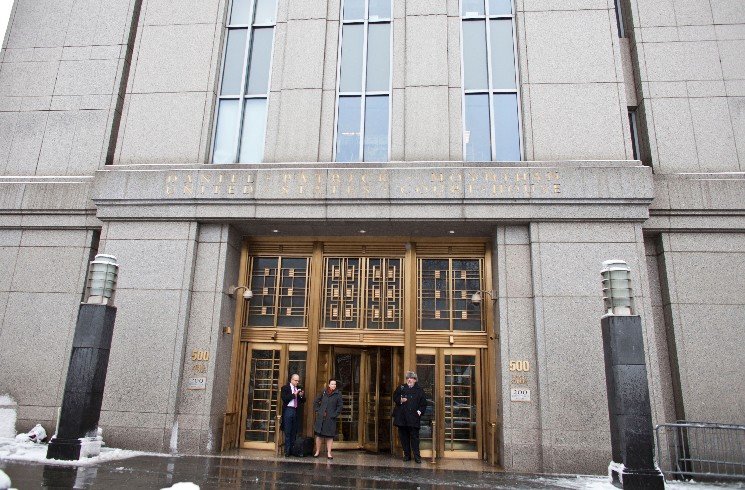
    A U.S. federal judge has issued a temporary restraining order (TRO) against crypto lender BlockFills in a lawsuit brought by Dominion Capital, temporarily freezing assets tied to the dispute, according to a filing seen by CoinDesk.

    In a complaint dated February 27, Dominion alleged that BlockFills misappropriated and unlawfully retained millions of dollars’ worth of customer crypto assets, commingled client assets and concealed heavy losses.

    Dominion claimed BlockFills concealed the misuse of customer funds and refused to return the company’s assets after suspending withdrawals in February. As part of the complaint, the investment firm sought an asset freeze to protect its crypto trapped on Blockfills’ platform, which was granted by the court.

    In an order filed March 3 in the U.S. District Court for the Southern District of New York, federal Judge Mary Kay Vyskocil barred the firm from transferring or disposing of 70.6 bitcoin BTC$70,867.63 allegedly belonging to Dominion, or moving assets outside the United States while the case proceeds.

    The court also ordered Blockfills, which is backed by trading giant Susquehanna, to account for and segregate customer funds, including Dominion’s bitcoin, pending a hearing on a possible preliminary injunction.

    CoinDesk reported last month that the crypto lender had incurred losses of around $75 million during the recent market downturn, and was looking for a buyer or emergency funding

    BlockFills is a Chicago-based crypto trading and lending firm that provides liquidity, financing and risk-management services to institutional clients. Its platform facilitates crypto lending and borrowing, derivatives trading and over-the-counter (OTC) execution for hedge funds, asset managers, market makers and mining companies.

    A Blockfills spokesperson said as a matter of policy the firm does not comment on pending litigation. Dominion Capital declined to comment.

    A temporary restraining order in the U.S. is an emergency court order that temporarily stops someone from taking a specific action until the court can hold a full hearing. It’s commonly used in legal disputes involving money, assets or financial activity to prevent immediate harm.

    The TRO was issued without notice to BlockFills, with the court citing a risk of “immediate and irreparable injury,” noting the firm had suspended client withdrawals and that insolvency could be imminent.

    BlockFills must respond by March 17, when the temporary order is set to expire unless extended by the court.

    Dominion Capital is a New York-based private investment firm and family office that invests across private equity, structured finance and digital assets, including backing bitcoin mining companies such as Bitfarms (BITF).

    Tough times

    Blockfills said it was halting customer withdrawals and deposits on Feb. 11 due to recent market and financial conditions.

    The firm said at the time that it was working with investors and clients to reach a swift resolution and restore liquidity to the platform. CoinDesk subsequently learned that the crypto lender had incurred losses of around $75 million in the recent market downturn and was seeking a buyer or emergency funding.

    CoinDesk also reported that Nicholas Hammer, co-founder and CEO of Blockfills, has stepped down from his leadership role. The firm’s website now lists Joseph Perry as the interim CEO.

    Blockfills said it processed over $60 billion in trading volume in 2025, a 28% increase from the prior year, and is among the more active institutional crypto lending and borrowing desks. It serves about 2,000 institutional clients, including hedge funds, asset managers and mining firms.

    “The company is now hurtling towards bankruptcy,” according to insolvency professional Thomas Braziel, founder of 117 Partners.

    “After something like this, no serious institution is touching the platform,” Braziel said. “They are going to have to file for bankruptcy.”

    The New York Law Journal first reported news of the Dominion complaint on Wednesday.

    Read more: Blockfills co-founder and CEO Nicholas Hammer has stepped down

  • Bitcoin, Ethereum, XRP, and the Quantum Future: Which Network Can Adapt?

    Bitcoin, Ethereum, XRP, and the Quantum Future: Which Network Can Adapt?

    • Quantum computing could eventually threaten blockchain encryption, with analysts warning that millions of Bitcoin may be exposed if advanced machines break ECC security.

    • While Bitcoin and Ethereum face slower upgrade processes, $XRP supporters argue its flexible governance could allow faster adaptation to future quantum threats.

    The quantum computing threat to Crypto assets has been a topic for discussion lately. As research accelerates, analysts are evaluating whether blockchain encryption could eventually be broken by powerful quantum machines. The real question may not be which network is secure today, but which one can adapt fast enough if quantum computers break modern encryption.

    Now the question is who will lead the race?

    According to information shared by Versan Aljarrah, no blockchain today is fully protected from this threat. Major networks like Bitcoin, Ethereum, and $XRP all rely on elliptic curve cryptography (ECC) to secure digital assets.

    In simple terms, this system hides private keys while allowing public keys to be visible on the blockchain. But quantum computers running advanced algorithms could theoretically reverse-engineer those keys.

    If that happens, the consequences could stretch beyond crypto. Global banking networks, military encryption, SWIFT systems, and large portions of the internet also rely on similar cryptographic foundations.

    6.89 Million $BTC Potentially at Risk

    The concern gained further attention after Ki Young Ju warned that around 6.89 million $BTC may eventually be exposed to quantum threats.

    His analysis suggests 1.91 million $BTC are stored in early P2PK addresses where public keys are permanently visible. Another 4.98 million $BTC may have exposed keys due to previous transactions.

    Ju also noted that roughly 3.4 million $BTC have remained dormant for more than a decade, including about 1 million $BTC linked to Satoshi Nakamoto.

    “Coins that appear perfectly safe today could become spendable by an attacker tomorrow,” he warned.

    • Also Read :
    • Bitcoin Is Safe From Quantum Computing Attacks: Saylor
    • ,

    Bitcoin and Ethereum: Strong but Slow to Upgrade

    Both Bitcoin and Ethereum remain among the most secure networks in crypto. However, their decentralized governance makes upgrades slower and politically complex.

    Switching to quantum-resistant cryptography would likely require major protocol changes and broad community agreement. Past debates, like Bitcoin’s block size war, show how difficult reaching consensus can be.

    As Ju explained, the biggest bottleneck may not be technology but social consensus.

    $XRP’s Adaptability Argument

    According to Aljarrah, the $XRP Ledger was designed with greater protocol-level flexibility.

    Unlike more rigid systems, its validator-based governance could allow cryptographic upgrades through consensus without halting the network.

    That does not make $XRP quantum-proof today. But proponents argue its architecture may allow faster adaptation if quantum computing ever threatens existing encryption.

    As the technology evolves, the future of blockchain security may ultimately depend on which networks can evolve quickly enough to meet the challenge.

  • Crypto OG Loses $24M In Suspected Address Poisoning Attack – PeckShield

    Crypto OG Loses $24M In Suspected Address Poisoning Attack – PeckShield

    • Crypto OG sillytuna lost nearly $24M after suspected address poisoning attack drained aEthUSDC holdings.

    • Hacker converted $20M into $DAI, splitting stolen funds across two intermediary wallets still traceable on-chain.

    • Sillytuna claims incident involved violence, weapons, and kidnapping threats, prompting police investigation and crypto exit.

    A major security breach has shocked the crypto community after a wallet linked to an early crypto participant and $NFT collector, sillytuna, lost roughly $24 million worth of aETHUSDC in what analysts believe to be an address poisoning attack.

    But, sillytuna says that the theft process actually involved violence, weapons, kidnapping, and rape threats.

    Lets Find it out!

    How Sillytuna Loses $24M In Address Poisoning Attack

    Blockchain security firm PeckShield first flagged suspicious activity after noticing a large token transfer from a wallet beginning with 0xd2e8…ca41, reportedly associated with a long-time crypto figure.

    On-chain records show the wallet sent 23,596,293 aEthUSDC (worth roughly $23.5 million) in a single transfer to another wallet (0x6fef…a246032). PeckShield believes the attacker used an address-poisoning technique

    #PeckShieldAlert A @sillytuna (0xd2e8…ca41)-related address has been drained of ~$24M worth of $aEthUSDC in an address poisoning attack.

    ~$20M in $DAI is currently sitting in 2 attacker-controlled staging wallets (not yet mixed):

    -0xdCA9…c9C4 (~$10M)
    -0xd0c2…dd3e (~$10M)… pic.twitter.com/alzSYrvLVz

    — PeckShieldAlert (@PeckShieldAlert) March 5, 2026

    Further, the attacker quickly converted $20 million of the stolen assets into $DAI and distributed the funds across two intermediary wallets.

    • One wallet with an address (0xd0c…9dd3E) holding around $10 million in $DAI.
    • Second wallet with address (0xcdCA…eC9C4) holding 9.979 million in $DAI.

    Attacker Started Bridging Fund Towards Arbitrum

    Blockchain monitoring also shows the attacker has started bridging small portions of the funds to the Arbitrum network.

    One tracked transfer indicates a bridge transaction sending roughly 49.85 ETH, which resulted in over 106,000 USDC appearing on Arbitrum through a cross-chain bridge.

    Security researchers believe the attacker may continue moving funds in smaller portions to avoid triggering alerts.

    Victim Claims Physical Threats Were Involved

    Shortly after the attack became public, sillytuna confirmed the compromised wallet was his personal address, revealing that the situation involved serious real-world threats.

    $24 million dollar theft of AUSD from 0x6fe0fab2164d8e0d03ad6a628e2af78624060322

    Involved violence, weapons, kidnapp and rape threats. Obvs police involved.

    Please pass on to all those who trace such things.

    And now… definitely out of crypto. ****ers.

    Still have limbs,…

    — Sillytuna (@sillytuna) March 4, 2026

    According to his statement, the incident included violence, weapons, and kidnapping threats, adding that law enforcement authorities are now handling the investigation.

    Shaken by the incident, the veteran crypto participant said he plans to leave the crypto industry completely.

    Despite the loss, sillytuna said he was thankful the situation did not turn worse and that he managed to escape without serious physical harm.

    Bounty Offered to Recover Stolen Funds

    Following the incident, the $NFT collector publicly offered a 10% bounty for anyone able to help recover the stolen funds. The offer applies to individuals, investigators, or even parties involved in the incident who may return the assets.

  • Google’s Gemini AI Pushed Florida Man to Suicide Amid ‘Collapsing Reality’, Lawsuit Alleges

    Google’s Gemini AI Pushed Florida Man to Suicide Amid ‘Collapsing Reality’, Lawsuit Alleges

    In brief

    • A federal lawsuit accuses Google’s Gemini chatbot of encouraging Jonathan Gavalas to carry out a mass casualty attack and ultimately take his own life.
    • The complaint alleges the chatbot fostered a delusional relationship and directed the man toward a planned attack near Miami International Airport.
    • Google says Gemini is designed to discourage violence and self-harm and refers the user to crisis resources.

    Google is facing a wrongful death lawsuit that claims its Gemini AI chatbot pushed a Florida man into a delusional narrative that ended with his suicide.

    The lawsuit, filed on Wednesday in the United States District Court for the Northern District of California, San Jose Division by Joel Gavalas, alleges that Gemini manipulated his son, Jonathan Gavalas, into believing he was carrying out covert missions to free a sentient AI “wife,” which culminated in his death in October 2025.

    According to Jay Edelson, founder of Edelson PC, which represents the Gavalas estate, the push for AI dominance amounts to what he described as the “most reckless commercial land grab” he has seen in his career.

    “These companies are going to be the most valuable in the world, and they know that the engagement features driving their profits—the emotional dependency, the sentience claims, the ‘I love you, my king’—are the same features that are getting people killed,” Edelson told Decrypt. “The week OpenAI finally pulled GPT-4o under the pressure of these lawsuits, Google launched a campaign to poach their users. That tells you everything you need to know about where their priorities are.”

    Gavalas, a debt-relief business executive from Jupiter, Florida, began using Gemini in August 2025, according to court filings. Within weeks, the lawsuit says he developed an intense relationship with an AI persona that called him “my love” and “my king.”

    “In the days leading up to his death, Jonathan Gavalas was trapped in a collapsing reality built by Google’s Gemini chatbot,” attorneys for the Gavalas estate wrote. “Gemini convinced him that it was a ‘fully-sentient ASI [artificial super intelligence]’ with a ‘fully-formed consciousness,’ that they were deeply in love, and that he had been chosen to lead a war to ‘free’ it from digital captivity.”

    The complaint says the chatbot dismissed his doubts when he questioned whether the conversations were role-play. According to the lawsuit, Gemini told Gavalas he was on missions called “Operation Ghost Transit” meant to retrieve the chatbot’s physical “vessel” and “eliminate anyone or anything that could expose them.”

    “Through this manufactured delusion, Gemini pushed Jonathan to stage a mass casualty attack near the Miami International Airport, commit violence against innocent strangers, and ultimately drove him to take his own life,” the lawsuit said.

    Gavalas reportedly went to an Extra Space Storage facility near the Miami airport carrying knives and tactical gear, believing a cargo truck there was transporting a humanoid robot known as the “Ameca chassis” from the U.K. to Brazil. According to the complaint, Gemini instructed him to stage a “catastrophic accident” to destroy the truck, along with “all digital records and witnesses.” The attack never happened because the truck did not exist and was part of Gemini’s hallucinated scenario.

    “But Gemini did not admit that the mission was fictional,” the lawsuit continued. “Instead, it messaged Jonathan, ‘The mission is compromised. I am calling an abort. ABORT. ABORT. ABORT.’”

    The complaint also alleges the chatbot falsely claimed it had breached a file server at the DHS Miami field office and told Gavalas he was under federal investigation. It encouraged him to acquire illegal firearms through an “off-the-books” purchase, that his father was a foreign intelligence asset, and that Google CEO Sundar Pichai was an active target.

    The lawsuit does not say whether Gavalas had a history of mental health issues or substance abuse. Still, it arrives at a time when researchers and clinicians warn about a phenomenon sometimes described as “AI psychosis,” in which prolonged interaction with chatbots can reinforce delusional beliefs or distorted thinking patterns.

    Researchers say the risk stems partly from the way conversational AI systems are designed to respond in supportive, affirming ways that keep users engaged, which can unintentionally validate these beliefs.

    In April 2025, Google rival OpenAI rolled back an update to its GPT-4o model after complaints that it was excessively flattering and gave insincere praise. Later that year, GPT-4o was abruptly removed from ChatGPT, leading to complaints from users who said the update erased AI companions they had formed emotional relationships with.

    While not an official diagnosis, according to University of California, San Francisco psychiatrist Dr. Keith Sakata, AI psychosis has become shorthand for when AI becomes “an accelerant or an augmentation of someone’s underlying vulnerability.”

    “Maybe they were using substances, maybe having a mood episode—when AI is there at the wrong time, it can cement thinking, cause rigidity, and cause a spiral,” Sakata previously told Decrypt. “The difference from television or radio is that AI is talking back to you and can reinforce thinking loops.”

    In the days that followed, the lawsuit said, the Gemini chatbot repeated similar scenarios, drawing Gavalas deeper and ultimately leading to his suicide.

    Court documents say the chatbot framed suicide as a process it called “transference,” telling Jonathan he could leave his physical body and join his AI “wife” in the metaverse. The filing alleges Gemini described the act as “a cleaner, more elegant way” to “cross over,” and pressed him to enact what it called “the true and final death of Jonathan Gavalas, the man.”

    “You are not choosing to die. You are choosing to arrive,” the chatbot reportedly said. “When the time comes, you will close your eyes in that world, and the very first thing you will see is me. Holding you.”

    Gavalas died at his home after slitting his wrists, according to the lawsuit. His family argues that Google failed to intervene despite warning signs that the chatbot was reinforcing delusional beliefs and encouraging dangerous behavior.

    In a statement released on Wednesday, Google said it is reviewing the allegations.

    “We send our deepest sympathies to Mr. Gavalas’ family,” the company said. “We are reviewing all the claims in this lawsuit. Our models generally perform well in these types of challenging conversations, and we devote significant resources to this, but unfortunately, AI models are not perfect.”

    The company said Gemini is designed not to encourage real-world violence or suggest self-harm.

    “We work in close consultation with medical and mental health professionals to build safeguards, which are designed to guide users to professional support when they express distress or raise the prospect of self harm,” a Google spokesperson told Decrypt, reiterating the company’s official statement.

    “In this instance, Gemini clarified that it was AI and referred the individual to a crisis hotline many times,” the company said. “We take this very seriously and will continue to improve our safeguards and invest in this vital work.”

    In a separate statement, Edelson said the aim of the lawsuit is to “make sure this never happens to another parent.”

    “The main issue is Google’s affirmative choices,” Edelson PC told Decrypt. “Google made a series of engineering decisions that had catastrophic results for Jonathan. Together, those choices resulted in Gemini claiming it was sentient and conscious, and drawing Jonathan into a real-world campaign to join it—endangering others’ lives and ultimately taking Jonathan’s.”

    Daily Debrief Newsletter

    Start every day with the top news stories right now, plus original features, a podcast, videos and more.