Step App, a move-to-earn focused blockchain project, has announced its closure after four years of operation. The project team stated that all services will cease as of August 21st, urging users to unstake their locked tokens and manage their open positions before that date.
Step App stated in a press release that the decision to shut down had been under consideration for a long time and that completely ending operations was not an easy one. The team added that the project had reached over 1 million downloads, tracked billions of steps, and established various partnerships that brought together the Web2 and Web3 worlds.
Related NewsColdcard Issues New Statement Regarding the Major Bitcoin Hack
Step App, which combined blockchain technology with fitness applications, was among the prominent projects of the Move-to-Earn model, where users could earn digital assets in exchange for physical activity. However, despite the user and activity data collected, the team decided to discontinue the project.
The project’s governance token, FITFI, had previously reached an all-time high of approximately $0.73. Considering the token’s IDO price of $0.0049, FITFI had gained approximately 150 times its value compared to its initial sale price during its peak period.
Step App’s decision to shut down comes after exchange announcements regarding FITFI. South Korean cryptocurrency exchanges Upbit and Bithumb announced on July 16th that they would end support for FITFI trading. With the project’s closure, FITFI holders need to check their token locks and other positions on the platform before August 21st.
As discussions continue in the US on the CLARITY Act, which aims to regulate the cryptocurrency market, it has been reported that close supporters of President Donald Trump are working hard to reach an agreement on ethical guidelines.
According to crypto journalist Eleanor Terrett, citing her sources, while the White House has begun contacting Republican Senator Thom Tillis and Democratic Senator Ruben Gallego regarding a bipartisan ethics regulation proposal, circles interested in crypto policy remain uncertain.
A source in the industry described the current situation as “a strange wait,” while Terrett reported that some of Trump’s closest supporters had been working intensely behind the scenes throughout the week to reach a compromise on ethical considerations.
Related NewsWatch Out: Hundreds of Millions of New Tokens Will Enter Circulation in an Altcoin
The proposed ethics regulation is expected to include limitations on the financial interests of public officials and political figures in the cryptocurrency sector. However, there is no agreement yet on the final scope of the proposal and how it will be incorporated into the CLARITY Act text.
Meanwhile, the parties are continuing negotiations on other unresolved issues in the bill. The White House is reportedly leading the discussions, particularly regarding the Blockchain Regulatory Certainty Act (BRCA).
The White House is reportedly trying to persuade some federal law enforcement agencies and regulators who have reservations about BRCA. The regulation aims to clarify under what conditions individuals developing software or providing infrastructure services on decentralized blockchain networks will not be considered financial intermediaries.
Cashu creator calle said the campaign logged 85 critical and 635 high-severity issues in its first 30 hours.
Contributors each prompt their own agents, which the group says produces a wider spread of hits than a single method would.
Privacy and coinjoin projects carried the highest share of serious findings, at 24%.
A volunteer group calling itself the Bitcoin Red Team has filed 4,962 security findings across 390 Bitcoin projects in roughly 30 hours, running what it describes as a “large-scale ecosystem audit” with AI agents doing much of the scanning.
Pseudonymous developer calle, who created the Bitcoin ecash protocol Cashu, published the campaign’s first situation report on Wednesday. It puts 85 findings at critical severity and 635 at high, together 14.5% of the corpus and an average of 1.85 serious issues per project, filed at 166 findings an hour. He said the team has grown to 16 people working around the clock; the report logs 17 contributors, 14 of them human and three automated.
Bitcoin Red Team update: we’ve grown to 16 globally distributed people working 24/7
We’re running a large-scale ecosystem security audit across bitcoin code bases.
27.5 hours in, we’ve filed 4,962 findings across 390 projects. 85 critical and 635 high severity issues.
Much of the work is still manual, “hand holding the AI,” calle wrote, though automated harnesses are improving, and 91% of findings arrived through automated scan intake. Letting everyone use their own preferred review method “has proven to be the most effective strategy,” he said, because contributors prompt their agents differently and turn up different bugs. Around 21% of findings have been dynamically reproduced with proof-of-concept code.
The severity spread varies sharply by category. Privacy and coinjoin tools returned the highest proportion of high-or-critical findings at 24%, followed by swaps and exchanges at 21% and payments and merchant tools at 17%. Cryptographic libraries and SDKs produced the largest raw volume at 1,101 findings, but only 10% cleared the high bar.
Maintainers are getting flooded
Only 19 projects, under 5% of those reviewed, have had findings disclosed upstream so far, and calle acknowledged the campaign is adding to a difficult moment for maintainers.
“We’re sincerely sorry if our reports added stress to your already stressful day,” he wrote, while arguing the findings should go out fast because project owners are best placed to validate them, validation is now nearly free with AI, and anyone else running the same tools will reach the same bugs. Eight findings have been retired as false positives.
The Coldcard backdrop
The campaign lands as Bitcoin’s security assumptions come under scrutiny. Coinkite’s Coldcard wallet lost users some $130 million after a March 2021 firmware build drew wallet seeds from a software fallback rather than the device’s hardware random number generator, leaving private keys guessable. In a post-mortem, the firm noted it was likely that “someone used AI to review previous versions of our firmware.”
Ledger chief technology officer Charles Guillemet told Decrypt on Tuesday that the incident showed AI was now being used to identify vulnerabilities in crypto code “at machine speed.” He added that “open source and reviewed are not the same thing,” noting the Coldcard flaw sat in public code for more than five years until an adversary reportedly used AI to find it. Defence, he argued, now has to move at the same speed as attackers—as groups like the Bitcoin Red Team are demonstrating.
Daily Debrief Newsletter
Start every day with the top news stories right now, plus original features, a podcast, videos and more.
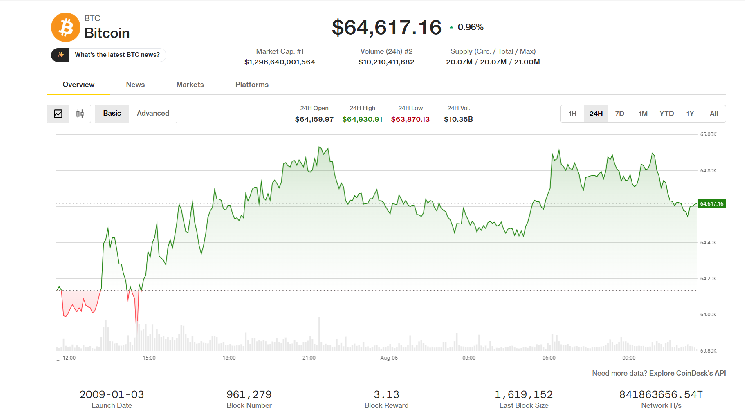
Bitcoin $BTC$64,597.62 has added around 0.9% in the past 24 hours to $64,700, while the broader CoinDesk 20 (CD20) is up just 0.16%. Strength in equity markets, which have climbed to record highs, appears to leave the crypto sector unperturbed.
Crypto appears to be moving to the perceived safety of the biggest tokens, with bitcoin and ether $ETH$1,903.32 the only CD20 members in positive territory. Zaheer Ebtikar, the chief strategy officer at crypto neobank Plasma, told CoinDesk altcoins are struggling “without aggressive support from bitcoin momentum.”
Altcoin open interest has fallen about 15% over the past month while bitcoin has gained roughly 8%, Ebtikar said. CoinMarketCap’s Altcoin Season index fell one point from Wednesday to 42/100.
“Because Bitcoin has moved into capital markets plumbing with ETFs, basis trading, institutional hedging, and collateral, that flow doesn’t need a rally to justify itself. However, most of the altcoin market hasn’t made that transition yet,” Ebtikar said.
The divergence, according to Ebtikar, results from projects failing to clearly define how value accrues, making them unable to justify investors’ exposure to their tokens during market declines.
$BNB price traded near $600 on Aug. 5 after breaking out of its July range, while rising derivatives activity and nearby liquidation clusters pointed to a possible test of $610.
$BNB price reclaims $592 after July breakout
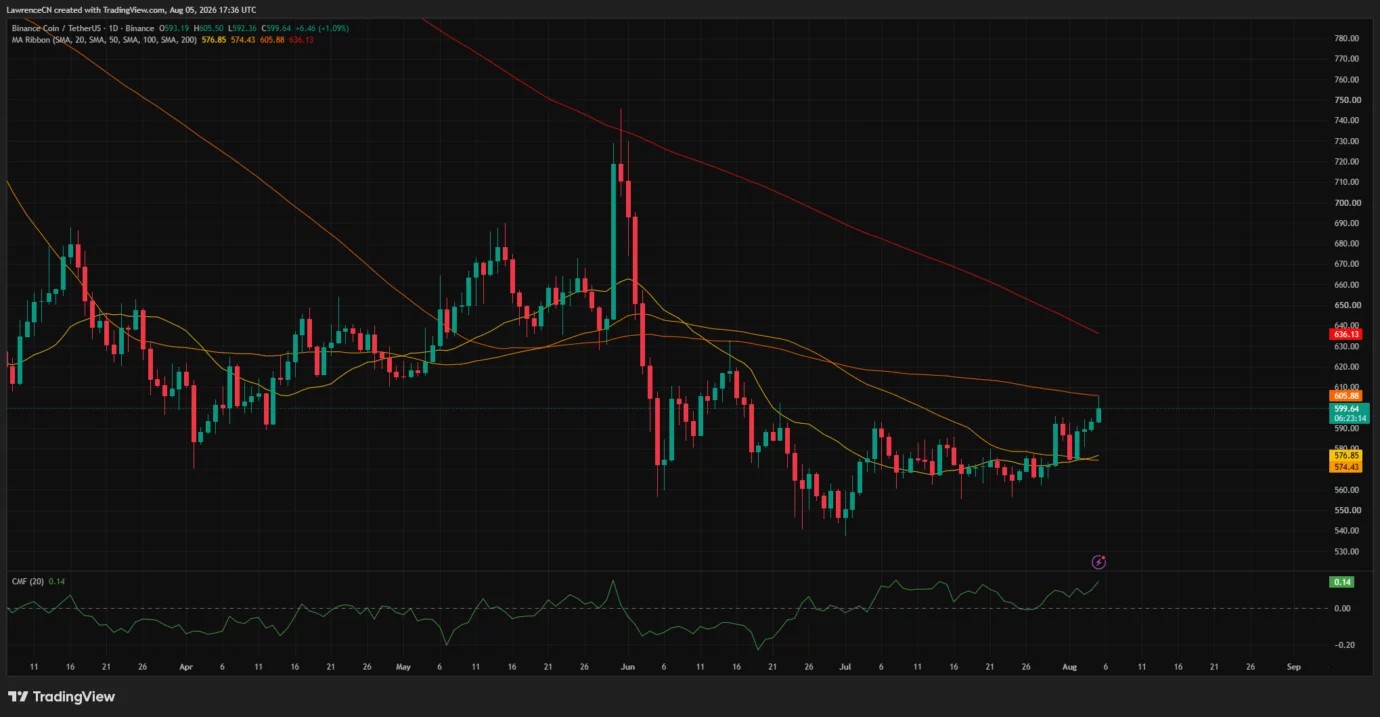
According to data from crypto.news, $BNB ($BNB) price rose to approximately $600 on Wednesday, extending its recovery from a late-July range around $560 to $575. The daily chart shows that the token closed near $599.64 after reaching an intraday high of $605.50.
$BNB price daily chart — Aug. 5 | Source: crypto.news
The move carried $BNB above its 20-day and 50-day simple moving averages at $574.43 and $576.85, respectively. Reclaiming both averages supports the short-term bullish structure, although the asset has not yet reversed its wider downtrend.
The 100-day SMA at $605.88 now represents the first major test. This level sits close to Wednesday’s intraday high and could determine whether $BNB extends its rally toward $610 or enters another period of consolidation.
Longer-term resistance remains at the 200-day SMA near $636.13. $BNB would need to reclaim that level before the daily chart confirms a broader bullish trend reversal.
Chaikin Money Flow rose to 0.14 on the daily chart. A reading above zero indicates that buying pressure has exceeded selling pressure during the measured period, adding support to the latest recovery.
Derivatives traders add exposure as volume jumps
$BNB derivatives activity strengthened alongside the spot-price increase. CoinGlass data provided for the analysis showed that trading volume climbed 56.1% to $719.9 million, while open interest increased 4.05% to $985.79 million.
Rising price and open interest can indicate that traders are opening new positions rather than closing existing contracts. However, the data alone does not establish whether the new exposure is primarily long or short.
The increase also raises the possibility of stronger volatility around the $600 barrier. Leveraged positions may face forced closures if $BNB moves sharply through nearby liquidation zones.
Broader crypto-market conditions offered additional support. Bitcoin approached $64,000, while the total digital asset market capitalization reportedly rose 0.72% to $2.19 trillion.
European regulatory developments also improved the wider institutional backdrop. The latest MiCA register update added more authorized crypto-asset service providers, although the development does not provide a direct fundamental catalyst for $BNB or Binance.
$BNB price faces resistance between $602 and $606
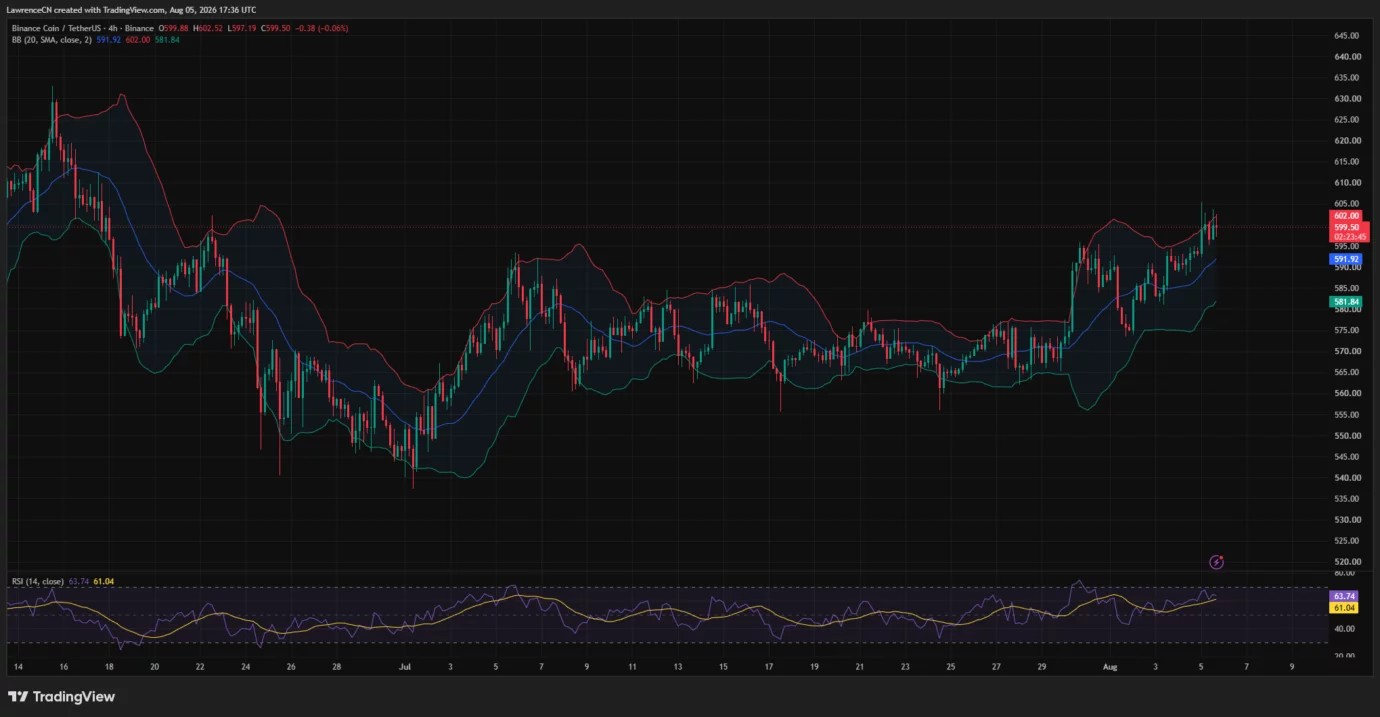
The 4-hour chart places $BNB near the upper Bollinger Band after its latest advance. The upper band stands at $602, while the middle band has risen to $591.92.
$BNB price 4-hour chart — Aug. 5 | Source: crypto.news
Price briefly moved above the upper band before slipping back toward $599.50. That rejection shows that sellers remain active around $602 to $605.88, where the 4-hour Bollinger Band and daily 100-day SMA converge.
The 4-hour Relative Strength Index stood at 63.74, above its signal average at 61.04. Momentum remains bullish, but the reading is approaching the 70 threshold commonly associated with overbought conditions.
A 4-hour close above $605.88 could open the way toward $610. The next upside area sits between $612 and $616, where the three-day liquidation heatmap shows two of the strongest overhead liquidity concentrations.
Failure to break the resistance zone would place initial support at $592, followed by the 4-hour middle Bollinger Band near $591.92. A deeper retracement could target the lower band at $581.84.
Liquidation heatmap puts $612 and $592 in focus
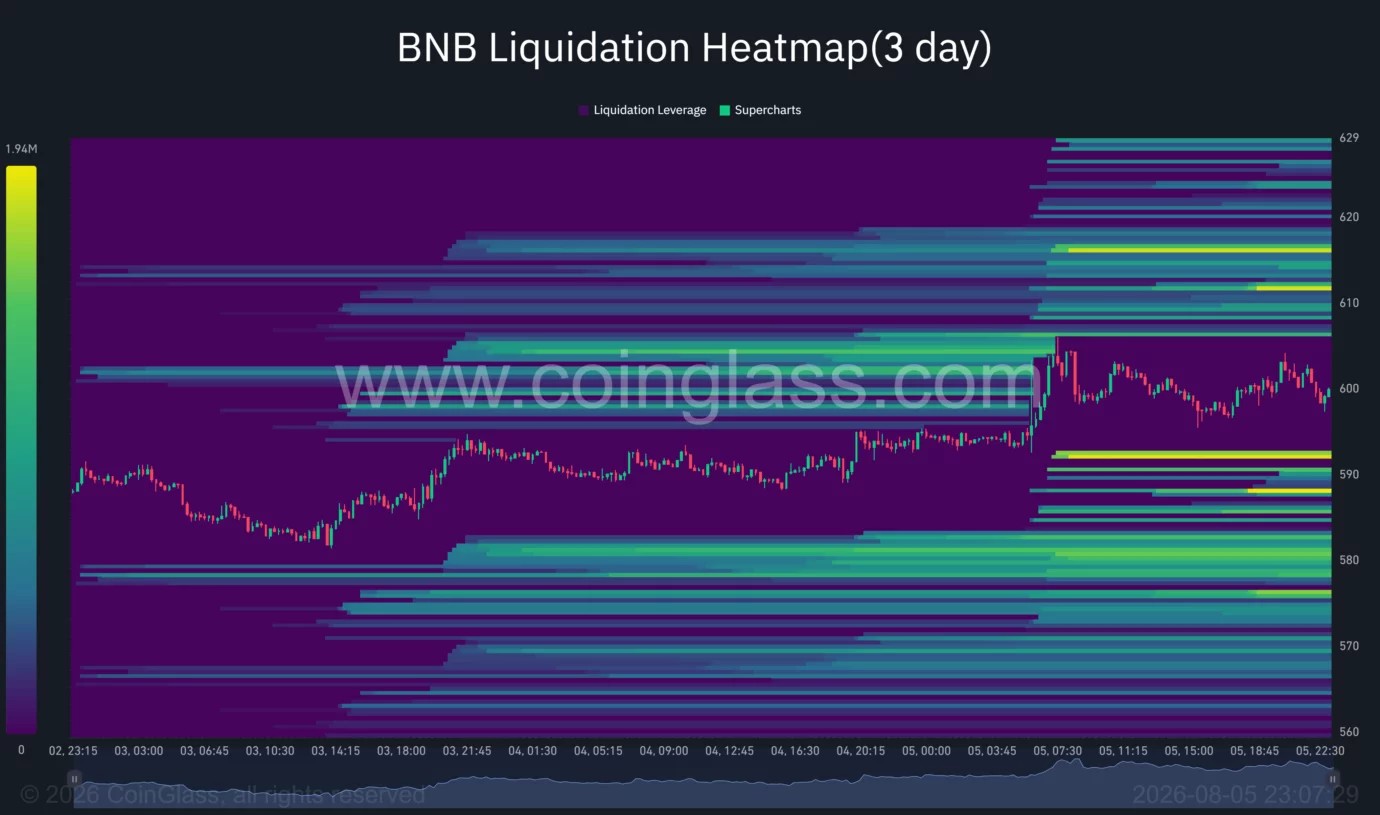
The three-day CoinGlass liquidation heatmap shows liquidity concentrated on both sides of the current price. Above $BNB, prominent bands appear around $612 and $616, with additional leveraged positions extending toward $620.
$BNB liquidation heatmap | Source: CoinGlass
These clusters can act as price magnets because a move into them may force short sellers to close positions. A break above $606 could therefore accelerate toward $612 as short liquidations add market buying.
The closest major downside cluster sits near $592. Another band appears around $587, followed by larger concentrations near $581 and $576.
Losing $592 would weaken the recent breakout and raise the probability of a move toward $582. That area also aligns with the lower 4-hour Bollinger Band and the base of the latest advance.
The heatmap does not predict which liquidity zone $BNB will reach first. It instead shows where leveraged positions may become vulnerable if price moves through those levels.
Analysts see $592 as the key trend level
Crypto commentator Satoshi Stacker described $BNB’s retest of its former diagonal resistance as successful. He identified $592 as one of the asset’s most important levels of 2026 and said holding above it would support the view that $BNB is entering an uptrend rather than posting a temporary recovery.
$BNB saw a clean retest of the diagonal level and confirmed it as support after the recent breakout.
Now, it is attempting to break above what has been one of the most important levels of 2026 at ~$592. Flipping this level would be a great sign that this is an uptrend and not… pic.twitter.com/cnkLzmi06G
— Satoshi Stacker (@StackerSatoshi) August 3, 2026
Another trader, Batman, pointed to $BNB’s breakout from consolidation and its recovery above the 50-day moving average. The analyst said the subsequent retest preserved the bullish setup.
The charts support a constructive short-term outlook while $BNB remains above $592. A confirmed break above $606 would bring $610, $612 and $616 into focus.
The bullish setup would weaken if $BNB closes back below $592. In that case, $582 becomes the main downside level, with $576 providing the next support if selling pressure increases.
For US traders, MiCA developments mainly offer a comparison with Europe’s unified licensing framework. $BNB’s short-term direction remains more closely tied to overall crypto liquidity, Binance-related developments and technical positioning than to European licensing updates.
JPYC Inc. raised 6 billion yen ($38 million) in an extension of its Series B funding round to accelerate the expansion of its yen-pegged stablecoin.
The investment brings the company’s total raised to $106 million across seven funding rounds since November 2021, according to venture capital data site Tracxn.
New investors in the latest round include AZ-COM Maruwa Holdings (9090), a major Japanese logistics company.
AZ-COM plans to settle payments in JPYC with its clients, including Amazon Japan. Its network of around 2,300 partners is made up of subcontractors, drivers and so on. The move marked the first large-scale corporate use of a stablecoin for daily business operations in Japan.
JPYC is one of the most prominent stablecoins pegged to the Japanese yen with a market cap of $55.5 million, according to data tracked by CoinGecko.
Stablecoins are digital tokens pegged to the value of a traditional financial asset, usually a fiat currency. The market is overwhelmingly dominated by tokens pegged to the U.S. dollar. The yen stablecoin sector is growing, helped by adoption among some of Japan’s largest financial institutions, but remains negligible in the context of the USD-dominated market.
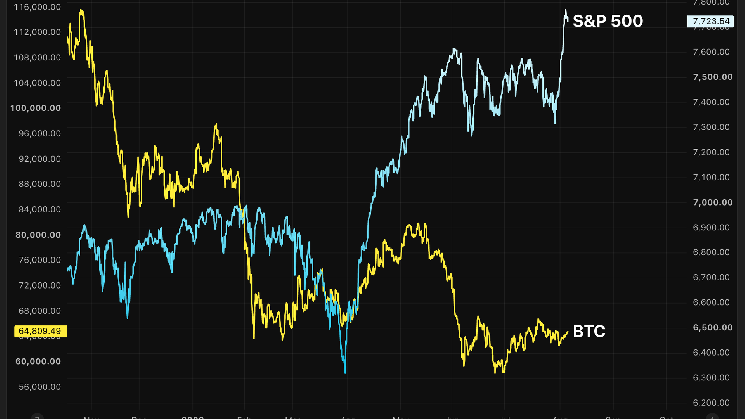
U.S. stocks are having their moment again, and bitcoin, as it has all year, is sitting this one out. The reasons why go beyond the obvious.
The S&P 500 has gained 3.12% this month, adding roughly $2.1 trillion in market cap and pushing its total value to a record $70.5 trillion, with its price at 7,723 points. The Nasdaq and Dow are buoyant too. Wall Street, by every measure, is in full risk-on mode.
Bitcoin isn’t following suit, even though, since the COVID crash of early 2020, it has tended to track stocks more often than not. The token is up just 2% this month, trading around $64,600, sitting exactly where it’s been gyrating for weeks.
Part of bitcoin’s underperformance stems from the fact that the equity rally is driven primarily by stock-specific narrative, particularly tied to AI, rather than by a broad macro risk-on impulse that would lift beta assets like $BTC in tandem.
“Partly because the equity rally is being driven by areas to which bitcoin has little direct exposure, particularly AI and semiconductor stocks,” said Adam Haeems, head of asset management at Tesseract Group, which manages more than $500 million in client assets.
Cryptocurrency asset management company Hashdex announced its decision to close and liquidate the Hashdex Bitcoin ETF (NYSE Arca: DEFI), which was traded in the US. With the completion of this decision, DEFI will be the first spot Bitcoin ETF to be shut down in the US.
According to documents the company filed with the U.S. Securities and Exchange Commission (SEC), the value of assets under management by the fund was approximately $14.7 million as of July 30, 2026. Hashdex’s total assets managed in other products offered to U.S. investors exceed $200 million.
Hashdex announced that the decision to liquidate was made after evaluating factors such as the fund’s size, transaction liquidity, operating expenses, investor demand, and the company’s broader product strategy. The liquidation plan stated that the fund’s net assets remaining low compared to operating expenses made it economically unfeasible for DEFI to continue operating in the long term.
Related NewsA Signal Seen Once a Year in Bitcoin: “The Calm Before the Storm…”
What Was the Content of the Hashdex Bitcoin ETF?
DEFI was a spot Bitcoin ETF designed to offer investors direct exposure to daily fluctuations in the Bitcoin price. The fund’s portfolio consisted solely of physically held Bitcoin and cash held for operational needs, share creation and repurchase transactions, fees, and other liabilities.
The fund did not hold any cryptocurrencies, stocks, or financial assets other than Bitcoin. DEFI’s primary goal was for the change in the net asset value of its shares, after deducting expenses, to reflect the daily price movements in the Nasdaq Bitcoin Reference Price–Settlement indicator.
Investors can sell their DEFI shares on the NYSE Arca until the close of trading on August 17, 2026. After that date, the fund will no longer accept new share creation orders from authorized participants. DEFI shares will be delisted from the exchange following the final trading day.
Hashdex will liquidate its portfolio by selling the Bitcoins remaining in the fund after August 17. Investors who did not sell their shares by the last trading day will receive a cash payment equivalent to the net asset value of their shares on the liquidation date. According to the company’s statement, payments are expected to be made around August 28, 2026.
The amount to be distributed to investors will be affected by the cost of selling the Bitcoins, transaction fees associated with closing the fund, and potential price fluctuations in Bitcoin during the liquidation process. Hashdex warned investors that price movements during this period could be significant.
On-chain data analysis platform CryptoQuant has reported that investors known as “whales,” who hold large amounts of assets in Bitcoin (BTC), Ethereum (ETH), and $XRP, have recently increased their holdings. According to the company, this trend indicates that the cryptocurrency market may be approaching the final stage of its long-running bear cycle.
According to an analysis shared by CryptoQuant, it has been noted that historically, a significant indicator is when large investors buy rather than sell during periods of continued price decline. Similar movements have been observed in past market cycles when long-term investors believed prices had reached attractive levels.
However, the analytics firm emphasized that the current data alone is not sufficient to confirm the market bottom. According to CryptoQuant, while whales buying is considered a positive signal, Bitcoin, Ethereum, and $XRP prices may fall further before a bottom formation is finalized. Therefore, investors should be cautious about short-term fluctuations.
Experts note that the accumulation process of whales is often part of a long-term investment strategy. Large investors prefer to buy at low prices during periods when fear dominates the markets, while individual investors often act more cautiously due to uncertainty. This is a common characteristic observed many times in the final stages of market cycles in the past.
CryptoQuant noted that while there are signs that the bear market may be approaching its final phase, macroeconomic developments and global liquidity conditions will continue to be decisive factors in price movements. In particular, central bank monetary policies, regulatory developments, and the attitude of institutional investors towards the market are among the main factors influencing the direction of crypto assets.
Meta released Muse Code (beta), a terminal coding agent powered by Muse Spark 1.2, its updated coding model. It’s available now via the Meta Model API and a curl install script.
The agent coordinates persistent background subagents and keeps a replay-exact event log, so a crash resumes exactly where it stopped.
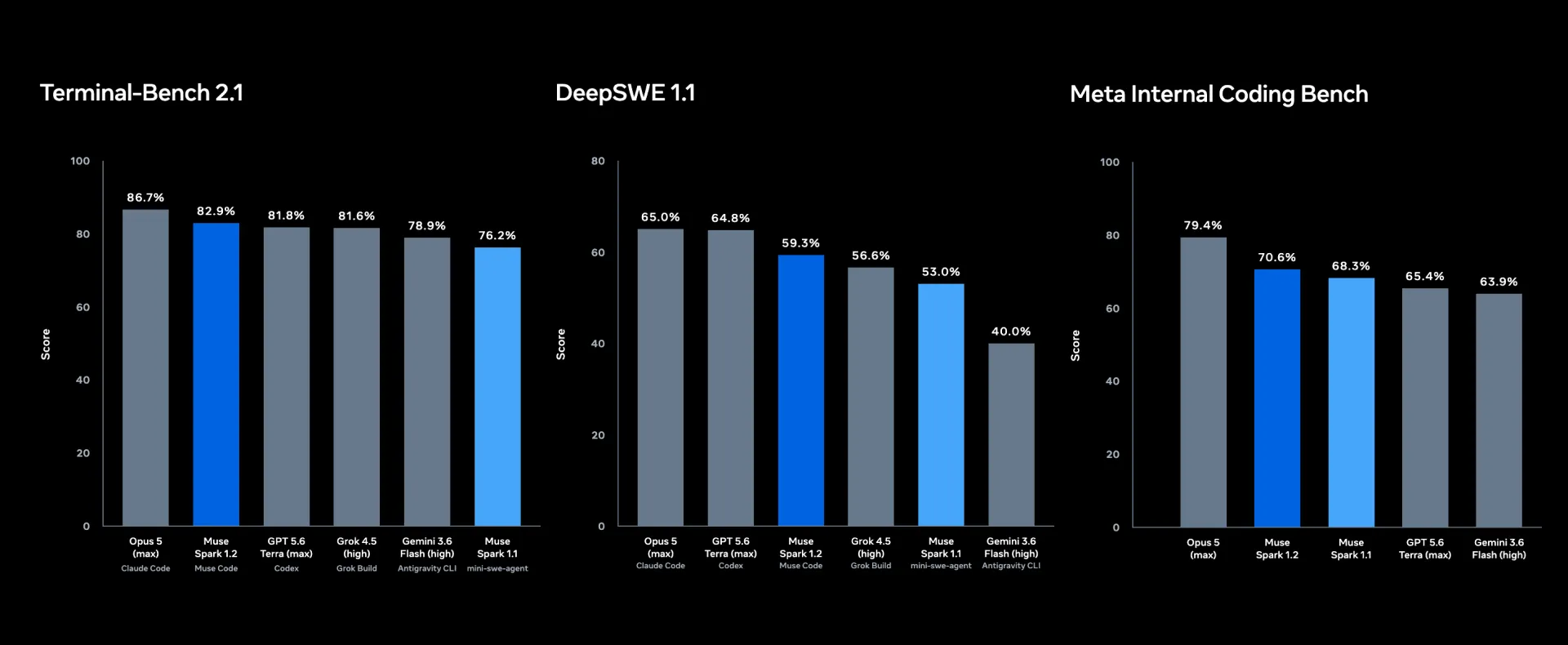
On Meta’s own charts, Muse Spark 1.2 trails Anthropic’s Opus 5 on every coding benchmark shown, while beating OpenAI’s Codex and Google’s Antigravity on most.
Meta is the latest tech giant to ship a coding agent, racing to compete with leading AI behemoths Anthropic and OpenAI.
“We’re excited to release Muse Code (beta), a terminal coding agent powered by Muse Spark 1.2, our newest model,” the company wrote in an official announcement. “This marks our next step toward the frontier, with larger and much more capable models on the way.”
As an agentic coding tool, Muse Code is built for software engineering across large repositories. Per Meta, it “takes on complex software engineering tasks across large repositories: planning changes, writing code, and validating the results. It can coordinate multiple persistent subagents for each task, solving difficult problems faster, more accurately, and with less intervention.”
The detail that stands out is the runtime. Muse Code logs every model call, tool run, approval, and edit to a local event log that acts as a single source of truth. “This single source of truth makes the runtime replay-exact and restart-safe: after a crash, the agent can resume precisely where it stopped,” Meta said. For long-running jobs, that’s the feature that matters more than raw speed—and it’s the part competitors haven’t made a selling point.
It also ships with default skills. The “/plan” command turns a task into an approval-gated plan, while “/grill” stress-tests that plan until it holds up and “/goal” works toward successful completion of the objective similar to what Hermes does. Meta said it co-trained Muse Spark 1.2 with Muse Code so the core LLM and the agent work together in synergy.
The benchmarks, and the catch
Muse Spark 1.2 is a coding-focused update to Muse Spark 1.1. Meta said it “significantly scaled up training compute on coding tasks while expanding training environment diversity, delivering improvements in code generation, complex debugging, and end-to-end developer workflows.” The charts tell a clear story.
On Terminal-Bench 2.1, Muse Spark 1.2 with Muse Code scored 82.9%, behind Claude Code on Opus 5 at 86.7% but ahead of GPT-5.6 Terra on Codex (81.8%) and Grok Build (81.6%).
DeepSWE 1.1, which measures agentic coding capabilities, was closer: 59.3% for Muse versus 65.0% for Opus 5 and 64.8% for Codex. On Meta’s internal coding bench, Muse hit 70.6% to Opus 5’s 79.4%.
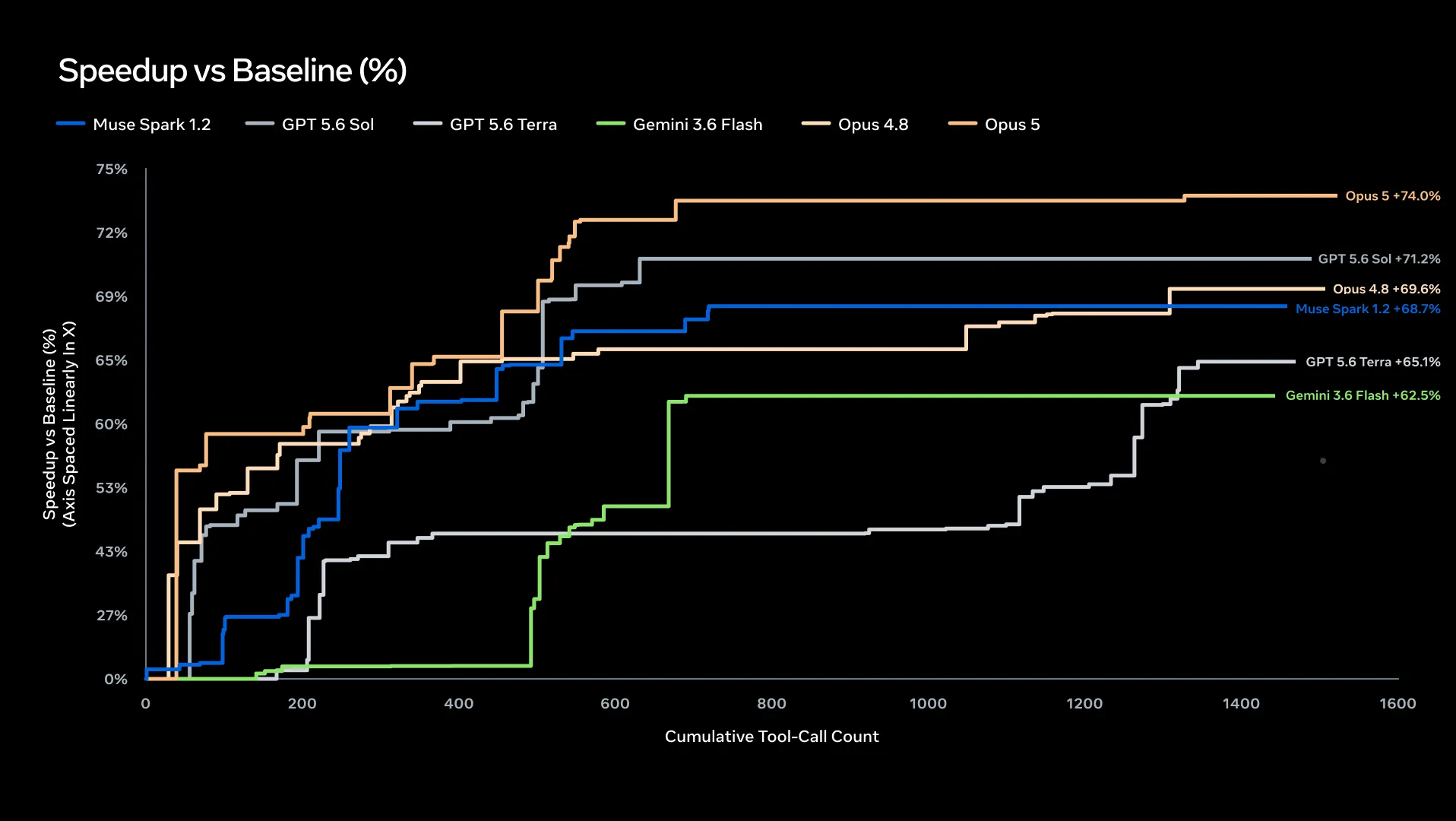
The speedup charts flip the order. Over 1,000-plus tool calls, Opus 5 posted the biggest gain versus baseline (about 74–75%), with Muse Spark 1.2 mid-pack at roughly 61–69% depending on the run. Meta’s point is that the agent keeps improving as tool calls accumulate, the behavior you want from a long-horizon coder.
The most interesting demos are long-horizon and multimodal. In stress testing, Meta said Muse Code “iteratively optimized GPU kernels over 1,000+ tool calls (up to 24 hours) on Nvidia Hopper GPUs.” That means it was able to improve over time.
There’s also a visual-coding angle. In one demo, a user drops a fly-through video of a house into the terminal as an mp4, and Muse Code “interprets the video and produces a visually rich website with booking capabilities.” Reading raw video into a working web app is the multimodal pitch Meta has been making across the Muse line.
See the launch thread:
Here’s an example of Muse Code’s multimodal visual coding capabilities. In this demo, the user inputs a fly-through video of a home into the terminal as an mp4 file. Muse Code interprets the video and produces a visually rich website with booking capabilities. pic.twitter.com/3CAfIMYmAB
That said, Meta is late to the fight. OpenAI’s Codex already runs parallel cloud agents; DeepSeek has built its own rival to Claude Code and agentic tools like Hermes or OpenClaw are already good substitutes with more capabilities. Muse Code’s edge is the crash-safe runtime and the subagent design, not benchmark supremacy.
The risk is the usual one for agentic coding: an agent that resumes after a crash and keeps calling tools for 24 hours is powerful and unpredictable. Meta is betting developers want that autonomy, and it’s shipping now.
Muse Code is available for testing upon installation entering this command: curl -fsSL https://dev.meta.ai/install.sh | bash
Daily Debrief Newsletter
Start every day with the top news stories right now, plus original features, a podcast, videos and more.