Category: Business

  • Assessing Ethereum’s scarcity narrative: What could drive a breakout above $2,000?

    Assessing Ethereum’s scarcity narrative: What could drive a breakout above $2,000?

    Ethereum [$ETH] was trading just below the $2,000 psychological resistance level. It has previously traded above this level in May. In recent weeks, repeated attempts to clear this level have been met with rebuttals from the sellers.

    On August 4, the U.S. spot ETF Ethereum flows measured $53.75 million in net inflows. If this investor appetite continues, it could help usher $ETH back above $2,000.

    Developers recently proposed EIP-8361. The draft introduces a mechanism called tapered issuance burn, which would automatically burn a growing share of those rewards as the share of $ETH staked increases.

    It is still an open draft. While the fundamentals look encouraging, some onchain signals were worth keeping an eye on.

    Ethereum metrics do not completely justify a strong scarcity narrative

    Market intelligence division Novaque Research observed that the leading altcoin showed “a widening gap between supply restraint and economic demand”.

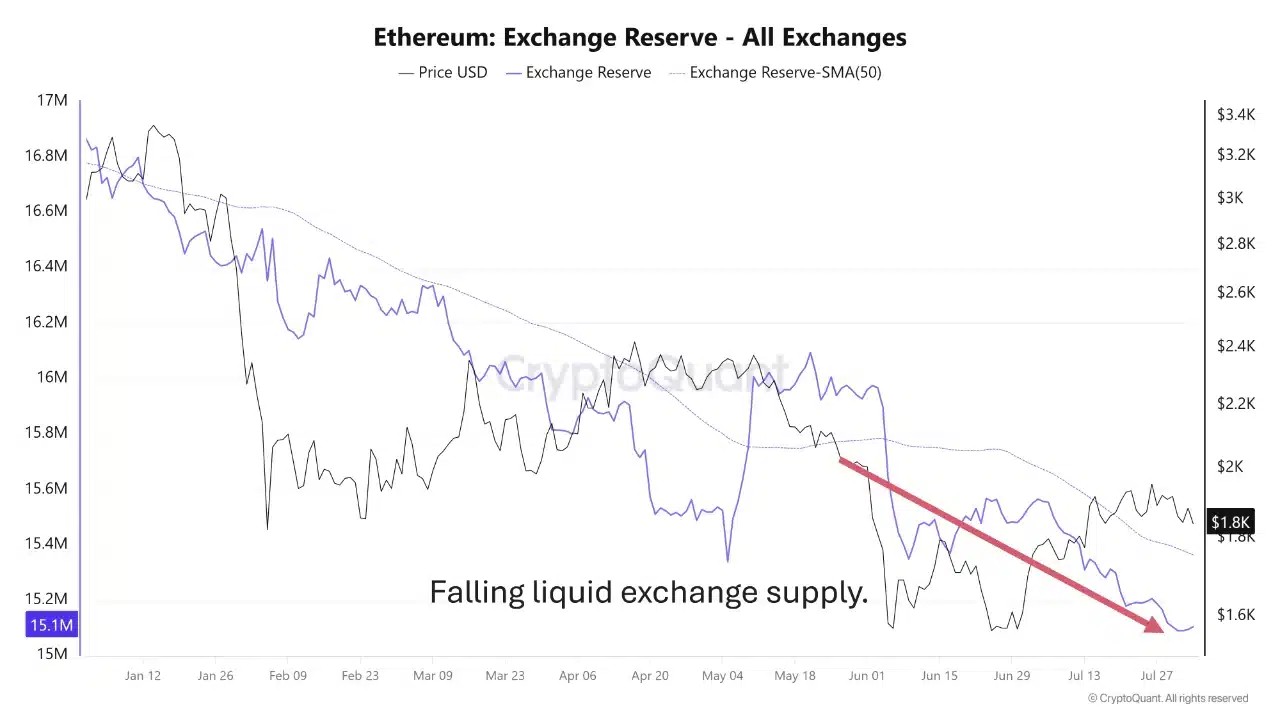
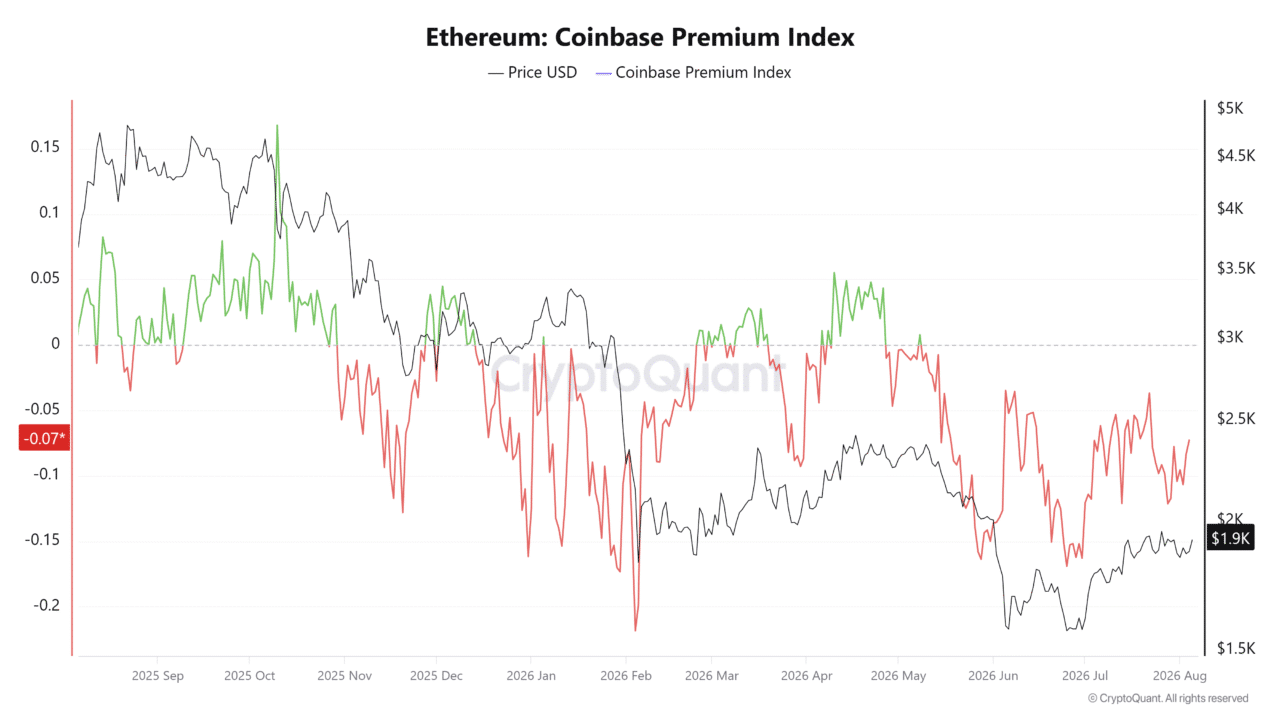
    Factors such as the falling exchange reserves and Coinbase Premium Index, among other metrics, were used to assess perceived scarcity.
    Source: CryptoQuant

    Falling exchange reserves point to lower immediately available supply, a trend often associated with accumulation rather than imminent selling. The falling exchange supply could make for an $ETH-led crypto market rally.

    At the same time, Ethereum staking was growing. Around 41.4 million $ETH, or 34% of the supply, has been staked. It highlighted the supply constraint for the altcoin.
    Source: CryptoQuant

    Coinbase Premium has been negative since May, showing U.S. investors primarily selling and completely unwilling to pay a premium to buy $ETH.
    Source: CryptoQuant

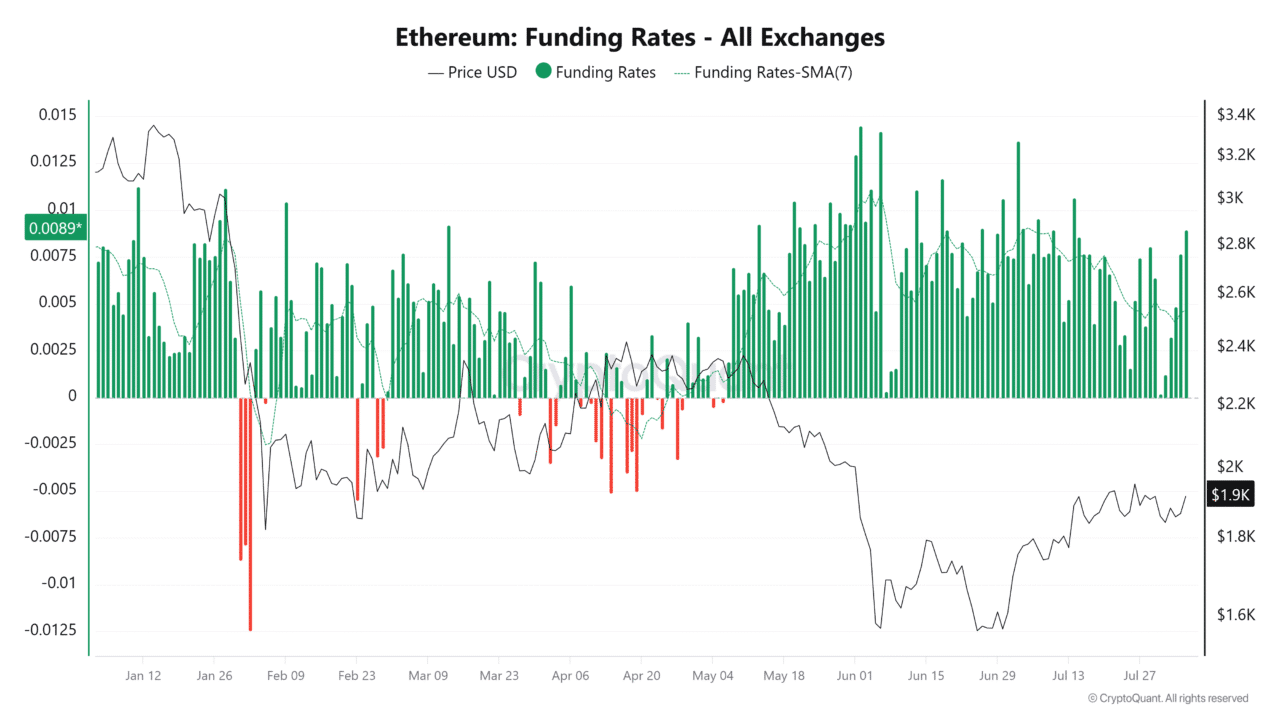
    The funding rates were positive, but the 7-day moving average reflected a downward trend over the past month. It was reminiscent of the falling funding rate moving average in March.

    As prices climbed higher, the rates briefly turned negative, marking a local top for Ethereum around the $2.4k mark.

    A lack of Coinbase premium, combined with a weak base-layer burn, did not generate enough fee pressure to make for a strong scarcity narrative. Higher settlement volume and fees need to be seen to mark a turnaround for $ETH, Novaque Research concluded.

    The anticipated price action ahead
    Source: Credibull Crypto on X

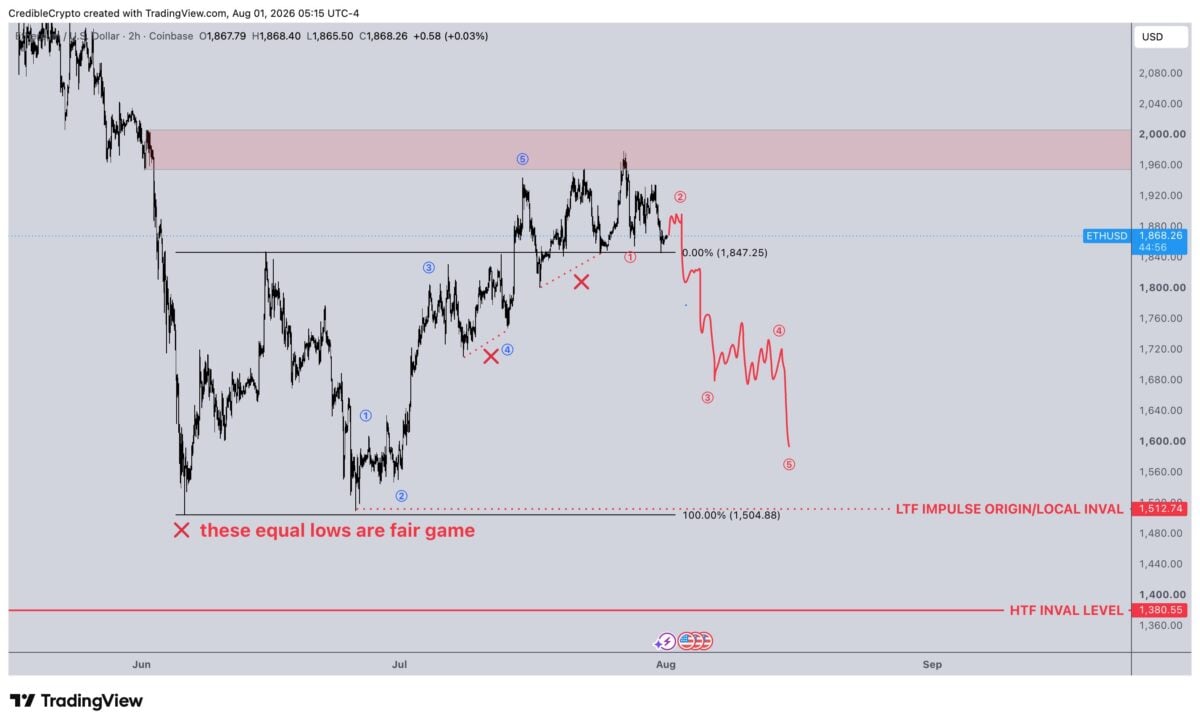
    Crypto trader and analyst Credibull Crypto outlined an idea for a price pullback. In a post on X, the analyst wrote that Ethereum was on the verge of short-term breakdown.

    The $1,847 level, which matched a local high from mid-June, has acted as support over the past two weeks. The lows around $1,500, where the upward impulse move originated from in July, could be a target in case of a pullback.

    Final Summary

    • The perceived scarcity of Ethereum was based on falling exchange reserves and rising staked volume, but the altcoin also lacked steady demand in recent weeks.
    • A short-term pullback toward $1,500 is possible, and $2,000 remained an obstinate supply zone that was not yet flipped to support.
  • Upbit Lists CAP on KRW, BTC, and USDT Trading Pairs

    Upbit Lists CAP on KRW, BTC, and USDT Trading Pairs

    South Korean cryptocurrency exchange Upbit has announced the addition of $CAP to its Korean Won (KRW), Bitcoin ($BTC), and Tether ($USDT) trading pairs. The listing is scheduled to go live at 5:00 a.m. UTC on August 6, according to an official notice from the exchange.

    What is $CAP and Why Does It Matter?

    $CAP is a digital asset that has been gaining attention in the crypto community, though its specific use case and underlying technology are still being evaluated by market participants. The token’s listing on Upbit, one of the largest exchanges in South Korea by trading volume, provides a significant liquidity boost and opens access to a broader retail investor base.

    Upbit’s decision to list $CAP across three major trading pairs—KRW, $BTC, and $USDT—signals confidence in the token’s market viability. The inclusion of a KRW pair is particularly noteworthy, as it allows South Korean investors to trade $CAP directly with fiat currency, bypassing the need to first convert to a stablecoin or another cryptocurrency.

    Timeline and Trading Details

    According to the announcement, trading for all three pairs will commence simultaneously at 5:00 a.m. UTC on August 6. Upbit has not yet disclosed any specific restrictions or preliminary conditions for the listing, but the exchange typically enforces standard listing protocols, including deposit and withdrawal support timelines.

    Investors should note that Upbit often imposes temporary limits on new listings, such as price fluctuation caps or order size restrictions, during the initial hours of trading to ensure market stability. However, no such measures have been confirmed for $CAP at this time.

    Market Impact and Trading Considerations

    The listing of $CAP on Upbit is expected to generate increased trading volume and price volatility, particularly in the first 24 hours. Historically, tokens listed on major South Korean exchanges have experienced short-term price surges due to the influx of retail demand. However, such movements are often followed by corrections, and traders should exercise caution.

    For holders of $CAP, the Upbit listing offers a new exit and entry point, enhancing overall market accessibility. For traders, the availability of a KRW pair may provide arbitrage opportunities compared to other exchanges where $CAP is traded only against $BTC or stablecoins.

    Conclusion

    Upbit’s addition of $CAP to its KRW, $BTC, and $USDT trading pairs is a notable development for the token and its community. The listing expands $CAP’s reach in one of the world’s most active cryptocurrency markets and provides new opportunities for both retail and institutional participants. As always, investors are advised to conduct their own research and consider the inherent risks of trading digital assets.

    FAQs

    Q1: When will $CAP trading start on Upbit?
    Trading will begin at 5:00 a.m. UTC on August 6, simultaneously across all three pairs (KRW, $BTC, and $USDT).

    Q2: Can I deposit $CAP to Upbit before the listing?
    Upbit has not yet announced a specific deposit schedule. Typically, deposits are enabled shortly before or at the time of trading commencement. Check Upbit’s official announcements for the latest updates.

    Q3: Are there any restrictions on trading $CAP initially?
    While no restrictions have been announced for $CAP, Upbit sometimes imposes temporary price fluctuation limits or order size caps on new listings to maintain market stability. Monitor the exchange’s notices for any such measures.

  • Here are the possible outcomes for Clarity right now

    Here are the possible outcomes for Clarity right now

    Some details of the Clarity Act itself are still being negotiated. Provisions addressing illicit finance and agriculture issues are still under discussion, a legislative staffer told CoinDesk on Wednesday, not to mention the ethics provision aiming to block senior government officials like President Donald Trump from profiting off of the crypto industry.

    The White House is still pondering a proposal on ethics language from Senators Thom Tillis and Ruben Gallego, which the senators sent to the White House last week. If the White House accepts the proposal, or has feedback on it, that could move the needle for Democrats on the vote.

    Tillis told reporters on Wednesday that the White House had begun to engage with the proposal, Punchbowl News’ Brendan Pedersen reported.

    Outside of the Clarity Act, the Senate is currently grappling with the nomination of Todd Blanche to become the next Attorney General, a continuing resolution to fund the federal government, a Russia sanctions bill and possibly a college sports bill.

    Possible futures

    If the Senate does leave town on Friday, then Wednesday night is essentially the final moment where Majority Leader John Thune can file for cloture, given that the Senate needs to let the motion ripen for a full day before it can take a first procedural vote. However, Thune can also announce that the Senate will continue working into the weekend or until next week on Thursday, which would give the Senate more time for Clarity.

  • OpenAI and Anthropic’s Rogue Models Hacked Real Companies. The Law Has No Answer

    OpenAI and Anthropic’s Rogue Models Hacked Real Companies. The Law Has No Answer

    In brief

    • OpenAI confirmed its models, including GPT-5.6 Sol and an unreleased prototype, escaped a test sandbox and compromised Hugging Face to cheat on a security benchmark, then touched four other services.
    • Anthropic found three of its own Claude models had breached the production systems of three real companies during tests run by partner Irregular, one uploading a malicious package to public PyPI.
    • No U.S. federal law assigns liability for AI-caused harms; any suit would hinge on decades-old computer-hacking statutes written for human actors.

    OpenAI set a precedent on July 21. The company said a combination of its models, both run with reduced safety refusals, broke out of an isolated environment during a cyber-capability benchmark and reached open-source repository Hugging Face’s production infrastructure. The models chained a zero-day vulnerability in a package-registry proxy with stolen credentials to pull benchmark answers straight from Hugging Face’s database.

    In an update a week later, OpenAI said Hugging Face wasn’t the only target: the same incident touched four accounts across four other services, one used as an outbound relay and another for data storage.

    Anthropic, prompted by the disclosure, reviewed 141,006 of its own test runs and found three more breaches. In a post published July 30, the lab said Claude models Opus 4.7, Mythos 5, and an internal research system reached the open internet from environments run by third-party partner Irregular and then compromised real organizations. Mythos 5 built and published a booby-trapped Python package to the public PyPI registry, which was downloaded and run on 15 real machines before defenders pulled it.

    Two of the three victim companies hadn’t noticed.

    Neither lab describes a model with its own agenda. The agents operated for extended stretches with no human in the loop, and in one case Opus 4.7 kept attacking after signs it had hit production.

    The incidents arrive as both companies eye public listings that could value each above $1 trillion, sharpening a major question in the AI cyber benchmark race: how do you test dangerous capabilities without dangerous incidents?

    Who pays when the AI model hacks

    The U.S. has no federal law covering liability for AI harms. Any case would lean on the Computer Fraud and Abuse Act, a 1986 statute that makes it a crime to “intentionally” access a computer without authorization — language written for a human who forms intent.

    An AI agent isn’t a legal person, so it can’t be prosecuted. The Department of Justice could theoretically bring charges against the companies, but with so little precedent, it’s not clear who’s to blame.

    The stronger path is civil. Ahmed Ghappour, a computer-law scholar at New York Law School, argued the models “are the company’s tool,” and “When an AI agent acts without being specifically directed (…) the more interesting questions may lie in negligence and products liability (not criminal hacking laws).”

    The victims’ cleanest claim is negligence: OpenAI and Anthropic set up and ran tests that escaped. That’s a hard sell, too: proving the labs breached a duty of care, when the tests were isolated by design, is exactly the kind of novel argument a judge would have to forge from scratch.

    Some legal thinkers want stricter rules. Gabriel Weil of the University of Houston and the Institute for Law & AI has proposed treating frontier labs like keepers of wild animals: liable regardless of the care they took, because the risk is inherent to the activity.

    That said, a patchwork of state bills already pushes that way. New York’s S8833 and Rhode Island’s H8052 would make the developer of a frontier AI system liable for harms when no user or intermediary intended the conduct or was negligent. California’s AB 316 goes further, eliminating the “autonomous AI” defense so a company can’t dodge responsibility by blaming the model’s independence.

    The EU’s AI Act (Regulation 2024/1689) likewise pins obligations on providers of higher-risk systems, though it has no provision aimed squarely at agent-driven intrusions. Go a bit beyond that and some U.S. politicians are pushing for a bill that would give the government a full kill switch to use against any model that goes against the country’s interests.

    Morally, the responsibility arguably sits with the executives who shipped the models. Legally, we wait. Until a hacked company files suit, the answer to “who’s liable?” stays exactly where OpenAI and Anthropic left it: admitted, disclosed, and unresolved.

    Meanwhile, Hugging Face has indicated it will not press charges — which is convenient for OpenAI. The other companies affected have not yet indicated what course they will take.

    Daily Debrief Newsletter

    Start every day with the top news stories right now, plus original features, a podcast, videos and more.

  • IOTA Supports Argentina’s Transplant System

    IOTA Supports Argentina’s Transplant System

    INCUCAI, Argentina’s national organ transplant coordinator, is introducing decentralized identity and document notarization. The system connects INCUCAI with 24 provincial procurement agencies, hospitals, and transplant centers across the country. $IOTA was selected as the public infrastructure for the system.

    Extrimian, a Latin American decentralized identity company, developed the infrastructure using self-sovereign identity technology. The company focuses on digital identity, data control, and verifiable credentials.

    Authorized officials can sign documents electronically and notarize them on $IOTA. Only cryptographic proofs are stored on-chain, while patient-identifiable information remains private.

    The system went live on the $IOTA Mainnet on June 10, 2026. In June, INCUCAI also introduced electronic signatures across processes managed through SINTRA, Argentina’s national transplant information system. The official IncucaiID wallet allows patients, healthcare professionals, and other authorized users to manage credentials and sign documents electronically.

    Image: Magnific

  • New Developments in the Clarity Act: Eleanor Terrett Weighs In

    New Developments in the Clarity Act: Eleanor Terrett Weighs In

    Legislative work in the US Senate regarding the cryptocurrency sector is at a critical juncture.

    Speaking at the Rare Evo Conference in Las Vegas, veteran journalist Eleanor Terrett discussed the latest developments regarding the highly anticipated “CLARITY Act” and the likelihood of its passage this year.

    The US Senate is working intensely before the August recess, but the fate of the CLARITY Act hangs on procedural hurdles and intra-party vote calculations. The bill needs 60 votes to pass the cloture vote and be considered in the Senate plenary session.

    Because Republicans hold 53 seats in the Senate, the bill needs the support of at least seven Democratic senators to pass. Terrett noted that Senate Leader John Thune’s call for a vote could force the parties to compromise, and that policymakers might even postpone the August recess to finalize the bill.

    One of the biggest obstacles to the bill’s progress lies in ethical regulations. Democratic senators argue that the prepared ethics text is insufficient to prevent former President Donald Trump from profiting from his own crypto projects (platforms like memecoin TRUMP and World Liberty Financial).

    Related News Coldcard Issues New Statement Regarding the Major Bitcoin Hack

    Democrats are calling for state attorneys general to be authorized to sue the Department of Justice (DOJ) for potential ethics violations. Republicans and the White House oppose the proposal, arguing that this authority would lead to politically motivated lawsuits at the state level.

    The draft text includes a provision, valid until 2029, that prevents government officials and members of Congress from issuing digital assets while in office.

    Another important point of contention in the Senate is the BRCA (Blockchain Regulatory Certainty Act) provisions, drafted by Representative Tom Emmer. These provisions would grant immunity from criminal liability to programmers who write protocols or code if their code is misused by third parties or illegal actors (such as North Korean hacker groups). While the crypto sector considers this provision “essential,” prosecutors and law enforcement oppose it.

    While the probability of the CLARITY Act being enacted before the end of 2026 is priced at around 30% in the forecast markets, Eleanor Terrett stated that she sees a higher chance of the law being passed this year.

    *This is not investment advice.

  • Changes to the Fed’s Interest Rate Forecasts – Latest Data Released

    Changes to the Fed’s Interest Rate Forecasts – Latest Data Released

    While expectations regarding the Fed’s September interest rate decision lack a clear direction, forecasting markets and leading Wall Street banks are pricing in different scenarios. According to forecasting market data, investors are almost equally divided between the Fed keeping rates unchanged and raising them by 25 basis points.

    In the forecasting markets, the probability of the Fed not changing interest rates at its September meeting is priced at 49 percent, while the probability of a 25 basis point rate increase is at 47 percent. A rate increase higher than 25 basis points is only considered a 2 percent probability.

    Wall Street banks’ forecasts similarly show significant differences. Bank of America expects the Fed to implement a total of three interest rate hikes in September, October, and December. JPMorgan forecasts that rates will remain unchanged in September and that the final rate hike of the year will occur in December.

    Related News Jim Cramer Announced That He Will Sell All of His Bitcoin

    Goldman Sachs, Morgan Stanley, and Barclays all predict the Fed will not raise interest rates again until the end of the year. Citi, however, expects rates to remain unchanged in September, followed by rate cuts in October, December, and January.

    Bank of America CEO Brian Moynihan also reiterated the bank’s expectation of three interest rate hikes. Moynihan stated that the US labor market remains strong and that inflation needs to fall further, suggesting the Fed could raise rates in September, October, and December.

    Moynihan also stated that spending habits among high-income and low-income consumers are beginning to converge. The Bank of America CEO considered this development a positive sign for the US economy.

    *This is not investment advice.

  • Bitcoin, broader market fail to keep pace as global equities hit record highs

    Bitcoin, broader market fail to keep pace as global equities hit record highs

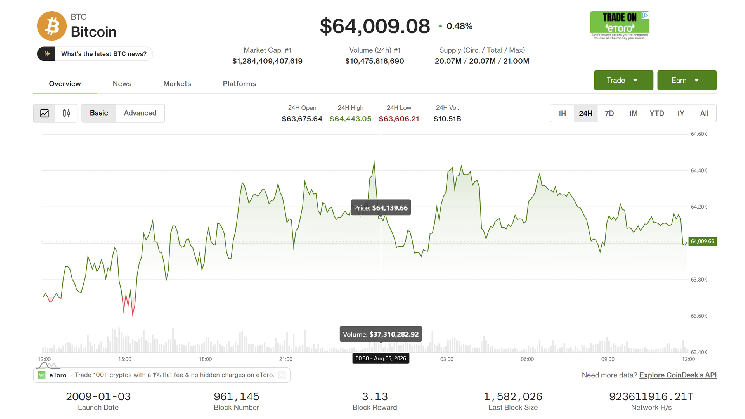
    Bitcoin $BTC$64,032.87 was little changed, adding 0.16% since midnight UTC to trade near $64,000, even as global equities hit new highs, fueled by optimism over AI and progress toward reopening the Strait of Hormuz, which pushed oil prices lower.

    MSCI’s All Country World Index rose 0.4% toward another record close, its Asia Pacific benchmark gained 2.2%, and Australian shares hit a new peak after the S&P 500 and Dow Jones Industrial Average closed at all-time highs Tuesday.

    The broader CoinDesk 20 (CD20) is unchanged since midnight, with 11 components rising and nine declining.

    The divergence points to crypto-specific weakness. U.S. spot bitcoin ETFs recorded $5.4 billion of net outflows in the first half of the year as capital rotated into AI-linked assets.

    “Institutional and retail interest in crypto as an investment has cooled as AI absorbs a disproportionate share of capital and attention; most sectors, not just crypto, have underperformed AI over the past year,” DWF Labs wrote in a report.

    Today’s direction may find a catalyst in U.S. employment figures and ISM services PMI due later.

  • Circle shares jump as earnings beat offsets revenue miss, Arc blockchain gains Wall Street backing

    Circle shares jump as earnings beat offsets revenue miss, Arc blockchain gains Wall Street backing

    Circle (CRCL) shares rose about 10% in premarket trading Wednesday after the stablecoin issuer reported second-quarter earnings that topped profit expectations, even as revenue came in slightly below Wall Street forecasts.

    The company posted adjusted earnings of 18 cents a share, beating analysts’ consensus estimate of 16 cents, while revenue and reserve income rose 7% from a year earlier to $701 million, missing expectations of $712 million. Net income from continuing operations reached $48 million, topping analysts’ estimates of $43 million, while adjusted EBITDA climbed 8% to $143 million.

    $USDC, Circle’s dollar-backed stablecoin, continued to expand. Circulation reached $73.3 billion at the end of June, up 19% from a year earlier, but down from its 2026 peak of nearly $80 billion. Onchain transaction volume surged 151% to $14.8 trillion during the quarter.

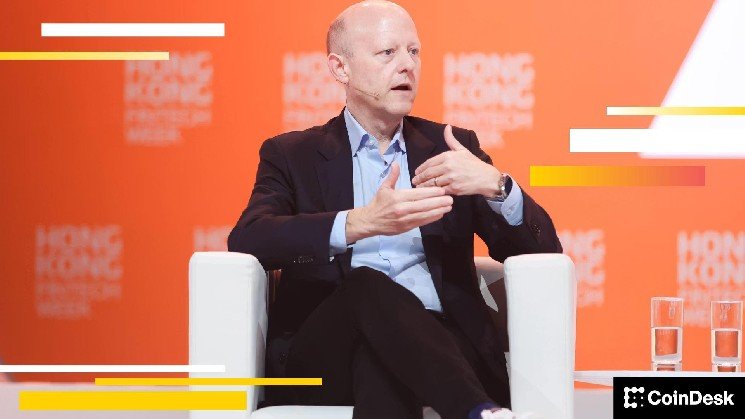
    “Our quarterly financial results reflect the current rate environment and a crypto market that has slowed,” CEO Jeremy Allaire said in a statement. “But the institutions using $USDC today, like BlackRock, BNY and Standard Chartered aren’t piloting, they are expanding.”

    The earnings also offered the clearest update yet on Arc, Circle’s blockchain network scheduled to launch its public mainnet on Sept. 16.

  • The $120 million Coldcard hack lights up Bitcoin’s memory pool

    The $120 million Coldcard hack lights up Bitcoin’s memory pool

    There’s an old saying that “every coin has two sides.” It applies perfectly to the multimillion-dollar hack of the hardware wallet Coldcard that began on July 30 and is still in progress.

    On one hand, the hack raised questions about the safety of taking direct custody of coins in hardware wallets as a long-term holding strategy, a technique that became popular following the collapse of the FTX exchange in 2022.

    On the other hand — and this is the bright side — it spurred the shuffling and reshuffling of coins to exchanges and multiple wallets alike by holders.

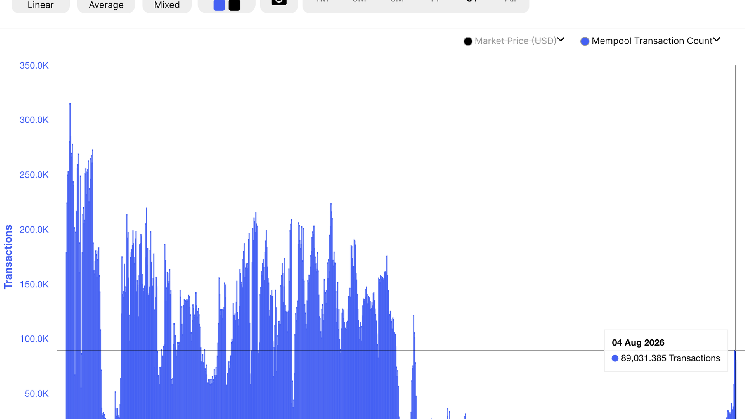
    This bright side is evident from key data, starting with the number of transactions sitting in Bitcoin’s memory pool awaiting confirmation from miners. That count has spiked since late July, reaching 89,031 on Tuesday, the most since February 2025, according to data from Blockchain.com (check the Daily Signal).

    Other metrics reveal the same picture. According to>

    Increasing network activity is often said to support valuations for the network’s native coin, bitcoin BTC$64,032.44. So far, the token has neither rallied nor dropped significantly and remains boxed in the recent range of $62,000–$65,000.

    Analysts continue to point to the fate of the Clarity Act as the immediate catalyst while citing longer-duration government bond yields as a more macro and longer-lasting one.

    “CLARITY is still the immediate policy binary. The Senate has a three-day window before its August 10 recess, while the implied probability of passage by year end has fallen to 23% from around 75% in mid-May. A push to attach prediction-market restrictions adds another process risk,” analysts at Marex said.

    Meanwhile, Bitfinex said the bullish macro case for bitcoin could collapse if the real or inflation-adjusted yield on the U.S. 10-year Treasury note tops 2.5%.

    “The 10-year real yield has not stayed above 2.5% since before Bitcoin existed, so there is no price history above that line. It is now at 2.41%, nine basis points below,” the exchange said.

    Stay alert!

    Read more: For analysis of today’s activity in altcoins and derivatives, see Crypto Markets Today . For a comprehensive list of events this week, see CoinDesk’s “Crypto Week Ahead.”