Category: Business

  • Spot Ethereum ETFs Post $5M Net Inflows as Fidelity and Bitwise Lead

    Spot Ethereum ETFs Post $5M Net Inflows as Fidelity and Bitwise Lead

    U.S. spot Ethereum exchange-traded funds recorded approximately $5 million in net inflows on Aug. 17, according to data from Farside Investors. The tally excludes BlackRock’s ETHA and the staking-focused ETHB, which were not included in the reported figures.

    Fund-Level Breakdown

    Among the funds that reported flows, Fidelity’s FETH led with $4.3 million in net inflows, followed by Bitwise’s ETHW with $700,000. The data underscores a modest but positive day for Ethereum investment products, even as broader market sentiment remains cautious.

    Context and Implications

    The inflows come amid a period of mixed activity for digital asset ETFs. While Bitcoin ETFs have seen more volatile flows, Ethereum products have attracted steady, albeit smaller, interest from institutional investors. The exclusion of BlackRock’s products from the tally is notable, as ETHA has been one of the largest Ethereum ETFs by assets under management since its launch. The omission may reflect reporting discrepancies or a deliberate choice by Farside to focus on funds with clearer flow data.

    Why It Matters

    For investors tracking the adoption of Ethereum-based financial products, these flows provide a snapshot of demand. Even modest inflows can signal growing confidence in Ethereum as an asset class, particularly as staking features and regulatory clarity evolve. However, the overall scale remains small compared to the broader crypto market, and daily flows can be volatile.

    Conclusion

    While the $5 million figure is not transformative, it represents a continuation of steady interest in spot Ethereum ETFs. As the market matures, daily flow data will remain a key metric for gauging institutional participation and sentiment.

    FAQs

    Q1: What are spot Ethereum ETFs?
    Spot Ethereum ETFs are exchange-traded funds that directly hold Ethereum ($ETH), allowing investors to gain exposure to the cryptocurrency without owning it directly. They trade on traditional stock exchanges.

    Q2: Why were BlackRock’s ETHA and ETHB excluded from the inflow data?
    Farside Investors, the data provider, did not include these funds in the reported tally. The reason may be due to data availability or a specific methodology choice, but it is not uncommon for providers to exclude certain products for clarity.

    Q3: How significant is $5 million in net inflows for Ethereum ETFs?
    While the amount is modest, it indicates continued interest from investors. Larger inflows are often seen during periods of market optimism or regulatory milestones, but steady, small inflows can also reflect growing institutional comfort with the asset class.

    Related Reading

    • Bitcoin at Risk: $1.265B in Long Liquidations If BTC Drops Below $60,941
    • Brevan Howard and Graham Capital Slash Bitcoin ETF Holdings by Over 70% in Q2
    • Fundstrat Warns Bitcoin Could Swing 30% in Either Direction as Volatility Hits Record Lows
    • Peter Schiff Says Bitcoin Rebound Is a Selling Chance, Flags $65K Resistance
    • Altcoin Season Index Slips to 44 as Bitcoin Continues to Outperform
  • Why is XRP falling below $1 even as Ripple expands its banking footprint?

    Ripple ($XRP) remains under pressure on Tuesday as uncertainty across the broader cryptocurrency market and weak technical momentum weigh on the altcoin.

    $XRP has slipped below the key $1.00 level. Mixed derivatives and on-chain indicators point to cautious sentiment, leaving $XRP at risk of additional losses.

    Derivatives traders maintain bearish bias

    CoinGlass data shows that the long-to-short ratio for $XRP stands at 0.92, near its lowest levels in a month.

    A reading below one means short positions outnumber long positions, indicating that more traders are betting on prices falling than rising.

    The ratios therefore reflect a bearish tilt across the derivatives markets of $XRP. The funding rates also support the current bearish narrative.

    $XRP’s funding rate turned negative on Tuesday and currently reads -0.0021%, after hitting 0.0055% on Monday.

    A negative funding rate means traders holding short positions are paying those with long exposure, signalling a bearish positioning bias despite some potential for a short squeeze.

    CryptoQuant’s indicators suggest cautious optimism for $XRP but a weaker outlook for XLM.

    $XRP’s futures market has recorded large whale orders, while most other indicators remain neutral.

    This could support a recovery if larger investors continue building positions and market conditions improve.

    $XRP’s bearish performance over the past 24 hours comes despite South Korea’s Jeonbuk Bank announcing a partnership with blockchain payments company Ripple to deploy its cross-border payment system for business customers.

    As part of the agreement, the Ripple Payments platform would let the bank’s customers settle overseas transfers in seconds to minutes, with operations around the clock.

    The service targets businesses including import-export companies, technology startups and online content creators.

    $XRP price outlook: Token loses key $1 support

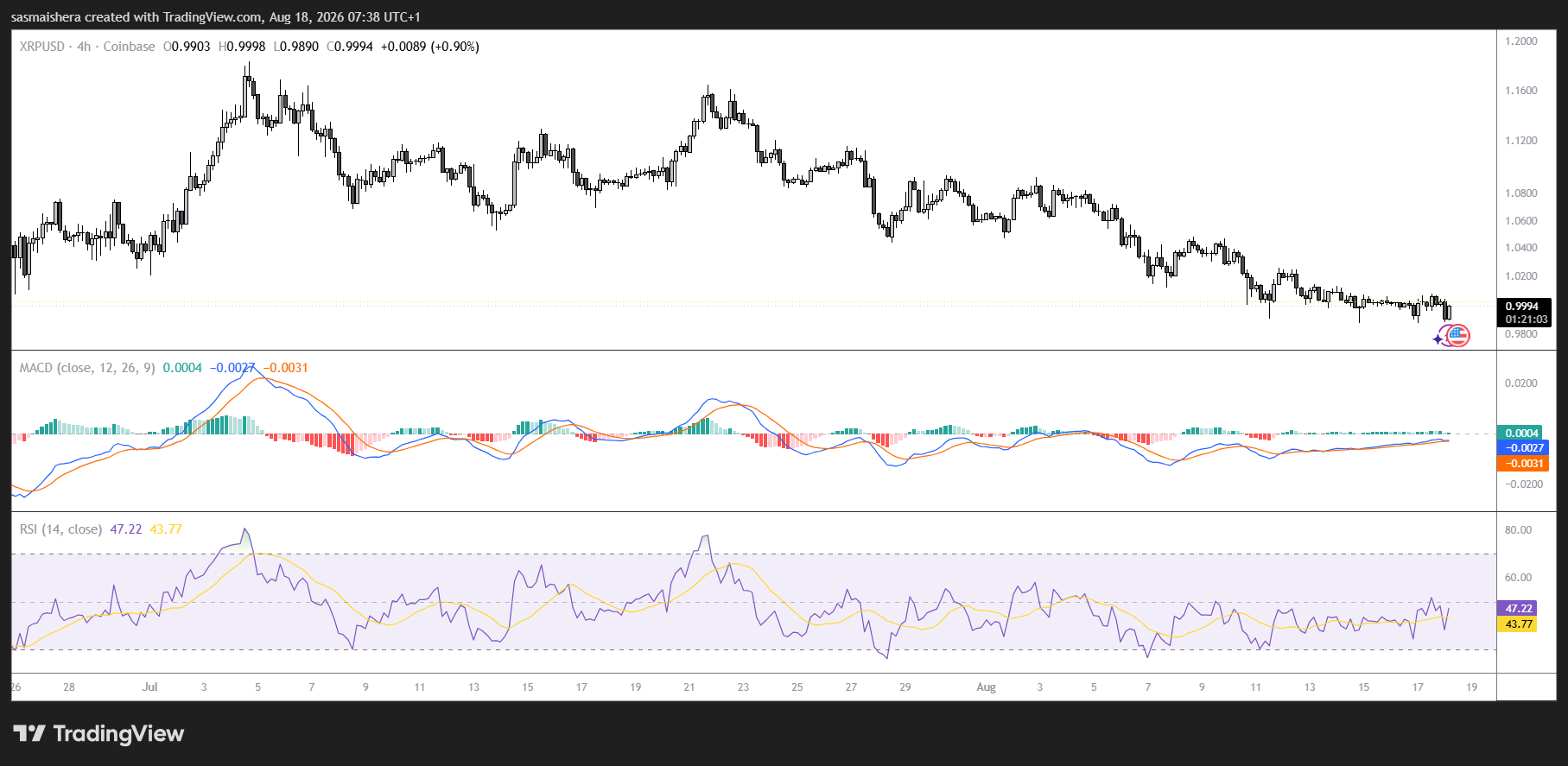
    $XRP is down by roughly 1% in the last 24 hours and trades around $0.99 on Tuesday, maintaining a bearish short-term outlook after slipping below the psychological $1.00 level and its descending trendline.

    The token also remains below its major daily Exponential Moving Averages.

    The 50-day EMA stands at $1.07, the 100-day EMA at $1.15, and the 200-day EMA at $1.34. These indicators now form several layers of overhead resistance.

    Momentum indicators reinforce the downside risk. The Relative Strength Index is near 43, reflecting weak buying momentum without yet reaching oversold territory.

    The Moving Average Convergence Divergence indicator is also slightly negative, pointing to lingering bearish pressure rather than an established reversal.

    For a recovery, $XRP must first reclaim and hold above $1.00. A successful move could bring the 50-day EMA at $1.07 into focus, followed by the 100-day EMA at $1.15 and horizontal resistance at $1.30.

    The 200-day EMA at $1.34 and the higher resistance level at $1.90 represent more distant upside targets.

    No clear support level is defined immediately below $XRP’s current price, leaving the token vulnerable to further price discovery if demand does not return around the $1.00 region.

  • Can XLM hold $0.14 as bearish traders tighten their grip on Stellar?

    Stellar ($XLM) remains under pressure on Tuesday as uncertainty across the broader cryptocurrency market and weak technical momentum weigh on Stellar.

    $XLM is down by more than 2% in the last 24 hours, extending its corrective decline beneath $0.155.

    Mixed derivatives and on-chain indicators point to cautious sentiment, leaving $XLM at risk of additional losses.

    $XLM maintains bearish bias despite Bitcoin’s rally

    $XLM is underperforming despite Bitcoin hitting the $64,000 level on Monday. The bearish performance comes as derivatives data indicates that traders are reducing their positions in the market.

    CoinGlass data shows that the long-to-short ratio for $XLM stands at 0.90. A reading below one means short positions outnumber long positions, indicating that more traders are betting on prices falling than rising.

    The funding rate also supports the current bearish price action. $XLM’s funding rate turned negative on Tuesday and now reads -0.0215%.

    A negative funding rate indicates that traders holding short positions are paying those with long positions, suggesting that the bears are in control of the market.

    Similar to XRP, $XLM’s CryptoQuant indicators suggest a bearish outlook. The indicator shows sell-side dominance across its markets alongside large whale orders.

    These conflicting signals suggest that major participants remain active, but selling pressure continues to control the near-term trend.

    The derivative data has supported the bearish price action in recent weeks.

    While Bitcoin has been consolidating between $62,000 and $64,000 in recent weeks, $XLM has lost 17% of its value in the last one month and could record further losses in the near term.

    $XLM price outlook: Stellar approaches oversold conditions

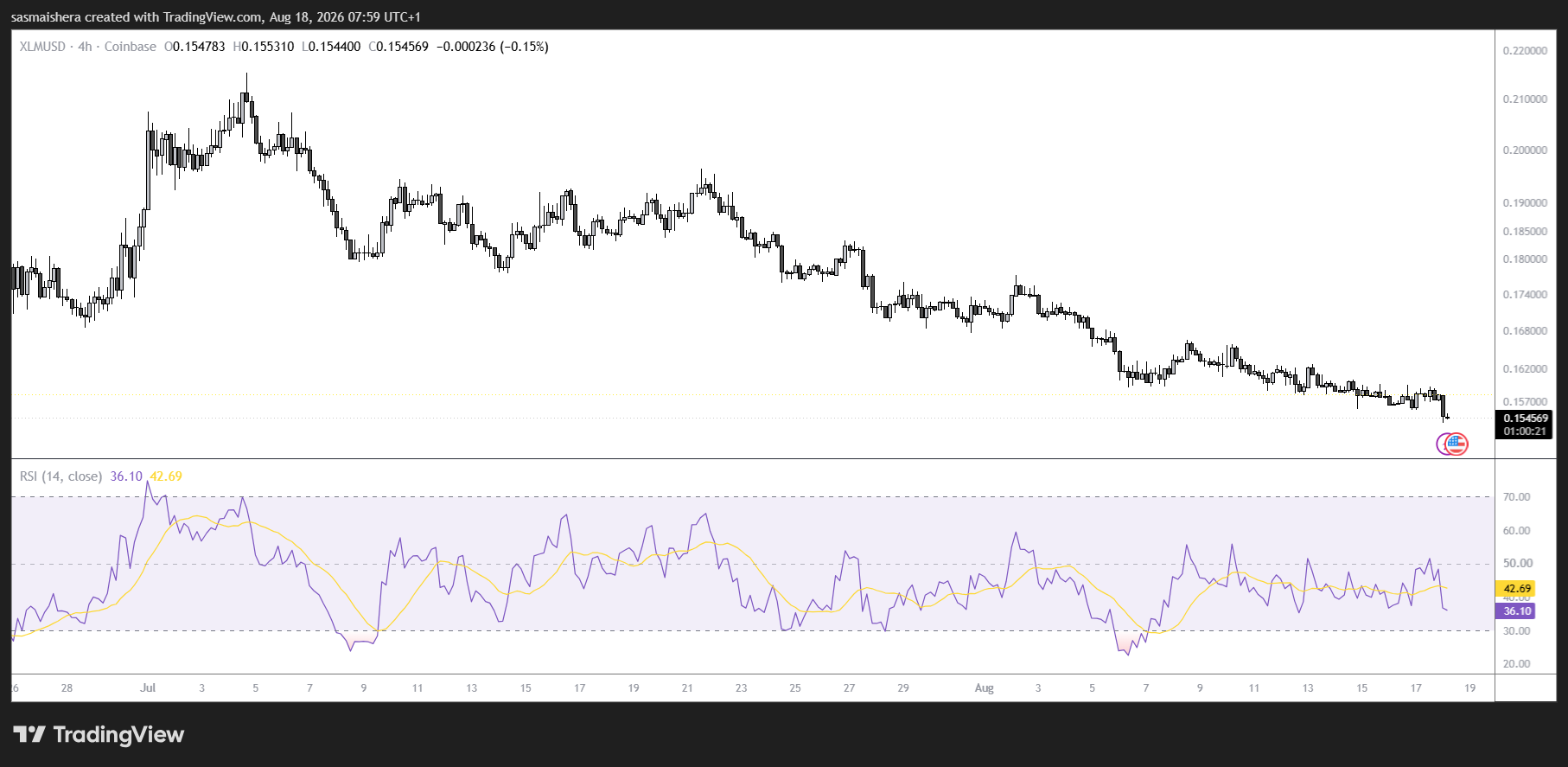
    The $XLM/USD 4-hour chart is bearish and efficient as Stellar trades at approximately $0.154 on Tuesday, extending its decline below all major daily EMAs.

    The 50-day EMA at $0.173, the 100-day EMA at $0.178 and the 200-day EMA at $0.190 form a significant resistance cluster.

    As long as $XLM remains below these levels, the broader technical outlook will remain bearish.

    The RSI is near 36, placing $XLM close to oversold territory. Meanwhile, the MACD has turned marginally positive around its zero line, suggesting that selling momentum may be weakening.

    However, neither indicator confirms a sustainable recovery while the price remains below the major moving averages.

    The first meaningful resistance sits around $0.173, where the 50-day EMA aligns with the 78.6% Fibonacci retracement. The next barriers are located at $0.177 and the 100-day EMA at $0.178.

    A stronger recovery could target the 200-day EMA at $0.190, followed by Fibonacci resistance at $0.200, $0.218, $0.237 and $0.260. The cycle high near $0.298 remains a distant target.

    On the downside, $XLM could test the support zone between $0.142 and $0.139. A decisive daily close below this range would strengthen the bearish outlook and could trigger a deeper decline.

  • Bitpanda Hit With Europe’s First Published MiCA Penalty in Austria

    Bitpanda Hit With Europe’s First Published MiCA Penalty in Austria

    In brief

    • Austria’s FMA fined Bitpanda 70,000 euros (~$82,000) in what stands as the first publicly disclosed enforcement penalty under the EU’s Markets in Crypto-Assets Regulation (MiCA).
    • The breaches were procedural and disclosure-related—failing to submit a white paper to the regulator 20 working days before publishing it, running a marketing communication before publishing the underlying white paper, and omitting a required disclaimer and contact details—rather than fraud or investor-loss allegations; the ruling is legally final.
    • The case lands as MiCA’s transition period for crypto firms winds down across the bloc, with Brussels also expected to revisit the framework in 2027 to tighten oversight of foreign stablecoin issuers.

    Austrian regulators have fined crypto exchange Bitpanda 70,000 euros, roughly $82,000, in what stands as the first publicly disclosed enforcement penalty under the European Union’s landmark crypto rulebook.

    Austria’s Financial Market Authority, known as the FMA, said the sanction stems from several breaches of the Markets in Crypto-Assets Regulation, or MiCA, the bloc’s comprehensive framework for digital assets.

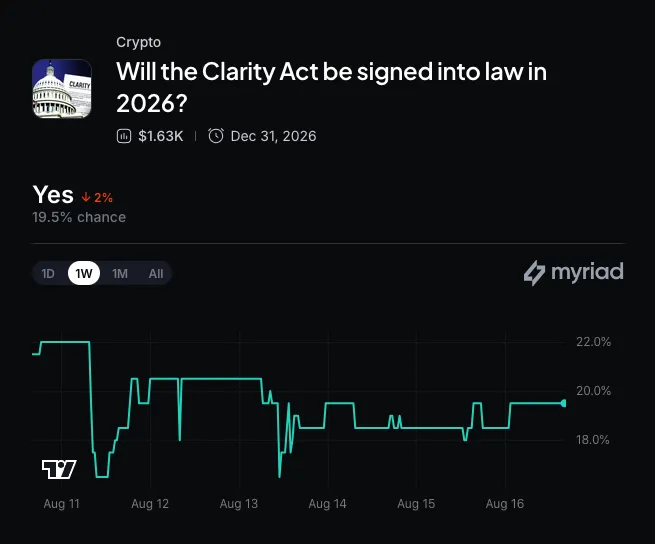
    Myriad: Will the Clarity Act be signed into law in 2026? Click to make your prediction.
    Myriad: Will the Clarity Act be signed into law in 2026? Click to make your prediction.

    The regulator said the Vienna-based company failed to submit a required crypto-asset white paper to the FMA at least 20 working days before publishing it, as the rules mandate.

    The FMA also found that Bitpanda circulated a marketing communication before publishing the underlying white paper, a sequencing MiCA prohibits. In a separate marketing message, the company omitted a mandatory disclaimer stating that the material had not been reviewed or approved by any regulator and that the offeror bears sole responsibility for its content, and left out a required phone number and email address.

    The case was wrapped up through an accelerated procedure under Austrian financial-market law, and the FMA said the penalty ruling is legally final.

    The violations are procedural and disclosure-related rather than allegations of fraud or investor losses, but the case is notable as an early marker of how European authorities intend to police the new regime. MiCA is designed to create a single set of rules across all 27 member states, with the stated goals of protecting investors and safeguarding the integrity of crypto markets.

    The penalty lands as the industry navigates MiCA’s rollout. The framework took full effect for crypto-asset service providers in late 2024, with a transition period letting existing firms keep operating while they secured authorization. That grace window has been winding down across the bloc, squeezing companies that hadn’t yet come into full compliance. Brussels is also expected to revisit MiCA in 2027, with proposed revisions that would tighten oversight of foreign stablecoin issuers.

    Bitpanda, one of Europe’s larger crypto platforms, holds MiCA licensing and has expanded aggressively across the continent. The relatively modest fine suggests the FMA treated the lapses as compliance failures rather than serious misconduct.

    Daily Debrief Newsletter

    Start every day with the top news stories right now, plus original features, a podcast, videos and more.

  • Popular Memecoin Platform Announces Cease Operations Due to Funding Problems!

    Popular Memecoin Platform Announces Cease Operations Due to Funding Problems!

    Printr, a platform offering cross-chain memecoin creation and trading services, has announced it is ceasing operations due to funding difficulties. According to the company’s announcement, the platform will completely shut down on August 31st, ending its services to users.

    The Printr team stated that they have been evaluating all possible options to continue the project for the past three months. However, due to current market conditions, insufficient funding, and lack of distribution support, it has become impossible to continue operations. The statement emphasized that the decision was made after lengthy evaluations and that the platform’s sustainability is no longer guaranteed.

    As part of the closing process, all on-chain staking positions and accumulated staking rewards on the platform have begun to be automatically resolved starting today. The relevant assets will be returned to the addresses where users made their initial investments. Staking services will be completely terminated upon completion of this process.

    On the other hand, Printr announced that its previously planned token generation event (TGE) and airdrop program have also been canceled. The project team stated that these plans will no longer be implemented as part of the closing process.

    The Printr application’s user interface will be closed after August 31st, and transactions will no longer be possible through the platform. However, tokens previously created through the platform will continue to exist as independent entities on the blockchain.

    The recent difficulty in accessing funding and declining investor interest in the crypto sector have put pressure on early-stage projects in particular, and Printr’s closure is seen as one of the latest examples of these challenging market conditions.

    *This is not investment advice.

  • Wall Street’s Leading Market Maker Raises Bitcoin Exchange Traded Funds (ETFs) Above $1 Billion!

    Wall Street’s Leading Market Maker Raises Bitcoin Exchange Traded Funds (ETFs) Above $1 Billion!

    Jane Street, a leading market maker on Wall Street, made a notable investment in Bitcoin exchange-traded funds (ETFs) in the second quarter of 2026.

    According to a 13F filing submitted to the U.S. Securities and Exchange Commission (SEC), the company purchased approximately $630 million worth of Bitcoin ETF shares during that period. This brought Jane Street’s total Bitcoin ETF holdings to $1.06 billion.

    The data released indicates a reversal of the strategy the company followed in the first quarter of the year. Jane Street reduced its Bitcoin ETF positions by approximately 71 percent in the first three months of 2026 and adopted a cautious stance towards the cryptocurrency market. However, strong purchases in the second quarter have increased expectations that institutional investor interest in Bitcoin may be revived.

    Market experts say Jane Street’s move is significant not only in terms of investment size but also its timing. Despite the volatility in Bitcoin prices in recent months, the company’s increase in positions is seen as a signal that long-term expectations remain positive.

    Spot Bitcoin ETFs traded in the US have become a significant tool for institutional investors to access the cryptocurrency market. Products offered by major financial institutions like BlackRock and Fidelity, in particular, are facilitating the flow of traditional capital into Bitcoin.

    Analysts say Jane Street’s second-quarter purchases indicate that institutional demand has not completely disappeared. However, investors will closely monitor upcoming 13F announcements to see if other major funds and financial institutions make similar changes to their Bitcoin ETF positions.

    The continued shift of institutional investors towards Bitcoin through ETFs is considered a key indicator of the market’s medium- to long-term outlook.

    *This is not investment advice.

  • Bitcoin scores a rare win over S&P 500 with 2.6% rise versus 0.5% fall

    Bitcoin scores a rare win over S&P 500 with 2.6% rise versus 0.5% fall

    Bitcoin $BTC$64,087.35 scored a rare achievement on Monday by outperforming the S&P 500.

    The largest cryptocurrency rose 2.6% to over $64,000, registering its best daily performance in over a month, according to CoinDesk data. Wall Street’s benchmark equity index, S&P 500, fell by 0.52%.

    Bitcoin, therefore, not only outpaced equities but moved in the totally opposite direction. This was once a norm. Bitcoin has spent most of its history being the higher-beta asset relative to stocks, meaning it typically moves more than stocks in both directions.

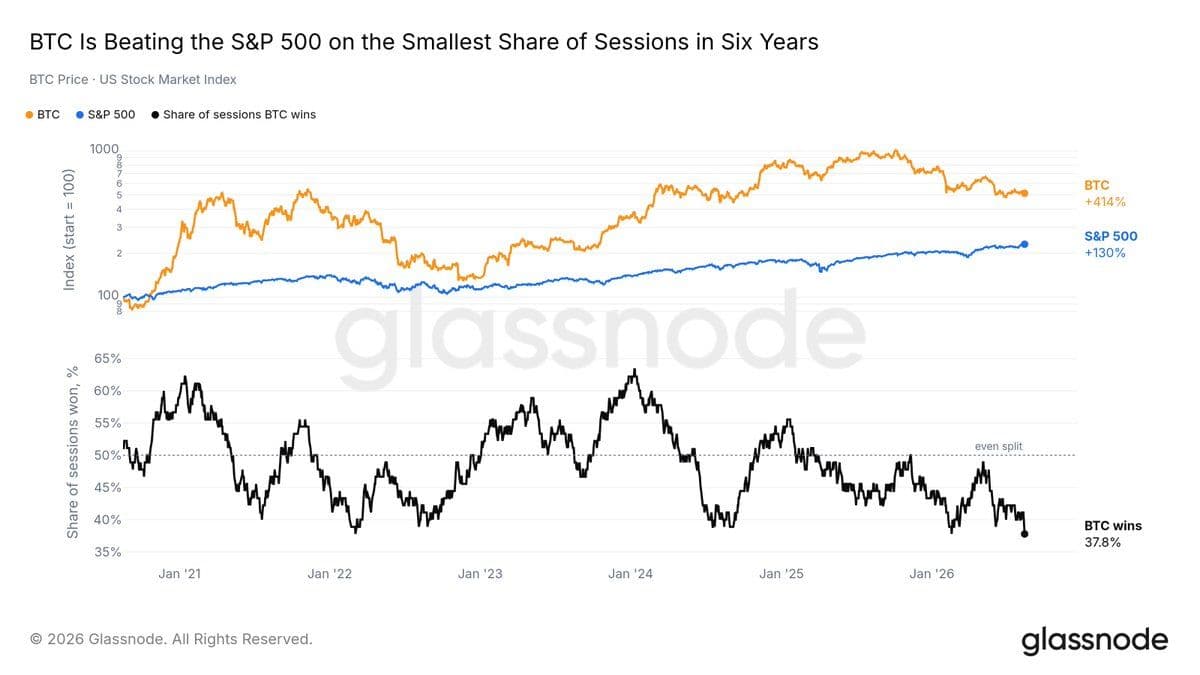
    “$BTC outperformed the stock market today. This has become a less common occurrence lately. 1/2 In fact, $BTC only outperformed the S&P 500 on around one third of trading days over the last three months,” blockchain analytics firm Glassnode said in a Telegram chat.

    $BTC has mostly underperformed the S&P 500 in recent three months. (Glassnode)

    Underperforming two-thirds of the time means $BTC has been acting less like a higher-beta asset relative to stocks and more like a laggard. Key reasons for that include the AI stock frenzy on Wall Street that has sucked out capital from other corners of the financial market, including cryptocurrencies.

    The bear market phase of bitcoin’s self-fulfilling four‑year cycle has also played a role in keeping demand for $BTC subdued. $BTC peaked above $126,000 in October last year and quickly entered the bear market, which is expected to bottom out by October this year.

  • Anti-Bitcoin Peter Schiff Sees Bitcoin’s Recent Price Recovery as a Selling Opportunity

    Anti-Bitcoin Peter Schiff Sees Bitcoin’s Recent Price Recovery as a Selling Opportunity

    Peter Schiff, CEO of Euro Pacific Capital, known for his anti-Bitcoin views, said that Bitcoin’s recent price recovery should be seen as a selling opportunity rather than a buying opportunity for investors. Schiff, who has been in the spotlight for many years for his critical statements about Bitcoin, made noteworthy assessments regarding the cryptocurrency market in a post on the social media platform X.

    Schiff stated that he was unsure why Bitcoin hadn’t experienced a decline in the last trading day, arguing that the price increase presented an opportunity for long-term investors to reduce their positions. The renowned economist noted that he couldn’t see the fundamental factors supporting the current rise and that it was unclear what factors were keeping the price afloat.

    In his statements, Schiff specifically drew attention to the $65,000 level, arguing that this area represents a significant resistance point for Bitcoin. According to the experienced investor, Bitcoin does not have significant upside potential above this level. Conversely, he stated that if the price remains below $65,000, the downside risks outweigh the downside risks.

    Schiff’s comments come amid ongoing debate about whether Bitcoin’s recent recovery is sustainable. While some investors in the cryptocurrency market believe the rally will continue, others remain cautious due to macroeconomic uncertainties and market volatility.

    According to CoinMarketCap data, Bitcoin was trading at $64,405 at the time of writing, having gained 2.49% in the last 24 hours. Despite its recent surge, the largest cryptocurrency is still hovering near critical technical levels, with investors closely watching how the price will react to the $65,000 resistance.

    *This is not investment advice.

  • Crypto Fear and Greed Index Rises to 41, Optimism Signals Strengthening in the Market!

    Crypto Fear and Greed Index Rises to 41, Optimism Signals Strengthening in the Market!

    The Crypto Fear and Greed Index, a key indicator measuring investor sentiment in the cryptocurrency markets, rose to 41 today, signaling a limited improvement in market sentiment.

    According to the data, the index rose by 10 points compared to the previous day. However, despite this increase, the indicator is still in the “fear” zone.

    The index is used to measure investors’ risk perception and overall sentiment towards the market. As the indicator approaches zero, it shows increased fear and selling pressure in the market; as it approaches 100, it indicates that investors are more optimistic and willing to take risks. Therefore, the current level of 41 reveals that market participants remain cautious but exhibit a more positive outlook compared to previous days.

    Analysts note that the rise in the index could signal a gradual recovery in investor confidence. However, the fact that the indicator is still in the fear zone suggests that the market has not fully transitioned to an optimistic outlook and that investors continue to closely monitor macroeconomic developments and price movements in the cryptocurrency market.

    *This is not investment advice.

  • Monad, an Ethereum rival, offered early investors up to $60 million to cash out. Almost all said no

    Monad, an Ethereum rival, offered early investors up to $60 million to cash out. Almost all said no

    Investors were allocated about 19.7 billion $MON, nearly 20% of the original supply. Those tokens were locked when Monad’s public network launched last November and begin unlocking after a one-year wait, followed by monthly releases over the remainder of a four-year schedule.

    That makes November the first point at which early investors begin receiving tokens they can sell normally.

    $MON traded around $0.021 on Tuesday, about 16% below the $0.025 price of last year’s public sale. Roughly 11.8 billion $MON are currently circulating, giving the token a market value near $250 million against a fully diluted value of about $2.1 billion.

    As such, the token price has struggled while activity on the network has grown.

    The amount of money deposited in Monad-based decentralized finance apps has climbed to about $895 million from roughly $360 million on July 2, according to DeFiLlama, an increase of almost 150% in about six weeks. Stablecoins on Monad are worth about $707 million, while decentralized exchanges on the network handled roughly $79 million of trading over the past day.

    That growth does not explain why investors rejected the Foundation’s offer. And without knowing how steep a discount they were asked to take, the lack of sellers cannot be read simply as a bullish call on $MON.