Category: Business

  • Bitcoin Surpassed $65,000: Liquidations Occurred, and a Major Short Whale Suffered an Unbelievable Loss

    Bitcoin Surpassed $65,000: Liquidations Occurred, and a Major Short Whale Suffered an Unbelievable Loss

    Bitcoin’s price surpassing the $65,000 level triggered liquidations in highly leveraged short positions. According to on-chain data, a large whale holding approximately $117 million worth of Bitcoin short positions had $23.36 million of those positions forced to close during the surge.

    It was reported that the whale in question continues to hold a short position of approximately 1,440 $BTC, currently valued at $93.21 million, following the liquidation. The current liquidation price of the open position is stated to be approximately $65,042. It is assessed that if the Bitcoin price remains above this level or continues its upward trend, the liquidation pressure on the position may increase.

    On the other hand, the on-chain analytics platform Glassnode shared noteworthy data regarding long-term investor behavior in the Bitcoin market. According to Glassnode, the “strong hands” in the market, i.e., investors who tend to hold onto their assets long-term despite price fluctuations, continue to accumulate Bitcoin.

    The platform stated that market bottoms typically form when profit-taking slows and investors with high confidence begin buying. It noted that the current market structure, in some aspects, resembles the bottom formation process seen in 2022.

    According to Glassnode data, the largest increase in the amount of Bitcoin held by high-trust investors occurred when the $BTC price fell to around $60,000 in January.

    *This is not investment advice.
  • Citi to Launch Bitcoin Custody as Wall Street Pushes Deeper Into Crypto

    Citi to Launch Bitcoin Custody as Wall Street Pushes Deeper Into Crypto

    In brief

    • Citi expects to launch digital asset custody later this year, starting with Bitcoin.
    • The service will let institutional clients access traditional and crypto custody through the same framework.
    • Citi Token Services already supports 24/7 transfers of tokenized deposits in select markets.

    Citi is preparing to add Bitcoin custody alongside traditional assets as the banking giant builds out its digital asset infrastructure.

    Announced on Tuesday, the service will be part of Custody+, a suite of custody and settlement tools. The bank said clients will be able to access traditional securities and crypto custody through the same framework.

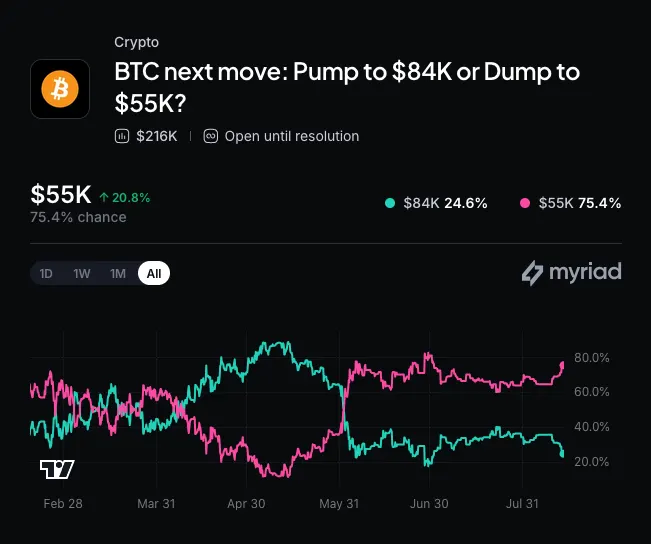
    Myriad: Bitcoin's next move? Click to make your prediction.
    Myriad: Bitcoin’s next move? Click to make your prediction.

    The announcement expands on plans Citi revealed in October to launch institutional Bitcoin custody in 2026.

    “Custody+ is the product of a multi-year commitment to building infrastructure that matches the speed of our clients’ strategies,” Amit Agarwal, Head of Custody at Citi Investor Services, said in a statement. “We have designed each solution to help clients simplify their operating models amid increasing complexities in the operating environment.”

    Citi said more than 80% of its asset-servicing event volume is now processed in real time. Its Citi Token Services platform also allows clients to move tokenized deposits nearly instantly, 24 hours a day, across select markets.

    “Custody+ is our response to their evolving needs as the industry continues to transform, moving away from legacy to next-generation architecture,” Agarwal added.

    The announcement comes as major banks expand their digital asset businesses.

    In January, the New York Stock Exchange said it was working with Citi and BNY on a planned blockchain-based platform supporting tokenized stocks and ETFs. In February, Morgan Stanley applied for a national trust bank charter for an entity that would offer crypto custody.

    Daily Debrief Newsletter

    Start every day with the top news stories right now, plus original features, a podcast, videos and more.

  • LendProtocol Launches Fixed-Rate XRP Lending

    LendProtocol Launches Fixed-Rate XRP Lending

    LendProtocol, a centralized lending service, has launched a fixed-rate lending platform for $XRP and $RLUSD holders on the $XRP Ledger. The service offers a 12% annual rate. Borrowers must provide collateral worth 120% of the loan amount.

    LendProtocol operates as a centralized lending service rather than a native $XRP staking platform. The $XRP Ledger does not use Proof-of-Stake and does not distribute staking rewards. Users who want to earn returns on $XRP therefore need to use third-party lending, exchanges, or other yield products.

    According to LendProtocol, the platform has facilitated more than 743 million $XRP in loans and currently serves over 13,713 active lenders. The company says borrowers pay 12.7% APR, while depositors receive 12%, with the difference covering the platform’s operating spread.

    Users can deposit $XRP or $RLUSD, while collateral can include Bitcoin, Ethereum, Solana, $XRP, $RLUSD, and USDT. LendProtocol says it takes direct lending exposure if a borrower defaults. The platform also uses cold storage, data encryption, and two-factor authentication.

    Image: Magnific

  • L4VA Launches Tokenized Silver Vault with Toto Finance

    L4VA Launches Tokenized Silver Vault with Toto Finance

    L4VA, a programmable capital markets infrastructure, has launched the Toto Finance Silver Vault on the Cardano blockchain. The new vault gives users access to tokenized physical silver backed by the underlying asset.

    The vault allows participants to acquire tokens representing a proportional share of the physical silver. These tokens can be traded through decentralized liquidity pools, creating an on-chain market for the asset. Eligible users can also receive L4VA ecosystem rewards for qualifying activity, while liquidity providers can earn trading fees.

    L4VA provides infrastructure for turning real-world assets into digital financial products. Toto Finance focuses on asset-backed products and is working with L4VA to expand access to physical commodities through blockchain technology.

    Image: Magnific

  • Attention XRP Investors: Ripple Announces Partnership with a Major Bank! “It Will Be the First Bank of Its Kind in Its Country!”

    Attention XRP Investors: Ripple Announces Partnership with a Major Bank! “It Will Be the First Bank of Its Kind in Its Country!”

    Despite still experiencing significant upward movement in XRP price, Ripple aims to solidify its leading position in the blockchain ecosystem.

    At this point, Ripple is expanding its corporate digital asset services by forging new partnerships to continue its global growth.

    Accordingly, Ripple announced that it has established a strategic partnership with Jeonbuk Bank, one of South Korea’s most important regional banks.

    The bank, which operates under the umbrella of JB Financial Group, will use Ripple Payments infrastructure for cross-border commercial payments.

    According to Ripple’s official statement, Jeonbuk Bank will be the first regional bank in South Korea to use Ripple Payments.

    The partnership aims to provide faster cross-border payment services, particularly to corporate clients such as import-export companies, technology startups, and online content creators who make international payments.

    Thanks to Ripple, payments will be processed in minutes!

    The statement indicates that Ripple Payments’ infrastructure can enable payments to be processed within seconds or minutes, 24/7.

    The statement explains that Jeonbuk Bank’s use of Ripple Payments could reduce the numerous intermediary steps involved in the current SWIFT-based international money transfer process and support real-time payments in seconds.

    Ripple Asia-Pacific General Manager Fiona Murray stated that the partnership demonstrates the growing interest of South Korea’s corporate finance sector in digital asset infrastructure.

    JB Jeonbuk Bank Chairman Park Choon-won stated in his announcement that through this collaboration, the bank plans to enhance its digital financial competitiveness and expand its global financial services.

    *This is not investment advice.

  • Bitcoin Wallet Untouched for 15 Years Suddenly Springs to Life

    Bitcoin Wallet Untouched for 15 Years Suddenly Springs to Life

    In brief

    • A Bitcoin wallet holding 8.54 BTC, first funded on June 13, 2011, moved its coins for the first time in 15 years on Aug. 16.
    • The position is now worth about $538,000 for a roughly 461,981% gain if sold.
    • It follows a trend of ancient Bitcoin wallets suddenly coming to life.

    A Bitcoin stash that had sat frozen since the network’s earliest days has moved for the first time in more than 15 years, the latest in a string of ancient wallets flickering back to life.

    According to Galaxy Research‘s blockchain monitoring, a Bitcoin address beginning in “1Emi” holding 8.54 BTC first received the coins on June 13, 2011, when Bitcoin traded around $14, and then went silent for 15.1 years.

    Myriad: Bitcoin's next move? Click to make your prediction.
    Myriad: Bitcoin’s next move? Click to make your prediction.

    The balance, now worth roughly $538,000, was swept out on Aug. 16 in a single transaction recorded in block 962,770. At an average cost basis near $14, the position represents a gain of about 461,981%.

    Movements like this draw outsized attention because so few holders from Bitcoin’s infancy still control their coins, or their private keys, after this long. In 2011, Bitcoin was a thinly traded curiosity worth pocket change, not a trillion-dollar asset.

    Wallets that have stayed untouched since then are widely presumed lost, so when one stirs, analysts and traders take notice, watching for signs that an early adopter may be preparing to cash in.

    The metric they lean on is Coin Days Destroyed, which tallies the age a coin accumulates for each day it sits unmoved. A single transfer from a 2011 wallet wipes out thousands of those accrued days at once, flagging a long-held balance changing hands even when the owner’s motive stays hidden. A large print can mean profit-taking, but it can just as easily reflect a holder relocating funds for security or custody.

    The reactivation is far from a one-off. Ancient Bitcoin wallets coming back to life has become something of a trend within the last two years.

    Just last week, a Bitcoin address holding millions moved its stash after 12 years. Another wallet dormant since 2011 moved 49.97 BTC earlier this month, a Bitcoin whale shifted $383 million after eight years, and roughly $2 billion in coins untouched since 2013 changed hands in a single 2024 sweep that analysts pinned on a custodian rebalancing. In most such cases, the coins have flowed toward professional trading infrastructure rather than a retail seller dumping on the open market.

    Galaxy noted the awakened address carried no public attribution, leaving the identity and intentions of its owner unknown.

    Daily Debrief Newsletter

    Start every day with the top news stories right now, plus original features, a podcast, videos and more.

  • Toyota Finance opens tokenized bonds to retail investors via mobile payment app

    Toyota Finance opens tokenized bonds to retail investors via mobile payment app

    Toyota’s finance arm is launching a tokenized bond that retail investors can buy directly through the Japanese carmaker’s mobile payment app, Toyota Wallet.

    Toyota Finance said Tuesday that applications have opened for the one-year bond, with investments starting at 100,000 Japanese yen ($676). The new bond will be distributed directly by Toyota Finance, allowing investors to buy it without opening a securities account.

    The 1 billion yen bond carries a 1.72% annual interest rate and will be managed on blockchain infrastructure provided by Japanese security-token firm BOOSTRY.

    The carmaker said the direct distribution model will allow it to integrate applications, communications with bondholders and investor benefits within the same ecosystem.

    Investors may also receive Toyota Wallet balances and qualify for benefits including Fuji Speedway tickets and test-drive experiences, including in Lexus and selected classic Toyota vehicles.

    The offering is Toyota Finance’s second security token bond following its debut issuance in March 2025, which was sold through securities companies.

  • Why Was the SEC’s Big Crypto Meeting Canceled? Big Names Emerge From Behind the Scenes! Here Are the Details

    Why Was the SEC’s Big Crypto Meeting Canceled? Big Names Emerge From Behind the Scenes! Here Are the Details

    New developments continue to emerge regarding planned regulations for the US cryptocurrency market. First, a meeting scheduled for Friday by the SEC, where a new regulatory framework for initial public offerings of crypto assets was to be discussed, was canceled at the last minute. The SEC was expected to initiate the formal rule-making process for this new framework, dubbed “Regulation Crypto Assets,” at that meeting.

    One of the first to announce the cancellation of this meeting was American journalist Eleanor Terrett, who stated in her post that the SEC’s official reason was “an unforeseen programming problem.”

    While speculation continues in the market about why the meeting was canceled, some sources are now pointing the finger at Wall Street.

    Is the SEC Under Pressure from Wall Street?

    According to Decrypt, Wall Street played a role in the cancellation of the SEC’s Friday meeting. Sources say that pressure from the Securities Industry and Financial Markets Association (SIFMA), a major Wall Street organization, was instrumental in the cancellation.

    According to sources who spoke to Decrypt, SIFMA opposed the SEC’s creation of a framework that could provide crypto companies and tokenization firms with broad exemptions from existing securities regulations.

    The report states that SIFMA’s main objection centers on whether the SEC can create such a broad regulatory framework using its existing statutory powers.

    Sources also reported that SIFMA signaled that it could take legal action if the SEC took such a step. This is said to have influenced the SEC’s decision to postpone the planned meeting.

    At this point, sources indicate that the real debate behind the scenes is the SEC’s regulatory authority over the cryptocurrency market and Wall Street’s objections to that regulation.

    It is noteworthy that these developments come immediately after the US Senate failed to make progress on the CLARITY Act before going on recess in August, and the CLARITY Act was postponed until September.

    According to experts, the SEC’s independent efforts to develop comprehensive regulations for the cryptocurrency market, coupled with Congress’s attempt to create a legal framework through the Clarity Act, make the debate over which institution and under what authority will shape cryptocurrency regulations in the US even more significant.

    It remains unclear when the SEC will reschedule the meeting and whether the “Regulation Crypto Assets” process will continue.

    *This is not investment advice.
  • Chainalysis Sues US Government Over $94.6M ICE Contract Handed to Rival TRM Labs

    Chainalysis Sues US Government Over $94.6M ICE Contract Handed to Rival TRM Labs

    In brief

    • Chainalysis Government Solutions filed a bid protest on July 27 challenging ICE’s roughly $94.6 million sole-source contract awarded to rival TRM Labs.
    • TRM Labs intervened on July 28 to defend the award alongside the government; Chainalysis’s core complaint remains under seal to protect trade secrets.
    • ICE justified the award by saying a roughly six-day market-research window found none of the eight responding companies could match TRM’s capabilities.

    Chainalysis has taken the U.S. government to court over a nearly $95 million Immigration and Customs Enforcement contract awarded to competitor TRM Labs without an open bidding process, pitting the two biggest names in blockchain forensics against each other.

    The company’s government arm, Chainalysis Government Solutions, filed the bid protest on July 27 in the U.S. Court of Federal Claims. The dispute centers on a one-year deal worth about $94.6 million, running from July 1, 2026, through June 30, 2027, that covers blockchain forensic software and support services for Homeland Security Task Force investigations, including work on scams, cybercrime, and sextortion cases.

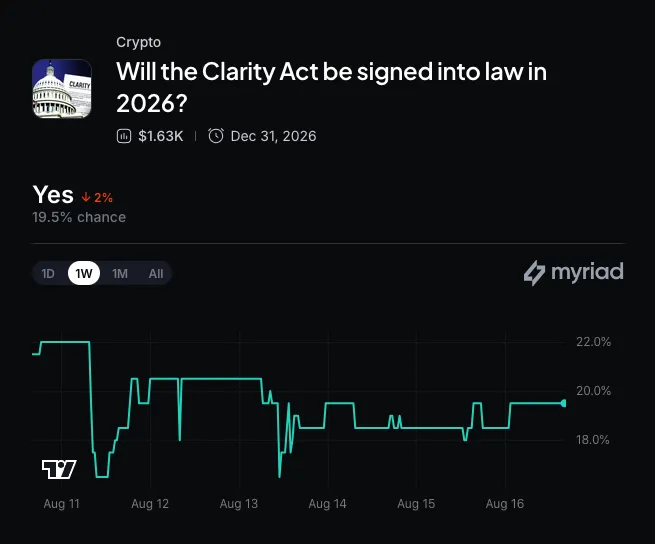
    Myriad: Will the Clarity Act be signed into law in 2026? Click to make your prediction.
    Myriad: Will the Clarity Act be signed into law in 2026? Click to make your prediction.

    Chainalysis argues ICE’s decision to route the award to TRM on a sole-source basis was arbitrary, capricious and unreasonable, saying it had submitted a capability statement after the agency signaled its intent to buy the services from a single provider.

    The heart of its legal argument stays hidden for now: the court granted Chainalysis permission on July 31 to keep its complaint under seal because it contains confidential business information and trade secrets.

    TRM Labs entered the case on July 28 as a defendant-intervenor, lining up alongside the government to defend the award. Judge Stephen Schwartz has set oral arguments for September 2 under an expedited schedule, with the government requesting a decision by September 10.

    At issue is how ICE reached its conclusion. According to the agency’s justification, it ran a market-research window of roughly six days before determining that only TRM could meet its requirements. Eight companies responded, four of them small businesses, and ICE found all of them lacked the necessary capabilities.

    The fight underscores how lucrative federal work has become for blockchain-intelligence firms. Chainalysis built much of its business selling tracing tools to agencies including the IRS and the U.S. Air Force, and the Joe Biden administration moved to expand crypto-tracking capabilities to combat ransomware. TRM has since grown its own government footprint, previously landing smaller sole-source awards from ICE.

    A bid protest challenges a procurement decision and is not an accusation of wrongdoing by the winning vendor.

    Daily Debrief Newsletter

    Start every day with the top news stories right now, plus original features, a podcast, videos and more.