Category: Business

  • What’s Next for Bitcoin After Historic Rally? Experts Weigh In

    What’s Next for Bitcoin After Historic Rally? Experts Weigh In

    In brief

    • Bitcoin climbed above $72,000 Thursday after gaining nearly 15% since Monday.
    • Analysts pointed to Treasury bond purchases, policy headlines, and a massive short squeeze as drivers of the rally.
    • With much of the short squeeze exhausted, analysts are watching spot demand, technical levels, and Treasury yields.

    Bitcoin’s rally above $72,000 wiped out billions of dollars in bearish bets, but analysts say it will need fresh buyers to keep climbing.

    Bitcoin reached its highest price since June on Thursday after gaining nearly 15% since Monday, with more than $3 billion in crypto short positions liquidated. That’s the largest liquidation of short positions on Bitcoin since at least 2021. What’s more, spot Bitcoin ETFs pulled in $517 million Wednesday, their largest single-day inflow since May.
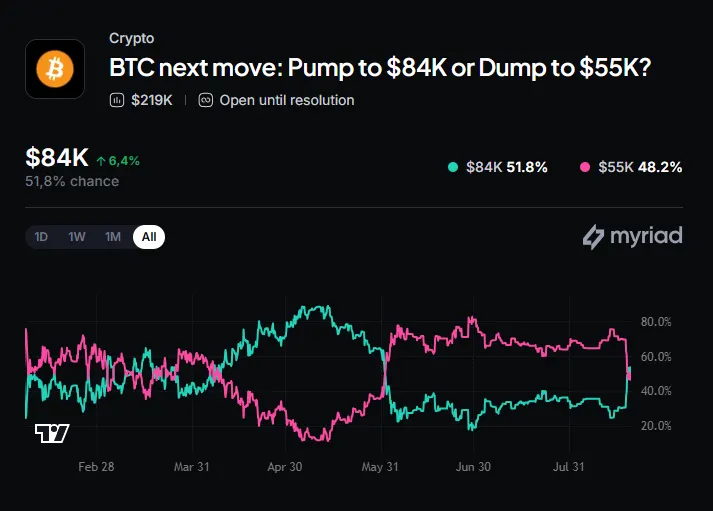
    Myriad: Bitcoin price next move? Click to make your prediction.
    Myriad: Bitcoin price next move? Click to make your prediction.

    Julio Moreno, head of research at CryptoQuant, attributed the rally to the U.S. Treasury buying long-dated government bonds, which markets interpreted as increasing liquidity, and President Donald Trump suggesting that the U.S. government could purchase Bitcoin.

    “The rally may be sustainable if spot demand growth continues after the initial impact of these macro events,” Moreno told Decrypt. “Officially we are still in a bear market, so a price pull back is possible, more so after this sudden increase.”

    Moreno said he is watching Bitcoin’s 365-day moving average, currently around $83,000, along with CryptoQuant’s profit-and-loss index and bull score, neither of which has turned bullish.

    “To confirm that a bull market has started, I’m watching CryptoQuant’s P&L Index, specifically if it crosses its 365-day moving average to the upside, which it has still not crossed,” Moreno said. “Moreover, CryptoQuant’s bull score continues in bearish mode, so I’m waiting for it to switch into bull territory.”

    Nansen Senior Research Analyst Nicolai Sondergaard said Bitcoin’s technical picture has improved after reclaiming its 200-day simple moving average around $69,000. Bitcoin also sits about 8% above its 20- and 50-day moving averages, while its MACD, a momentum indicator used to track changes in price trends, has turned bullish.

    “The key line is the 200-day SMA near $69,000 and holding above it keeps the breakout valid, while a close back below would signal a failed move,” Sondergaard told Decrypt. “Above, the recent high ~$72,824 is immediate resistance.”

    However, Sondergaard warned that much of the rally was driven by liquidations rather than sustained buying, leaving Bitcoin vulnerable once the short squeeze runs out. Positioning remains mixed, he said, though whales and public figures on Hyperliquid are net long by $27.9 million and $33.9 million, respectively.

    “The largest risk is that this was a short-squeeze spike, not fresh sustained buying,” he said. “Once forced covering exhausts, thin follow-through can reverse quickly.”

    Sondergaard said trader positioning remains mixed and warned that “any reversal in that narrative or a broader risk-off move could stall the rally fast.”

    Adam McCarthy, a researcher at crypto trading firm Lo:Tech, also attributed the move to the Treasury’s expanded buyback program and the short squeeze. More than half of Wednesday’s gain occurred within a single hour as traders were forced out of a one-sided short position, he said.

    “The Treasury’s buyback expansion gave the market a reason to reprice, but more than half of Wednesday’s gain came in one hour when a one-sided short position was forced out,” McCarthy told Decrypt. “That fuel is spent, so the next leg has to be bought rather than squeezed.”

    McCarthy said he is watching the 30-year Treasury yield, particularly whether it moves back toward 5.3%, and crypto funding rates for signs of sustained buying.

    “In crypto, whether funding starts showing a real long premium, because that’s what actual buying looks like,” he said.

    McCarthy warned that the short positions that helped drive Bitcoin higher have largely been cleared.

    “The short base is largely cleared and nothing has replaced it, so the move that got us here can’t repeat,” McCarthy said. “And if dealers are short gamma at $70k as we think, the hedging that exaggerated the way up exaggerates the way down.”

    Bitwise Research Analyst Ishmael Asad was more bullish, calling the rally the strongest indication yet that Bitcoin has bottomed. He pointed to the Treasury’s expanded bond buybacks, the SEC’s proposed Regulation Crypto Assets framework, and this week’s White House crypto summit as catalysts.

    “After this steep leg up, I wouldn’t expect the rally to continue at the same pace from here,” Asad told Decrypt. “But I would take this move as the strongest confirmation we’ve seen yet that the bottom is in.”

    Asad said much of the potential downside, including the failure to pass the Clarity Act this year and possible rate hikes, has already been priced in. Still, he said a return to a bull market would require additional catalysts.

    “The market will likely move sideways or higher in the coming months as we look towards the next milestones, like a potential Senate vote on Clarity in September,” he said.

    CoinShares Head of Research James Butterfill also expects conditions to remain favorable, but said Bitcoin is more likely to trade within a range than enter a sustained breakout.

    “The rally is primarily a macro story rather than a crypto specific one,” Butterfill told Decrypt. According to Butterfill, recent inflation and employment data have weakened expectations for further Federal Reserve tightening, while large Bitcoin holders have stopped selling and begun accumulating again.

    “We expect the constructive backdrop to persist, but we would characterize the market as range-bound for now rather than in a sustained breakout, as accumulation by large holders is not yet at a scale that would imply one,” he said.

    Digital asset investment products have also attracted about $1.3 billion so far this week. Still, Butterfill expects Bitcoin to remain range-bound because accumulation by large holders is not yet strong enough to support a sustained breakout.
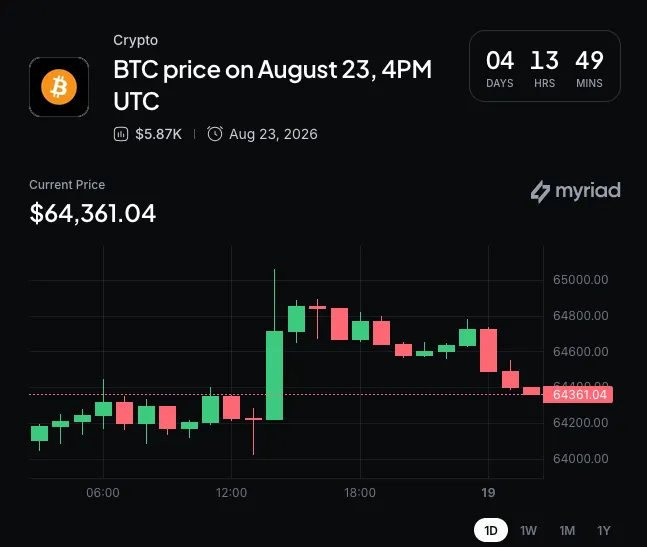
    Myriad: Bitcoin next price move? Click to make your prediction.
    Myriad: Bitcoin price on Sunday? Click to make your prediction.

    Bitcoin’s move above its 200-day moving average has improved the technical picture, Butterfill said, with $80,000 now a key level to watch.

    “On the upside, the US $80,000 area remains the important boundary, and a decisive move through it would likely require clearer confirmation from the Federal Reserve that policy risks have shifted away from further tightening,” he said.

    Monetary policy, he added, remains the biggest risk, noting that persistent inflation could force the Federal Reserve to keep policy tighter for longer, reversing the liquidity conditions supporting Bitcoin’s rally.

    “With accumulation by large holders still modest in scale, the market lacks the depth of conviction that typically underpins a durable breakout,” Butterfill said.

    Daily Debrief Newsletter

    Start every day with the top news stories right now, plus original features, a podcast, videos and more.

  • U.S. CFTC chief puts staff on notice to create crypto regulations if Clarity Act fails

    U.S. CFTC chief puts staff on notice to create crypto regulations if Clarity Act fails

    “To achieve this, I’ve directed the CFTC staff to begin exploring rules to codify a CFTC market structure for crypto assets using the agency’s existing authorities,” Selig said, promising the agency will be in a position to move swiftly. And he said he’s also steered staff toward work with developers to build regulations to “offer their protocols in a legal and compliant manner in the United States, future-proofing developer protections once and for all.”

    The CFTC’s sister agency, the Securities and Exchange Commission, just this week proposed its first major crypto rule, known as Regulation Crypto Assets, to allow crypto startups and fundraising with fewer regulatory hurdles. And the two agencies had previously jointly issued a policy stance defining the different kinds of digital assets and what regulatory buckets they should fall into, though it wasn’t set as a formal rule.

    But SEC Chair Paul Atkins was quick to point out at an event with President Donald Trump on Wednesday that “the most important priority is for Congress to send the Clarity Act to your desk for your signature,” and he’s routinely argued that the new law would be the way to assure permanence for crypto policy.

    The CFTC chief agreed on Thursday, saying, “Passing Clarity is the surest way that we can prevent another Gary Gensler from running a rogue campaign of lawfare against the individuals and companies in this room today.”

  • The Cryptocurrency Market Is Recovering: There Are Some Important Developments and Warnings Regarding the Recent Bitcoin Hack

    The Cryptocurrency Market Is Recovering: There Are Some Important Developments and Warnings Regarding the Recent Bitcoin Hack

    Coldcard has released a new firmware update to enhance the security of its hardware wallets. The company stated that some recovery phrases created in previous software versions may pose a potential security risk, and advised affected users to create a new recovery phrase and transfer their assets to the new wallet.

    As you know, a security vulnerability in the Coldcard hardware wallet recently resulted in the theft of over $70 million worth of Bitcoin from users’ wallets.

    Coldcard has released version 5.6.1 for the Mk4 and Mk5 models, and 1.5.1Q for the Q model. The update is the result of a comprehensive security review lasting approximately three weeks, following the emergency security patch released on July 31st.

    With the new firmware, every new recovery string created on Coldcard devices must now include at least one user-provided source of physical entropy.

    Users will be able to do this using one of the following options: at least 65 irregular keystrokes, 50 physical dice rolls, or 128 physical coin tosses.

    This user-generated randomness will be combined with new entropy derived from the device’s STM32 TRNG hardware and the SE1 and SE2 secure elements. Coldcard stated that this change aims to make the recovery string generation process more resilient to potential attacks.

    The update doesn’t just change how recovery statements are generated. The new version also enables real-time and incremental PSBT verification before the signing process.

    In addition, security measures for USB connections and firmware update processes have been strengthened, and the Delta Mode isolation mechanism has been improved.

    The update addresses several issues related to backing up active wallets, while also implementing more robust random number generators and making error checks more rigorous. Various security and accuracy improvements are included in the update, along with changes to the SIGHASH defaults.

    The most important warning in Coldcard’s announcement concerns the current recovery statements.

    The company specifically emphasized that installing the new firmware does not eliminate a potential security issue in recovery strings created using previously affected software versions.

    Users affected by the security alert must first update their devices to the new firmware version, then create and verify an entirely new recovery string, and transfer their existing Bitcoin assets to the newly created wallet.

    Coldcard also strongly advised all Mk4, Mk5, and Q users to update their devices as soon as possible and verify the digital signature of the downloaded firmware file.

    *This is not investment advice.

  • CFTC Chair Readies Crypto Rules If Congress Fails to Pass Clarity Act

    CFTC Chair Readies Crypto Rules If Congress Fails to Pass Clarity Act

    In brief

    • CFTC Chair Michael S. Selig directed staff to explore crypto market structure rules using the agency’s existing authority.
    • Selig said he will direct staff to formally propose the rules if the Clarity Act remains stalled in Congress.
    • The potential framework could cover crypto exchanges, leveraged trading, and on-chain finance protocols.

    Commodity Futures Trading Commission Chair Michael S. Selig has directed agency staff to begin developing crypto market structure rules, preparing the regulator to act if Congress fails to pass the Clarity Act.

    Speaking Thursday at the inaugural meeting of the CFTC’s Innovation Advisory Committee, Selig said passing bipartisan market structure legislation remains his preferred path. If the bill remains stalled, however, he said the CFTC will use its existing authority to establish a regulatory framework for crypto markets, calling it “the most important step towards future-proofing this industry is passing this bipartisan bill.”

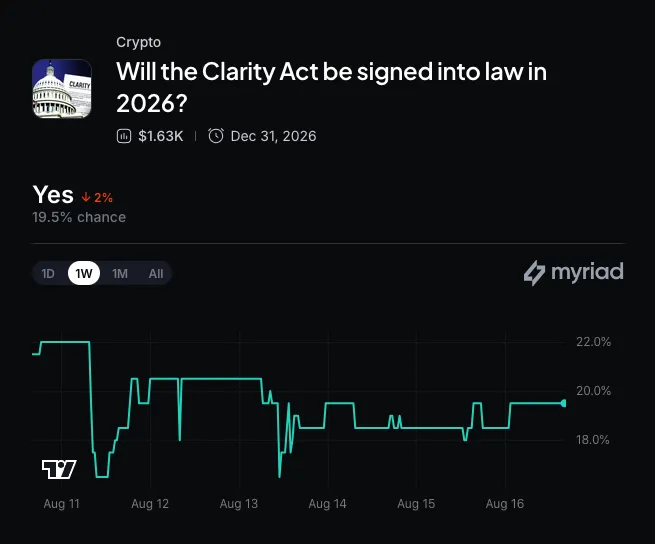
    Myriad: Will the Clarity Act be signed into law in 2026? Click to make your prediction.
    Myriad: Will the Clarity Act be signed into law in 2026? Click to make your prediction.

    The Clarity Act would establish a federal framework for digital assets and clarify the CFTC and SEC’s roles in overseeing crypto markets. Selig said legislation would make those rules harder for a future administration to reverse.

    “Passing Clarity is the surest way that we can prevent another Gary Gensler from running a rogue campaign of lawfare against the individuals and companies in this room today,” Selig said, referring to the former SEC chair who brought several costly lawsuits against crypto startups.

    On Wednesday, President Donald Trump urged Congress to pass a “fair version” of the Clarity Act. However, if Congress fails to act, Selig said, the CFTC is prepared to move ahead on its own.

    “If Clarity continues to stall because of Democrat obstruction, the CFTC will utilize its existing authorities to begin establishing a regime for crypto asset markets,” he said.

    Selig has already directed staff to begin exploring what those rules could look like.

    “To achieve this, I’ve directed the CFTC staff to begin exploring rules to codify a CFTC market structure for crypto assets using the agency’s existing authorities,” he said.

    Under the framework outlined by Selig, current CFTC registrants and currently unregistered crypto exchanges could come under CFTC oversight and offer leveraged or margined crypto trading under rules tailored to digital asset markets.

    Selig also directed staff to work with developers of on-chain finance protocols on how they could legally operate in the United States.

    “I’ve also directed staff to engage with developers of on-chain finance protocols to establish ways in which developers can offer their protocols in a legal and compliant manner in the United States, future-proofing developer protections once and for all,” he said, referencing previous comments made by President Trump.

    During the press conference with leading crypto executives on Wednesday, Trump also said Selig is working to bring decentralized perpetual futures exchange Hyperliquid into the United States.

    Selig said the agency will give Congress more time to pass the Clarity Act before moving forward on its own.

    “Rest assured, I will direct CFTC staff to move swiftly to propose these rules for the industry,” he said.

    Daily Debrief Newsletter

    Start every day with the top news stories right now, plus original features, a podcast, videos and more.

  • A Golden Cross Is on the Horizon for Bitcoin—Here’s What It Means and What Might Happen

    A Golden Cross Is on the Horizon for Bitcoin—Here’s What It Means and What Might Happen

    Bitcoin ($BTC), with its recent accelerated rise, is approaching the “golden cross” pattern, which is considered one of the key indicators of long-term bullish momentum in technical analysis.

    Bitcoin’s price surged above $72,000, with gains exceeding 12% in the past week. This rise also pushed $BTC above its 200-day simple moving average (SMA), currently standing at $69,005.

    Critical Threshold for Golden Cross in Bitcoin

    A golden cross occurs when a shorter-term moving average crosses a longer-term moving average from below to above. For Bitcoin, the key indicators followed by the markets are the 50-day and 200-day moving averages.

    If $BTC continues its upward trend and the 50-day SMA crosses above the 200-day SMA, a golden cross pattern will officially form. In technical analysis, this crossover is generally considered a signal that the long-term uptrend is strengthening.

    The fact that Bitcoin is currently trading slightly above its 200-day SMA is also a noteworthy development for the market.

    Why is the 200-Day Average Important?

    The 200-day SMA (Short-Motion Moving Average) shows the average of Bitcoin’s closing prices over the last 200 trading days and is among the most closely followed technical indicators for determining the long-term direction of the market.

    Bitcoin remaining above its 200-day moving average for an extended period can be interpreted as a sign that the overall market structure may shift from a bearish to an bullish trend. Conversely, a drop back below this level could signal a weakening of the bullish momentum.

  • Following the Major Rally, the Coinbase CEO Revealed His Bitcoin Price Forecast – “$300,000 to $400,000”

    Following the Major Rally, the Coinbase CEO Revealed His Bitcoin Price Forecast – “$300,000 to $400,000”

    Coinbase CEO Brian Armstrong stated that Bitcoin ($BTC) could experience a strong upward trend in the coming years, adding that reaching the $300,000 to $400,000 range by 2030 is “very likely.”

    Appearing on the Varney & Co. program on Fox Business Network, Armstrong shared his long-term expectations regarding the price of Bitcoin, while also drawing attention to recent developments in cryptocurrency regulation in the US.

    Armstrong stated, “Looking ahead to the next few years, say by 2030, I think it’s very likely we’ll see Bitcoin at the $300,000 and $400,000 levels. We’ll see how it progresses after that.”

    Bitcoin surged sharply, surpassing the $72,000 level, in the period following Armstrong’s statements. $BTC’s gains in the last 24 hours approached 10%, and market activity accelerated with the crypto-friendly statements from Washington.

    Armstrong: There’s a Great Sense of Urgency in the Trump Administration

    Coinbase CEO stated that he also attended a meeting held by US President Donald Trump at the White House on Wednesday with high-ranking figures from the cryptocurrency and traditional finance sectors.

    According to Armstrong, one of the most important items on the meeting’s agenda was the long-debated CLARITY Act.

    Armstrong said the following regarding the matter:

    “Just yesterday, the chairman had a meeting with top regulators from the SEC and the CFTC. This was the main topic of discussion. There was a strong sense of urgency within this administration: to complete and enact CLARITY.”

    Following the meeting, Trump also called on Congress to move forward with the Clarity Act, describing the legislation as a “very, very powerful” piece of law.

    The bill, which was previously expected to be voted on in August, is now expected to be put to a vote in September following the delay.

    The long-awaited CLARITY Act aims to create a comprehensive regulatory framework in the US that determines under what conditions digital assets are classified as securities, commodities, or stablecoins used for payment purposes.

    The cryptocurrency sector has argued for years that the legal status of digital assets in the US needs to be more clearly defined. If the bill becomes law, it is expected that the jurisdiction of regulatory bodies such as the SEC and CFTC in the crypto market will also become clearer.

    However, the CLARITY Act struggled to progress throughout much of 2026 due to ongoing debates between the banking sector and crypto companies regarding stablecoin yields.

    Some banks have warned that crypto companies offering high returns to stablecoin holders could lead to a shift of deposits from traditional banks to crypto platforms.

    Armstrong, however, said that not the entire banking sector was opposed to the bill.

    The Coinbase CEO said, “There are actually many banks that have stated their support for the CLARITY Act. Most banks acknowledge that it gives them new powers and allows them to grow their businesses thanks to this new technology. That’s great. However, I can say that there are still a few banks that oppose it.”

    *This is not investment advice.

  • Nearly 2,000 Hacked WordPress Sites Turned Into Criminal Infrastructure

    Nearly 2,000 Hacked WordPress Sites Turned Into Criminal Infrastructure

    In brief

    • Check Point Research identified nearly 2,000 compromised WordPress sites used by the StopAndProtect malware operation.
    • More than 6,000 unique IP addresses had been compromised as of July 24, including 1,852 in the United States.
    • Researchers believe the attackers accidentally infected themselves, exposing internal files and tools used to manage compromised sites.

    Nearly 2,000 hacked WordPress websites were used to distribute malware, steal data, monitor victims, and deploy ransomware, according to cybersecurity firm Check Point Research.

    In the report published on Tuesday, researchers said the StopAndProtect ransomware family was first discovered in mid-May before tracing it to a broader operation. The hacked websites hosted malware, sent commands to infected computers, and stored stolen documents, screenshots, and activity logs.

    Myriad: Who wins BLAST Open Porto 2026? Click to make your prediction.
    Myriad: Who wins BLAST Open Porto 2026? Click to make your prediction.

    “The operation doesn’t rely on a single piece of malware, but on a whole toolkit of criminal software working together,” Check Point researcher Jaromír Horejsi wrote. “Some components encrypt files, others silently steal documents or lock the screen, and another acts as a live chat between the attackers and their victims.”

    According to Check Point, the malware targets Windows users and begins with a fake CAPTCHA on a compromised website. The ClickFix prompt instructs victims to run a PowerShell command that installs malware capable of stealing credentials, cryptocurrency wallet seed phrases, spreading through networks and USB drives, locking screens, and deploying ransomware.

    The report did not say whether macOS and Linux users are affected.

    However, mistakes by the attackers gave Check Point researchers a deeper look inside the operation, the company said.

    “Operational security (OPSEC) failures by the developer exposed lots of files, including detailed infection logs from victims’ machines, screenshots from infected computers, and source code of tools the criminals use to mass-manage compromised websites,” Horejsi wrote.

    By July 24, the campaign had compromised more than 6,000 unique IP addresses, including 1,852 in the United States and 630 each in Russia and India.

    Exposed directories contained infection logs and screenshots from victims’ computers. Researchers said they were able to collect over 31,000 screenshots between mid-May and the end of July, along with more than 700 archives containing stolen data, including documents, passwords, and cryptocurrency wallet files.

    Check Point believes the threat actor also accidentally infected themselves.

    “We collected a few hundred files exfiltrated from victims’ machines, and we believe that in one instance the threat actor infected themselves, as one archive contained several unusual files with suspicious content,” Horejsi wrote. “This also helps us better understand how the actor operates and how many compromised domains they likely control.”

    ClickFix has surfaced in several other malware campaigns this year.

    In May, an apparel website linked to FBI Director Kash Patel was taken offline after macOS visitors were reportedly targeted with ClickFix malware. Users were prompted to paste a command into Terminal that installed an infostealer capable of targeting browser data, session tokens, and crypto wallets.

    In July, Jamf Threat Labs found ClickFix-style malware being distributed through a sponsored ad on X. The ad redirected users to a website that instructed them to open Terminal and run a command that installed a variant of the Atomic infostealer. In August, Microsoft researchers warned that hackers were using compromised websites and BNB Chain smart contracts to distribute malware through fake CAPTCHAs.

    Daily Debrief Newsletter

    Start every day with the top news stories right now, plus original features, a podcast, videos and more.
  • Hudson River Trading signs multibillion dollar CoreWeave AI computing deal

    Hudson River Trading signs multibillion dollar CoreWeave AI computing deal

    Hudson River Trading signed a multiyear agreement worth billions of dollars with CoreWeave to expand the computing infrastructure used for its trading research and models.

    The agreement builds on an existing partnership between the companies and represents a material expansion of their relationship, CoreWeave Chief Revenue Officer Jon Jones told Bloomberg. He declined to disclose specific financial terms.

    As part of the deal, HRT will become one of the first CoreWeave customers to receive wide scale access to Nvidia’s newest Vera Rubin AI chips.

    HRT, one of the largest nonbank trading firms in the US, has been increasing its use of specialized cloud providers such as CoreWeave as its research requires greater computing capacity. Additional processing power allows researchers to test more models and evaluate trading strategies across a wider range of markets and time horizons.

    Kevin Lee, head of research and development at HRT, said greater access to computing resources lets the firm’s researchers run more experiments and potentially identify new trading opportunities. He also said CoreWeave had performed well in delivering infrastructure on schedule and operating Nvidia hardware efficiently.

    The deal further expands CoreWeave’s customer base as the company works to reduce its historical dependence on Microsoft and increase its exposure to financial services customers. HRT became a CoreWeave customer in March.

    CoreWeave highlighted its growing relationship with HRT in its second quarter earnings report last week as it pushes further into financial services alongside its existing technology and AI customers.

    Jane Street, one of HRT’s largest competitors, has also expanded its relationship with CoreWeave. The trading firm previously agreed to spend $6 billion on CoreWeave data center capacity and invested $1 billion in the cloud infrastructure provider.

    CoreWeave has also raised billions of dollars in debt to finance additional computing capacity tied to demand from customers including HRT and Jane Street.

    Jones said financial firms are increasingly adopting the same advanced computing infrastructure used by developers of frontier AI models as trading companies expand their use of artificial intelligence and large scale computing.

  • The Bitcoin Bull Run Continues: BTC Reached the $73,000 Mark in the Latest Rally—Here’s Why It’s Rising and the Latest Data

    The Bitcoin Bull Run Continues: BTC Reached the $73,000 Mark in the Latest Rally—Here’s Why It’s Rising and the Latest Data

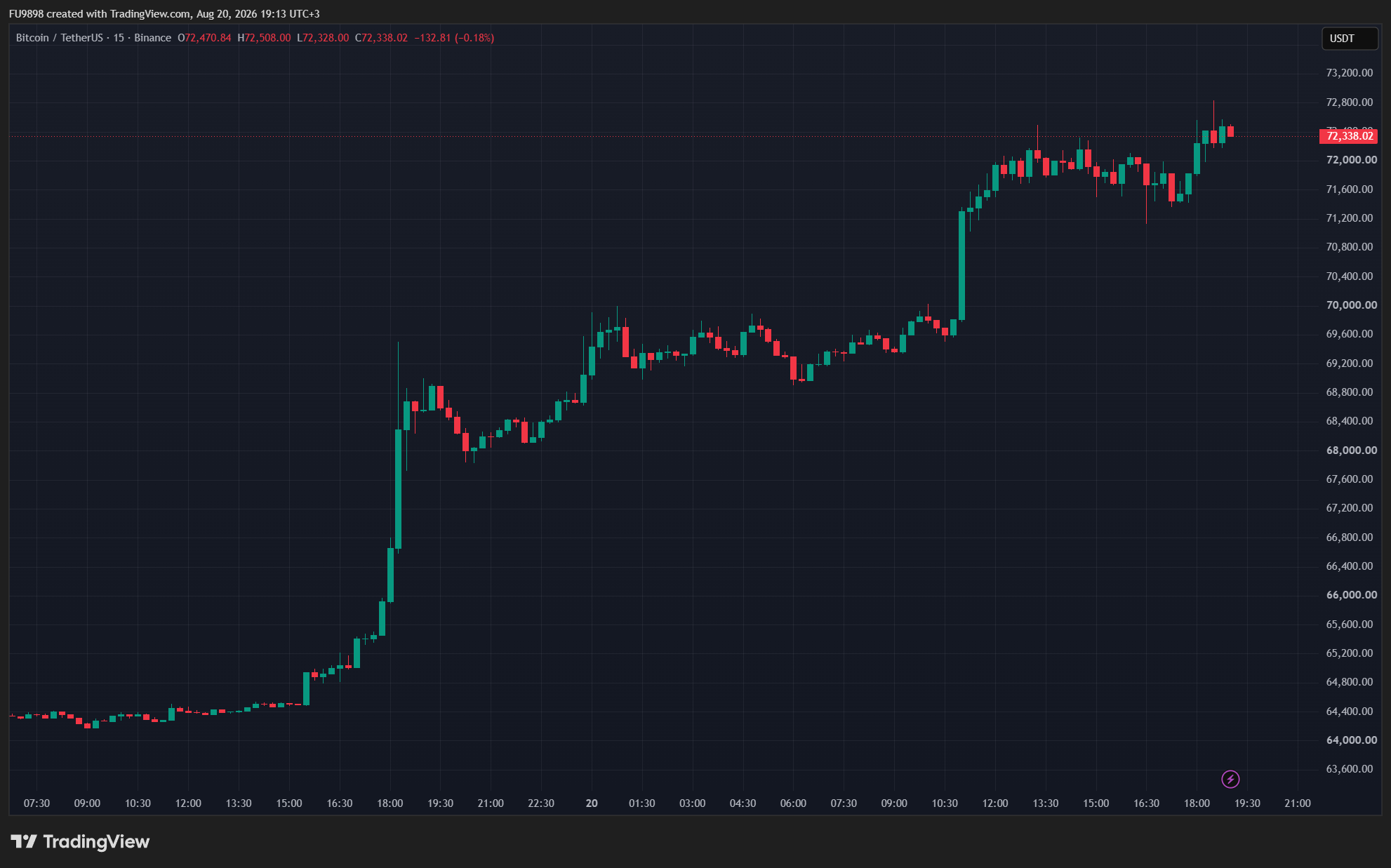
    Bitcoin surged a second time today, surpassing $72,000 and reaching its highest level since June, following yesterday’s sharp rise. According to Binance data, $BTC climbed as high as $72,830 during the day, and is currently trading around $72,500 at the time of writing.

    A chart showing the increase in $BTC price.

    The rise in the cryptocurrency market is believed to be driven by two significant developments from the US. The first catalyst was the US Treasury Department’s announcement that it will at least double the size of its repurchase operations for long-term government bonds.

    Under the new plan, the maximum size of buyback operations for 10-20 year and 20-30 year bonds is planned to be increased from $2 billion per transaction to at least $4 billion.

    Following the decision, the US 30-year Treasury yield, which had previously climbed to 5.337%, its highest level since 2007, fell sharply. The decline in long-term bond yields increased the relative attractiveness of alternative assets like Bitcoin, which does not provide yield, and $BTC was one of the first assets to react strongly to the news.

    Crypto Meeting at the White House Boosts Bitcoin Once Again

    The second wave of Bitcoin’s rise occurred following new news from Washington.

    US President Donald Trump reportedly met with representatives of the cryptocurrency industry, including executives from Coinbase, Payward, and Blockchain.com, at the White House.

    During the meeting, Trump reportedly mentioned the possibility of the US purchasing a “significant amount” of Bitcoin and urged Congress to pass the CLARITY Act before the critical September 15 deadline.

    These statements quickly triggered a new wave of buying in Bitcoin. $BTC rapidly rose from around $69,000 to over $71,000, continuing its upward trend and reaching $72,830.

    $1.54 Billion Worth of Short Positions Liquidated While Bitcoin Rises

    The sudden surge in Bitcoin and Ethereum also led to large-scale liquidations in leveraged markets.

    In the last 24 hours, a total of $1.76 billion in leveraged positions were liquidated in the cryptocurrency market, with $1.54 billion of this amount consisting of short positions. The amount of long positions liquidated was recorded as $219.52 million.

    In the last 12 hours, $512.81 million worth of short positions were liquidated, bringing the total liquidation to $612.17 million. In the last four hours alone, $96.75 million worth of short positions were eliminated from the market.

    In the most recent one-hour period, a total of $55.24 million in liquidations occurred, with $50.72 million of that coming from investors who took short positions.

    With the rise in $BTC and ETH prices, the dollar-denominated value of open positions in the futures markets has also increased significantly.

    However, data indicates that approximately 90 percent of the increase in open positions is due not to the entry of entirely new leveraged positions into the market, but rather to the appreciation of existing positions in dollar terms as a result of rising Bitcoin and Ethereum prices.

    This suggests that growth in derivatives markets may not represent as large an influx of new speculative capital as it initially appears.

    *This is not investment advice.

  • Treasury buybacks could set up Bitcoin’s next move toward $180,000, says strategist

    Treasury buybacks could set up Bitcoin’s next move toward $180,000, says strategist

    That matters for bitcoin because high Treasury yields can pull capital toward government bonds and away from risk assets. Buybacks can support bond prices and help contain yields, potentially removing some of that pressure.

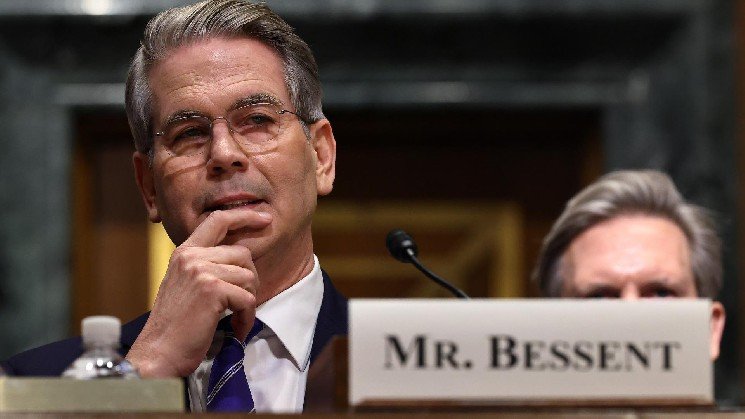
    Connors said the initial purchases remain small but he expects Treasury support could eventually reach between $10 billion and $30 billion a month, far beyond the $4 billion announced by Bessent.

    The move has also changed his outlook for bitcoin. Connors had expected $BTC to remain subdued until November as it followed its traditional four-year cycle. He is now less certain that investors will have to wait that long.

    He believes another potential step could involve changes to the supplementary leverage ratio, or SLR, which affects how much Treasury debt banks can hold relative to their capital. Easing those constraints could give banks more room to absorb government bonds.

    “When that happens, that’s when bitcoin starts to seek that first $180,000 price threshold,” Connors said. His target range for the cycle through 2030 is $180,000 to $360,000.

    In the immediate term, $72,000 could carry added significance because of how crypto traders are positioned.

    Charles Schwab director of crypto research Jim Ferraioli said earlier modeling showed a large concentration of leveraged bitcoin shorts around $72,000.