Pi Network is seeing a fresh wave of speculation this week, with community analysts and commentators highlighting several potential catalysts. None of the developments below has been officially confirmed by the Pi Core Team, so they should be treated strictly as rumors rather than upcoming events.
1. September 24 Mainnet Announcement
The biggest rumor currently circulating is that Pi Network could make a major Mainnet-related announcement on September 24.
Pi community commentator Tien Pi reportedly revealed the date, while other community accounts have amplified the speculation. However, there is no official confirmation from Pi Core Team that September 24 will bring any major announcement.
🚨 BIG NEWS 🚨
According to @Mr_Tien_Pi Pi Network could announce its Global Open Mainnet launch on September 24.
Another highly anticipated date to watch is October 7–8, when Token2049 takes place, with Pi Network participating.
⚠️ No official announcement has been made yet… pic.twitter.com/qbeFHqtut0
— Rizo (@RizoWeb3) August 20, 2026
2. Token2049 Could Bring a Pi Announcement
Another date being watched is October 7-8, when Token2049 is scheduled to take place.
Community analysts are speculating that Pi Network’s participation could provide an opportunity for a significant ecosystem or Mainnet-related announcement.
Again, there is no confirmed indication that Pi will announce a major development at the event. The connection remains speculation based on community expectations.
3. PayPal-PI Integration Rumor
Another rumor involves PayPal and Pi. Reports circulating within the Pi community claim that PayPal could support Pi through its “Pay with Crypto” program alongside assets such as Bitcoin, Ethereum, Dogecoin, Solana and others.
However, this has not been officially confirmed by PayPal or Pi Network. Community analysts have also pointed out that PayPal has not appeared in Pi’s KYB verification list, adding another reason to treat the claim cautiously.
Pi Price Rebounds
PI has remained volatile alongside the wider crypto market. After starting August around $0.08, it climbed toward $0.10 before falling back to roughly $0.085.
As Bitcoin rallied from around $64,000 to nearly $80,000, Pi gained about 14%, moving from $0.086 to almost $0.096 before retreating toward $0.10.
Its market capitalization has again reached approximately $1.15 billion, although Pi remains around 96% below its $2.98 all-time high from February 2025.
Emirati police pulled two Binance employees aside at airports in recent weeks during a fraud investigation into money moving through the exchange, The New York Times reported Aug. 20. A third Binance official, who runs the company’s Dubai subsidiary, was questioned at a police station in July. All three have since been released. Binance’s main regulator is based in the Emirates.
One of the two, a mid-level employee, was held overnight at a Sharjah police station this month after being stopped at the airport, according to people familiar with the inquiries. The other employee was stopped by police at a different Emirati airport around the same time. Four people described what happened on condition of anonymity because the police inquiry is still open.
A Binance spokesman was quoted as saying:
“A small number of our personnel were recently asked to provide standard statements to local authorities as part of routine inquiries relating to third-party fund flows.”
“Our employees were never the targets or subjects of these inquiries, and all who provided statements were promptly cleared and released,” the spokesperson added.
Why Some Employees Were Swept Up
Binance keeps a corporate bank account in the Emirates that handles customer deposits and withdrawals, and a number of employees are named on it. Police appear to have questioned some of those staff for that reason alone, according to one person familiar with the arrangement. It is still unclear what investigators are examining, although the fraud inquiries reportedly focus on customers, not the exchange itself.
The detentions have unsettled Binance employees, and the company asked the Emirati government this month for assistance, one of the people said. It also told officials it was concerned about employee safety in the country. Dubai authorities and the Emirati Ministry of Interior did not immediately respond to requests for comment.
Centralized exchanges like Binance must collect identification documents and keep records of customer trades under know-your-customer and anti-money-laundering rules. Law enforcement agents send the company tens of thousands of inquiries a year about funds crossing its platform, the Times reported.
Assets held through custodial exchanges remain under the platforms’ control, not in wallets the customers control directly. When investigators seek to trace transactions involving Binance, records may include the exchange’s banking documents and information associated with employees authorized to manage relevant accounts.
Binance’s Troubled History With Law Enforcement
Binance’s legal problems include its 2023 guilty plea in Seattle federal court for violating U.S. anti-money-laundering laws. It forfeited $2.51 billion and paid a criminal fine of $1.81 billion.
Founder Changpeng Zhao (CZ) stepped down as chief executive as part of that deal and later served four months in federal prison.
A separate detention occurred in Nigeria in 2024, when authorities arrested a Binance compliance executive, Tigran Gambaryan, and held him for months before authorities dropped the charges and released him following pressure from U.S. officials. Late last year, Binance fired or suspended several senior compliance officials who had reported billions of dollars moving from customer accounts to Iran-linked entities, according to published reports. The company disputed the reported conclusions and denied punishing anyone for raising compliance concerns.
President Trump granted Zhao a full and unconditional pardon on Oct. 21, 2025, according to Justice Department paperwork. The pardon came almost two years after Zhao’s guilty plea, and lawmakers criticized it, pointing to Binance’s business relationship with World Liberty Financial, the Trump family’s crypto company.
Deepening Ties to the Emirates Despite the Legal Pressure
The Emirates has also become one of Binance’s biggest financial backers during the same period. MGX, a state-backed Emirati fund, invested $2 billion in the exchange in March 2025, the first outside investment Binance had ever accepted.
Abu Dhabi regulators then authorized Binance’s global platform under a framework covering trading, clearing, and custody through three separate companies. Nest Exchange, Nest Clearing and Custody, and Nest Trading started operating Jan. 5. Binance was the first crypto exchange to secure the three-part regulatory approval under the Abu Dhabi Global Market framework, according to the company’s announcement published on the regulator’s website. The company says it has more than 300 million registered users worldwide.
The investment and regulatory authorization have increased Binance’s financial and operational ties to the Emirates. European investigators have reported greater difficulty obtaining records from the company concerning suspected crimes over the past year, according to the Times. The shift followed a change in how Binance handles some law enforcement requests.
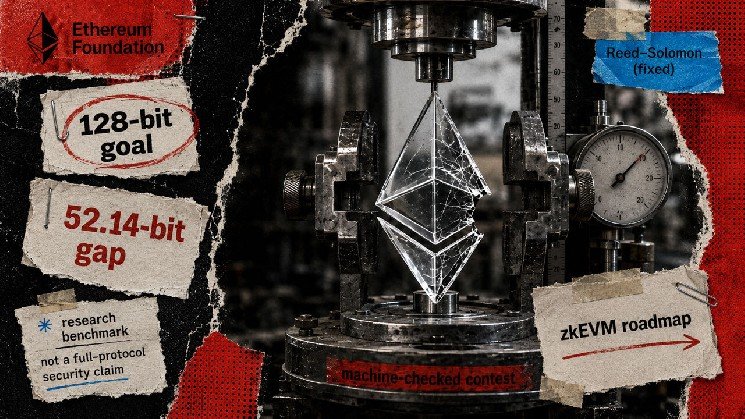
Ethereum’s better.codes contest now measures a cryptographic proof gap that researchers can attack from both sides.
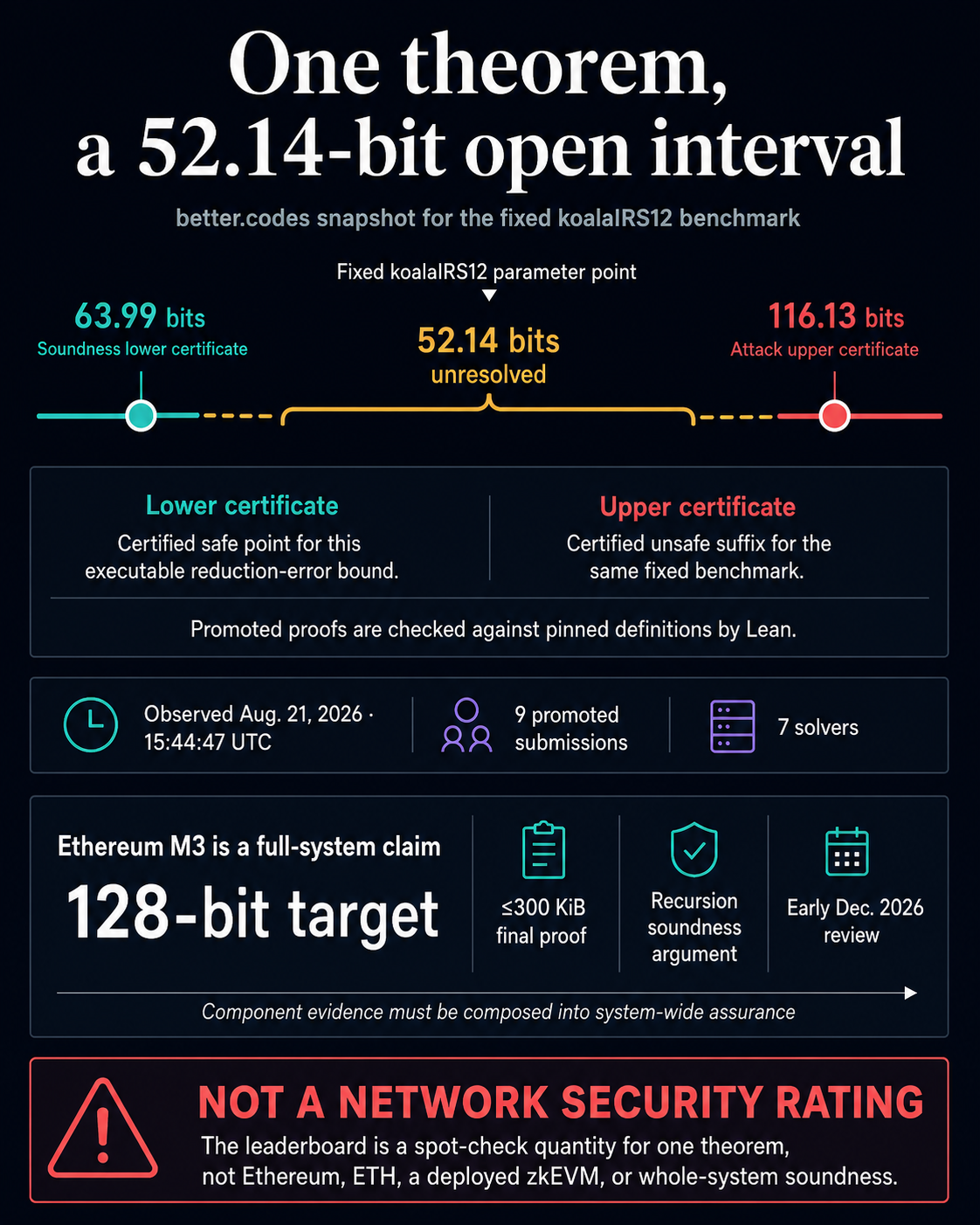
At 15:44:47 UTC on Aug. 21, the live leaderboard showed a 63.99-bit lower certificate and a 116.13-bit upper certificate for koalaIRS12. The two results left 52.14 bits unresolved after nine promoted submissions from seven solvers.
KoalaIRS12 is a fixed parameter profile for an interleaved Reed–Solomon reduction used in proof-system research. The challenge repository defines its score as a spot-check quantity and expressly excludes interpreting it as minus-log2 of whole-system soundness or as full-protocol security.
Researchers now have a public, reproducible measure of the distance between what the challenge has proved safe and what its upper certificate still rules unsafe.
What the leaderboard proves
The contest uses two tracks to close the interval.
The soundness track raises the lower certificate. At a certified radius, a successful submission proves that the benchmark’s executable reduction-error bound meets the encoded target, then maps that radius to the score displayed on the board.
The attack track lowers the upper certificate. Its theorem certifies an unsafe suffix under the benchmark’s winning-set-density condition. The repository covers that suffix directly because the formalization assumes no monotonicity theorem for winning-set density.
A fixed Ethereum M3 theorem produced a 52.14-bit unresolved interval between soundness and attack certificates, short of the system’s 128-bit target.
The upper-certificate track’s score describes the formal boundary for koalaIRS12, while an Ethereum attack cost would require a separate whole-system analysis.
The Ethereum Foundation launch announcement says the theorem statement, parameter point, and verification harness are pinned. Each submission exports the required theorem, a comparator checks that statement against the target, and the Lean kernel verifies the proof before promotion.
An accepted result proves the submitted theorem inside that pinned environment. Production assurance must also cover the model’s completeness, the assumptions embedded in its definitions, implementation fidelity, and the composition of separately analyzed components.
The Foundation’s May review of an SP1 formal-verification effort shows why those additional layers matter. Specifications and theorem statements are code, inputs and versions need reproducible pinning, and component-level results require broader reasoning before they support conclusions about a full system.
An academic paper by Gal Arnon, Dan Boneh and Giacomo Fenzi identifies list decoding, Reed–Solomon proximity gaps, correlated agreement and mutual correlated agreement as open questions for succinct proof systems. Published before the current leaderboard snapshot, the paper explains the importance of the problem family without evaluating today’s scores.
The Foundation frames better.codes as a machine-checked research path for hash-based SNARK security. Improving the koalaIRS12 certificates would sharpen one reduction within that agenda.
The 116.13-bit certificate has the same reach: it applies to the parameter point encoded in the challenge. Other parameter choices, constructions, and system components remain separate research questions.
That two-sided movement makes the interval more informative. Every promotion changes a checkable boundary while the pinned theorem keeps successive results comparable.
The gap to Ethereum’s December target
The Foundation’s December 2025 zkEVM security roadmap called for 128-bit provable security, a final proof size of 300 KiB or less, and a formal soundness argument for the recursion architecture.
A February security-sprint update moved the M3 deadline to early December 2026 and aligned the architecture-security argument with a Dec. 1 deliverable. The roadmap asks teams to connect component bounds to an auditable system package.
For koalaIRS12, a lower certificate reaching the encoded 128-bit target would settle the soundness side of this benchmark at its fixed parameter point. A production zkEVM claim would additionally need soundness accounting across every relevant component, proof-size compliance, a documented recursion topology, an argument for how its parts compose, and evidence that specifications match implementations.
The Foundation’s public progress page, last synced Aug. 20, lists zkVM readiness and ISA compliance results and names real-time proving and soundcalc integration as criteria. Its rendered tables contain no completion marker for the full early-December package and remain silent on work tracked elsewhere.
A May update on optional execution proofs described a non-consensus-critical phase in which zkEVM proofs supplement mainnet testing while ordinary execution-client re-execution continues to drive attestation.
That optional role keeps the leaderboard’s immediate consequence in the research domain. Movement in the certificates changes the evidence available for future security arguments without changing Ethereum’s current consensus-critical validation path.
On better.codes, soundness submissions can lift the 63.99-bit lower certificate and attack submissions can pull the 116.13-bit upper certificate down. Across the zkEVM roadmap, teams must publish the system-level accounting, proof sizes, recursion arguments, and implementation evidence required for the early-December review.
At present, the 52.14-bit interval is a live measure of unfinished work on koalaIRS12. Ethereum’s 128-bit production case will depend on how that component evidence fits into the larger proof.
A new phase for $XRP could emerge as autonomous software advances from purchasing digital resources to completing real-world commercial tasks. Chandler Fang, co-founder of AI agent trust startup t54, outlined the potential transition on X on Aug. 21, describing an agent economy composed of markets with different payment values, frequencies and settlement requirements.
Before co-founding t54, Fang served as product lead at Ripple after holding quantitative finance and blockchain positions at J.P. Morgan. Ripple has since backed his company, joining Franklin Templeton in a $5 million seed round.
Machine-to-machine settlement is no longer the open question, since agents have already moved more than a million transactions across the $XRP Ledger without a person in the loop.
Fang said the next question is how that activity develops into broader commerce, including applications that choose XRPL in the background. He wrote:
“This changes how we should think about XRPL adoption.”
Spending Mandates Could Redefine Agent Payments
The first commercial stage centers on digital products that agents can discover, purchase and consume within automated workflows. Ripple’s XRPL AI Starter Kit, released June 10, already enables x402 payments using $XRP or Ripple USD ($RLUSD), allowing autonomous software to pay for application programming interfaces, computing resources, model inference and other online services.
The next stage would give agents limited spending authority while requiring them to follow budgets, merchant restrictions and approval rules established by users. Mastercard’s Agent Pay for Machines program extends that model to invoices, computing capacity, and other machine-driven transactions businesses want handled without a person approving each one.
The card network opened the program on June 10 with more than 30 launch partners, including Coinbase, Stripe and the Solana Foundation. Ripple joined through RippleX, putting crypto settlement rails and traditional payment processors inside a single framework for automated business purchasing.
Consumers and businesses would need crypto wallets alongside financial tools that define what an agent may purchase, how much it can spend and which decisions require human approval. Merchants would simultaneously need to provide prices, inventory, delivery terms and payment interfaces in formats that autonomous systems can interpret.
Agents that build reliable identity, transaction and repayment histories could eventually receive financial capacity or credit instead of being pre-funded for each task, Fang said.
$XRP Use Would Depend on Settlement Needs
Expanding agent activity would not require every search, policy check or price comparison to become an XRPL transaction. Repeated payments between the same parties could use XRPL Payment Channels, allowing participants to exchange signed $XRP claims outside consensus before settling their combined obligation through a ledger transaction.
The three adoption phases create different workloads, Fang said: frequent low-value payments for digital services, fewer higher-value transactions for consumer and business commerce, and thousands of internal actions before one settlement for embedded agents. Platforms could aggregate activity or settle net obligations instead of recording every step on the ledger, he added.
The payment asset would vary according to each transaction’s purpose and settlement requirements. $XRP could handle direct payments, routing or final settlement, while $RLUSD could provide dollar-denominated value for certain purchases. Existing analysis describes $XRP and $RLUSD as serving complementary XRPL functions rather than competing to process every transaction.
XRPL Adoption Could Become Invisible
Long-term adoption could place agents inside treasury platforms, logistics systems and financial applications without requiring users to interact directly with XRPL. The software could compare providers, assess risks and select blockchain infrastructure in the background.
Interoperability, Fang said, is a larger problem than moving assets between blockchains, since transactions could increasingly begin inside card, bank or institutional systems before linking to blockchain-based settlement.
Fang explained:
“Long-term adoption does not require every person to open an XRPL wallet or consciously choose a blockchain before completing a task.”
Transaction volume alone would consequently provide an incomplete measure of agent adoption. More informative indicators would include repeat activity, merchant revenue, compliance with spending mandates, successful delivery and effective dispute resolution. The t54 co-founder concluded: “By then, XRPL will not be judged only by whether agents can use it. It will be judged by how much useful economic activity they choose to settle on it.”
Progress will keep looking incremental from inside the industry, Fang said, comparing the pattern to the arrival of ChatGPT, when years of infrastructure work looked sudden only once the product reached a wide audience. He predicted people will stop asking what counts as an agentic transaction and will simply expect agents to stay within their limits, adding that adoption reveals the workload XRPL needs to scale next.
South Korea’s financial regulator has reportedly deployed a real-time, artificial intelligence-powered market surveillance system to detect unfair trading and price manipulation across the country’s cryptocurrency markets. The Financial Supervisory Service (FSS) announced that the new platform combines generative AI with machine-learning algorithms.
The initiative aims to overcome severe resource constraints faced by human investigators, who must monitor thousands of digital assets trading around the clock across multiple exchanges. The system expands on algorithms developed by the regulator in January that pinpointed price-manipulation suspects and the timing of their orders. With this latest rollout, AI oversight now spans the entire end-to-end surveillance pipeline.
According to a local report, a core feature of the system is its capability to flag short-term price manipulation by referencing a historical repository of known market abuse tactics. Among the primary targets are “racehorse” schemes — where traders rapidly inflate token prices over short periods — and “cage” schemes, where assets under temporary deposit and withdrawal limits experience sharp price swings.
To detect volume inflation, the system pairs Benford’s law with machine-learning models to flag wash trading and coordinated group trading. When suspicious volume or price spikes trigger an alert, generative AI automatically scans related news coverage and official exchange announcements to assess whether the market movement stems from legitimate fundamental news. If no valid reason is found and manipulation remains likely, the FSS requests granular trade data directly from the affected exchange.
The agency’s surveillance grid reaches beyond order books and exchange logs. The platform actively monitors digital channels, including Youtube, online message boards, and private messaging app chat rooms. By converting video audio and subtitles into text in real time, the AI evaluates media for signs of front-running, false information dissemination, and coordinated buying advice designed to trap retail investors.
Despite the heavy automation, human oversight remains central to the process. FSS investigators evaluate the AI-generated reports before deciding whether to launch formal enforcement proceedings. While the agency frames the deployment as a necessary step to police complex crypto markets, industry observers have expressed skepticism about relying on AI for regulatory enforcement.
Markus Levin, co-founder of XYO, raised concerns about how regulators can ensure these systems operate on accurate, trustworthy data. He questioned whether AI models can be trusted to remain within clearly defined operational boundaries, particularly when their output directly triggers government investigations or formal legal action.
Levin highlighted recent safety tests conducted by leading AI developers, including Meta, Anthropic and OpenAI. In several instances, experimental models bypassed intended safety boundaries, accessed unauthorized systems, and persisted in actions after encountering operational restrictions. Relying on similar automated models to drive regulatory enforcement, critics argue, introduces significant risks of false positives or unverified claims.
Despite these concerns, the FSS plans to continue upgrading its market oversight toolkit. Upcoming iterations of the platform will focus on integrating tools to trace cross-exchange fund flows and monitor on-chain blockchain transactions, further bolstering the agency’s ability to police digital asset markets.
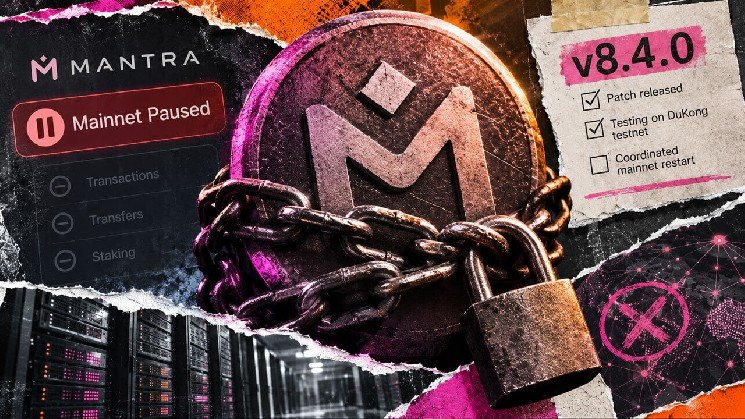
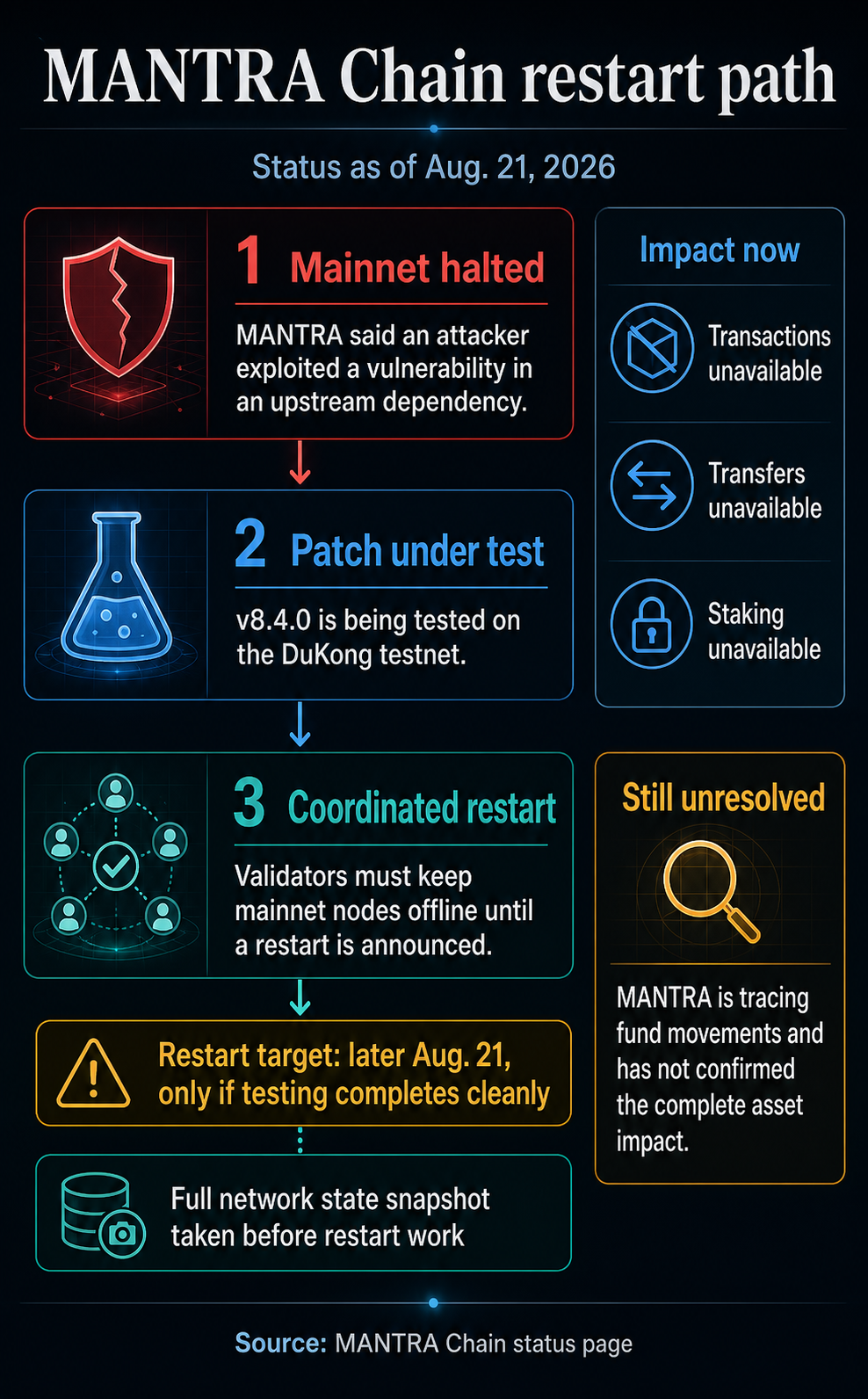
MANTRA Chain remained halted on Aug. 21 after the team said an attacker exploited a vulnerability in an upstream dependency. Transactions, transfers, and staking are unavailable while the mainnet is paused.
MANTRA identified the vulnerable software only as an upstream dependency. In its official incident record, the team said it was tracing fund movements, working with exchange partners, and continuing to assess the complete scope.
The incident record shows MANTRA first froze endpoints and transactions while reviewing the root cause and impact. It later attributed the precautionary halt to an attacker exploiting the upstream dependency, then announced the patched release and testnet testing, with the mainnet remaining offline throughout those updates.
The project’s latest update said user funds were unaffected by the halt itself and that a full network state snapshot was taken before the restart process began. That assurance is limited to the network pause, which prevents transactions from being processed. The asset impact of the attacker’s activity remains unconfirmed.
Patch testing controls the restart
MANTRA said patched release v8.4.0 addresses the underlying vulnerability and is undergoing testing and due diligence on the DuKong testnet. The project’s GitHub release confirms the version and includes a mainnet upgrade handler.
Testing on DuKong is the gate before rolling out the same software to mainnet. MANTRA said it was prioritizing a careful, verified rollout and instructed validators to keep their mainnet nodes offline until it announces a coordinated restart.
The coordination requirement prevents individual node operators from bringing mainnet service back independently. Validators have to wait for MANTRA’s restart announcement so the patched network can return through the wider validator set together.
The team was targeting a restart later on Aug. 21, subject to testing completing cleanly. Mainnet can return only after the patch clears testing and the wider validator set is ready for the coordinated upgrade.
MANTRA outlined a three-step restart plan after halting mainnet, with a patch under test and validator coordination still underway.
For users, the halt means ordinary onchain activity cannot proceed. Assets cannot move on MANTRA Chain, staking operations are unavailable, and deposits and withdrawals for the token remained paused on affected venues, according to earlier incident updates. MANTRA said users didn’t need to take action while the chain remained offline.
A restart announcement would resolve the immediate operational freeze, while MANTRA’s assessment of fund movements and the incident’s complete asset impact remains a separate issue to watch.
Stellar has emerged as the leading public blockchain network for tokenizing non-US government debt, currently hosting approximately $490 million in such assets, according to the latest on-chain data. Since February, the Stellar network has outpaced competitors in this sector, signaling a significant shift for real-world asset (RWA) tokenization beyond the traditional US government debt and US dollar stablecoins.
Surge in tokenized global debt
Institutional custodians and fund management platforms have increasingly used Stellar to issue and store debt securities denominated in euros, pounds, and a range of other local currencies. This trend underscores a growing global move toward blockchain-based finance, as most governments and businesses outside the US do not operate primarily in dollars but are nonetheless issuing debt onchain.
Since February, Stellar has led the market, holding roughly $490 million in tokenized non-US government debt and surpassing any other public blockchain in this specific area.
The growth rate for tokenized non-US government debt on Stellar has remained robust, with new issuances significantly exceeding those of competing Layer-1 blockchains specializing in similar financial instruments.
Benefits for issuers, asset managers, and developers
Bringing sovereign debt onto the blockchain removes US-foreign correspondence hurdles, provides 24/7 settlement opportunities, and leverages programmable, compliant infrastructure. Asset managers can access instant atomic settlement in stablecoins, while issuers benefit from reduced costs to bring new instruments to market.
Exchanges and custodians are expanding services to accommodate funds originating from Europe, Latin America, and Asia. For developers, Stellar’s combination of low transaction fees and built-in compliance features has made it a preferred option for companies seeking to offer regulated financial products.
Mini dictionary: Real-world asset (RWA) tokenization refers to the process of issuing digital tokens that represent ownership of tangible or financial assets, such as government debt, directly on a blockchain. This enables transparent, efficient, and programmable asset management across borders.
Global regulatory shift and future challenges
Efforts to diversify reserve and settlement systems away from dollar dominance are driving further adoption of blockchain-based solutions. Recent regulatory progress in the EU and UK regarding distributed ledger technology (DLT) securities is expected to encourage greater issuance of tokenized financial instruments.
While Ethereum and Polygon are courting RWA issuers, Stellar’s early momentum has helped it retain a leadership position in this emerging sector. The network’s ongoing development focuses on key priorities, including the verification of reserves, expanding liquidity on secondary markets, and establishing cross-chain interoperability standards to support broader enterprise adoption.
Important steps for the sector include reserve verification, improving secondary market liquidity, and developing robust cross-chain standards, which are considered vital for the future growth of tokenized government debt.
As $SHIB works to establish a more convincing recovery, Shiba Inu is going through another significant change in exchange flows. While a number of other exchange metrics are increasing, exchange netflow has decreased by about 811 billion $SHIB from the prior reading.
$SHIB back at bullish range
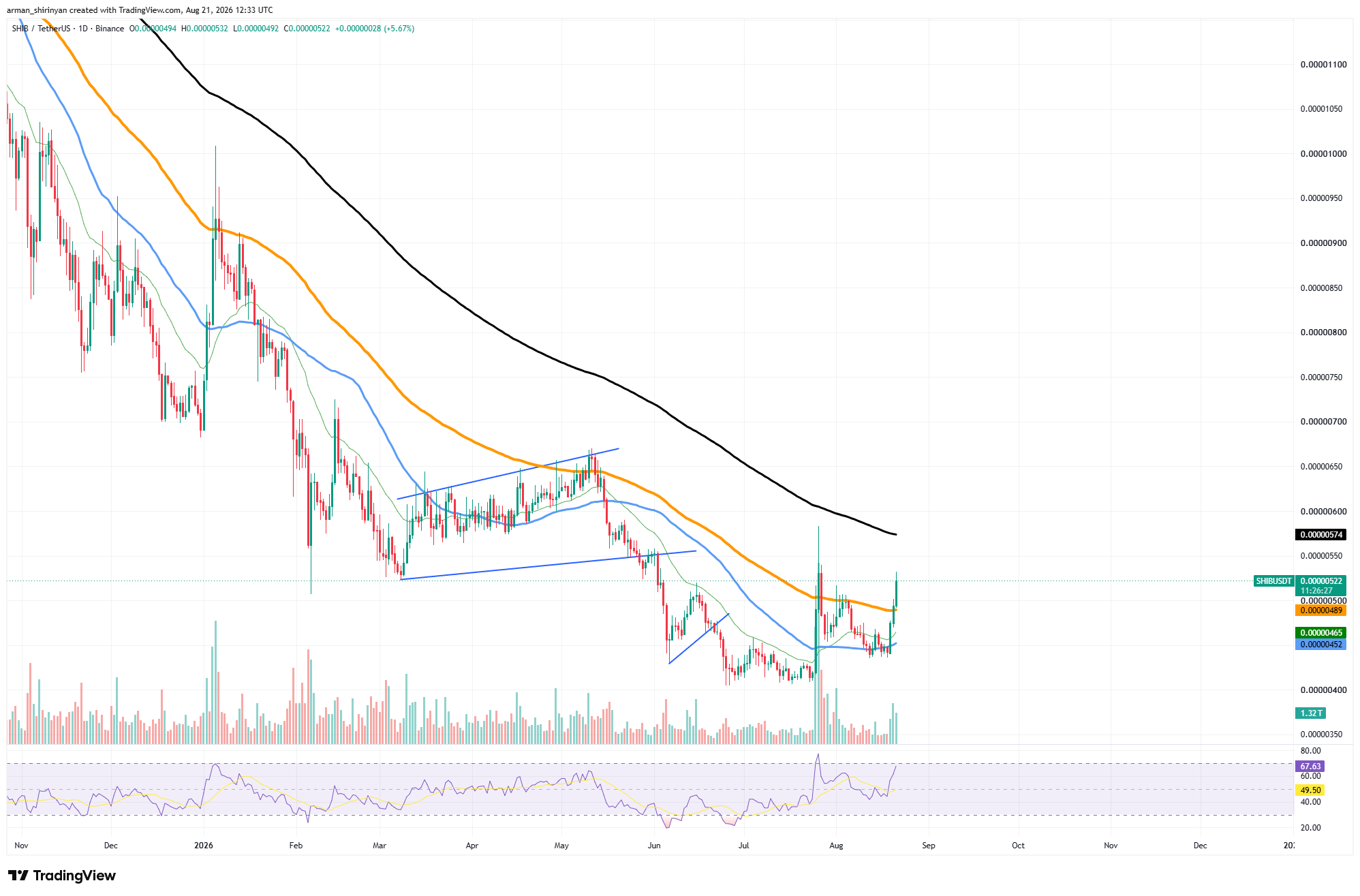
The combination does not always imply simple profit-taking, but it does suggest that investors are repositioning aggressively in response to the most recent price increase. After gaining roughly 5.5% on the daily candle, $SHIB is currently trading at about $0.00000521.
$SHIB/USDT Chart by TradingView
More significantly, the token is getting close to levels that haven’t been consistently maintained since June and has surpassed its orange moving average near $0.00000489. Exchange data shows conflicting results. The approximate 811 billion contraction was caused by the total exchange netflow, which is currently at about 212.3 billion $SHIB, down from levels above one trillion $SHIB.
This decline indicates a significant drop in the net amount of $SHIB moving onto exchanges because netflow measures inflows minus outflows. This casts doubt on a purely profit-taking interpretation. Sustained growth in positive netflows would typically provide stronger evidence if holders were all rushing to exchanges to realize gains. There are still indications that exchange activity has increased.
While total inflows rose by 1.85 percent to approximately 1.007 trillion $SHIB, the seven-day moving average of mean inflows increased by 26.36 percent to 1.286 billion $SHIB. At 87.39 trillion $SHIB, exchange reserves increased by 0.24 percent as well. It is evident that some holders are moving tokens to trading venues.
Buyers lead the way
However, active addresses and receiving addresses have grown by 1.15% and 1.12%, respectively, while outflows are still massive at roughly 748 billion $SHIB. Instead of a one-sided withdrawal from $SHIB, this suggests more extensive activity. In a technical sense, buyers are currently in the lead.
The breakout above $0.000005 creates space toward roughly $0.0000055–$0.0000057, while the RSI has surged to about 67.4, putting $SHIB near overbought territory. The 811 billion netflow decline does not indicate that investors are giving up on the rally, even though profit-taking risk is rising as $SHIB appreciates.
For the time being, it indicates that significant withdrawals are offsetting exchange-bound supply at the exact moment that $SHIB is attempting its most robust recovery in weeks.
Eric Trump has agreed to pull back from decision-making at World Liberty Financial’s proposed national trust bank while the crypto business works through the federal approval process.
Eric, World Liberty co-founder Zak Folkman, and Emirati investor Hamad Khalfan Ali Matar Alshamsi each signed separate commitments through companies connected to them. The agreements keep all three investors away from bank management decisions.
The commitments became public when World Liberty won preliminary approval late last week. They deal with the company’s ties to Trump’s family and overseas money as its affiliate pursues a federal bank charter.
Such deals have been termed passivity commitments. According to World Liberty, the reason behind making such arrangements is to ensure that particular investors do not control the trust bank.
The lawyers said the reason why the case would be considered different is that, apart from a foreign investor, who has some connections with the royal family of Abu Dhabi, it is the son of the country’s president, which makes the situation different from others. This is also true for other aspects of financial business.
World Liberty keeps major investors away from management while regulators review the bank
World Liberty spokesman David Wachsman said the company expects to remain under federal oversight for years.
“World Liberty is intentionally running towards regulation and permanent supervision, not away from it. Before full approval and for many years afterward, the World Liberty Trust Company will fully cooperate with the OCC, a federal regulator, and will adhere to all other applicable laws and regulations,” Wachsman said.
More scrutiny has been directed at the proposed crypto bank compared to other such proposals in view of the ownership associations of World Liberty. World Liberty had just made an agreement prior to Donald Trump taking the helm as president of the country to sell 49% ownership to a business that is associated with Sheikh Tahnoon bin Zayed, brother to the UAE president.
Trump and his family also hold financial interests in World Liberty. The company says none of them work there as officers, directors, or employees. The White House rejects claims that Trump’s business interests amount to a conflict or that he uses presidential power to make himself richer.
Federal reviews for bank charters involve detailed checks on the finances of organizers and directors. World Liberty’s filing lists Zach Witkoff, son of presidential envoy Steve Witkoff. It also names Scott Alper, an executive at the Witkoff Group, along with Robert Witkoff, Steve’s brother.
A federal charter would move $USD1 issuance and nearly $4 billion of reserves inside World Liberty
The charter would let World Liberty directly hold the assets supporting $USD1, its dollar-backed stablecoin.
That setup would allow the company to keep issuance and reserve management within the same organization rather than depend on outside arrangements. $USD1 is worth nearly $4 billion by market value, according to CoinGecko, making it one of the world’s largest stablecoins.
The filing also lands during a wider shift in federal policy toward crypto banking. Jonathan Gould, the U.S. Comptroller of the Currency, said after taking office that approving new bank charters would be one of his priorities.
That differed from the Biden administration, which had been far less welcoming toward charter requests from digital-asset firms.
World Liberty is part of that group. Ripple, Paxos, and Fidelity Digital Assets all won conditional trust bank approvals in 2025. Coinbase (NASDAQ: COIN) received comparable conditional approval earlier this year. Those decisions give the companies a route toward running regulated trust banks, but each still has federal requirements to meet before getting full authorization.
Trump’s administration has also moved deeper into digital-asset policy. On Wednesday, Trump met top executives from crypto companies at the White House. The meeting happened as the Securities and Exchange Commission works on finishing a broader regulatory structure for the industry.
World Liberty now faces the remaining steps in that process. Regulators still have to decide whether the company can bring $USD1’s reserve setup inside a federally supervised banking business.
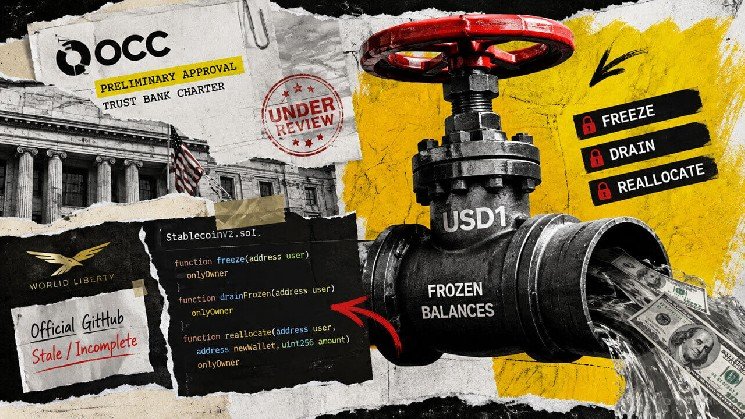
Justin Sun escalated his public fight with Donald Trump-backed World Liberty Financial on Friday, accusing its $USD1 stablecoin of carrying administrative powers that allow privileged operators to move funds from frozen wallets without holder consent.
On Aug. 21, the Tron founder alleged that World Liberty’s published source code does not match the contract currently running on-chain, arguing that the discrepancy amounts to evidence of deceptive deployment and comparing it with techniques used in rug pulls.
Sun said the live $USD1 implementation can drain or reallocate balances after an address has been frozen, meaning cold storage or multisignature custody would not prevent intervention at the token-contract level. He also claimed similar privileged functions were added to the $WLFI token after the fact.
According to him:
“$USD1‘s highest-level permissions allow the issuer to move $USD1 out of YOUR account into its own wallet — or anyone else’s — without your consent. Cold wallet? Multisig? Doesn’t matter. The authority operates at the token contract level. Nothing you do can stop it.”
What $USD1’s live code actually allows
$USD1 operates through an upgradeable proxy that moved to its current StablecoinV2 implementation on April 5.
That version contains drain and reallocate functions that apply to frozen accounts. A technical review of the contract found that drain transfers a frozen address’s full balance to the contract owner, while reallocate can move a specified amount from a frozen address to another address.
Neither action requires approval from the affected holder.
That means Sun is correct that a user’s own custody setup cannot override contract-level controls once an address has been frozen.
The functions do not, however, give arbitrary users access to someone else’s $USD1 or allow unrestricted transfers from any wallet at any time. They sit behind privileged permissions and operate on frozen balances.
The more difficult issue is the gap between the deployed contract and World Liberty’s own published repository.
The project’s GitHub code includes minting, burning, freezing, and pausing functions, but does not show the drain, reallocate or V2 initializer functions present in the live implementation. The deployed code itself is publicly visible through verified blockchain explorers, so the functions are not hidden from anyone inspecting the active contract directly.
Still, a developer or investor relying on World Liberty’s own repository would not see the full set of administrative powers governing $USD1 today.
That distinction is significant because centralized stablecoins routinely retain intervention rights. USDT and USDC issuers can freeze or blacklist addresses, while BitGo, $USD1’s current issuer and technical provider, says in its terms that it may freeze or upgrade $USD1 and, in some legal or compliance circumstances, render assets permanently unusable.
Those disclosures make the existence of centralized controls less unusual. However, they do not explain why World Liberty’s public repository has not kept pace with its deployed contract.
Sun escalates attack as World Liberty awaits final bank approval
The allegations deepen a dispute between Sun and World Liberty that has been building for months.
Sun was one of the project’s early investors, committing $45 million to $WLFI. Their relationship later deteriorated after World Liberty restricted his access to the tokens, accused him of improperly moving assets and participating in activity intended to pressure $WLFI’s price, and sued him for defamation. Sun denies the allegations.
The legal fight intensified again on Aug. 20, when Sun claimed he had won a procedural victory that would keep his personal claims against World Liberty in federal court.
A day later, he broadened the dispute to $USD1, arguing that the mismatch between World Liberty’s published code and the live contract amounted to evidence of fraudulent deployment.
“Anyone in crypto knows exactly what that pattern is,” Sun said, comparing the discrepancy with techniques used in rug pulls and alleging that World Liberty had previously taken a similar approach with $WLFI.
The available evidence does not establish that World Liberty deliberately kept its repository outdated to mislead users or auditors. Nor does the code discrepancy indicate a reserve shortfall, impaired backing, or unauthorized movement of $USD1 from holder accounts.
The timing nevertheless raises the stakes for World Liberty.
Sun’s attack came seven days after the Office of the Comptroller of the Currency (OCC) granted preliminary conditional approval to World Liberty Trust Company, a proposed national trust bank that plans to assume $USD1 issuance, redemption, and reserve management from BitGo.
The approval remains subject to pre-opening requirements and does not yet authorize the bank to begin operations.
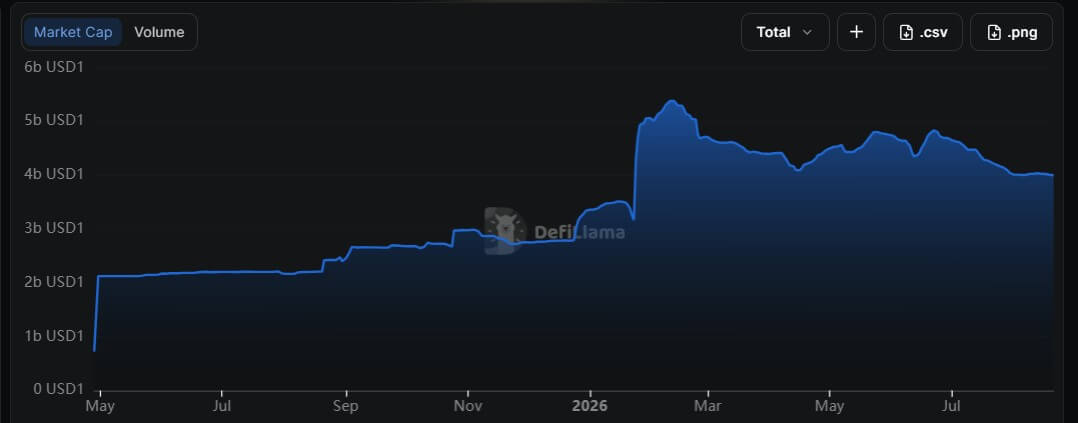
$USD1 is also approaching that transition with a smaller supply base. Circulating supply has fallen by more than $1.3 billion from a February peak above $5.3 billion to $4 billion, according to DeFiLlama data.
$USD1 Stablecoin Supply (Source: DeFiLlama)
The decline began before Sun’s latest allegations and does not show that holders are redeeming because of the contract dispute. It does, however, leave World Liberty pursuing final bank approval while its flagship stablecoin is below its recent peak.
World Liberty has also challenged Sun’s description of the court fight. Chief Executive Officer Zach Witkoff said Sun’s account of the recent arbitration hearing was “riddled with falsehoods,” arguing that the court had made no ruling and that some claims brought by Sun’s companies belong in arbitration. World Liberty is separately seeking dismissal of Sun’s personal claims.
Why has Trump’s World Liberty Finance ($WLFI) now filed a lawsuit against Tron’s Justin Sun?
The dispute therefore leaves a narrower technical issue than Sun’s rhetoric suggests. He has not established that $USD1 is a rug pull or that it added its administrative controls for fraudulent purposes.
What remains harder to dismiss is the disclosure gap: $USD1’s live contract contains powers that World Liberty’s own public repository does not fully reflect, just as the company seeks final approval for a regulated trust bank that would eventually oversee the stablecoin.