Category: Business

  • LayerZero to axe 14 low-activity chains after KelpDAO exploit – Details

    LayerZero to axe 14 low-activity chains after KelpDAO exploit – Details

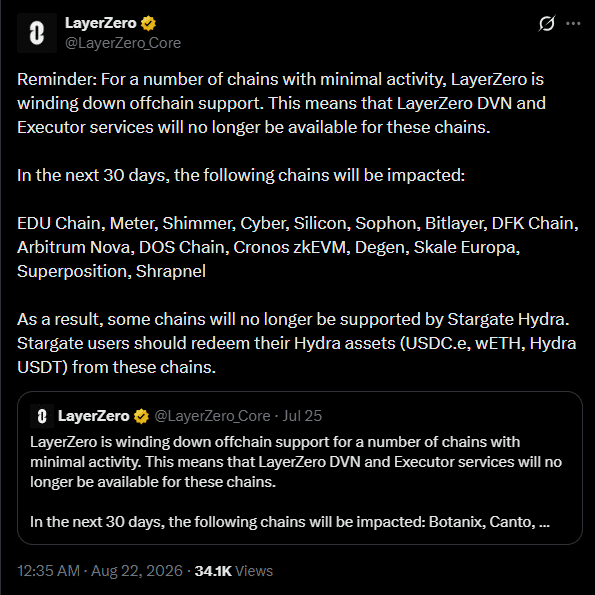
    Cross-chain interoperability provider LayerZero will withdraw off-chain support for 14 low-activity chains, including Arbitrum Nova.

    In its latest statement, the firm said that its DVN (decentralized verifier network) and Executors, collectively responsible for off-chain communication between different chains, will be deprecated for the 14 chains.

    The affected networks include Cronos zkEVM, Degen, Skale Europa, Superposition, Shrapnel, and more. As a result, some assets, including stablecoins (USDT and USDC) across these chains, could be stranded if not moved before the full shutdown.

    According to LayerZero, the off-chain support will be axed in 30 days (by September).
    Source: X

    Since July, LayerZero has flagged over 30 chains with low activity, including the recently shut BounceBit. Although the move is positioned as operational efficiency, security risk and competition seem to be key reasons behind the aggressive shift.

    Chainlink CCIP traction threatens LayerZero

    LayerZero has massive financial backing, including top-tier VC firms such as Sequoia Capital, a16z (Andreessen Horowitz), Binance Labs, and Coinbase Ventures.

    And the bet was simple: bridge the fragmented liquidity across various blockchains. But the KelpDAO’s $292M hack, one of the largest DeFi exploits in 2026, triggered a massive fallout.

    The exploit stemmed from LayerZero’s recommended “1-of-1” DVN setup, which doesn’t give enough verification before large minting or fund transfers are approved. Since the same loophole can be used with low-adopted reserve assets, Aave has stopped supporting most of them, including ghost chains.

    In fact, several projects have since migrated from LayerZero to rival Chainlink CCIP (Cross-Chain Interoperability Protocol). Notably, the Wyoming state government, BitGo (WBTC), and Nethermind have migrated from LayerZero to CCIP.

    Chainlink’s Zach Rynes estimated that a total of $15B has been migrated from LayerZero, underscoring the expensive lesson for LayerZero for the KelpDAO fallout.

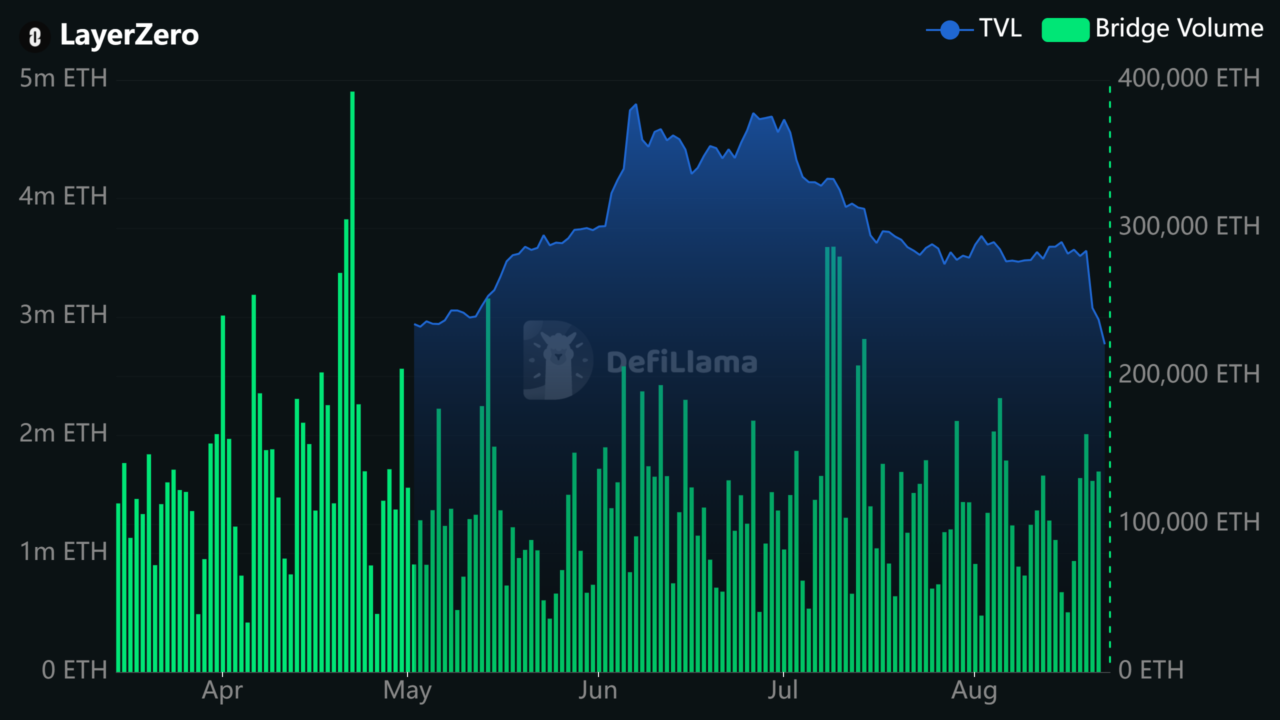
    Notably, after the exploit, LayerZero bridged volume dropped 4x from nearly 400K $ETH to about 100K $ETH.
    Source: DeFiLlama

    As such, LayerZero’s aggressive move to wind down support for over 30 chains may be viewed as a strategic play to reduce its security risk exposure. By extension, it’s meant to counter Chainlink CCIP’s growing competition after the KelpDAO exploit.

    But whether that’s enough to stop its top projects from migrating to Chainlink remains to be seen.


    Final Summary

    • LayerZero to withdraw support for 14 chains by September.
    • Chainlink CCIP has attracted over $15B in assets migrating from LayerZero since the KelpDAO hack.
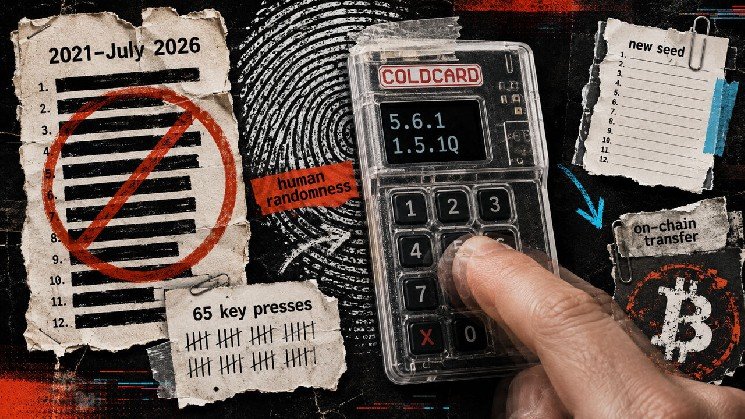
  • Coldcard now requires 65 key presses after seed exploit, while exposed funds still must move

    Coldcard now requires 65 key presses after seed exploit, while exposed funds still must move

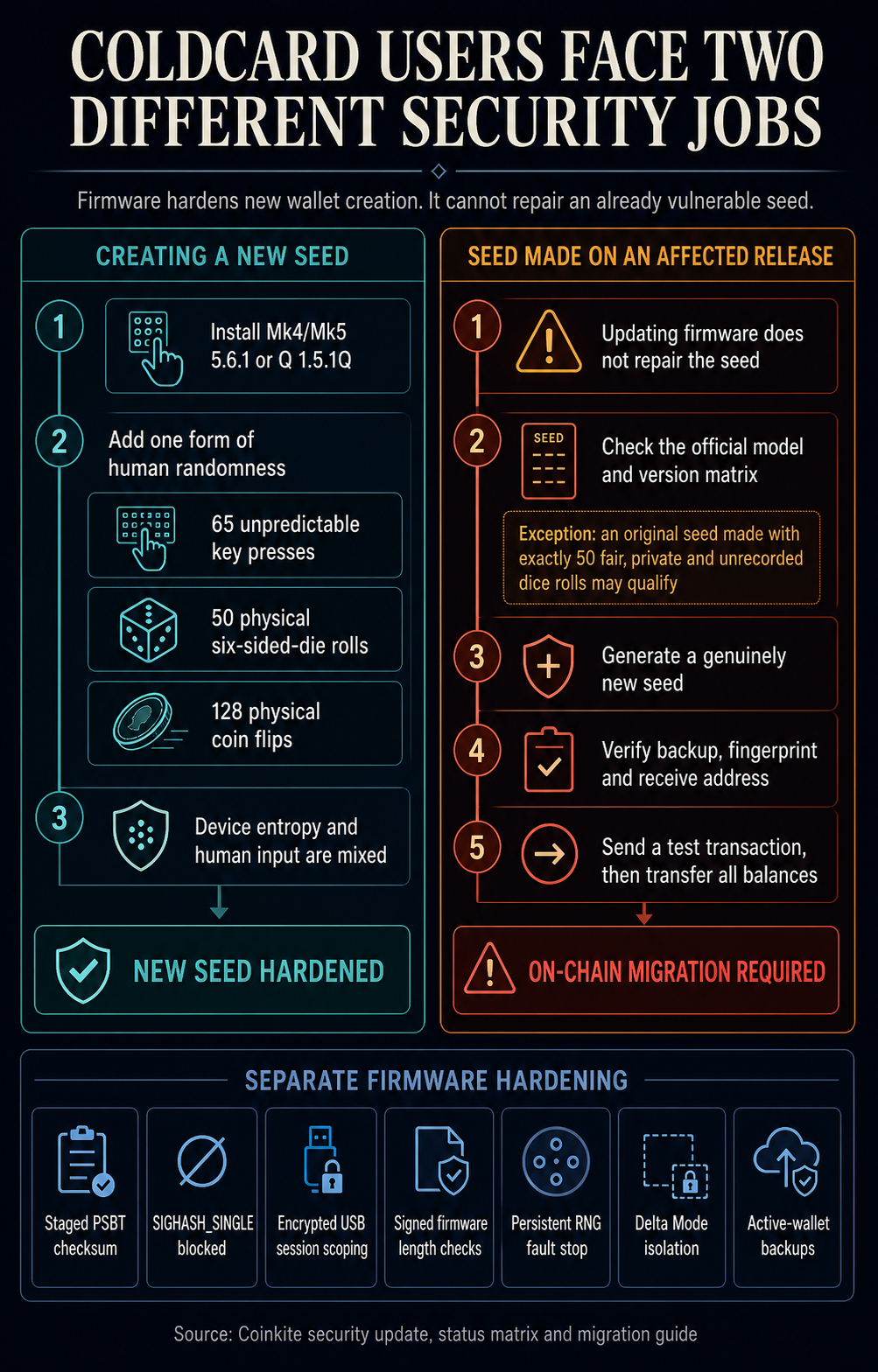
    Coinkite, the maker of the Coldcard Bitcoin hardware wallet, released new standard firmware on Aug. 20 that forces users to add physical randomness whenever they generate a seed.

    Owners who generate a seed after installing the current fixed release can use the hardened process. Owners still relying on a seed produced by affected firmware must generate another seed and transfer the funds unless that wallet meets the dice-roll exception.

    During standard seed creation, every seed combines fresh device entropy with one required human input source: at least 65 key presses made at unpredictable intervals, 50 rolls of a physical six-sided die, or 128 physical coin flips. The requirement reduces reliance on the wallet’s random-number generator alone.

    Coldcard’s current security status recommends version 5.6.1 for Mk4 and Mk5 devices and 1.5.1Q for Q devices. The advisory’s exposure list is wider and track-specific. Coinkite’s official migration guidance covers Mk2 and Mk3 firmware 4.0.1 through 4.1.9; Mk4 and Mk5 standard firmware before 5.6.0 and Edge firmware before 6.6.0X; and Q standard firmware before 1.5.0Q and Edge firmware before 6.6.0QX.

    Block’s independent technical analysis uses a broader Mk2 and Mk3 boundary that includes version 4.0.0. Owners of that release should not treat the vendor boundary as proof of safety.

    Installing fixed firmware does not change an old seed. Unless the advisory’s dice exception applies, Coinkite’s migration guide tells affected users to generate a genuinely new seed, verify its backup and wallet fingerprint, confirm a receiving address on the device, send a small test transaction, and then transfer every balance tied to the old seed. Cloning or restoring the wallet does not create a new seed.

    Migration is not required for this RNG flaw when the user added at least 50 fair, independent and private physical die rolls through the affected workflow and never recorded or exposed the sequence. Fewer rolls, or uncertainty about those conditions, means the user should migrate.

    Block traced the original defect to code that could route requests to a deterministic MicroPython fallback because a feature flag defined as zero was treated as present. Mandatory human input adds outside entropy to new standard seeds, limiting damage if device randomness fails again. It cannot retroactively add entropy to a seed that already exists.

    Coldcard treats the mixed flow differently from the advanced Dice Rolls Only option. That mode excludes hardware randomness and requires 50 rolls for a 12-word seed or 99 for a 24-word seed.

    The firmware package reaches signing and data paths too. It binds USB review to a staged PSBT checksum, rechecks transaction bytes before signing, blocks SIGHASH_SINGLE modes by default, restricts USB downloads to the current encrypted-session result, and validates firmware file length. It adds persistent RNG-fault stops, a boot-time hardware-RNG linkage check, more Delta Mode isolation, and active-wallet backup behavior.

    The status page lists targeted source review, a real-device RNG-path test, and a reproducible build and dice-path trace, but Coldcard says they do not amount to a full audit of every fixed binary. Coinkite says some customers suffered severe losses and law enforcement is investigating, but it has not published a verified victim count or loss total.

  • Why Did Bitcoin Actually Rise? Is the 4-Year Cycle Over? Here Are Caitlin Long’s Thoughts

    Why Did Bitcoin Actually Rise? Is the 4-Year Cycle Over? Here Are Caitlin Long’s Thoughts

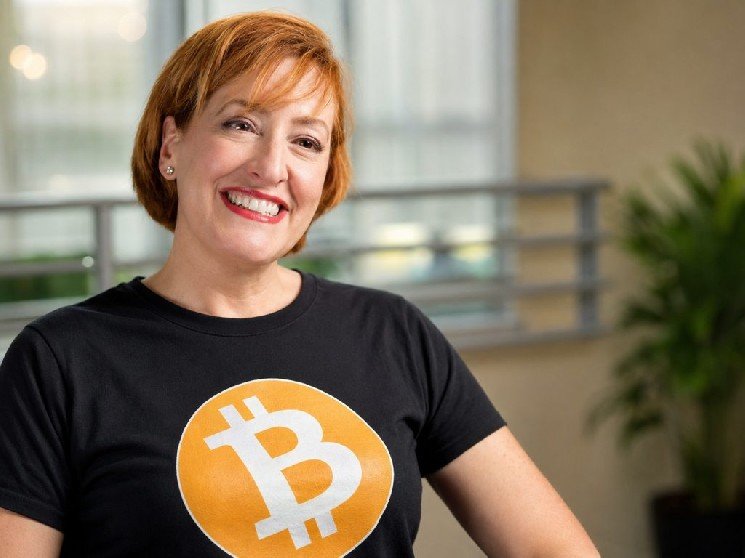
    Following the sudden and sharp rise in the cryptocurrency markets, Caitlin Long, Founder and CEO of Custodia Bank and a leading figure in the market, assessed the recent activity in Bitcoin and the general financial markets. Long stated that a macroeconomic reason and the actions of the US Treasury Department were behind the sharp jump in the market.

    Caitlin Long, commenting on the US Treasury Department’s announcement that it will more than double its long-term bond (30-year Treasury bond) repurchases, described this as a form of “yield curve control.”

    Long stated that this move directly triggered a sharp movement in interest rates and put pressure on the US dollar, weakening it. He added that a weaker dollar generally supports risk assets. This situation triggered a sharp upward movement in leading crypto assets such as Bitcoin and Ethereum.

    Responding to the question “Has the 4-year cycle ended?”, which has been frequently debated in the market recently, Long argued that the charts and fundamental data indicate that the cycle is still ongoing. He stated that the basic dynamics of the mining economy have not changed; it is a natural part of the cycle for miners to lose profitability due to high electricity and computing costs and withdraw from the market.

    Long, who refrained from making price predictions, stated that based on past experience, Bitcoin appears cheap at current levels.

    *This is not investment advice.

  • Solana Developer Mert Mumtaz Praises an Altcoin Big Time

    Solana Developer Mert Mumtaz Praises an Altcoin Big Time

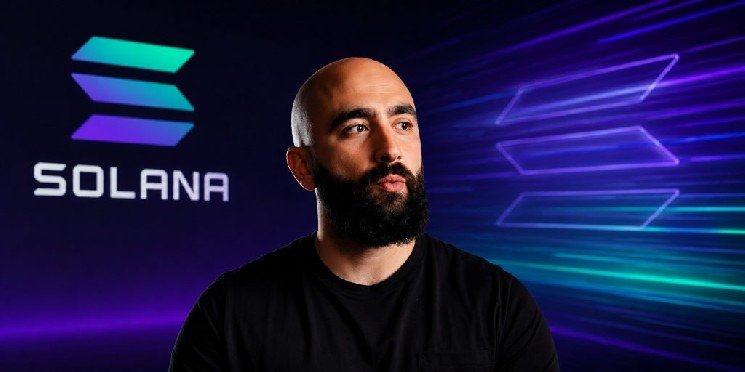
    The cryptocurrency and privacy-focused financial world is experiencing eventful times. Valor Group Founder Dev and Mert Mumtaz, a well-known figure in the crypto ecosystem, participated in The Rollup program on the crypto broadcasting platform, sharing the latest developments on the Zcash (ZEC) network and a critical roadmap for the project’s future. The discussions highlighted the network’s scalability, security updates, and measures taken against quantum threats.

    The recent Ironwood update implemented on the Zcash network is considered one of the project’s most important milestones. Speaking at the event, Mert recalled that during internal red teaming and AI-powered security audits, a potential vulnerability was identified in the Orchard pool that could have allowed the creation of counterfeit notes. Through extensive work and official verification, it was proven that the code mathematically matched the specifications perfectly. With the seamless transfer of funds from the Orchard pool to the new Ironwood pool, the risk of counterfeit coin minting on the network has been completely eliminated, and community concerns have been addressed.

    Dev, who shared important technical details about Zcash’s future vision, emphasized that Valor Group’s main goal is to achieve a transaction volume on the scale of a credit card for Zcash. He stated that they aim to process more than 50,000 transactions per second at sub-second speeds while maintaining a full proof-of-work mechanism, and that the main obstacle to scaling is not the nodes themselves, but the wallet scanning processes. It was noted that thanks to new wallet architectures and optimizations, synchronization delays in the user experience will become a thing of the past.

    The upcoming Tachion update promises to make Zcash fully protected against quantum computing threats. The update will integrate recursive zero-knowledge proofs into the network. This is reported to reduce transaction sizes by more than five times, eliminate node processing overhead, and resolve state growth issues. With Tachion, the network is claimed to achieve not just “quantum recoverable” but a truly “quantum-proof” privacy structure.

    *This is not investment advice.

  • A Daily Token Burn Record Was Set Yesterday for an Altcoin—an All-Time High

    A Daily Token Burn Record Was Set Yesterday for an Altcoin—an All-Time High

    Uniswap’s native token, $UNI, reached a new record for daily burn value. According to data, approximately $590,000 worth of $UNI was burned on August 21st (yesterday). This figure represents the highest daily $UNI burn amount ever recorded in dollar terms.

    The largest portion of the burn occurred on the Ethereum network. Approximately $267,000 worth of $UNI was removed from circulation on Ethereum, $165,000 on Base, and approximately $87,000 on Robinhood Chain. Including burns on other networks, the total daily value approached $590,000.

    In terms of token volume, approximately 150,000 $UNI were burned on August 21st. This amount stands out as the second highest daily burn in $UNI terms recorded on the date.

    The data shows that the $UNI burning mechanism has accelerated significantly recently, with activity spreading across different networks.

    $UNI’s price has risen 6.88% in the last 24 hours, but it is still trading 90.7% lower than its all-time high of approximately $45.

    *This is not investment advice.

  • Crypto Outperforms AI Stocks: Why Bitcoin & Ethereum Are Winning

    Crypto Outperforms AI Stocks: Why Bitcoin & Ethereum Are Winning

    For much of the recent market cycle, AI was one of Wall Street’s hottest sectors. Technology stocks pulled in massive amounts of money as investors bet that heavy spending on AI would eventually lead to higher profits and better productivity.

    However, the latest 50-day performance comparison shows a big shift in momentum. Bitcoin was up 31.60% and Ethereum surged 53.50%, according to recent data. In contrast, the S&P 500 gained just 2.26%, while the Nasdaq barely moved at 0.22%.

    Gold and silver also had solid runs, up 14.31% and 19.26% respectively.

    Why is Crypto Outperforming AI Stocks?

    One possible explanation is that crypto has attracted a new wave of liquidity and institutional interest precisely when stock momentum has started to stall.

    US spot Bitcoin ETFs pulled in about $1.6 billion between Monday and Thursday in the August 17-21 week, the strongest weekly inflow of 2026 so far. Thursday alone brought in around $606 million.

    Ethereum is experiencing a similar trend. Spot Ether ETFs recorded approximately $221 million on August 20, marking their fourth straight day of inflows.

    This is notable because it shows the rally isn’t just retail traders jumping on momentum, but that there’s also institutional money coming in through regulated products.

    Has Capital Moved from AI Stocks into Crypto?

    The gap in performance shows crypto is beating stocks, but it doesn’t tell us where the money is coming from. Investors could be holding Nvidia, an S&P 500 ETF, Bitcoin, and Ethereum at the same time.

    In fact, the divergence we’re seeing might be powered by different factors at work, not necessarily a straight shift from one asset class to another.

    Crypto’s recent run has been driven by stronger ETF demand and better liquidity. On the other hand, as reported by Reuters, the S&P 500 and Nasdaq were headed for weekly losses, and higher Treasury yields kept putting pressure on tech stocks.

    Still, this doesn’t mean investors have suddenly gone cold on AI. Rather, it suggests crypto has stronger drivers at the moment.

    Crypto’s Biggest Advantage Right Now May Be Momentum

    Right now, the biggest difference between the two markets is momentum, and crypto leads in that regard.

    Bitcoin is now approaching the $80,000 area after rising roughly 30% from its recent low near $60,000. What’s more, BTC is getting close to its strongest weekly performance in more than two years, with the price up around 22% during the week.

    Crypto’s total market capitalization has also increased sharply, indicating that the rise isn’t limited to one token.

    Nonetheless, it’s important to note that when a market goes from lagging badly to leading strongly in a short time, the momentum itself can become a risk. Short sellers may be compelled to cover their positions, and traders may rush to ride the uptrend. Such a dynamic can intensify gains, but it can also make any pullback much harsher.

    So, the strongest bullish signal for crypto to maintain its lead would be continued ETF inflows, along with better liquidity and more involvement from assets beyond just Bitcoin.

    In any case, the AI market shouldn’t be written off yet. Nvidia’s upcoming earnings report on August 26 will be a big test for whether the AI investment cycle can get its momentum back, and strong earnings could quickly pull capital back toward tech stocks.

  • Crypto Outperforms AI Stocks: Why Bitcoin & Ethereum Are Winning

    Crypto Outperforms AI Stocks: Why Bitcoin & Ethereum Are Winning

    For much of the recent market cycle, AI was one of Wall Street’s hottest sectors. Technology stocks pulled in massive amounts of money as investors bet that heavy spending on AI would eventually lead to higher profits and better productivity.

    However, the latest 50-day performance comparison shows a big shift in momentum. Bitcoin was up 31.60% and Ethereum surged 53.50%, according to recent data. In contrast, the S&P 500 gained just 2.26%, while the Nasdaq barely moved at 0.22%.

    Gold and silver also had solid runs, up 14.31% and 19.26% respectively.

    Why is Crypto Outperforming AI Stocks?

    One possible explanation is that crypto has attracted a new wave of liquidity and institutional interest precisely when stock momentum has started to stall.

    US spot Bitcoin ETFs pulled in about $1.6 billion between Monday and Thursday in the August 17-21 week, the strongest weekly inflow of 2026 so far. Thursday alone brought in around $606 million.

    Ethereum is experiencing a similar trend. Spot Ether ETFs recorded approximately $221 million on August 20, marking their fourth straight day of inflows.

    This is notable because it shows the rally isn’t just retail traders jumping on momentum, but that there’s also institutional money coming in through regulated products.

    Has Capital Moved from AI Stocks into Crypto?

    The gap in performance shows crypto is beating stocks, but it doesn’t tell us where the money is coming from. Investors could be holding Nvidia, an S&P 500 ETF, Bitcoin, and Ethereum at the same time.

    In fact, the divergence we’re seeing might be powered by different factors at work, not necessarily a straight shift from one asset class to another.

    Crypto’s recent run has been driven by stronger ETF demand and better liquidity. On the other hand, as reported by Reuters, the S&P 500 and Nasdaq were headed for weekly losses, and higher Treasury yields kept putting pressure on tech stocks.

    Still, this doesn’t mean investors have suddenly gone cold on AI. Rather, it suggests crypto has stronger drivers at the moment.

    Crypto’s Biggest Advantage Right Now May Be Momentum

    Right now, the biggest difference between the two markets is momentum, and crypto leads in that regard.

    Bitcoin is now approaching the $80,000 area after rising roughly 30% from its recent low near $60,000. What’s more, BTC is getting close to its strongest weekly performance in more than two years, with the price up around 22% during the week.

    Crypto’s total market capitalization has also increased sharply, indicating that the rise isn’t limited to one token.

    Nonetheless, it’s important to note that when a market goes from lagging badly to leading strongly in a short time, the momentum itself can become a risk. Short sellers may be compelled to cover their positions, and traders may rush to ride the uptrend. Such a dynamic can intensify gains, but it can also make any pullback much harsher.

    So, the strongest bullish signal for crypto to maintain its lead would be continued ETF inflows, along with better liquidity and more involvement from assets beyond just Bitcoin.

    In any case, the AI market shouldn’t be written off yet. Nvidia’s upcoming earnings report on August 26 will be a big test for whether the AI investment cycle can get its momentum back, and strong earnings could quickly pull capital back toward tech stocks.

  • How a Treasury buyback tweak helped bitcoin surge 25% to nearly $80,000 in days

    How a Treasury buyback tweak helped bitcoin surge 25% to nearly $80,000 in days

    A relatively small change in the U.S. government bond market helped set off one of bitcoin’s sharpest rallies in months this week, as falling long-term yields gave traders an excuse to unwind a record pile of bearish crypto bets.

    The U.S. Treasury said it would double the size of its buyback operations in the longest-dated government bonds, to $4 billion from $2 billion per operation. The announcement helped push the 30-year Treasury yield down from 5.34%, a 19-year high, to around 5.19%.

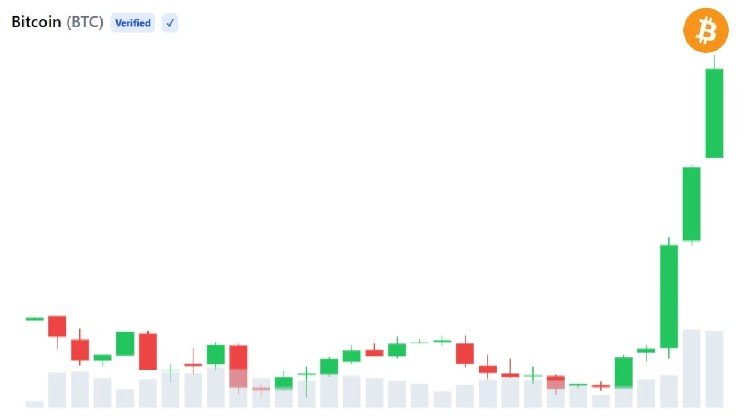
    Bitcoin jumped about 25% since Wednesday and surged past $78,000 as of Asian morning hours Saturday, with roughly $4 billion in bearish crypto positions liquidated on Thursday and Friday as prices rose.

    A Treasury buyback involves the government buying previously issued bonds back from investors, a program mainly designed to make older Treasury securities easier to trade and help the government manage the composition of its debt. Importantly, this is no quantitative easing, where the Federal Reserve creates reserves to purchase assets in an effort to loosen financial conditions.

    “Mechanically, a buyback is not QE but primarily a tool for managing liquidity and the composition of Treasury liabilities,” said Jeff Ko, chief analyst at CoinEx, in a note to CoinDesk. “Given the program’s relative small size, I would read this more as a signal, a soft policy put on the long end.”

    Bond yields had become a growing problem for risk assets. A bond’s yield is, in simple terms, the return an investor receives for holding it. When prices of existing bonds rise, their yields fall. When bond prices fall, yields rise.

    U.S. government debt is generally treated as one of the safest places investors can put their money. Bitcoin pays no interest simply for holding it, so its return depends largely on the price appreciating.

    The more an investor can earn from Treasuries with relatively little risk, the more attractive bitcoin and other volatile assets need to become before that investor is willing to move money up the risk curve.

    “Yield could increasingly become Bitcoin’s competition,” said Hong Yea, co-founder and CEO of Grvt, in an email. “When risk-free yields are high, Bitcoin isn’t competing only with other risk assets. It’s competing with the return investors can earn for doing very little. That changes the hurdle rate for capital.”

    “If investors can earn 4-5% in traditional markets, crypto has to offer a much stronger reason for capital to move up the risk curve,” Yea said. “When yields fall, that hurdle comes down. Capital becomes more willing to seek growth and risk again, which has historically been a much better environment for Bitcoin.”

    How long-term rates influence markets

    Long-term Treasury influence borrowing costs across the economy and are closely watched as a gauge of how tight financial conditions are. Higher long-term rates can make everything from mortgages to corporate financing more expensive and tend to reduce investors’ willingness to own assets whose value depends heavily on future growth or improving liquidity.

  • Zcash jumps 48% to over $800 as Grayscale spot ETF push adds to ‘next bitcoin’ buzz

    Zcash jumps 48% to over $800 as Grayscale spot ETF push adds to ‘next bitcoin’ buzz

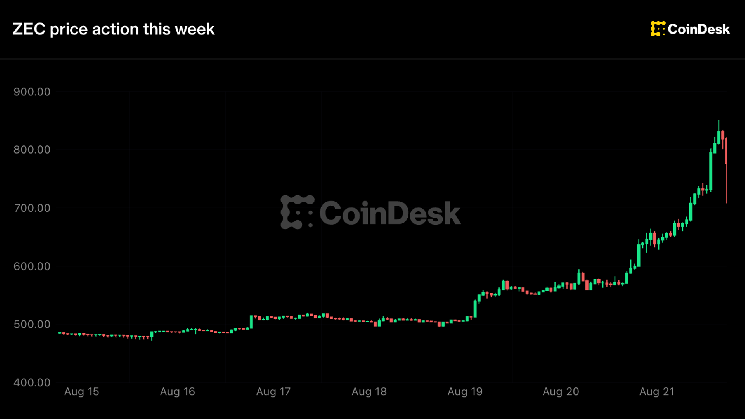
    Zcash surged past $800 for the first time since 2018 on Saturday, as “next bitcoin” chatter, billions in futures volume and Grayscale’s spot ETF push fueled a 38% rally.

    The privacy-centric token was built on Bitcoin’s design and inherited its 21 million supply cap, proof-of-work mining and halving schedule, with shielded transactions layered on top. CoinDesk Research examined the technical case for it in several reports this year, covering the Tachyon upgrade and the network’s approach to quantum readiness.

    Saturday’s move took it past the January 2018 peak near $800, which had stood as the token’s high water mark for eight years, and past the $750 it reached last November. It traded as low as $589 and as high as $851 in a 24-hour period, a swing of 45%.

    Crypto fund DCG sits behind several of the developments surrounding Zcash. Grayscale, which it owns, filed its fourth amendment on Aug. 18 to convert its Zcash Trust into a spot exchange-traded fund on NYSE Arca under the ticker ZCSH.

    The amendment keeps the conversion process moving but does not mean the ETF has been approved, with the filing still subject to SEC review.

  • Analysts See Strong Bitcoin Rally, But Profit-Taking Risk Remains

    Analysts See Strong Bitcoin Rally, But Profit-Taking Risk Remains

    Why Bitfinex Sees a Longer Runway Than a Squeeze

    Bitcoin’s climb to a multi-month high has left every buyer from the past five months sitting on a paper gain. The price peaked at $79,491 on Aug. 21, and analysts at crypto exchange Bitfinex said spot demand and short covering, not fresh leverage, carried the move. Rallies built on borrowed money unwind faster than rallies built on cash purchases.

    In a statement to Bitcoin.com News, Bitfinex analysts shared:

    “Squeeze-led rallies usually carry a question mark over whether they hold, because liquidations do the lifting.”

    “Here the combination of ETF demand, the macro shift and the absence of heavy selling gives this one a longer runway, with small retracements along the way,” they added.

    What Pushed Yields Down and Bitcoin Up

    The U.S. Department of the Treasury announced on Aug. 19 that it would double the maximum size of its long-end liquidity support buybacks. Each operation will now reach at least $4 billion, up from $2 billion, and the larger sizes apply from Sept. 9 through Nov. 4.

    Liquidity conditions have shaped $BTC’s price for a decade, with bitcoin’s four-year boom-and-bust cycle providing historical context for those shifts. Global liquidity indices have shown roughly 90% correlation with bitcoin since 2015, while cheaper funding at the long end of the curve tends to support risk assets.

    Short sellers took the first hit on Aug. 19, when bitcoin jumped to $69,749 and about $1.48 billion in crypto positions liquidated inside an hour, most of them shorts. Spot bitcoin ETFs added $297.6 million the same session. The squeeze supplied the first leg, and what followed came from buyers paying cash.

    Spot Buying or Leverage: How to Tell the Difference

    Open interest measures the total value of futures contracts left open, and it rises when traders add borrowed exposure. A rally that lifts price and open interest together is running on credit. One that lifts price while open interest lags is running on cash.

    “The shape of the move is the tell. Rallies built on fresh leverage show open interest jumping in step with price. Price climbed 10 to 11 percent while open interest (OI) rose only around 4 percent, which points to spot buying and short covering doing the work, with leverage playing a minor role,” the exchange’s research desk noted, adding:

    “The weaker version of this setup is open interest stacking up while price stalls, and that isn’t what happened.”

    Why $68,000 Is the Line That Decides the Next Move

    Buyers from the past five months share a cost basis in the $68,000 to $69,000 zone, the level Bitfinex flags as the most important line on the chart. Bitcoin trading above it keeps that cohort in profit and takes away the pressure that pushes underwater buyers to sell any bounce.

    The record high of $126,000 in October 2025 gave way to a drawdown that dragged $BTC near $64,000 earlier this month. Five boom-and-bust cycles have shaped that history, each one reshuffling who holds coins at what price.

    What US Buyers Have to Prove This Week

    U.S. spot bitcoin ETFs pulled in $606.29 million on Aug. 20, their largest single day since May 1, with Blackrock’s IBIT capturing 82% of the total. Net assets across the funds reached $90.16 billion, while ether products took in $220.77 million.

    A full week at that pace would harden the support beneath the price and mark a real shift in demand structure, by the analysts’ reckoning. Aug. 20 was the fourth consecutive session of inflows. Whether the pace holds through the coming week decides how much of the rally has a floor under it.

    The Coinbase Premium gauges whether U.S. buyers pay more for bitcoin than traders on offshore venues. It printed negative in every session from May 19 through late July, a record stretch beyond 70 trading days. Bitfinex treats a return to positive territory as clean confirmation that American demand has come back.

    What Could Stop the Rally

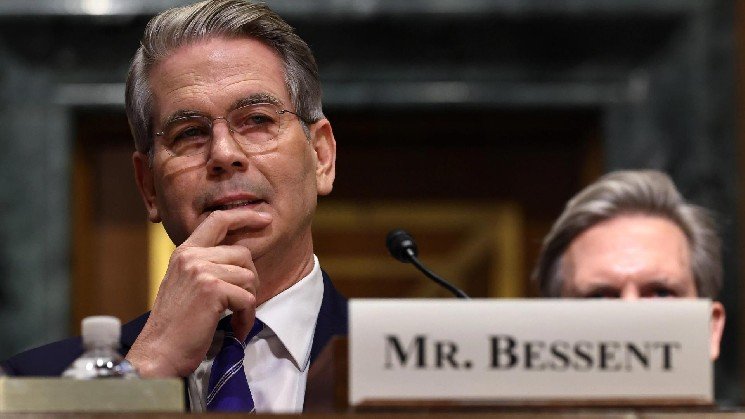
    Treasury Secretary Scott Bessent told CNBC on Aug. 20 that buyback operations could exceed $4 billion per issue. The 30-year yield had reached roughly 5.33% earlier in the week, then fell 8 to 10 basis points once Treasury confirmed the larger operations. Long-dated bonds remain the pressure point for risk assets.

    The Bitfinex team cautioned:

    “The obvious risk is the volume of bitcoin sent to exchanges in profit during this move, which could turn into the largest profit-taking wave of the year if it lands.”

    Real yields climbing back to the levels that pinned bitcoin below $65,000 through July would test the rally faster than any on-chain signal. Bitfinex analysts warned on Aug. 4 that the market stays macro-dependent, with strain from long-dated bonds passing straight through to price. Treasury figures released Aug. 19 put the national debt above $40 trillion for the first time.