Author: rb809rb

  • Binance Announces Addition of 10 New Trading Pairs to its Spot Market Product Range! Here Are the Details

    Binance Announces Addition of 10 New Trading Pairs to its Spot Market Product Range! Here Are the Details

    Binance continues to expand its portfolio in the spot market. The platform, one of the world’s largest cryptocurrency exchanges, announced it will list 10 new trading pairs under its bStocks product family to offer users more trading options. The company also stated that it will reduce the maker trading fee to zero for these newly listed assets for a limited period.

    According to a statement by Binance, the bStocks assets named AAOIB (Applied Optoelectronics), ARMB (Arm), AVGOB (Broadcom), BABAB (Alibaba), HOODB (Robinhood), IBMB (IBM), MRVLB (Marvell Technology), NOKB (Nokia), RKLBB (Rocket Lab), and TSMB (TSMC) will be available for spot trading with $USDT pairs on July 15, 2026, at 16:30. Simultaneously, the Spot Algo Trading Bots service will also be launched for these trading pairs.

    The newly listed trading pairs will be AAOIB/$USDT, ARMB/$USDT, AVGOB/$USDT, BABAB/$USDT, HOODB/$USDT, IBMB/$USDT, MRVLB/$USDT, NOKB/$USDT, RKLBB/$USDT, and TSMB/$USDT. This will allow users to perform both manual trades and utilize algorithmic trading bots for these tokens.

    Binance has also launched a special campaign to support the listing. Accordingly, the maker commission fee for all bStocks trading pairs listed above will be 0% from the listing date until August 31, 2026 at 02:59. This means that investors providing liquidity to the order book will be able to trade without paying maker fees during the campaign period.

    bStocks products stand out as digital assets based on the shares of some major companies in traditional financial markets. Recently, Binance has been expanding this product line, aiming to offer its users blockchain-based investment opportunities in leading companies in the technology and finance sectors.

    Market experts say the new listings could boost trading volume and that the zero-maker commission campaign could particularly appeal to professional investors and market makers. Binance’s move is seen as part of its strategy to strengthen integration between traditional finance and the digital asset ecosystem.

    This is not investment advice.

  • U.K. Government Proposes Social Media Curfew for Older Teens Alongside Under-16 Ban

    U.K. Government Proposes Social Media Curfew for Older Teens Alongside Under-16 Ban

    The U.K. government has proposed a social media curfew for older teenagers alongside its pending ban for those under 16.

    According to the BBC, 16 and 17-year-olds could face apps such as Instagram, TikTok and YouTube being unavailable to access by default between the hours of midnight and 6 a.m. However, they would be able to opt out of this by changing their settings.

    In June, it was announced that the U.K. was moving ahead with a full social media ban for children under 16 years old. The curfew for 16 and 17-year-olds would take effect alongside the ban, which if passed in Parliament, will begin in spring 2027.

    The platforms to be banned for under-16s include Snapchat, TikTok, YouTube, Instagram, Facebook and X. WhatsApp and Signal will not be part of the ban.

    The BBC reports that “addictive” features like auto-play and infinite scrolling would also be disabled, and there will also be measures to help under-18s use AI chatbots safely, including enforced breaks. Technology Secretary Liz Kendall said in a statement that, along with the midnight curfew, this measure will be “crucial in helping young people get the sleep they need, focus on school and college, and spend more quality time with family and friends, all of which are fundamental to building a happy, healthy and fulfilling adult life.”

    She added: “We want young people to enjoy the benefits of technology while having the tools to make the online world a place where they can thrive.”

    The proposed U.K. ban follows similar legislation introduced in Australia, Indonesia and France earlier this year.

  • Ledger adds Celo fee abstraction, expands support to 18 token gas payment options

    Ledger adds Celo fee abstraction, expands support to 18 token gas payment options

    Celo has enhanced its collaboration with Ledger by integrating a key network feature into the hardware wallet provider’s platform, offering more flexible transaction fee options to users worldwide.

    Ledger supports Celo’s CIP-64 fee abstraction

    Ledger has implemented support for Celo’s fee abstraction, made possible through the network’s CIP-64 upgrade. This change allows users to pay transaction fees using a variety of Celo-native assets, rather than being restricted to the $CELO token.

    The new functionality builds on Ledger Live’s December 2025 update, where users gained the ability to transact and exchange $CELO and Celo stablecoins through Ledger’s interface.

    With this latest expansion, Ledger’s user base of more than 8 million people in over 200 countries can now settle gas fees in any of 18 supported tokens. These payment options include Tether USD₮, USDC, Wrapped Ether (WETH), and multiple fiat-referenced stablecoins developed by Mento Labs.

    Accepted fiat-backed tokens span a range of global currencies such as the euro, British pound, Japanese yen, Canadian dollar, Australian dollar, Nigerian naira, Kenyan shilling, and South African rand, offering considerably broader payment flexibility.

    Mini dictionary: CIP-64, or Celo Improvement Proposal 64, is an upgrade that enables transaction fees to be paid with approved ERC-20 tokens on the Celo network, rather than requiring users to exclusively use the $CELO token for gas payments.

    Stablecoins overtake $CELO for transactions

    Launched in July 2023 during the network’s Gingerbread hard fork, CIP-64 has allowed users to pay transaction fees with selected stablecoins and other ERC-20 tokens. This approach, now widely adopted across the Celo network, has led to a significant shift in transaction behavior.

    Celo reports that nearly half of all transaction volume on the network now uses stablecoins denominated in US dollars, instead of the network’s native $CELO token.

    By allowing users to handle transaction fees with familiar currencies, Celo aims to lower barriers to entry and streamline the experience of using money across blockchain payments and decentralized finance applications.

    The integration with Ledger is expected to further simplify onboarding, particularly for users interested in exploring Celo payments and DeFi solutions.

    Celo leads in tokenized gold adoption

    Beyond network transactions, Celo highlighted its leading position in the market for tokenized gold. According to network figures, 107,622 users on Celo own Tether Gold (XAUT), positioning the network as the dominant platform for tokenized gold holders.

    Blockchain data estimates a total of 118,500 XAUT holders across seven blockchain networks. Of these, Celo accounts for 90.8%, followed by Solana at 4.5%. Other platforms with measurable XAUT user bases include HyperEVM (1.9%), Arbitrum One (1.8%), Plasma (0.6%), Monad (0.3%), and Ink (0.1%).

    Celo attributes its dominance to a growing ecosystem, including applications such as MiniPay, Squid Router, Uniswap, Featherlend, Morpho, and TheoriqAI, that together drive adoption of real-world asset tokenization.

    Celo, a mobile-first blockchain that aims to make decentralized financial services accessible to anyone with a smartphone, is now advancing into sectors beyond digital-only payments. By making stablecoin-based gas payments easier and leading the charge on tokenized gold, Celo is seeking new use cases for blockchain technology in mainstream finance.

    Celo’s expanding ecosystem and diverse payment options underscore its strategy to position itself as a leading platform for accessible and practical financial instruments on the blockchain.

  • NEAR Governance Vote To Scrap Gas Rebates Puts Developer Incentives Under Review

    NEAR Governance Vote To Scrap Gas Rebates Puts Developer Incentives Under Review

    $NEAR Governance Vote To Scrap Gas Rebates Puts Developer Incentives Under Review is a useful reminder that crypto coverage is not only about token prices. Sometimes the more important story is the infrastructure, regulation, security, or product layer sitting underneath the market noise.

    The immediate point is straightforward: nEAR governance voted to scrap developer gas rebates. That gives readers something concrete to work with, rather than another vague sentiment update.

    TL;DR

    • $NEAR governance voted to scrap developer gas rebates.
    • The change affects developers who relied on protocol gas distributions.
    • It raises a broader question about how chains should reward app builders.

    Why This Matters Now

    The timing matters because $NEAR is already part of a wider conversation across the market. Traders want to know whether the development changes liquidity or risk. Builders want to know whether it changes what can be deployed. Compliance teams want to know whether it changes how platforms operate.

    In that sense, the story is bigger than one headline. It sits inside the ongoing shift from speculative crypto cycles toward more practical questions: who can use these systems, how safe are they, and whether the underlying incentives actually work.

    The best way to read it is with discipline. It is not a guarantee of immediate upside, and it should not be treated as one. But it does add a fresh data point to the way the market is thinking about $NEAR.

    The $NEAR Angle

    For $NEAR, the important part is the specific mechanism. If this is a security issue, the risk sits in dependencies and user protection. If it is a listing or product launch, the question is access and liquidity. If it is a governance or research proposal, the question is whether the idea can survive implementation.

    That is where this update becomes useful. It is not just a label attached to a trend. It gives readers a way to understand what might actually change if the development gains traction.

    Crypto has a habit of turning every announcement into a broad market claim. This one deserves a narrower read. The value is in seeing how it affects the users, developers, institutions, or traders closest to the issue.

    The Risk Side

    There is also a caution attached. Source material can confirm that a development exists, but it cannot prove that adoption will follow. A proposal still needs support. A product still needs users. A chart still needs confirmation. A compliance tool still needs integration.

    That is why the responsible reading is not to oversell the story. The stronger takeaway is that this adds to a pattern. The crypto market is steadily becoming more professional, more technical, and more sensitive to real operational details.

    Readers should also watch for follow-up signals. That could mean developer feedback, exchange support, regulatory response, wallet adoption, liquidity data, or simply whether market participants continue reacting after the first headline fades.

    What Comes Next

    The next stage will decide whether this remains a narrow update or becomes part of a larger market theme. In crypto, that difference matters. Plenty of stories look important for a few hours and then disappear. The ones that last usually show up again through usage, liquidity, enforcement, governance, or developer adoption.

    For now, this gives the market another piece of information to weigh. It is specific enough to be useful, but still early enough that readers should keep the caveats in view.

    That makes it worth covering without pretending it settles anything. The story is a signal, not a final verdict.

    The key is not to confuse coverage with certainty. $NEAR stories can move quickly, especially when they touch security, regulation, listings, infrastructure, or price levels. The useful approach is to track the next confirming detail rather than assume the first update carries the whole market story. That is how traders avoid chasing noise and how readers separate a genuine development from another passing headline.

    This report is based on information from thedefiant.io.

    This article was written by the News Desk and edited by Samuel Rae.

  • Iran launches attacks across region as US strikes continue

    Iran launches attacks across region as US strikes continue

    NewsFeed

    Iran attacked Kuwait, Bahrain, and Jordan on Tuesday night, claiming to destroy the US Fifth Fleet’s command centre. The attacks come after US strikes on Iran’s coastal cities and the collapse of talks.

  • Bitmine generated $46M from Ethereum staking last quarter

    Bitmine generated $46M from Ethereum staking last quarter

    Bitmine Immersion Technologies recorded $45.7 million in revenue from Ether staking and validation last quarter, following the launch of its institutional-grade Ethereum staking platform in March.

    Staking revenue accounted for 98% of total revenue for the three months ended May 31, far outpacing the $624,000 from self-mining Bitcoin (BTC) and the $168,000 from consulting services, according to Bitmine’s latest 10-Q filing. On Monday, Bitmine said it had staked 85% of its $ETH holdings, equating to around 4.9 million Ether ($ETH).

    “Bitmine has staked more $ETH than other entities in the world. At scale (when Bitmine’s $ETH is fully staked by MAVAN and its staking partners), the projected $ETH staking reward is $284 million on an annualized basis,” said Tom Lee, chairman of Bitmine.

    The latest quarterly results show how Bitmine’s pivot to Ethereum has reshaped its revenue mix. A year ago, Bitmine recorded just $2 million in total revenue for the quarter ended May 31, 2025, primarily from machine leasing.

    The results also reflect the March launch of MAVAN, an institutional-grade Ethereum staking platform that operates validator infrastructure for its own holdings and external clients.

    Related: Ethereum backers launch nonprofit to lead institutional adoption efforts

    MAVAN, short for “Made in America VAlidator Network,” followed the acquisition of Australia-based non-custodial validator operator Pier Two Holdings. It was originally developed to support Bitmine’s own Ethereum treasury; its scope expanded to serve institutional investors, custodians and ecosystem partners.

    Lee calls Robinhood Chain a “breakaway success”

    On Monday, Lee highlighted the success of the newly launched Robinhood Chain, with dollar volumes exceeding $1 billion since its July 1 launch.

    “Robinhood Chain now has more trading volume than any other decentralized exchange (DEX), demonstrating the outstanding utility and product market fit for Ethereum, which is the underlying chain,” he said.

    “Robinhood Chain uses $ETH as the native gas token. And transaction fees are denominated in $ETH and the finality is settled on Ethereum. Robinhood’s 27 million users are paying crypto fees denominated in $ETH. In other words, everyday users are starting to see $ETH as money,” he added.

    Magazine: Strategy became a symbol of the dot-com crash: Could history repeat?

  • ETH Price Eyes $2,163 Target as Double Bottom Completes on Daily Chart

    ETH Price Eyes $2,163 Target as Double Bottom Completes on Daily Chart

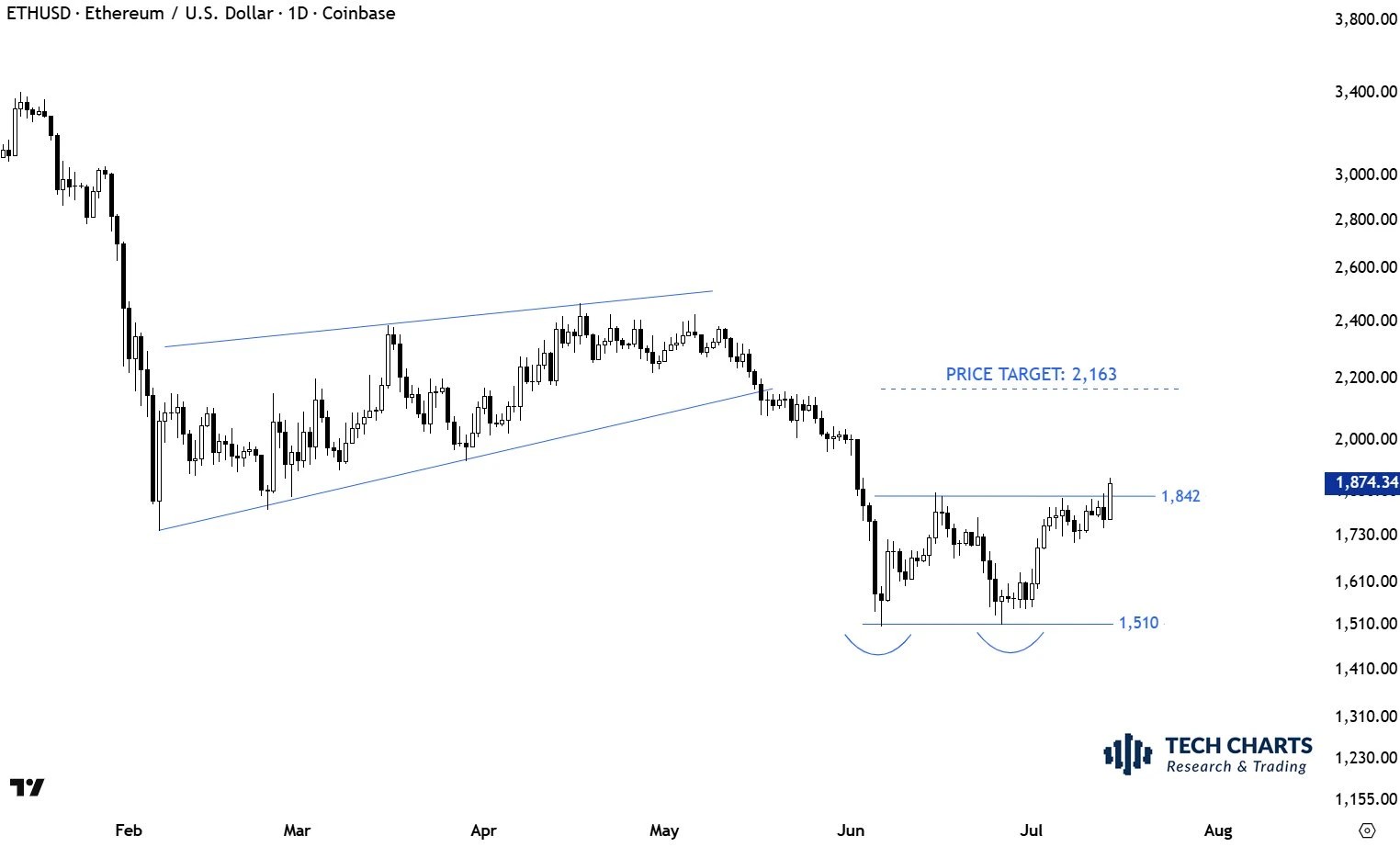
    Ethereum ($ETH) is showing strong technical signs of a short-term bottom reversal, with a projected surge to $2,163.

    Ethereum targets $2,163 following double bottom completion

    As shown in the chart below, $ETH has clearly formed a classic double-bottom reversal pattern near the $1,510 support. Even more, just two days ago, the coin broke above the $1,842 neckline resistance after a period of consolidation. At press time, $ETH was still sustaining this bullish momentum, trading at about $1,883 (+6.88% in the last 24 hours).

    Source: Tech Charts

    According to veteran chartist Aksel Kibar, this setup projects an upside target of $2,163 – calculated from the pattern’s move from the double bottom to the neckline. It also follows a similar short-term bullish prediction made by the analyst just three days ago, indicating continued bullish momentum in the reversal.

    Further supporting this thesis is the rising multi-month trendline, which shows higher lows between February and May. This trajectory means buyers are consistently accumulating even as prices rise, further reinforcing the previously mentioned bullish thrust.

    Recent developments fueling upside bias

    In addition to the above technical analysis, EthSystems, a spin-off from the Ethereum Foundation, recently launched as an independent for-profit research and engineering company. The Ethereum community expressed optimism for the event, as it signaled Ethereum’s commitment to providing blockchain privacy to heavily regulated institutions.

    Furthermore, today’s cooler-than-expected inflationary data encouraged investors to flow into crypto assets. Other than retail investors, institutions continue to accumulate the coin, with Bitmine Immersion Technologies now holding 5.77 million $ETH tokens (about 4.8% of the circulating supply).

    Key levels to watch for

    Important levels to watch out for now include the $1,842-$1,850 double-bottom neckline resistance. A downside penetration below this threshold could invalidate the bullish setup.

    Additional resistance lies between $1,900 and $2,000, which marks the highs hit between May and June just before the sharp decline.

    Breaking above these two zones, coupled with rising trade volumes, would pave the way for the $2,163 target.

  • Trump welcomes Iraqi PM to White House, vows ‘a lot of deals’

    Trump welcomes Iraqi PM to White House, vows ‘a lot of deals’

    NewsFeed

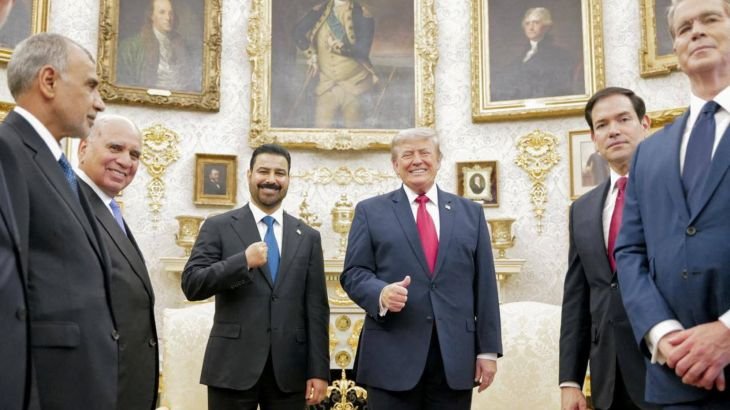
    US President Donald Trump and Iraqi Prime Minister Ali al-Zaidi have met at the White House in Washington, DC, with both leaders pledging to deepen economic ties and boost Iraq’s oil output. The meeting comes as the US prepares to reduce its military presence in Iraq. Al Jazeera’s Tanya Noury has the latest.