Author: rb809rb

  • T-Mobile’s Home Internet Deals Include $200 Cash-Back Credit and Free Subscriptions to Hulu and Paramount+

    T-Mobile’s Home Internet Deals Include $200 Cash-Back Credit and Free Subscriptions to Hulu and Paramount+

    If you purchase an independently reviewed product or service through a link on our website, Variety may receive an affiliate commission.

    T-Mobile is making it more affordable to cut ties with traditional internet providers.

    For a limited time, new customers who sign up for any T-Mobile 5G Home Internet plan can receive their first month of service on T-Mobile1, plus up to $200 back through a virtual prepaid card.2

    The rebate amount depends on which plan customers select. New subscribers can receive $100 back with the Rely or Amplified plans, while those who choose the higher-tier All-In plan are eligible for the full $200 virtual prepaid Mastercard.

    T-Mobile 5G Home Internet uses the carrier’s cellular 5G network rather than a traditional cable or fiber connection. Customers receive a wireless gateway that converts the nearby mobile signal into a Wi-Fi network for devices throughout the home, helping eliminate the need for cable installation or a technician appointment.

    The service has become an increasingly prominent alternative to major cable companies, particularly for households looking for simpler pricing and fewer long-term commitments. T-Mobile’s 5G Home Internet plans include unlimited data and do not require annual contracts, though availability and speeds vary by address.

    T-Mobile also includes a five-year price guarantee with eligible plans, promising not to raise the price of fixed-wireless 5G internet data during that period. Exclusions like taxes and fees apply.

    The All-In plan also adds perks including Hulu with ads and Paramount+ Essential – totaling more than $20 in monthly savings compared to the streamers’ regular subscription prices.

    Find out more about T-Mobile’s best home internet deals here.

  • ‘The Daily Show’ Sets 30th Anniversary Podcast Hosted by News Team (EXCLUSIVE)

    ‘The Daily Show’ Sets 30th Anniversary Podcast Hosted by News Team (EXCLUSIVE)

    The Daily Show” blew out the candles on 30 years this month, and to celebrate, the Comedy Central talk series is putting out a three-episode podcast series titled “30 F#@king Years: The Daily Show Remembers.”

    The limited audio series is hosted by the News Team — that’s Jordan Klepper, Desi Lydic, Ronny Chieng, Michael Kosta, Josh Johnson, Grace Kuhlenschmidt and Troy Iwata — as they recount their favorite moments from “The Daily Show’s” three-decade history. Per the description, the anchors will discuss “iconic field pieces and legendary correspondents that helped define ‘The Daily Show’s’ unparalleled legacy.”

    “The Daily Show” has produced a catalog of ancillary podcasts and video series over the years. The audio version of the nightly show, “The Daily Show: Ears Edition,” has generated 767 million lifetime listens. And Jon Stewart’s “The Weekly Show” podcast finds the host interviewing political figures from Zohran Mamdani to JB Pritzker.

    Last week, “The Daily Show” put out a 17-minute video with clips from throughout the series’ history, including the early years hosted by Craig Kilborn and Trevor Noah’s seven-year stint in between Stewart regimes.

    “The Daily Show” has been on the upswing since Stewart returned behind the desk in 2024 — even if only on Mondays. The show is up for seven Emmys this year, including for outstanding variety series. And in the first quarter of 2026, the program scored its best young adult ratings in more than eight years. On Stewart’s Mondays, “The Daily Show” is the No. 1 show in late night with adults 18-49.

  • Fed holds rates steady, extending pause as markets await Kevin Warsh’s policy roadmap

    Fed holds rates steady, extending pause as markets await Kevin Warsh’s policy roadmap

    The Federal Reserve left its benchmark fed funds rate range unchanged at 3.50%-3.75% on Wednesday, extending its pause for a sixth consecutive meeting as policymakers continue to grapple with stubborn inflation.

    The decision came after one of the most uncertain pre-meeting setups in years. Futures markets had assigned roughly a 65% probability to a hold and 35% odds of a quarter-point increase, according to CME FedWatch data.

    It was an unusual setup, as for years, the Fed had typically tried to communicate to markets the direction it was going to take on policy

    Attention now turns to Chair Kevin Warsh’s post-meeting press conference. Warsh has been openly critical of the Fed’s traditional use of forward guidance and the quarterly “dot plot,” and investors will be watching closely for signs that the central bank’s communication strategy is changing under his leadership.

  • Ethereum Price Stalls as Fed Rate Decision Looms

    Ethereum Price Stalls as Fed Rate Decision Looms

    In brief

    • Ethereum fell 1.53% to $1,890 on Wednesday, pulling back from a session high of $1,926 as traders froze ahead of the Federal Reserve’s rate decision.
    • Spot ETH ETFs attracted $14.53 million in inflows today, capping three straight weeks of net positive flows totaling $71.17 million in the seven days ending July 28.
    • The “death cross” remains in place, but charts point to growing trend strength.

    The whole crypto market is in a holding pattern, eagerly awaiting the Federal Reserve’s next move.

    Bitcoin is hovering near $64,000 while the Fear & Greed Index sits at 29—deep in “fear” territory. All eyes are on the Federal Reserve, which is expected to hold rates at 3.50–3.75%, but could rattle risk assets with a hawkish tone from Fed Chair Kevin Warsh. Equity markets are similarly cautious.

    Ethereum, the second largest digital asset by market cap, opened Wednesday at $1,919.80, tagged a session high of $1,926.10, and has since slipped to $1,890.60—down 1.53% on the day. The move is a modest setback after a sharp recovery from 2026 lows reached earlier this month.

    That bounce has been quietly supported by institutional flows: According to SosoValue, ETH has registered three consecutive weeks of net inflows, the strongest run since April.

    The death cross—where the 50-day EMA (exponential moving average of the last 50 days) trades below the 200-day—is still firmly in place, keeping the structural bias bearish. EMAs show where average price has been over different time periods; when the shorter-term average crosses below the longer one, it’s a classic signal that the medium-term trend remains down. Until that flips, the burden of proof is on bulls.

    What has changed is the Average Directional Index, or ADX, which now reads 23.2 with buying pressure (DI+) outpacing selling pressure (DI–). ADX measures trend strength regardless of direction; readings above 20 suggest something real may be forming. Right now, bulls are technically “winning” the internal tug-of-war—just not convincingly enough to confirm a real trend yet.

    The Relative Strength Index, or RSI, sits at 54.7—neutral territory showing a small buying interest. RSI measures whether an asset is overbought or oversold on a scale of 0 to 100; readings between 40 and 60 give no strong directional signal. The Squeeze Momentum Indicator has just released after a period of compression, with momentum reading 0.71 positive—a slight lean toward the upside, but one that needs a catalyst to follow through.

    The Fibonacci retracement for ETH’s recent leg—measured from the $1,846 low to the $1,980 top—puts the golden zone (the highest probability of market cooldown) between $1,897 and $1,913. Price is sitting just below it, making this the critical near-term pivot: resistance on the way up, and the threshold bulls need to reclaim to keep the recovery thesis credible.

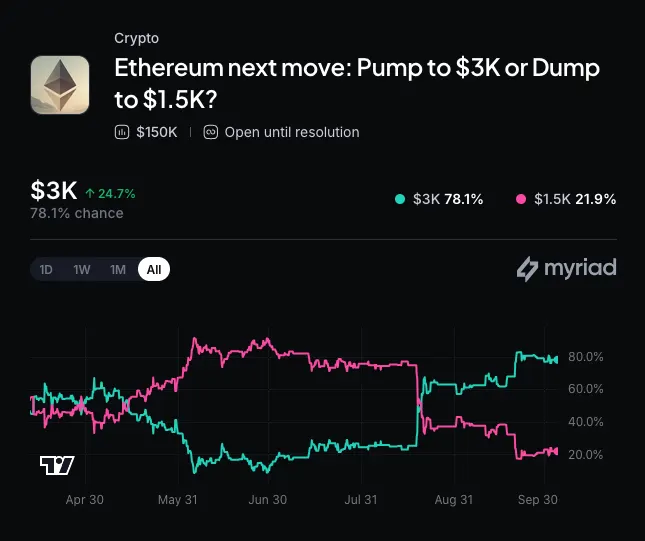
    On Myriad, the prediction market operated by Decrypt‘s parent company Dastan, traders remain broadly biased toward a dump to $1,500 before any rally to $3,000.

    Sentiment peaked at 83% in favor of the dump in mid-June when ETH was near $1,682, according to Decrypt. The recovery since then has trimmed those odds—but with ETH sitting 58% below $3,000 and just 21% above $1,500, the math still leans bearish.

    Why the bullish case could work

    A Fed hold paired with a softer-than-expected tone from Warsh could be the macro unlock. ETF inflows are real and sustained. If ETH closes above $1,913 today or in the next session, it reclaims the golden zone and puts $1,944 in play—the 23.6% Fibonacci extension.

    Beyond that, $1,980 marks the top of the current Fib leg and the next serious ceiling.

    Why the bearish case is more likely

    A hawkish Fed or any rate-hike signal sends ETH straight back to test the $1,874–$1,846 support band. The death cross isn’t flipping soon—the 200-day EMA is sitting near $2,174, still well above current price. ADX at 23.2 hasn’t yet crossed the 25 threshold needed to confirm a genuine trend, but with the Fed as the wild card, direction is a coin flip.

    Most of the chart’s story still points south until ETH clears $1,980 convincingly.

    Disclaimer

    The views and opinions expressed by the author are for informational purposes only and do not constitute financial, investment, or other advice.

    Daily Debrief Newsletter

    Start every day with the top news stories right now, plus original features, a podcast, videos and more.

  • As crypto perpetual futures boom, Ethereum’s role is shifting

    As crypto perpetual futures boom, Ethereum’s role is shifting

    For years, Ethereum has been synonymous with decentralized finance. It pioneered onchain financial tools like lending protocols and tokenized assets, which today underpin much of the crypto economy. But one of crypto’s fastest-growing sectors, perpetual futures, or “perps”, has largely flourished elsewhere.

    Ask traders where onchain perpetuals live today, and the answer is more likely to be Hyperliquid or Solana than Ethereum. That is because perpetuals demand something Ethereum’s base layer was never designed to optimize for: extremely fast, low-cost, high-frequency trading.

    “Perps require frequent transactions, fast execution, and deep liquidity,” said AJ Warner, chief strategy officer at Offchain Labs, the main developer firm behind the layer-2 Arbitrum. “That makes them a natural use case for the Arbitrum platform.”

    The distinction has become increasingly important as decentralized perpetual exchanges mature from crypto-native products into markets attracting institutional attention.

    Why Ethereum L1 fell behind

    Perpetuals are one of the most demanding applications in crypto. Their exchanges require thousands of rapid-fire updates, liquidations, funding payments, and order executions, all without interruption.

    “Perps onchain are really hard,” said Brian Smith of the Jito Foundation. “It’s not just the average performance that matters, it’s the 99.99% success rate. If your perps platform goes down, that’s existential risk.”

    Ethereum’s security-first architecture made it an ideal settlement layer, but historically, its block times and gas costs made it an expensive place to run latency-sensitive trading applications.

    When decentralized perps exchange GMX launched on Arbitrum in 2021,, it helped establish a template that many others would follow. “Ethereum mainnet fees were prohibitively expensive, which naturally attracted perps builders to Arbitrum,” Warner said. Offchain Labs then leaned into that momentum, actively prioritizing perpetuals as a strategic category.

    “By prioritizing the vertical, we were able to attract a concentration of builders and capital to the ecosystem.” Today, much of Ethereum’s perpetual trading activity lives not on the Ethereum mainnet, but on layer-2 networks like Arbitrum and, increasingly, Base.

    Ethereum’s layer-2 ecosystem has become something of a compromise: preserving Ethereum’s security while dramatically improving trading performance. Networks like Arbitrum and Base have reduced block times while also becoming an increasingly attractive trading destination because of their growing user base and liquidity.

    Chris Boulous of Dromos Labs, the main developer firm behind Aerodrome, a decentralized exchange that lives on the Base network, argued that technical performance is only part of the story.

    “Trading is effectively a network-effects business,” he said. “You have to build where the liquidity and users currently exist.” That dynamic has become self-reinforcing: protocols launch where traders already are, liquidity providers follow the traders, and then new applications build around existing liquidity. It’s one reason Boulous sees Aerodrome as complementary to perpetual exchanges rather than competitive with them.

    “You can kind of think of perps as a customer of spot exchanges,” Boulous said. Spot exchanges provide pricing, liquidity and hedging opportunities that perpetual markets depend on. “Spot and perps are two sides of the same liquidity coin.”

    Why Solana and Hyperliquid surged

    Still, Ethereum’s layer-2 ecosystem isn’t the only place where developers can build high-performance trading infrastructure. Hyperliquid built an application-specific chain optimized almost entirely for perpetual trading. Solana, meanwhile, combined low fees with a large base of retail traders already actively trading memecoins and other speculative assets.

    According to Smith of Jito, that user base matters as much as the technology. “The most important ingredient for any exchange platform, but especially perps, is retail organic flow,” he said. “Solana is the king of retail trading activity.”

    Smith also argues Ethereum faces an additional challenge: fragmentation. “You need to be able to trade everything in a single spot,” he said. “What Ethereum is suffering from is a level of fragmentation.”

    Ethereum’s scaling strategy largely relied on layer-2 networks like Arbitrum and Base to handle high-volume activity. While that approach dramatically reduced costs and improved performance, it also dispersed users and liquidity across multiple ecosystems. Traders often need to bridge assets between networks, making the experience less seamless than on single-chain ecosystems such as Solana. Earlier this year, Ethereum co-founder Vitalik Buterin acknowledged that the original layer-2 roadmap vision “no longer makes sense” as layer 2s have decentralized more slowly than expected and Ethereum’s base layer has itself become more scalable.

    Not everyone sees that fragmentation as a fatal flaw, however. Some Ethereum proponents argue the focus on execution misses the network’s longer-term role in the onchain financial stack. Matthieu Saint Olive, a staff product manager at MetaMask, argues the framing itself misses what’s happening. “I’d push back gently on the premise that it’s a competition in the first place,” he told CoinDesk.

    Purpose-built trading chains may ultimately win on execution speed, but they still require somewhere to source collateral, liquidity, stablecoins, and settlement. “Ethereum’s role is the settlement and collateral base where the deepest liquidity, the widest range of assets, the stablecoins, and the most mature DeFi primitives live.”

    Several leading perpetual trading platforms either operate directly on Ethereum layer 2s or remain closely connected to Ethereum’s ecosystem for collateral, settlement, and developer tooling. “L2s are how Ethereum scales into use cases like active trading without giving up the thing that makes the base layer valuable,” Saint Olive said.

    The institutional question

    As institutions begin paying closer attention to onchain derivatives, the conversation is shifting from whether decentralized perpetuals can work to whether they can compete with traditional infrastructure. “It comes down to execution, custody, and predictability, not ideology,” Saint Olive said.

    Institutions, Warner of Offchain Labs argued, still need deeper liquidity, more efficient capital usage, and better execution before deploying significant trading volume onchain. “Capital is still fragmented across venues,” Warner said. “Institutions will want better access to credit, cross-margining, and the ability to trade across venues without leaving large amounts of capital idle.”

    For Boulous, the next milestone is straightforward: “You have to be able to do things onchain that you can’t do, or can’t do as cheaply, in traditional markets.”

    While much of today’s decentralized perpetual volume still revolves around crypto assets, market participants increasingly see the infrastructure supporting perps as the foundation for broader capital markets. Saint Olive believes perpetuals are already demonstrating what programmable markets can become.

    “Perps are the leading indicator, the first place you can watch traditional financial activity genuinely migrate onchain,” Saint Olive said.

    That may also explain why Ethereum’s role in the market is evolving rather than diminishing.

    Solana and purpose-built chains like Hyperliquid have established themselves as the venues where traders execute high-speed transactions. Ethereum, meanwhile, is increasingly positioning itself as the settlement and collateral layer that underpins those markets through its layer-2 ecosystem and broader DeFi infrastructure.

    Whether that division of labor persists will depend on how quickly Ethereum can solve some of the challenges its critics point to: fragmented liquidity across layer 2s, better interoperability between networks, and a smoother user experience. If it can, proponents argue Ethereum doesn’t necessarily need to become the fastest place to trade perpetuals. It simply needs to remain the deepest and most trusted place to settle them.

    Read more: Perpetual futures could become crypto’s next ETF moment

  • Is the world at risk of another energy shock?

    Disruptions across Strait of Hormuz, Bab al-Mandeb and the Black Sea threaten supplies and raise costs for consumers.

    Shipping through the Strait of Hormuz remains in effect halted.
    Tankers are now avoiding another critical waterway – Bab al-Mandeb – as Yemen’s Houthi forces threaten Saudi-linked vessels. Ukrainian strikes have hit Russian export infrastructure.
    Three major routes are now disrupted at once: the Gulf, the Red Sea and the Black Sea.

    Together, they threaten trade flows equivalent to nearly a quarter of global oil supplies just as reserves sit at multiyear lows.
    Goldman Sachs says oil could rise above $120 a barrel by the fourth quarter if disruptions in the Strait of Hormuz alone persist.
    Economies worldwide are bracing for another energy shock.

  • Solana Policy Institute Calls on U.S. Senate to Pass CLARITY Act for Crypto Legal Certainty

    Solana Policy Institute Calls on U.S. Senate to Pass CLARITY Act for Crypto Legal Certainty

    The Solana Policy Institute (SPI) has formally urged the U.S. Senate to pass the CLARITY Act, a bill aimed at providing legal certainty for digital asset developers, institutions, and consumers. In a letter addressed to Senate Republican Leader John Thune and Democratic Leader Chuck Schumer, SPI argued that the time to act is now, warning that delays could erode American competitiveness in the global blockchain industry.

    What the CLARITY Act Proposes

    The CLARITY Act, whose full name is the Clarifying Lawful Overseas Use of Data Act, is designed to establish clear jurisdictional rules for digital assets and blockchain-based transactions. The bill seeks to resolve ongoing regulatory ambiguity that has left many U.S.-based crypto firms uncertain about compliance requirements. SPI emphasized that the legislation would give developers and institutions the legal confidence needed to innovate and scale within the United States.

    Why the Senate Letter Matters

    The letter from SPI, reported by The Block, comes at a critical juncture for U.S. crypto policy. The industry has faced a patchwork of state-level regulations and conflicting federal guidance, which many argue has driven talent and capital overseas. SPI’s direct appeal to Senate leadership signals that the Solana ecosystem views the CLARITY Act as a foundational piece of legislation that could unlock broader adoption and investment.

    Broader Implications for the Crypto Industry

    If passed, the CLARITY Act could serve as a model for future digital asset regulation. It would not only clarify legal boundaries but also potentially reduce litigation risks for companies operating across state lines. For consumers, clearer rules could mean better protections and more transparent markets. However, the bill’s path through the Senate remains uncertain, with competing priorities and differing views on crypto regulation among lawmakers.

    Conclusion

    The Solana Policy Institute’s call for swift passage of the CLARITY Act reflects a growing sense of urgency within the blockchain industry. As other nations advance their own regulatory frameworks, the U.S. risks falling behind without decisive action. The Senate’s response to this appeal will be closely watched by developers, investors, and policymakers alike.

    FAQs

    Q1: What is the CLARITY Act?
    The CLARITY Act is a proposed U.S. federal law that aims to clarify legal jurisdiction and regulatory rules for digital assets and blockchain transactions, reducing uncertainty for developers and institutions.

    Q2: Why did the Solana Policy Institute send a letter to Senate leaders?
    SPI urged Senate Republican Leader John Thune and Democratic Leader Chuck Schumer to pass the CLARITY Act, arguing that legal certainty is essential for the U.S. to remain competitive in the global crypto industry.

    Q3: What impact could the CLARITY Act have on the crypto market?
    The bill could reduce regulatory risk, encourage innovation, attract investment, and provide clearer consumer protections, potentially boosting the U.S. digital asset ecosystem.

    Related Reading

    • SEC Commissioner Peirce’s Remarks on Crypto Vaults Signal Move Toward Formal DeFi Regulation, Sentora CLO Says
    • White House Crypto Official Says BRCA Amendment Conflicts With Administration Policy
    • BNY Mellon Brings Blockchain-Based Transfer Agency to $8.6 Trillion Fund Services Unit
    • Grayscale: Hyperliquid’s HYPE Token Remains Undervalued Compared to Fintech Peers
    • CES Organizer Pushes Senate to Advance CLARITY Act for Blockchain Regulation
  • ‘Tony’ Review: Dominic Sessa Finds Ideal Balance Between Cocky and Lost in Tender Coming-of-Age Portrait of a Young Anthony Bourdain

    ‘Tony’ Review: Dominic Sessa Finds Ideal Balance Between Cocky and Lost in Tender Coming-of-Age Portrait of a Young Anthony Bourdain

    Anyone who ever read Anthony Bourdain’s books, watched one of his globe-hopping culinary travel series or even just sat down to a mouth-watering plate of steak frites at Manhattan’s Brasserie Les Halles during his tenure there as executive chef probably has an idea of the man behind the self-made success. His bluntly unfiltered storytelling and conversational style, his passion and curiosity as a cultural explorer, his eloquence in the language of food and even his amusing bad-boy arrogance were all part of a larger-than-life, unapologetically authentic personality. Almost a decade after his shocking suicide by hanging, Bourdain remains an iconic figure as both celebrity chef and accidental anthropologist.

    Matt Johnson’s Tony is a prologue to all that, tightly focused on the pivotal summer the rudderless 19-year-old Bourdain spent in Provincetown in 1975, washing dishes in a seafood joint, where he stumbled onto his vocation, right before enrolling in the Culinary Institute of America. It’s a lovely grace note that Bourdain’s friend and colleague for more than 20 years, Eric Ripert, is on the admissions panel in a brief scene.

    Tony

    The Bottom Line

    More of a light bite than a full meal, but flavorful.

    Release date: Friday, Aug. 7
    Cast: Dominic Sessa, Antonio Banderas, Emilia Jones, Leo Woodall, Stavros Halkias, Michael Jibrin, Monica Raymund, Rich Sommer, Dagmara Dominczyk, Liam Fitch, Joe Burns, Eric Ripert
    Director: Matt Johnson
    Screenwriters: Todd Bartels, Lou Howe, Matt Johnson, Matthew Miller

    Rated R,
    1 hour 46 minutes

    A slender slice of a famous life, the movie feels a little wispy in its mix of scrappy and sweet, rough-edged and yet bathed in the balming glow of nostalgia. But it has an idiosyncratic charm that fits the title character, without ever sanding down the abrasive side of a chronic liar or masking his insecurities. 

    Making good on his promise in The Holdovers, Dominic Sessa is excellent in the role, nailing the contradictory aspects of a slippery character while mapping his coming-of-age arc with empathy and honesty. There’s no dark foreshadowing of the tragedy we know will come 43 years later — only chutzpah, raw potential and intermittent flickers of vulnerability.

    Working from an original script by Todd Bartels and Lou Howe, Johnson and regular producing and writing partner Matthew Miller — they collaborated on 2023’s BlackBerry and this year’s mockumentary Nirvana the Band the Show the Movie, among other projects — reshaped the perspective to capture the interiority of the unformed Bourdain. We meet the title character as a lost young man, trying to figure out who he wants to be, but putting up a façade of brash self-assurance in the meantime.

    Even on a visit to his childhood home in New Jersey, Tony — the more serious, grown-up “Anthony” comes later — reads as a narcissistic blowhard with his parents, warmly affectionate Pierre (Rich Sommer) and flinty Gladys (Dagmara Dominczyk), who seems to view their eldest son with a look of preemptive disappointment. He applies for a paid writing fellowship at Vassar, pitching a novel that sounds like he’s making it up during the interview. Despite that, Tony is so sure he aced it he starts sharing the news that he has secured the fellowship, continuing even after he is informed that it went to another candidate.

    We hear the word “bildungsroman” at least four times in the early scenes, as if the writers felt the need to spell out their intentions in a bio-drama that is less a portrait of a life than of a transitional moment.

    At a student-hangout bar one night, he spots Nancy (Emilia Jones), his former high school crush and — subsequent to the period covered in the movie — future wife, sitting with friends, including a snarky cousin who instantly tags Tony as a shameless bullshitter. But Nancy is mildly intrigued, telling him she will be spending the summer in Provincetown but inviting him to come find her in the fall at Vassar.

    With his plans for the summer nixed, Tony lifts a handful of cash from his dad’s wallet and impulsively follows Nancy to the former fishing port on the tip of Cape Cod. It doesn’t take him long to find her, working a pizzeria counter, but he’s crushed to see her kissing a horny co-worker (Joe Burns).

    Tony tries drowning his sorrows at the bar of the Flagship, a no-frills seafood eatery run by a man identified only as Chef (Antonio Banderas). But when he comes on strong with bartender-waitress Mary (Monica Raymund), he gets thrown out and roughed up by Sal (Leo Woodall), the oyster-shucking bruiser from the kitchen.

    With a black eye and an empty wallet, Tony decides to leave on the next morning’s ferry, but a chance encounter with Nancy changes his mind. He continues to lie about the writing fellowship and assure her that she has nothing to do with his reasons for being there. Whether Nancy buys it or not, she invites him to a party that night at the house she’s sharing with her girlfriends.

    Meanwhile, Tony meets the Flagship chef again, this time on less hostile terms. Soulfully played by Banderas as a contemplative man who attends Mass in Portuguese every Sunday — a nod to the town’s early immigrant fisherman community — and maintains an air of mystery about what brought him to Provincetown, Chef offers Tony a job washing dishes and a place to crash, sleeping on a hammock on the deck of his beach house. 

    Tony also finds Sal tagging along to Nancy’s party and watches morosely as she drifts off with the pizza dude while Sal literally carves a notch in a bedroom door frame following what appears to be just the latest in an endless succession of quickie hookups.

    So begins a summer of education, chastening disaster and eventual redemption for the fledgling super-chef, who’s no innocent but not yet a confident adult who knows what he wants, either. Basically, he’s just faking it as he goes along.

    A big part of Tony’s experience is his unexpected friendship with Sal, a brawler who’s never slow to start throwing punches, eager to consume whatever drugs are available and whose louche charms and sexy smile are catnip to women. This is a terrific role for Woodall, with shades of his party-boy hustler in season two of The White Lotus, Sal’s loose-cannon volatility balanced by surprising loyalty to Tony.

    The more instructive part, however, is Tony’s time in the chaotic Flagship kitchen, where Chef turns a blind eye to the cocaine and weed circulating but has strict rules about timekeeping and efficiency. When Sal inevitably screws up, Tony gets promoted to oyster shucker, suddenly finding himself part of an alternate family, with fellow kitchen staffers Stavros (comedian Stavros Halkias) and Tyrone (Michael Jibrin), and Mary running front of house.

    This central plot thread is almost like a blueprint for the behind-the-scenes access to restaurant life in Bourdain’s bestselling first book, Kitchen Confidential — hazardous, intense, messy and a magnet for misfits. It seems true to the title character as drawn here that he would thrive in such a high-pressure environment, especially under the exacting mentorship of Chef. 

    We also get a glimpse of Bourdain as someone who runs toward a challenge, entrepreneurial in his proposal to Chef that they introduce a Friday-night lobster thermidor special, which he wants to prepare, undaunted by the limitations of his culinary education. Banderas’ character is well past his ambitious years, having done his time in Michelin-starred restaurants all over Europe. But his avuncular encouragement of Tony in what could be absolute folly brings real heart to this section — until calamity intrudes.

    The relatively weak link in the script is Nancy, who’s too underdeveloped as a character to give her burgeoning romance with Tony much structure, and consequently gives Jones (CODA) little to work with. She’s cool and attractive, but not much more, even if her slow-burning interest in Tony suggests she’s drawn to his weirdo vibe.

    Johnson shows a light touch with the period needle drops (Eric Burdon and the Animals, Richard and Linda Thompson, Kool & the Gang, etc.). But Walter Murphy’s classical-goes-disco banger “A Fifth of Beethoven” is the most dynamic of them, punching up the energy for Tony’s Icarus-like rise and fall — even if the single wasn’t released until a year after the movie’s timeframe. Elsewhere, sharp use is made of a playful score by longtime Johnson collaborator Jay McCarrol, with sleepy piano passages echoing underlying notes of melancholy.

    The production and costume designs capture the mid-’70s with pleasing understatement, and Johnson’s fondness for pop culture humor is evident in quirky asides like a passing shot of the nearby Wellfleet Drive-In signage, showing the seemingly incongruous double-feature pairing of Jaws with the Charles Bronson crime thriller Violent City. The ultimate Cape Cod movie, Jaws was first released that year and became a defining cultural moment of summer 1975, while Violent City was a favorite of Bourdain’s, its Ennio Morricone title track in high rotation on his cooking playlists.

    The soft pink glaze of the Cape Cod light (gorgeously captured by DP Michael Bauman, fresh off his Oscar-nominated work on One Battle After Another) gives the film an atmospheric luster that helps fortify the somewhat ambling nature of the narrative. Enough of the shoot was done in Provincetown itself to provide a warm evocation of the popular Massachusetts summertime destination, even if the movie could almost be accused of straight-washing its picturesque setting.

    While P-town’s explosion as an LGBTQ mecca came later, the roots of its gravitational pull for queer tourism by all accounts were readily apparent in the post-Stonewall years. Making the Flagship’s Mary and her partner the only same-sex couple we catch a glimpse of feels like tokenism. But hey, local institution Spiritus Pizza, where Nancy works, still operates today, often fondly referred to as “Slut Pizza” because of the throng of gay men that converge there every night at 1 a.m. when the bars close, many of them madly swiping left on Grindr. I guess that will have to count as representation. 

  • A Super Sonic Deal: Save $100 With This JBL Outdoor Speaker at Walmart

    A Super Sonic Deal: Save $100 With This JBL Outdoor Speaker at Walmart

    Please don’t stop the music. Walmart has the JBL Xtreme 5 outdoor speaker on sale for $299, heavily marked down from its regular $399.95 list price. This limited-time promotion gives you a 25% discount on a portable sound station packing AI Sound Boost, an IP68 waterproof and drop-proof chassis, up to 28 hours of playtime, and Auracast multi-speaker syncing. This deal is a certified banger!

    Securing a current-generation audio powerhouse with dynamic ambient edge lighting, a built-in power bank, and lossless USB-C audio support at the $299 mark is an exceptional value. It is your best chance to add a soundtrack to your life, wherever you go.

    This major price cut brings next-level audio performance, giving party hosts, campers, and music lovers a rare opportunity to capture chest-thumping audio depth without the standard retail price strain. Get it before it’s gone!

    WALMART DEAL ALERT

    JBL Xtreme 5 Outdoor Speaker

    AI sound boost, IP68 waterproof/drop-proof, up to 28h battery, Auracast™, ambient light, powerbank


    $299.00
    at Walmart

    $399.95
    Save $100.95


    Get Deal

    The JBL Xtreme 5 speaker powers your outdoor soundtrack with dual subwoofers, tweeters, and AI Sound Boost for clean, distortion-free bass. It has an IP68 waterproof and drop-proof body, shoulder strap hooks, and ambient edge lighting. You also get a 28-hour battery with Playtime Boost, Auracast pairing, and a built-in device power bank to make life easier. But if you need to see more options, take a look at PCMag expert Tim Gideon’s list of the best outdoor speakers for 2026.

    The JBL Xtreme 5 combines AI-optimized bass performance with IP68-rated durability. At 25% off, it places 28 hours of battery power, Auracast multi-speaker syncing, and dynamic ambient lighting straight into your hands. Get one before the song ends.

    Recommended by Our Editors

    However, if you want a more compact alternative for your portable music needs, this Anker Soundcore 2 Bluetooth speaker deal is currently available at under $30.

    More Deals on Outdoor Speakers

    *Deals are selected by our commerce team

    • More Bluetooth Speaker Deals on Amazon

    • More Bluetooth Speaker Deals on Walmart

    • More Bluetooth Speaker Deals on Best Buy

    About Our Expert