Wim Wenders has boarded “Truth:Beauty,” a feature documentary about legendary German fashion photographer Peter Lindbergh, as executive producer.
The project, produced by Maja Hoffmann and Human Humans, will mark the feature directorial debut of French novelist Alexandra Matine, whose books include “Scopophilia” and “La Pire Amie du monde.”
Matine is also writing the film, which is being developed in partnership with the Peter Lindbergh Foundation, giving the filmmakers full access to the photographer’s archives.
The announcement comes on the heels of the world premiere of Wenders’ latest documentary, “From Inside Out,” at the Venice Film Festival.
Principal photography on “Truth:Beauty” is expected to kick off before the end of the year.
One of the most influential fashion photographers of his generation, Lindbergh, who died in 2019 at the age of 74, helped usher in the era of the supermodel with his striking black-and-white portraits. Over a career spanning four decades, he became known for bringing a more natural and realistic approach to fashion photography, moving away from the heavily stylized images that had dominated the industry.
Wenders and Lindbergh, who belonged to the same generation of German artists, shared a friendship spanning several decades. Their work also influenced one another. Lindbergh’s 1993 Harper’s Bazaar editorial “City of Angels” was directly inspired by Wenders’ “Wings of Desire.”
One of Germany’s most celebrated filmmakers, Wenders won the Palme d’Or at Cannes for “Paris, Texas,” the Golden Lion at Venice for “The State of Things,” and the best director prize at Cannes for “Wings of Desire.” He has also earned four Oscar nominations, including three in the documentary feature category for “Buena Vista Social Club,” “Pina” and “The Salt of the Earth.”
Hoffmann, who serves as president of the Locarno Film Festival, has a track record of backing documentaries about major figures in the art world, notably “Marina Abramović: The Artist Is Present,” “Peggy Guggenheim: Art Addict” and “Jean-Michel Basquiat: The Radiant Child.”
“Truth:Beauty” is produced by Human Humans in association with Composite Films.
The guidance covers MiCA-regulated crypto services, including trading platforms, exchange services, order execution, custody, transfers, investment advice and portfolio management.
ESMA said crypto firms should implement technical, contractual and organisational controls to prevent EU clients from acquiring or increasing their exposure to unauthorised stablecoins.
Regulators may permit limited services to help clients exit existing positions, including liquidation, conversion, withdrawal, transfers and safekeeping. However, ESMA said such activities must be temporary and closely supervised.
The update expands on ESMA’s January 2025 guidance, which called for restrictions on trading and exchange services that involved non-compliant stablecoins.
Bitcoin $BTC$82,652.62 extended its slide during Asian hours, dipping to about $82,300 before recovering to around $82,800, roughly 4% below Tuesday’s high near $86,600. The CoinDesk 100 has lost close to 2% over 24 hours.
Ethereum Foundation researcher Justin Drake used a post on X, viewed almost 4 million times, to urge the industry to begin planning for what he called “bunker mode.”
The idea is a gradual migration of funds to new addresses whose public keys have never been exposed. Drake argued that AI-driven advances in mathematics make it reasonable to brace for a break of the elliptic-curve signatures securing bitcoin and ether wallets in “months not years.” He pointed to a batch of 722 mathematical results released by OpenAI this week as evidence.
Not everyone agreed on the urgency. Ethereum co-founder Vitalik Buterin said the risk from AI-accelerated math should be taken seriously, but advised holders against scrambling to move funds. Samson Mow, CEO of bitcoin technology firm Jan3, told followers there was no need to panic “because an Ethereum researcher is saying silly things.”
Brett McGurk‘s new book Brink: Inside the Race to Free the October 7th Hostages offers an insider account of the diplomatic rollercoaster to secure a ceasefire and hostage release in the war in Gaza.
The book, published this week, also offers a glimpse at White House messaging about the conflict, including two figures the president turned to in delivering a key speech: Jeffrey Katzenberg and Steven Spielberg.
McGurk, who served as deputy assistant for national security affairs to Biden, wrote of the scene as they prepared the president for his address on May 31, 2024. While Katzenberg and Spielberg’s role have been reported before, McGurk gave a first-hand account in the room, for a speech focused on a proposal to end the fighting and to secure a release of the hostages.
By that point, the Gaza conflict had created divisions within the Democratic coalition, protests at college campuses and presidential appearances and concerns over its impact on the November elections. There was pressure from the campaign for the president to make an address on the crisis, per McGurk.
McGurk wrote of the rehearsal, “In the Map Room, Biden peered at two screens behind me. ‘Jeffrey, Steven, welcome,’ he said. I turned around to see Jeffery Katzenberg and Steven Spielberg on Zoom. They greeted Biden warmly, Spielberg saying this was the speech they wanted to hear.
“It was a reminder that while I saw this speech as a policy address with a functional aim, it had a political purpose, too,” McGurk wrote.
He added, “The speech was timed for Friday night in Israel, when much of the country shuts down, allowing time for us to shape its reception there and around the world. Notably, we did not inform Netanyahu that we were making the speech until shortly before Biden delivered it, as we knew the address would lock Netanyahu into the terms of the deal now on the table.
“Biden said he was ready.
“Katzenberg advised, ‘Remember, slow Joe, let the audience hear every word.’
“Biden smiled, ‘Slow Joe? Don’t let Jill hear that.’
“He read through the draft, pausing at times to ask questions about the text, which we addressed with rewrites.”
McGurk wrote that he found Biden “fully engaged, leaning forward on the podium.”
He wrote, “The moguls told him he looked strong, and he did. There was no sign of the Biden we’d all see on a debate stage with Trump only four weeks later.”
The latter was a reference to Biden’s disastrous debate performance against Trump. What followed were weeks of calls on Biden to drop out, coming from some elected Democrats and prominent donors, until he exited the race on July 19. Katzenberg had played a prominent role as a top adviser to Biden’s re-election campaign.
While the Biden speech focused on a peace proposal, as it turned out, it would take until the next year, a week before Trump returned to office, for a ceasefire agreement to be reached.
A class action settlement related to deceptive Amazon Prime practices began paying out to eligible customers in fall 2026.
Rating:
Context
Eligible Amazon Prime customers do not need to do anything to receive their payment. The FTC is also warning people that some scammers are exploiting the legitimate class action lawsuit to steal people’s personal information. The FTC said it will not call any eligible customers, nor will they demand money or promise a special prize.
Rumors are spreading online about supposed payouts from a class action lawsuit benefiting Amazon Prime subscribers.
Social media users on platforms like Reddit and Facebook shared screenshots of notifications about the lawsuit or receiving payment (screenshotted). Some online posters claimed they received payment, whereas others asked if the settlement was real.
Snopes readers also searched the website for information on the Amazon Prime lawsuit.
This is a legitimate settlement involving payouts to eligible Amazon Prime customers.
The Federal Trade Commission reached a $2.5 billion settlement with Amazon over allegations that the company “enrolled tens of millions of customers in Amazon Prime subscriptions without their knowledge or consent” and “made it difficult for customers to cancel their Amazon Prime subscriptions.” As part of the settlement, Amazon did not admit fault.
An official notice on the Federal Trade Commission website states that Amazon began sending payments in November 2025 and “will continue to send automatic refunds to eligible Prime customers through April 2027.”
Customers who received a previous payment of up to $51 may receive additional payments due to a revised settlement order. Eligible customers may receive up to $200 in total (so up to $149 if you received a $51 payment previously).
It is worth noting, however, that the FTC is also warning people that scammers are calling people and claiming to be part of the Amazon class action lawsuit payouts.
“The FTC will never demand money, make threats, tell you to transfer money, or promise you a prize. And no one from Amazon will ever ask you for money to get a refund,” the FTC website said. “Only scammers say they can get you special access or a guaranteed refund.”
Eligibility and payment process
According to the FTC, eligible claimants do not need to take any actions to receive a refund. Amazon will send automatic refund payments by mailed check, PayPal or Venmo, and all you need to do is accept the payment.
Here’s how to know if you’re eligible, per the FTC’s news release (emphasis theirs):
Who is eligible for a refund?
Under the revised settlement order, you are eligible for a refund if you meet all three requirements:
You are an Amazon Prime customer in the United States.
You signed up for an Amazon Prime subscription through a “challenged enrollment flow” or tried to cancel through the online cancellation flow but were unable to do so between June 23, 2019 and June 23, 2025.
You used no more than 20 Amazon Prime Benefits (including Prime Music or Prime Video products offered for free to Prime subscribers) in any 12-month period following Amazon Prime enrollment.
The “challenged enrollment flows” are universal Prime decision page, shipping selection page, single page checkout, or the Prime Video enrollment flow.
No action is needed to receive a refund. You do not have to file a claim, respond to a notice, or complete any forms. Amazon will send automatic payments to eligible customers.
How to check if a class action lawsuit is legitimate
In the case of the Amazon settlement, the FTC’s news release on the federal agency’s official website — with a “.gov” domain — lends it legitimacy.
However, Snopes has previously verified class action lawsuits that are not brought by the government. In those cases, it’s worth checking the lawsuit’s case number in PACER, a public database for federal electronic court records, or CourtListener, a more user-friendly nonprofit repository that pulls information from PACER documents and other court records.
Even if the FTC did not make an announcement, for example, the screenshots of payments shared on social media include a case number for the Amazon settlement: 2:23-cv-01372.
Searching that case number in CourtListener returned two pages of results. On the second page, there’s a case called “In re: Amazon Return Policy Litigation.” That’s proof that a real lawsuit has been filed. The case page includes links to all the documents in the court docket for that particular case. A document titled, “Exhibit A – Amazon Settlement Agreement” states that a settlement was reached.
A medical doctor advising Christa Pike’s legal team has said the 50-year-old has been removed from a ventilator and can now speak.
Following two failed attempts by the State of Tennessee to execute Pike via lethal injection, the convicted murderer was rushed to hospital to receive life-saving care.
Dr Joel Zivot, a medical professional assisting Pike’s team, has shared an update on her condition with PEOPLE and his thoughts on what her recovery will look like.
“I was told yesterday that she had recovered sufficiently that she was able to be removed from her mechanical ventilator and was able to speak,” he said, adding that she does not remember her execution at the moment but noted that her ‘memories may continue to evolve’.
When it comes to her recovery, Zivot noted that it was too soon to share a prognosis for Pike, but said that her current condition puts her in a ‘good position’ going forward.
Pike remains in hospital (Tennessee Department of Corrections)
“I think it’s still early, critically ill patients tend to move in a variety of ways,” he said.
“The fact she is doing something now puts her in good position, but I wouldn’t suggest it’s smooth sailing from here and there won’t be any residual impact.”
Meanwhile, Stephen Farrell, one of Pike’s lawyers, revealed to Radio 4 that she is now ‘up and walking’ for the first time since the execution.
“She is up and walking for the first time today, just around the room, not very far,” he said, adding that her arms are still ‘very injured’ from the failed attempts to insert IV lines, meaning that she can’t ‘use them very much’.
Zivot previously revealed that Pike was able to communicate in a basic way with those around her, but seemed confused about the fact that we were now in October.
Her first words are reported to have been: “Where am I and who are you?”
Pike’s attorney Randy Spivey previously said that his client has a ‘long road to recovery’, telling reporters that she had a ‘blood clot in one of her arms’ as well as ‘pneumonia’.
“She is not able to swallow yet, so she has not eaten,” he added.
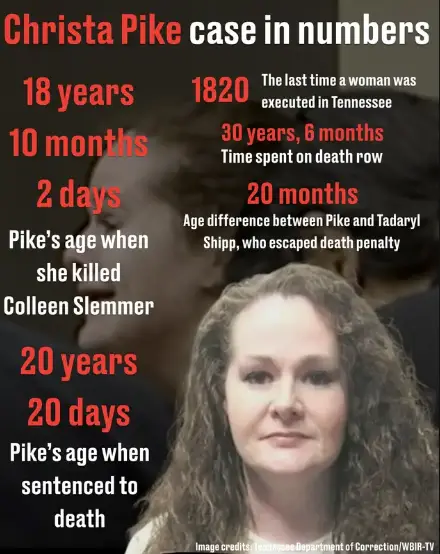
The Christa Pike case in numbers (LADbible/Tennessee Department of Correction/WBIR-TV)
Why was Christa Pike on death row and what happens next?
Christa Pike received the death sentence after being convicted of the 1995 murder of her Job Corps classmate Colleen Slemmer.
Pike, her then-boyfriend Tadaryl Shipp and their friend Shadolla Peterson lured Slemmer to an isolated part wooded area in Knoxville. Pike and Shipp then beat Slemmer to death while Peterson acted as a lookout for the couple.
Shipp was sentenced to life in prison as he was only 17 and therefore not eligible for the death penalty, while Peterson received probation after becoming a witness for the prosecution.
It’s not currently clear whether or not the state of Tennessee will attempt to execute Pike again at a later date. Executions in the state have currently been paused while an investigation is carried out.
Crypto and fintech investment firm Deus X Capital has ceased operations as its backers pursue separate investment strategies, the company told CoinDesk.
The company, led by former Galaxy Digital (GLXY) executive Tim Grant, will formally unwind on Jan. 31, 2027. Chief Investment Officer Stuart Connolly will remain to oversee the transition, while some portfolio businesses will continue operating with the involvement of existing stakeholders.
The Morton family investors behind Deus X are splitting their investment activities. Shane Morton is establishing Darius, focused on artificial intelligence, while Owen and Jason Morton are setting up 95, focused on markets and fintech.
Grant, who led Galaxy Digital’s Europe, Middle East and Africa business before joining Deus X, will become CEO of TensorX, an AI venture within Darius owned by Shane Morton, one of Deus X’s founders and backers.
“We want to be a prominent player in AI in Europe,” Grant told CoinDesk in an interview.
Crypto is facing growing competition from AI for investor attention and capital. Galaxy Research said in September that interest in artificial intelligence was diverting attention from digital assets, adding to venture firms’ fundraising challenges.
Wells Fargo, one of the largest banks in the US, is reportedly in talks with Payward, the parent company of Kraken, to expand its operations in the cryptocurrency market. According to sources close to the matter, Payward could become the bank’s liquidity provider for digital asset transactions.
Liquidity providers help large transactions be completed without causing excessive price fluctuations in the market by offering constant prices for buy and sell orders. In a potential collaboration, Wells Fargo clients’ orders could be placed through the bank interface, while the necessary cryptocurrency liquidity could be provided by Payward.
Such a model could allow the bank to offer digital asset transactions to its clients without building a cryptocurrency exchange infrastructure from scratch. Payward, in turn, could leverage Kraken’s spot and derivatives markets, as well as its custody, staking, tokenized equity, and institutional trading infrastructure.
The doc, which offers an intimate look at the Theranos founder’s life a month before she began an 11-year prison sentence for defrauding investors, will hit cinemas in the U.K. and Ireland on Nov. 20. A24 is self-releasing the film.
“You Can See Everything” first premiered as a surprise screening at Telluride Film Festival in September — earning rave reviews and sparking Oscar buzz — before heading to New York Film Festival, and is set to hit U.S. theaters on Oct. 16.
“Thirty-four days before she’s sent to prison, notorious Silicon Valley founder Elizabeth Holmes invites a skeptical film crew to document her every move,” the doc’s official synopsis reads. “What begins as an intimate portrait of an enigmatic felon becomes a mind-bending three-year journey into the abyss.”
During a Q&A at New York Film Festival last week, “The Rehearsal” and “Nathan for You” creator Fielder explained how he ended up co-helming the project with Oppenheim, who just made his narrative directorial debut with “Primetime” starring Robert Pattinson. After befriending Fielder, Oppenheim remembered that Holmes had reached out to A24 — the studio behind “Primetime” and “The Rehearsal” — about someone documenting her final days before prison. Fielder had already been fascinated by her, and they set up a meeting with Holmes and A24.
“When I met her, I remember having this weird experience where she seems so genuine at times,” Fielder said. “But then I’m like, ‘no,’ and clocking and tracking my thoughts and being like, ‘Okay, I know she’s a liar.’ It was a weird mental thing. From there, we were like, ‘Can we roll the dice on something if they were open to having cameras in?’”
Roll the dice they did, and it resulted in Fielder fully moving into Holmes’ house that she shares with her partner, Billy Evans, and their two young children.
“I cannot tell you how weird it was that we were there,” Fielder said. “Truly, to this day, we’re still like — anyways, sorry. I wouldn’t think I’d be the person you would want for your final period. I’m a nice person, I do believe, but I’m not the most comforting. You know what I mean? I think you know.”
Of the Bitcoins seized, 568.7 $BTC comes from assets confiscated in the Potapenko and Turogin case. The remaining approximately 264.9 $BTC is from seizures related to the Bitfinex attack.
40,285 $BNB were transferred from a separate government wallet. The tokens, worth approximately $31.63 million, were first moved to an unlabeled address and then to a second unknown wallet. The BNBs were reportedly among the assets seized from Alameda Research.
Sending cryptocurrencies to a Coinbase Prime address can, in some cases, indicate preparation for sale. However, exchange-linked addresses can also be used for custody, wallet management, or inter-institutional transfers. Blockchain data alone does not prove that the asset has ultimately been sold.
The US government reportedly holds approximately $27.5 billion in seized cryptocurrency assets. These assets originated from legal seizures, not from market purchases funded by tax revenue.
The Bitcoins transferred to the government under the decree dated March 2025 are intended to be held in the Strategic Bitcoin Reserve. However, the legal status and sales authorization of assets in specific cases may vary. It would be incorrect to interpret the transfer as a definitive sale before an official announcement.