Author: rb809rb

  • Paramount Pitches Judge On November Start Of WBD Merger Antitrust Trial, While State AGs & WGA Propose April

    Paramount Pitches Judge On November Start Of WBD Merger Antitrust Trial, While State AGs & WGA Propose April

    Paramount wants a trial to start in November in the antitrust lawsuit brought by a dozen state attorneys general and the Writers Guild America. Not surprisingly, the state AGs and the guild want an April start to the proceedings.

    The sides outlined their proposals ina joint filing Friday, with the ultimate decision on scheduling left to the federal judge in the case, Araceli Martinez-Olguin.

    “The parties have discussed the trial schedule, but they have not reached agreement,” the parties wrote.

    The trial dates are hugely important for the transaction, and even Paramount’s proposed date likely will cost the company hundreds of millions. After September 30, Paramount will be on the hook for about $7 million for every day that the transaction doesn’t close, under an agreement with WBD that was a sweetener to the deal.

    A Paramount spokesperson said, “Our request for a November trial date is more than sufficient to give both sides the time they need to conduct discovery, gather evidence, and prepare for trial. Plaintiffs’ request to delay proceedings until April is nothing more than a stonewalling tactic that goes well beyond the timelines sought in similar prior proceedings and ignores the substantial evidence plaintiffs have already received in this matter. Delay will also harm the many individuals outside this courtroom who will be denied the expanded content offerings and industry stability that a combined Paramount-WBD promises to bring.”

    California Attorney General Rob Bonta, who is leading 12 states in the lawsuit, said in a statement, “Our challenge to the unlawful Warner Bros./Paramount merger is a clean-cut antitrust challenge through and through: it’s about protecting the vibrancy of an industry, the pockets of consumers, and the quality of films and television programs that take center stage in many of our lives. This challenge deserves careful and thorough review and today my office and attorneys general across the country asked the court for a trial date next spring. We are eager to continue to make our case and look forward to a final determination of the schedule by the court.”

    Last week, Paramount said it would not close the merger until June 1, 2027, or until days after the legal issues are resolved, and indicated it wanted to go directly to trial. Its announcement came just days after the judge granted the state AGs a temporary restraining order that prohibited the transaction from closing for 14 days, an order that was later extended to 28 days.

    The company spokeswoman said a trial “on the merits is the best and most direct way for us to prove what we’ve said from the start — this transaction is lawful, pro-competitive, and raises no antitrust concerns.”

    In the filing Friday, Paramount proposed a 12-day trial starting November 4 that would encompass the cases brought by the states and the WGA.

    Paramount also noted that the later date would give the judge “much less time to decide” the case by June, the outside date it had set for the merger to close, as well as time for the company to appeal.

    Among other things, they noted that the DOJ’s antitrust case seeking to block AT&T’s merger with Time Warner went to trial on March 19, 2018, four months after the federal government brought the case. Makan Delrahim, who is Paramount’s chief legal officer, was then the chief of the DOJ’s antitrust division; on the other side was attorney Daniel Petrocelli, representing Time Warner, and now representing WBD in this case.

    The company also noted that Bonta had last week favored a January trial start, but now was proposing a date four months later.

    “Given the stakes of this case, there is no basis and no time to delay for the sake of delay, particularly when delay significantly prejudices Defendants and the Hollywood ecosystem more broadly,” Paramount’s legal team wrote in the filing.

    The company also argued that Paramount and the WGA will have had sufficient time for discovery.

    Paramount’s legal team wrote, “State Plaintiffs had six-plus months before they filed their complaint to conduct unilateral discovery regarding the proposed transaction. State Plaintiffs also had the benefit of waivers granted by Defendants to enable the U.S. Department of Justice (DOJ) to share with State Plaintiffs all information and materials that Defendants produced to the DOJ. In sum, the discovery that State Plaintiffs received many months ago includes over two million documents from more than 80 of Defendants’ employees.”

    The company’s legal team noted that the later date would require them to refile merger materials with the Justice Department, which has already cleared the transaction, and that it would leave the creative community in a period of uncertainty, as Paramount plans to boost production to 30 films per year.

    The state AGs and WGA proposed a start of April 5, 2027, lasting at least 12-15 days, with each plaintiff presenting their cases sequentially.

    The state plaintiffs wrote that extensive discovery is needed, including of “the definition of the relevant product and geographic markets, the nature and scope of harm in those markets, whether expansion by other firms will prevent harm in those markets, and whether the merger will produce verifiable, merger-specific efficiencies sufficient to outweigh harm in those markets.”

    They pointed specifically to areas like Paramount’s assertion that the merger will generate billions in synergies, “a claim that Plaintiff States are entitled to test in discovery, including discovery of Defendants’ integration plans for their merged company.”

    The states noted that Paramount’s document productions “largely cut off” before the merger agreement was signed in February, leaving the plaintiffs with few internal documents about post-closing plans.

    The state AGs wrote, “Defendants’ pre-complaint productions also do nothing to address the need for discovery from third party customers and competitors. Importantly, no depositions of percipient fact witnesses from Defendants or third parties have occurred.”

    The states also contended that their schedule was “reasonable,” claiming that the 402 days from the signing of the merger agreement on February 27 to the proposed trial date “moves this case to trial more rapidly than virtually every merger case in recent history.” The AT&T-Time Warner trial started 513 days after the merger deal was signed, they noted, as opposed to when the DOJ lawsuit was filed. The state AGs also wrote that an April trial would still leave the judge with time to decide the case by June.

    The state AGs also called Paramount’s proposed schedule “one-sided,” arguing, “Their extraordinarily truncated schedule unfairly favors Defendants because they (1) have information Plaintiff States need to prove their case and (2) do not bear the burden of persuasion.”

  • Paramount Pitches Judge On November Start Of WBD Merger Antitrust Trial, While State AGs & WGA Propose April

    Paramount Pitches Judge On November Start Of WBD Merger Antitrust Trial, While State AGs & WGA Propose April

    Paramount wants a trial to start in November in the antitrust lawsuit brought by a dozen state attorneys general and the Writers Guild America. Not surprisingly, the state AGs and the guild want an April start to the proceedings.

    The sides outlined their proposals ina joint filing Friday, with the ultimate decision on scheduling left to the federal judge in the case, Araceli Martinez-Olguin.

    “The parties have discussed the trial schedule, but they have not reached agreement,” the parties wrote.

    The trial dates are hugely important for the transaction, and even Paramount’s proposed date likely will cost the company hundreds of millions. After September 30, Paramount will be on the hook for about $7 million for every day that the transaction doesn’t close, under an agreement with WBD that was a sweetener to the deal.

    A Paramount spokesperson said, “Our request for a November trial date is more than sufficient to give both sides the time they need to conduct discovery, gather evidence, and prepare for trial. Plaintiffs’ request to delay proceedings until April is nothing more than a stonewalling tactic that goes well beyond the timelines sought in similar prior proceedings and ignores the substantial evidence plaintiffs have already received in this matter. Delay will also harm the many individuals outside this courtroom who will be denied the expanded content offerings and industry stability that a combined Paramount-WBD promises to bring.”

    California Attorney General Rob Bonta, who is leading 12 states in the lawsuit, said in a statement, “Our challenge to the unlawful Warner Bros./Paramount merger is a clean-cut antitrust challenge through and through: it’s about protecting the vibrancy of an industry, the pockets of consumers, and the quality of films and television programs that take center stage in many of our lives. This challenge deserves careful and thorough review and today my office and attorneys general across the country asked the court for a trial date next spring. We are eager to continue to make our case and look forward to a final determination of the schedule by the court.”

    Last week, Paramount said it would not close the merger until June 1, 2027, or until days after the legal issues are resolved, and indicated it wanted to go directly to trial. Its announcement came just days after the judge granted the state AGs a temporary restraining order that prohibited the transaction from closing for 14 days, an order that was later extended to 28 days.

    The company spokeswoman said a trial “on the merits is the best and most direct way for us to prove what we’ve said from the start — this transaction is lawful, pro-competitive, and raises no antitrust concerns.”

    In the filing Friday, Paramount proposed a 12-day trial starting November 4 that would encompass the cases brought by the states and the WGA.

    Paramount also noted that the later date would give the judge “much less time to decide” the case by June, the outside date it had set for the merger to close, as well as time for the company to appeal.

    Among other things, they noted that the DOJ’s antitrust case seeking to block AT&T’s merger with Time Warner went to trial on March 19, 2018, four months after the federal government brought the case. Makan Delrahim, who is Paramount’s chief legal officer, was then the chief of the DOJ’s antitrust division; on the other side was attorney Daniel Petrocelli, representing Time Warner, and now representing WBD in this case.

    The company also noted that Bonta had last week favored a January trial start, but now was proposing a date four months later.

    “Given the stakes of this case, there is no basis and no time to delay for the sake of delay, particularly when delay significantly prejudices Defendants and the Hollywood ecosystem more broadly,” Paramount’s legal team wrote in the filing.

    The company also argued that Paramount and the WGA will have had sufficient time for discovery.

    Paramount’s legal team wrote, “State Plaintiffs had six-plus months before they filed their complaint to conduct unilateral discovery regarding the proposed transaction. State Plaintiffs also had the benefit of waivers granted by Defendants to enable the U.S. Department of Justice (DOJ) to share with State Plaintiffs all information and materials that Defendants produced to the DOJ. In sum, the discovery that State Plaintiffs received many months ago includes over two million documents from more than 80 of Defendants’ employees.”

    The company’s legal team noted that the later date would require them to refile merger materials with the Justice Department, which has already cleared the transaction, and that it would leave the creative community in a period of uncertainty, as Paramount plans to boost production to 30 films per year.

    The state AGs and WGA proposed a start of April 5, 2027, lasting at least 12-15 days, with each plaintiff presenting their cases sequentially.

    The state plaintiffs wrote that extensive discovery is needed, including of “the definition of the relevant product and geographic markets, the nature and scope of harm in those markets, whether expansion by other firms will prevent harm in those markets, and whether the merger will produce verifiable, merger-specific efficiencies sufficient to outweigh harm in those markets.”

    They pointed specifically to areas like Paramount’s assertion that the merger will generate billions in synergies, “a claim that Plaintiff States are entitled to test in discovery, including discovery of Defendants’ integration plans for their merged company.”

    The states noted that Paramount’s document productions “largely cut off” before the merger agreement was signed in February, leaving the plaintiffs with few internal documents about post-closing plans.

    The state AGs wrote, “Defendants’ pre-complaint productions also do nothing to address the need for discovery from third party customers and competitors. Importantly, no depositions of percipient fact witnesses from Defendants or third parties have occurred.”

    The states also contended that their schedule was “reasonable,” claiming that the 402 days from the signing of the merger agreement on February 27 to the proposed trial date “moves this case to trial more rapidly than virtually every merger case in recent history.” The AT&T-Time Warner trial started 513 days after the merger deal was signed, they noted, as opposed to when the DOJ lawsuit was filed. The state AGs also wrote that an April trial would still leave the judge with time to decide the case by June.

    The state AGs also called Paramount’s proposed schedule “one-sided,” arguing, “Their extraordinarily truncated schedule unfairly favors Defendants because they (1) have information Plaintiff States need to prove their case and (2) do not bear the burden of persuasion.”
  • How bitcoin cold wallets lost $70 million in an attack that never touched the devices

    How bitcoin cold wallets lost $70 million in an attack that never touched the devices

    More than 1,000 bitcoin, worth about $70 million, was drained from 1,196 wallets in a 41-minute window on July 30, nearly double the amount reported when the theft first surfaced.

    Galaxy Research mapped the full event on Friday, finding 1,082.65 BTC swept between 01:10 and 01:51 UTC across six blocks, with three intervening blocks containing nothing, which suggests the transactions were broadcast in batches rather than continuously.

    The proceeds sit in four addresses and have not moved. Early reporting captured only one of those addresses, which is why the figure has grown.

    The size of the attack is much smaller than some of the bigger attacks this year, but the mechanism is what makes this unusually — and why the attack is such a big deal.

    Why the Coldcard wallet exploit is a bigger deal than most exploits

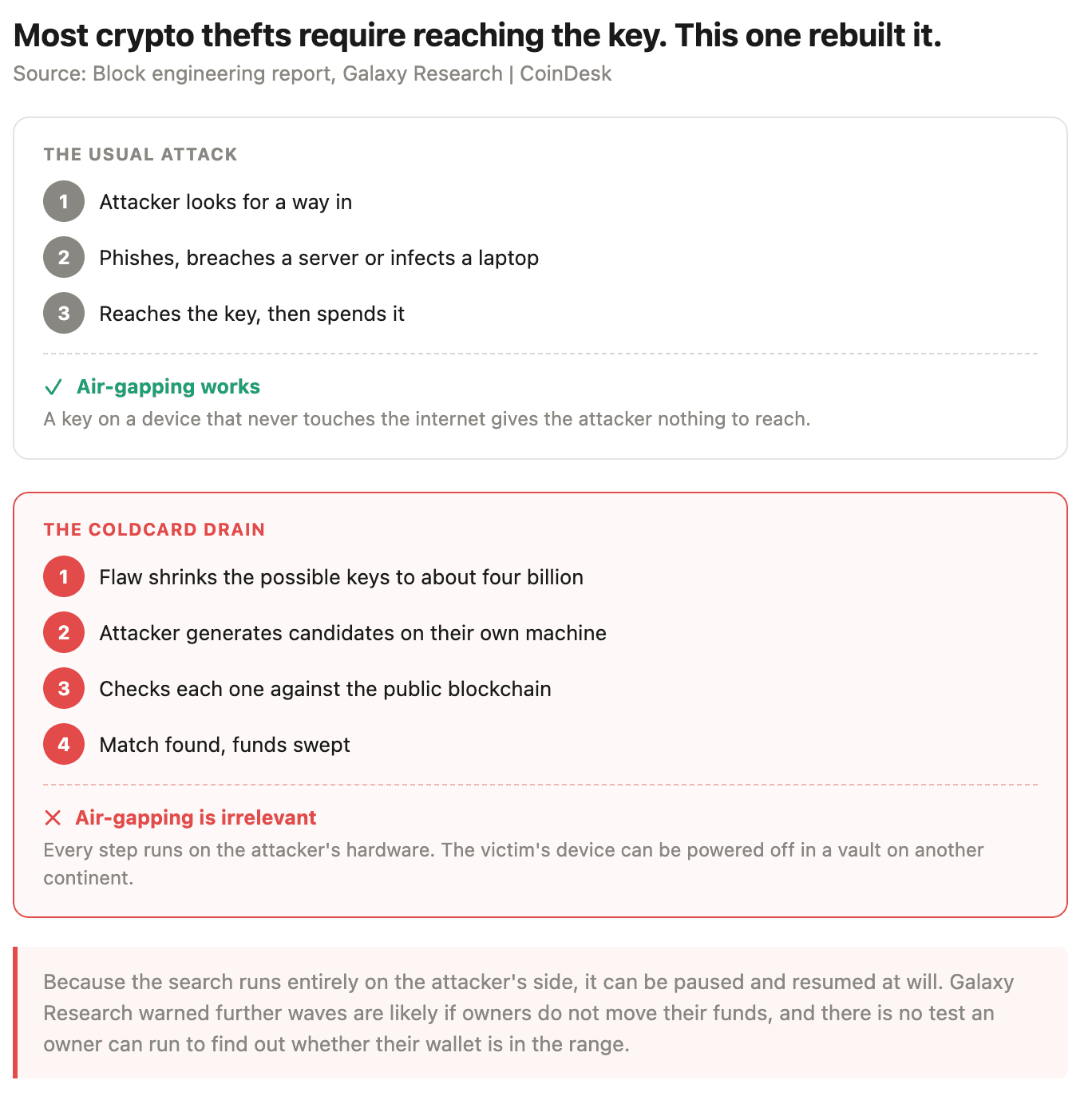
    Most crypto theft involves getting to something. An exchange is breached, a contract is tricked, a key is phished off a laptop. The defence has always been distance, which is precisely what a hardware wallet sells. Keep the key on a device that never connects to the internet and, theoretically, there is nothing for an attacker to touch.

    Most crypto thefts require reaching the key. This one rebuilt it. (Shaurya Malwa/CoinDesk)

    When a wallet is created, the device is supposed to pick a number so large and so unpredictable that guessing it is impossible.

  • Tiger Shroff to Star in Viccky Jain’s VJ Frames Launch Title, Directed by Remo D’Souza, With Abhishek Banerjee, Elvish Yadav Also Set (EXCLUSIVE)

    Tiger Shroff to Star in Viccky Jain’s VJ Frames Launch Title, Directed by Remo D’Souza, With Abhishek Banerjee, Elvish Yadav Also Set (EXCLUSIVE)

    Indian producer and entrepreneur Viccky Jain has launched a new production banner, VJ Frames, timed to coincide with his birthday.

    The company’s debut project is an action franchise directed by Remo D’Souza, starring Tiger Shroff, Abhishek Banerjee and Elvish Yadav.

    VJ Frames is positioned as a home for large-scale cinematic stories and commercial entertainers aimed at audiences across the India. The action franchise, developed through a creative collaboration between Jain and D’Souza, is described as combining high-octane action with dramatic storytelling.

    Jain, best known for his stint on “Bigg Boss 17,” is making his debut as a film producer with VJ Frames. Shroff was most recently seen in “Baaghi 4,” while Banerjee’s recent credits include “Thamma” and “Toaster.” D’Souza’s last directorial credit was “Be Happy,” starring Abhishek Bachchan.

    “Launching VJ Frames is a dream that has been years in the making, and I couldn’t have asked for a better occasion than my birthday to begin this journey,” Jain said. “Cinema has always inspired me, and with VJ Frames, I hope to create stories that entertain, connect with audiences, and leave a lasting impact. Beginning this journey with an ambitious action franchise alongside Remo and an incredible cast makes it even more special. This is just the beginning, and I’m excited for everything that lies ahead.”

    D’Souza added, “I’m really happy to be directing the first film from VJ Frames. Viccky has come on board with a clear vision and a genuine passion for cinema, and it’s exciting to be part of this journey with him. We’ve got a fantastic cast in Tiger Shroff, Abhishek Banerjee and Elvish Yadav, and I’m looking forward to creating something that’s entertaining, action-packed and enjoyable for audiences.”

  • FIFA Chief Gianni Infantino on the Ropes as He Ditches Controversial $20 Billion Private Investment Plan

    FIFA Chief Gianni Infantino on the Ropes as He Ditches Controversial $20 Billion Private Investment Plan

    Gianni Infantino, the embattled president of soccer’s governing body FIFA, has abandoned his controversial plan to create a $20 billion company, FIFA Forward Enterprise, that would control the commercial rights to its events, principally the World Cup.

    In a statement released late Friday, Infantino said it had “become clear that the project has created divisions of a nature that, regardless of the level of support, are no longer in the interest of the objective set out in the first place.”

    The survival of Infantino, who is up for re-election for a fourth term as president at the FIFA Congress in March, is now in doubt.

    Infantino said, “Our purpose has always been – and will always be – to unite and improve. Moving forward, my intent is to bring all interested parties back together in the coming days and weeks in the spirit of shared interest in our game.”

    The climbdown by Infantino follows a threat by European countries, represented by the continent’s soccer governing body UEFA, to boycott all FIFA events, including the World Cup, if the plan moved forward.

    Opposition to Infantino’s plan had also come from Concacaf, which governs soccer in North, Central America and the Caribbean, and the sport’s governing body in Asia, the Asian Football Confederation.

    Resistance to the plan had also come from within FIFA. Carlos Cordeiro, Infantino’s senior adviser on global strategy and governance, resigned over the issue, saying the proposal was “a bad deal” for soccer and would “mortgage” its future.

    Then on Friday, the organization’s chief operating officer Kevin Lamour said its own administration had been “deceived” about the project. Lamour described the plan as “the project of one person,” and said, “the time has now come for [soccer’s] political leaders to ask themselves the right questions and make the right decisions.”

    Lamour added that he had a duty of loyalty to “certain values” and supporting his colleagues. “If that means I lose my job, then so be it. I will understand and respect that decision. At least I’ll sleep well tonight.”

    Under Infantino’s proposal, each FIFA member country would have received an initial payment of $20 million and a doubling of their annual stipend to $5 million. This would have been partially funded by the sale of a roughly 20% stake in FIFA Forward Enterprise to an investor group led by Thrive Eternal. Thrive Eternal is run by Joshua Kushner, whose brother Jared Kushner is married to President Donald Trump’s daughter Ivanka.

  • XRP Ledger upgrade brings back features once pulled over critical bugs

    XRP Ledger upgrade brings back features once pulled over critical bugs

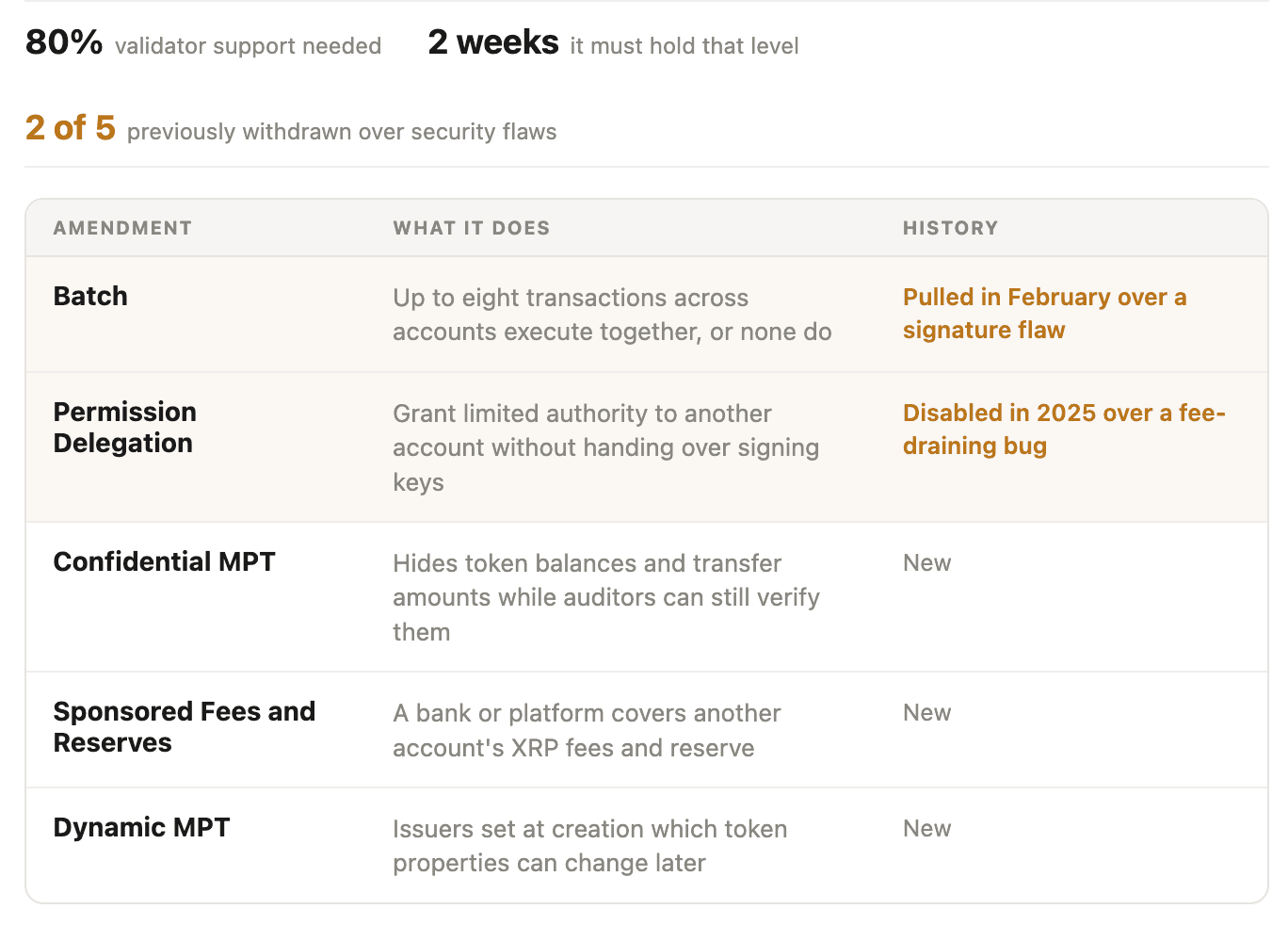
    Validators (entities that supply their resources to run and maintain a network) were advised to reject it, and an emergency server release marked it unsupported to prevent activation. No funds were lost, because it never reached the main network.

    Permission Delegation, which lets an institution grant another account narrowly scoped authority without handing over full signing power, was disclosed as vulnerable in September 2025 and disabled.

    The bug allowed one account to charge transaction fees to another and potentially drain its balance. The ledger’s documentation has listed both amendments as obsolete since, to be replaced by revised versions.

    (Shaurya Malwa/CoinDesk)

    The other three are new. Confidential MPT combines zero-knowledge proofs, which let someone prove a statement is true without revealing the underlying data, with elliptic-curve encryption, so that balances and transfer amounts on Multi-Purpose

    Tokens stay private while auditors or regulators can still verify them when required.

    Sponsored Fees and Reserves lets a bank or platform cover another account’s $XRP fees and reserve requirement, removing the need for every user to acquire $XRP before transacting.

    Lastly, Dynamic MPT lets an issuer specify at creation which token properties can be changed later, avoiding a full migration to a new token when fees or metadata need updating.

  • US drops charges against Olympian for damage to Reflecting Pool

    US drops charges against Olympian for damage to Reflecting Pool

    NewsFeed

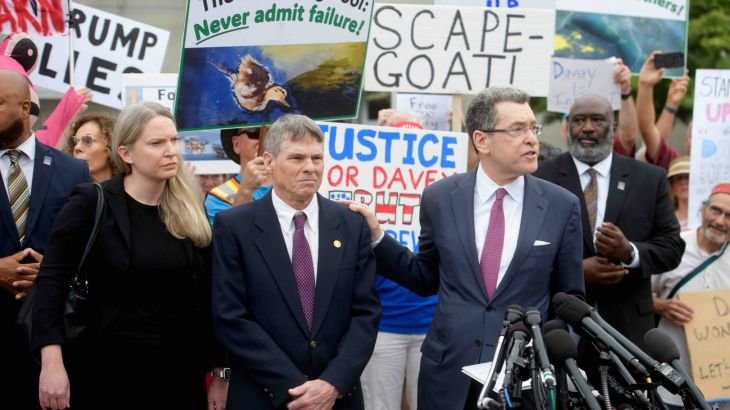
    The US Department of Justice has moved to dismiss its case against Olympian David Hearn over damage to the Reflecting Pool in Washington DC. The DOJ says new evidence points to flawed installation by the contractor, not vandalism.

  • Five Major New Features Are Coming to XRP—Ripple Official Reveals

    Five Major New Features Are Coming to XRP—Ripple Official Reveals

    Ripple’s Head of Product, Jazzi Cooper, announced five new updates that could significantly expand the use of the $XRP Ledger in institutional finance and tokenized asset markets. These features are planned for release in xrpld 3.3.0, expected next week.

    Cooper stated that XRPL has already proven its ability to support tokenized assets on a large scale, and the next step is to utilize these assets more effectively in global transfers, trading, collateralization, and settlement transactions.

    The first modification to be included in the new version, “Confidential MPT,” will provide native privacy features to Multi-Purpose Tokens on XRPL through zero-knowledge proofs and elliptic curve cryptography. This system will allow token balances and transaction amounts to be kept private on the public ledger. However, authorized parties, such as auditors or regulators, will be able to verify transaction details when necessary.

    The “Batch” feature will allow up to eight transactions between different accounts to be executed atomically in a single ledger entry. All transactions will either be successful or none will occur. This structure is expected to facilitate corporate finance applications, particularly those involving payment-for-delivery and atomic reconciliation.

    Related News Has Bitcoin Hit Bottom, or Is a Shakeout on the Way? What About $XRP?

    The “Delegation of Authority” arrangement will allow institutions to define limited transaction permissions without transferring full control over private keys. This means that treasury teams will continue to control asset issuance keys, while trading desks or operations teams will be able to perform specific transactions within defined limits.

    With the “Sponsored Fees and Reserves” feature, banks, token issuers, or platforms will be able to cover other users’ $XRP transaction fees and account reserves. Users will retain ownership of their accounts and private keys, eliminating the need to purchase and manage $XRP before joining the network. Ripple believes this feature will improve the user experience in both enterprise and consumer-focused applications.

    Finally, the “Dynamic MPT” regulation will allow token issuers to update transaction fees, metadata, and other specific features after the token is created. Under the current system, such changes may require the issuance of a new token and the migration of users to the new asset. With the new feature, issuers will be able to predetermine which features can be changed in the future during the token creation phase.

    Cooper added that version 3.3.0 of xrpld is expected to be released next week, but these changes will not be automatically activated. The updates will need to be verified by validators before they can be activated on the $XRP Ledger.

    *This is not investment advice.

  • Paramount Pitches Judge On November Start Of WBD Merger Antitrust Trial, While State AGs & WGA Propose April

    Paramount Pitches Judge On November Start Of WBD Merger Antitrust Trial, While State AGs & WGA Propose April

    Paramount wants a trial to start in November in the antitrust lawsuit brought by a dozen state attorneys general and the Writers Guild America. Not surprisingly, the state AGs and the guild want an April start to the proceedings.

    The sides outlined their proposals ina joint filing Friday, with the ultimate decision on scheduling left to the federal judge in the case, Araceli Martinez-Olguin.

    “The parties have discussed the trial schedule, but they have not reached agreement,” the parties wrote.

    The trial dates are hugely important for the transaction, and even Paramount’s proposed date likely will cost the company hundreds of millions. After September 30, Paramount will be on the hook for about $7 million for every day that the transaction doesn’t close, under an agreement with WBD that was a sweetener to the deal.

    A Paramount spokesperson said, “Our request for a November trial date is more than sufficient to give both sides the time they need to conduct discovery, gather evidence, and prepare for trial. Plaintiffs’ request to delay proceedings until April is nothing more than a stonewalling tactic that goes well beyond the timelines sought in similar prior proceedings and ignores the substantial evidence plaintiffs have already received in this matter. Delay will also harm the many individuals outside this courtroom who will be denied the expanded content offerings and industry stability that a combined Paramount-WBD promises to bring.”

    California Attorney General Rob Bonta, who is leading 12 states in the lawsuit, said in a statement, “Our challenge to the unlawful Warner Bros./Paramount merger is a clean-cut antitrust challenge through and through: it’s about protecting the vibrancy of an industry, the pockets of consumers, and the quality of films and television programs that take center stage in many of our lives. This challenge deserves careful and thorough review and today my office and attorneys general across the country asked the court for a trial date next spring. We are eager to continue to make our case and look forward to a final determination of the schedule by the court.”

    Last week, Paramount said it would not close the merger until June 1, 2027, or until days after the legal issues are resolved, and indicated it wanted to go directly to trial. Its announcement came just days after the judge granted the state AGs a temporary restraining order that prohibited the transaction from closing for 14 days, an order that was later extended to 28 days.

    The company spokeswoman said a trial “on the merits is the best and most direct way for us to prove what we’ve said from the start — this transaction is lawful, pro-competitive, and raises no antitrust concerns.”

    In the filing Friday, Paramount proposed a 12-day trial starting November 4 that would encompass the cases brought by the states and the WGA.

    Paramount also noted that the later date would give the judge “much less time to decide” the case by June, the outside date it had set for the merger to close, as well as time for the company to appeal.

    Among other things, they noted that the DOJ’s antitrust case seeking to block AT&T’s merger with Time Warner went to trial on March 19, 2018, four months after the federal government brought the case. Makan Delrahim, who is Paramount’s chief legal officer, was then the chief of the DOJ’s antitrust division; on the other side was attorney Daniel Petrocelli, representing Time Warner, and now representing WBD in this case.

    The company also noted that Bonta had last week favored a January trial start, but now was proposing a date four months later.

    “Given the stakes of this case, there is no basis and no time to delay for the sake of delay, particularly when delay significantly prejudices Defendants and the Hollywood ecosystem more broadly,” Paramount’s legal team wrote in the filing.

    The company also argued that Paramount and the WGA will have had sufficient time for discovery.

    Paramount’s legal team wrote, “State Plaintiffs had six-plus months before they filed their complaint to conduct unilateral discovery regarding the proposed transaction. State Plaintiffs also had the benefit of waivers granted by Defendants to enable the U.S. Department of Justice (DOJ) to share with State Plaintiffs all information and materials that Defendants produced to the DOJ. In sum, the discovery that State Plaintiffs received many months ago includes over two million documents from more than 80 of Defendants’ employees.”

    The company’s legal team noted that the later date would require them to refile merger materials with the Justice Department, which has already cleared the transaction, and that it would leave the creative community in a period of uncertainty, as Paramount plans to boost production to 30 films per year.

    The state AGs and WGA proposed a start of April 5, 2027, lasting at least 12-15 days, with each plaintiff presenting their cases sequentially.

    The state plaintiffs wrote that extensive discovery is needed, including of “the definition of the relevant product and geographic markets, the nature and scope of harm in those markets, whether expansion by other firms will prevent harm in those markets, and whether the merger will produce verifiable, merger-specific efficiencies sufficient to outweigh harm in those markets.”

    They pointed specifically to areas like Paramount’s assertion that the merger will generate billions in synergies, “a claim that Plaintiff States are entitled to test in discovery, including discovery of Defendants’ integration plans for their merged company.”

    The states noted that Paramount’s document productions “largely cut off” before the merger agreement was signed in February, leaving the plaintiffs with few internal documents about post-closing plans.

    The state AGs wrote, “Defendants’ pre-complaint productions also do nothing to address the need for discovery from third party customers and competitors. Importantly, no depositions of percipient fact witnesses from Defendants or third parties have occurred.”

    The states also contended that their schedule was “reasonable,” claiming that the 402 days from the signing of the merger agreement on February 27 to the proposed trial date “moves this case to trial more rapidly than virtually every merger case in recent history.” The AT&T-Time Warner trial started 513 days after the merger deal was signed, they noted, as opposed to when the DOJ lawsuit was filed. The state AGs also wrote that an April trial would still leave the judge with time to decide the case by June.

    The state AGs also called Paramount’s proposed schedule “one-sided,” arguing, “Their extraordinarily truncated schedule unfairly favors Defendants because they (1) have information Plaintiff States need to prove their case and (2) do not bear the burden of persuasion.”

  • ‘Barbie’ Sequel Stalled as Warner Bros. Tries to Reach Deals With Greta Gerwig, Margot Robbie, Ryan Gosling

    ‘Barbie’ Sequel Stalled as Warner Bros. Tries to Reach Deals With Greta Gerwig, Margot Robbie, Ryan Gosling

    The Barbie sequel has hit a roadblock on its way back to Barbieland.

    Warner Bros. has until December to reach a deal with the stars of the 2023 film, Margot Robbie and Ryan Gosling, as well as director and co-writer Greta Gerwig, before the rights revert to Mattel, according to a report from the New York Times.

    The studio has been negotiating with the principal talent for months, offering them a share of the profits if the film reaches certain box office milestones. The outlet also claims that Warner Bros. Discovery CEO David Zaslav declined to approve the proposed deal because he believed it was “too generous.”

    The Times went on to report that a Warner Bros. spokesperson disputed that characterization, saying talent representatives declined an offer made in May and have not yet submitted a counteroffer.

    “We have a rights deal with Mattel in place and have made a series of big offers to try and finalize deals to make the next Barbie film,” studio co-chairs Pam Abdy and Michael De Luca said in a statement. “Unfortunately, we have been unable to reach an agreement thus far.”

    The Hollywood Reporter reached out to Warner Bros. for comment, and they had nothing further to add.

    Gerwig and her Barbie co-writer Noah Baumbach have had an idea for Barbie 2 for a couple of years. THR first reported in 2024 that the couple was in the “early stages” of developing a story for the sequel.

    Barbie was a massive hit with audiences and critics, grossing $1.5 billion worldwide and earning eight Oscar nominations, winning one for best original song (“What Was I Made For?” by Billie Eilish and Finneas O’Connell). Upon its release in July 2023, the film also became a cultural phenomenon thanks to its marketing campaign, signature pink aesthetic and simultaneous release with Christopher Nolan’s Oppenheimer, dubbing the name, “Barbenheimer.”