After several days of high activity, on-chain data indicates that Shiba Inu’s exchange flow dynamics have changed once more, with netflows returning to almost neutral territory. After last week’s dramatic fluctuations, the most recent metrics show a net exchange flow of roughly -2.31 billion $SHIB over the previous 24 hours, indicating that inflows and outflows are now mostly balanced. A negative netflow indicates that slightly more tokens are leaving exchanges than are entering.
Shiba Inu moving between exchanges
In comparison to the trillions of $SHIB that frequently shift between exchanges during times of increased volatility, a figure of -2.3 billion $SHIB may seem insignificant. The most recent reading indicates that the market is entering a phase of consolidation rather than aggressive accumulation or heavy distribution.
Additional on-chain indicators corroborate that interpretation. At about 86.99 trillion $SHIB, exchange reserves are essentially unchanged, suggesting that the total quantity of tokens held on centralized exchanges has stabilized. The seven-day average of exchange outflows decreased by 16.6 percent, while exchange inflows increased slightly by 0.65%, indicating that the withdrawal wave that was observed earlier this week has begun to subside.
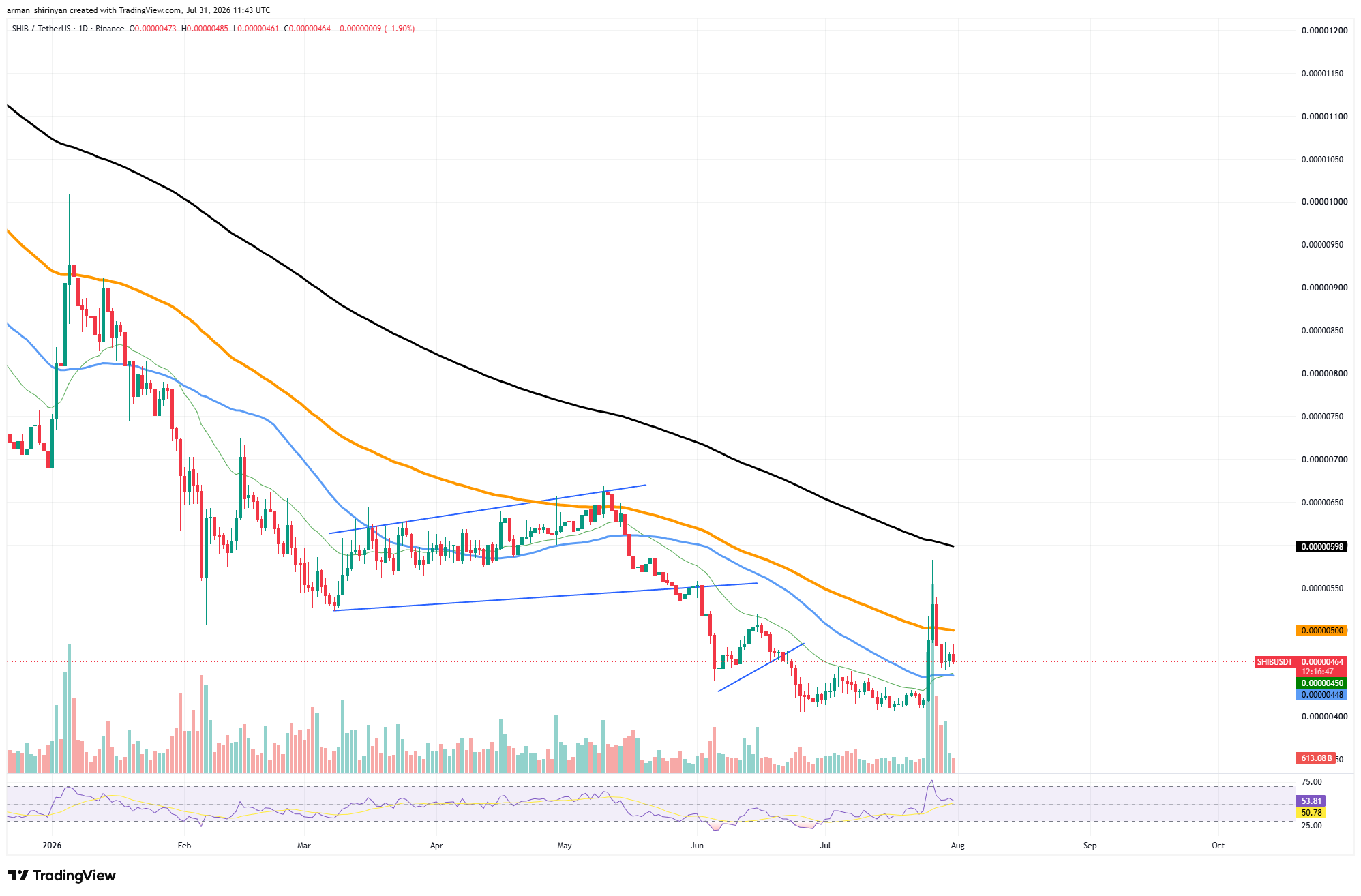
$SHIB/USDT Chart by TradingView
Despite the slowdown in exchange movements, network activity is still comparatively strong. Active receiving addresses increased by 0.86% over the previous day, while active addresses increased by 0.81%. Additionally, there was a slight increase in the number of transactions, indicating that users are still using the network despite the decline in speculative trading. Technically speaking, $SHIB is trying to stabilize following its dramatic rally and the decline last week.
At $0.00000465, the token is currently trading well above the 50-day and 100-day moving averages. After months of consistent weakness, those indicators have now started to function as close support. The 200-day moving average around $0.00000598 remains the main barrier, however.
Shiba Inu’s comfort zone
During its recent breakout, $SHIB came close to the larger resistance zone around $0.00000500, but it was unable to sustain momentum, which led to profit-taking and a return to moving-average support.
After momentarily going into overbought territory during the rally, the Relative Strength Index has also returned to normal. The RSI, which is currently in the mid-50s, indicates that momentum has cooled without turning bearish, opening the door for another attempt to rise if buying pressure resumes. As of right now, neutral exchange netflows show that neither buyers nor sellers have established a clear advantage.
The argument for fresh accumulation would be strengthened if exchange reserves started to fall while net outflows started to rise once more. On the other hand, increasing inflows combined with declining price action may indicate that more holders are getting ready to sell.
Both on-chain metrics and the technical picture point to consolidation rather than a clear directional shift, suggesting that $SHIB is currently consolidating its recent gains rather than starting a new trend.
Pi Network [PI] has been in a relentless downtrend since April 2025. The altcoin has made successive lower highs and lower lows on the longer-term price charts. Any bounces the bulls were able to enforce, such as the one in March 2026 that nearly reached $0.30, were unable to establish a bullish structure.
On July 19, the token saw yet another short-term bounce that reached a high of $0.104. It turned out to be a sweep of the liquidity clustered around the $0.10 round-number resistance.
PI crypto value has slid by nearly 21% in the two weeks since then. The Pi Network’s protocol v25 upgrade would improve stability and also bring BN254 cryptography and Poseidon hashing.
A liquidity pool containing SLICE and Test-Pi was launched recently. This test launch uses an automated market maker alongside the Pi DEX order book.
Over the past three days, from the 28th to the 30th, the token rallied by 7.1%.
Will this bounce result in further PI crypto value drawdown?
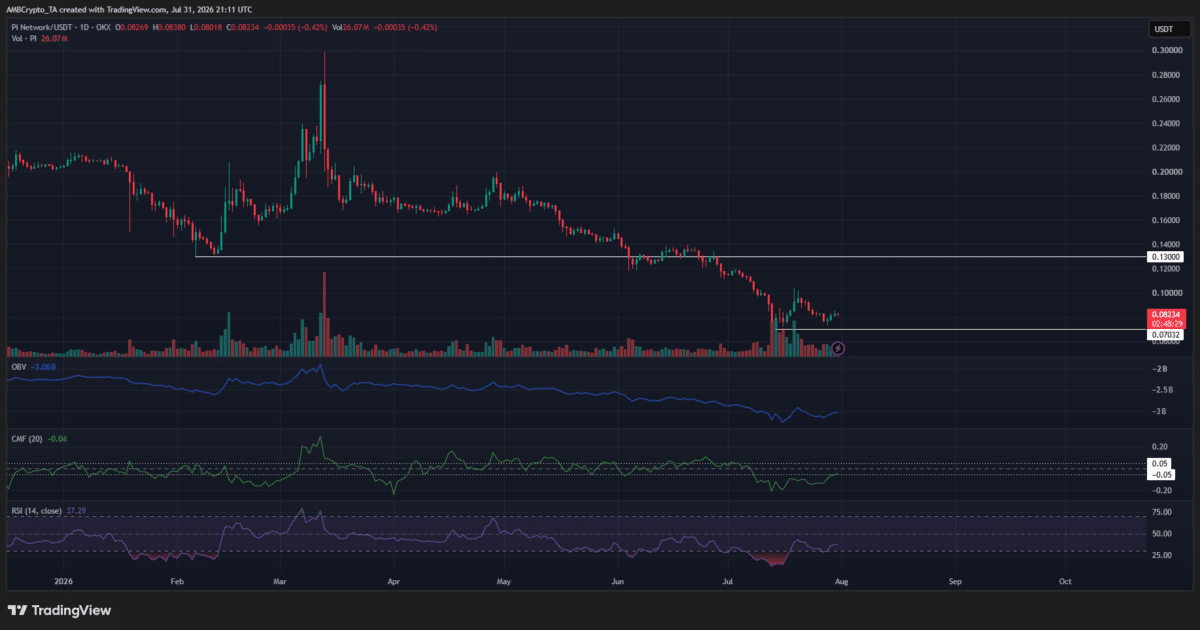
Source: PI/$USDT on TradingView
The $0.13 low from February was breached, and a new swing low at $0.07 has been established. The technical indicators on the 1-day chart were firmly in favor of the sellers.
The OBV has been trending lower throughout 2026. The CMF fell below -0.05 earlier in July to signal increased selling pressure on the token. Only recently did the indicator climb back into neutral territory.
The RSI was at 37 and has been below neutral 50 since May. Once again, it indicated dominant bearish momentum.
Traders’ call to action- There is potential for a bounce
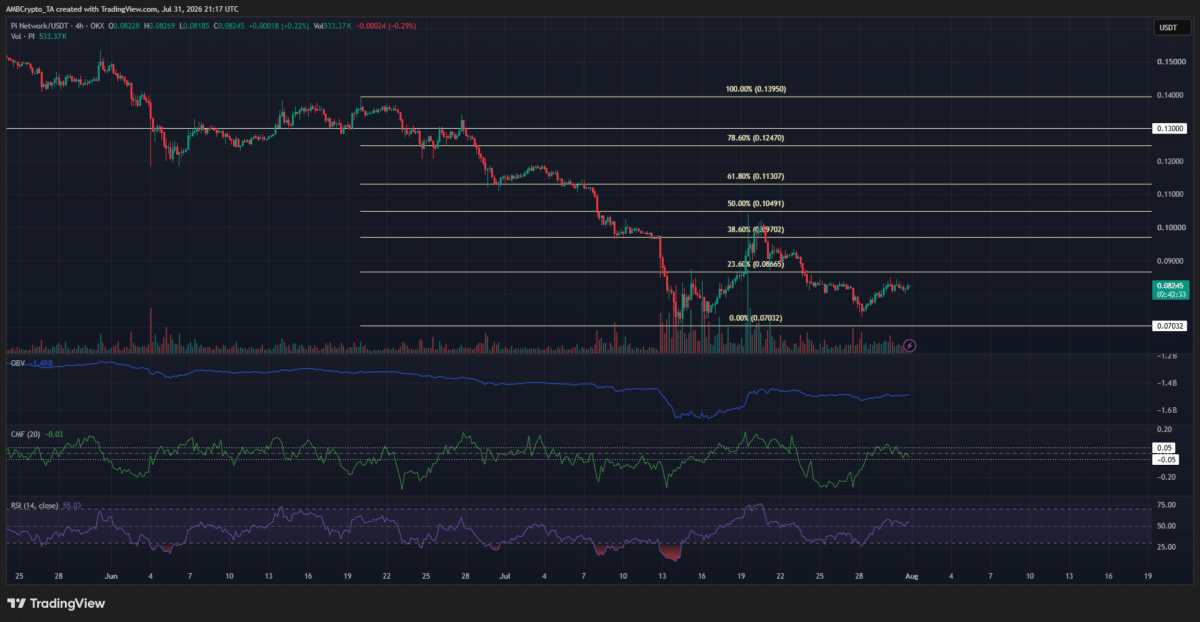
Source: PI/$USDT on TradingView
The 4-hour swing structure was also bearish. The golden pocket, according to the Fibonacci retracement levels, was at $0.113-$0.124. Unfortunately for the buyers, an attempt to climb above the psychological $0.10 barrier was firmly refuted earlier this month.
In the short-term, the $0.083-$0.085 area must be flipped to support to give bulls hope of a resurgence.
Unless there is renewed demand for PI, further downside would be likely. A bounce toward $0.10-$0.125 would offer a selling opportunity to swing traders.
Final Summary
The PI crypto value saw a 7% bounce from the week’s low at $0.073.
The technical indicators showed sellers were dominant, and a sizeable PI bounce does not appear likely in the coming days.
The SEC has delivered an unusually blunt ultimatum to lawmakers: if the CLARITY Act stalls, the agency will write its own crypto market rules. The statement, flagged in the latest weekly roundup, injects fresh unpredictability into a regulatory process that already faces heavy bank lobbying. The warning came during a week that also saw Morgan Stanley launch spot Ethereum and Solana exchange-traded products and BNY Mellon move fund recordkeeping on-chain.
The SEC’s posture effectively raises the stakes on a bill that has been teetering in the Senate. With less than four days before a scheduled vote, major banking interests have been pushing to weaken or stall the legislation, as detailed in reports on the bank lobbying effort. The agency’s willingness to act unilaterally signals that senior officials do not intend to leave the market in a regulatory vacuum, even if Congress fails.
Morgan Stanley Opens Spot ETPs on Two Chains
On the product side, Morgan Stanley’s decision to list spot ETH and Solana ETPs marks a notable expansion beyond Bitcoin. While Bitcoin spot ETPs have been available in the US since early 2024, Ethereum and Solana products represent a deeper push into programmable blockchain exposure. The launch comes as traditional asset managers continue to test institutional appetite for multi-asset crypto baskets.
Solana’s inclusion is particularly striking. The network has drawn attention for its high throughput and growing developer base, but it has also faced outage concerns and regulatory ambiguity. Morgan Stanley’s move suggests that the bank’s wealth management clients are interested in exposure that goes beyond the largest market cap assets.
BNY Mellon Goes On-Chain for Fund Recordkeeping
BNY Mellon’s decision to shift part of its fund recordkeeping infrastructure on-chain reflects a different kind of institutional conviction. Rather than creating a new product for clients, the custody giant is integrating blockchain into its own back-office operations. The move mirrors a broader tokenization trend that accelerated this week, with total real-world assets on-chain crossing $20 billion, as covered in a recent tokenization roundup.
When a 240-year-old bank begins migrating internal processes to distributed ledgers, the signal is harder to dismiss than a press release. It suggests that cost savings and settlement efficiency are being tested inside regulated workflows, not just in startup sandboxes.
Strategy Posts a Heavy Loss While Holding Nearly 844,000 $BTC
Not every piece of institutional news pointed upward. Strategy—formerly MicroStrategy—reported an $8.22 billion second-quarter loss. The company continues to hold approximately 844,000 $BTC, making it the largest corporate bitcoin holder. The loss stems from an impairment charge driven by bitcoin’s price decline during the quarter.
The result underscores how deeply Strategy’s balance sheet is tied to spot bitcoin movements. While its conviction thesis remains unchanged, the volatility creates a unique risk profile for equity holders. The episode may also influence how other publicly traded firms approach bitcoin treasury strategies going forward.
Digital Asset Treasuries Pivot Toward AI Infrastructure
Separately, a cluster of digital asset treasury firms is quietly shifting capital from pure crypto holdings into AI data centers. The pivot reflects a search for yield-generating physical infrastructure at a time when holding digital assets on balance sheets carries significant mark-to-market risk. Several firms are repurposing mining facilities or building new capacity tailored for AI compute workloads, a trend that intersects with growing demand for decentralized storage solutions like those examined in a Filecoin price prediction analysis.
What unites these developments is a market moving on two tracks simultaneously. On one track, regulators are signaling they will tighten oversight with or without Congress. On the other, established financial institutions are embedding blockchain infrastructure deeper into their operations, while corporate treasuries adapt to the realities of holding volatile digital assets. The coming weeks will test whether that dual pressure reshapes market structure faster than Washington can legislate.
The creator of Lioness, as well as Landman, Mayor of Kingstown, Tulsa King and Yellowstone and its spinoffs, has a surprise on-camera role in season three of the Paramount+ spy thriller, The Hollywood Reporter has learned.
“He’s involved. I mean, he has a role, which is great. And the show’s better for it when he plays a role,” Thad Luckinbill told THR of Sheridan’s balancing acting with writing and producing his many television series. “He’s a great character, and he kills it. So, I love when he comes in and plays with us.”
THR also reached out to Paramount for comment.
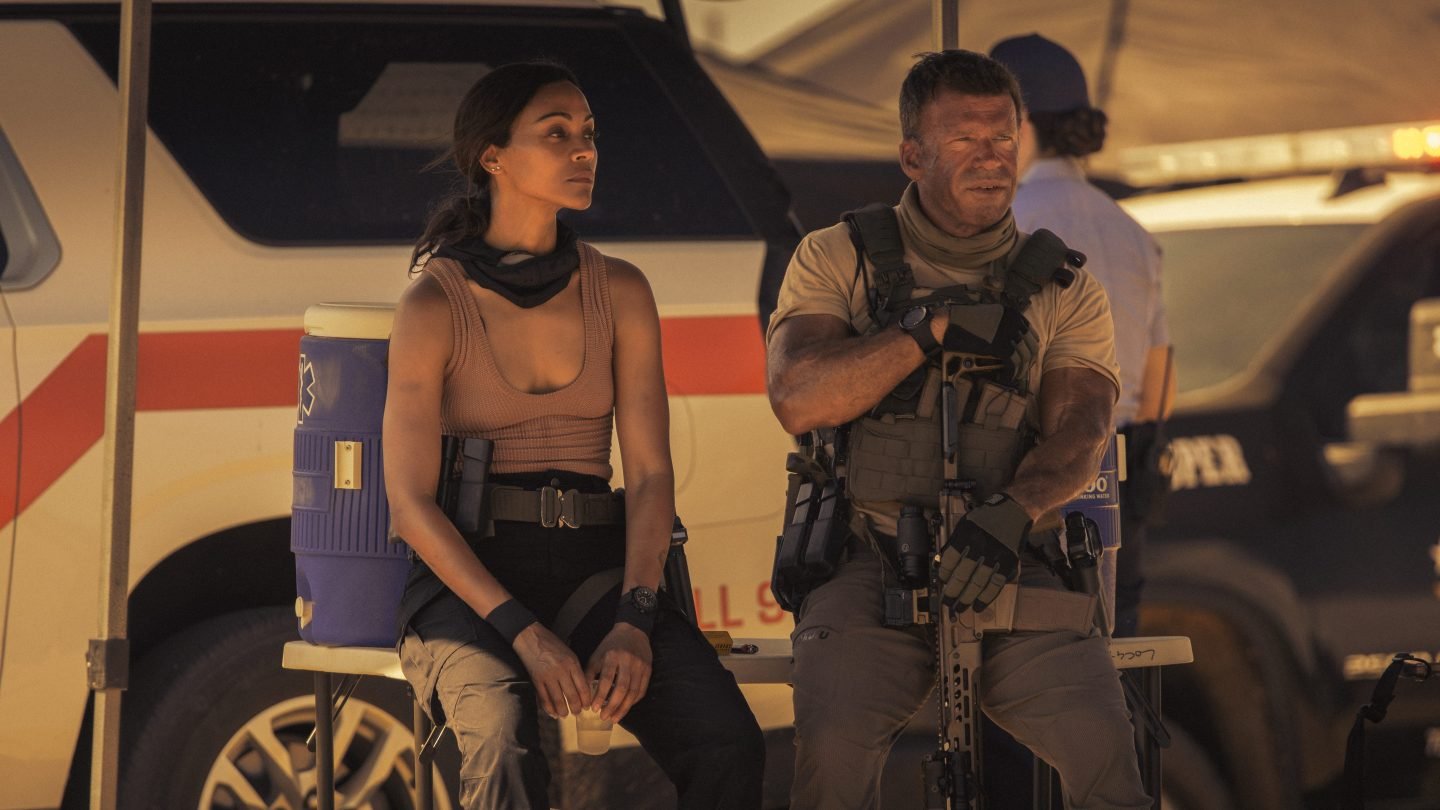
While Luckinbill, who plays Kyle McManus, a field-active CIA paramilitary officer and old friend of station chief Joe (Zoe Saldaña), couldn’t say much more about what Sheridan’s role would entail, he did reveal they share scenes together. Sheridan previously appeared as CIA officer Cody Spears in a cameo during season two.
It isn’t unfamiliar territory for Sheridan. Before becoming one of television’s most prolific creators, he appeared in series including Sons of Anarchy and Veronica Mars, in addition to onscreen roles in Yellowstone and 1883.
Whether it’s in front of or behind the camera, Luckinbill said he still gives every part his full attention.
“He’s so real. Whether he’s an actor, writer, director or a producer, he’s still the same guy,” Luckinbill, who co-starred with Sheridan in 2018’s 12 Strong, said. “He’s gonna give you the same opinions, and he cares the same about the product. So it doesn’t really change. He is who he is and you get it. He’s full access.”
Matt Gerald, who plays Army Delta Force operator Cody J, teased that the stakes are “incredibly high, if not the highest yet.”
“It starts with a bang. It’s nonstop throughout the entirety of the season — and it ends with a bang.”
As for the behind-the-scenes training, Gerald explained, “We started with some weapons training with some of our top military class, some of the best coaching forces guys on the planet that we were lucky enough to train with. They put us through some close quarter combat stuff. So shooting a variety of weapons, training, movement stuff, a lot of explosions, breaching doors. We did it all.”
He added, “In a time where there’s a lot of war going on in the world, we’re asking our soldiers to risk life and limb, to be able to get an understanding of the things they do when they go to work every day, it’s highly rewarding.”
Per Paramount+, here’s the official season three logline: “Hidden networks, foreign operatives and personal betrayals collide. Joe (Saldaña) walks the line between duty and home as unseen forces circle her world. Patterns appear where they shouldn’t, names vanish and paths rearrange. Guided by Kaitlyn (Nicole Kidman) and Westfield (Michael Kelly), Joe confronts enemies operating in the shadows, leaving her to reckon with a war that now reaches into every part of her life.”
Lioness season three premieres Sunday on Paramount+.
“The FIFA Forward Enterprise project was intended to provide a basis for further strengthening our FIFA Member Associations and our sport worldwide, especially in those countries where support is most needed. And more so, as we said from the outset, to do this only if a majority of the FIFA Member Associations were in support and always subject to a consultation process with them, the FIFA Council, the Confederations and wider stakeholders,” Infantino said in a statement on Friday.
“Having listened carefully to all the views, it has become clear that the project has created divisions of a nature that, regardless of the level of support, are no longer in the interest of the objective set out in the first place,” he continued. “Our purpose has always been — and will always be — to unite and improve. As a result, this proposal will not proceed.”
The proposed plan would have consisted of FIFA setting up a new entity, FIFA Forward Enterprise (FFE), that would bundle soccer associated money-making operations while a significant stake would be sold to private investors. 20 percent of the company would have been sold to Thrive Capital, an invest group run by Joshua Kushner, the brother of President Donald Trump’s son-in-law, Jared Kushner.
Earlier this week, U.K. Prime Minister Andy Burnham released a statement online that read, “football does not belong to investors. It belongs to the people who fill the stands and who stand on the touchline week in, week out, rain or shine. The World Cup is not a product. It is the greatest competition in world sport, and it was never anyone’s to sell. Dress the deal up however you like. Once you have sold a piece of it, you have sold out.”
Infantino’s statement continued, “Moving forward, my intent is to bring all interested parties back together in the coming days and weeks in the spirit of shared interest in our game, and with the objective to continue growing football everywhere, particularly in those countries that mostly need our support.”
According to a deep analysis from Galaxy Research, the core theft unfolded in a tightly coordinated burst lasting about 25 minutes, while broader analysis later connected roughly 1,196 addresses and as much as 1,083 bitcoin, valued at nearly $70 million, to activity spanning approximately 41 minutes. The final figures could change as investigators continue tracing transactions on the public Bitcoin blockchain.
A 5-Year-Old Bug Reaches Bitcoin Wallets Worldwide
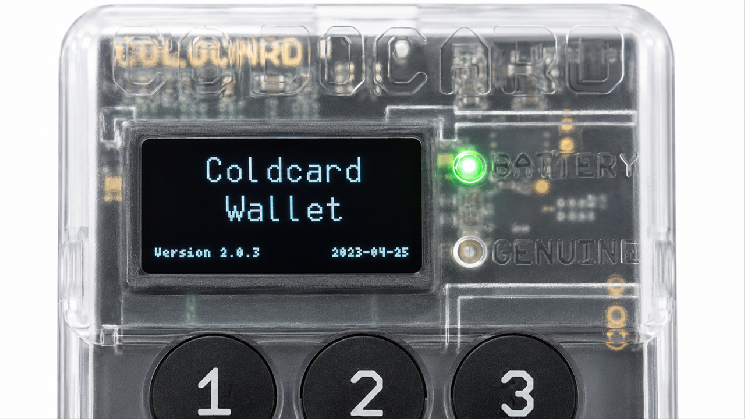
The affected wallets belonged largely to long-term holders who generated their recovery seeds using Coldcard devices running vulnerable firmware released from March 2021 onward. Coldcard is an air-gapped hardware wallet made by Canadian manufacturer Coinkite and designed to keep bitcoin (BTC) keys isolated from internet-connected devices.
Many of the emptied addresses had remained dormant for years. The attacker moved rapidly, paid elevated fixed transaction fees, and left no change outputs, meaning each address was emptied completely. That pattern suggested an automated operation using a prepared list of private keys rather than customers independently moving their funds.
The theft was not caused by phishing, malware on a user’s computer, physical device theft or a conventional remote breach. Instead, a firmware error weakened the randomness used when some Coldcard devices created wallet seeds. Those seeds looked normal but came from a far smaller range of possible combinations than users had been promised.
Coldcard’s Random Number Generator Quietly Failed
A Bitcoin wallet seed is a secret, commonly displayed as 12 or 24 words, from which the wallet generates its addresses and private keys. A properly generated 12-word seed contains 128 bits of entropy, a technical measure describing an enormous number of possible combinations that makes guessing the seed effectively impossible.
Coldcard devices were supposed to obtain that randomness from a hardware random number generator inside the device’s microcontroller. The component draws from physical electrical noise that an outside observer should not be able to predict.
During a software-library migration in 2021, however, Coinkite disclosed that two random-number functions with matching interfaces became confused. One accessed the device’s proper hardware generator. The other was a weak software fallback intended for boards without suitable hardware.
A configuration setting disabled the default MicroPython hardware path because Coinkite supplied its own hardware wrapper. The software checked only whether that setting existed, not whether it was enabled. Because the setting was present but assigned a value of zero, the build completed successfully, while seed generation silently shifted to the weaker software generator.
Factory Data and Timing Replaced True Randomness
That fallback relied heavily on predictable device information, including a chip identifier similar to a serial number and internal clock values associated with startup timing. An attacker who could narrow those inputs would face a much smaller search than the 128-bit range expected from a securely generated seed.
Coinkite estimated the effective search space for vulnerable Mk3 seeds at about 40 bits under current assumptions. That is still a large number of possibilities, but it can be searched with specialized computing equipment, especially when an attacker can compare candidate seeds against bitcoin addresses visible on the blockchain.
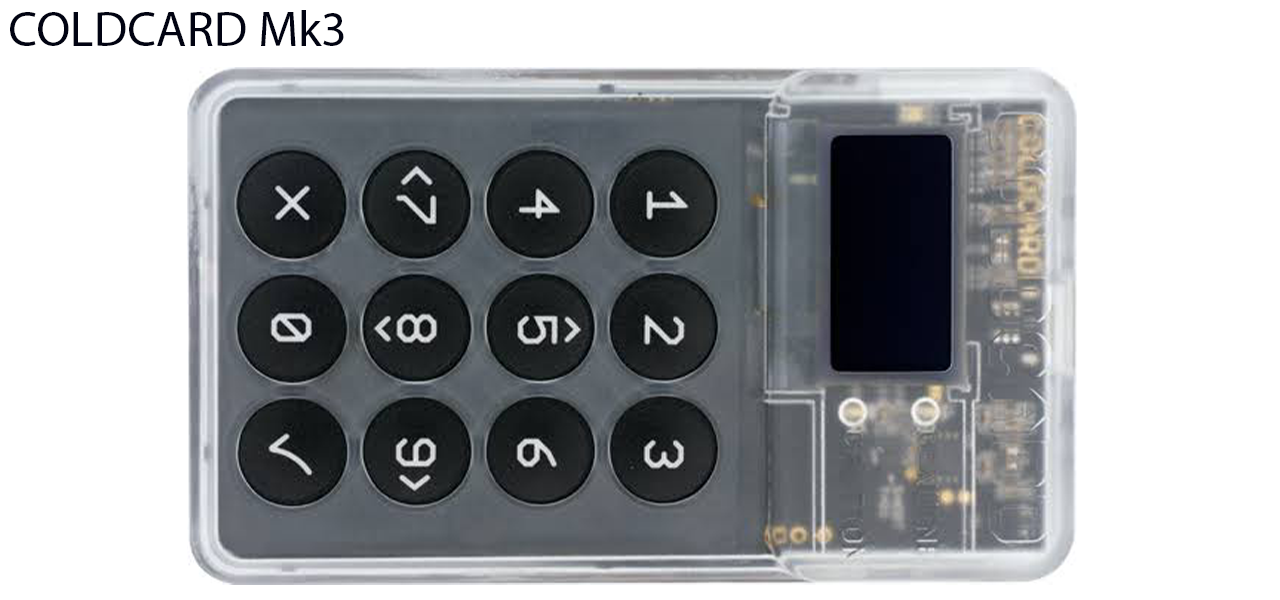
Snapshot of the Coldcard Mk3 model.
Later Coldcard models, including the Mk4, Q and Mk5, added some randomness from a secure element. However, only a limited portion reached the affected generator, leaving an estimated 72 bits of effective entropy on seeds created before corrected firmware was installed. That was stronger than the Mk3 path but still below the intended 128-bit standard.
The difference is similar to replacing a truly random lock combination with one derived from a lock’s serial number and the time it was first switched on. The resulting combination may look random, but someone who knows the formula and can estimate the starting information can reproduce it. Many users are migrating, not only from Mk3 devices, but from Mk4, Q, and Mk5 as well.
Coinkite Tells Users to Create Entirely New Seeds
Coinkite released security advisories and corrected firmware after becoming aware of the active threat. The company said users who generated seeds on affected firmware should create a completely new seed using a fixed version and transfer their bitcoin to addresses controlled by that seed.
Installing the update alone is not enough. A seed created under the flawed system remains weak permanently because the firmware update cannot add randomness to words that already exist.
Coinkite advised users to update their device, create a new seed, verify the backup and wallet fingerprint, confirm the receiving address, send a small test transaction, and then move the remaining balance. Users should retain the old backup until the transfer is confirmed, but should no longer treat the old seed as secure.
The company identified fixed releases including Mk3 version 4.2.0 or later, Mk4 and Mk5 version 5.6.0 or later, and Q version 1.5.0Q or later, along with corresponding Edge versions. Tapsigner, Opendime, and Satscard products use different code and were reportedly not affected.
Added Security Protected Some Coldcard Owners
Users who added enough independent dice rolls when generating a seed were substantially protected because their own randomness overwhelmed the defective software input. Coinkite said at least 50 private rolls of a fair die provided adequate protection from this issue, though additional rolls can provide a wider safety margin.
A strong BIP-39 passphrase also creates a separate wallet that cannot be reconstructed from the seed words alone. Multi-signature wallets, which require keys from multiple devices or locations before bitcoin can move, were largely or fully protected when the vulnerable Coldcard seed represented only one part of the signing arrangement.
Those safeguards were optional, however. Many victims appear to have followed the standard security advice available at the time: Buy a respected hardware wallet, generate the seed offline, protect the backup, and never enter it into an internet-connected device.
Coinkite Accepts Blame as Debate Turns to AI
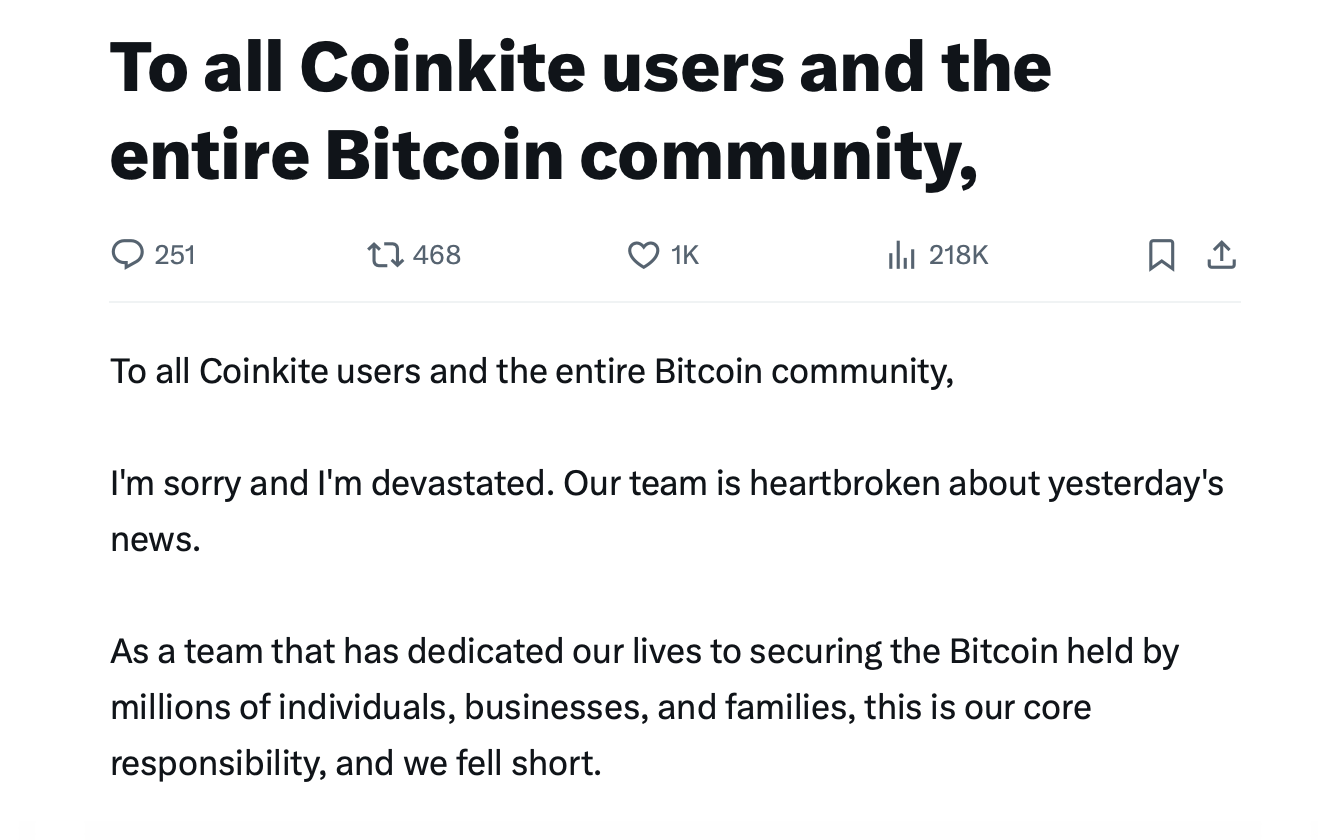
Coinkite CEO Rodolfo Novak, widely known as NVK, apologized publicly on July 31 and said the company accepted full responsibility for the firmware failure. “I’m sorry and I’m devastated. Our team is heartbroken about yesterday’s news,” Novak wrote. He acknowledged that the hotfix secures newly created seeds but cannot repair seeds generated under vulnerable software.
Coinkite CEO Rodolfo Novak’s apology article. Image source: X.
Novak explained that Coinkite would publish a full technical account after verifying the details and assist affected users seeking police reports, insurance claims or independent investigations. He also warned developers that artificial intelligence (AI) tools can now scan old public code for hidden weaknesses faster than traditional review processes may detect them.
Coinkite stressed it must assume an attacker used AI to inspect its open-source firmware, though no evidence has established how the flaw was discovered. The company also acknowledged that a recent review performed with a leading AI model failed to identify the problem. Several competitor hardware wallet manufacturers have taken to social media to note that their products are not affected.
“Ledger is not affected by the recently published Coldcard Mk3 advisory,” the company told X users after the Coldcard incident. “Ledger devices use a certified True Random Number Generator (TRNG) built directly into our Secure Element chip, generating full 256 bits of entropy for every 24-word Secret Recovery Phrase.”
“Trezor users: your funds are safe,” the hardware wallet maker Trezor explained on Friday. “The recent Coldcard issue is limited to their own custom firmware and how some of their devices generated randomness. Trezor does not share that code.”
The Trezor X account added:
“We have always mixed multiple independent sources of randomness together (device hardware + host + secure elements on newer models). We are truly sorry for everyone who has lost bitcoin.”
What Coldcard Users Should Watch Next
The attacker’s identity remains unknown, and the stolen bitcoin could move from its consolidation addresses at any time. Investigators are still working to determine how many vulnerable seeds were actually generated, how much bitcoin remains exposed, and whether additional high-value wallets have already been identified by the attacker. However, Coinkite may not have much info on owners from long ago.
“Fun double-edged sword: Coinkite purges all their customer records after 120 days to protect against data breaches,” the co-founder of Casa, Jameson Lopp, reported on X. “Which means they are unable to reach out to customers who bought vulnerable coldcards over the past 5 years to warn them of this vulnerability.”
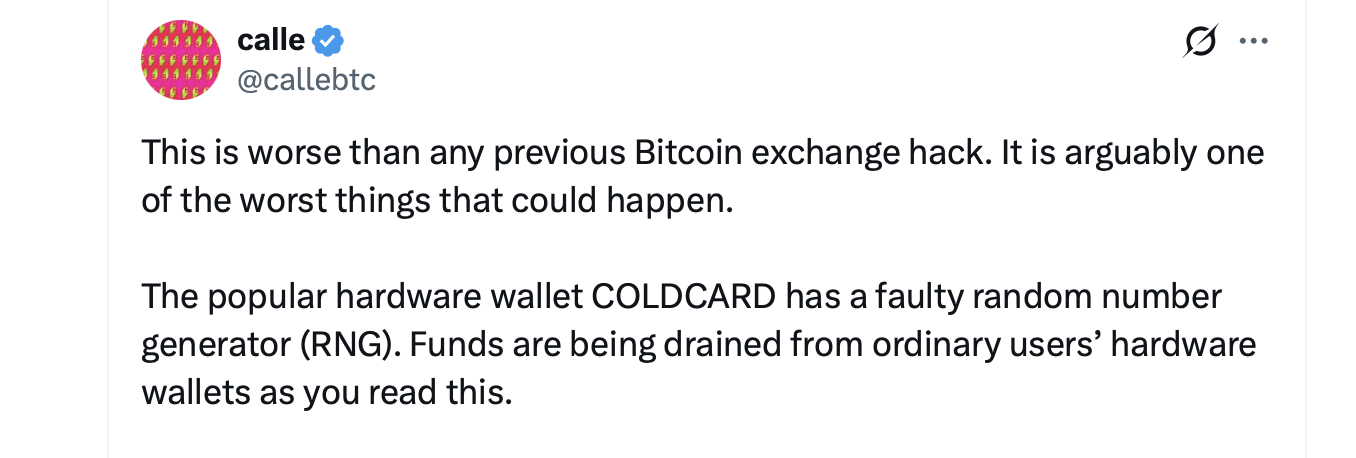
The pseudonymous open-source bitcoin developer dubbed calle shared thoughts on the matter. “I am truly saddened for everyone affected, especially those who may have just lost their life savings. The worst part is that they did everything right,” calle said on X.
The incident will also test whether Coinkite can restore confidence in Coldcard and whether hardware-wallet makers adopt stronger independent reviews of seed generation. For users, the immediate priority is simpler: Anyone who created a seed on affected firmware without strong independent dice entropy, a passphrase, or multisignature protection should treat it as compromised and move funds carefully to a newly generated wallet.
Beyond the devastating theft, bitcoiners across the community are sounding the alarm and pushing others to spread the word before more vulnerable wallets are emptied.
While Marvel fans are expected to turn out in droves to see “Spider-Man: Brand New Day” in theaters this weekend, a high-quality bootleg of the film leaked on X, with millions of people having viewed it.
Posted by an account named Fredrick Bryan at 6:05 a.m. PT, the leaked video reached 5.9 million accounts and counting, with over 143,000 people liking the post and 10,000 people resharing before it was taken down around 3:25 p.m. PT.
Several other X accounts also posted copies, though most didn’t last long on the platform. Studios typically send infringement notices to those posting unauthorized copies, though it can be difficult to keep ahead of the volume of posting for the most popular new films.
Sony had no comment.
“Brand New Day” is far from the first big-budget film to leak online. Last week, Christopher Nolan’s tentpole “The Odyssey” leaked on X with its own high-quality bootleg. It reached 2.1 million views within two and a half hours and was eventually taken down with a notice. The account itself was suspended as well.
Addressing “The Odyssey” leak, Universal issued a statement to Variety on Sunday: “We became aware of the unauthorized posting of the film and immediately initiated takedown protocols. We take copyright infringement seriously and will pursue all appropriate remedies to protect our content and intellectual property rights.”
Regardless of the leak, “Brand New Day” is already doing exceptional business at the box office. It made a record-breaking $72 million in previews, including Tuesday early access screenings — the most of any movie in history. That placed it above “Avengers: Endgame,” which grossed $60 million in Thursday previews.
“Brand New Day” sees the return of Tom Holland as the famous web-slinger, with Emmy-winner Zendaya returning as MJ. The cast also includes Sadie Sink in a mystery role, Jon Bernthal and Jacob Batalon.
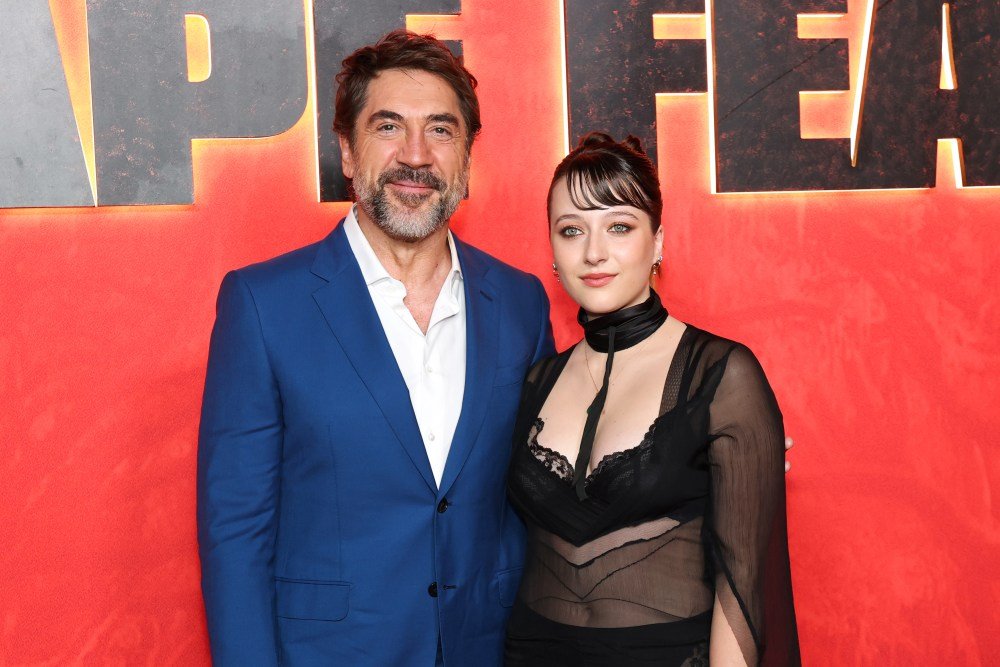
In 2007, Javier Bardem delivered one of the century’s most chilling performances as Anton Chigurh in “No Country for Old Men.” Nearly two decades later, he’s proved once again he could convincingly play a sociopath, reimagining the vengeful murderer Max Cady on Apple TV+’s hit summer series “Cape Fear.”
Cady was previously played by Robert Mitchum in 1962 and Robert De Niro in 1991, but the brilliance of Bardem’s performance lies in the long stretches of perceived stillness, heightening the tension of the cat-and-mouse game he plays with the Bowden family, which star Lily Collias described as “a lot of fun” but “sometimes very jarring.”
“We’re playing cat and mouse, and then the cameras turn off, and I still feel like a mouse,” Collias told Variety at the “Cape Fear” finale screening in New York. “And he still feels like Tom from ‘Tom and Jerry.’”
Collias plays Natalie Bowden, the daughter of Anna (Amy Adams) and Tom (Patrick Wilson), two lawyers who Bardem’s Cady blames for his incarceration. After 10 episodes of buildup, the series finale depicts an epic battle in which Cady invades the Bowden’s home, placing Anna and Tom on “trial” for colluding against him and threatening their children.
“[Episode] 10 felt almost like a play,” Collias said. “It was just the family and him in the house, and we were doing the most insane things and laughing so hard off camera. It felt like such a joy that it was actually a beautiful time.”
Before filming one violent sequence in which Cady grabs Natalie by the hair, Collias says Bardem politely apologized in advance and made sure she felt comfortable with the physicality.
“We would go through such weird circumstances, it’s little things that make me still giggle to this day,” Collias said. “In Episode 10, there’s one point where he has to grab me by my hair, and before the scene, he’s like, ‘I’m so sorry, my love. Is it OK if I just — I’m going to grab you like that?’ I’m like, ‘Yeah, that’s fine.’ Then we start rolling and I see this thing coming up to me and I’m like, ‘What the fuck?! Well, OK, that’s your job!’”
When asked about filming the intense finale scenes, Bardem smirked, explaining how he’s learned to lean into the “play” involved with acting as he’s gotten older.
“For me, it’s more about a game,” Bardem said. “You use your imagination to jump in and step out of it. I respect everybody’s process, as long as those processes respect other people’s processes. For me, the fun part is to really be part of a group of people that imagine things that don’t exist, and they create it together based on the fact that it’s all a big lie.”
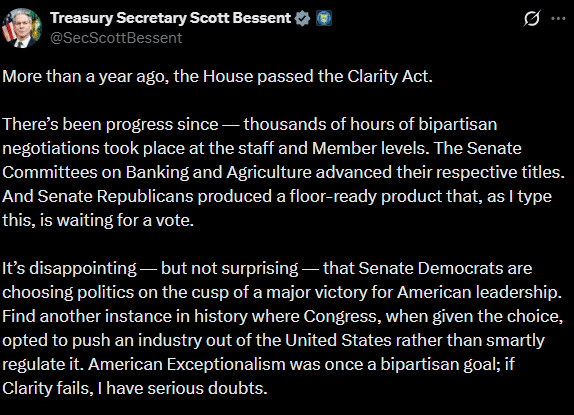
U.S Treasury Secretary Scott Bessent has dismissed Senate Democrats for stalling the crypto market structure bill, the CLARITY Act.
In a statement on Thursday, the 30th of July, Bessent noted that Democrats’ opposition was not surprising but “disappointing.”
It’s disappointing — but not surprising — that Senate Democrats are choosing politics on the cusp of a major victory for American leadership. American Exceptionalism was once a bipartisan goal; if Clarity fails, I have serious doubts.
The Senate Democrats, including pro-crypto ones such as Angela Alsobrooks and Ruben Gallego, withheld support for the bill, citing ethics, developer protections (BRCA) and illicit finance provisions.
For Bessent, some of the raised concerns, like developer protections under the Blockchain Regulatory Certainty Act (BRCA), formalize some historical government policies.
The BRCA does nothing other than codify longstanding Treasury Department policy: non-custodial builders and developers are not, and have never been, subject to registration obligations under the Bank Secrecy Act.
Source: X
Clarity Act: Republican support falters
That said, Sen Thom Tillis (R-NC) and Ruben Gallego (D-AZ) reportedly reached an ethics deal. The draft included the role of state attorneys general (AGs).
This is one of the key demands Democrats had pushed for, arguing that ethics cases and oversight can not be left to the Department of Justice (DoJ) alone.
Whether this will be enough to win over Senate Democrats is unclear. But there is only 1 week before the August recess. Additionally, other bills like the ‘SAVE America’ Act are also being prioritized by President Donald Trump.
At the same time, the CLARITY Act does not have unanimous support amongst Republicans. AMBCrypto had earlier estimated that only about 49 Senate Republicans would support the bill. Now, Josh Hawley (R-MO) is reportedly a holdout, according to pro-crypto Sen. Cynthia Lummis.
She noted,
Republican support is very high. But I don’t think it will be unanimous, as people like Josh Hawley are really resistant. I think we’ll have an overwhelming majority.
In other words, Republicans will need over 11 Democratic votes to pass the bill on the Senate floor.
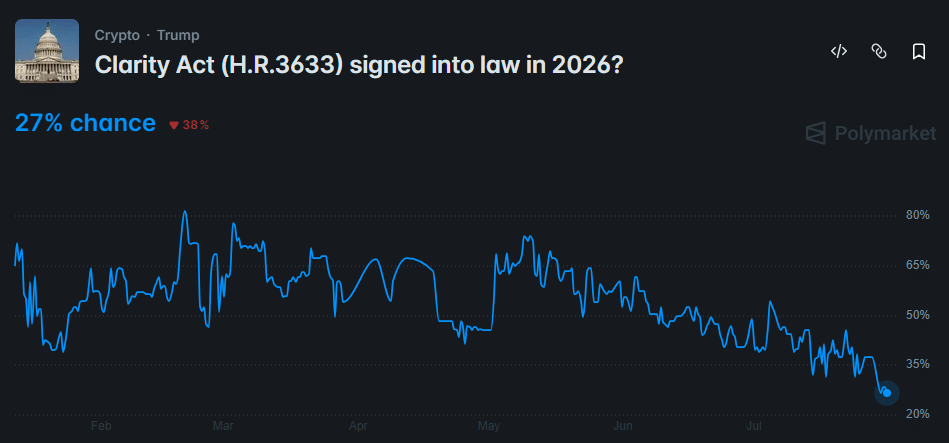
That said, as of writing, early Friday, the market was very pessimistic about CLARITY Act passage this year. The odds dropped to another yearly low of 27%.
Source: Polymarket
Overall, there is movement to resolve the ethics provision stalemate. But White House priority and the incoming August recess have made the market doubt the bill’s potential progress next week.
Final Summary
U.S Treasury Secretary Bessent was “disappointed” with Senate Democrats’ opposition to the CLARITY Act.
Chances of the bill’s passage dropped to a record yearly low of 27% amid a shrinking window
Researchers at Galaxy Digital say about $70 million has been stolen due to an exploit in the popular Bitcoin wallet Coldcard.
The attack was enabled by a firmware bug that dramatically reduced the randomness of how the wallet creates its secret recovery phrase.
According to Galaxy, the vast majority of the funds were stolen in less than an hour.
“While new attacks are likely to occur if users do not migrate their funds out of affected Coldcard-generated addresses, the initial attack is identifiable onchain. Note that this analysis may not be complete, but it represents our best-efforts attempt at scoping the initial impact…
The full event spans six blocks and 41 minutes. Three intervening blocks contain no sweep activity at all, suggesting the transactions were broadcast in batches rather than streamed…
The loss profile is dominated by sub-1 $BTC addresses in count, but by 1-50 $BTC addresses in value. This is the shape of individual self-custody, not institutional or exchange holdings.”
Coinkite, the company behind Coldcard, says it takes full accountability for the firmware bug and has apologized to affected users.
The company has released emergency firmware updates for all affected models: version 4.2.0 or later for Mk3, 5.6.0 or later for Mk4 and Mk5, and 1.5.0Q or later for the Coldcard Q.
These updates remove the vulnerable software fallback path and ensure new seeds use the intended hardware true random number generator.
Critically, a firmware update alone does not secure existing seeds. Users must generate an entirely new recovery phrase on the fixed firmware and migrate their $BTC.