Author: rb809rb

  • China Announces National Blockchain Network: This Altcoin’s Price Surges

    Chinese authorities also aim to improve regulations regarding the determination of data ownership, data trading, and the distribution of economic rights. Making cross-border data flows more efficient and secure is also among the components of the new economic strategy.

    Related News New Record Forecast for Bitcoin Within 90 Days: Renowned Analyst Expects a Drop to This Level First

    Conflux ($CFX) Price Rises Following China News

    China’s announcement regarding its national blockchain network has increased investor interest in China-linked projects, resulting in a notable price movement for Conflux ($CFX).

    According to Binance data, $CFX surged from around $0.0505 on October 10th to over $0.059. This represents a gain of approximately 17% compared to its intraday lows.

    $CFX, trading at around $0.0582 at the time of writing, showed a recovery after a brief period of sharp selling.

    *This is not investment advice.

  • Musk Sees SpaceX Worth Far More Than Earth’s Economy; Saylor Is Bullish

    Musk Sees SpaceX Worth Far More Than Earth’s Economy; Saylor Is Bullish

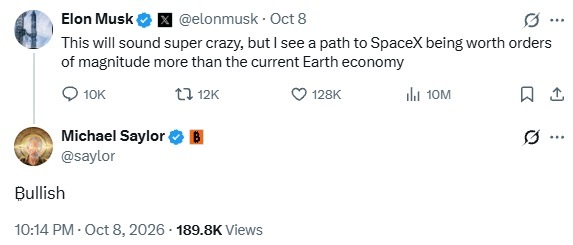
    A follow-up on Oct. 9 gave Musk’s outlook a numerical reference while retaining significant uncertainty about success. He described a valuation above $1 quadrillion, equivalent to $1,000 trillion, as a possible outcome he previously considered unattainable. He characterized the probability as accelerating from a tiny base and separately clarified that seeing a path did not express extreme confidence. The SpaceX CEO wrote:

    “>$1000T now appears to me to be in the set of possible outcomes, whereas before I had thought it was not.”

    His latest comments extend an earlier conditional valuation claim made July 9 during an exchange about an AI computing agreement involving Anthropic, the company behind the Claude AI assistant. That exchange also tied his valuation outlook to achieving SpaceX’s long-term goals.

    Reusable Rockets and Solar-Powered AI Underpin Musk’s Vision

    Musk’s economic argument centers on using solar energy beyond Earth to power much larger computing operations. In a June 8 discussion filed with the Securities and Exchange Commission (SEC), he outlined solar-powered AI computing in orbit. The proposal puts computers aboard satellites to process AI workloads. He identified three requirements: launch capacity, solar power, and computing chips.

    Lower launch costs would make that expansion more practical by allowing the company to transport substantially more equipment into orbit. Musk’s space-based AI ambitions rely on Starship, SpaceX’s rocket system, achieving reuse of both stages with short turnaround times. On Sept. 28, it completed its first orbital flight and deployed 26 satellites for Starlink, the company’s satellite communications business.

    Lunar manufacturing represents a further stage of the plan, potentially reducing the need to launch equipment from Earth. Musk described producing solar panels and radiators on the moon, then using an electromagnetic launcher to accelerate AI satellites into space through electromagnetic force. Its lower gravity and lack of atmosphere underpin that proposed approach.

    Saylor Gives Musk’s SpaceX Outlook a Bitcoin Twist

    The valuation exchange drew a one-word response from Michael Saylor, executive chairman of the largest bitcoin treasury company Strategy Inc. (Nasdaq: MSTR). His Oct. 8 reply read “₿ullish,” replacing the initial letter with the bitcoin symbol. The spelling connected his favorable reaction to the cryptocurrency while responding directly to Musk’s SpaceX outlook.

    That reaction follows Saylor’s earlier comments linking SpaceX to corporate bitcoin ownership. On June 13, he congratulated Musk on the company’s public listing and counted SpaceX alongside Tesla among major technology businesses holding bitcoin. His “Mag8” grouping added SpaceX to the Magnificent Seven: Alphabet, Amazon, Apple, Meta, Microsoft, Nvidia, and Tesla.

    The connection also extends to SpaceX’s balance sheet, which includes a substantial holding of the digital asset. Its quarterly filing disclosed 18,712 bitcoin as of June 30, unchanged from Dec. 31, 2025. Their acquisition cost, or cost basis, was $661 million. Their fair value, reflecting the market price on June 30, was approximately $1.098 billion.

  • ‘Midday Meal’ Review: Touching Iranian Drama Charts a Teacher’s Desperate Acts to Provide for His School

    ‘Midday Meal’ Review: Touching Iranian Drama Charts a Teacher’s Desperate Acts to Provide for His School

    “Midday Meal” isn’t necessarily about the art of cooking, but it is in part about the rituals of food, rituals which become more precious with scarcity. But more than that, the new film from director Majid Majidi — best known for his 1997 drama “Children of Heaven”, the first Iranian production ever nominated for the Best International Feature Oscar — is about the right to have food, a punishing struggle to find and provide it in the absence of governmental care.

    Set in the Iranian village of Goorankesh, housed in an incredibly arid and seemingly inhospitable region, the film follows schoolteacher Davoud Soulan (Mohammad Rahimi), whose job lies on precarious foundations. His livelihood is mostly privately funded — though his salary is from the ministry of education, he’s only a contractor — and his benefactor has passed away. Worse still, the dead man’s heirs don’t wish to continue the investment that allows him to provide lunches for his students. This pause in food supply imperils the entire school due to a domino effect: With no lunch, the kids will stop showing up, which would shut the school down after an estimated two weeks.

    The teacher accepts the semi-transactional nature of his relationship with his students: It’s hard to fault a child for being hungry, and it’s difficult not to be moved by the desperate measures that Soulan takes to keep his school open. He lives in the building to save on rent (which then goes to food), and moonlights smuggling and selling fuel to keep the school running. (Here, smuggling is a pastime than many engage in, children included.)

    But it’s not so simple as Soulan choosing and continuing to do the right thing. His determination to keep the school open comes with some moral compromises — and this is what makes “Midday Meal” more interesting, and more fraught, than expected.

    The conflict between pragmatism and generosity begins at a small scale and incrementally escalates. At first, it’s seen in Soulan’s hesitation at accepting children from other villages to his class — then in his rage at his mother for feeding guests at the potential expense of the children’s meals. Between Rahimi’s performance and Majidi’s patient exploration of his reactions, it comes off as very human rather than as an idealistic cipher for how the director wishes the world was. Desperation shifts Soulan’s actions into more dubious territory, especially as one character even calls into question how much of what he does is charity and how much is pursuit of a guaranteed salary.

    Either way, Rahimi balances the character’s clear vulnerability with just enough ambiguity about his plans for the school, accentuated through Majidi’s restrained and naturalistic approach. The director’s deliberate obfuscation of Soulan’s immediate intentions — beyond his desire to keep the school open — make for a fascinating character study. Rahimi plays him as a mostly sincere but deeply conflicted man, and most importantly a desperate one, capable of some rather unexpected deceptions. One of these is effectively kept hidden from scene to scene, especially once a sick old man falls into Soulan’s care.

    At one point, Soulan points out that the crime of fuel-smuggling is minor compared to the barons profiting off the very same — and shouldn’t the motivation, the practical outcome of the act, count for something? Majidi tests the limits of this sentiment throughout “Midday Meal,” often to great effect. The film starts from a point of frustration about a lack of governmental care, and a community falling apart from the stressors of being left with no support. The few encounters with representatives of the law are exasperating — an officer chastises Soulan for being a bad role model for his students — though not necessarily cut and dried. Meanwhile, a member of the education department treats his organization and financing with suspicion, despite having already left him to his own devices.

    This is where the anger of “Midday Meal” comes in, an innate frustration at how so many institutions continually fail to make the simplest decision in the world: to provide for people. Majidi’s matter-of-fact style of shooting underlines the cold reality that Soulan tries to navigate, and strips away any semblance of potential didacticism. For every good deed he does, there’s an underside of pragmatism to it, which can seem a little ruthless.

    But some good deeds do seem to come back around, in moments of grace that keep “Midday Meal” from being a punishingly bleak affair. Despite his seeming sternness and the board’s outright negligence, the inspector sees Soulan’s charity and decides to help how he can — even if the scene of the inspection itself is incredibly stressful. In a film that, at the outset, seems like it could be open-and-shut in terms of moral simplicity, there are ultimately no easy answers.

  • Rosalía Performs an Entire Number En Pointe on ‘SNL,’ Then Cools Off With a Nice Shower

    Rosalía Performs an Entire Number En Pointe on ‘SNL,’ Then Cools Off With a Nice Shower

    To the question of whether Rosalía would be dancing during her “Saturday Night Live” appearance or not, that depends on how you’re looking at it. The acclaimed singer stood in place, perfectly still, during her first number, “Reliquia” — but appeared to be standing en pointe for the entire four-minute performance.

    For her second “SNL” number, “Magnolias,” Rosalía didn’t assume such a difficult position, but the equally gorgeous performance had a different set of physical demands, as an in-studio rain shower erupted midway through the song, dampening her hair and face and turning her white dress clingy and sheer.

    On social media, viewers immediately marveled at Rosalía’s ability to deliver her usual powerful vocals during the first song while striking the pose — and some wondered if she was somehow being propped up through unseen means. Fans who have seen her balletic prowess on display on her global “Lux” tour testified to her ability to pull off something that athletic without resorting to artificial measures. She was joined at the very end of “Reliquia” by a dozen dancers, who lined up on either side of her as a strobe effect took over.

    In her subsequent singin’-in-the-rain performance of “Magnolias,” the singer’s undergarments became visible as her dress got more drenched. But viewers had already seen Rosalía in them minutes earlier, at the conclusion of her one appearance in a comedy sketch. The skit had the singer appearing in a thought bubble and and encouraging host Shane Gillis to abandon his gravely ill mother’s bedside to go to a Jelly Roll concert at Las Vegas’ Sphere.

  • Papertrade Faces Oracle-Manipulation Allegation as House Pool Shows $3.14 Million

    Papertrade Faces Oracle-Manipulation Allegation as House Pool Shows $3.14 Million

    El33 described a second leg in which the trader switches from shorts to longs on Papertrade, then unwinds the Hyperliquid position. “Seems like someone currently draining Papertrade LP by Oracle manipulation,” the observer wrote, linking the wallet ending in `840e`. The characterization remains an allegation, not an established loss estimate.

    Marcin Kazmierczak, co-founder of oracle provider RedStone, shared the post and called it an “Interesting Oracle manipulation strategy on Papertrade during weekends.” His post did not provide a separate transaction analysis.

    Winning Trades Draw on a Separate Pool

    Papertrade’s public protocol summary reported a positive pool balance and zero queued profits. PaperDash likewise displayed a $3.14 million LP balance and an empty payout queue. Those readings do not show that winning traders were waiting for payments at that snapshot.

    The house reserve is distinct from customer deposits. As The Defiant previously reported, the $137.1 million in combined launch-day TVL included both trader balances and house liquidity; it was not all available to pay winners.

    Papertrade administrator @izebel_eth explained that only user losses enter the pool, not their collateral. When a winning trade closes while a queue exists, the original collateral becomes available again, but “only the profits are queued.”

    The team’s published launch controls give administrators the ability to pause new positions, freeze markets, change fee and impact parameters, and adjust opening headroom. Under those rules, existing positions in a frozen market can still close against the paused bid-offer midpoint.

  • Filecoin Nears End of Six-Year Vesting, Removing 68 Million FIL in Annual Releases

    Filecoin Nears End of Six-Year Vesting, Removing 68 Million FIL in Annual Releases

    The published token allocation assigns 300 million $FIL to Protocol Labs, including its team and contributors, and 100 million to the Filecoin Foundation. Their combined six-year allocation releases about 66.7 million $FIL annually. Lotus’s supply-accounting code includes another 9.8 million $FIL in the same six-year bucket, bringing the scheduled annual release to about 68.3 million.

    The code measures that schedule as six 365-day years starting at the network’s liftoff epoch. That puts completion on **Oct. 14, 2026**, based on the mainnet parameters and recorded liftoff block.

    Filfox reported about 56,449 $FIL produced over 24 hours in its snapshot at block 6,445,866. Annualized over 365 days, that is 20.6 million $FIL. Against the explorer’s reported circulating supply of 919.9 million $FIL, gross annualized additions would fall from about **9.7% to 2.2%**. The Protocol Labs and Foundation streams alone account for roughly three-quarters of the pre-completion total.

    Provider Rewards Continue

    These figures measure vesting releases plus newly mined rewards, not net circulating-supply growth or exchange selling. Filecoin’s supply accounting also reflects reserve disbursements, burns and locked collateral. Already vested balances remain available after the schedule ends.

    Block rewards have their own mechanics. Filecoin’s documentation describes a time-based minting component and another tied to network performance, so the remaining issuance rate is not fixed. Under the documented reward-vesting rules, 25% of earned block rewards are immediately accessible, while 75% vest over 180 days.

  • Sci-Fi Thriller ‘Overstake’ Gets Generative AI Rebuild, Boarded by Cappu Films at Busan Market (EXCLUSIVE)

    Sci-Fi Thriller ‘Overstake’ Gets Generative AI Rebuild, Boarded by Cappu Films at Busan Market (EXCLUSIVE)

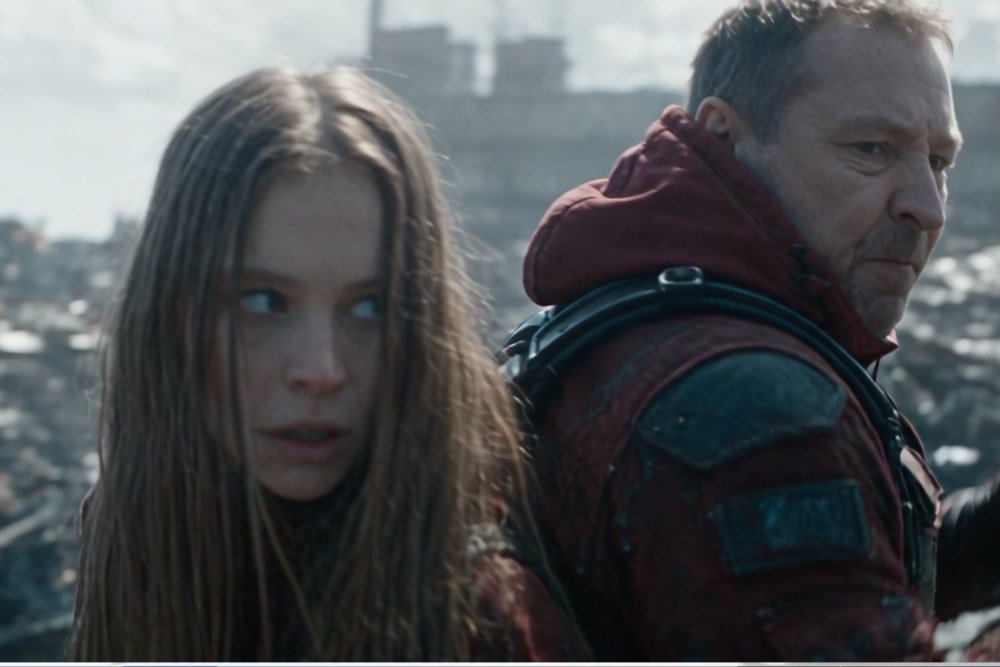
    Hong Kong’s Cappu Films has signed on as worldwide sales agent for “Overstake,” a sci-fi action thriller from writer-director Stas Mareev that pairs a live-action shoot with settings being rebuilt through generative AI.

    The sales company is introducing the title to buyers at the Busan International Film Festival’s Asian Contents & Film Market.

    In the film, a wounded veteran joins a deadly betting game for a life-changing payout: he has two hours to cross an industrial city and keep his ex-wife alive, while strangers get offers on their phones to save him or stop him in his tracks. The game’s organizers turn the pair’s fight for survival into a show. The cast includes Konstantin Adaev, Vika Tokareva, Oleg Chernov, Konstantin Sidikhin, Denis Starkov and Sergey Russkin.

    “‘Overstake’ is a chance to return to a film I already directed and rebuild its world at a scale that was impossible for us before,” Mareev said. “The performances and story remain the foundation, while generative AI allows me to rethink the environments, action and visual language without losing the human core of the film.”

    “We’ve handled international sales for many films in this genre, and sci-fi and action are particular strengths for Cappu,” said Janice Woo of Cappu Films. “We were impressed by Stas’s promo and look forward to introducing the film to our distribution partners in Busan.”

    The AI work is still in progress, so buyers in Busan will see a promo along with a handful of finished sequences.

    Cappu’s Busan lineup also features “Banr”; “Fox Hunt”; “Ephemera,” Shan Jiang’s Tribeca title; WWII spy series “Operation Doolittle,” told across nine episodes; martial arts film “Lion Fist”; Joy Hopwood’s dramedy “Her Last Laugh,” from Australia; and “Zombie Plane,” an action comedy toplined by Vanilla Ice, Sophie Monk and Chuck Norris.

  • Pete Hegseth Is Unhinged in ‘SNL’ Cold Open Mocking Christa Pike’s Botched Execution and RFK Jr.

    Pete Hegseth Is Unhinged in ‘SNL’ Cold Open Mocking Christa Pike’s Botched Execution and RFK Jr.

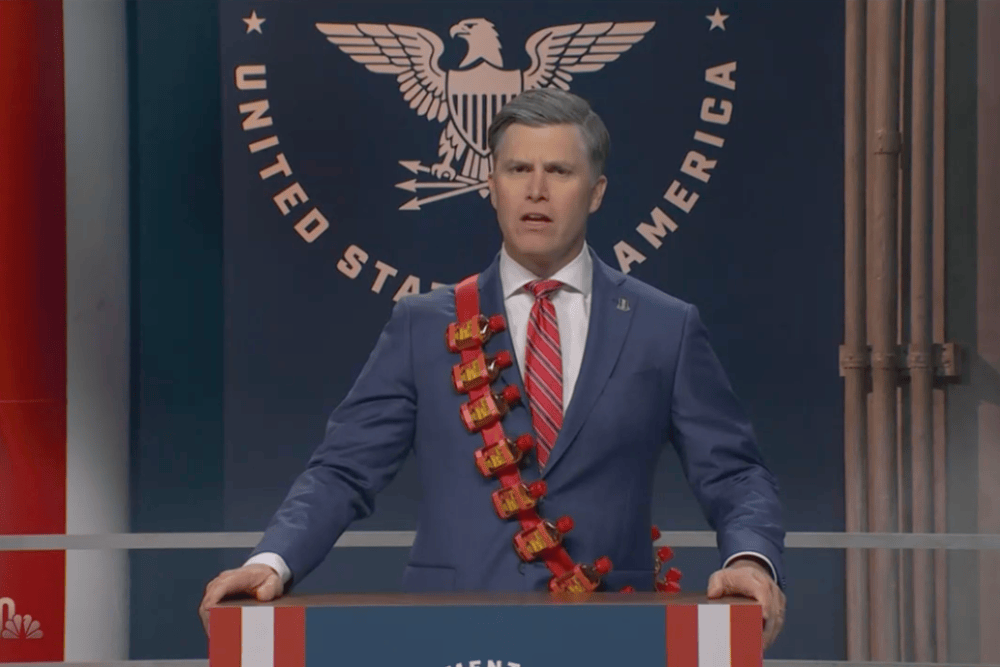
    Colin Jost returned as an especially rowdy Pete Hegseth in this week’s “Saturday Night Live” cold open, welcoming home sailors aboard the USS Abraham Lincoln after nearly a year at sea.

    The Oct. 10 sketch opened with an introduction to the ship’s returning crew, who were told that before reuniting with their families, they would first have to hear from “the guy who put you on the boat in the first place.”

    Enter Jost’s Hegseth, sporting an ammunition belt stocked with miniature bottles of Fireball Cinnamon Whisky, “the only alcohol designed to taste better on the way back up.”

    “How are you sailors doing tonight?” Hegseth asked the crew.

    “We’re bad,” they responded.

    “I heard awesome,” he shot back.

    The sketch took aim at reports of deteriorating conditions aboard the aircraft carrier, including plumbing issues and mental-health struggles among the crew during their extended deployment.

    “I couldn’t be more proud of you. Only eight of you attempted suicide. Two of you since I started talking,” Jost’s Hegseth remarked. “You executed over 3,000 combat missions and you did it with zero casualties, zero flight mishaps and zero working toilets.”

    He then honored one particularly brave sailor who managed to hold his bladder for 300 days rather than complain about the broken bathrooms. When the sailor asked if he could finally relieve himself, Hegseth directed him to a Starbucks three blocks away.

    Jost’s Hegseth also caught the sailors up on some of the Trump administration’s latest activities on land, including plans for a televised execution in December. “Public executions are back, kind of like ‘Scrubs,’” he announced, adding that if the prisoner survives the firing squad, he’ll have to fight Jake Paul.

    He then proudly unveiled the Department of War’s new eagle logo, which has drawn comparisons to Nazi imagery.

    “Sorry, is that a Nazi eagle?” one sailor asked.

    “It’s an American eagle with a Nazi vibe, okay?” Hegseth replied.

    The sketch then brought out James Austin Johnson as RFK Jr. to deliver an equally questionable update on the country’s health.

    “I’m happy to report that America is healthier than ever,” Johnson’s Kennedy began, in the Secretary of Health’s signature croaked voice. “That’s why I would officially like to rename cold and flu season to cold and flu and listeria and measles and trench brain season.”

    He also addressed recent meat recalls, assuring Americans that catfish, pony and cricket remain “valuable proteins” before revealing that the recalled products had been tested on the sailors themselves.

    “The research you provided on Operation Hell Cruise will be vital for years to come,” he declared.

    Hegseth wrapped up his welcome-home speech with a musical tribute to the sailors, quoting Linkin Park’s “In the End.”

    “You tried so hard and got so far, but in the end it doesn’t even matter,” he sang, before thanking the crew for being willing to go down with the ship — even if it breaks his “personal rule of never going down on anyone.”

    The cold open comes just two days after the real USS Abraham Lincoln returned to San Diego following a 322-day deployment supporting the U.S. war with Iran. The aircraft carrier spent more than 260 consecutive days at sea without a port call, with reports of supply shortages, broken plumbing and eight suicide attempts among its crew.

    Jost also appeared as Hegseth in last week’s cold open, which saw the defense secretary chugging Tom Holland’s non-alcoholic Bero beer while joining a cast of Republican officials attempting to drum up excitement ahead of the November midterm elections.

    This week’s episode is hosted by Shane Gillis, marking his third time hosting the NBC sketch comedy series since being fired as a cast member in 2019 over resurfaced racist and homophobic remarks. Rosalía will serve as musical guest.


  • Arthur Hayes Sees Mega Crypto Bull Run Beyond AI Encryption Fears

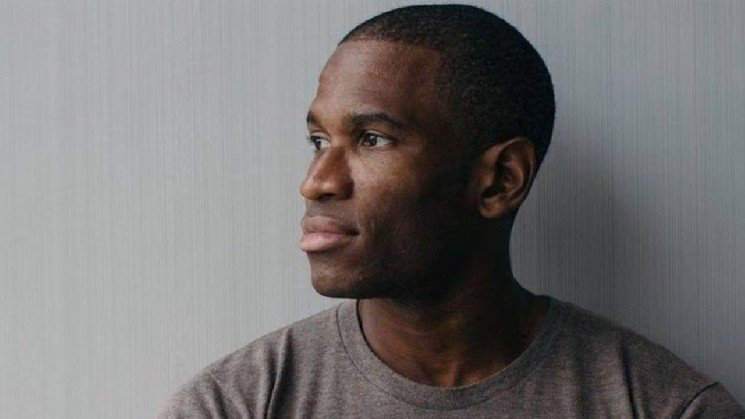
    Arthur Hayes Sees Mega Crypto Bull Run Beyond AI Encryption Fears

    The forecast builds on his earlier argument that government efforts to manage borrowing costs can support digital assets. In an Aug. 24 essay, Hayes contended that expanding dollar liquidity could flow into bitcoin and other cryptocurrencies. His framework emphasizes financial conditions as a driver of investment demand.

    Money Printing Could Fuel Crypto’s Next Rally

    Greater availability of money and credit underpins Hayes’ expectation that policy responses to financial pressure could lift prices. Global liquidity describes those conditions across the financial system. In his scenario, capital released through government intervention could reach speculative investments, including cryptocurrencies.

    In the Aug. 24 essay, Hayes connected that reasoning with the U.S. Treasury’s expanded bond repurchases, arguing that Treasury buybacks supported a new bitcoin bull market. These debt-management operations purchase outstanding government securities. He viewed their effects on yields as favorable to risk assets while distinguishing them from Federal Reserve asset purchases.

    His AI-bust scenario anticipates a larger intervention if heavily financed infrastructure encounters financial stress. In an interview published Oct. 2, Hayes projected that an AI bust could trigger multitrillion-dollar support, potentially benefiting crypto through money creation. He placed the prospective reckoning around 2027 or 2028 as target=”_blank” rel=”noopener noreferrer”>disputed an imminent AI breakthrough, arguing there was no evidence of a break in established cryptographic assumptions. His objection addresses the technical premise behind the anxiety Hayes incorporated into his bullish analogy.

    Separately, AI-assisted security work has demonstrated how automated analysis can uncover weaknesses in existing crypto software. A researcher examining Zcash identified a flaw in its shielded transaction system, illustrating the role of AI-assisted vulnerability discovery in reviewing older code. That involved a software defect rather than defeating the mathematical protections underlying digital signatures. Developers patched the vulnerability within days of its discovery.

  • Shane Gillis Bombs ‘SNL’ Monologue (Again): ‘You’re Either Gay or You’re Hitler’

    Shane Gillis Bombs ‘SNL’ Monologue (Again): ‘You’re Either Gay or You’re Hitler’

    Shane Gillis returned to host “Saturday Night Live” for the third time since his 2019 firing, emerging in a matching black T-shirt and pants for a meandering monologue about needing to lose weight and being miserable (and trying to be unthreatening to women) while hiking.

    “I tried to go to a public gym. Going to the public gym as a fat guy, especially in New York, is a nightmare, dude,” he opined. “It’s just the hottest gay guys you’ve ever seen. They’re jacked and they look at me, like, ‘Yeah, right.’ ‘I know, dude.’”

    “Also, I haven’t been to the gym in so long I didn’t know women just dress like whores now?” he cracked to groans from the in-studio audience. “Look, I’m sorry, there’s no other way to describe [it]. Have you seen it? I’ve seen it. You’ve seen the shorts? They’re those neon, like, artificial vape-colored [shorts], and the wrinkles go around the cheeks and all combine at the butthole. And don’t look! You’re not allowed to look. For real, don’t look, because they are filming. I’m in the background of ten TikToks right now [grinning].”

    There was more, of course. Gillis riffed on his “two big, fat-bitch sisters” who would heckle him by saying “the meanest things,” like calling him “bitch hips,” and poked fun at how his receding hairline is starting to make him resemble a certain fascist leader.

    “I’ll tell you the thing that I’m really bothered by is: I’ve balded directly into an Adolf Hitler haircut,” he joked. “And it’s not good. Because I give a lot of speeches and the front falls down a lot, and there’s no way to adjust it without looking exactly like [Hitler]. It’s the only way. I’m not going to [brush it to the side], that’s gay. That’s it: You’re either gay or you’re Hitler, and isn’t that where we’re at as a country?” There were few laughs, and then it abruptly ended. Gillis has shown considerable comedy chops in his stand-up specials and hosting the ESPYs, but nailing an “SNL” monologue seems to be elusive for him.

    Gillis, 38, has had a very rocky “SNL” journey.

    Back in Sept. 2019, he was announced as one of the sketch-comedy show’s newest cast members, alongside Chloe Fineman and Bowen Yang. He was fired five days later after clips resurfaced from Gillis’s podcast where he mocked Asians and used anti-gay slurs — which looked even worse given that Yang had just made history as the first “SNL” cast member of full Asian descent (and third openly-gay male cast member ever). Gillis subsequently made a name for himself sans “SNL” with a popular podcast, two stand-up specials, creating and starring in the Netflix series “Tires” and a role in the upcoming biopic “Madden.”

    “SNL” creator Lorne Michaels would later admit that he was forced to give Gillis the boot against his wishes by NBC brass, telling The Wall Street Journal, “That was very strong from the people in charge. And obviously I was not on that side, but I understood it.” And since then, it seems that Michaels has been on a mission to make good with Gillis, offering him the role of Donald Trump for “SNL’s” 50th season (Gillis turned it down) as well as allowing him to host the show three times. While Gillis bombed his monologue during his first hosting stint in 2024, later blaming the Gen Z crowd for not getting his Civil War jokes, he’s since impressed with popular sketches like “CouplaBeers.”