Versant Media said second-quarter net income fell by 30% as the new media company continued its efforts to add non-traditional assets to lend ballast to its linear media operations.
The owner of MS NOW, CNBC and USA said net income fell to $211 million from $302 million in the year-earlier quarter, a decline of $91 million. The company cited lower revenue, the costs of operating as a public company, interest expense following its separation from Comcast, and increased tax expense tied mostly to the divestiture of SportsEngine, an online sports management software company that was sold in May.
Versant, spun off from Comcast earlier this year, is focused on generating new revenue from digital and direct to consumer operations. In recent weeks, it has expanded Fandango into a broader consumer entertainment platform, and made progress on new subscription projects at both CNBC and MS NOW. “Together, we believe these initiatives build on the foundation of our portfolio, deepen consumer engagement, and position Versant for long-term growth,” said Mark Lazarus, the company’s CEO.
Revenue in the second quarter fell 3.8% to $1.64 billion. Distribution fees fell 6.3% in the second quarter, largely due to subscriber declines. Ad revenue was off 0.6%, compared with a decline of 13% in the year-earlier quarter, reflecting improvements in ratings at some of its networks. Revenue from platforms, which include many of Versant’s direct to consumer businesses, rose 0.8%, due to higher revenue at Fandango and GolfNow.
Versant said it was confident in its near-term future, raising revenue and cash-flow projections for the second half of the year.
$BNB price traded near $600 on Aug. 5 after breaking out of its July range, while rising derivatives activity and nearby liquidation clusters pointed to a possible test of $610.
$BNB price reclaims $592 after July breakout
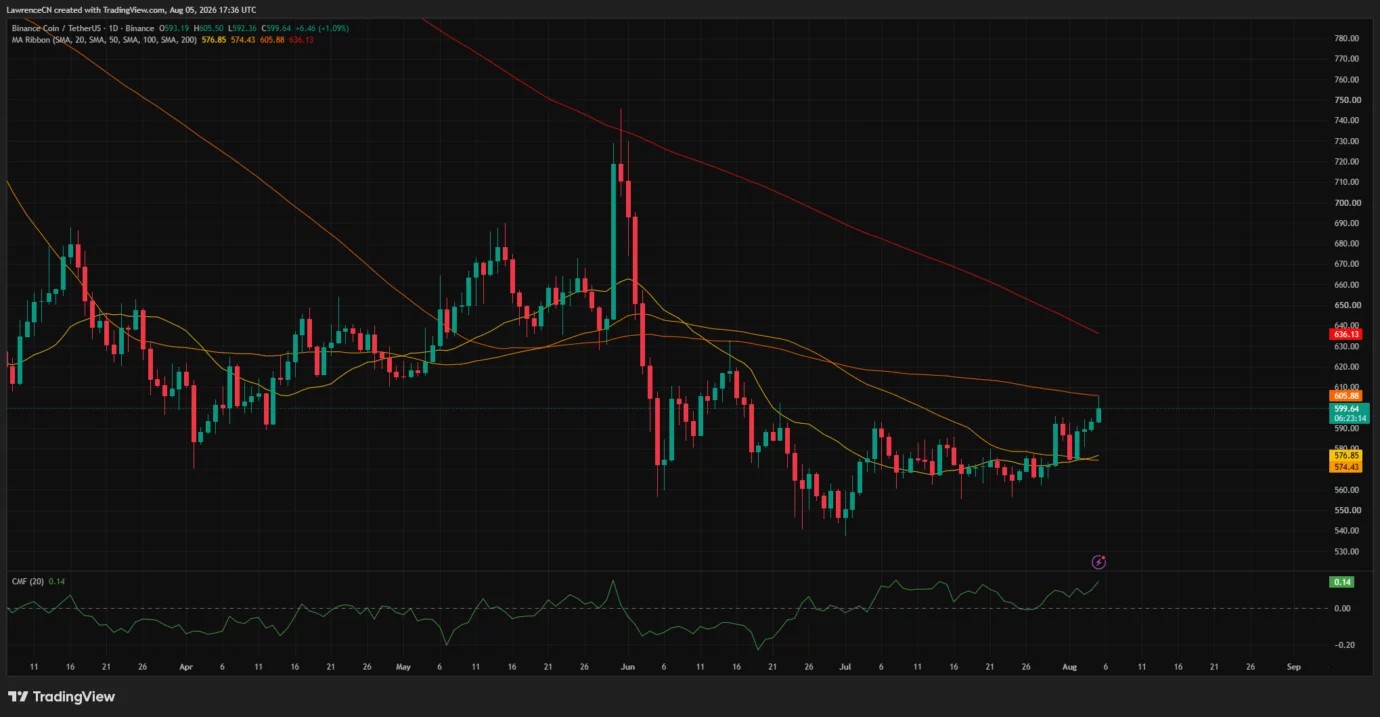
According to data from crypto.news, $BNB ($BNB) price rose to approximately $600 on Wednesday, extending its recovery from a late-July range around $560 to $575. The daily chart shows that the token closed near $599.64 after reaching an intraday high of $605.50.
$BNB price daily chart — Aug. 5 | Source: crypto.news
The move carried $BNB above its 20-day and 50-day simple moving averages at $574.43 and $576.85, respectively. Reclaiming both averages supports the short-term bullish structure, although the asset has not yet reversed its wider downtrend.
The 100-day SMA at $605.88 now represents the first major test. This level sits close to Wednesday’s intraday high and could determine whether $BNB extends its rally toward $610 or enters another period of consolidation.
Longer-term resistance remains at the 200-day SMA near $636.13. $BNB would need to reclaim that level before the daily chart confirms a broader bullish trend reversal.
Chaikin Money Flow rose to 0.14 on the daily chart. A reading above zero indicates that buying pressure has exceeded selling pressure during the measured period, adding support to the latest recovery.
Derivatives traders add exposure as volume jumps
$BNB derivatives activity strengthened alongside the spot-price increase. CoinGlass data provided for the analysis showed that trading volume climbed 56.1% to $719.9 million, while open interest increased 4.05% to $985.79 million.
Rising price and open interest can indicate that traders are opening new positions rather than closing existing contracts. However, the data alone does not establish whether the new exposure is primarily long or short.
The increase also raises the possibility of stronger volatility around the $600 barrier. Leveraged positions may face forced closures if $BNB moves sharply through nearby liquidation zones.
Broader crypto-market conditions offered additional support. Bitcoin approached $64,000, while the total digital asset market capitalization reportedly rose 0.72% to $2.19 trillion.
European regulatory developments also improved the wider institutional backdrop. The latest MiCA register update added more authorized crypto-asset service providers, although the development does not provide a direct fundamental catalyst for $BNB or Binance.
$BNB price faces resistance between $602 and $606
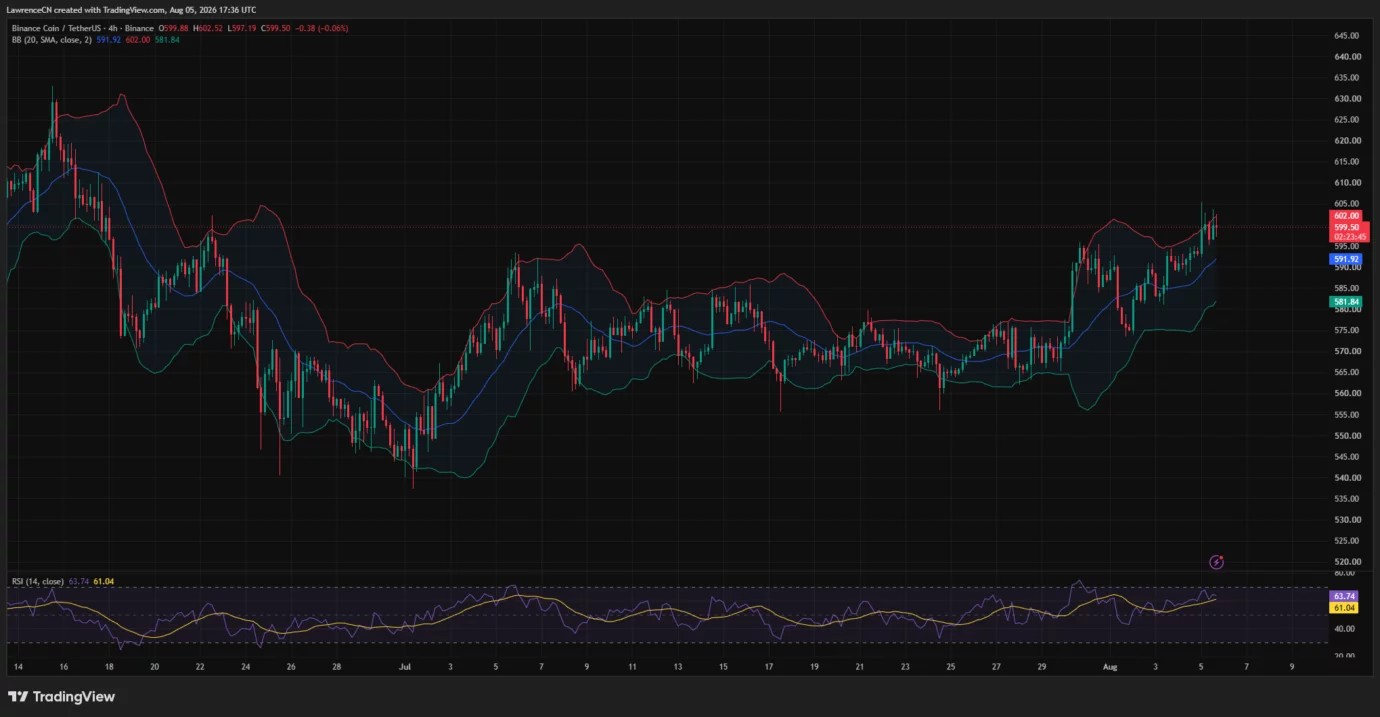
The 4-hour chart places $BNB near the upper Bollinger Band after its latest advance. The upper band stands at $602, while the middle band has risen to $591.92.
$BNB price 4-hour chart — Aug. 5 | Source: crypto.news
Price briefly moved above the upper band before slipping back toward $599.50. That rejection shows that sellers remain active around $602 to $605.88, where the 4-hour Bollinger Band and daily 100-day SMA converge.
The 4-hour Relative Strength Index stood at 63.74, above its signal average at 61.04. Momentum remains bullish, but the reading is approaching the 70 threshold commonly associated with overbought conditions.
A 4-hour close above $605.88 could open the way toward $610. The next upside area sits between $612 and $616, where the three-day liquidation heatmap shows two of the strongest overhead liquidity concentrations.
Failure to break the resistance zone would place initial support at $592, followed by the 4-hour middle Bollinger Band near $591.92. A deeper retracement could target the lower band at $581.84.
Liquidation heatmap puts $612 and $592 in focus
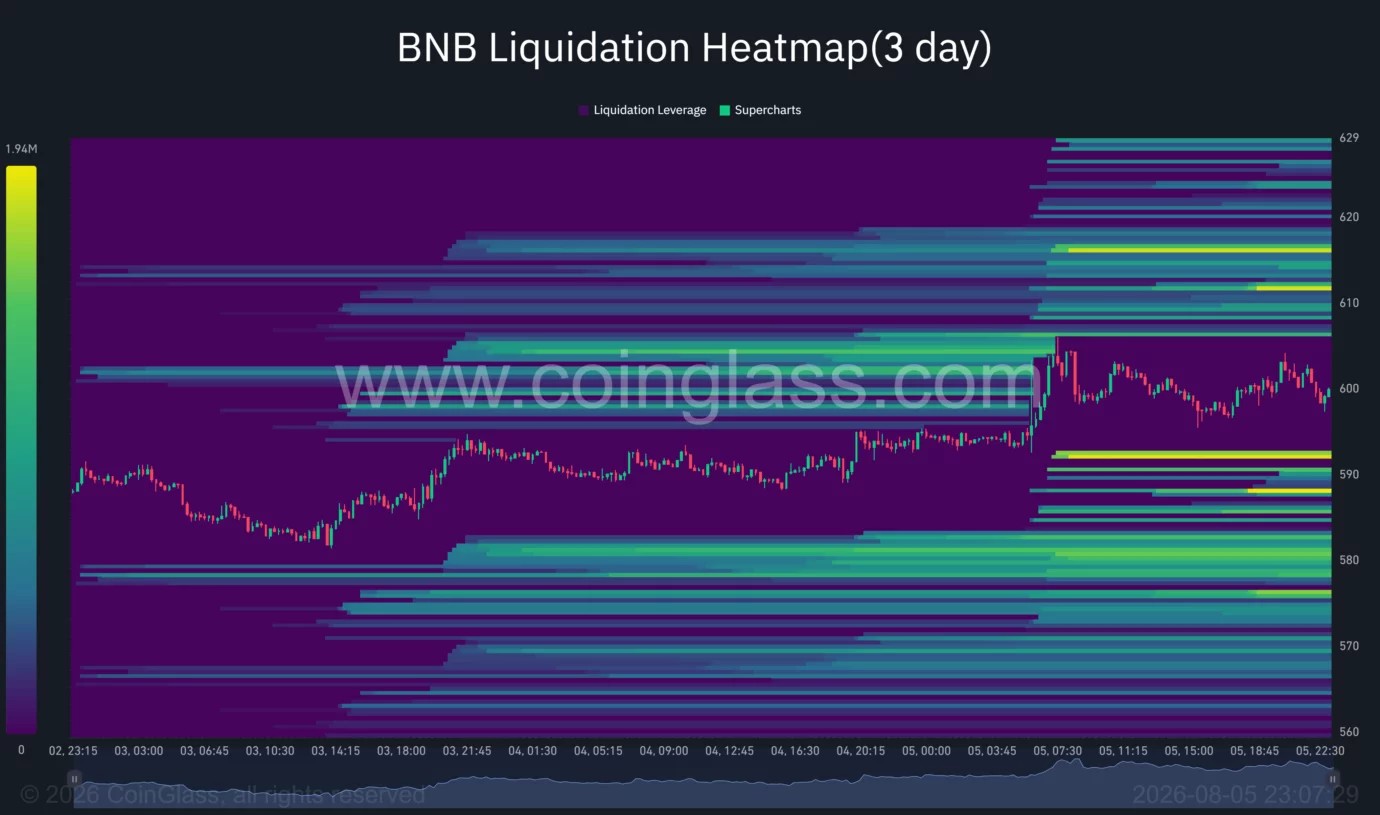
The three-day CoinGlass liquidation heatmap shows liquidity concentrated on both sides of the current price. Above $BNB, prominent bands appear around $612 and $616, with additional leveraged positions extending toward $620.
$BNB liquidation heatmap | Source: CoinGlass
These clusters can act as price magnets because a move into them may force short sellers to close positions. A break above $606 could therefore accelerate toward $612 as short liquidations add market buying.
The closest major downside cluster sits near $592. Another band appears around $587, followed by larger concentrations near $581 and $576.
Losing $592 would weaken the recent breakout and raise the probability of a move toward $582. That area also aligns with the lower 4-hour Bollinger Band and the base of the latest advance.
The heatmap does not predict which liquidity zone $BNB will reach first. It instead shows where leveraged positions may become vulnerable if price moves through those levels.
Analysts see $592 as the key trend level
Crypto commentator Satoshi Stacker described $BNB’s retest of its former diagonal resistance as successful. He identified $592 as one of the asset’s most important levels of 2026 and said holding above it would support the view that $BNB is entering an uptrend rather than posting a temporary recovery.
$BNB saw a clean retest of the diagonal level and confirmed it as support after the recent breakout.
Now, it is attempting to break above what has been one of the most important levels of 2026 at ~$592. Flipping this level would be a great sign that this is an uptrend and not… pic.twitter.com/cnkLzmi06G
— Satoshi Stacker (@StackerSatoshi) August 3, 2026
Another trader, Batman, pointed to $BNB’s breakout from consolidation and its recovery above the 50-day moving average. The analyst said the subsequent retest preserved the bullish setup.
The charts support a constructive short-term outlook while $BNB remains above $592. A confirmed break above $606 would bring $610, $612 and $616 into focus.
The bullish setup would weaken if $BNB closes back below $592. In that case, $582 becomes the main downside level, with $576 providing the next support if selling pressure increases.
For US traders, MiCA developments mainly offer a comparison with Europe’s unified licensing framework. $BNB’s short-term direction remains more closely tied to overall crypto liquidity, Binance-related developments and technical positioning than to European licensing updates.
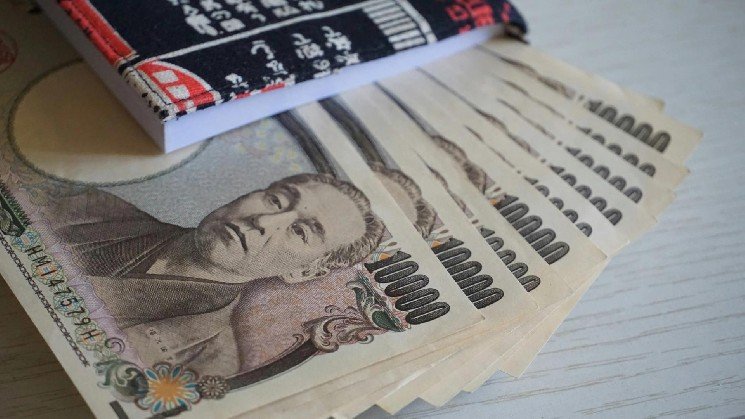
JPYC Inc. raised 6 billion yen ($38 million) in an extension of its Series B funding round to accelerate the expansion of its yen-pegged stablecoin.
The investment brings the company’s total raised to $106 million across seven funding rounds since November 2021, according to venture capital data site Tracxn.
New investors in the latest round include AZ-COM Maruwa Holdings (9090), a major Japanese logistics company.
AZ-COM plans to settle payments in JPYC with its clients, including Amazon Japan. Its network of around 2,300 partners is made up of subcontractors, drivers and so on. The move marked the first large-scale corporate use of a stablecoin for daily business operations in Japan.
JPYC is one of the most prominent stablecoins pegged to the Japanese yen with a market cap of $55.5 million, according to data tracked by CoinGecko.
Stablecoins are digital tokens pegged to the value of a traditional financial asset, usually a fiat currency. The market is overwhelmingly dominated by tokens pegged to the U.S. dollar. The yen stablecoin sector is growing, helped by adoption among some of Japan’s largest financial institutions, but remains negligible in the context of the USD-dominated market.
U.S. stocks are having their moment again, and bitcoin, as it has all year, is sitting this one out. The reasons why go beyond the obvious.
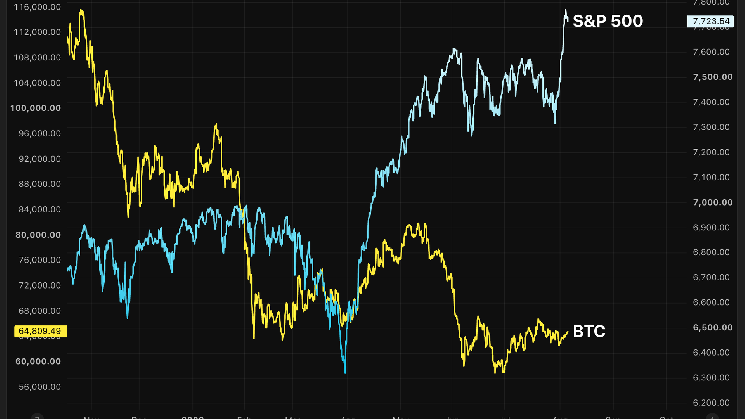
The S&P 500 has gained 3.12% this month, adding roughly $2.1 trillion in market cap and pushing its total value to a record $70.5 trillion, with its price at 7,723 points. The Nasdaq and Dow are buoyant too. Wall Street, by every measure, is in full risk-on mode.
Bitcoin isn’t following suit, even though, since the COVID crash of early 2020, it has tended to track stocks more often than not. The token is up just 2% this month, trading around $64,600, sitting exactly where it’s been gyrating for weeks.
Part of bitcoin’s underperformance stems from the fact that the equity rally is driven primarily by stock-specific narrative, particularly tied to AI, rather than by a broad macro risk-on impulse that would lift beta assets like $BTC in tandem.
“Partly because the equity rally is being driven by areas to which bitcoin has little direct exposure, particularly AI and semiconductor stocks,” said Adam Haeems, head of asset management at Tesseract Group, which manages more than $500 million in client assets.
Cryptocurrency asset management company Hashdex announced its decision to close and liquidate the Hashdex Bitcoin ETF (NYSE Arca: DEFI), which was traded in the US. With the completion of this decision, DEFI will be the first spot Bitcoin ETF to be shut down in the US.
According to documents the company filed with the U.S. Securities and Exchange Commission (SEC), the value of assets under management by the fund was approximately $14.7 million as of July 30, 2026. Hashdex’s total assets managed in other products offered to U.S. investors exceed $200 million.
Hashdex announced that the decision to liquidate was made after evaluating factors such as the fund’s size, transaction liquidity, operating expenses, investor demand, and the company’s broader product strategy. The liquidation plan stated that the fund’s net assets remaining low compared to operating expenses made it economically unfeasible for DEFI to continue operating in the long term.
Related NewsA Signal Seen Once a Year in Bitcoin: “The Calm Before the Storm…”
What Was the Content of the Hashdex Bitcoin ETF?
DEFI was a spot Bitcoin ETF designed to offer investors direct exposure to daily fluctuations in the Bitcoin price. The fund’s portfolio consisted solely of physically held Bitcoin and cash held for operational needs, share creation and repurchase transactions, fees, and other liabilities.
The fund did not hold any cryptocurrencies, stocks, or financial assets other than Bitcoin. DEFI’s primary goal was for the change in the net asset value of its shares, after deducting expenses, to reflect the daily price movements in the Nasdaq Bitcoin Reference Price–Settlement indicator.
Investors can sell their DEFI shares on the NYSE Arca until the close of trading on August 17, 2026. After that date, the fund will no longer accept new share creation orders from authorized participants. DEFI shares will be delisted from the exchange following the final trading day.
Hashdex will liquidate its portfolio by selling the Bitcoins remaining in the fund after August 17. Investors who did not sell their shares by the last trading day will receive a cash payment equivalent to the net asset value of their shares on the liquidation date. According to the company’s statement, payments are expected to be made around August 28, 2026.
The amount to be distributed to investors will be affected by the cost of selling the Bitcoins, transaction fees associated with closing the fund, and potential price fluctuations in Bitcoin during the liquidation process. Hashdex warned investors that price movements during this period could be significant.
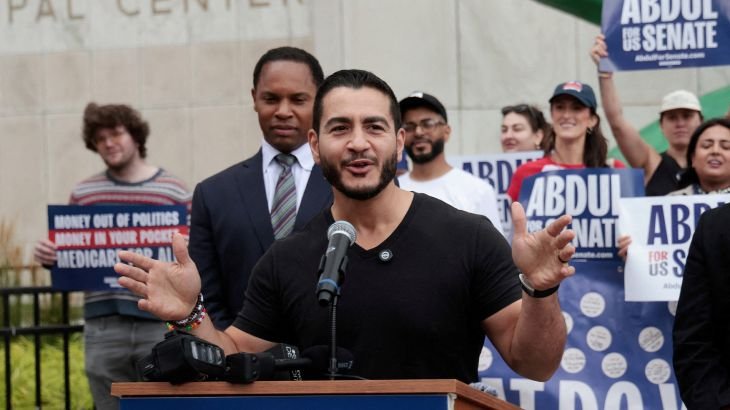
US President Donald Trump attacked Michigan’s Democratic Senate candidate Abdul El-Sayed, repeatedly calling him a ‘hater of Jews’ and ‘a hater of Israel.’ El-Sayed won the Democratic nomination on Tuesday, overcoming millions in campaign spending from pro-Israel lobbying groups.
On-chain data analysis platform CryptoQuant has reported that investors known as “whales,” who hold large amounts of assets in Bitcoin (BTC), Ethereum (ETH), and $XRP, have recently increased their holdings. According to the company, this trend indicates that the cryptocurrency market may be approaching the final stage of its long-running bear cycle.
According to an analysis shared by CryptoQuant, it has been noted that historically, a significant indicator is when large investors buy rather than sell during periods of continued price decline. Similar movements have been observed in past market cycles when long-term investors believed prices had reached attractive levels.
However, the analytics firm emphasized that the current data alone is not sufficient to confirm the market bottom. According to CryptoQuant, while whales buying is considered a positive signal, Bitcoin, Ethereum, and $XRP prices may fall further before a bottom formation is finalized. Therefore, investors should be cautious about short-term fluctuations.
Experts note that the accumulation process of whales is often part of a long-term investment strategy. Large investors prefer to buy at low prices during periods when fear dominates the markets, while individual investors often act more cautiously due to uncertainty. This is a common characteristic observed many times in the final stages of market cycles in the past.
CryptoQuant noted that while there are signs that the bear market may be approaching its final phase, macroeconomic developments and global liquidity conditions will continue to be decisive factors in price movements. In particular, central bank monetary policies, regulatory developments, and the attitude of institutional investors towards the market are among the main factors influencing the direction of crypto assets.
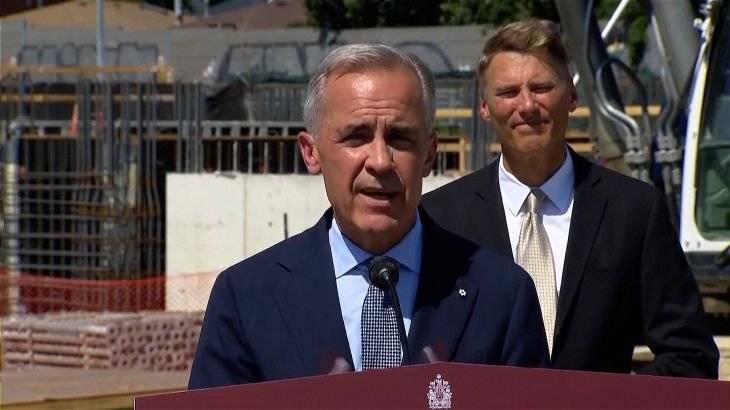
FIFA’s President Gianni Infantino gets the support of executive members at an emergency meeting in Morocco after his failed plan to sell a stake in the World Cup. But, Canada’s Prime Minister Mark Carney, whose country co-hosted this year’s event, says he’s lost faith in Infantino.
The spouses and parents of US service members have been reportedly detained or deported after the Trump administration ended protections for military families. The Associated Press believes the dozens of cases its investigation found are just the beginning.
It seems Rihanna is at “work, work, work, work, work, work” on her next album.
With fans incredibly hungry for another album from the Grammy winner, especially since it’s been a decade since she released her last studio project, 2016’s Anti, her longtime partner, A$AP Rocky, is offering a little status update.
During a recent interview on The Jason Lee Show, the rapper was asked by host Jason Lee, “Are you the reason why we don’t have an album?” He was referencing the long-running joke among fans that the delay in new music was due to her relationship with Rocky, their growing family (they share three children) and Rihanna’s many business ventures.
However, Rocky shut down those claims. “Nah,” he replied. “She in the studio right now. Yeah, I said it. Sorry, babe.”
He added, “Bro, she working. She cooking, no funny shit. Damn, I’mma get in trouble for this. Her fans are going to kill me.”
When Rihanna’s Anti dropped in 2016, it became a hit, spending two weeks atop the Billboard 200 chart. It also included her fan-favorite songs “Work,” “Needed Me,” “Love on the Brain” and “Desperado.”
Though she hasn’t released an official album since then, she has put out a few standalone singles tied to film soundtracks, including “Lift Me Up” and “Born Again” for Black Panther: Wakanda Foreverand “Friend of Mine” for Smurfs.
When Rihanna was previously asked for an update on her next album, dubbed R9, she told Entertainment Tonight in 2024 that while she’s “starting over,” she also doesn’t “want to neglect the songs that I have, so I actually want to go back and listen to stuff with new ears, with my new perspective and then see what applies and what I’m still in love with.”
That same year, she also told Interview magazine that her “brain is working backward right now” regarding her next musical endeavor. “I usually have the music first, and the music leads me into all of these visual opportunities, and now I’m having all of these visuals,” she added.
Elsewhere on The Jason Lee Show, Rocky was also asked if fans could expect a “double album of y’all both together on every song” in the future.
“Nope,” the rapper quickly replied. “I would hate Rocky and Rihanna if they both did that. That’s trash. Nobody wants to hear us together, bro.”
Rocky explained that he believes their separate sounds wouldn’t make sense together because “I make subversive weird ass indie rap,” adding that “the music that I make is for a niche demographic of people who actually get this shit.”