Author: rb809rb

  • As Live Shopping Blows Up, It’s a Bidding War for Auction-Fluencers

    As Live Shopping Blows Up, It’s a Bidding War for Auction-Fluencers

    Taylor Lally is a blue-eyed, burly, bespectacled man, with a beard about halfway to the the full Duck Dynasty look. And just past midnight on a Monday evening this summer, he’s hawking candy bars inside a purple-painted room no bigger than 300 square feet, with a disco ball hanging from the ceiling.

    It’s not exactly Willy Wonka and the Chocolate Factory. The thirty-something is an online auction maestro, broadcasting to a few dozen people competing to buy confections with the swipe of a finger. Mini auctions like this one on WhatNot, the liveshopping app, will help Lally cross one million dollars in sales this year, he said.  

    “We’re live for about four hours, but we’re here prepping for maybe four hours before and maybe two to four hours after,” he tells THR. “So we’re putting in like 12- to 16-hour days.”

    Lally began selling sweets on WhatNot last year, offering customers $20 boxes where they could pick individual candy items to buy. He nearly shut down the account because it didn’t yield enough money to justify the time he spent on the platform. But around six months ago, another WhatNot seller reached out with advice: try ultra-fast, single-item auctions. “This kind of totally changed how we do business,” he says. 

    WhatNot and other live shopping retailers are shedding their reputations as purveyors of baseball cards by expanding their digital aisles, benefitting niche auction-fluencers like Lally. In July, WhatNot — which continues to add new verticals like food and golf — raised hundreds of millions of dollars at a $20 billion valuation. Despite WhatNot’s first-mover advantage, a formidable rival has emerged in TikTok Shop, which allows sellers to go live and reach the app’s 100 million-plus user base. 

    Ashley Christenson, a livestreaming consultant, says Gen Zers are increasingly using TikTok to search for products, making it an attractive selling channel for retailers and a lucrative business for the social media giant. “The fact that now they can do that as a live experience is a natural evolution that makes a ton of sense for TikTok,” she says. 

    The evolution of live shopping from infomercial-like marathons to fast-paced micro sales has sparked bidding wars, so to speak, over popular auction-fluencers. TikTok representatives reached out to Lally and met with the creator multiple times, hoping to woo him to their WhatNot competitor. Joining another platform is something Lally will entertain because of WhatNot’s fee structure. “A big deal about WhatNot, which we can’t really get around, is a thirty-cent transaction fee, regardless of what we sell,” Lally says. “So it’s just negotiating those terms with TikTok.” 

    WhatNot’s bidding process — seconds-long auctions with more time added if customers bid — is now standard across other platforms like TikTok Shop. Many sellers start their auctions at $1 as a way to hook prospective bidders. “If you start something that’s $1 but it’s actually worth $50, people aren’t asking themselves, ‘Should I buy it?’ They’re asking themselves, ‘What am I willing to spend on it?’” said Kip Roland, a liveshopping seller and advisor.  

    Josh Luber, a co-founder of the online sneaker seller StockX, believes more retailers are poised to spin up live commerce platforms. But one company, he said, has a massive edge. “Ultimately, all marketplaces live and die on liquidity, and TikTok is going to have the most liquidity from day one,” he said. “It’s a question of can they convert them over to be consumers.”

    TikTok’s massive audience helped Roland reach 40,000 viewers when he decided to sell World Cup jerseys in June. Even though his account has only a smidge more than 13,000 followers, the social media behemoth boosted the auction to other TikTokers. “The algorithm recognized that people were staying for a long time, they were converting to buyers, they were engaging, and so it just pushed it to more and more and more people,” he says.

    For buyers, live shopping is more conducive to impulse buys — a Blu-Ray DVD or Pokémon trading card — than with more thoughtful purchases. But that doesn’t mean every livestream involves low-ticket items. On Super Bowl Sunday, Jimmy Donaldson, a.k.a. Mr. Beast, went live on WhatNot as part of a partnership with the company and gave away items like a Birkin bag and a Lamborghini. “Anytime Jimmy’s paying attention and testing something, it’s worth looking at,” says Christenson.

    Many live shopping creators prefer to narrate auctions behind the camera as opposed to becoming on-air hosts like Mr. Beast. But in a recent survey commissioned by Adobe, 30 percent of live shoppers said their purchasing decisions were driven in part by the identity of the host. Lally is doubling down on adding human faces to the mix by hiring another host for his account to fill more hours of the day. And earlier this year, eBay built a service for camera-shy sellers to hire livestream hosts.

    Despite big growth, it’s still early days for live shopping in the United States. WhatNot says it sold $8 billion worth of goods in 2025, but total e-commerce sales in America topped $1.3 trillion, according to data from the U.S. Census Bureau. Meanwhile, Chinese buyers spend hundreds of billions of dollars annually on live shopping. 

    As more buyers embrace live shopping, Christenson expects more creators to market goods as a way to make additional income. Their social media skills often make them natural salespeople. “They can talk to a chat, and entertain, and make people feel something,” she says. “Whether they’ve got five viewers or 500, they have the potential to sell something while live.”

  • Minnesota Says xAI’s Grok Created ‘Marketplace for Digital Sexual Violence’

    Minnesota Says xAI’s Grok Created ‘Marketplace for Digital Sexual Violence’

    In brief

    • Minnesota is fighting xAI’s attempt to block the state’s first-of-its-kind law targeting AI-generated sexual images.
    • xAI says the law violates the First Amendment, while Minnesota argues Grok Imagine is a technological tool, not protected speech.
    • The state accused xAI of creating an “unparalleled marketplace for digital sexual violence” as a federal judge prepares to hear the case Wednesday.

    Minnesota is fighting Elon Musk’s xAI over the company’s attempt to block HF-1606, a first-of-its-kind state law targeting AI tools that generate realistic sexual images of identifiable people.

    In a Friday court filing, Minnesota Attorney General Keith Ellison argued that xAI is unlikely to succeed in its constitutional challenge and has failed to show that enforcing the law would cause irreparable harm.

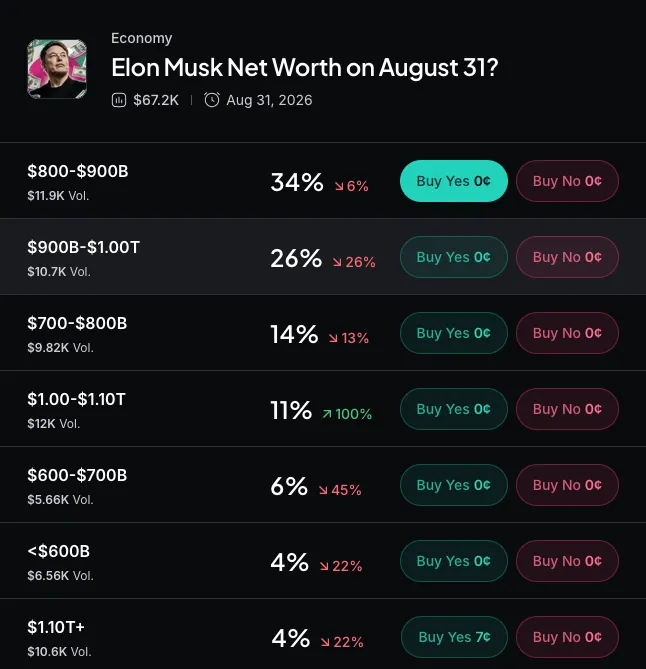
    Myriad: What will Elon Musk's net worth be by August 31? Click to make your prediction.
    Myriad: What will Elon Musk’s net worth be by August 31? Click to make your prediction.

    “With Grok Imagine, X.AI has created an unparalleled marketplace for digital sexual violence that poses virtually no barrier to entry,” Ellison wrote. “That marketplace, coupled with the functional capabilities of Grok Imagine, would doom Minnesota from the start if it could not direct its laws to the technology that makes digital sexual victimization possible in the first place.”

    The law, enacted in April and which took effect August 1, prohibits platforms and software developers from allowing users to create realistic images showing intimate body parts that did not appear in the original image of an identifiable person.

    Ahead of the implementation of the law, in July, xAI sued Ellison to block the law, arguing it violates the First Amendment and could apply to protected images, including shirtless men, swimmers, and political satire. Violations carry penalties of up to $500,000 per image.

    “There is no safe harbor for good-faith efforts of the provider of general-purpose AI creative tools to avoid harms,” xAI wrote in its complaint. “Liability attaches even if the depicted persons consented—or created the image themselves—and even if the image is never shared.”

    Minnesota passed the measure 132-1 in the House and 65-0 in the Senate after lawmakers heard reports of a man who used social media photos to create sexual images of more than 80 women he knew.

    “Today, we led the nation protecting women, children and everyone in public life from the harm caused by AI nudification technology,” Senator Maye Quade, who led the push, said in a statement at the time. “Companies that make this technology available for free online and in app stores will no longer be allowed to enable predators who abuse and victimize adults and children with the click of a button.

    The case now centers on whether the law regulates speech or technology.

    Grok has also faced scrutiny over sexually explicit deepfakes.

    In January, a watchdog estimated Grok generated more than 23,000 sexualized images of children over 11 days, prompting investigations in several countries.

    In March, three minors in California joined others in suing xAI, alleging Grok was used to turn their photos into AI-generated child sexual abuse material. xAI has said it suspended more than 50,000 accounts and filed more than 70,000 reports with the National Center for Missing and Exploited Children in 2026.

    Daily Debrief Newsletter

    Start every day with the top news stories right now, plus original features, a podcast, videos and more.

  • California A.G. Rejects $1.88 Billion Paramount Bond, Says Company Wants a ‘Do-Over’ on Merger Delay

    California A.G. Rejects $1.88 Billion Paramount Bond, Says Company Wants a ‘Do-Over’ on Merger Delay

    The California attorney general’s office fired back against Paramount’s request for a $1.88 billion bond on Monday, saying the company is seeking a “do-over” on its agreement to delay the Warner Bros. merger until an antitrust trial next March.

    In a statement, the A.G.’s office argued that Paramount is a “sophisticated” company that knew it would face regulatory review when it agreed to pay Warner Bros. shareholders a $7 million-per-day ticking fee, and that California should not be made to bear the burden of that decision.

    “Bottom line: Paramount went into this process with eyes wide open,” the office said. “They are lying in a bed of their own making, and once again, trying to blackmail us to get us to back down.”

    California Attorney General Rob Bonta is leading a 12-state coalition to block the merger on the grounds that it will reduce competition in the theatrical and basic cable markets. Last month, Paramount agreed to hold off on closing the deal until after the case is resolved at trial, or until next June, whichever comes first.

    But Paramount was hoping for an earlier trial date — ideally in November. In a motion filed on Monday, the company argued that it will be forced to pay $1.7 billion in ticking fees to Warner Bros. shareholders if the case drags out until June 1, plus another $190 million in financing costs.

    Paramount argues that the states and the Writers Guild of America — which has filed its own antitrust suit — should be required to post a bond to cover its losses arising from the delay in the event that the deal is ultimately approved.

    Judge Araceli Martinez-Olguin initially granted a 14-day restraining order to block the merger in July. In that order, she waived the requirement to post a bond, saying the states had shown they were acting in pursuit of “important public interests.”

    The states, the WGA and Paramount later entered a stipulation to delay the merger — the functional equivalent of a preliminary injunction — which did not include any bond requirement. Now that Martinez-Olguin has set the trial for March 2, Paramount is seeking to amend the agreement to include the $1.88 billion bond. Failing that, Paramount wants to dissolve the deal and allow the merger to close.

    “Paramount and Warner Bros. are two sophisticated companies who willfully decided to include a costly ticking fee as a provision in their merger contract. They knew this merger would undergo regulatory review; they knew it was not a done deal; and they chose to include it anyway,” the A.G.’s office said Monday. “What’s more, Paramount itself stipulated to the timing it is now protesting — they agreed to the dates and did not request a bond as a condition of agreeing not to close until after the trial, and potentially as late as June 2027.  Now, they’re trying to get a do-over.”

    In a statement on Monday, Paramount argued that the 12 states are defying a global consensus that the deal presents no issues of competitive harm and should be approved.

    “We remain confident that plaintiffs’ case is without merit and will defend our pro-competitive transaction in court,” the company said.

  • Donald Trump Attacks CNN’s Kristen Holmes for Asking if He Spoke to North Korean Dictator: ‘You’re a Loud, Boisterous Person. Be Quiet!’

    Donald Trump Attacks CNN’s Kristen Holmes for Asking if He Spoke to North Korean Dictator: ‘You’re a Loud, Boisterous Person. Be Quiet!’

    President Donald Trump grew angry at CNN‘s Kristen Holmes during a press briefing at the White House Monday, after she asked whether he had spoken with North Korean dictator Kim Jong-un.

    “Quiet,” Trump told Holmes, CNN’s senior White House correspondent, after she queried the president about if Jong-un had asked Trump to curtail U.S. military exercises with South Korea. “You’re a loud, boisterous person. You’re faking news!”

    In a social media post Sunday, Trump had said that “Based on my very good relationship with Kim Jong Un, of North Korea, I am not happy with the fact that the United States has, long ago, agreed to participate in Joint Military Exercises with South Korea” and that he would instruct Defense Secretary Pete Hegseth to “substantially reduce the Joint Military Exercises!”

    Holmes tried to follow up on her question to the president, saying, “I was trying to find out if you had been talking to Kim Jong-un, if he had asked you to scale back on those military exercises.” Trump, talking over her, said: “Be quiet! Be quiet! Be quiet! You’re a fake reporter and you report fake news.”

    Meanwhile, the White House lashed out at Holmes because during the same event, she asked Trump for his response to a remark by Georgia Sen. Jon Ossoff about one of Trump’s aides. Earlier in the day at a campaign rally, Ossoff said that Trump “doesn’t want to do the job. He wants to build his ballroom and travel with Natalie on their apparently defenseless flying palace gifted by the Emir of Qatar,” referring to Natalie Harp, the president’s executive assistant. Harp was among the small group of Trump officials who (along with the president) were secretly escorted off the Qatar-donated Air Force One to a smaller military aircraft in Turkey because of a threat from Iran.

    Following the exchange in the Oval Office, the White House’s Rapid Response 47 account on X wrote, “.@KristenhCNN is a disgraceful, humiliating embarrassment to her alleged profession. @POTUS hosts a hero lifeguard in the Oval Office and she uses it as an opportunity to take a cheap shot about one of President Trump’s staffers. These scumbags are the lowest of the low.” The press event Monday at the White House was meant to honor teenage lifeguard Ryder Williams, who rescued a 10-year-old boy at a beach in Santa Cruz, California, last month.

    The White House comms team followed that up with this comment: “.@KristenhCNN: Someday, your children will come across your disgusting and inhumane question. They will be sickened and embarrassed to have a parent be so callous and vindictive. It’s quite troubling.”

    In a statement responding to the White House attacks, CNN said, “Kristen Holmes is one of the most respected and accomplished journalists covering the White House. This afternoon, she did her job and asked the President of the United States a tough, relevant, and newsworthy question on behalf of the American people. Public officials are free to challenge reporting they disagree with, but personal attacks on journalists for asking questions are beneath the office and inconsistent with the principles of a free press. We stand firmly behind Kristen and reject these attacks in the strongest possible terms.”

  • ‘Spy Kids’ Actor Alexa PenaVega Shares Heartbreak After Deaths of Fellow Child Stars Hayden Panettiere, Michelle Trachtenberg and Daveigh Chase: ‘Hug Your People Close Today’

    ‘Spy Kids’ Actor Alexa PenaVega Shares Heartbreak After Deaths of Fellow Child Stars Hayden Panettiere, Michelle Trachtenberg and Daveigh Chase: ‘Hug Your People Close Today’

    Alexa PenaVega’s “heart is heavy” after the death of Hayden Panettiere, most notably because it marks the third passing of a fellow child star in 2026. The “Spy Kids” actor noted in a statement on social media that she rose to fame with and grew up alongside the likes of Panettiere, Michelle Trachtenberg and Daveigh Chase. All three actors died in their 30s between February and August.

    “Hayden, Michelle, Daveigh… my heart is heavy today,” PenaVega wrote. “These aren’t just names from my childhood. They’re girls I grew up alongside, sharing a world that was exciting and also incredibly hard. We were kids navigating something so big, and not everyone had the foundation or support they deserved.”

    “Today, I’m grieving and holding their families close in my prayers and thinking of everyone still fighting battles we can’t see,” she added. “Hug your people close today.”

    PenaVega, Panettiere, Trachtenberg and Chase all came of age together in Hollywood in the 2000s. PenaVega’s breakout turn in 2001’s “Spy Kids” made her a regular at Hollywood premieres, where she was often photographed with her fellow child-turned-teen stars. Chase and PenaVega walked part of Disney’s “Freaky Friday” red carpet together in 2003 (one year after Chase voiced Lilo in the studio’s animated movie “Lilo & Stitch”), while PenaVega attended the premiere of Panettiere’s “Raising Helen” in 2004, among several other Hollywood encounters.

    Panettiere died on Sunday in Greenville, South Carolina, at the age of 36. Her death is currently under investigation, but there were “not any signs of foul play or suspicious circumstances,” according to police. She was beloved for the television series “Heroes” and “Nasvhille,” but she broke out as a Disney child star in “A Bug’s Life” and “Remember the Titans,” among other hit roles.

    Also beginning work as a child actor, Trachtenberg appeared in the ’90s Nickelodeon series “The Adventures of Pete & Pete” before starring in the family film “Harriet the Spy” in 1996 at the age of 10. As a teenager, she featured as Dawn Summers in “Buffy the Vampire Slayer” and later played Georgina Sparks on the teen drama “Gossip Girl.” Trachtenberg died in February at 39 years old due to natural causes, as a result of complications from diabetes mellitus.

    Chase, who voiced Lilo in “Lilo & Stitch” and starred in “The Ring,” died June 16 in Los Angeles at 35. The actor’s cause of death was AIDS, according to the coroner’s office. A secondary cause was listed as “chronic polysubstance use.” Chase’s father, John David Schwallier, told the New York Times that she had been homeless and had struggled with drugs since the age of 13.

  • Expert Analyst Claims One Scenario is Strengthening in Ethereum Price: “Watch Out for This Level!”

    Expert Analyst Claims One Scenario is Strengthening in Ethereum Price: “Watch Out for This Level!”

    Crypto analyst Michaël van de Poppe, evaluating the recent technical outlook for Ethereum ($ETH), stated that the bullish scenario is becoming increasingly stronger. According to the analyst, the high lows and high highs formed on $ETH’s daily chart highlight the possibility of an upward breakout.

    Van de Poppe noted that Ethereum’s daily chart “is starting to look better day by day,” and highlighted the $1,870 and $2,000 levels in the current market structure.

    According to the analyst, if $ETH loses the $1,870 level, the decline could be quite rapid due to the high liquidity zones below the price. In such a scenario, it is possible for $ETH to fall below $1,700 and then recover.

    However, Van de Poppe believes that the current technical structure supports an upward movement rather than a downward one. Noting the continued formation of higher lows and higher highs in the Ethereum price, the analyst therefore sees a higher probability of an upward breakout.

    $2,000 is a Critical Threshold for Ethereum

    According to Van de Poppe, if Ethereum clearly surpasses the $2,000 level, the upward movement could become quite sharp. The analyst stated that after such a breakout, he doesn’t expect $ETH to linger at significant resistance levels for long, and a surge similar to some of the rapid price movements seen in 2025 could occur.

    Van de Poppe noted that $ETH might encounter short-term resistance around $2,200 during its rise, adding that this could be an intermediate level within a larger move.

    The analyst’s main upside target is the $2,800 level. Accordingly, a strong break above $2,000 could bring Ethereum’s price first to the $2,200 level and then to the $2,800 region.

    On the other hand, the $1,870 level stands out as a critical support in a downward scenario. Van de Poppe warns investors that if this level is lost, a rapid liquidity movement towards below $1,700 could occur.

    *This is not investment advice.

  • Prediction Markets Give the Fed 74% Odds of Standing Pat in September

    Prediction Markets Give the Fed 74% Odds of Standing Pat in September

    In brief

    • Polymarket is pricing in a 74% chance of no change at the next Fed meeting, and just 25% on a quarter-point hike.
    • Kalshi’s September Fed-decision contract prices a 73.5% hold, with roughly $10 million wagered on the outcome.
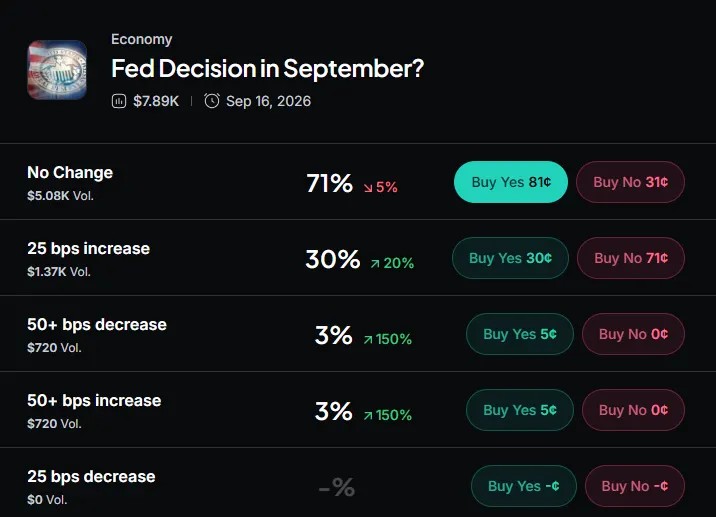
    • Myriad’s “Fed Decision in September?” market lists “No Change” at about 75% odds, and resolves after the September 15–16 FOMC meeting.

    Prediction markets are converging on the same forecast for the Federal Reserve’s September meeting: don’t expect anything to change.

    Polymarket’s “Fed Decision in September?” market puts the odds of no change at 74%, with a quarter-point hike at 25% and a cut near 1%, on $33.9 million in volume. CFTC-regulated exchange Kalshi lands almost identically at 73.5%, backed by close to $10 million wagered, while Myriad, the prediction platform run by Decrypt’s parent company Dastan, has “No Change” trading around 71%.

    The spread across all three is tight enough to read as consensus.

    Myriad: What will the Fed do in September? Click to make your prediction.

    Traders and investors track Fed decisions so closely because the federal funds rate ripples through nearly every corner of financial markets. The rate sets the baseline cost of borrowing money, which in turn shapes how much investors are willing to pay for riskier bets.

    When the Fed hikes, borrowing gets pricier and safe assets like Treasuries offer better returns, pulling money away from speculative corners of the market. When it cuts, cheap money tends to flow back into risk assets such as tech stocks and crypto.

    That dynamic has played out repeatedly this year. Bitcoin and Ethereum have wavered around recent Fed holds, and prices slid earlier in the year as a strong jobs report cast doubt on rate cuts. Traders have also been bracing for a surprise hike even with a hold as the base case.

    The calm reflects the backdrop. At its July meeting, the FOMC held the rate at 3.50%–3.75% in a divided 9–3 vote, with three members pushing for a hike. A Reuters poll found nearly 70% of economists expect no change through the rest of 2026.

    The FOMC meets September 15–16, with its statement due September 16.

  • World Liberty wins conditional approval for US trust bank

    World Liberty wins conditional approval for US trust bank

    World Liberty Financial has received preliminary OCC approval to establish a national trust bank that would issue $USD1, manage its reserves, and provide digital asset custody across the United States.

    World Liberty bank cannot open until conditions are met

    The Office of the Comptroller of the Currency said in its Aug. 14 decision that it had granted preliminary conditional approval for World Liberty Trust Company, National Association. The proposed bank would operate from Bay Harbor Islands, Florida, as a wholly owned subsidiary of Delaware-registered WLTC Holdings LLC.

    Preliminary approval permits the company to organize the bank but does not allow it to start operations. The OCC said World Liberty Trust must complete its preopening requirements and obtain final authorization under federal banking law before conducting business.

    Until final approval is issued, the regulator can modify, suspend, or withdraw its decision if new information raises concerns. World Liberty Trust must also apply for stock in a Federal Reserve Bank, maintain at least $20 million in eligible capital, and receive the OCC’s written confirmation that all opening conditions have been met.

    Under its proposed business plan, World Liberty Trust would issue and redeem the dollar-backed $USD1 stablecoin for institutional clients across the country. The bank would also maintain reserves, offer custody services, and let custody customers convert approved stablecoins into $USD1 using assets already held with the institution.

    World Liberty Trust would not operate as a standard commercial bank. Its proposed charter does not cover ordinary retail deposits or conventional lending, with the business instead limited to trust, custody, reserve, and related payment services.

    Citing the National Bank Act and the GENIUS Act, the OCC said national trust banks may provide digital asset custody and issue payment stablecoins. The agency also reported that uninsured national trust banks under its supervision held $7.2 trillion in assets under administration as of March 31, including $1.7 trillion in custody and safekeeping accounts.

    $USD1 operations would move from BitGo

    Once authorized to open, World Liberty Trust plans to replace BitGo Bank & Trust as the exclusive issuer and custodian of $USD1. The OCC said the proposed bank would acquire the token’s reserve assets and assume the liabilities tied to them.

    Federal rules governing transactions between banks and their affiliates could apply to the transfer. However, the agency approved an exemption from certain limits, collateral rules, and restrictions on low-quality assets under Regulation W as part of its review of the new institution.

    BitGo will remain responsible for $USD1 issuance and custody until the proposed bank completes the OCC’s conditions. World Liberty Trust would need additional regulatory clearance if the final structure of the reserve transfer triggers other federal bank merger requirements.

    For American institutions using $USD1, an operating national trust bank would place issuance, reserve management, and custody under direct OCC supervision. Federal status would also let the bank provide its approved services nationwide under one regulator instead of securing separate state permissions.

    World Liberty Chairman and President Zach Witkoff said the structure would put $USD1’s main functions under the same federal supervisor.

    “A national trust bank brings $USD1 issuance, custody, and reserve management together under OCC supervision, examined on the same standards that have governed banks for generations.”

    Witkoff also said the company welcomed “continuous scrutiny from federal regulators.”

    World Liberty has joined several crypto companies pursuing federal trust structures. The OCC conditionally approved applications involving Circle, Ripple, BitGo, Fidelity Digital Assets, and Paxos in December 2025, while Coinbase, Crypto.com, and Stripe-owned Bridge later received similar decisions.

    Circle completed its preopening requirements and obtained final authorization for its national trust bank in July. The process shows that conditional approval alone does not permit a proposed institution to begin banking operations.

    Trump family ties trigger a Senate bill

    Political scrutiny has followed the application because President Donald Trump and his three sons are affiliated with World Liberty. The company’s website has said that a Trump family-linked entity controls about 38% of its equity interests.

    Trump nominated Comptroller Jonathan Gould in 2025, leading several Democratic lawmakers to question whether the regulator could review the application independently. Before the decision, Senator Elizabeth Warren asked the OCC to delay its review until Trump gave up his financial interest in the company.

    As crypto.news reported in June, Warren challenged Gould during a Senate Banking Committee hearing and argued that the application presented conflict-of-interest and national security concerns. Gould said the agency would follow its legal duties and handle the review through a nonpartisan process.

    Addressing the issue in its approval, the OCC said, “the Comptroller and staff acted consistently with their statutory duties and ethical obligations with respect to the Application.” Career agency employees reviewed the filing, while nonpolitical examiners would supervise the bank, according to the decision.

    The OCC also disclosed that it received seven comments from four commenters. Two questioned whether the proposed activities fit the legal powers of a national trust bank, while three argued that the public lacked enough information or time to comment.

    Agency officials rejected both objections. The decision said World Liberty submitted the required public and confidential information on time, and the comment period complied with federal rules.

    After the approval, Warren and nine other senators introduced the Ending Presidential Corruption in Banking Act. The proposal would prevent a president, vice president, their spouses or their children from owning or controlling a bank.

    Senate Banking Committee Democrats said the measure would require federal agencies, within 60 days of enactment, to review banking applications approved after Jan. 20, 2025. Regulators would have to terminate an approval issued while a person covered by the bill owned or controlled the applicant.

    “This is the most brazen act of self-dealing our financial system has ever seen — and Congress cannot allow it to stand,” Warren said.

    The legislation is backed by Senators Chris Van Hollen, Angela Alsobrooks, Chris Murphy, Bernie Sanders, Richard Blumenthal, Jack Reed, Andy Kim, Tammy Duckworth, and Ruben Gallego.

    UAE investment remains under congressional review

    Congressional questions also cover World Liberty’s foreign investors and its transactions involving $USD1. An Abu Dhabi company backed by UAE National Security Adviser Sheikh Tahnoon bin Zayed Al Nahyan reportedly purchased a 49% interest in World Liberty for $500 million through an agreement signed in January 2025.

    In June, five Democratic senators requested congressional hearings into the transaction. Their letter asked whether the investment affected subsequent Trump administration decisions involving UAE arms sales and access to advanced artificial intelligence chips.

    The OCC said it considered public comments about World Liberty’s non-US investors. Its decision found that the foreign investors were not principal shareholders of the proposed bank, while several investors signed agreements promising not to control or influence its operations.

    StringZ Holdings, DT Marks SC, and AMGUS made those commitments in July. Under the agreements, the investors cannot appoint bank employees, seek board seats, obtain material nonpublic information, or influence management decisions, pricing, personnel, and operations.

    Eric Trump signed the commitment for DT Marks in his role as president of the Trump family-linked entity. Any voting interest of 10% or more must remain an investment, while voting power above 9.9% would be exercised through a proxy using the same proportion as votes cast by other shareholders.

    Separate scrutiny has centered on MGX, another Abu Dhabi entity chaired by Sheikh Tahnoon. MGX used $2 billion in $USD1 for an investment in Binance in May 2025, helping increase the stablecoin’s circulation.

    A February report on $USD1 cited Arkham Intelligence data showing that Binance-controlled wallets and customer accounts held about $4.7 billion of the token, equal to nearly 87% of its $5.4 billion supply at the time. Binance said exchanges commonly hold large amounts of listed assets, while World Liberty and the exchange denied having an improper relationship.

    President Trump later pardoned former Binance CEO Changpeng Zhao. A White House spokesperson has repeatedly rejected allegations that Trump’s investments create conflicts, saying his assets are held in a trust managed by his children and that administration decisions are made independently of family business activities.

  • Own the Newest Version of Microsoft Visual Studio Professional 2026 for $30

    Own the Newest Version of Microsoft Visual Studio Professional 2026 for $30

    TL;DR: Microsoft Visual Studio Professional 2026 is $29.97 for a lifetime license, down from its $499.99 MSRP.

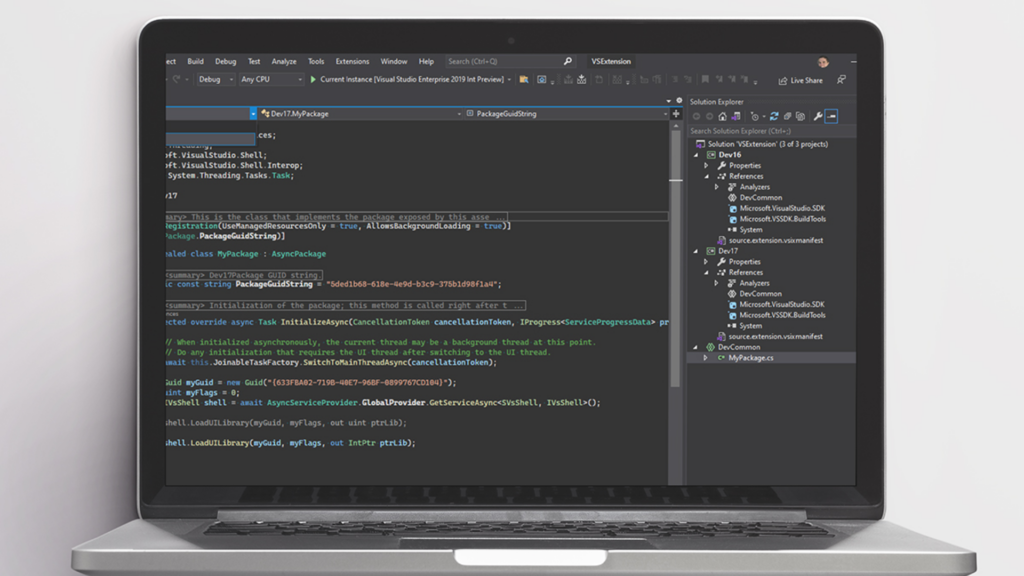
    Built as a 64-bit environment, Visual Studio Professional 2026 supports development across .NET, C++, Blazor, and .NET MAUI for cross-platform mobile and desktop projects. It’s currently available for $29.97 (MSRP $499.99).

    IntelliCode-powered AI analyzes code context to deliver ranked completion suggestions and assist with refactoring, reducing bugs and boilerplate along the way. CodeLens surfaces commit history, test status, and code references directly in the editor without requiring a context switch.

    Live Share enables real-time collaborative editing and debugging without requiring teammates to clone repos or configure matching environments. The IDE also integrates natively with Azure, GitHub, and DevOps workflows, and supports hot reload across .NET and C++ projects so code changes apply instantly during runtime.

    This is a single-user lifetime license redeemable on one supported device. The code must be redeemed within 30 days of purchase.

    Recommended by Our Editors

    Get Microsoft Visual Studio Professional 2026 for $29.97 (MSRP $499.99) today.

    Microsoft Visual Studio Professional 2026


    $29.97
    at StackSocial

    $499.99
    Save $470.02


    Get Deal

    Prices subject to change. PCMag editors select and review products independently. If you buy through StackSocial affiliate links, we may earn commissions, which help support our testing.

    About Our Expert

  • Best Buy’s 60th Anniversary Sale Is Here and You Can Save on Everything From Apple AirPods to Samsung SSDs

    Best Buy’s 60th Anniversary Sale Is Here and You Can Save on Everything From Apple AirPods to Samsung SSDs

    Let’s hop into the Wayback Machine and travel to August of 1966, when Richard M. Schulze opened his first hi-fi stereo store, Sound of Music, in St. Paul, Minnesota. Capitalizing on the pop craze, the store made a million dollars in revenue its first year and grew explosively, expanding its product offerings and eventually renaming itself to…Best Buy. Sixty years later, the chain is going strong with 1,117 locations in the United States and Canada, making it the largest specialty electronics retailer in the business. How to celebrate? With a sale, of course.

    Saturday is the official big day, and your local Best Buy will have exclusive in-store price drops. But online discounts are live now on some of our favorite products, and here are four of the most enticing.

    Apple AirPods Pro 3 Deal

    Apple AirPods Pro 3

    Bluetooth, active noise cancellation, 8 hours battery life


    $189.99
    at Best Buy

    $249.99
    Save $60.00


    Get Deal

    Getting Apple products at real deep discounts isn’t something that happens often, so a 24% price cut on the exceptional AirPods Pro 3 is worth throwing a party over. Best Buy has a bunch of Apple stuff on sale, but this offer is by far the most eye-catching. We gave these comfortable and powerful earbuds an ultra-rare “Exemplary” rating as well as an Editors’ Choice award in our review, with audio expert Eric Zeman raving that they “pack recalculated AI-based smarts and support features like hearing protection, live language translation, heart rate monitoring, and fitness tracking,” in addition to category-leading audio quality and active noise cancellation.

    Although visually the AirPods Pro 3 look seemingly identical to the last generation, inside the shell big changes have happened. Custom high-excursion drivers with custom high dynamic range amplifiers deliver rich, well-rounded sound, and Apple’s custom H2 chip provides seamless connection to paired devices. Better battery life and longer Find My range are just the icing on the cake. If you use other Apple products, these are the best earbuds on the market, full stop.

    More Earbuds Deals

    *Deals are selected by our commerce team

    Samsung 990 Pro 2TB Internal SSD Deal

    Samsung 990 Pro 2TB Internal SSD

    2TB, PCle Gen 4, 7450/6900 MBps read/write


    $389.99
    at Best Buy

    $639.99
    Save $250.00


    Get Deal

    Storage Wars isn’t just a TV show, but a description of how SSD prices have been exploding over the last year or so. Building a new battle station can really put a hurting on your wallet, so we’re happy to say that Best Buy is delivering some pretty impressive component price drops as part of their 60th anniversary sale. The Samsung 990 Pro is one of the better PCIe drives on the market, putting out solid benchmarking results in our review and earning an “Excellent” rating in the process. With great raw speed, efficient cooling, and hardware-based encryption, it checks all the boxes at a very competitive price.

    Samsung keeping manufacturing control over its V-NAND flash memory and controller lets the company innovate faster than brands that rely on resellers, and the custom nickel-coated controller is the first one on the market to use 8-nanometer architecture, improving power efficiency by 50% from the last model. Durability is also a strong point, with the drive warrantied for five years or 1200 terabytes, whichever you hit first.

    More SSD Deals

    *Deals are selected by our commerce team

    Dyson V15 Detect Vacuum Deal

    Dyson V15 Detect Vacuum Cleaner

    Cordless, 34 minutes battery life, 230w suction


    $499.99
    at Best Buy

    $849.99
    Save $350.00


    Get Deal

    Best Buy also does heavy trade in home appliances, and right now you can snag a huge discount on a powerful Dyson vacuum that’ll keep your floors clean all year round. We gave a glowing review to the V15 Detect, praising its numerous attachments and reliably strong suction, but noting that the $850 sticker price was a lot to swallow, even for a cleaning machine this good. Best Buy obviously heard our laments and decided to make things right, slicing a whopping $350 off and putting it in competition with other vacuums that it easily outclasses.

    With a Dyson Hyperdymium motor that pumps out up to 230 air watts of suction, the V15 Detect has the muscle to pick up all kinds of dirt and debris, and the patented five-stage filtration system grabs 99.99% of the dust in the process. The robust attachments make for optimal cleaning on different surfaces and situations, including tight corners, hard floors, and delicate fabrics. The green laser diode on the vacuum’s tip lets you play CSI as you hunt down stray dirt you can’t see with the naked eye.

    Recommended by Our Editors

    More Vacuum Cleaner Deals

    *Deals are selected by our commerce team

    HP OmniBook X Flip 2-in-1 Laptop Deal

    HP OmniBook X Flip 2-in-1 Laptop

    16-inch 2K touch display, Intel Core Ultra 7 256V CPU, 16GB RAM, 1TB SSD


    $749.99
    at Best Buy

    $1,199.99
    Save $450.00


    Get Deal

    HP’s OmniBook X Flip is a capable midrange laptop with some nice features, but at full retail price there are options we’d typically prefer. When Best Buy gets out the katana of savings and amputates $450 off the cost, though, it becomes one of the best convertibles in its price bracket. In our review of the 14-inch model, we noted that the OmniBook X Flip’s screen was bright and responsive, build quality felt stable and solid in the hand, and overall productivity performance was good. Connectivity is also solid, with Wi-Fi 6E, Bluetooth 5.3, and plenty of ports.

    The biggest downside to this portable is that it weighs a bit too much to use comfortably in tablet mode for long periods of time, but if you don’t mind a wrist work-out that shouldn’t deter you. At $750, it clears almost every laptop in this price range, especially convertibles. HP’s new AI Companion app jumps on board the trend with live translation and captioning, image and text generation, and more.

    More Laptop Deals

    *Deals are selected by our commerce team

    Want to save like every day is your birthday? Our deals page has the best prices on top tech.

    About Our Expert