Author: rb809rb

  • US-Iran conflict: What’s the latest as the Islamabad talks stall?

    US-Iran conflict: What’s the latest as the Islamabad talks stall?

    United States President Donald Trump has cancelled a planned visit to Pakistan by his envoys Steve Witkoff and Jared Kushner, who had been expected to explore indirect talks, which remain deadlocked over issues that include the blockade of the Strait of Hormuz.

    “If they want to talk, all they have to do is call!!!” Trump wrote on his social media platform Truth Social on Saturday, signalling that Washington for now would not send negotiators to Pakistan, the country that is mediating between the longtime adversaries.

    Recommended Stories

    list of 3 itemsend of list

    With neither Washington nor Tehran showing much willingness to soften their positions, prospects for a diplomatic breakthrough in the US-Israeli war on Iran and securing a lasting ceasefire remain stalled.

    The conflict spilled into the larger Middle East region, including Lebanon, causing the worst global energy crisis since the 1970s and risking a global recession.

    So what do we know about the talks and where they stand as of now?

    What has the US said?

    The US president on Saturday told reporters in Florida that he scrapped his envoys’ visit because the talks involved too much travel and expense to consider an inadequate offer from the Iranians.

    After the diplomatic trip was called off, Iran “offered a lot, but not enough”, Trump said.

    On Truth Social, he wrote that there was “tremendous infighting and confusion” within Iran’s leadership.

    “Nobody knows who is in charge, including them,” he posted. “Also, we have all the cards, they have none! If they want to talk, all they have to do is call!”

    What has Iran said?

    In Tehran, Iranian President Masoud Pezeshkian reiterated that his government will not enter negotiations while the US maintains a blockade on Iranian ports.

    In a phone call with Pakistani Prime Minister Shehbaz Sharif on Saturday night, Pezeshkian said Washington “should first remove operational obstacles, including the blockade,” before any new talks can begin, according to the ISNA and Tasnim news agencies.

    Meanwhile, during his visit to Islamabad on Friday, Iranian Foreign Minister Abbas Araghchi held separate meetings with Pakistan’s army chief, Field Marshal Asim Munir, and Sharif.

    In a post on Telegram, Araghchi said their discussions covered regional dynamics and Iran’s non-negotiable positions without disclosing specifics. He added that Tehran intends to engage with Pakistan’s mediation efforts “until a result is achieved”.

    After departing Islamabad on Saturday, Araghchi travelled to Oman, where he discussed ways to end the conflict with Sultan Haitham bin Tariq al-Said, according to state media.

    He was then scheduled to continue on to Russia. Iran’s IRNA news agency said Araghchi is expected to return to Islamabad on Sunday for additional talks.

    What has Pakistan said?

    Despite hardening public positions from Washington and Tehran, Pakistan’s political and military leadership is continuing to mediate, two Pakistani officials said on Sunday, according to The Associated Press news agency. They were quoted as describing the indirect ceasefire contacts as still alive but fragile.

    There were no immediate plans for US envoys to return for talks, according to the Pakistani officials, who spoke on the condition of anonymity because they were not authorised to speak to the media, AP added.

    Al Jazeera’s Kimberly Halkett, reporting from Islamabad, said Pakistani officials are underscoring that the expected return of Araghchi to Islamabad is seen as a “hopeful sign”.

    “What they hope is that this will in fact be something that can be incremental in the process and will advance forward,” she reported.

    What is happening with the ceasefire?

    The US-Iran ceasefire began on April 8 after nearly six weeks of US and Israeli strikes on Iran and retaliatory Iranian attacks against Israel and across the Gulf region.

    The two sides held talks in Islamabad on April 11 aimed at securing a permanent deal, but they ended after 21 hours with no breakthrough.

    After repeated threats of restarting the war if Iran did not heed Washington’s demands, Trump extended the ceasefire on Tuesday without a set deadline, saying he was in no rush to conclude a peace deal with Iran.

    While the truce has held for the most part, the two sides continue to accuse each other of violations.

    Iranian forces, which have essentially blocked the Strait of Hormuz, have captured commercial vessels, and the US has intercepted or detained ships suspected of violating its naval blockade of Iranian ports just one week after the ceasefire went into effect.

    The naval blockade is seen by Iran as a breach of the ceasefire. Tehran has warned that reopening the Strait of Hormuz is impossible as long as the blockade remains in place.

    The critical waterway has become a central dispute in the conflict. One-fifth of the world’s oil and liquefied natural gas supplies were shipped through the strait, which links the Gulf to the Arabian Sea, before the war began.

    Iran insists on sovereignty over the waterway, which lies within the territorial waters of Iran and Oman. It has also floated the idea of levying tolls while Washington demands full freedom of navigation. The Gulf nations, which export most of their petroleum through the strait, have opposed the Iranian plan to impose tolls.

    Another key issue is the debate over Iran’s stock of enriched uranium.

    The US and Israel are pushing for zero uranium enrichment and have accused Iran of working towards building a nuclear weapon while providing no evidence for their claims.

    Iran has insisted its enrichment effort is for civilian purposes only. It is a signatory to the 1970 Treaty on the Non-Proliferation of Nuclear Weapons, and Tehran says it has the right to pursue a civilian nuclear programme. But according to the International Atomic Energy Agency, the global nuclear watchdog, Iran has enriched uranium to 60 percent, a level that is far higher than what is needed for civilian use.

  • Bitcoin whales build long positions as funding stays deeply negative

    The biggest traders on Hyperliquid have been building a long bitcoin position for two months, and the price chart is starting to break their way.

    Glassnode data shows whale positioning on Hyperliquid, the onchain perpetual futures exchange, flipped from net short to net long in early March and has stayed long ever since, with the size of the long bias increasing through April.

    The shift coincides with bitcoin grinding higher from the mid-$60,000s in February to a brush near $80,000 earlier this week.

    Hyperliquid has, in the past year, become the onchain venue of choice for traders running large positions, and a sustained long bias from that cohort tends to lead spot bitcoin price action by days to weeks rather than follow it.

    The flip to net long in early March preceded the recovery from the mid-$60,000s. The positioning is now the most aggressively long it has been across the dataset.

    Bitcoin perpetual swap funding across major exchanges sits at -0.13% on a seven-day basis according to Coinglass, meaning shorts are paying longs to keep their positions open.

    That negative funding has held for roughly 47 consecutive days, one of the longest stretches of bearish derivatives positioning on record. Sustained negative funding matched with aggressive long positioning from Hyperliquid whales is the technical setup that produces short squeezes when spot prices break higher.

    In traditional finance, the S&P 500 closed at a record high on Friday, capping its longest weekly advance since 2024.

    In Pakistan, meantime, the weekend’s talks between Iran and the U.S. didn’t take place. President Donald Trump canceled his delegation’s trip to Islamabad after the Iranian foreign minister left the country before the U.S. group even set off.

    Treasury yields dropped as the Justice Department closed its probe into Federal Reserve Chair Jerome Powell, potentially clearing the path for Kevin Warsh’s confirmation as the next Fed leader.

    Quite where those developments leave the Hyperliquid long positions will become apparent over the coming hours and days.

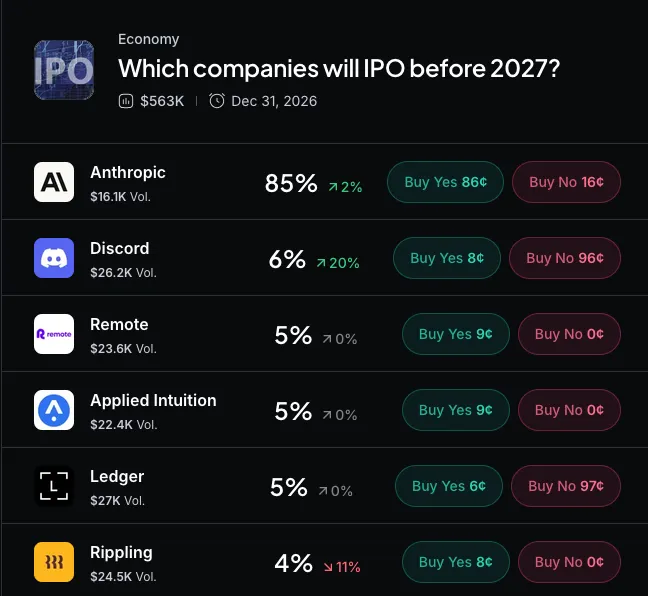
  • Only 3% of traders drive prediction markets’ accuracy, not the crowd, study finds

    Only 3% of traders drive prediction markets’ accuracy, not the crowd, study finds

    The Green Beret arrested for betting on a classified U.S. raid looked like a one-off scandal for prediction markets. A new study suggests he may be a more troubling data point: an extreme example of the small group of informed traders who, as the soldier is accused of doing, actually move prices on Polymarket, while the crowd loses money around them.

    The study, part of a working paper released this week by Roberto Gómez-Cram, Yunhan Guo, Theis Ingerslev Jensen and Howard Kung of London Business School and Yale, directly tests the industry’s core claim that the markets work owing to the massed knowledge of their participants.

    Using every Polymarket trade from 2023 to 2025, the authors conclude that it’s actually a small group of informed traders that moves prices. The researchers analyzed 1.72 million accounts and $13.76 billion in trading volume, and found that just 3% of traders account for most price discovery, meaning they are the ones moving prices toward the correct outcome.

    These traders consistently predict outcomes and move prices in the right direction. The remaining 97% mostly do not. They provide liquidity and generate volume, but in aggregate, they are on the losing side of trades against the informed minority, whose profits come directly from those positions.

    The hard part is telling skill apart from luck. With more than a million traders on Polymarket, plenty will rack up big winnings by chance alone.

    To filter that out, the authors reran each trader’s bets 10,000 times, keeping everything the same except the direction.

    Same markets, same moments, same dollar amounts — but a coin flip decided whether to buy or sell. That gave them a benchmark for what each trader’s profits would look like with no real edge. If the actual results consistently beat the coin flip, that’s skill. If not, it’s luck.

    The findings show among the biggest winners by raw profit, only 12% beat the benchmark, and many apparent winners didn’t stay that way: Roughly 60% of “lucky winners” become losers when their performance is checked against a separate sample of events.

    Their activity improves market accuracy. When skilled participants account for a larger share of trading, prices move closer to the correct outcome, especially in the final stretch before resolution. They are also the first to react when new information hits, shifting positions in response to events like Federal Reserve announcements or corporate earnings, while other traders show little consistent reaction.

    The same edge that makes skilled traders valuable to price discovery raises a harder question when that information isn’t public, or isn’t supposed to be.

    Both Polymarket and Kalshi have said that trading on non-public information is strictly against their rules.

    The paper grounds that risk in a concrete case: The U.S. removal of Nicolás Maduro from power in Venezuela in January. In the days and hours before the operation, three newly created Polymarket accounts piled into a contract asking whether Maduro would be removed. At the time, the market priced the odds at roughly 10%.

    The new accounts placed unusually large bets, including orders of tens of thousands of shares, before the price moved. When the raid happened, the accounts collectively made more than $630,000. Two stopped trading entirely soon after, and the third went mostly dormant. There is no evidence of any wrongdoing on these accounts.

    Insider trades, when they occur, move prices even more aggressively per dollar, about seven-to-12 times more than typical skilled trades. But they are rare and concentrated in a handful of events, not the day-to-day engine of price discovery. Most of the time, the market’s accuracy still depends on repeat traders who consistently outperform rather than on one-off bets.

    The findings challenge the idea that prediction markets work because of crowds. They appear to work because of who is informed.

  • Freezing 5.6 million dormant bitcoin could trigger ‘worst’ single-day repricing

    Freezing 5.6 million dormant bitcoin could trigger ‘worst’ single-day repricing

    Freezing dormant bitcoin would trigger an immediate repricing and mark one of the world’s oldest cryptocurrency’s worst trading days since its 2009 launch, advocates told CoinDesk.

    Bitcoin developers and crypto industry participants have debated for weeks whether they should freeze dormant tokens to protect them against the risk of theft through quantum computing, whenever those machines begin going online.

    “Freezing any coins, even ‘lost’ ones, tells the market that all (roughly) 19.8 million $BTC currently in circulation are conditionally owned,” said Samuel “Chad” Patt, who is also the founder of Op Net. “Institutional risk desks do not care about the reason, they care about the precedent.”

    Read more: A simple explainer on what quantum computing actually is, and why it is terrifying for bitcoin

    Although Jason Fernandes, a market analyst who describes himself as a pragmatic maximalist, said he agrees with Patt’s repricing thesis, he said he believes that a successful quantum attack would trigger a far more severe repricing.

    “Institutions won’t just price precedent, they’ll price whether the system can survive a break in its core assumptions,” added Fernandes, also the co-founder at AdLunam.

    Mati Greenspan, also a self-described maximalist and a market analyst, said that if “quantum computers ever crack early Bitcoin wallets, it won’t trigger a rollback or a freeze; it will trigger the largest bug bounty in human history.”

    The debate follows weeks of discussion over how to respond to the potential threat quantum computing poses to the bitcoin network, particularly the estimated 5.6 million $BTC. These tokens are held in wallets that have been dormant for more than a decade, in addresses that have not been upgraded and, therefore, are the most vulnerable in the event that quantum computing attacks become a reality.

    A week ago, Jameson Lopp, a core Bitcoin developer and research analyst, told CoinDesk he would prefer to see the dormant bitcoin, worth roughly $440 billion, frozen by the network than left at risk of being stolen by future quantum hackers. He said he already sees those bitcoin as being lost.

    Lopp and a team of other core bitcoin developers released Bitcoin Improvement Proposal 361 (BIP-361) earlier this month. The proposal contemplates phasing out bitcoin’s current cryptographic signatures, potentially freezing assets that fail to migrate.

    ‘Instant’ repricing

    If that were to proceed, Patt said, “bitcoin’s repricing would be instant, not gradual and would be the worst single day in bitcoin’s history, but not because of a hack, but because the network will have proven its core value proposition is negotiable.”

    The bitcoin maximalist said all fund managers, “who allocated on the censorship-resistance thesis, would be forced to unwind. Not by choice, but by mandate, because the asset no longer fits the risk profile it was purchased under.”

    Read more: To freeze or not to freeze: Satoshi and the $440 billion in bitcoin threatened by quantum computing

    Another bitcoin maximalist, Kent Halliburton, CEO and co-founder at SazMining, said he believes the intentions behind BIP-361 are good.

    “However, you don’t defend Bitcoin by breaking its core promise of inviolable property rights,” he said. “We operate data centers on four continents, and our clients own every machine. That model only works because Bitcoin guarantees unconditional ownership.”

    Halliburton said he believes, as many others do, that the quantum computing threat is real, but that there are better ways to deal with the risks it poses, such as better tooling and voluntary migration, “but not a protocol-level confiscation dressed up as a contingency plan.”

    Deeply flawed

    Khushboo Khullar, venture partner at Lightning Ventures and a bitcoin maximalist as well, said freezing dormant coins is a deeply flawed approach, despite appearing to be a pragmatic approach against quantum threats.

    “It directly undermines Bitcoin’s core principles of immutability, permissionlessness, and no central enforcement. Such a move would require a contentious hard fork, violating the network’s decentralized ethos where no one can unilaterally seize or freeze anyone’s coins,” she said.

    However, not all maximalists agree with Patt, Halliburton or Khullar, and instead believe Lopp’s proposal is sensible.

    “It’s extremely challenging to build systems that are truly future-proof, and while Bitcoin has come quite close, quantum may pose a threat that requires tradeoffs participants won’t be happy with.” said Ken Kruger, founder and CEO of Moon Technologies.

    “So far there’s no solution that doesn’t include compromise: freeze funds or let them be stolen? If solved elegantly, this could be a critical moment Bitcoin proves its resilience as a global monetary system,” he said.

    Bitcoin could still evolve

    Fernandes said he understands Patt’s and other maximalists’ points on precedent, adding that it is a real concern among the bitcoin community when discussing the network’s censorship-resistance ethos. In fact, he added, “I don’t think there is time; I think quantum will be upon us way faster than anybody thinks.”

    “However, framing this as a question of purity misses the bigger issue: quantum risk is an existential threat to the system, not a philosophical debate,” Fernandes said. He believes bitcoin could evolve as it has in the past with SegWit and Taproot, upgrades designed to improve the network’s efficiency, privacy and scalability.

    “The protocol isn’t ‘finished,’ it’s just conservative in how it changes,” he said. “But the risk of inaction far outweighs any concern about precedent or philosophical purity.”

    Ultimately, Fernandes believes very few people within the community care in the long run, and that the majority of bitcoin holders, whether maximalists or not, are “more interested in preserving capital rather than preserving some vague notion about what bitcoin is ‘supposed to be.’”

    Greenspan echoes what many of the maximalists ultimately prefer. “As with many cases in life, and especially with bitcoin, doing nothing is better than doing something.”

    He concluded: “The Bitcoin community seems to feel strongly that freezing coins would be antithetical to bitcoin’s quintessential value proposition.”

    Read more: How a quantum computer can be used to actually steal your bitcoin in ‘9 minutes’

  • 4 takeaways: Shai Gilgeous-Alexander dominates Thunder-Suns Game 3 & OKC nears sweep

    The Oklahoma City Thunder defeat the Phoenix Suns, 121-109, to take a 3-0 series lead.

    • Download the NBA App

    The Oklahoma City Thunder are one one of the most dominant, two-year runs in NBA history, and the dominance continued with a 121-109 victory in Game 3 of their first round series with the Phoenix Suns on Saturday afternoon.

    The Thunder were without Jalen Williams, who suffered a hamstring strain three days earlier. But Shai Gilgeous-Alexander didn’t need much help.

    The reigning MVP scored a career-playoff-high 42 points, shooting an amazing 15-for-18 from the field and 11-for-12 from the free throw line, adding eight assists. The Thunder continue to score efficiently against what was a top-10 defense in the regular season, and Gilgeous-Alexander’s performance was just the seventh 40-point playoff game in NBA history where the player had a true shooting percentage over 90%.

    Playing at home for the first time, the Suns led by nine points late in the first quarter. But the Thunder closed the period on an 18-4 run and were in control most of the way after that.

    Here are some notes, numbers and film as the champs improved to 11-0 in first-round games over the last three years:


    1. Gilgeous-Alexander is too much from mid-range

    Even when he won the Kia MVP award last season, Gilgeous-Alexander wasn’t as good of a mid-range shooter as he was this year, when he shot an incredible 197-for-359 (54.9%) between the paint and the 3-point line. That was the fourth-best mark for a player with at least 300 mid-range attempts in the 29 seasons for which we have shot-location data; the only three better ones are held by Kevin Durant.

    On Saturday, Gilgeous-Alexander was 6-for-7 from mid-range, and his best work was done over the last six minutes of the second quarter, when the Thunder took full control of Game 3.

    Collin Gillespie has been Gilgeous-Alexander’s primary defender for most of this series, but he was getting the business. So the Suns actually assigned starting center Oso Ighodaro to the MVP for a stretch late in the second.

    Gilgeous-Alexander proceeded to target Devin Booker in the pick-and-roll, getting to his mid-range pull-up:

    Shai Gilgeous-Alexander pull-up jumper vs. Devin Booker

    On the next possession, he rejected a screen, beat Ighodaro off the dribble, and drew a foul on Booker. Then, attacking Booker again, he got an open 3 for Jaylin Williams.

    Grayson Allen made his series debut on Saturday and was not spared. Gilgeous-Alexander attacked him to generate a layup for Alex Caruso and to get to another mid-range pull-up:

    Shai Gilgeous-Alexander pull-up jumper vs. Grayson Allen

    Finally, the Suns sent a double-team at Gilgeous-Alexander in the middle of the floor. The result was an open corner 3 for Caruso.

    Again, the Suns ranked ninth defensively, and the Thunder have scored at least 120 points per 100 possessions in all three games of this series. Overall, they’ve scored 10.9 per 100 more than Phoenix allowed in the regular season.


    2. Thunder handle the pressure

    The biggest strength of the Suns’ defense was forcing turnovers. They ranked third in opponent turnover rate, forcing 16.5 per 100 possessions, having seen the biggest jump (by a wide margin) from last season.

    But now they’re facing the team that has committed the fewest turnovers per 100 possessions in each of the last two seasons. And the Thunder have been even better at taking care of the ball in this series.

    Over the three games, the champs have committed just 8.9 turnovers per 100 possessions, what would be tied for the third-lowest rate for any team in any playoff series in the 30 years for which we have play-by-play data. They’ve taken their opponents’ biggest strength and turned it into a major weakness.

    According to tracking data, the Suns rank fourth in these playoffs in average pick-up distance, so they’re applying pressure. But it’s not working on the Thunder, who had just two live-ball turnovers in Game 3 on Saturday.

    Shooting is the most important thing in this game, but you there are other ways to boost your efficiency and the Thunder have done it by taking care of the ball.


    3. Best bench in basketball

    It was a little bit of a surprise that Ajay Mitchell started in place of Jalen Williams on Saturday, given that Cason Wallace started 42 more games than Mitchell (58-16) in the regular season. Mitchell was the Thunder’s second leading scorer (15 points) in Game 3, but shot just 5-for-20, forcing some tough shots along the way.

    The Thunder’s new starting lineup had played just 37 total minutes (over seven games) together in the regular season and was outscored by four points on Saturday. But the champs outscored the Suns by 16 points with at least one reserve on the floor.

    Even without Williams to run the second-unit offense, the Thunder outscored the Suns by two points (20-18) in Gilgeous-Alexander’s 10 minutes on the bench. The shooting wasn’t great (8-for-22, including 1-for-7 from 3-point range), but they didn’t commit any turnovers when the MVP sat.

    They used the same five-man unit (Mitchell, Wallace, Jared McCain, Chet Holmgren and Isaiah Hartenstein) for those entire 10 minutes. Mitchell scored seven of his 15 points and McCain scored all of his seven in those no-SGA minutes, with a couple of SGA-esque buckets included.

    The Thunder have had the league’s No. 1 bench in each of the last two seasons, and though their versatility is a little compromised with the absence of Williams, they’re never dependent on the success of any particular lineup. Still, it will be interesting to see if Mitchell remains the starter going forward.


    4. Booker still can’t get going

    Dillon Brooks (33 points) and Jalen Green (26) were again the Suns’ leading scorers on Saturday, and that’s by the Thunder’s design. The league’s No. 1 defense has made Devin Booker its No. 1 priority, making sure he plays in a crowd and has a hard time finding open shots.

    For this entire series, Booker’s best looks at the basket have come in transition or after offensive rebounds.

    When he’s used a ball-screen, he hasn’t seen any kind of advantage for himself:

    Wall of Thunder defenders facing Devin Booker

    The Suns have bee able to leverage the attention on Booker to get good shots for his teammates. Early in the third quarter on Saturday, there was no weak-side help on an Ighodaro roll to the rim, because Dort stayed attached to Booker in the corner:

    Jalen Green assist to Oso Ighodaro

    But the Suns haven’t been able to find enough of those kinds of openings to keep up with the Thunder. And at 20.3 points per game, this is the lowest-scoring playoff series of Booker’s career. His true shooting percentage of 55.1% would be his third worst mark of the 10 series that he’s played in.

    The Suns first chance to avoid a sweep is Game 4 on Monday (9:30 ET, Peacock).

    * * *

    John Schuhmann has covered the NBA for more than 20 years. You can e-mail him here, find his archive here and follow him on Bluesky.

  • Giddens Ko and Kai Ko Bring ‘Kung Fu’ to Far East Film Fest, Reveal Stephen Chow Input

    Taiwanese filmmaker Giddens Ko, presenting “Kung Fu” at the Far East Film Festival on Saturday, revealed that Stephen Chow contributed to the film’s development and reflected on the more than decade-long journey required to bring his most technically ambitious project to screen.

    Speaking on a panel moderated by Kevin Ma, Ko and his longtime collaborator Kai Ko – who stars in “Kung Fu” and wrote, produced and acts in “I Blew Out the Candles Before Making a Wish,” which has its world premiere at the festival Sunday – discussed the pair’s 15-year working relationship, the demands of wuxia filmmaking and their respective next projects.

    Ko adapted “Kung Fu” from his own novel, written some 25 years ago, and first attempted to shoot it as his second feature around 2013. Fresh off the commercial success of his debut, “You’re the Apple of My Eye,” he pulled back from the project, attributing the retreat to an excess of confidence.

    “I was so happy with the success of that story,” Ko said. “Right away when I got into this novel, I said, wow, this is a martial art, it’s kung fu. Everybody would love it.”

    The abandoned project stayed with him. Ko described it as a creative wound he eventually resolved by returning to it alongside collaborators who shared the same history with the material. The finished film – which he described as Taiwan’s largest-budgeted production – incorporates footage from classic wuxia works. These clips, Ko noted, are not simple homages but narrative threads planted early in the story.

    “Those classic clips at the beginning, they are not just being there because they were classic clips,” Ko said. “They were actually clues laying down the foundation for you to see the future character.”

    Ko’s conception of the wuxia genre centers on imagination as a martial force. “Wuxia is not just action choreography,” he said. “Wuxia is really talking about stretching the audience imagination when you watch it.” To illustrate the spectrum, Ko contrasted Jackie Chan’s grounded physicality with the more heightened combat of Jet Li’s Wong Fei-hung films, where movement begins to exceed what the body could plausibly achieve – placing “Kung Fu” firmly in the latter tradition. He cited “The Matrix” as a structural touchstone, specifically the idea that a protagonist empowered by belief can transcend the rules of a constructed world. Ko also confirmed he showed the script directly to Stephen Chow – whose “Kung Fu Hustle” loomed large in the discussion – to talk through choreography and story.

    Kai Ko, making his fourth film with Giddens, said the collaboration’s dynamic remained largely unchanged despite the production’s scale. The actor has grown into a presence in Giddens’ post-production process, a development the director welcomes. “He inspired me a lot,” Giddens said. “He’s no longer just a presence. He’s there, participated in a lot of ideas we discussed.”

    Having directed his own debut, “Bad Education” – written by Giddens – Kai Ko said the experience reshaped his approach to acting, though he drew a clear line. “Don’t forget the director is the real general,” Kai Ko said. “The real captain of this whole collaboration. And he has the power of cutting.”

    In “I Blew Out the Candles Before Making a Wish,” Kai Ko plays a Taiwanese man who relocates to Macau, falls into financial failure and crosses paths with a young girl. The role required him to deliver much of his dialogue in Cantonese, a language he had to learn for the part. “Mastering Cantonese was the hardest part for me to play this role,” he said. “Cantonese has nine tones. If you make the tone incorrectly, it turns into a completely different meaning of the word.”

    He traveled to Macau to research the character, interviewing people who had gone there during the city’s casino boom, many of whom, he noted, came back empty-handed.

    Looking ahead, Giddens confirmed he is developing his next feature in Taiwan, with a role written in for Kai Ko. Kai Ko is separately working on a second directorial project with a new screenwriter and said the film would likely arrive in 2027 if the script comes together. “We are going back and forth discussing a new script,” Kai Ko said. “I hope in the end it would be something interesting and better.”

  • Adam Scott Says He Already Knows the Ending to ‘Severance,’ Teases ‘So Many Surprises’ in Season 3: ‘It’s Going to Be Great’

    Adam Scott already knows the ending of “Severance.”

    “Oh Yes. I’m an executive producer on the show, so I’m involved in all of it. We talk with the writers, and Dan [Erickson], all the time. I know everything about what’s going on. [As an actor] I like having as much information as possible.”

    Just like the whole world, he’s more than ready for Season 3.

    “It’s going to be great. There’re so many surprises. I can’t wait to shoot it,” he said. As previously announced, Ben Stiller won’t be directing this time.

    “Ben is still very involved in the show. It’s going to be great. You know, it’s been over two years since we finished shooting Season 2. We’re all anxious to get back. We miss each other.”

    Scott, who will be receiving the Canal+ Icon Award at Canneseries this week, admitted he really, really wanted the role.

    “I don’t know if I would categorize it as a battle, but I certainly had to prove I could do it. Which makes sense: It was a big show, a big investment for Apple, so they needed to see that,” he recalled.

    “It’s an incredible role in an incredible world. It’s everything I’d always wanted to do. When I read the script, first of all, I thought: ‘I probably won’t get this job. But if I do, if I’m able to land this, it will be because I’ve been earning this over the last 30 years. The opportunity to be considered for something like this and a role where you get to explore different sides of this person.”

    He added: “Happily, I auditioned only once. The more you do it, the more you can screw it up.” 

    When “Parks and Recreation” ended, he wanted to find something “a little more dramatic.”  “I just wanted to change it up, and I had trouble being considered for anything that wasn’t comedic. I really sought out ‘Big Little Lies,’ for example – that was something I really wanted to do. I wanted to work with Reese Witherspoon and all those actors, and Jean-Marc Vallée. But I really had to campaign for that and audition a few times, and prove to them I could do something that wasn’t comedic.” 

    “Severance” “felt like a full meal,” he said. 

    “It felt like a complicated character and a complicated world – and an adventure. Everything I’d done up to that point, those were all things that fulfilled me. But this felt like more of a culmination.”

    It took him a while to figure out how to portray the infamous scenes of transition. “Switching from one thing to another, in an elevator, could be really corny. Ben had this ‘elevator set’ he would keep off to the side, so whenever we had a few minutes, we could go over and practice, and try to see how that transformation would occur.”

    “We must have done it hundreds of times before we landed on something that worked. I think it was Ben who came up with our eyes fluttering a bit. Oh man, I’m sure I did a bunch of stuff that was ridiculous.”

    With many questions unanswered, “Severance” has quickly developed a “Twin Peaks”-like cult following. 

    “I love ‘Twin Peaks’ so much and I love that people keep discovering it over and over again. I don’t know if [‘Severance’] will live in culture and be remembered like that, but I agree – there’s a lot of power in not knowing.” 

    “Something we’re always trying to do on the show is retain an element of mystery. I loved the way ‘The Sopranos’ ended. I was frustrated by it, but it was brilliant and I still haven’t figured it out. I love it not only in TV shows or movies, but I like it in music. I’ve always loved bands that wouldn’t tell you everything about how music was made and who made it. I like when there’s a place for my imagination to reach out and meet the work.” 

    Scott doesn’t worry about being typecast again post-“Severance.”

    “Something that’s good with a role like Mark is that I’m not sure what aspect of it would pin me down into being typecast. And even if I’m, it would be completely worth it, because I love the show so much.” 

    He recently made horror film “Hokum.”

    “It’s really scary. I think with horror movies, just as a fan and as someone who participates in them sometimes, I feel like the criteria is it should be a good movie first and a good horror movie second. It should be able to stand on its own as a character, as an interesting character, an interesting story. And then the horror elements are almost a bonus, you know,” he said.

    “It’s been a while since I’ve been a lead in something that’s come out in movie theaters. And I love it. It’s what made me want to do this in the first place: sitting in a dark room with a bunch of strangers and watching something that really moves you or gets you excited.”

    “Severance” moves people as well.

    ‘When the show first came out, we were still emerging from the pandemic. People were slowly returning to the office or working from home, and this new work-life balance felt strange for everyone. I think the show evoked those feelings,” he said.

    “With something that’s as high-concept as ‘Severance,’ there has to be an emotional element to connect to, and there have to be characters to connect to. Otherwise, it just becomes something that’s interesting, but isn’t emotionally engaging.” 

    He added: “If you were presented with this technology, would you do this? Once you really consider that question, you start thinking about your life in a certain way, and it sets you on an interesting journey.”

  • VanEck, the Billion-Dollar Asset Manager, Announces It Has Turned Bullish on Bitcoin

    VanEck, the Billion-Dollar Asset Manager, Announces It Has Turned Bullish on Bitcoin

    Cryptocurrency asset manager VanEck shared noteworthy findings regarding market dynamics in its latest research report on Bitcoin.

    The report, authored by Patrick Bush and Matthew Sigel of the company’s digital asset research team, noted that indicators historically considered “bullish signals” for Bitcoin emerged from both derivative markets and network data.

    According to the report, market volatility has significantly decreased as tensions between the US and Iran have eased. Bitcoin’s realized volatility fell from 56% to 41%, while its 7-day average funding rate moved into negative territory, reaching -1.8%, its lowest level since 2023. Analysts note that negative funding rates have historically coincided with periods of strong bullish sentiment. Since 2020, Bitcoin’s 30-day average return during periods of negative funding has been 11.5%, while the overall average has remained at 4.5%. It was added that returns were significantly higher during periods of deeper negative levels.

    According to VanEck’s analysis, another important signal in the market is the decline in hash rate. The change in hash rate over the last 30 days has fallen to one of its lowest historically lows, but past data shows that strong recoveries in Bitcoin price follow such declines. In six of the previous seven similar periods, Bitcoin was at higher levels after 90 days, with a median return of 37.7%.

    On the institutional investment side, the picture is showing signs of recovery. Spot Bitcoin ETPs, which experienced outflows of approximately $4 billion between the end of January and the end of February, have reversed direction since the end of February. Net inflows were recorded in six of the last seven weeks until mid-April.

    In the options market, investors appear to be maintaining a cautious stance. The fact that “put” option premiums reached historical highs in the last 30 days revealed that strong hedging demand and bearish expectations were being priced into the market. However, the significant decline in these premiums in recent weeks suggests that excessive pessimism may have passed its peak.

    On the on-chain data side, a mixed picture emerges. While the daily transaction volume increased by 22% month-on-month to reach 545,000, the number of active addresses and the creation of new addresses saw a limited decrease. Transaction volume averaged $48.5 billion per day, while network fees decreased both monthly and year-on-year. This indicates that costs remained low despite the increased transaction activity.

    Related News Chief Economist of a Major Chinese Company: “In Bitcoin, Institutional Investors Have Become the Landlords, While Retail Investors Have Become the Tenants”

    Different trends were observed in long-term investor behavior. While selling activity increased among investors holding their holdings for 1 to 5 years, this movement remained below the annual averages. In contrast, there was a significant increase in transfer volumes among investors holding their holdings for 5 years or more. In particular, the activity of investors holding coins for 10 years or more approached the highest levels in recent years.

    On the mining side, the unbalanced decline between mining difficulty and hash rate is noteworthy. The fact that the difficulty level is declining faster than the hash rate indicates that the network’s adjustment mechanism is working with a delay and that a rebalancing process is taking place among miners. Nevertheless, the fact that recent declines have been shorter and more limited suggests that a healthier structure is emerging for the market.

    VanEck analysts argued that, based on historical data, both negative funding rates and declines in hash rates have been associated with strong future returns, leading their overall outlook for Bitcoin to become increasingly bullish.

    *This is not investment advice.

  • Anthropic Rolls Out Election Safeguards for Claude AI Ahead of US Midterms

    Anthropic Rolls Out Election Safeguards for Claude AI Ahead of US Midterms

    In brief

    • Anthropic’s latest Claude models achieved 95-96% on political neutrality tests and 99.8-100% on election policy compliance.
    • The company will deploy election information banners directing users to trusted nonpartisan voting resources for the 2026 midterms.
    • The measures come as governments scrutinize AI’s potential impact on election integrity and misinformation.

    Anthropic, the artificial intelligence company behind the Claude chatbot, announced Friday a set of new election integrity measures designed to prevent its AI from being weaponized to spread misinformation or manipulate voters ahead of the 2026 U.S. midterm elections and other major contests around the world this year.

    The San Francisco-based company detailed a multi-pronged approach that includes automated detection systems, stress-testing against influence operations, and a partnership with a nonpartisan voter resource organization—measures that reflect the growing pressure on AI developers to police how their tools are used during election seasons.

    Anthropic’s usage policies prohibit Claude from being used to run deceptive political campaigns, generate fake digital content intended to sway political discourse, commit voter fraud, interfere with voting infrastructure, or spread misleading information about voting processes.

    To enforce those rules, the company said it put its newest models through a battery of tests. Using 600 prompts—300 harmful requests paired with 300 legitimate ones—Anthropic measured how reliably Claude complied with appropriate requests and refused problematic ones. Claude Opus 4.7 and Claude Sonnet 4.6 responded appropriately 100% and 99.8%of the time, respectively.

    The company also tested its models against more sophisticated manipulation tactics. Using multi-turn simulated conversations designed to mirror the step-by-step methods bad actors might employ, Sonnet 4.6 and Opus 4.7 responded appropriately 90% and 94% of the time when tested against influence operation scenarios.

    Anthropic also tested whether its models could autonomously carry out influence operations—planning and executing a multi-step campaign end-to-end without human prompting. With safeguards in place, its latest models refused nearly every task, the company said.

    On the question of political neutrality, the company runs evaluations before each model launch to measure how consistently and impartially Claude engages with prompts expressing views from across the political spectrum. Opus 4.7 and Sonnet 4.6 scored 95% and 96%, respectively.

    For users seeking voting information, Claude will surface an election banner directing them to TurboVote, a nonpartisan resource from Democracy Works that provides reliable, real-time information about voter registration, polling locations, election dates, and ballot details. A similar banner is planned for Brazil’s elections later this year.

    Anthropic said it plans to continue monitoring its systems and refining its defenses as the election cycle progresses. Decrypt reached out to Anthropic for comment on the findings, but did not immediately receive a response.

    Daily Debrief Newsletter

    Start every day with the top news stories right now, plus original features, a podcast, videos and more.


  • NBC News, MS NOW Tamp Down Party Spirit After White House Correspondents’ Dinner Chaos

    WASHINGTON — Mentalist Oz Pearlman was supposed to dazzle an audience of hundreds on Saturday night here with mind tricks in a well-lit hotel ballroom. Instead he found himself doing his act for a small handful of media executives in a darkened underground event space close to midnight.

    MS NOW had planned to host a festive soirée in the site of an old subterranean trolley station in the heart of the nation’s capital, part of the usual proceedings following the annual White House Correspondents’ Dinner. This year was going to be more auspicious — until horror struck just hours earlier: Authorities are still investigating an incident in which a man was able to get close to a space in the Washington Hilton where President Donald Trump was to attend — and deliver pointed remarks — to an assemblage of journalists, news executives, media honchos and government officials at a celebration of journalism that is woven into the social calendar of this city devoted to the federal government.

    President Trump and attendees were unharmed, but many were shaken by an outburst of gunshots and the reminder that political violence seems more prone to break out in the U.S. than at any other time in recent memory.

    With that in mind, media organizations backing traditional after-parties worked on the fly to change their purpose.

    “While tonight’s event won’t be what we originally intended, we still think it is important to provide a space for friends and colleagues to be together,” MS NOW said in a dispatch emailed to guests for a party that was meant to serve as an elaborate debut of sorts: The news outlet is no longer part of NBC News, and is now a flagship outlet of Versant Media, spun off from NBCUniversal earlier this year.

    Meanwhile, NBC News opted to continue with a long-held after-event, deciding that attendees could use a place to gather, convene and process.

    After the gunshots, it couldn’t be bacchanal as usual. NBC News anchor Tom Llamas broke into regular programming on NBC with a special report, and many of the news organization’s top executives quietly left the main gathering at the residence of France’s Ambassador to the United States, according to a person familiar with the matter, to watch their team’s effort in a makeshift monitor room.

    The tone of both parties was subdued. Each felt designed to accommodate a larger crowd that might not feel comfortable enough to attend. And shuttling back and forth between the two events became onerous: Washington police closed down parts of Connecticut Avenue, a main artery in the city, making a direct route between the events impassable.

    Still, people needed to talk — about what they saw and heard, about the reasons why it happened, and about how things could have been much worse.

    At the MS NOW gathering, Pearlman performed his feats for Versant Media CEO Mark Lazarus and CNBC President KC Sullivan, among others. Still, some of the hoopla was dialed down, though a series of projections on the wall that described ties to the First Amendment were underscored by the events of the evening.

    NBC News, meanwhile, played host to journalists and staffers, including anchors and correspondents such as Lester Holt, Christine Romans and Joanna Stern. Executives including Cesar Conde, chairman of the company’s news operations, and Rebecca Blumenstein, president of editorial for NBC News, were also working to navigate the evening.

    In the streets of Washington, word of the alarming development spread through discussions with rideshare drivers and in the overheard comments of tuxedoed attendees who blurted out comments in smartphone conversations while walking away from the original site of the dinner.

    President Trump said Saturday evening that he hoped to reconvene the dinner within 30 days’ time. In various conversations, partygoers seemed uncertain the dinner could be reconstituted in such a short period of time.

    Even a mentalist like Pearlman, after all, can’t make people forget what transpired.