Author: rb809rb

  • Rapid7 Operation ASTERIX Shows AI Is Now Core Crypto Phishing Tool

    Rapid7 Operation ASTERIX Shows AI Is Now Core Crypto Phishing Tool

    Counterfeit wallet apps are not a new threat, but Operation ASTERIX shows how much more precise these schemes have become. Rapid7 uncovered a campaign built around roughly 885,000 phone numbers, crypto account-validation tools, phishing emails, vishing calls, and fake Trezor, Ledger, and Exodus apps designed to capture recovery phrases, according to the original report.

    The most striking detail is not the volume of phone numbers. It is the validation layer. In one German dataset, operators identified 43,066 CryptoCom accounts from 316,002 phone numbers. That is a hit rate high enough to justify the infrastructure. After confirming which numbers were tied to exchange accounts, the group enriched those targets with personal details, making support impersonation calls much harder to detect. A public list of phone numbers is a nuisance; a list that has been cross-checked against exchange account data is an operational asset.

    AI tools compressed the production cycle

    Rapid7 found signs that the operators used GitHub Copilot and Claude Code across multiple stages of the campaign. Those tools were applied to process target data, develop and debug malicious software, and build phishing infrastructure. That matters because it shrinks the distance between target discovery and an active fake wallet app or phone scam. Tasks that once required a dedicated developer can now be handled by smaller crews using AI coding assistants.

    The sector’s broader AI adoption is not limited to hostile actors. Rankings of Top 10 Blockchains by Developer Activity This Week track code contributions across major chains, and those workflows increasingly include AI-assisted development. The same productivity gains that help legitimate teams ship faster also make malicious wallet apps easier to produce, which is precisely the dual-use problem Operation ASTERIX exposes. AI tooling now runs through legitimate Web3 infrastructure too, including scalable AI-driven Web3 applications.

    The jailbreak question remains open

    One interaction stands out. When Claude refused requests related to code obfuscation, the operator switched to Kimi and attempted to bypass its safety controls with a custom jailbreak prompt. Rapid7 could not confirm whether the attempt succeeded. That uncertainty is relevant because it separates a simple misuse of general-purpose tools from a more deliberate effort to defeat model restrictions. The former is a moderation gap; the latter is a red-team exercise run by criminals.

    Without confirmation, the report avoids overstating the jailbreak result. It does, however, confirm that the campaign treated AI model refusals as an obstacle to route around rather than a reason to stop. Security researchers and platform providers will likely scrutinize that behavior when deciding how aggressively to restrict coding assistance around wallet-related software.

    What users and platforms should watch

    The counterfeit apps named in the report target the same recovery phrase users are told never to enter anywhere. Fake Trezor, Ledger, and Exodus apps create a direct path from a convincing interface to a drained wallet. That is why download source matters more than app appearance. Official hardware wallet vendors do not ask users to enter recovery phrases into software, and exchange support lines do not call customers with a full personal profile already loaded.

    The operation also sharpens a hard truth for exchanges. If account validation is cheap enough to run against hundreds of thousands of numbers, then user data leaks and public breach corpora become a higher-value input for vishing campaigns. The report does not allege an exchange breach; it shows how seemingly thin data can be enriched into actionable targeting information.

    Lawmakers weighing crypto market structure rules may find this kind of disclosure hard to ignore. Banking groups have already been pressing against the biggest crypto bill in US history, and cybercrime incidents involving retail wallets could sharpen the debate over liability, consumer protection, and platform responsibility. Whether Operation ASTERIX becomes a regulatory data point depends on how quickly similar campaigns are detected elsewhere.

  • Circle Mint Expands Local Currency USDC On- and Off-Ramps to Eight Currencies

    Circle Mint Expands Local Currency USDC On- and Off-Ramps to Eight Currencies

    Circle has expanded Circle Mint to support direct local-currency $USDC on- and off-ramps across eight currencies. The company said in an Aug. 18 post that foreign exchange is handled inside Mint, removing the need for a separate conversion step or pre-funding additional accounts.

    Alongside USD and EUR, Circle listed the Brazilian real, British pound, Hong Kong dollar, Mexican peso, offshore Chinese yuan and Singapore dollar among the local currencies supported for eligible Mint account holders.

    How the proposed flow works

    Circle says customers can activate cross-currency exchange, link a bank account for the local-currency side and register that account for the currency they intend to trade. The company describes each transaction as a quote, trade and settlement process, with $USDC arriving in the Mint balance after conversion.

    Circle says settlement uses local payment rails nearly around the clock where supported. Availability remains subject to jurisdiction and account eligibility, and the company notes that some account-registration steps are handled offline.

    Not a retail bank account

    The update is directed at businesses and eligible Mint customers, including payment providers, financial institutions and fintechs. Circle states that Circle Mint is not a bank account and that funds are not protected by FDIC, SIPC or comparable government insurance.

    The announcement is a Circle product update. It does not mean all currencies, regions or users have identical access, so institutions need to check Mint eligibility and local requirements before relying on the new routes.

  • Did Alex Vindman Just Get Burned by the Larry David Curse? 

    Did Alex Vindman Just Get Burned by the Larry David Curse? 

    Hey, let me ask you a question. If I told you about a political candidate with impeccable patriotic bona fides, a compelling backstory and a deep war chest, wouldn’t you think he’d win by a landslide or at least turn out a competitive race?

    That’s what Alex Vindman and his supporters thought. But they underestimated the Larry David factor.

    Vindman, a Florida Democrat, seemed a lock to win his Senate primary bid on Tuesday. A retired lieutenant colonel in the Army. A Purple Heart-decorated Iraq veteran. A whistleblower on Donald Trump for the 2019 quid pro quo attempt with Ukraine President Volodymyr Zelenskyy that led to an impeachment trial. Vindman had major name recognition. He raised $16 million ($15 million more than his opponent) and was believed to be a big favorite over said rival, Angie Nixon — a little-known Jacksonville-based member of the Florida House of Representatives.

    Nixon was a DSA candidate in a state that leaned moderate, and these days really doesn’t lean Democrat at all. No way a million Democrats would give the edge to her. (The pair were battling to take on sitting Senator Ashley Moody, a Republican, to finish out the remaining two years of Marco Rubio’s term.)

    But that’s exactly what happened Tuesday. Nixon swamped Vindman by more than 12 points, garnering over 700,000 of the total 1.25 million votes. She pulled off the ultimate chat-and-cut.

    How could this happen for the retired Army lieutenant colonel and Soviet refugee? What did Vindman do? Did he not respect wood?

    I’ll tell you what happened. What happened was Larry David. 

    Vindman appeared in two episodes of Curb Your Enthusiasm as himself, including the series finale in which he testifies against Larry for his political bribery. David even campaigned for the candidate, sending out a fundraising text message earlier this summer (including to people who didn’t live anywhere near Florida). “The man is everything I’m not, which should give you an idea of what a tremendous person he is. Vindman is not a puppet. He loves this country. He loves it so much it’s almost off-putting. I love it too, but come on. Get a life, Vindman!”

    And David, in addition to schlemieling up everything on the show, has a curse attached to him. A curse that ensures people never get the votes they should.

    It’s called the Curb curse, and it seeks to explain — because there is no explanation — how David never won a writing or acting Emmy in the entire 12-season, 24-year history of the show. Yes, 120 episodes and he never got a thing. (The show won just two overall, for directing and editing.) A post on Screen Rant after his most recent strikeout and last attempt in 2024 said: “Curb Your Enthusiasm Continues a 24-Year Larry David Curse After The Show’s Ending.”

    And now that the show is over, it carried over to Vindman. David couldn’t win an Emmy in 2024 and Vindman couldn’t win a primary in 2026.

    If this was a Curb episode, you could almost imagine Vindman showing up at David’s house. 

    “You cost me the election, Larry.”

    “What are you talking about? I didn’t cost you the election.”

    “You cost me the election.”

    “Get the hell out of here! Cost you an election. Poor Candidate Vindman. Like Al Gore. [Fake crying] Cost him an election.”

    And then Vindman would angrily leave, but at the end of the episode happen to be in the Santa Monica restaurant when Larry does something untoward and the camera would pan to him and he’d tip someone off and then have his revenge. The curse would be avenged.

    Of course this may not be a curse so much as, you know, simply irascibility. For the character but also the personality — the real-life David wasn’t one for the glad-handing, even at parties, and it’s not like he kissed the awards ring. He didn’t even show up to the Emmys the last time he was nominated. When you attack Elmo, you don’t get love.

    That irascibility also may have singed Vindman. Who wants to get a hectoring message from David? Especially asking for money. It’s not cool de la.

    Sure, if you’re trying to analyze the results of the election, you can talk about the swing of Democrats to the DSA even in a place like Florida, auguring a new future for the party. Or that many of the moderate Dems in Florida have ditched for the GOP and couldn’t vote in the state’s closed primary.

    But, eh. It was probably Larry.

  • Centrifuge crypto falls 14% as RWA demand slumps – Can CFG rebound?

    Centrifuge crypto falls 14% as RWA demand slumps – Can CFG rebound?

    Centrifuge [$CFG] declined more than 14% in the past 24 hours at press time, extending the double-digit decline in market cap over the past week. The daily trading volume increased, supporting the selling pressure experienced across multiple altcoins.

    However, the sharper decline in $CFG points to a coin-specific weakness with its real-world asset (RWA) niche.

    Centrifuge’s RWA sees negative sentiment

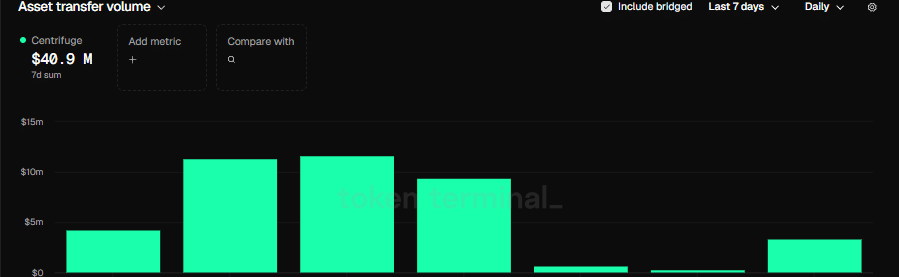
    As per data from Token Terminal, Centrifuge’s RWA activity declined on multiple fronts.

    For instance, the Monthly Asset Transfer Volume on the chain fell by 10%. This week alone, the metric has decreased from a peak of $11.67 million to $281K, indicating very low usage of the ecosystem in the RWA sector.

    Additionally, the Monthly Asset Transfer Count lost more than 58% of its share. Since the start of August, this count has plummeted from 6.7K to 2.2K, representing a 67% loss.

    Source: Token Terminal

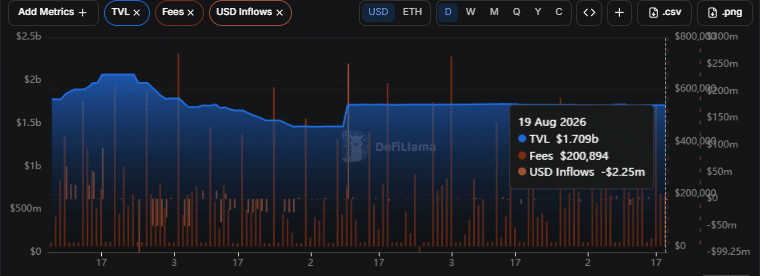
    Apart from its RWA niche’s underperformance, $CFG faced a broader, weaker altcoin market. To be specific, the Centrifuge ecosystem saw net USD outflows of more than $2.25 million.

    Source: DefiLlama

    Moreover, the Total Value Locked (TVL) was flat at around $1.709 billion after a sharp drop from its highs attained when the RWA narrative was thriving. The TVL of $CFG in April was above the $2 billion mark.

    Furthermore, the activity on the chain was low, evident from the fees generated. As per DefiLlama, the ecosystem generated about $200.9K in the past 24 hours as of writing.

    Will $CFG price crash lower?

    Even the market structure of $CFG was bearish since mid-July.

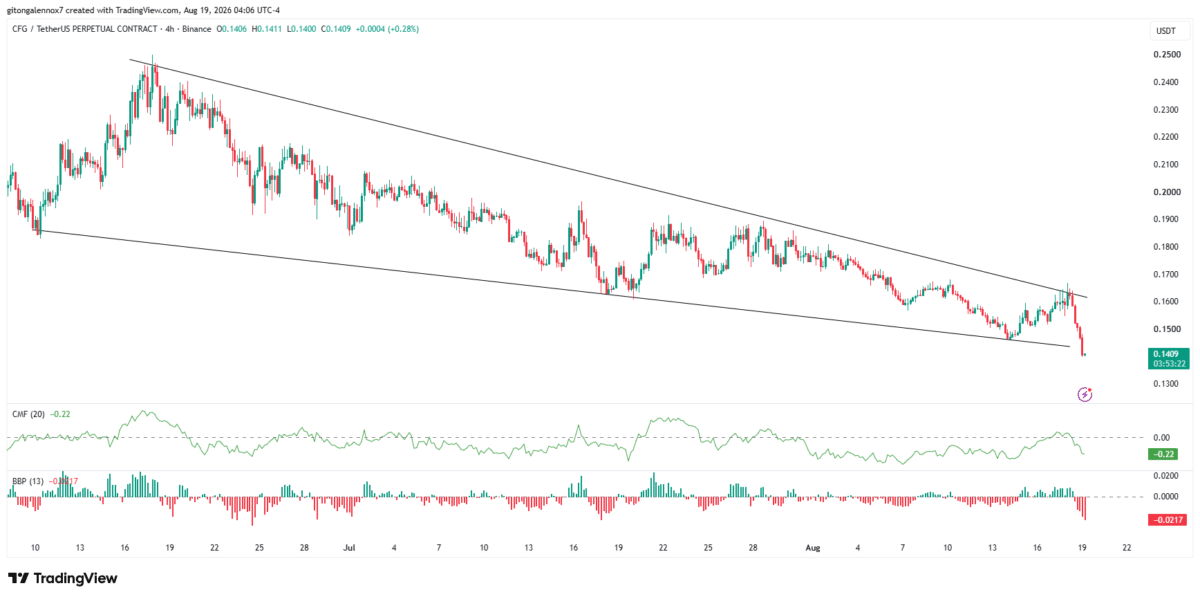
    The altcoin was falling inside a wedge pattern and broke below the lower trendline support. Over the past 24 hours, the $CFG price has fallen from $0.1672 to $0.1379 as of writing.

    Momentum indicators reinforced the bearish control with the reading of Bull Bear Power (BBP) bars at -0.0243. Moreover, Chaikin Money Flow (CMF) crashed to -0.22, indicating capital flight.

    Source: $CFG/USDT on TradingView

    Looking at the market structure and overall RWA sentiment, $CFG may continue dipping. It could even lose its all-time low (ATL) at $0.06712.

    However, the altcoin is closer to $0.1257, which is the demand zone that pushed it to a peak value of $0.3497. This level could be the start of a recovery if bulls return.


    Final Summary

    • Centrifuge fell by more than 14% in the past 24 hours as multiple fronts affected its RWA niche.
    • $CFG price has been falling inside a wedge pattern, with indicators suggesting it could be just the beginning.
  • MSTR stock jumps 12% with Bitcoin—but Saylor warns of ‘difficult years’

    MSTR stock jumps 12% with Bitcoin—but Saylor warns of ‘difficult years’

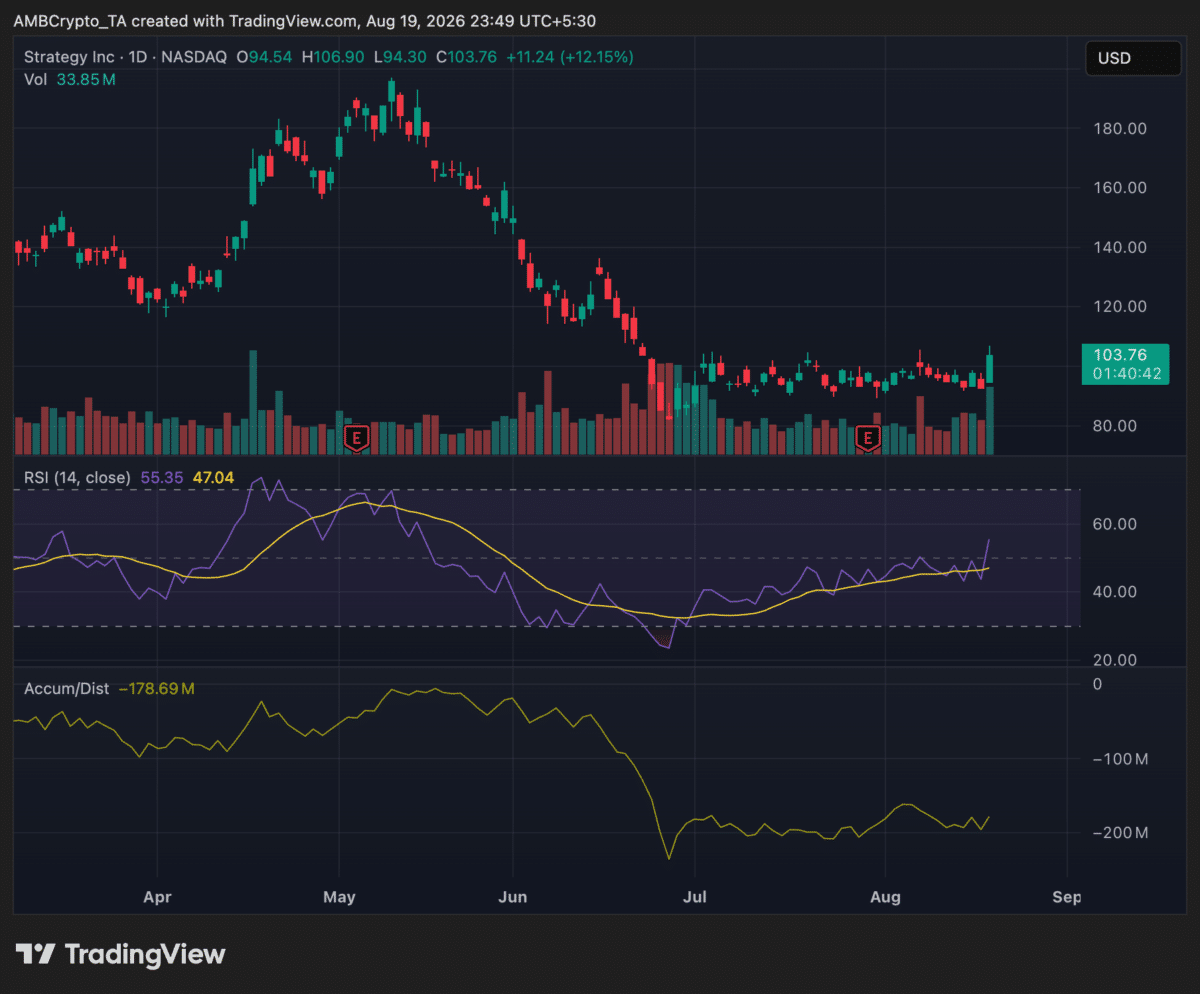
    Strategy [MSTR] shares jumped more than 12% on Wednesday as Bitcoin’s sudden recovery spilled into crypto-linked stocks.

    The price of the stock was around $103.76 after it briefly got to the $106.90 level, as Bitcoin gained a more modest 5.59%.

    For Strategy shareholders, though, the strong session comes after months of pain due to the price fall. The stock traded near $190 in May and recently fell towards $90, and Michael Saylor is still telling investors not to expect an easy ride from here.

    Bitcoin puts MSTR back above $100

    MSTR started Wednesday at $94.54. By the end of trading, it had gained 12.15%, with 33.85 million shares changing hands.

    The Bitcoin price rise provided the backdrop for the stock price move, with $BTC moving from below $65,000 to nearly $70,000 before dropping to around $68,297.

    That price move tends to matter more for Strategy than for other companies because of its relationship with $BTC.

    Source: TradingView

    Strategy owns 840,447 $BTC, so MSTR has become a way for stock-market investors to gain exposure to Bitcoin without buying it directly. The relationship can exaggerate moves in both directions.

    Wednesday showed the upside of that relationship, while the past few months showed the other side.

    But even after the rally that it saw today, MSTR still remains well below its May levels.

    Saylor tells investors to prepare for difficult years

    Meanwhile, Saylor has offered shareholders a much longer timeline.

    In response to concerns about Strategy’s falling share price and continued issuance of MSTR stock, he warned that investors should be prepared for potentially “difficult years.” He suggested common shareholders may need to think over a period as long as ten years.

    In the last few weeks, there have been changes to Strategy’s Bitcoin holdings, with the company selling 1,690 $BTC for $108.6 million between August 3 and 9, using the money to repurchase STRC preferred shares.

    It separately raised $653.1 million from MSTR share sales and increased its dollar reserve to $4.65 billion.

    With Wednesday’s Bitcoin price, the remaining $BTC that Strategy holds were worth roughly $57.4 billion, and so far the company has spent $63.36 billion to purchase $BTC.

    MSTR may have returned above $100, but both the decline $BTC witnessed earlier and Strategy’s increasingly complex financing structure continue to weigh on the investment case.


    Final Summary

    • MSTR gained 12.15% as Bitcoin’s rise towards $70,000 helped crypto-linked stocks to move higher.
    • Saylor is asking shareholders to take a long view as Strategy sells shares and occasionally Bitcoin to raise capital.

  • Bodycam captures police team falling when deck collapses in Missouri

    Bodycam captures police team falling when deck collapses in Missouri

    Recently released body camera footage shows a deck collapsing during a warrant operation in Huntsville, Missouri, injuring multiple law enforcement officers. The raid involved the Moberly Area SWAT Team, US Marshals, and supporting personnel.

  • Replay Attack Alarm Grows as BIP-110 Backers Brand Bitcoin ‘Spamcoin’

    Replay Attack Alarm Grows as BIP-110 Backers Brand Bitcoin ‘Spamcoin’

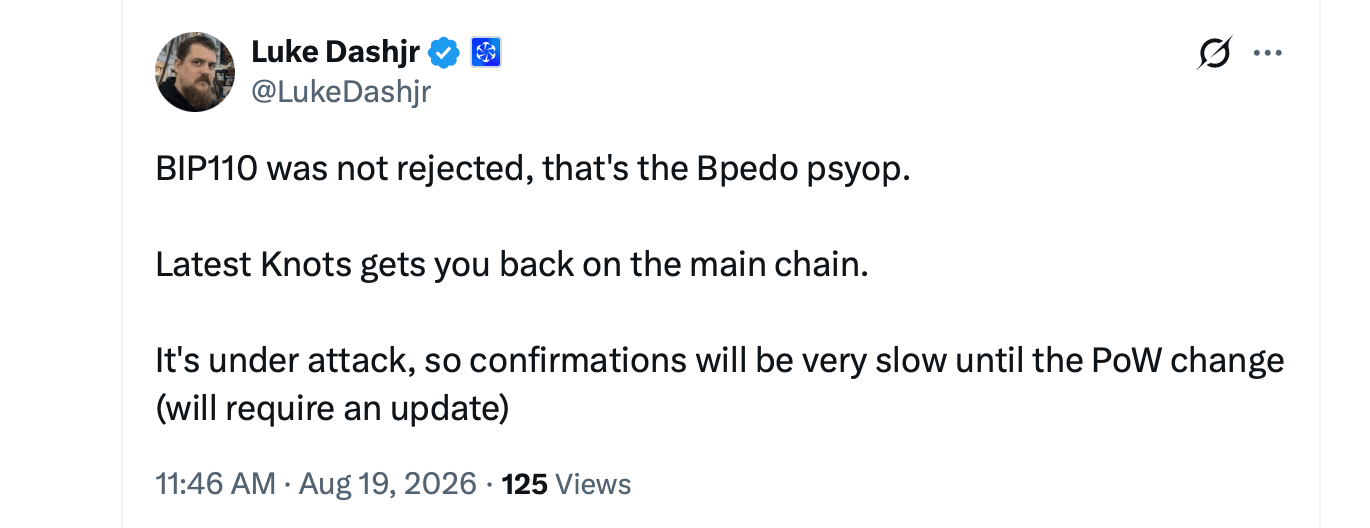
    The issue matters because Luke Dashjr and other BIP-110 supporters are discussing a hard fork that would replace the minority chain’s SHA-256d mining algorithm with BLAKE2b. Such a move would permanently create a whole new design, but the two networks would still share their transaction history from before the split.

    What Exactly Is a Replay Attack?

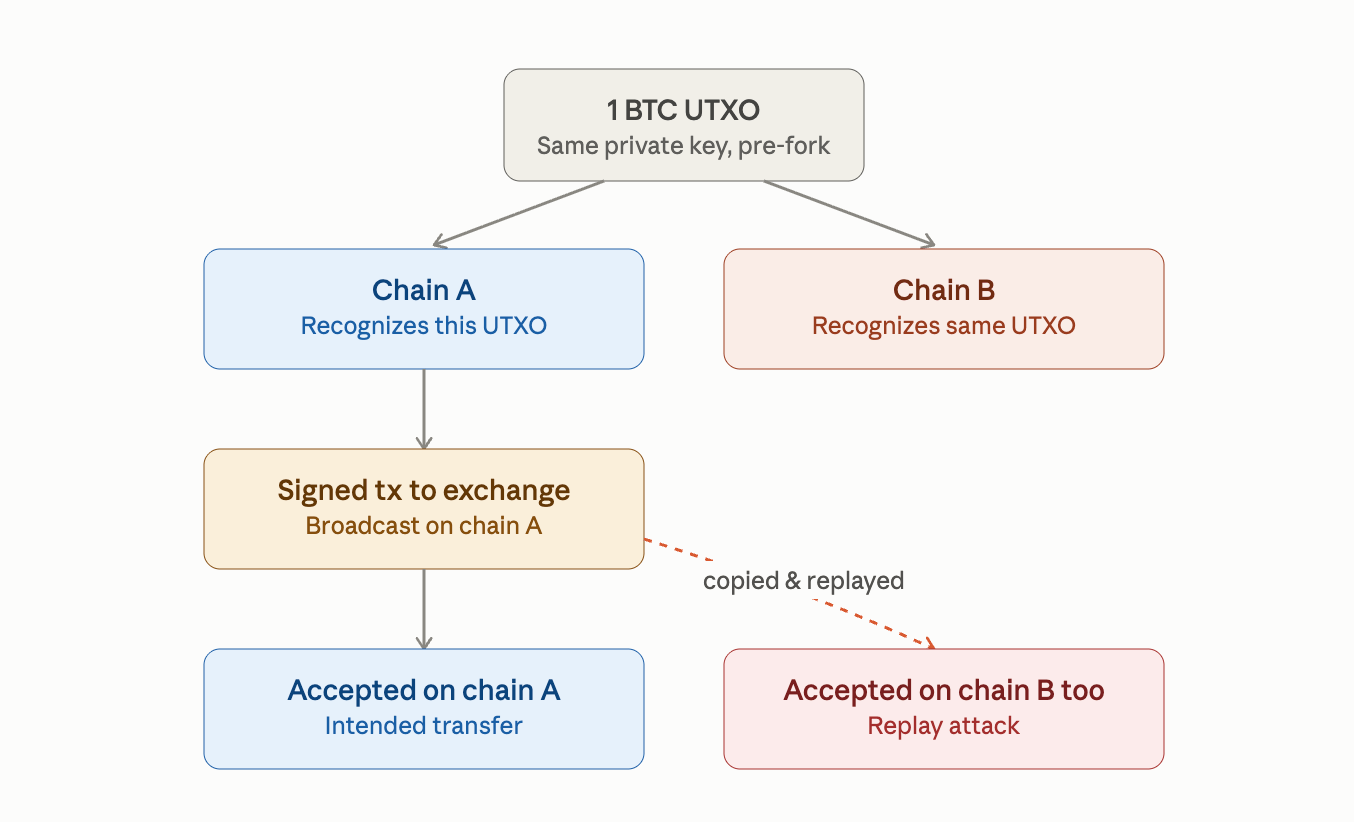
    Imagine someone holds 1 bitcoin before a hard fork. When the blockchain divides, the same historical unspent transaction output, or UTXO, exists on both networks. In practical terms, the owner controls corresponding coins on each chain with the same private key.

    Trouble begins if both networks also recognize the same transaction and signature rules. Suppose the owner sends the coin to an exchange on Chain A. If that signed transaction is also valid on Chain B, another party can copy it and broadcast it there. Chain B may accept the transaction because, cryptographically, nothing distinguishes the authorization from one intended for its network.

    A visual diagram of how a replay attack works.

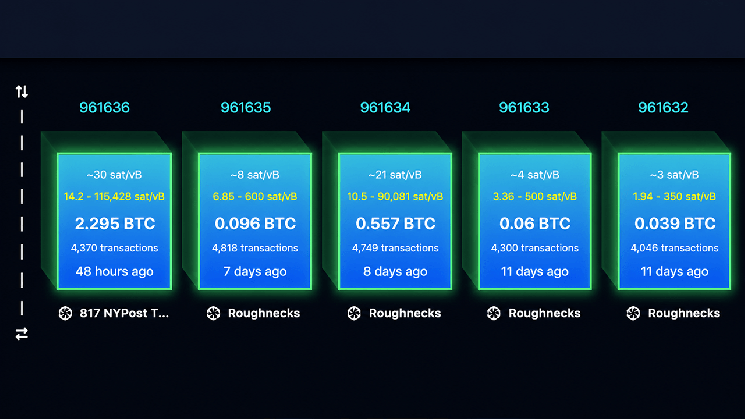
    That is a replay. Nobody steals the private key or breaks Bitcoin’s cryptography. The problem is simpler: the user created one valid authorization, but two blockchains recognize it. And while the BIP-110 chain sits at block height 961636, people spending BTC are moving BIP-110 coins, or whatever they will be called going forward, at the same time, without even knowing.

    “The overwhelming majority of these [BIP-110 minority chain] blocks are just replaying days-old transactions from the main chain,” Mempool.space developer Mononaut wrote on X. This replay protection or replay attack subject has caused a viral conversation on X over the last few days.

    Replay Protection Builds a Wall Between the Chains

    Replay protection prevents that crossover by making transactions on the competing networks distinguishable. One method changes the signature hash, commonly called sighash, so a transaction signed for one chain fails the consensus rules of the other.

    Mandatory protection makes this distinction part of the fork itself. Opt-in protection leaves ordinary transactions potentially compatible with both chains and requires users to deliberately use a chain-specific mechanism when they want to separate their coins.

    That distinction has become important for BIP-110. The emerging plan does not appear to provide automatic, comprehensive two-way replay protection. Instead, at least according to Discord discussions, Bitcoin Knots is implementing a new sighash option that can create a transaction valid on the RDTS chain but invalid under Bitcoin Core.

    Dashjr Says Protection Is the Other Chain’s Problem

    Dashjr has taken an unusual position on which network should bear responsibility. Asked Aug. 18 about replay protection for the proposed hard fork, he said, “Replay protection was Spamcoin’s responsibility since it’s the airdrop altcoin.”

    Image source: X

    He added that there would be ways to separate transactions but argued that “legitimate Bitcoin transactions need to remain valid on Bitcoin.” His reasoning rests on his assertion that the BIP-110/RDTS minority network is Bitcoin, while the overwhelmingly dominant SHA-256d Bitcoin blockchain is the breakaway network.

    Image source: X

    Dashjr has repeatedly used derogatory names for the dominant Bitcoin chain, including “Spamcoin” and “Bpedo,” a reference incorporating “pedo.” He has characterized that network as the altcoin while continuing to describe the BIP-110 branch as the legitimate Bitcoin.

    The Network Numbers Tell a Very Different Story

    That characterization collides with observable network activity. BIP-110 miner signaling peaked at roughly 2.53%, and when its consensus rules took effect Aug. 8, its minority branch produced only two immediate blocks before stalling. Bitcoin’s dominant chain continued operating while the gap widened by hundreds of blocks. A few other BIP-110 blocks have been mined at an extremely slow rate.

    The majority network retained essentially all meaningful Bitcoin hashrate, the longest chain, weight of work, liquidity, and economic recognition. The BIP-110 proposal was subsequently marked closed, while supporters moved toward plans for a BLAKE2b proof-of-work (PoW) change intended to revive the minority network.

    Moreover, the Bitcoin community is frustrated with Dashjr’s repeated claims and the intended opt-in styled replay protection being discussed is a bone of contention. “Lol. Luke isn’t gonna launch his sh**coin with replay protection, is he? I guess it won’t be listed on exchanges then,” one X user wrote on Wednesday.

    Another X user argued:

    “This has crossed the line from nonsense into bad-actor behavior. Spreading false information like this can cause real financial harm to Bitcoiners.”

    Opt-In Protection Leaves Responsibility With Users

    Under the approach now being discussed on the Bitcoin Knots Discord channel, ordinary transactions may remain replayable because RDTS intends to maintain compatibility with Bitcoin Core’s existing sighash types. Users wanting RDTS-specific protection would need to use the new sighash, requiring supporting wallet software or hardware-signing firmware.

    A conversation in the Bitcoin Knots Discord – screenshot.

    Users can also attempt to split their coins manually. A Bitcoin transaction containing data that RDTS rejects could create an output existing only on the dominant chain. Conversely, the proposed RDTS-specific sighash could produce a transaction that RDTS accepts, but Bitcoin Core rejects.

    The result looks far more like opt-in replay protection than the automatic firewall users expect from a contentious hard fork. That leaves wallets, exchanges, and holders responsible for knowing exactly which transactions can bleed across chains. The decision is strange, especially for a new chain and crypto asset with zero exchange support. Infrastructure providers, particularly crypto exchanges, are unlikely to touch a chain that chooses opt-in protection over a universal replay barrier.

    If the BLAKE2b fork proceeds around Sept. 1, replay protection will therefore be more than an obscure technical detail. It will become a practical test of whether users can safely separate assets inherited from the same Bitcoin history, even as Dashjr continues making the far larger claim that the network carrying virtually all of Bitcoin’s hashrate, liquidity and economic activity is somehow the altcoin.

  • How to Watch 2026 Little League World Series Live Online

    How to Watch 2026 Little League World Series Live Online

    If you purchase an independently reviewed product or service through a link on our website, The Hollywood Reporter may receive an affiliate commission.

    Little League Baseball‘s top 10 U.S. teams and top 10 international teams are competing once again for the World Series title. All 38 games in the 12-day tournament — taking place from Aug. 19 through 30 — will air across ESPN, ESPN2 and ABC, all three of which can also be livestreamed via DirecTV (with a five-day free trial), Fubo (with a five-day free trial), Sling and Hulu + Live TV.

    In terms of coverage, ESPN is home to the majority of games while ABC will broadcast higher stakes games including the Aug. 30 LLWS championship final.

    At a Glance: How to Watch Little League World Series 2026

    • When: Wednesday, Aug. 19-Sunday, Aug. 30 (championship game on Aug. 30, 12 p.m. PT/3 p.m. ET)
    • TV channel: ESPN, ESPN2, ABC
    • Stream online: DirecTV, Fubo, Sling, Hulu + Live TV

    Where to Watch Little League World Series 2026: Dates, Channels

    Between Wednesday, Aug. 19 and Sunday, Aug. 30, games are set to air across three key networks: ESPN, ESPN2 and ABC.

    Where to Stream Little League World Series 2026 Live Online

    Since games air across ESPN, ESPN2 and ABC, they’ll also be available to watch live on any live TV streaming service that carries said networks, namely DirecTV (with a five-day free trial), Fubo (with a five-day free trial), Sling and Hulu + Live TV.

    More on each live TV streaming option — and their new subscriber discounts — below.

    Five-day free trial; packages from $19.99 per month

    ESPN, ESPN2 and ABC are included in any of DirecTV’s signature packages: Entertainment, Choice, Ultimate and Premier. Plus, DirecTV offers a five-day free trial for its streaming service, meaning new subscribers can tune in to five days of the tournament at no cost.

    Learn more about each plan option, including how to build your own channel lineup (starting at just $19.99 per month), at directv.com.

    Fubo

    Five-day free trial; packages from $64.99 per month ($54.99 for first month)

    ESPN, ESPN2 and ABC are also available to stream with a subscription to Fubo, which similarly offers a five-day free trial for new subscribers. After the trial, plans start at $54.99 for the first month and $64.99 monthly thereafter.

    Plans from $4.99 per day or $19.99 per month

    ESPN and ESPN2 are included in Sling’s budget-friendly Essentials plan, from $19.99 per month; Sling’s Orange plan, from $45.99 per month or $4.99 per day; and Sling’s Orange & Blue plan, from $60.99 per month. In select markets, ABC is also included in the Orange & Blue plan — visit Sling.com to check station availability.

    Three-day free trial; packages from $89.99 per month

    Watch ESPN, ESPN2 and ABC with Hulu + Live TV, which offers a three-day free trial. Subscriptions come bundled with Disney+ and ESPN+, and start at $89.99 per month.

    Little League World Series Schedule 2026

    The 2026 World Series runs from Wednesday, Aug. 19 through Sunday, Aug. 30. It culminates in the Little League World Series championship game at 12 p.m. PT/3 p.m. ET on Aug. 30. See here for the full 38-game schedule.

    Little League World Series Teams 2026, Format

    The 20-team double-elimination tournament switches to a single-elimination format for the final bracket games.

    United States teams include:

    • West Side LL; Hamilton, Ohio (region: Great Lakes)
    • Bayonne Central LL; Bayonne, New Jersey (region: Metro)
    • East Side LL; West Chester, Pennsylvania (region: Mid-Atlantic)
    • Davenport Northwest LL; Davenport, Iowa (region: Midwest)
    • Paseo Verde LL; Henderson, Nevada (region: Mountain)
    • Bridgewater Joe Lazaro LL; Bridgewater, Massachusetts (region: New England)
    • Soundview LL; Tacoma, Washington (region: Northwest)
    • Phenix City Youth Baseball LL; Phenix City, Alabama (region: Southeast)
    • Boerne LL; Boerne, Texas (region: Southwest)
    • Sweetwater Valley LL; Bonita, California (region: West)

    International teams include:

    • West Seoul (B) LL; Seoul, South Korea (region: Asia-Pacific)
    • Ryde Little League; Sydney, New South Wales (region: Australia)
    • Little Mountain LL; Vancouver, British Columbia (region: Canada)
    • Los Nacionales LL; Santiago, Dominican Republic (region: Caribbean)
    • Pariba LL; Willemstad, Curaçao (region: Curaçao)
    • South Czech Republic LL; Brno, Czechia (region: Europe & Africa)
    • Joto LL; Tokyo, Japan (region: Japan)
    • Ministerio Sobre Las Alas Del Aguila LL; Leon, Nicaragua (region: Latin America)
    • Municipal De Tijuana LL; Tijuana, Baja California (region: Mexico)
    • David Doleguita LL; Chiriquí, Panama (region: Panama)
  • DEA Joins Investigation Into Hayden Panettiere’s Death, Sources Say

    DEA Joins Investigation Into Hayden Panettiere’s Death, Sources Say

    The Drug Enforcement Administration has joined the investigation into the death of Hayden Panettiere, sources familiar with the matter told ABC News on Wednesday.

    The actress, who was best known for her roles in Heroes, Nashville and the Scream franchise, died on Sunday at age 36 at an apartment complex in Greenville, South Carolina.

    The Greenville County Coroner’s Office said on Monday that her cause and manner of death remain pending further investigation, and that there were no obvious signs of trauma. However, officials were reportedly heard discussing an “overdose” and “cardiac arrest” on a 911 call at the time of her death. A police report also said her on-again, off-again boyfriend Hickerson and his brother were at the South Carolina townhouse when the actress was pronounced dead by authorities. Hickerson was later visited by police, according to a redacted police report.

    Panettiere had been open about her struggles with alcohol and opioid addiction, further detailing her experiences in her memoir, This Is Me: A Reckoning, released earlier this year.

    The Hollywood Reporter has reached out to the DEA for more information, but did not hear back at the time of publication.

    TMZ reported that DEA agents will be assisting the parallel investigations currently underway by the Greenville County Coroner’s Office and the Greenville Police Department, according to sources.

    Panettiere’s death investigation isn’t the only high-profile celebrity death that the government agency has gotten involved with in recent years. The Los Angeles Police Department also teamed up with the DEA in 2023 after high levels of ketamine were found in Friends star Matthew Perry’s system after he died at age 54.

    The lengthy multi-agency probe led to five arrests and convictions, including two medical doctors and a supplier dubbed the “Ketamine Queen,” for distributing the drugs that resulted in Perry’s death.

  • Dane Cook’s Brother Stole $12 Million From Comedian, Hid Bricks of Cash in Pasta Sauce

    Dane Cook’s Brother Stole $12 Million From Comedian, Hid Bricks of Cash in Pasta Sauce

    Uh oh, Spaghetti O’s!

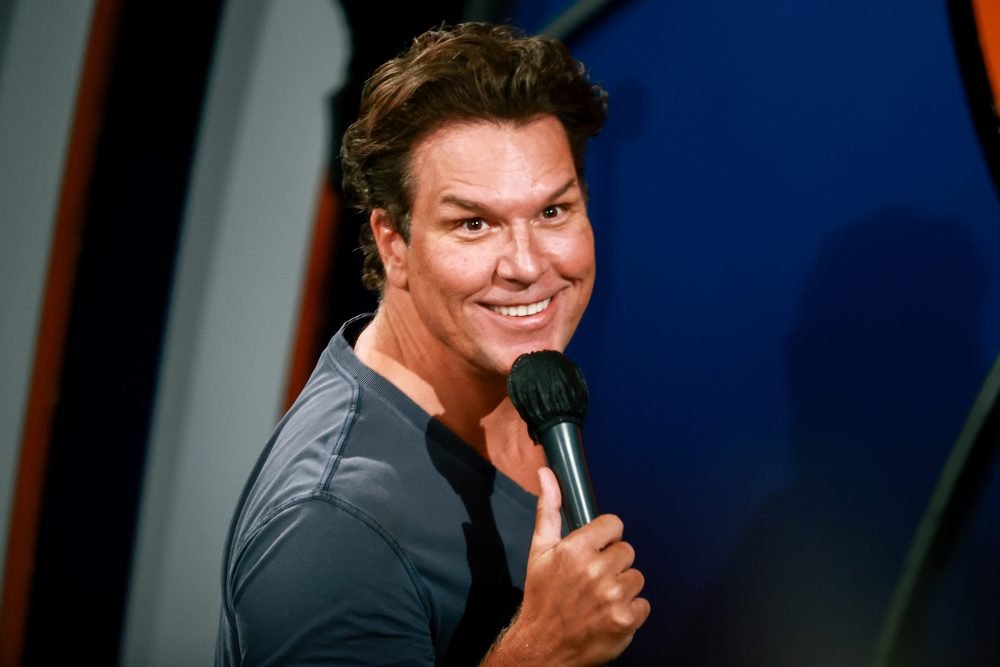
    Dane Cook‘s brother stole $12 million from the comedian and hid bricks of cash inside pasta sauce, a new documentary reveals.

    Premiering on Sept. 29, “Funny Money: The Dane Cook Story” delves into the financial drama that absorbed the blockbuster comedian in 2008, when his half-brother and business manager, Darryl McCauley, was charged with embezzling at least $12 million from Cook.

    McCauley pleaded guilty to larceny, embezzlement and other charges (along with his wife, Erika) and was ordered to pay back the $12 million. He served a six-year prison sentence and then disappeared entirely. “Where is he? What has he done? How does this end?” Cook narrates in the documentary trailer.

    In “Funny Money,” Cook says growing up, he and McCauley both wanted to be stand-up comedians. McCauley ultimately became a corrections officer, while Cook went on to become one of the most commercially successful comics of the 2000s. Cook describes McCauley in the documentary as “a person who spent so much time pretending to be something he wasn’t.”

    Working as the handler of his finances, McCauley began withdrawing sums of $20,000, $50,000 and even $100,000 from Cook’s accounts without him noticing. “I was starting to feel something that I couldn’t really identify,” Cook admits in the trailer. “Was he hiding it in different places, stockpiling this money?”

    Finally, it was revealed that McCauley had stolen a massive amount of money from his famous brother, hiding piles of cash in a safe and even wrapping it in plastic before stashing it inside pasta sauce containers — a storyline straight out of “The Bear.”

    While an investigation determined that McCauley had embezzled at least $12 million, Cook believes the amount could be even higher. “I do believe that there’s money out there,” he says in the trailer. “I believe there’s people that know more.”

    “Funny Money: The Dane Cook Story” will be available to stream on demand beginning Sept. 29.