
Author: rb809rb

  • San Sebastian to Close With ‘Le Faux Soir,’ About Media Hack in Nazi-Occupied Belgium

    San Sebastian to Close With ‘Le Faux Soir,’ About Media Hack in Nazi-Occupied Belgium

    Belgian filmmaker Michaël R. Roskam will return to the San Sebastián Film Festival to close the official selection of the 74th edition of the Spanish festival in an out-of-competition with Le Faux Soir, which will gets its European premiere following its world premiere at Toronto 2026.

    The movie “recreates one of the most curious episodes of the Belgian resistance movement during the Second World War, a clandestine operation that turned the press into a weapon against the Nazi occupiers,” according to a synopsis.

    With The Drop (2014), starring Tom Hardy, Noomi Rapace and James Gandolfini, the filmmaker won the jury prize for best screenplay at San Sebastian.

    Based on the book Le “Faux” Soir, 9 novembre 1943 by Marie Istas, the cast of the new film features Arieh Worthalter, Mélanie Thierry, Karim Leklou, Mara Taquin, Bouli Lanners, Julien Frison and François Damiens, among others. The story is set in 1943, when, having occupied Belgium, the Nazis turn the national newspaper Le Soir into their propaganda tool. “To raise the spirits of the Belgian people, a group of resistance fighters comes up with a wild idea, to print a fake edition of the newspaper mocking the occupier in what some historians consider to be the first-ever media hack,” reads the synopsis.

    Le Faux Soir is a Belgian-French co-production.

    Roskam, who worked as a journalist for the Dutch-language newspaper De Morgen, made his feature film debut with Bullhead (2011). In 2021, he directed the first three episodes of the miniseries Black Bird, starring Taron Egerton, which received Emmy and Golden Globe award nominations.

    Earlier this week, the Spanish festival unveiled Fatih Akin’s Ghost Song as its 2026 opening film. The 73rd edition of the San Sebastian festival takes place Sept. 18-26.

  • Alexa+ Is Now Free on Fire TV Devices: Here’s What the AI Tool Can Do For You

    Alexa+ Is Now Free on Fire TV Devices: Here’s What the AI Tool Can Do For You

    Amazon is making its AI-powered assistant, Alexa+, available for free on all eligible Fire TV devices in the US.

    Alexa+ is a smarter version of the older Alexa assistant Amazon launched earlier this year via compatible devices, a dedicated website, and the Alexa app. It can understand natural-language prompts and deliver responses similar to those you’d get from AI chatbots like ChatGPT and Gemini.

    An Alexa+ standalone subscription costs $19.99 per month, but Prime members can access it for free. On Fire TV devices, the deal is even better now: you can get Alexa+ at no extra cost, even without a Prime subscription.

    This offer extends to all current-generation Amazon Fire TV Sticks, the Fire TV Cube, Amazon Ember smart TVs, and smart TVs with Alexa+ built in, including those from Panasonic and Hisense.

    If you own any of these devices, no action is required from your end. “Eligible Fire TV customers are automatically upgraded to the Alexa+ experience… No app to download, and no subscription to activate. Just use your Fire TV as you normally would,” Amazon says in a blog post.

    What Can Alexa+ Do on Your Fire TV?

    Alexa+ on Fire TV

    (Credit: Amazon)

    The biggest difference between the older Alexa and the new Alexa+ lies in how each processes input. The older Alexa relied on keyword matching, meaning you needed to know a title or specific phrasing to get your desired destination.

    With Alexa+, you can just describe what you’re in the mood to watch, and then ask it to refine recommendations using follow-up prompts. For example, Amazon says you could start with “Find me a funny movie from the ‘90s,” and then refine the results with “Something the whole family can watch.”

    You can also use the AI assistant to get information about on-screen content. A sample prompt shared by Amazon says: “Alexa, how many movies has Hilary Duff been in?” followed up with: “Is she still on tour?”

    Like most other AI tools, Alexa+ will understand your context, remember preferences, and deliver more relevant recommendations over time, the company adds.

    Recommended by Our Editors

    Beyond entertainment, you can use Alexa+ to control smart home appliances. For instance, you can ask it to move a show you’re watching on a Fire TV in the living room to a Fire TV in the bedroom. You can ask it to pull up your front-door Ring camera view, and a live feed will pop up on your TV.

    Alexa+ pulls up Ring camera feed on a Fire TV device

    (Credit: Amazon)

    You can also ask it to dim your smart lights or lock your doors with a paired smart lock. Since the AI assistant has real-world information, it can also provide weather forecasts, recipe recommendations, and sports scores.

    All of these commands can be executed hands-free. If you’d like Alexa+ to use a different tone, you can also change its personality.

    Though Alexa+’s rollout on Fire TV is limited to the US at launch, Amazon said it could add additional devices and regions over time.

    About Our Expert

  • San Sebastián Sets Michaël R. Roskam’s ‘Le Faux Soir’ as Closing Night Film

    San Sebastián Sets Michaël R. Roskam’s ‘Le Faux Soir’ as Closing Night Film

    “Le Faux Soir,” a Belgian-French WWII resistance drama from “Bullhead” director Michaël R. Roskam, has been set as the closing night film of this year’s San Sebastián Film Festival.

    Playing in the festival’s Official Selection out of competition, the film will have its European premiere at San Sebastián after world premiering at Toronto, where it screens in Special Presentations. It will close the festival after the awards ceremony on Sept. 26 at the Kursaal.

    “Le Faux Soir” is produced by Belgium’s Frakas Productions and Roskam’s Harbor Men Pictures with France’s Rectangle Productions. Goodfellas handles international sales, while Cinéart will release the film in Benelux.

    Set in Nazi-occupied Belgium in 1943, the film follows a group of Resistance fighters after the occupying forces turn national daily Le Soir into a propaganda outlet.

    With commemorations of the 1918 Armistice banned, they hatch a plan to produce a fake edition of the newspaper, reproducing its paper, nameplate and format but filling its pages with articles mocking the German occupiers. The operation has been described as “the world’s first media hack.”

    Arieh Worthalter (“The Goldman Case”) leads the ensemble, alongside Mélanie Thierry (“Da 5 Bloods”), Karim Leklou (“Jim’s Story”), Mara Taquin (“Zero Fucks Given”), Bouli Lanners (“The Night of the 12th”), Julien Frison (“The Happening”) and François Damiens (“The Bélier Family”).

    The closing berth brings Roskam back to San Sebastián 12 years after his U.S. crime drama “The Drop,” starring Tom Hardy, Noomi Rapace and James Gandolfini, which won the Jury Prize for Best Screenplay in 2014.

    Roskam, who previously worked as a journalist for Dutch-language newspaper De Morgen, broke through internationally with feature debut “Bullhead.” After premiering in Berlin’s Panorama section, the film earned an Academy Award nomination for best foreign-language film and landed Roskam on Variety’s Ten Directors to Watch list.

    He later directed “Racer and the Jailbird,” starring Matthias Schoenaerts and Adèle Exarchopoulos, which screened out of competition at Venice and was selected as Belgium’s Academy Awards entry. He also helmed the first three episodes of Apple TV+ miniseries “Black Bird.”

    “Le Faux Soir” returns Roskam to the thriller territory that has marked much of his career. Roskam wrote the screenplay, with Bernard Falaise co-credited on dialogue, loosely adapting Marie Istas’ book Le “faux” Soir, 9 novembre 1943.

    The 74th San Sebastián Film Festival runs Sept. 18-26.

  • HBO Max Picks 12 European Writers for Script Engine Program

    HBO Max Picks 12 European Writers for Script Engine Program

    HBO Max and WBD Access, Warner Bros. Discovery’s talent development division, have picked the 12 European writers who will participate in this year’s Script Engine Program.

    Veteran producer and showrunner Frank Spotnitz, (The X-Files, The Man in the High Castle, Medici) will serve as lead facilitator and mentor on the four-month program which aims to help screenwriters develop original locally-rooted series concepts that they will pitch to HBO Max executives in November.

    “European storytelling has never been in greater demand,” said Spotnitz. “Audiences around the world are looking for distinctive voices and stories that reflect different cultures and perspectives, and European writers are increasingly creating work that travels internationally. Script Engine is important because it doesn’t just help writers develop their craft, it introduces them to a collaborative way of working that empowers writers to do their best work. [The program] gives mid-level writers the confidence, skills and professional mindset to build sustainable international careers.”

    The writers for the 2026 program include France’s Tolula Dada (Gangs of London, Grantchester), Justine Gautier (Petits Secrets en Famille, Leo Mattei), Storm Sigal-Battesti (Off Season, Carême); Germany’s Tunde Aladese (Transatlantic, Shuga), Stefanie Ren (A Thin Line, Nicht tot zu kriegen), and Ben Braeunlich (Tatort, Professor T.); Italy’s Tommaso Matano (Curon, Survivors), Emanuele Mochi (Zio Gianni), Simona Nobile (5 minuti prima); and Spain’s Jesica Aran (Campamento Newton, Bandidos), Lidia Fraga (Auga Seca, Montecristo) and Miguel Mayorga Moscoso.

    The four-month program includes a series workshops, masterclasses and networking opportunities led by HBO Max executives and industry experts. During the program, writers will also benefit from the expertise of HBO Max market advisors for their local territories. The curriculum was developed together with the Series Mania Institute.

    The initiative reflects HBO Max’s move to integrate its originals strategy, with both U.S. and international programming teams grouped together under HBO Max head of original programming Sarah Aubrey. HBO Max completed its European rollout this year, launching in several major territories, including Germany, France, Italy and the U.K..

  • Banking Regulator Races to Finalize GENIUS Act Stablecoin Rules

    Banking Regulator Races to Finalize GENIUS Act Stablecoin Rules

    In brief

    • OCC head Jonathan Gould said Wednesday the agency will finalize its GENIUS Act stablecoin rules by November, racing to meet a Jan. 18 statutory deadline before the law takes effect in January 2027 after blowing past an earlier July target.
    • The 376-page proposal, released in February and open for comment through May, covers the full life cycle of a payment stablecoin—reserves, redemption at par, liquidity, risk management, audits, custody and wind-downs.
    • Gould said the OCC expects to begin processing issuer applications in 2027 and reported an eightfold jump in digital-asset chartering activity versus the Biden administration.

    The top U.S. banking regulator says it will finalize its rules for stablecoin issuers by November, moving to beat a fast-approaching deadline for the country’s landmark digital-dollar law.

    Jonathan Gould, head of the Office of the Comptroller of the Currency, laid out the timeline Wednesday at the Wyoming Blockchain Symposium, an event hosted by SALT in Jackson. He said the agency is working at a rapid pace and expects to publish a final rule by November as it weighs feedback gathered from the crypto industry.

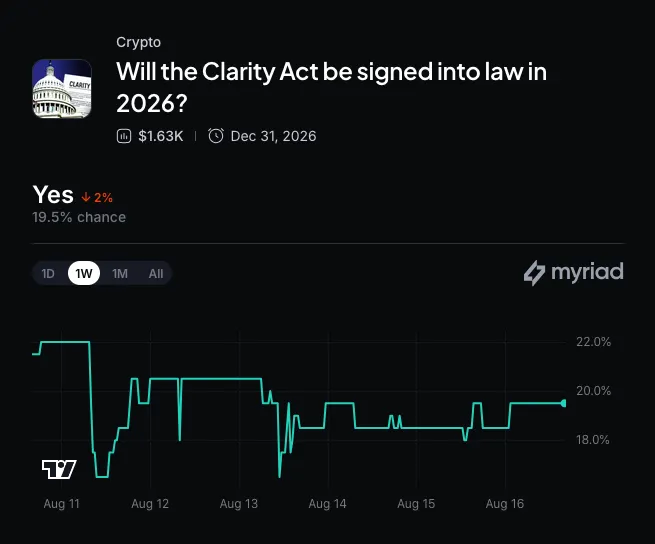
    Myriad: Will the Clarity Act be signed into law in 2026? Click to make your prediction.
    Myriad: Will the Clarity Act be signed into law in 2026? Click to make your prediction.

    “We are very intent on moving quickly and getting a final rule out by November so that we will be able to start processing applications within the new year,” Gould said.

    The rules will implement the GENIUS Act, the stablecoin framework President Donald Trump signed in July 2025. The law tasks federal regulators with writing the details governing payment stablecoins, and it takes effect in January 2027. Agencies face a statutory deadline of Jan. 18 to have regulations in place, and the OCC has already blown past an earlier July target, a slip that has fed concern about lingering regulatory uncertainty.

    The OCC’s proposal, a 376-page draft released in February and opened for public comment through May, covers the full life cycle of a payment stablecoin. The framework spells out requirements for reserve assets, redemption at par, liquidity, risk management, audits, custody and supervision, along with the process for winding down a failed issuer. Anti-money-laundering and sanctions requirements were carved out into separate rulemaking coordinated with the Treasury Department.

    Gould said the agency expects to begin processing applications from stablecoin issuers starting in 2027. He also pointed to a surge of interest in federal oversight, saying digital-asset chartering activity has jumped eightfold compared with the Biden administration, and he criticized the prior administration’s approach to crypto risk as shortsighted.

    The stakes for the industry are steep. Under the GENIUS Act, only permitted issuers will be able to offer payment stablecoins to Americans, and Treasury has separately proposed rules that would bar platforms from selling noncompliant stablecoins to U.S. customers once the law’s provisions kick in.

    The OCC did not lay out a firm date within November for the final rule.

    Daily Debrief Newsletter

    Start every day with the top news stories right now, plus original features, a podcast, videos and more.

  • China’s Pingyao Film Festival Sets 10th Edition Dates – Global Bulletin

    China’s Pingyao Film Festival Sets 10th Edition Dates – Global Bulletin

    PINGYAO PREMIERE

    The Pingyao International Film Festival will mark its 10th edition with a run set for Sept. 24–30, at the Pingyao Festival Palace in Shanxi Province. Founded in 2017 by director Jia Zhangke, the festival spans four programs: Screening, Market, Cultivation and Academics. The Screening slate will include Crouching Tigers, dedicated to emerging directors’ debut, second or third features; Hidden Dragons, reserved for Chinese-language filmmakers at a similar career stage; and Galas, showcasing major works and festival prizewinners. Films in Crouching Tigers and Hidden Dragons will compete for the Roberto Rossellini Awards and the Fei Mu Awards, with the Fei Mu Best Film prize carrying a cash award of RMB1 million ($140,000) and Best Director earning RMB200,000 ($28,000). Past editions have showcased early works from directors including Chloé Zhao, Wei Shujun and Liu Jian, among many others.

    BHOPAL BOW

    India’s Madhya Pradesh state will get its own festival platform, with the inaugural People’s International Film Festival of India (PIFFI) set for Dec. 17–20, at Rabindra Bhawan in Bhopal. Organized by the People’s Art, Culture and Education Foundation, the four-day, competitive event will screen features, shorts, documentaries and AI-assisted films, alongside masterclasses, panel discussions and a closing awards gala. Filmmaker Anwar Jamal serves as festival director, with critic Saibal Chatterjee heading programming and Ruchi Vijayvargia chairing the organizing committee. The advisory board includes directors Adoor Gopalakrishnan and Sudhir Mishra and former Film and Television Institute of India director Tripurari Sharan.

    TAIYUPIAN TRIBUTE

    The Singapore Film Society, Asian Film Archive and Taiwan Film and Audiovisual Institute will team up for Treasured Legacy: Celebrating 70 Years of ‘Taiyupian,’ running Sept. 4–6, at the Oldham Theatre in Singapore. The program, Asia’s first stop on a world touring series, will present five newly restored classics spoken in Taiwanese Hokkien and the Amoy dialect, including Southeast Asia premieres of “Zhang Di Seeks A-Zu,” “Good Neighbors,” “The Rice Dumpling Vendors” and “Romance at Lungshan Temple,” alongside the archive’s restoration of “Taming of the Princess.” A free public talk on Amoy-dialect cinema will accompany the screenings.

  • Podcast Giant Goalhanger Hires Tom Miceli to Lead TV and Film Expansion (EXCLUSIVE)

    Podcast Giant Goalhanger Hires Tom Miceli to Lead TV and Film Expansion (EXCLUSIVE)

    Goalhanger, the British podcasting giant behind series such as as “The Rest is Football,” which recently launched as a Netflix show covering the World Cup, is looking to accelerate its growth on screen with the hire of Tom Miceli.

    Miceli joins from WME in the newly created role of head of IP development and will focus on expanding the company’s TV and film business. In his new role, Miceli will lead Goalhanger’s IP development and licensing strategy, identifying opportunities across its existing shows and development pipeline and turning them into compelling television and film propositions for U.K. and international markets.

    Reporting directly to Goalhanger’s founders, he will work closely with the company’s talent, editorial teams and general managers to develop a prioritised slate, build relationships with commissioners and production partners, and lead negotiations across licensing, co-production and format-sale opportunities.

    Miceli spent more than a decade at WME in the agency’s TV division, representing producers, directors, talent, and helping lead the agency’s international format business. Most recently, he led WME’s work on Goalhanger’s Netflix partnership, which brought “The Rest Is Football” to the platform for the World Cup and the upcoming Premier League season.

    “I couldn’t be more thrilled to be joining Goalhanger, a company I have long admired both as a business and as a fan,” said Micheli. “I consume its content every day and look forward to helping bring its IP to new verticals and platforms, while preserving the quality that has enabled Goalhanger to flourish and establish itself as one of the leading media and content companies in the industry.”

    Jack Davenport, co-founder of Goalhanger, added: “Our shows are built around distinctive ideas, brilliant talent and deeply engaged audiences, creating enormous potential to develop them beyond their original formats. Having worked closely with Tom for many years, we have seen first-hand the rare combination of creative judgement, commercial experience and strong industry relationships he brings. We’re delighted to welcome him in-house, where his dedicated expertise will help us identify the right opportunities and turn them into successful television and film projects.”

    The hire comes during a period of rapid growth for Goalhanger, which was recently named Britain’s fastest-growing private company in The Sunday Times 100. The company is set to bring its biggest shows together in London for its inaugural three-day Goalhanger: The Rest Is Fest in September.

  • BitGo secures South Korea virtual asset license, says it’s the first global crypto company to do so

    BitGo secures South Korea virtual asset license, says it’s the first global crypto company to do so

    BitGo Holdings BTGO$6.5800·At close, a crypto custody company, said it became the first global cryptocurrency firm to secure a virtual asset services provider license in South Korea, giving it access to institutions in one of the world’s most active crypto populations.

    The company, which went public on the New York Stock Exchange (NYSE) earlier this year at a $2 billion valuation, established a local entity, BitGo Korea, to add to existing regulated units in the U.S., Singapore, Germany, and Dubai. The Korea Financial Intelligence Unit (KoFIU) approval covers virtual asset custody and transfer services for institutional and enterprise clients, BitGo said Wednesday.

    South Korea’s retail crypto traders are considered to be particularly active, with daily volumes on local exchanges regularly outpacing those of stocks during peak periods. Now, the institutional crypto market is drawing increasing attention as retail trading is hit by a weak global crypto market that saw volumes drop and the two largest exchanges, Upbit and Bithumb, report slumping first-half retail trading profit.

    “Korean institutions are looking for infrastructure that combines institutional-grade security with local support and regulatory alignment,” said Abel Seow, managing director at BitGo.

  • US-based economics magazine Forbes announced that Bitcoin could become a neutral reserve asset for the global economy!

    US-based economics magazine Forbes announced that Bitcoin could become a neutral reserve asset for the global economy!

    The US-based business and economics magazine Forbes has suggested that Bitcoin could play a significant role as a neutral reserve asset in the global financial system in the future. According to the magazine, Bitcoin has the potential to offer an alternative to the growing debate surrounding the US dollar’s reserve currency status and the current system’s reliance on US government bonds.

    Forbes’ assessment stated that the dollar’s status as the global reserve currency provides significant advantages to the United States. While this status makes it easier for the US to secure financing, it also highlighted a structural problem known as the “Triffin Dilemma.” According to this concept, it is becoming increasingly difficult for the US to simultaneously meet its own economic needs and manage the world’s demand for reserve currency.

    The magazine stated that the current system attracts global capital to the US and allows American consumers access to imported goods at lower costs, but this weakens domestic competitiveness and deepens trade deficits. It noted that since the end of the gold standard, the system has largely been sustained through US bonds, but fundamental contradictions remain unresolved.

    Forbes argued that stablecoins also cannot fully solve the reserve asset problem because these assets are largely backed by US government bonds. While gold is a neutral reserve asset, it has some limitations in terms of portability, verification, and transaction efficiency.

    In contrast, it has been suggested that Bitcoin, with its fixed supply, lack of need for government credit guarantees, and ease of verification and transfer on a global scale, could become a new generation of neutral reserve assets.

    According to Forbes, while the dollar will continue to be used in international trade, Bitcoin could eventually assume the role of a reserve asset, reducing the global economy’s dependence on a single country’s debt instruments. However, the magazine also highlighted that obstacles such as price volatility and limited institutional adoption need to be overcome.

    *This is not investment advice.