Ashley Gold is joining Semafor as senior technology correspondent, taking on a key role in coverage including AI and global politics.
Gold joins from Axios, where she was senior tech policy reporter and co-authored the AI+ Government newsletter. She will start on Sept. 8 and report to Semafor’s senior Washington editor, Elana Schor.
Before Axios, Gold worked at The Information, Politico and the BBC. She’s broken stories on the Trump and Joe Biden executive orders on AI and Congress’ efforts to regulate social media, as well as the Department of Government Efficiency’s impact on technology and government.
Semafor launched in 2022, and has doubled the size of its Washington newsroom since then. Gold also will work with tech editor Reed Albergotti, who with other journalists has broken stories including Microsoft’s $10 billion investment in OpenAI and the Pentagon’s rift with Anthropic.
Semafor Editor in Chief Ben Smith said in a statement, “Technology is perhaps the most important policy area facing Washington — not to mention Brussels and Beijing. Ashley will help us own this coverage with the editorial judgment it deserves.” Gold said that she looks “forward to breaking big stories for Semafor’s global audience of decision-makers and working with some of the most talented journalists in Washington and the world.”
Music is everywhere, but the general population doesn’t want to hear what you’re listening to on the subway. You need a pair of headphones or earbuds to cultivate your own private Idaho soundscape, but you don’t need to shell out more than a Benjamin right now to get one of the best pairs of casual earbuds on the market.
Why? Because Best Buy has the Apple AirPods 4 on sale right now for $30 off, bringing the $129.99 list price down to $99.99. They might be the company’s most affordable wireless earbuds, but I’m sure you know—anything Apple puts its name on comes out of the factory looking (and sounding) fly, so this sale makes it the perfect time to grab a pair of your own.
Apple AirPods 4
Personalized Spatial Audio, H2 chip, Voice Isolation, 30 hours of total listening
As Apple’s entry-level wireless earbuds, the AirPods 4 don’t automatically come with active noise cancellation, but you can buy the version that does, which is currently our top pick for open earbuds. However, the AirPods 4 without active noise cancellation are a far more economical choice, since they’re about $80 cheaper with this deal right now. So, if you don’t care about drowning out the world around you, these earbuds are perfect for you.
Besides looking cool, the AirPods 4 also deliver exceptional audio performance right to your ears. The bass is impressive, and the highs are extra crisp—all made more immersive by Personalized Spatial Audio with dynamic head tracking to make you feel like you’re in a movie theater. And thanks to Apple’s newest H2 chip that supports Voice Isolation to reduce background noise, even your calls sound crystal clear.
What if you need to ask Siri a question? Well, since AirPods are nestled deeply within Apple’s ecosystem, you can summon the voice assistant with a simple “Siri” or “Hey Siri.” And if she asks a question, you can respond with a simple shake of your head for “yes” or “no.” Pretty neat! The cherry on top is an impressive 30-hour total battery life (when you consider the charging case) and the fact that both the case and the buds themselves are IP54-rated for dust, sweat, and water resistance.
In our detailed review, PCMag expert Tim Gideon gave the AirPods 4 an “Excellent” rating, calling their audio performance “exceptional” for an open-ear design. So grab a pair of these excellently affordable buds for yourself!
With 38 hours remaining in its campaign, Felicia Day‘s “The Guild” reunion movie has broken the record for highest crowdfunded movie in history, which was set by the “Veronica Mars” film project with $5,702,153 in 2013.
As of Thursday at 8:30 am ET, Day’s “The Guild: Ren Faire’d” hit $5,704,000 raised by a combined 37,455 backers.
Critical Role’s “The Legend of Vox Machina” still holds record for biggest TV show Kickstarter, raising $11.39 million from 88,887 backers in 2019. After the campaign broke records, Amazon’s Prime Video picked up the animated series, and last year renewed it for a fifth and final season.
Created, written by, and starring Day, “The Guild: Ren Faire’d” will reunite the characters from Day’s popular web series “The Guild,” including Codex (Felicia Day), Zaboo (Sandeep Parikh), Vork (Jeff Lewis), Tink (Amy Okuda), Clara (Robin Thorsen), and Bladezz (Vincent Caso), who will continue their story in “the same independent, community-driven spirit that made the original series a defining part of online fandom and geek culture.”
“The Guild: Ren Faire’d” cast will also include Nathan Fillion, Misha Collins, and Wil Wheaton.
“Becoming the most-funded movie in Kickstarter history is completely surreal,” Day said in a statement. “We started this campaign because we wanted to prove there was still a way to make something weird and wonderful with the people who actually want to see it, instead of waiting for someone to give us permission. And once again, the Guildies showed up in a way I never could have imagined. I’m overwhelmed, incredibly grateful, and so incredibly pumped to go make the movie they deserve. But mostly grateful. As the community says, suck it suits!”
As Variety reported earlier this week, Day said “The Guild: Ren Faire’d” applied for and was denied a California tax credit, making the fundraising efforts even more impactful to the project.
“I’ve talked to many other productions who have not gotten it, and I can’t name people, but they had A-list stars in them,” Day said. “There was an A-list showrunner, the first round they were knocked out. Having learned that only 5% of the money goes to anything under $10 million, that category is extremely competitive.”
Day said the credit “should be automatic” for any projects under $10 million. Currently, 5% (or $37.5 million) of the California Film Commission’s allotted film and TV tax credit funds is earmarked for independent projects under $10 million and another 5% goes to independents above $10 million.
“That is the way you revitalize this industry, not hoarding all the money for a couple $500 million projects where A-list stars are benefiting and A-list producers and big studios are benefiting, and then indies just don’t have a chance to stay in L.A.,” Day said. “I don’t want to move to Atlanta for two months, so I’m going to have to rewrite my script to make it work here. And if I can’t, then we’ll have to do something. But the fact that it’s so difficult and the price difference is so much is very upsetting.”
TL;DR: New users can get lifetime access to AI Invoice Maker for a one-time $19.99 (MSRP $39.99), with AI-assisted invoicing, nine PDF templates, receipt scanning, and support for 150+ currencies.
The app is designed for freelancers, consultants, contractors, tradespeople, and small businesses. AI-assisted creation handles the initial formatting, while nine PDF templates let users choose a layout that suits their brand.
Receipts and job sheets can be scanned to import billing information, reducing manual data entry. Automatic invoice numbering keeps records organized, and the client directory speeds up repeat billing.
Users can save frequently billed products and services, schedule recurring invoices, and apply tax rates. Support for more than 150 currencies makes the app practical for professionals working with international clients.
Finished invoices can be exported as PDFs and shared through email, messaging apps, or channels. Reports summarize billing activity, while CSV export moves data into bookkeeping and analysis workflows.
AI Invoice Maker works across iPhone, iPad, Mac, and Apple Vision.
Prices subject to change. PCMag editors select and review products independently. If you buy through StackSocial affiliate links, we may earn commissions, which help support our testing.
About Our Expert
StackCommerce Team (Sponsored)
Experience
Products featured in these stories are selected by our partners at StackCommerce. If you buy something through links on our site, PCMag may earn an affiliate commission.
The $34.5 billion mega-merger with Cox was announced in May 2025, with Charter, the second-largest cable company in the U.S. behind Comcast acquiring Cox, another cable giant with 6 million subscribers. The FCC approved it earlier this year.
“These transformative transactions create the leading broadband and video company in the nation and the fastest-growing mobile provider in its footprint, with seamless connectivity and video entertainment, and high-quality customer service delivering powerful benefits for customers, local communities, employees and shareholders,” the cable giant said.
“The addition of Cox to the Spectrum footprint is one that can be celebrated by customers, employees and investors alike,” said Chris Winfrey, Charter president and CEO. “Together, we will bring the best products, at the best price, coupled with the highest level of customer service to more customers across our expanded 45-state Spectrum footprint. And Cox employees will soon have access to all the programs and benefits that have made Charter an employer of choice where its 100 percent U.S.-based employees can build long-term careers.”
He added: “The market has changed considerably over the past decade, and regional providers like Spectrum are competing with national and even global connectivity and entertainment companies. Today, with expanded scale, we are better positioned to compete and continue investment in our products and service, tools and platforms, and to further the capability and reach of our Spectrum Fiber Broadband Network.”
Eric Zinterhofer, who had served as chairman of Charter’s board, added: “Congratulations to Chris, the Charter team and the Cox family for completing an industry-transforming transaction. I look forward to serving as lead independent director as Alex Taylor becomes Charter’s next chairman.”
Cable pioneer and Liberty Broadband chair John Malone shared: “When Liberty first invested in Charter more than a decade ago, we saw an opportunity to build scale behind a great management team and operating model. The combination of Charter and Cox creates a stronger, more competitive company to further invest and innovate, while giving Liberty Broadband shareholders a direct interest in its future.”
Taylor touted the deal as well. “For generations, my family has believed in building businesses that matter and stand the test of time,” he highlighted. “The broadband industry has shaped how people live, work and connect with one another, and we believe deeply in its future. I look forward to partnering with Chris and the board to build on a proud legacy and create long-term value for our shareholders, customers, employees and the communities we serve.”
Within a year following the transaction’s close, the firm will change its parent company name to Cox Communications but will continue to operate as Spectrum across all markets. The company will remain headquartered in Stamford, Conn., keeping “a significant presence” in Atlanta.
“To welcome its new customers, Spectrum is offering a free year of mobile service to Cox internet customers who don’t already subscribe to Cox Mobile; the first of many benefits Spectrum will
offer,” the company also said on Thursday. “In mid-September, Spectrum plans to launch its entire suite of products to all consumers, including existing customers, in former Cox markets offering Spectrum’s simple and transparent pricing and packaging, greater value and more opportunities to save.”
Helsinki is to host a new awards ceremony, to be known as The Freyas, which will celebrate Nordic film and TV talent, bringing together the region’s leading filmmakers as well as international industry guests.
The first-ever edition of The Freyas – also known as the Nordic Film & TV Awards – will launch on Sept. 22 at the iconic Finlandia Hall in Helsinki. The ceremony will be held while Helsinki Intl. Film Festival’s industry event, the Finnish Film Affair, is in progress (the FFA runs Sept. 23-25).
The awards will honor outstanding achievements by directors, actors, producers, cinematographers, screenwriters and composers, among others, across the five Nordic countries – Finland, Sweden, Norway, Denmark and Iceland.
“The Nordic countries have an extraordinary tradition of storytelling, and right now the world is paying attention,” Kirpi Uimonen, one of the founders of The Freyas, said. “The Freyas is about celebrating that talent at home while also creating a stronger international platform for Nordic creators, stories and ideas. We want the world to know not only the films and series coming from the Nordics, but also the Nordic professionals who continue to enrich the global ecosystem with their talent and creativity.”
The Freyas is conceived as a travelling event, rotating between the Nordic countries. Following the Helsinki edition, the awards will travel to Copenhagen (2027), Stockholm (2028), Oslo (2029) and Reykjavík (2030).
The initiative was conceived by Kirpi Uimonen, Joonas Nurmi, Tina Jøhnk Christensen and Anke Hofmann, among other film, TV and awards professionals in the Nordic region and the U.S.
Among the international guests at the inaugural event will be members of the press, film and television executives, actors, directors, producers, distributors, agents, financiers and festival representatives, alongside the Nordic talent being celebrated.
Partners of the Helsinki event include The Icebreaking Company, Strawberry, Kämp Hotel, Finlandia Hall and the Finnish Film Affair.
Roosa Toivonen, The Freyas’ head of industry and talent, told Variety that presenters and jury members in attendance will include actors Alexander Karim (Sweden), Nanna Blondell (Sweden), Ville Virtanen (Finland), Pekka Strang (Finland), Sara Soulié (Finland), Emmi Parviainen (Finland) and Oona Airola (Finland); directors Zaida Bergroth (Finland), Selma Vilhunen (Finland), Dome Karukoski (Finland), Juha Wuolijoki (Finland) and AJ Annila (Finland); and producers Madeleine Ekman (Sweden), Gudny Hummelvoll (Norway), Sofie Wanting Hassing (Denmark), Andri Ómarsson (Iceland) and Jani Pösö (Finland).
Further jury members and presenters will be announced shortly.
Flock Safety’s OS Investigate ships with 69 prewritten prompts that give police AI access to plate scans, arrest records, and commercial databases holding Social Security numbers and relatives.
Wired reports that 41 of the prompts require no special permission, and 14 need no plate, name, or description— just a place, a time, and a pattern of behavior.
One prompt finds a car’s “associates” by how often other vehicles appear at the same cameras within two minutes, flipping Flock’s promise that it doesn’t track people.
Flock Safety, the surveillance company whose cameras log vehicles across more than 6,000 U.S. communities, has built an AI tool that can identify and follow drivers using nothing but their movement.
The findings come in a report from Wired after it pulled the system’s code from files on Flock’s own site served to anyone who loaded its login pages.
The software—first called Nightshift, now renamed OS Investigate—is still in development and in testing with a small group of law enforcement partners, the company said.
An officer opens a chat box and picks from a menu of 69 canned prompts, or writes their own. One built-in query lists “witnesses” as the vehicles most seen in a neighborhood over the past two weeks.
Another finds everyone arrested more than twice in two years—exempting only drug offenses—then builds dossiers on the top three. A “workup” turns a name and birth date into relatives, phone numbers, and online accounts pulled from police records and commercial data brokers.
Fourteen of the prompts need no plate, name, or description at all. The officer supplies a location, a window of time, and a behavior—cars that hit three retail stores in three days, or several banks in a week—and the system returns the people who fit. A filter strips out buses and delivery vans, so an ordinary driver making those rounds stays on the list.
The associate-finding logic is spelled out in the code. It counts how often other plates appear at the same cameras within a two-minute window of a target car, flags any that show up three or more times above a 0.75 confidence score, and hands back up to 20 names.
“I don’t know how else to say this, but this sounds completely insane,” Noel Pichardo, a former Pawtucket, Rhode Island, police officer who reviewed the prompts, told Wired. “I don’t know how anyone can argue against the idea that Flock literally tracks people.”
Jay Stanley, a senior policy analyst at the ACLU, said the gap between what Flock’s cameras can do and what the company is already doing leaves “very little space… like China.”
Flock has long told the public its technology “cannot recognize, identify, or track individuals” and is “not for watching people.” Spokesperson Paris Lewbel called OS Investigate a separate product from the company’s license-plate readers, built to help investigators work across records their agencies already hold, and said its capabilities may change significantly before any wider release. The company didn’t dispute Wired‘s reporting.
The confrontation has already spilled into the streets. In June and July, activists spray-painted, taped over, and destroyed Flock cameras across the country; The Guardian counted at least 33 incidents across 23 states. The anger tracks with how police have actually used the network. A report by the Institute for Justice found over two dozen cases of officers resigning or being arrested for allegedly using license-plate readers to stalk current or former partners.
The pushback has reached Capitol Hill, where Rep. Thomas Massie’s planned bill would withhold federal funding from agencies that deploy the technology.
Researchers have built AI-generated patterns that confuse the plate-reading software, and Flock isn’t alone in pushing the boundary: Meta has patented cameras that recognize faces and log a person’s actions.
Daily Debrief Newsletter
Start every day with the top news stories right now, plus original features, a podcast, videos and more.
“Forza,” a family sports drama from Riva Studios, will open theatrically in Indonesia in late 2026, with an international rollout to follow in early 2027.
The studio also released the film’s teaser.
“Forza” marks Riva Studios’ first live-action feature. The independent production company was co-founded by Balsamo and Tara Sibel Demren and has bases in the U.S., France and Italy. The project also serves as Balsamo’s directorial debut. Shot on location in both Indonesia and Italy, the production draws on several languages and cultural backdrops.
The story centers on Bima, an 11-year-old boy from a struggling Bali community who hopes soccer can help support his family. Newcomer Ghazi Alhabsyi plays the role. A chance encounter with Marco Cagliostro, a veteran player near retirement played by Balsamo, sets Bima on a path toward a tryout with AC Milan’s youth academy in Italy.
Adhya Pictures will distribute “Forza” in Indonesia. Additional international sales agents and territorial partners are expected to be named in the coming months as the film heads toward its wider release.
Riva Studios is betting on a market it sees as underused given its scale. Indonesia’s population tops 280 million, and the country logged about 126.2 million cinema admissions in 2024, with domestic films setting a new high of 80.2 million admissions, or 65% of the total. Screen count remains comparatively low at around 2,350 nationwide, which the studio views as headroom for growth.
Atiqah Hasiholan, Oka Antara, Tio Pakusadewo, Rifnu Wikana, Yoriko Angeline, Arie Kriting and Ruth Marini round out the Indonesian ensemble. Alhabsyi, Demren and Lodovico Costacurta all make their acting debuts in the film, joined by Alessandro Costacurta, a former AC Milan and Italian national team defender.
Music supervisor Nigil Mack put together the soundtrack, pulling in tracks from Coast Contra, Kamauu, Dev Lemons, Mayday and Indonesian artist Saykoji.
“This project has been a long time coming, and it is deeply personal to me. Forza is a testament to what independent filmmaking can achieve when people across countries and cultures unite behind a shared vision. We cannot wait for audiences around the world to experience Bima’s journey and, hopefully, see a part of themselves in it,” said Balsamo, writer and director of “Forza.”
Demren, producer and co-founder of Riva Studios, said soccer serves as “a shared language that transcends borders, cultures and generations,” adding, “at its heart, the story is about finding belonging through a passion that unites us, no matter where we come from.”
Balsamo and Demren launched Riva Studios in 2022. The company works in both live action and animation, developing original film and television with partners spanning Europe, Asia and the U.S. It expanded into animation in December 2024 by acquiring TeamTO, a French studio counted among the continent’s top players in the space.
Hyperliquid, a leading decentralized perpetuals exchange, has burned approximately $4.24 million worth of its native $HYPE token over the past 24 hours. The burn was fueled by roughly $4.4 million in trading fees generated on the platform during the same period, according to data from blockchain analytics firm Onchain Lens.
How the Hyperliquid Burn Mechanism Works
Hyperliquid uses a deflationary token model where a portion of the platform’s trading fees is used to repurchase and permanently remove $HYPE tokens from circulation. This process reduces the total supply over time, potentially increasing scarcity for remaining holders. The latest burn represents a significant daily amount, reflecting strong trading activity on the exchange.
The burn mechanism is part of Hyperliquid’s broader tokenomics, which aims to align the interests of token holders with the platform’s long-term success. By consistently removing tokens from the market, the protocol can counterbalance inflationary pressures and reward long-term participants.
Market Context and Implications
The $4.2 million burn comes amid a period of heightened activity in the decentralized finance (DeFi) sector. Hyperliquid has positioned itself as a major player in perpetual futures trading, offering low fees and high-speed execution. The platform’s daily trading volume has consistently ranked among the top in the industry, driving substantial fee generation.
This burn event also highlights the growing trend of token buybacks and burns among crypto exchanges. Similar mechanisms have been adopted by platforms like Binance and FTX (prior to its collapse), though Hyperliquid’s approach is notable for its on-chain transparency and automated execution.
Why This Matters to Traders and Investors
For $HYPE holders, the burn represents a direct reduction in supply, which can support price appreciation if demand remains steady. It also signals that the platform is generating real revenue from user activity, a positive indicator for sustainability. However, investors should be aware that burns do not guarantee price increases, as market conditions and broader sentiment play a significant role.
From a broader perspective, Hyperliquid’s burn activity reflects the health of the DeFi ecosystem and the growing adoption of decentralized trading platforms. As more users seek alternatives to centralized exchanges, protocols with strong tokenomics and transparent operations are likely to gain traction.
Conclusion
Hyperliquid’s $4.2 million $HYPE burn in a single day underscores the platform’s robust trading volume and its commitment to a deflationary token model. While the burn is a notable event, its long-term impact on $HYPE’s price and the platform’s competitiveness will depend on sustained user engagement and market conditions. As always, investors should conduct their own research and consider the risks associated with cryptocurrency investments.
FAQs
Q1: What is a token burn? A token burn is the process of permanently removing tokens from circulation, reducing the total supply. This is often done to increase scarcity and potentially support the token’s value.
Q2: How does Hyperliquid generate trading fees? Hyperliquid charges fees on each trade executed on its platform, similar to traditional exchanges. These fees are then used to buy back and burn $HYPE tokens.
Q3: Does a token burn guarantee a price increase? No, a token burn alone does not guarantee a price increase. While reducing supply can create upward pressure, other factors such as market demand, competition, and overall sentiment also influence price.
Related Reading
FalconX Moves $14M in $HYPE to Gate, Fueling Speculation of Sell Pressure
Multicoin Capital-Linked Wallet Moves $4.4M in $HYPE to Coinbase Prime
Solana Stablecoin Active Addresses Hit Record 1.7 Million
$HYPE Drops 3.10% in Five Minutes, Trading at $69.51
Trump Says CFTC Working to Bring Hyperliquid’s Perpetual Futures to U.S. Market
The $BTC price prediction turns constructive after price broke decisively out of a months-long consolidation pattern, touching levels not seen since early June. The move triggered the largest wave of forced short covering in crypto’s history, even bigger than the shorts wiped out during last October’s record crash.
Bitcoin Price Analysis: Will Bitcoin Price Go Up After Breaking the Bear Market Resistance Band?
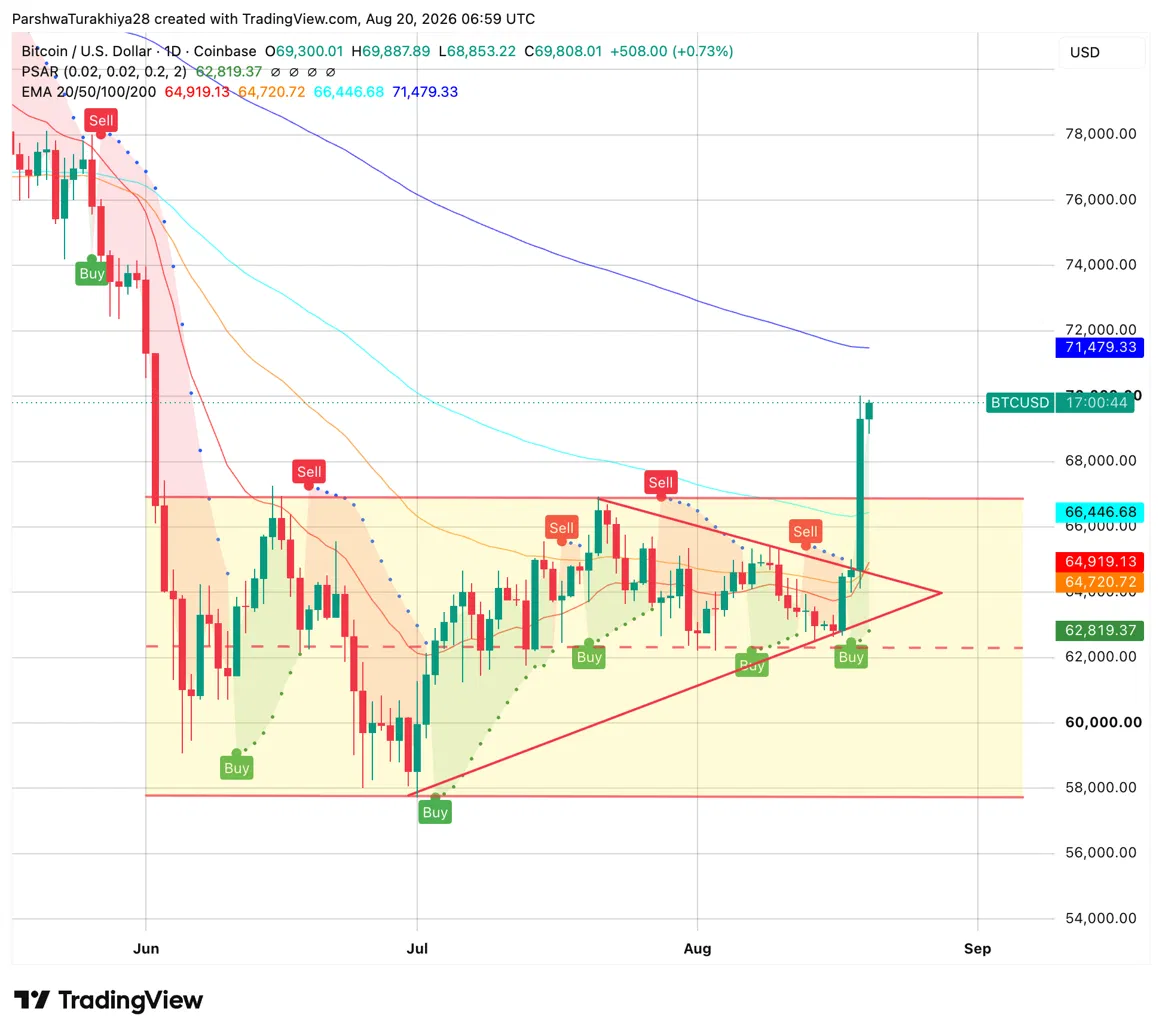
Bitcoin Price Analysis (Source: TradingView)
$BTC has spent since late May consolidating inside a symmetric triangle, bouncing between roughly $58,000 and $67,000 as the range steadily narrowed. Price broke sharply above that triangle’s upper boundary this week, surging from Wednesday’s low near $64,100 to touch nearly $69,900, a move of more than $5,700 in a single session.
The Parabolic SAR flipped bullish at $62,819.37, confirming the shift in short term trend. All four EMAs now sit below current price for the first time in months, with the 20-day at $64,919.13 marking the nearest support, followed by the 50-day at $64,720.72 and the 100-day at $66,446.68. The 200-day EMA at $71,479.33 sits just overhead and is the next real hurdle.
Why Cowen Says Bitcoin Faces a Real Test Here?
Analyst Benjamin Cowen framed the move as Bitcoin rallying back into what he calls the bear market resistance band, a zone that has capped every recovery attempt this cycle.
Cowen noted Bitcoin has closed above its 200-day moving average, historically a mixed signal, sometimes preceding a real trend change and sometimes a false start followed by another leg down, as seen in parts of 2014, 2019, and 2022.
Related: Chainlink Price Prediction Points To $14.50 As Cup And Handle Breakout Confirms
He said the real test is whether Bitcoin can push through this band and hold it as support on a retest, rather than simply topping out here again.
$BTC Support and Resistance Levels, August 20, 2026
Bitcoin News: Shorts Lose $2.74 Billion in Largest Squeeze on Record
Traders betting against Bitcoin lost nearly $2.74 billion in 24 hours as price surged toward $70,000, the largest wave of forced short closures in records going back to 2021, according to CoinGlass data. Total liquidations across all crypto reached almost $3 billion across more than 172,000 traders, with shorts accounting for roughly 92% of that total against just $257 million on the long side, a ratio of more than ten to one.
The comparison that gives the figure its weight is October 2025, when Bitcoin crashed days after hitting a record above $126,000, producing $19 billion in liquidations in a single day, still the largest deleveraging event in crypto history. Shorts made up $2.47 billion of that crash. Wednesday’s short liquidations were larger than that entire figure, without any comparable damage on the long side.
The squeeze was fast and concentrated. More than $1 billion in Bitcoin shorts closed in roughly an hour, totaling $1.42 billion for the full day. Ether shorts accounted for $1.13 billion and Solana $104.67 million. The single largest position wiped out was a $48.8 million Bitcoin trade on Hyperliquid.
Bitcoin News: Treasury Doubles Bond Buybacks, Trump Pushes Clarity Act
Bitcoin is surging hard on the news that the U.S. Treasury is going to buy back $4B of debt to “increase liquidity support by at least double”
Analyst Joe Consorti pointed to a Treasury announcement as the direct trigger for Bitcoin’s move, noting the Treasury will buy back $4 billion of long-term government debt to boost liquidity, double its prior $2 billion pace for bonds maturing in 10 to 30 years. Traders read the move as inflationary and bullish for hard assets like Bitcoin, sending bond yields lower and the dollar index down 0.8%.
JUST IN: 🇺🇸 President Trump says “We need Congress to take the next step by passing The Clarity Act.”
“And this landmark structure legislation is very, very powerful structure which will keep us ahead of China, keep us ahead of everyone else.” pic.twitter.com/0BwWWQcySP
— Bitcoin Magazine (@BitcoinMagazine) August 19, 2026
Separately, President Trump called on Congress to pass the Clarity Act, describing the crypto market structure legislation as powerful and necessary to keep the U.S. ahead of China and other countries in space.
Bitcoin Derivatives: Watch Whether $69,000 Holds
With the bulk of short positioning now cleared out, the key question is whether Bitcoin can hold above $69,000 through the coming sessions.
A squeeze this large removes the very positioning that fueled the rally, and moves built heavily on forced buying rather than fresh organic demand have historically given back some of their gains once the squeeze pressure fades.
$BTC Price Prediction: Upside and Downside Targets
Bullish Case, Target: $71,479.33 (200-day EMA)
$BTC holds above $69,000 through the Asian and European sessions, confirming the breakout wasn’t just a short squeeze fading out. Treasury liquidity support and progress on the Clarity Act add fundamental tailwinds, while a daily close that holds the bear market resistance band as support, the scenario Cowen flagged as the key signal, would strengthen the case for continuation. Clearing this zone opens the path toward the 200-day EMA at $71,479.33.
Bearish Case, Risk Level: $64,720.72 (50-day EMA)
Bitcoin gets rejected at the bear market resistance band once again, consistent with the pattern Cowen highlighted from 2018 and 2022, where similar sized rallies into August ultimately failed and gave way to lower prices later in the year. With short covering fuel now spent, the rally loses momentum without fresh buying to replace it, and $BTC falls back through the 20-day EMA at $64,919.13 toward the 50-day EMA at $64,720.72.
Conclusion
This rally has two distinct engines, a Treasury liquidity move that gave bulls a real fundamental reason to buy, and a short squeeze that then amplified the move mechanically once price
FAQs
What is the Bitcoin price prediction right now?
$BTC trades at $69,808.01 after breaking above a descending triangle. The bullish target is $71,479.33 at the 200-day EMA, while the bearish risk level is $64,720.72 at the 50-day EMA if the rally fails to hold.
Why did short sellers lose $2.74 billion in a single day?
Bitcoin’s breakout above $69,000 triggered a cascade of forced liquidations as traders betting on lower prices got caught offside, with more than $1 billion in Bitcoin shorts alone closing within roughly an hour.
How does this squeeze compare to October 2025’s crash?
It’s larger on the short side specifically. October 2025’s crash produced $19 billion in total liquidations with $2.47 billion coming from shorts, while this squeeze wiped out $2.74 billion in shorts alone despite far smaller total liquidations overall.
Why does the Treasury’s bond buyback matter for Bitcoin’s price?
The Treasury doubled its long-term debt buyback program to $4 billion per operation, a move traders interpreted as inflationary, which typically supports hard assets like Bitcoin while pushing bond yields and the dollar lower.
Is Bitcoin a good buy right now?
Bitcoin just cleared major resistance on real volume, but the rally was fueled heavily by forced short covering rather than confirmed organic demand, and moves built that way have historically given back some gains once the squeeze pressure fades. This is not financial advice, so weigh the bullish and bearish cases above against your own research and risk tolerance.