Author: rb809rb

  • ‘The Whisper Man’ Review: Robert De Niro, Michelle Monaghan and Adam Scott in Netflix’s Twisty Airport Paperback Serial-Killer Procedural

    ‘The Whisper Man’ Review: Robert De Niro, Michelle Monaghan and Adam Scott in Netflix’s Twisty Airport Paperback Serial-Killer Procedural

    The producing muscle of Anthony and Joe Russo likely played a part in the recruitment of such an accomplished cast for Netflix’s The Whisper Man. James Ashcroft’s thriller may feel more driven by content than craft, but this adaptation of the bestselling novel by British crime author Alex North is solidly entertaining, if not quite as bone-chilling as its plot about a copycat serial killer preying on preteen boys suggests. In that sense, it doesn’t approach the accelerating visceral intensity of the New Zealander director’s 2021 debut Coming Home in the Dark, but as streaming fodder, it gets the job done.

    Adapted by Ben Jacoby and It co-screenwriter Chase Palmer, the movie jumps right in with a police search through a semi-rural New Jersey area led by Detective Amanda Beck (Michelle Monaghan), looking for Neil Spencer, a boy abducted from his home the night before. No trace of Neil is found, but the dead body of another missing boy turns up.

    The Whisper Man

    The Bottom Line

    Smoother in the set-up than the wrap-up but carried by a strong cast.

    Release date: Friday, Aug. 28
    Cast: Robert De Niro, Michelle Monaghan, Adam Scott, Hamish Linklater, Owen Teague, Acston Luca Porto, Will Brill
    Director: James Ashcroft
    Screenplay: Ben Jacoby, Chase Palmer, based on the novel by Alex North

    Rated R,
    1 hour 53 minutes

    Around the same time, widowed crime writer Tom Kennedy (Adam Scott) relocates from the Jersey shore to the small town where he and his late wife grew up, hoping the change of environment will benefit his traumatized eight-year-old son Jake (Acston Luca Porto). But Jake seems ill at ease in the spacious old home his dad rented (sharp work from production designer Anastasia White), seeking comfort in the presence of an imaginary friend he brought along in the move.

    Meanwhile, Det. Beck finds eerie similarities between the recently discovered corpse and those of victims in a trail of killings from some 25 years earlier, committed by a murderer who became known as the Whisper Man for the way he beckoned his prey through their windows at night. The creepy nursery rhyme associated with those crimes has lingered in gruesome local folklore. But the culprit, Frank Carter — Netflix has requested that reviews not reveal the name of the unbilled actor playing him — remains behind bars, serving a life sentence.

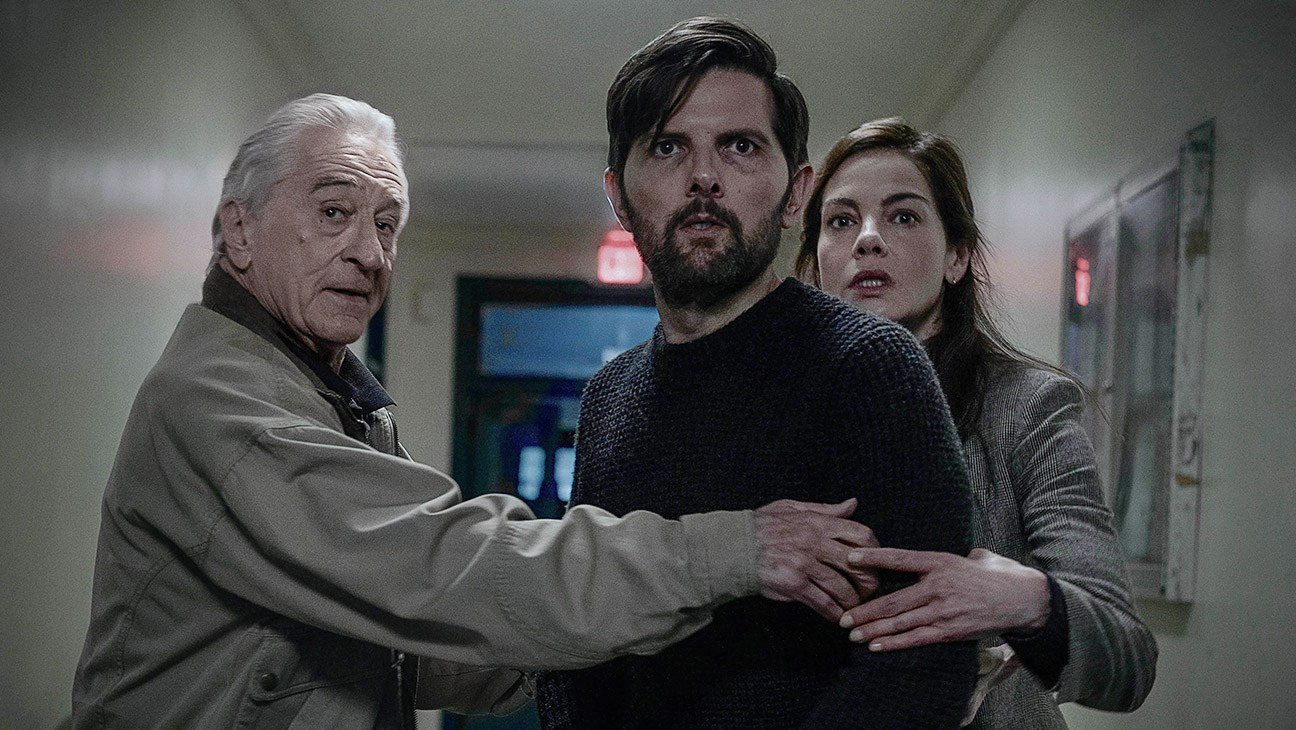
    Carter was apprehended by Det. Pete Willis (Robert De Niro), who retired soon after but has quietly continued obsessing over a sixth victim whose body was never found. When Jake is abducted, it emerges that Pete is Tom’s estranged father and has never even seen his grandson. The only clues come in the familiar form of a child’s drawing, accompanied by a cassette with a voice recording of the missing boy, mimicking the methods of Carter a quarter-century before.

    The writers show a deft sense of economy in going light on the details of Tom’s cold distance from his father, aside from a mention of Pete’s drinking. But it’s easy to imagine the absentee parenting of a man likely married to his job and consumed by one case in particular.

    The bitterness Tom feels toward his father surfaces as a torrent of contempt when they meet at a diner, where the novelist demands that Pete get involved in the investigation, despite repeated assertions that he has left detective work behind. Beck also asks for the veteran cop’s help; she has a hunch that Carter might hold the key to finding both Neil Spencer and Jake, but the convicted killer has only ever consented to be questioned by Pete.

    This is a good role for De Niro, remorse, fatigue and solitude written all over his face as Pete attempts to extend an olive branch to the stubbornly indifferent Tom. The psychological gamesmanship between Pete and Carter when the former detective comes around to cooperating brings a bristling sense of his long and frustrating history of being toyed with by the killer. 

    One person of interest in the case is Norman Collins (Hamish Linklater), an elegant sicko with a large collection of murder memorabilia, who twice in recent months visited the prison where Carter is incarcerated. But other possibilities also surface, pointing to a more direct connection between the present-day horrors and those of the Whisper Man, while building to explosions of violence and tragedy in the concluding stretch.

    Ashcroft directs with a sure hand even if some developments late in the action clearly owe more to pulpy crime fiction than psychological verisimilitude and he doesn’t quite stick the landing. But the actors keep it compelling enough even when the pace threatens to lag here and there, adding emotional texture through the script’s contemplation of difficult father-son dynamics. Colin Stetson’s score helps maintain the unsettling atmosphere. 

    The Whisper Man is not going to challenge The Silence of the Lambs as the high-water mark of this genre, nor does it have the benefit of a menacingly unhinged Nicolas Cage performance, like the one that made Longlegs turn heads. (Or for that matter like John Lithgow’s malevolent turn in Ashcroft’s mixed-bag second feature, The Rule of Jenny Pen.) But the movie has enough strengths to earn traction in the Netflix algorithm.

  • Bittensor jumps 10% as AI hype returns – Can TAO break $260?

    Bittensor jumps 10% as AI hype returns – Can TAO break $260?

    Bittensor [$TAO] gained more than 10% in the past 24 hours, at press time, extending $TAO’s weekly gains to more than 21%. Social Insights on CoinMarketCap showed that the mindshare of $TAO surged by 23%, with mentions and engagements surpassing 12.44K.

    Notably, a resurgence in the AI narrative and more liquidity exposure drove this shift in social sentiment.

    Is the AI narrative back as $TAO surges 10%?

    Typically, news surrounding tech stocks fuels the AI narrative, as it reflects overall market sentiment. As such, the Q2 earnings report indicated Nvidia [NVDA] had record revenue of $96.20 billion.

    This reading fueled tokenized NVDA to climb to around $221 with over $131 in daily volume. The strength spread across the AI sector, with Bittensor and Venice Token [VVV] benefiting.

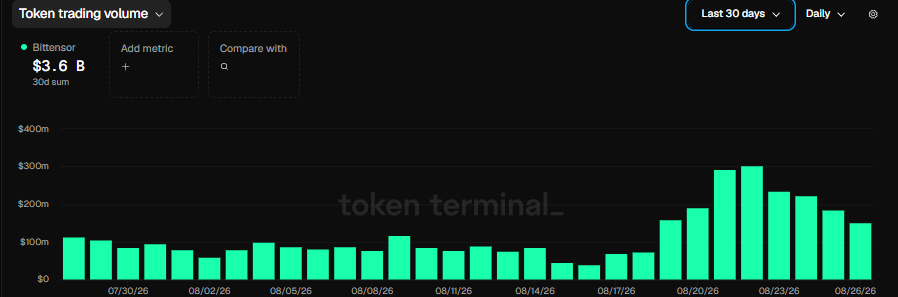
    Additionally, Bittensor expanded its liquidity by more than $600K after the $TAO-USDC pool went live on Aerodrome [AERO]. This means the token is now exposed to Base Chain users. As a result, token trading volume has surged significantly in August, with the average surpassing $300 million in mid-month.

    Source: Token Terminal

    Moreover, there was an organic social growth. The ecosystem was expanding with 128 subnets as of press time.

    In general, the market cap of the AI sector was up slightly, with $TAO being the most standout. Still, this AI narrative resurgence is not convincing enough to trigger a full bull reversal.

    What do $TAO bulls need to trigger a full reversal?

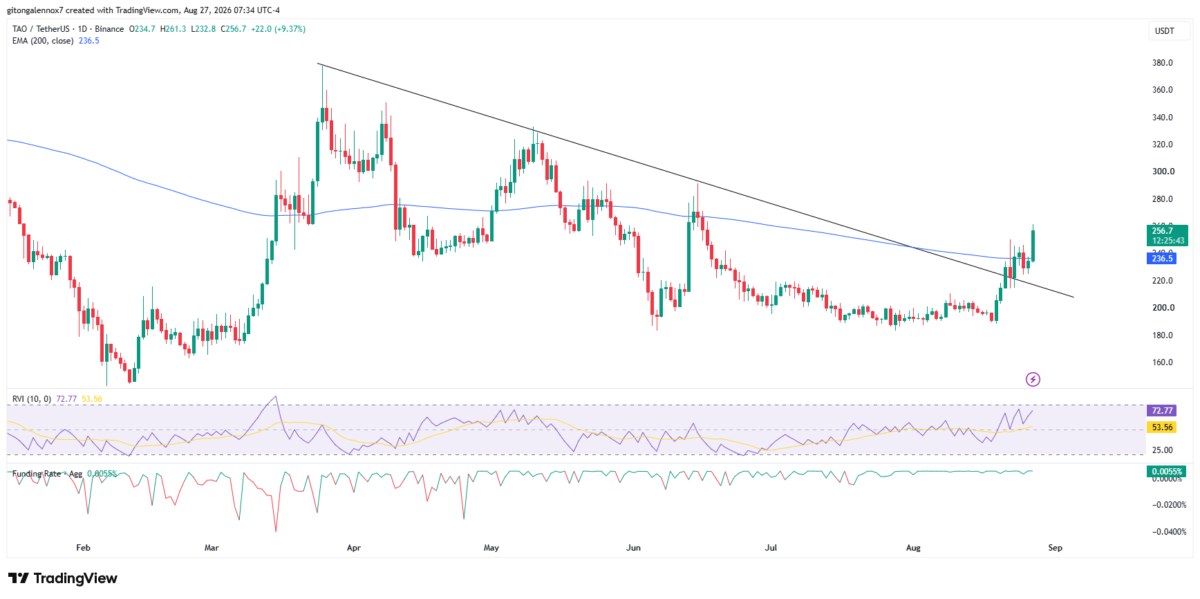
    On the daily chart, $TAO is trading above a descending trendline that has been a resistance since late March. The altcoin has also flipped the 200-day EMA at $236.5, reinforcing the shifting market structure. $TAO’s multi-month trendline breakout was confirmed with a retest at the $225 level.

    At the time of writing, the Funding Rate was also leaning toward buyer dominance with a reading of 0.0055%. Additionally, the Relative Volatility Index (RVI) was at 72.77, indicating volatility was rising with the prices.

    Source: $TAO/USDT on TradingView

    Despite the bullishness in $TAO, an analyst warned that a full reversal hinged on a level in the 3-day chart, noting,

    If $TAO breaches over the $260 range will be absolutely ready to trigger the full bullish reversal.

    If that becomes the case, $TAO may break subsequent levels at $290, $350, or even above $450, as levels above $450 were last visited in November.

    Otherwise, if a rejection happens at $260, $TAO may retest the broken trendline or even trade back into the consolidation pattern.


    Final Summary

    • Bittensor rallied by 10% amid record Q2 earnings for Nvidia, triggering an uptick in the broader AI sector.
    • $TAO cleared a multi-month trendline resistance and confirmed the breakout with a retest.
  • Inside ‘Married at First Sight’ Season 20: How Peacock’s Changes Led to 1.8 Billion Minutes Viewed, That Wild Reunion and Why Lindsay Hubbard Said No to the Show

    Inside ‘Married at First Sight’ Season 20: How Peacock’s Changes Led to 1.8 Billion Minutes Viewed, That Wild Reunion and Why Lindsay Hubbard Said No to the Show

    Millions of viewers are saying “I do” to Season 20 of “Married at First Sight.” The Kinetic Content relationship reality series, which moved to Peacock during Season 19 after 15 seasons on Lifetime, underwent a few changes this year.

    The finale and reunion dropped on Peacock on Thursday, revealing that all but two couples chose to break up on decision day. While Mecca Amen and BelléJolie Force said yes, they revealed at the reunion they ended their marriage shortly after. Cameron Mitchell and Michelle Le stayed together and, at the reunion, were still happily married. Unfortunately, all others split, and most are not on good terms.

    Since the Season 20 premiere on July 12 — purposefully scheduled after the conclusion of Peacock’s culturally dominant “Love Island USA” — “Married at First Sight” has amassed over 1.8 billion minutes viewed, per Peacock. It’s ranked as the No. 4 highest-reaching original reality season on the app, with total streaming up +153% from Season 19.

    Nicole Weingart/Peacock

    Although the show aired on Peacock for Season 19, the 20th season is the first fully produced for Peacock, and it seems that the changes made really worked as it became a Top 3 reality title on streaming for five consecutive weeks, according to Nielsen.

    “When we first acquired it, I was super excited — this is one of the great formats in unscripted history,” says Noah Samton, SVP of current production for Bravo and Peacock unscripted. “To have an opportunity to try to improve on what has already been established as something really strong, an opportunity to try to upgrade that and make it even better, is the most exciting challenge for me.”

    Below, we dive more into those changes and upgrades with Samton — including the reunion that featured an audience for the first time.

    Talk to me about what you first did when Peacock acquired “Married at First Sight.”

    Normally, if we acquired a show like this, I would try to watch every single episode. It just is impossible with this one. So I watched about 40 episodes, and it became very clear to me that there were some things that we could do to make it work better for a Peacock audience, make it a more fun, more exciting show, and just kind of revitalize it without losing what made it special and magical in the first place.

    Can you detail some of the creative changes?

    It falls into two buckets for me. One of which is we wanted to elevate production value across the board, and that starts right with the weddings. To me, it’s a fantasy for the viewer. “That’s a crazy thing to do, but would I do it?” You’re kind of playing along as you watch the show, and you want to see yourself in a beautiful wedding, in a beautiful setting and incredible decor. That was really important to help the viewer immerse themselves in the fantasy by making the weddings even more beautiful.

    Then, we wanted to make the cast a more aspirational cast. Traditionally, the most important thing for the cast is authenticity. But you can be authentic and aspirational. You shouldn’t have to choose between those two. That was a really big goal for us — to have a cast that really wanted to be there for the right reasons, and was still exciting and fun for a viewer to watch.

    Did you see the casting process?

    I went out west to Seattle. We spent five days with hundreds of cast members, and there’s a combined process of the experts looking for people who are suitable matches, and producers and network executives looking for people who make sense on television, and then, collaborating with those people to try to come up with the best cast possible. It’s extremely challenging, but also really fun.

    This was the first time a former reality TV star was cast on “MAFS” with Nick Uhlenhuth. Was that something you set out to do — bring in a familiar face?

    There were a lot of conversations around that one, and I wanted to do something that would get viewers to pay attention. In a crowded television landscape, it’s hard to get anybody to even think about your show. There are so many shows out there. So somebody that maybe viewers knew already [could help]. That was the original idea. Maybe there’s somebody who was on “Love Island,” who didn’t find love, and now they’re willing to get “Married at First Sight.” We looked at a lot of people on “Love Island,” and there wasn’t anybody that really made sense. And then the team at Kinetic said, “Let us look for some,” and the No. 1 qualifier for the whole thing was it has to be somebody who genuinely wants to get married, somebody who really makes sense. We’re not going to do it just for the sake of doing it.

    After talking to a whole lot of people, a lot of former reality cast members, they pitched Nick to me. At first I was like, I don’t know about this guy. But then they sent me a really long interview with him talking specifically about the show, and he really did seem to make sense. I’m just a little sad that we couldn’t find the right match for him.

    So would you bring back another former reality star?

    Maybe at some point. They have to be somebody who is there for the right reasons, and who makes sense with the show. We don’t want to do it just as a gimmick. But if there is the right person at the right time, who knows? I was talking to Lindsey Hubbard from “Summer House” the other day, and she has struggled a little bit to find the right relationship. So I said, “Why don’t you come on ‘Married at First Sight?’ And she said, “Yeah, no. In about 20 years, I think I’ll be ready for that!”

    Nicole Weingart/Peacock

    We’ll be ready at Season 41! You also changed up the experts this year, replacing Dr. Pepper Schwartz, Pastor Cal Roberson and Dr. Pia Holec with Paul C. Brunson and Dr. Lisa Paz. What were you looking for with that change?

    Initially, we were really looking for three experts. We wanted to find experts who spoke more to a Peacock audience, which was a little younger than the show when it was on Lifetime previously. We wanted people who felt younger, fresher and spoke to our audience. After meeting all these people, we realized the two of them stood out head and shoulders above every other expert we met with, and so we said, “Why do we need three? We have two great experts. Let’s just let them take the reins.”

    Were there other changes you wanted to implement?

    It was very important to me that we have seven couples instead of five. Originally, I wanted eight. I know it’s a lot for people to process, but I think one of the things that I struggled with in the 40 episodes that I watched of “Married at First Sight” is that you would see a couple who was clearly not right for each other. They didn’t like each other and didn’t want to be there, and because of the necessities of making a TV show, they were kind of strung along for every episode. I didn’t want that. If somebody was done with the relationship, they should walk away from the show. So that was one of the reasons we wanted to have more couples.

    Before we get to the reunion, can you talk about Felipe Cruz choosing to tell Tori Dahl that he thought about cheating all the time off-camera? How do you avoid that happening?

    This is the bane of the television producer’s existence. It’s something that happens on most shows. It’s a constant message from producers to cast members: Have those conversations on camera. I oversee all the “Below Decks” and “Summer House,” and one of the great things about those franchises is we have cameras rolling on the yacht 24/7 and in the house all weekend. So there are no conversations that happen off camera. On most shows, cameras shut down — they go home, they have the conversation. We’ve learned over the years a lot of ways of getting the information out, and you saw it in the diary cam with Tori. Good producers need to be on top of every situation, and they have to be able to sense when something is different in the dynamic. One of the biggest job requirements when you’re cast on a reality show is to be open and honest on camera and to share everything. That is literally what you’re hired for, and yet, still, people try to avoid it. And then the flip side, the job of a producer is to make sure that everything that happens is able to come out on camera.

    Nicole Weingart/Peacock

    Let’s get into the reunion a little — why invite an audience in for the first time? “MAFS” reunions have never had that.

    I was really hesitant about that. Kinetic and Ally Simpson over there really wanted to bring in a live audience. She thought it would bring a different dynamic, a different energy to the show. I was resistant. I was worried about leaks. I was worried about the production logistics of having a live audience during the show. She pushed hard. I gave in, and she was absolutely right. I thought the energy was great as a result. I thought the show looked great. It just gave a different dynamic to the reunion.

    It was kind of wild to see Adam Dehmlow’s new girlfriend claim the show was fake, which gave the experts an opportunity to defend it.

    Look, it’s something that we battle with, right? People are always like, “Well, it’s reality TV. It’s not real.” It’s all real. It’s produced at times, but everything I do on every one of my shows, what you’re watching, is real. It’s great to be able to show that this is the cast’s lived experience, and that they will support that. Because it’s endlessly frustrating for me to hear that from people. It’s real!

    Lastly, there have been some conversations online and rumors that the couples didn’t actually get married this season. What do you say to that?

    I would say that their experience is that they are a married couple, and they are living their lives as a married couple, and every aspect of what they experience on that is a marriage. They have a wedding at the beginning, and then they have a divorce if they want to go their separate ways at the end.

    This interview has been edited and condensed.

  • Zcash price reclaims $800 as coinholders vote on major NU7 changes

    Zcash price reclaims $800 as coinholders vote on major NU7 changes

    Zcash price [$ZEC] has returned above $800 as holders consider changes that could impact the network’s speed and issuance.

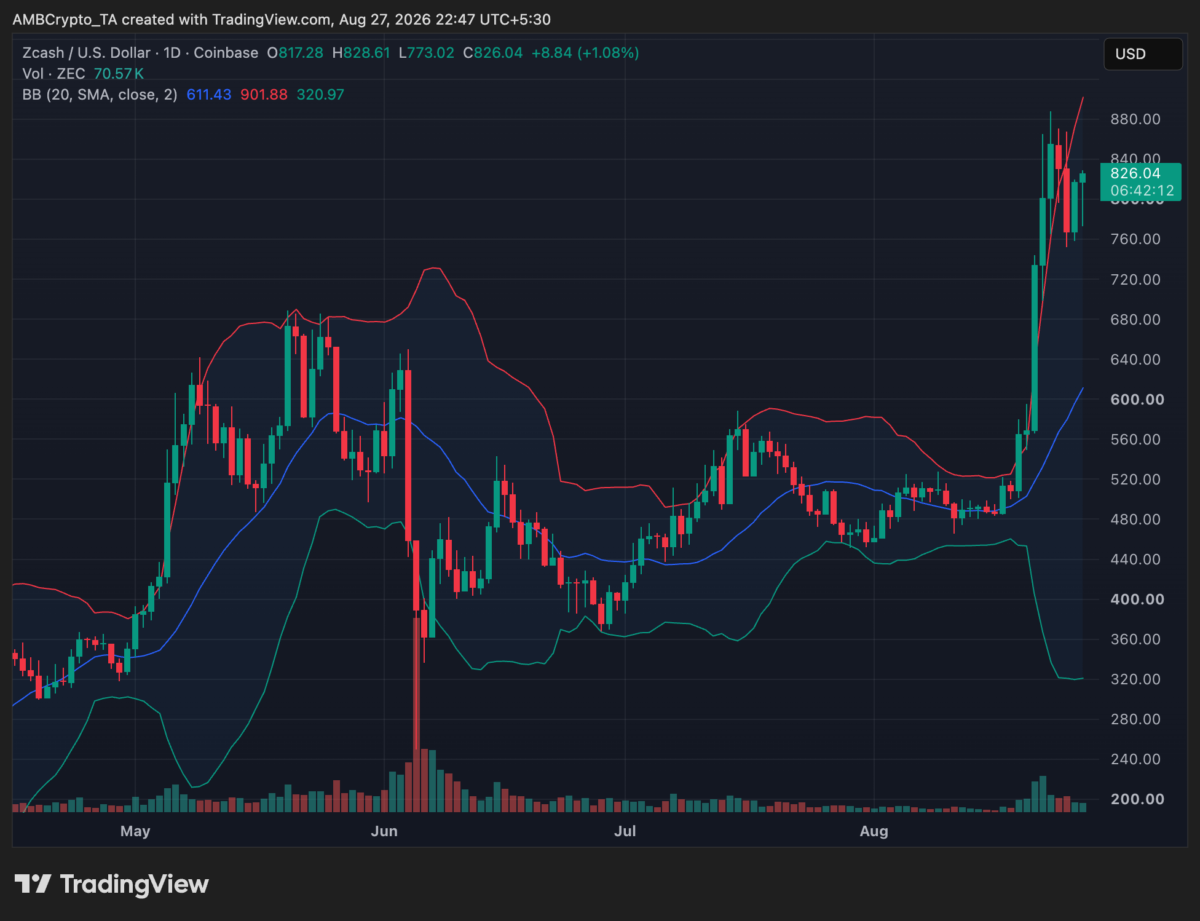
    $ZEC traded near $826 at the time of writing after falling briefly to the $773 level. The recovery comes during a time when it’s seeing a sharp weekly rally, even as the price remains below its recent peak near $890.

    Zcash coinholders weigh five NU7 questions

    The NU7 coinholder poll asks eligible $ZEC holders to vote on five questions concerning Zcash’s next major network upgrade.

    One of the proposals is asking for the current four-year halving cycle to be replaced with a smoother reduction in new issuance. Supporters of this proposal believe that this would give miners and users greater certainty instead of cutting rewards suddenly at fixed intervals.

    Coinholders are also considering whether part of the network’s transaction fees should return to future block rewards. Other questions cover retiring the old Sprout transaction system and allowing NU7 to proceed if some planned features face delays.

    Another proposal would reduce Zcash’s block time from 75 seconds to 25 seconds, which means users would wait less time for transactions to appear on the network.

    Cypherpunk Technologies has published its recommended positions on all five questions. The Zcash-focused treasury company strongly supports faster blocks, citing test results that it believes show the network can handle the change.

    The poll is also advisory, and its result will only show what participating coinholders prefer, but it does not guarantee that every supported proposal will enter NU7.

    $ZEC recovers after falling below $800

    $ZEC’s return above $800 follows a positive move from around $500 within several trading sessions.

    The rally briefly took it towards $890 before sellers stepped in, and then it dropped below $800, reaching $773 during the latest session. But buyers pushed it back to around $826.

    Source: TradingView

    That leaves $850–$880 as the next area to overcome, as a move beyond the recent high could bring $900 into view.

    The first support sits around $780, and if that level fails, the price could return to $750, an area where buyers previously responded.

    There was a lot of trading activity during the initial surge, but it has since reduced. That does not end the rally, but it suggests the latest rebound has led to less activity compared to the move that took its price to $800.


    Final Summary

    • Zcash holders are voting on faster blocks, issuance changes and other NU7 questions.
    • $ZEC recovered from a fall to $773 to around $826, leaving $850–$880 as its next test.

  • Rob Bonta Says It’s “Telling” Meta Settled With State AGs In The Midst Of Instagram Head Adam Mosseri’s Testimony & Before Mark Zuckerberg Took The Stand

    Rob Bonta Says It’s “Telling” Meta Settled With State AGs In The Midst Of Instagram Head Adam Mosseri’s Testimony & Before Mark Zuckerberg Took The Stand

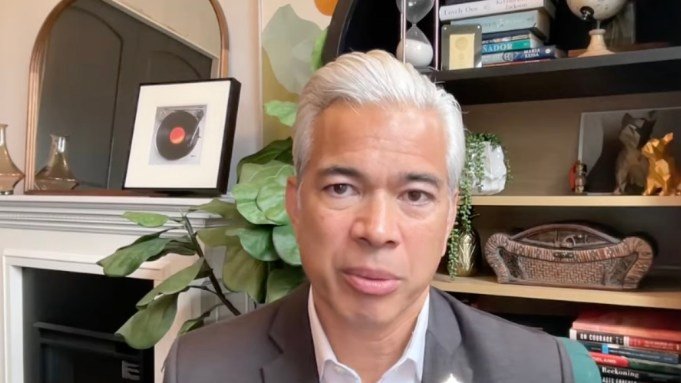
    California Attorney General Rob Bonta took a victory lap following a proposed settlement of up to $17 billion for claims brought by 51 attorneys general against Meta, suggesting that the parent of Instagram and Facebook realized that a trial was not going well for their side.

    As Bonta went through details of the settlement, including remedies designed to limit mental health harms and social media addiction among children and teens, he told reporters, “It’s also telling that Meta settled midway through Instagram President Adam Mosseri‘s testimony and before CEO Mark Zuckerberg could take the stand.”

    The company was defending itself in a trial that started on Aug. 18 in California.

    On the stand on Tuesday, Mosseri at one point was questioned by prosecutors about a feature, called Take a Break, a pop-up message suggesting to young users that they the give the app a rest after a fixed period of use. An internal document showed that only 1.8% of teens actually used the feature. A blog post by Mosseri around when it was introduced said “more than 90%” of users of the feature kept it on. But, the state AGs noted, the executive did not indicate that a very small number of people actually used it in the first place.

    “The trial was not going well for Meta. Having Instagram President Adam Mosseri giving testimony as we settled, it was not random … I think they were dying to have him get off the stand. It was not going well for him,” Bonta said.

    The settlement agreement still has to be approved by a federal judge.

    It includes a set of new restrictions that Meta will place on social media for users under 18, including a default daily time limit of two hours that can only be lifted by a parent. Other defaults are designed to limit use overnight and during school hours, and a ban on displaying numbers of likes or reactions for users under 18.

    Bonta also talked of the next step in their litigation: TikTok.

    “As big as Meta is, it doesn’t stand alone,” Bonta said. “We’re continuing our fight across social media, including our litigation against TikTok, and we’ll continue to demand better from all parts of this industry through our ongoing work with the legislature.” Bonta and other state attorneys general filed the TikTok lawsuit in 2024.

    Bonta also vowed to defend SB 976, the Protecting Our Kids from Social Media Addiction Act, a new California law that is being challenged by tech giants on First Amendment grounds.

    Bonta said that, with the Meta settlement, his “hope and my belief is that we will see commitments across the industry.” In addition to TikTok, he called out Snap and YouTube.

    Bonta later said that although YouTube is not the “same in its model as Meta and TikTok,” there are “similar features and products that YouTube uses that are along the same lines that … are designed to create excessive compulsive use that lead to mental health harms, and most importantly that hurt our children, and can and should be changed.”

    He added, “I think this …constellation of solutions in terms in injunctive relief that we’ve delivered here that apply to Meta, I really think that YouTube and Snap and TikTok should be thinking very closely about them and their commitment to adopt the same.”

    Several of the changes Meta agreed too are partly contingent on other social media players signing on. For instance, a default daily time limit of two hours for users under 18 that can only be lifted by a parent, under the settlement, would drop to one hour If other social media platforms agree to similar terms.

    And a default nighttime block between midnight and 6 a.m. for users under 18 that can only be lifted by a parent would expand to cover 10 p.m. to 7 a.m. if other social media platforms follow.

    This case and others lodged against social media giants have been compared to transformative litigation against big tobacco companies in the 1990s. Asked if he agress, Bonta said: “I think there are some similarities. There are also some limits to those similarities … Regardless, this is a major moment to clean up an industry that has been hurting our kids.”
     
    “So, in the way that the impact of the solutions delivered in [big] tobacco were good for health, good for kids, good for Californians and Americans, this is similar … It’s similar in that fact that it’s a number of AGs banding together, asserting ourselves, exerting our authority, demanding better, requiring accountability, and enforcing the law and delivering results. It’s similar in that way that Congress hasn’t been delivering and has left a vacuum and a gap, so that the state AGs stepped in.”
     
    He added, “It deals with public health. Different issues, but public health issues broadly … But I think the most important thing to focus on here, whether it’s similar tobacco or not, is this is transformative. This is momentous. This is a major step forward in the ongoing quest and journey to make sure that our children are safe everywhere, including online.”

    The settlement involved attorneys general from 47 states, the District of Columbia and U.S. territories.

  • Aave V4 Deposits Reach $806 Million After 30% Weekly Gain

    Aave V4 Deposits Reach $806 Million After 30% Weekly Gain

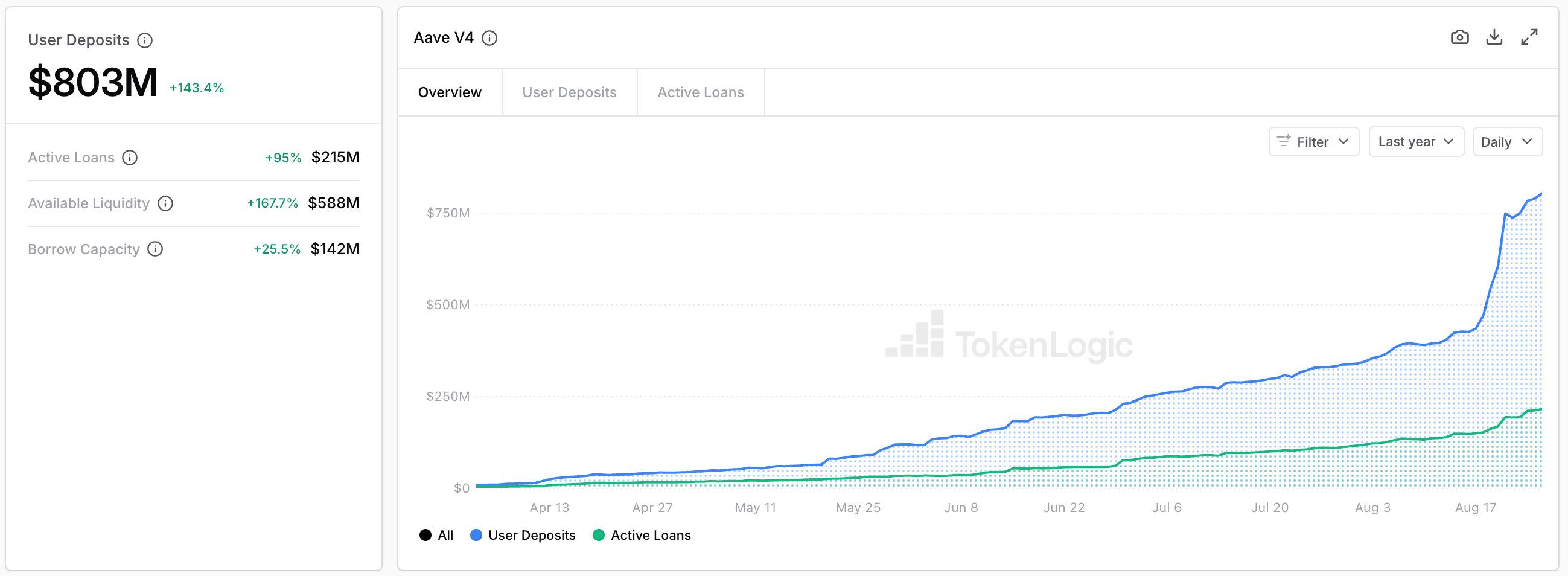
    Aave’s live onchain dashboard listed V4 user deposits at $806 million. Deposits jumped by 30% over seven days and reached a new all-time high above $800 million.

    The latest reading extends a steep August climb. Aave announced that V4 deposits crossed $500 million on Aug. 19 and $600 million on Aug. 21, before moving above $800 million six days later. A separate announcement said Ethereum V4 deposits alone crossed $500 million on Aug. 25. EtherFi Cash accounted for V4’s second-largest current market.

    The market is supporting borrowing as well as deposits. V4 had $216 million in active loans on the dashboard. Aave separately measured $62 million of active loans in the EtherFi market, where weETH collateral backed WETH borrowing at 92% utilization.

    The current market mix includes V4 deployments on Ethereum, Optimism and Avalanche. Ethereum Core held $378 million, followed by EtherFi Cash on Optimism at $257 million, Ethereum Global Dollar at $75 million and Ethereum Prime at $63 million. Avalanche Core and Ethereum Plus accounted for another $18 million and $15 million, respectively.

    The deposit mix was led by weETH at $97 million and USDG at $90 million. WETH and USDC each accounted for $81 million, followed by liquidETH at $77 million, liquidUSD at $58 million and WBTC at $54 million.

    V3 Retains a Far Larger Base

    Aave’s equivalent V3 dashboard showed $31 billion in user deposits, far above V4’s $806 million. Ethereum Core alone held $25 billion on V3.

    The versions organize liquidity differently. Aave’s documentation says V4 replaces V3’s market-per-pool design with a hub-and-spoke system: hubs consolidate liquidity and accounting, while spokes apply separate borrowing rules and risk limits to particular markets.

    On Aug. 27, TokenLogic said the EtherFi Cash market had been live for two weeks and was moving toward a $500 million lending-capacity target.

  • Investors just moved $7 billion into Bitcoin and gold in five days to escape an accelerating dollar crisis

    Investors just moved $7 billion into Bitcoin and gold in five days to escape an accelerating dollar crisis

    Gold and Bitcoin exchange-traded funds (ETFs) drew roughly $7 billion over five US trading sessions, a record combined haul that puts both assets at the center of a renewed investor push for protection against currency weakness and mounting fiscal pressure.

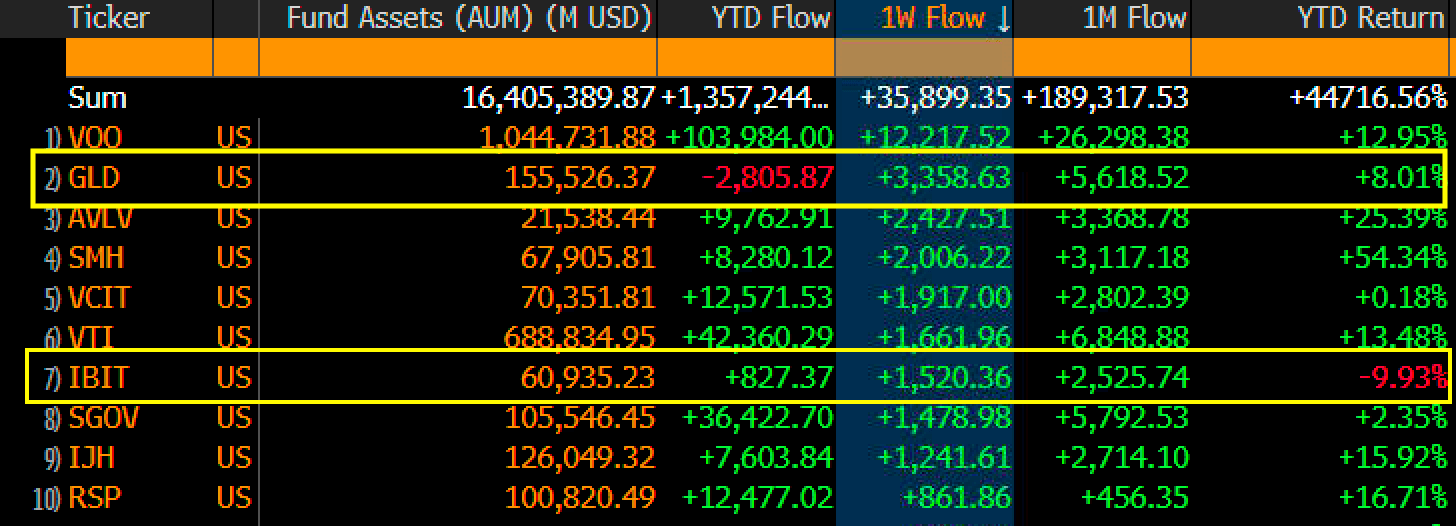
    About $3.4 billion of this capital went into SPDR Gold Shares (GLD) while BlackRock’s iShares Bitcoin Trust (IBIT) attracted roughly $1.5 billion. GLD manages more than $150 billion in assets, while IBIT holds around $60 billion, making each the dominant institutional access point in its respective market.

    Together, the two funds accounted for about 70% of the combined “debasement trade” inflow, showing how strongly the move was concentrated in the largest vehicles.

    Bloomberg Intelligence analyst Eric Balchunas said the five-day total was easily a record for the pair, with both GLD and IBIT ranking among the 10 biggest US ETFs by weekly inflows. He also noted that IBIT’s year-to-date flows had returned to positive territory after recovering from an earlier deficit.

    Top 10 US ETFs by Weekly Flow (Source: Bloomberg)

    The surge came as both assets climbed sharply. Bitcoin broke above $80,000, while gold traded above $4,600 an ounce, extending a move that has increasingly linked the two through the same scarcity narrative.

    Fiscal pressure revives demand for hard assets

    The synchronized buying accelerated as investors focused on US debt, Treasury-market strains and a softer dollar.

    Treasury’s Aug. 19 decision to at least double the maximum size of liquidity-support buybacks for longer-dated securities to $4 billion per operation added to that backdrop. The change helped pull long-term yields lower initially and came with U.S. public debt already above $40 trillion.

    That combination has revived the so-called debasement trade, where investors seek assets with constrained supply as protection against the possibility that persistent deficits and currency expansion erode purchasing power.

    Bitwise Chief Investment Officer Matt Hougan said the attraction partly reflects how traditional portfolios remain fully denominated in fiat money.

    “A 60/40 portfolio is 100% exposed to fiat currency,” Hougan said, arguing that investors are increasingly looking for a modest source of diversification as fiscal uncertainty rises.

    Strive Chief Executive Matt Cole framed the same shift through scarcity, saying dollar debasement expands the pool of capital searching for limited-supply assets and that Bitcoin’s continuing monetization allows it to capture a growing share of that demand.

    Bitcoin’s fixed 21 million supply makes it an obvious candidate for that trade, although it remains far more volatile than gold and has a much shorter history as a defensive asset.

    Market trends are currently moving in the same direction. Charlie Morris, founder of ByteTree, pointed out that both Bitcoin and gold have positively sloping 200-day moving averages and carry ByteTrend scores of 5, the firm’s strongest bullish reading. The dollar, by contrast, carries a score of zero.

    That alignment does not establish why investors are buying, but it reinforces the divergence now visible between scarce assets and the currency against which they are priced.

    Wall Street sees a longer-term scarcity trade

    The stronger argument for the trade is that the pressure may persist even after the latest move in yields and the dollar fades.

    Bernstein said the four-decade decline in interest rates appears to have ended just as sovereign debt burdens have reached record levels, leaving governments more exposed to rising debt-servicing costs. Higher yields can then feed back into larger interest bills, wider deficits and greater borrowing needs, increasing the difficulty of stabilizing public finances.

    The firm expects policymakers facing that tradeoff to ultimately favor currency debasement over prolonged fiscal restraint, which it views as the less politically disruptive path.

    That would strengthen the case for assets whose supply cannot be readily expanded.

    Bernstein said Bitcoin is particularly well positioned because of its fixed issuance, wider institutional and retail access, and a holder base that has historically absorbed severe drawdowns. It estimates about 60% of Bitcoin is held by investors that remained through declines of more than 50%.

    BlackRock has also pushed Bitcoin further into conventional portfolio discussions. In research published this month, the asset manager said historical modeling showed that a 1% to 2% Bitcoin allocation could have improved the risk-adjusted performance of a traditional 60/40 portfolio.

    Those arguments help explain why the latest ETF flows are attracting more attention than another short-term rally.

    Gold already has an established role as protection against monetary and fiscal uncertainty. Bitcoin is increasingly being considered for the same scarcity allocation, but its record remains far shorter and its volatility substantially higher.

    That leaves Bitcoin with a test gold does not face to the same degree.

    If the dollar strengthens or real yields rise and Bitcoin ETFs continue attracting capital, the latest $7 billion co-inflow would look more like a durable shift in portfolio construction than a trade built around favorable macro conditions.

    However, if Bitcoin demand fades while gold remains resilient, the two assets may have benefited from the same debasement narrative without yet earning the same status in investor portfolios.

  • Fidelity Executive Comments on the U.S. Treasury Department’s Latest Sensational Move Regarding Bitcoin’s Future

    Fidelity Executive Comments on the U.S. Treasury Department’s Latest Sensational Move Regarding Bitcoin’s Future

    Jurrien Timmer, Global Macro Director at Fidelity Investments, said that the US Treasury Department’s increase in long-term bond buybacks and its focus on issuing short-term Treasury bills is putting pressure on the dollar while supporting Bitcoin and gold.

    Timmer pointed out that the dollar weakened last week after the US Treasury Department repurchased more long-term bonds and issued more short-term bonds in return. He argued that the strong rise in gold and Bitcoin prices during the same period reflected market expectations regarding the future of fiscal and monetary policies.

    According to the renowned analyst, investors may have begun to price in a potential shift towards what is increasingly described as “fiscal dominance” in the US, and a weakening of the Federal Reserve’s independence.

    Timmer made the following statements:

    “It is noteworthy that the U.S. Treasury Department’s issuance of more short-term Treasury bills last week while simultaneously buying back more long-term bonds dragged the dollar down and caused both gold and Bitcoin to rise sharply. The market senses a slippery slope towards fiscal dominance and a possible loss of the Federal Reserve’s independence.”

    “Increased Buybacks May Be Necessary to Keep Bond Yields Low”

    According to Timmer, for the U.S. Treasury Department’s strategy to keep long-term bond yields under pressure to be successful, the bond repurchase program may need to be significantly increased beyond current levels.

    However, Timmer noted that such a scenario could force the Federal Reserve to become involved, potentially meaning the central bank would participate in a kind of “Operation Maturity Restructuring” policy aimed at changing the maturity structure of the bond market.

    Timmer stated that such a development could increase the risk of currency depreciation, and offered the following assessment:

    “For the U.S. Treasury Department to successfully keep interest rates low, it may need to significantly increase the size of repurchases. This could require the Federal Reserve to become involved in this Operation Maturity Restructuring policy, and could lead us down a path of currency depreciation.”

    Timmer: Loose Fiscal and Monetary Policy is Positive for Bitcoin

    According to the Fidelity executive, the simultaneous implementation of expansionary fiscal policy and loose monetary policy creates a particularly negative picture for the dollar.

    Noting that the dollar is on a significant long-term trend line, Timmer said that such a macroeconomic environment is distinctly positive for gold, and Bitcoin could similarly benefit from it.

    *This is not investment advice.

  • Judge Hears Arguments On Returning Trump’s Name To Kennedy Center, Sidesteps Talk Of Demolition Of Complex

    Judge Hears Arguments On Returning Trump’s Name To Kennedy Center, Sidesteps Talk Of Demolition Of Complex

    A federal judge heard arguments Thursday in the latest challenge to the Trump-controlled Kennedy Center‘s effort to install the president’s name on the complex, this time twice on its façade and once to designate the grounds for him.

    U.S. District Judge Christopher Cooper, however, stopped the center’s lawyer from bringing up the “dilapidated” condition of the center, referring to it as a “non sequitur” to the issue at hand: Whether the board can return Trump’s name to prominent locations at the complex.

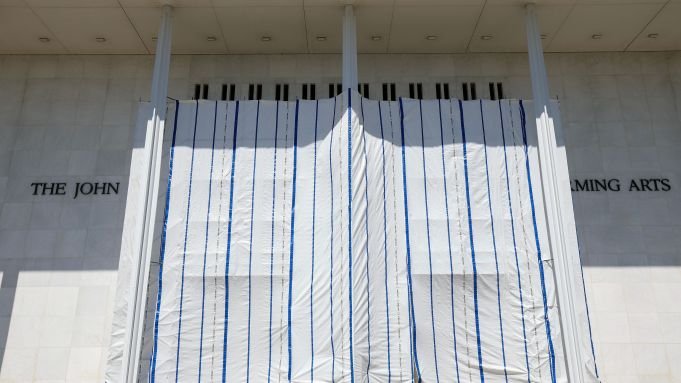
    Earlier this month, the Kennedy Center board voted to add “Renovated and Restored by President Donald J. Trump” to the front facade below the inscription, “The John F. Kennedy Memorial Center for the Performing Arts.” Once a $100 million threshold is met for an endowment, another inscription would be placed below that one to read, “Endowed by the Trump Kennedy Center Fund.”

    The board also voted to rename “the physical site and grounds upon which the center sits” as the “President Donald J. Trump Plaza.”

    Rep. Joyce Beatty (D-OH), an ex officio member of the board, is seeking a court order to stop the naming, as her attorneys argued that it violates a statute and the judge’s previous order. After the center’s board voted to add Trump’s name to the center, rebranding it as the Trump Kennedy Center, Beatty sued, arguing that only Congress could change the name of the complex, as it was designated as a memorial to President John F. Kennedy in 1964. Cooper agreed, and issued a preliminary injunction in June that forced the center to revert to the original name and remove lettering on the front façade of the complex.

    At the hearing, DOJ attorney Brantley Mayers, representing the center, argued that the latest plans for recognizing Trump are not a “renaming.” He also contended that it did not violate a congressional law in 1983 that restricted any other memorials at the complex. He noted that the board’s resolution “was quite clear that it wanted to recognize” Trump’s “ongoing contributions,” as memorials recognize something that happened in the past.

    But Cooper noted that the planned inscriptions are written in past tense.

    Earlier this week, in a court filing, the center’s attorneys warned that if Trump’s name wasn’t returned to the center, it would jeopardize its future, even pointing to the potential need for demolition.

    The judge declined to go into those arguments, stopping Mayers as he started to talk of the condition of the complex.

    “That is all fine and good, but what does that have to do with what Congress intended?” the judge asked. He later said that nothing in his earlier order prevented the center from proceeding with renovations, with Congress allocating more than $250 million for repairs as part of the One Big Beautiful Bill Act.

    Nathaniel Zelinsky, one of Beatty’s attorneys, said that the name change plans were an “outright defiance” of the judge’s injunction and an act of “massive bad faith.” He argued returning Trump’s name to the complex amounted to a rebranding, while Congress also intended the grounds and land the center sits on to solely honor Kennedy. He pointed to a past proposal, ultimately never realized, to construct a Kennedy Plaza on the grounds, saying that it was “another indication Congress didn’t intend to name [the complex] for anyone other than Kennedy.”

    Mayers, though, argued that Congress did not prevent the board from designating areas of the center for certain individuals. When Cooper asked if that meant the board could recognize Barack Obama or George W. Bush at certain parts of the complex, like a garage, Mayers agreed.

    Beatty sat with her attorneys during the hearing, in a courtroom packed with spectators including those from the group Hands Off the Arts. They have been protesting the changes at the center since Trump took control, including the efforts to install his name at the complex and a plan to close for two years for renovations.

    Also there was Secretary of Commerce Howard Lutnick, whose wife, Allison, is among the board members. During a brief break to address an audio issue, Lutnick huddled with DOJ lawyers.

    The judge raised some jurisdictional concerns over ruling on Beatty’s emergency motion as Trump is appealing. He did not indicate exactly when he would rule, but pressed Mayers on the deadline of September 8. The center has committed to refraining from installing Trump’s name until that date, but not after. Mayers said that the timing was the board’s decision.

    The judge also sounded weary that he was being asked to render a ruling so quickly, during a high time for summer vacation.

    In his May ruling, the judge also barred the center from embarking on the two-year closure, concluding that the board failed to consider options and the full impact. He left open the possibility of moving forward with such a plan if the board gave a more thorough consideration. In the meeting this month, the board again moved to shutter almost all of the complex, rejecting an alternative option to remain open during the construction. A consultant retained by the center concluded that remaining open would be more costly and force the renovations to extend to four years. The judge’s injunction remains in effect.

  • Emma Chamberlain Fronts J.Crew’s Fall Campaign With a “Tiny” Take on Its Heritage Rollneck Sweater

    Emma Chamberlain Fronts J.Crew’s Fall Campaign With a “Tiny” Take on Its Heritage Rollneck Sweater

    If you purchase an independently reviewed product or service through a link on our website, The Hollywood Reporter may receive an affiliate commission.

    J.Crew is giving one of its longtime wardrobe staples a fresh perspective for fall, with Emma Chamberlain (who founded Chamberlain Coffee at the ripe age of 18) leading the charge.

    The retailer has tapped the Gen Z fashion fixture to front its latest campaign, which introduces the Tiny Rollneck, a shrunken take on the cotton sweater J.Crew first introduced in 1988. The new style just dropped on J.Crew.com, featuring a slightly cropped length and closer fit, swapping the roomier proportions of the original for a silhouette that feels more in line with today’s fitted fall dressing.

    Best for Fall

    Available in a Vintage Red Stripe or Navy Faded Lilac.

    The Tiny Rollneck comes in bright, graphic colors, adding a more playful take to one of J.Crew’s signature preppy staples. The accompanying campaign, shot and directed by Ian Markell, puts Chamberlain in a candy-colored, retro-futuristic setting inspired by early-aughts fashion imagery and video-game character-selection screens. Her longtime stylist, Jared Ellner, worked with J.Crew creative director Olympia Gayot on the looks.

    The YouTuber, podcaster and fashion fixture has become a familiar face at fashion month and the Met Gala, further cementing her place in the fashion and entertainment worlds. Her Gen Z influence has helped make her one of the most recognizable style voices of her generation.

    The campaign also leans into the return of collegiate-inspired dressing, styling the Tiny Rollneck with pleated skirts, tailored trousers, loafers, argyle socks and slim rectangular glasses. The overall effect is part ’90s prep, part early-aughts nostalgia, with a distinctly more modern design.

    Easy to Style

    Made from 100 percent cotton and comes in six colorways.

    The Tiny Rollneck is the latest chapter in J.Crew’s ongoing Rollneck revival. The original sweater debuted in the brand’s 1988 catalog and was known for its heavyweight cotton knit, raglan sleeves and loosely curled neckline.

    Last fall, the retailer launched its “Next Rollneck Generation” campaign, featuring Benito Skinner, Molly Gordon, Maggie Rogers, Dominic Sessa, Lukita Maxwell, Rome Flynn and Taylour Paige-Angulo in new and archival-inspired versions of the sweater.

    J.Crew continued reworking the style this spring with “Rollneck Remix,” a New York Fashion Week project that invited Buci, Collina Strada, Eckhaus Latta, Patrick Taylor and Tanner Fletcher to reinterpret the sweater through lace, colorblocking, unconventional knit techniques and nautical details.

    Now, J.Crew is making the Rollneck smaller (and cuter) for fall. The Tiny Rollneck launched Aug. 26 on J.Crew.com, just in time to infuse the season’s preppy wardrobe with a little of the social media star’s signature whimsy.

    Related: Parke’s Viral Sweatshirt Gets a Dose of School Spirit in Brand’s Debut Collegiate Collection