Author: rb809rb

  • Inside the Global Rise of CJ ENM’s ‘The Legend of Kitchen Soldier’

    Inside the Global Rise of CJ ENM’s ‘The Legend of Kitchen Soldier’

    When “The Legend of Kitchen Soldier” was selected as the only K-drama in the Special Screening section at Series Mania in Lille earlier this year, it marked an early signal that something unusual was happening with a show that had started life as a calculated creative gamble. By July 31, when the series took best drama series at the Fifth Blue Dragon Series Awards, that signal had become a verdict.

    The 12-episode series – produced by Studio Dragon and released as a TVING original on CJ ENM‘s Korean streaming platform – follows Kang Seong-jae, played by Park Ji-hoon, a young man who joins the military to escape a difficult reality. His trajectory shifts when a virtual quest screen appears before him, redirecting him toward life as an army cook. As he completes each mission, buried secrets within the military base begin to surface.

    The show’s international performance has been striking across multiple platforms. It reached No. 2 overall on Disney+ Japan, ranked among the top three Korean drama titles on HBO Max across 17 countries and territories – performing especially strongly in Indonesia, Malaysia and the Philippines – and landed in the Rakuten Viki top five across the Americas, Europe, Oceania and MENA. On Sept. 15, chief producer Kim Tae-hoon will take part in a creator talk at K-Brand Week in Poland, extending the show’s reach into a new European market.

    None of this was treated as a foregone conclusion during production. The creative team at Studio Dragon made a series of deliberate formal choices that broke with K-drama convention, and they knew it.

    Central among them was the editing. Rather than using visual style as a background element, the production foregrounded it as part of the show’s identity – building the virtual quest screen into the fabric of the series, and adopting a lo-fi, high-energy aesthetic that amplified the comedy rather than simply serving the narrative.

    “I believe the success of ‘The Legend of Kitchen Soldier’ revolves around how experimental it was, especially in its direction and never-before-seen editing style, which hooks audiences instantly,” said Lee Hye-young, executive producer of “The Legend of Kitchen Soldier” at Studio Dragon. “However, it was also important for us to maintain depth in the show’s narrative. That’s why we incorporated the ‘over-the-top’ elements to an extent that would not interfere with the story’s cohesiveness.”

    The challenge of holding that balance extended to the cast. Led by Park and Lee Sang-yi, both of whom carry established international fanbases, the ensemble also includes Han Dong-hee as Lieutenant Cho Ye-rin and Lee Hong-nae as Senior Sergeant Yoon Dong-hyun.

    “While maintaining the extreme editing style, we also wanted to make sure the cast was not overwhelmed by these elements,” said Kim Tae-hoon, chief producer at Studio Dragon. “Thanks to all the cast members’ remarkable performances, we were able to bring our creative vision to life.”

    The show also made a structural bet that distinguished it from the bulk of globally travelling K-drama: it placed comedy at the centre without a romance narrative to anchor it. K-drama’s international rise has been built substantially on romantic melodrama, and a straight comedy with no rom-com scaffolding represented a genuine departure. The series made that departure without sacrificing character depth – each member of the ensemble was given distinct motivation and a narrative arc, allowing audiences to build investment across the run.

    The IP extended beyond the screen through Migak Boys, an in-universe K-pop group formed around the drama’s characters and their reactions to Kang Seong-jae’s cooking. The device brought together K-drama, K-pop and food culture within a single property, adding a layer of audience engagement beyond conventional viewership.

    “The success of the TVING original ‘The Legend of Kitchen Soldier’ demonstrates that fresh genres and original storytelling can resonate with audiences both in Korea and around the world,” said Choi Bo-hyun, chief contents officer at TVING. “Building on TVING’s bold creative vision and CJ ENM’s content capabilities, we will continue to expand the diversity and global competitiveness of K-content.”

    The Blue Dragon win and the Poland screening suggest the show’s impact is still accumulating. Sebastian Kim, head of the content business Unit at CJ ENM, said the series had opened a door the company intends to keep pushing through.

    “The success of ‘The Legend of Kitchen Soldier’ is proof that diverse genres of K-dramas can succeed in the global entertainment market, opening a new era in which global audiences are ready to embrace unconventional storytelling,” Kim said. “Standing at the forefront of K-culture’s global expansion, CJ ENM will continue to challenge ourselves to develop stories that are different, unique, and unexpected for global fans, delivering consistent surprises and new experiences to audiences around the world.”

  • Is Bitcoin’s Recent Rally a Bubble, or Is It Sustainable?

    Is Bitcoin’s Recent Rally a Bubble, or Is It Sustainable?

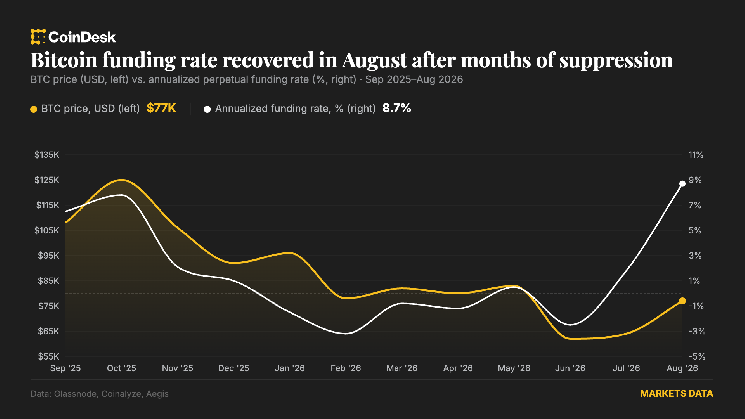
    In the cryptocurrency markets, Bitcoin’s ($BTC) recent surge from around $63,500 to over $80,000 is said to have been supported by strong spot demand rather than leveraged trading.

    According to an assessment published by QCP Capital, Bitcoin’s current market structure appears healthier than previous speculative rallies. The company states that approximately $2.8 billion in net inflows occurred into spot Bitcoin ETFs during $BTC’s rise from $63,500.

    In contrast, the amount of open positions in Bitcoin futures markets decreased from approximately 646,000 $BTC in mid-August to 588,000 $BTC. The fact that funding rates have remained at relatively low levels also indicates that the price increase is not driven by aggressively leveraged long positions.

    QCP stated that these data show that spot purchases and the closing of short positions were particularly prominent in the rally. This could indicate a more sustainable market structure for Bitcoin due to the limited accumulation of excessive leverage.

    On the macro front, the Fed and the US Treasury are being closely watched.

    Despite the positive technical structure in the Bitcoin market, the macroeconomic outlook remains uncertain. While core PCE inflation in July remained at 3.3% year-on-year, markets are pricing in a 35% probability of the Federal Reserve raising interest rates by 25 basis points at its September meeting.

    On the other hand, the expansion of the US Treasury’s repurchase program to support liquidity in long-term bonds is among the factors supporting risky assets.

    The Treasury announced that, starting September 9th, it will increase the upper limit for per-repurchase operations of 10- to 30-year bonds from $2 billion to at least $4 billion. Following this announcement, long-term bond yields fell, the dollar index weakened, while gold and Bitcoin prices rose.

    QCP also noted that Nvidia’s strong balance sheet contributed to risk appetite in global markets.

    However, it is noted that the US Treasury’s bond repurchase program is not quantitative easing (QE). The program aims to improve liquidity conditions in the long-term bond market, not to directly determine bond yields, and does not create a QE-like expansion in central bank reserves.

    According to QCP’s assessment, the key question for Bitcoin in the short term will be whether strong spot demand will continue.

    *This is not investment advice.

  • ‘Sea of Glass’ Review: A Widow’s Coastal Healing Retreat Turns Into a Stately, Moody Greek Tragedy

    ‘Sea of Glass’ Review: A Widow’s Coastal Healing Retreat Turns Into a Stately, Moody Greek Tragedy

    There are Greek waves aplenty lapping at the forlorn beachside setting of “Sea of Glass,” though they’re not especially weird ones. Amid a national cinema that has become internationally recognized for perverse plotting and deadpan absurdism, writer-director Alexis Alexiou‘s third feature stands out for its stark storytelling and earnest emotional intensity. There is more than a nod to classical Greek tragedy here, and the film — a contemporary tale of dysfunctional parent-child relationships with escalatingly brutal consequences — doesn’t wear it lightly. But a spirit of feminist independence also infiltrates these dark proceedings: Alexiou namechecks “Thelma and Louise” among his inspirations, and though “Sea of Glass” is never quite so rousing or rowdy, it’s finally a moving study of female allyship across generations.

    It’s been 11 years since Alexiou’s last feature “Wednesday 04:45,” a sleek, Michael Mann-indebted thriller that, despite its ticking-clock narrative setup, really led with heavy neon-nights ambience — and toured the festival circuit extensively following its Tribeca premiere. “Sea of Glass,” which recently bowed out of competition at Edinburgh, is similarly stern with its neo-noir inflections, though its script, by Alexiou with Afroditi Nikolaidou, branches out effectively into raging family melodrama. The results are absorbing, but at 130 minutes, could stand some tightening: A slow-burning setup takes rather too long to segue into the stirring, high-stakes female friendship portrait at the film’s heart.

    Though the louring atmospherics here are a leading attraction, “Sea of Glass” also serves as a strong showcase for veteran actress Evangelia Andreadaki (recently seen in last year’s Greek Oscar submission “Arcadia”), who’s charged with telling much of her character’s backstory in weary silence. In her mid-sixties, Vangelio’s days are spent caring for her older, bedridden husband, with little time or thought for herself, beyond perusing old tourist guidebooks with idle yearning; one introductory scene limns a life of under-appreciated, routine-bound service.

    When the old man dies, her numb reaction appears caught between grief and relief, though her two adult sons show little understanding of her emotional state. Impulsively, Vangelio decides on some alone time, on her own terms — booking an off-season vacation at a coastal resort on the Greek island of Evia. Presumably overrun with holidaymakers in the summer, it’s chilly and dolefully quiet when she arrives, as is the shabby hotel she checks into: Excellent sound design, in particular, captures the lonesome reverberations of weather and water in this wintry limbo. Still, the rundown mood of the place suits Vangelio’s own. Here, at last, is somewhere she can productively do nothing.

    Or it would be, if the hotel didn’t have its own drama of oppression and liberation brewing downstairs. 23-year-old Vicky (Christiana Matelska Toka) runs the establishment thanklessly and almost single-handedly, with little help from its owner, her boorish father (Michalis Iatropoulos). Dad is an abusive alcoholic, prone to berating and even assaulting his daughter in front of guests, of which Vangelio is currently the only one. That draws her into this domestic crisis whether she likes it or not; she soon forms a tacit bond with the desperately withdrawn Vicky, who’s visibly grateful for a maternal figure to confide in. Women have little voice in this community of stale, disappointed men, including the local cops who are her father’s best friends.

    Vicky could run away, but feels an unconditional obligation to look after the man holding her down; Vangelio, recognizing something of the life she just escaped in the young woman’s plight, in turn feels duty bound to help her out of it. Freedom, when it comes, comes violently, cuing a final act that exhilaratingly changes the pace, location and emotional scale of proceedings. It’s Andreadaki’s weathered, keenly watchful performance, and her galvanizing connection with her younger, more recessive co-star, that keep things grounded as the story ramps up in severity and consequence.

    The biblical title, drawn from a description in the Book of Revelation of the passage to heaven, also fittingly conjures the film’s aesthetic: DP Simos Sarketzis shoots in the softly frosted blues, greens and browns of glass shards faded and rounded by time and tide. Alexiou’s film feels defined by water, as the characters increasingly take to the ocean and stormy weather sets in from above. There is much pain, dirt and blood here to be washed away.

  • ’17’ Review: Harrowing Teen Pregnancy Drama from Macedonia Could Be the Feel-Bad Movie of the Year

    ’17’ Review: Harrowing Teen Pregnancy Drama from Macedonia Could Be the Feel-Bad Movie of the Year

    From the first frame, Kosara Mitić’s “17” refuses to pull any punches, plunging us immediately into the traumatic moment when a hookup between high-school student Sara (Eva Kostić) and two boys takes a violent turn. From here, this nervy teen drama from Macedonia picks up several months later and follows the withdrawn Sara over the first two days of a class trip to Greece, where one of her assailants is among the unruly group of youngsters. Winner of the Best Actress prize at Sarajevo after premiering in the Berlinale’s Perspectives section, the film has a bleak, unflinching gaze that sometimes skims the edges of shock-value miserablism. In the end, however, Mitić’s intrepid approach is undeniably bracing, and held together at its core by Kostić’s simmering performance. 

    In the most superficial sense, “17” resembles one of this year’s more auspicious festival breakouts “La Gradiva”: Both follow a raucous senior class to a foreign country and in the process unearth dark truths about the gang via restlessly fluid camerawork that, in extended close-ups, mercilessly lays bare its protagonist’s anxieties. Also partly filled with nonprofessional young actors, Mitić’s hair-raising debut makes that French first feature look sunny by comparison. There’s a practical reason for this darkness beyond the obvious Eastern European somberness: The first day of the trip, and the bulk of the film, takes place in a stopover hotel in Bitola that cinematographer Naum Doksevski casts in dim jaundiced lights and long shadows. 

    When the group arrives by bus, Sara is a conspicuously surly presence in her baggy sweatshirt and dragging jeans; her classmates, brusque, yappy, and shockingly entitled as they constantly talk back to their two teacher-chaperones, both grossly resigned to their students’ insolence. Denied the private room she paid double for because of a mix-up by hotel management, Sara must room with her guileless, overly eager friend Lina (Martina Danilovska) and her cool-girl ex bestie Nina (Eva Stojcevska). Nina is now dating the apish Filip (Dame Joveski), Sara’s ex and one of her rapists — unbeknownst to everyone, of course. 

    By teasing out the dynamics between Sara, her classmates and her teachers, the script by Mitić and Ognjen Sviličić highlights a culture of shame and straight masculine privilege; a don’t-ask-don’t-tell world where girls, especially, are peer-pressured to party and surrender their bodies to (often brutal) male whims. Worse yet, in these girls’ heads, is the slut-shaming and bullying that would ensue should this cruel code of silence be broken.

    And so, there’s a reason Sara is cagey, though Kostić’s remarkable breakout performance adds to this frayed reticence a coiled rage that comes out each time she lays eyes on Filip. That explodes into action in one startlingly seedy scene involving a rape in full view of revelers at a hotel party. When a hotel worker gets a beating from the sociopathic Filip and his juiced-up cronies, this sadism pushes the limits of credulity, though a comment from a teacher — that the kids better behave in Greece, a civilized country with real rules — reveals that Mitić might somewhat be thinking in metaphors.

    In any case, it’s not just that Sara, whose terrible secret is concealed by the straps cinched around her rounded belly, feels dirtied and disgraced; there are layers to her knowing gaze. A smirk she gives to Nina, who chalks up Sara’s bad attitude to jealousy over Filip, conveys the pity of a veteran soldier talking down to a fresh recruit.

    But because Sara is indeed only 17, wisdom is tempered by a quivering vulnerability as the reality of her pregnancy presses upon her, body and soul, forcing her to open up to Lina and discover the possibility of solidarity. Along with a brief moment of tenderness Sara experiences with her class’s resident dork, this feminine camaraderie makes for a nugget of niceness in a sea of despair. And at a border control checkpoint, a symbolic crossroads if there ever was one, Mitic has Sara decide in a bracing, breath-held final scene: Bury her truth at all costs or embrace it, haters be damned. 

  • Delcy Rodriguez says Venezuela ‘retains sovereignty’ despite US oil deal

    Delcy Rodriguez says Venezuela ‘retains sovereignty’ despite US oil deal

    Venezuela’s interim President Delcy Rodriguez has given a televised address to defend a deal to hand over 65 billion barrels of Venezuelan oil to the United States. Caracas has been under pressure to meet Washington’s demands since the US abducted President Nicolas Maduro in January.

  • Crypto market makers are cashing in on bitcoin’s rally – without betting on direction

    Crypto market makers are cashing in on bitcoin’s rally – without betting on direction

    When bitcoin rocketed from around $62,000 to above $77,000 in a matter of days last week, the move wiped out $3 billion from leveraged short sellers who had built up bearish bets during the prior drawdown. But for trading firms, the price hike presented an opportunity – one that had nothing to do with predicting where prices would go next.

    Major crypto trading firms, including Abraxas Capital, Fasanara Capital, and Wintermute, have quietly built what onchain data shows are hundreds of millions of dollars in short perpetual futures positions on Hyperliquid, the onchain derivatives exchange. Collectively, the three firms hold short positions of 138,569 $ETH (roughly $338 million) and 3,425 $BTC (around $265 million), according to onchain data tracked by Lookonchain.

    At the same time, Abraxas Capital has been pulling large amounts of spot crypto off centralized exchanges. On-chain data from Arkham Intelligence shows the firm withdrew 73,872 $ETH — worth approximately $173 million — from Binance over the past four days alone.

    Collecting yield, not making bets

    The strategy is known as a cash-and-carry, or basis trade, and it has become one of the most common yield-generating plays in crypto markets during bull phases. The mechanics are straightforward: traders hold a spot crypto position while simultaneously shorting an equivalent amount via perpetual futures. Because the two positions offset each other, the trader has minimal exposure to price movements. What they capture instead is the funding rate — a periodic payment that longs must pay to shorts when the market is bullish.

  • What Happens to Bitcoin, Ethereum and XRP if the CLARITY Act Passes?

    What Happens to Bitcoin, Ethereum and XRP if the CLARITY Act Passes?

    The CLARITY Act sets out to answer a question U.S. regulators have struggled with for over a decade: when does a crypto token count as an investment, and when does it behave more like a commodity such as gold. The answer determines who regulates a token, what its creators must disclose, and what rules a platform must follow when it lists that token or holds it on behalf of customers.

    Main Problem the Bill Is Trying to Fix

    When a company or development team creates a new token and sells it to fund a project, that sale can resemble an investment, since early buyers are often betting on the team successfully building and promoting the network. Years later, the same token might trade widely across a decentralized network with its value no longer tied to that original team. At that point, it starts to look more like a commodity than a security.

    U.S. law currently offers no clear rule for when a token crosses that line, and two different regulators are involved. The Securities and Exchange Commission oversees securities, while the Commodity Futures Trading Commission oversees futures markets and has narrower authority over direct commodity trading. Traditional assets fall cleanly into one category or the other. Crypto often does not.

    How CLARITY Would Treat Bitcoin

    Bitcoin is already generally treated as a commodity, largely because it has no central issuer or company behind it. Under the current system, the CFTC’s authority over spot Bitcoin trading is limited mostly to policing fraud and manipulation. CLARITY would expand that authority, giving the CFTC broader power to directly regulate the platforms where Bitcoin is bought and sold, not just to intervene after something goes wrong.

    How CLARITY Would Treat Ethereum and $XRP

    For tokens like Ethereum and $XRP, which sit in a greyer zone between fundraising history and current decentralized use, CLARITY attempts to draw a line based on function rather than origin. Fundraising activity would remain under SEC oversight, while later-stage trading in tokens that qualify as sufficiently decentralized could shift to the new CFTC framework. This would not automatically reclassify every token as a commodity. It creates a pathway for tokens to transition out of securities treatment once they no longer depend primarily on a central team.

    New Obligations for Platforms and Projects

    Platforms operating under the new CFTC framework would be required to register, keep customer assets segregated from their own funds, and follow rules covering disclosures, recordkeeping and conflicts of interest. Projects raising money through token sales would need to publish information about who is behind the project and how the underlying technology works, while insiders would face new limits on how quickly they can sell their holdings.

    Why the Bill Has Been So Difficult to Pass

    The disagreement is not over whether crypto needs rules, but over what those rules should say and who should enforce them. Three fights have defined the bill’s path so far.

    The first involved stablecoin rewards. Some platforms pay users rewards for holding stablecoins, similar to bank interest. Banks argued this could pull deposits out of the traditional banking system, while crypto companies countered that restricting rewards would simply shield banks from competition.

    After months of negotiation, lawmakers reached a compromise barring rewards paid simply for holding a stablecoin, while allowing rewards tied to actually using one. Coinbase backed the revised deal, and the Senate Banking Committee advanced the bill in May.

    The second fight centers on state authority. CLARITY would replace certain state-level requirements with a single federal framework. Supporters argue this creates consistency, while critics warn it could weaken states’ existing tools for investigating scams and holding platforms accountable.

    The third involves conflicts of interest among lawmakers themselves. The latest draft would bar federal officials and their spouses from being paid to issue or sponsor digital assets while in office. Democrats are pushing for stricter limits on lawmakers profiting from crypto, while Republicans backing the bill argue the current draft already goes far enough. The bill needs bipartisan support to pass, and identical versions must clear both the House and Senate before reaching the president’s desk.

    If CLARITY Passes

    Crypto businesses would gain a clearer federal rulebook for registering and operating in the U.S. Because the U.S. represents such a significant share of global crypto capital and users, businesses and exchanges operating outside the country may also adjust their practices to align with the new framework, extending its influence well beyond American borders.

    If CLARITY Does Not Pass

    Crypto would not become unregulated. Existing law would continue to apply, enforced through regulators, courts and individual states. The difference is timing. Many of today’s legal boundaries are only clarified after a product has already launched, often only once something has gone wrong. CLARITY is designed to establish those boundaries in advance rather than after the fact.

  • Official Trump surges 10% as liquidations top $13.57M – Could the memecoin revisit $2.2?

    Official Trump surges 10% as liquidations top $13.57M – Could the memecoin revisit $2.2?

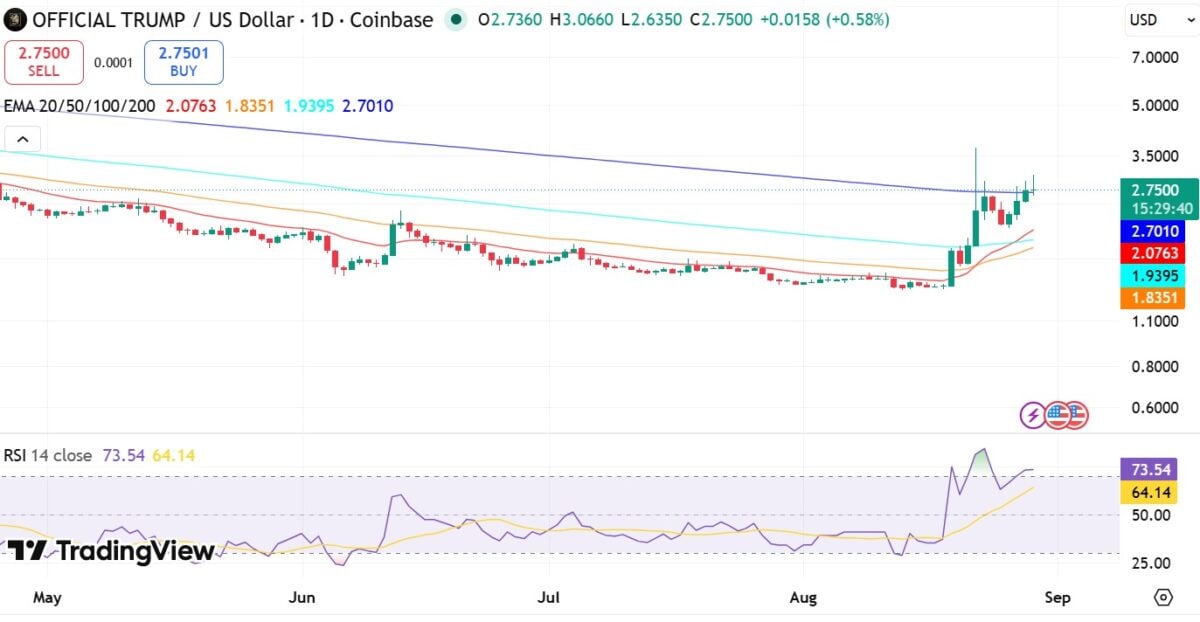
    Official Trump memecoin has experienced extreme volatility over the past day. In fact, the memecoin surged 10.2% and flipped $3 resistance to a high of $3.06.

    However, this pump failed to hold and the altcoin dropped again falling $2.6 before rising to $2.7 as of this writing. $TRUMP pumped as investors were tricked to believe the recently launched GOLD was $TRUMP 2.0.

    However , after the team behind GOLD was accused of rug pull sentiment flipped shortly after. In fact, Lookonchain reported that 15 wallets that purchased GOLD sold their holdings and exited the market taking over $312k in profit.

    $TRUMP investors panic exit amid rising liquidation risk

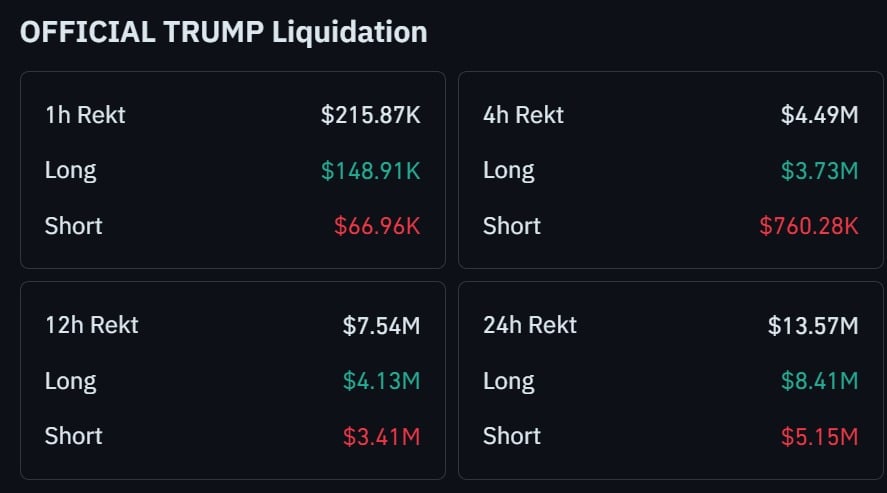
    This market volatility triggered a wave of liquidations for both longs and shorts. Traders who took long eyeing trend continuation, saw over $8.4 million in liquidations, while over $5.1 million worth of shorts were liquidated.

    Source: CoinGlass

    In total, the memecoin recorded over $13.57 million in total liquidations, indicating heightened volatility. Amid these liquidations, most traders both short sellers and longs, hurriedly closed their positions.

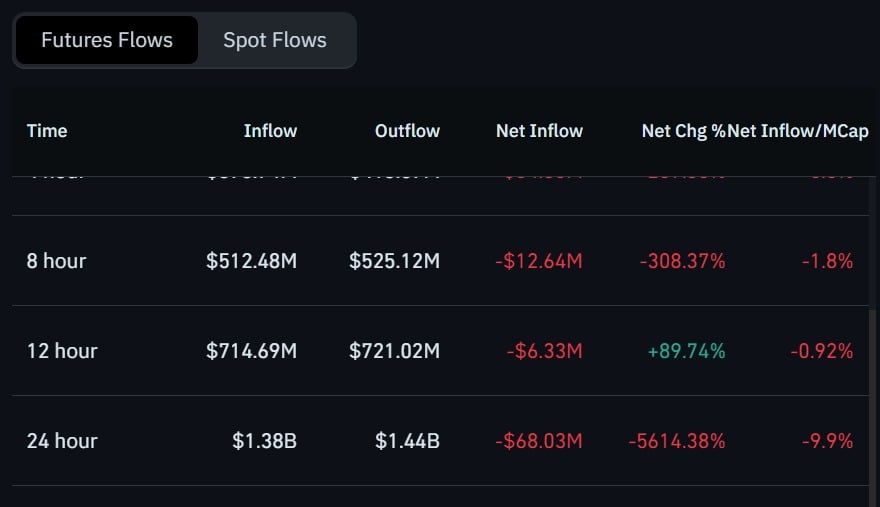
    According to Coinglass data, Official Trump [$TRUMP] recorded $1.44 billion in futures outflows compared to $1.38 billion in inflows. For that reason, Futures Netflow dropped 5614% to -$68 million.

    Source: CoinGlass

    A negative Netflow suggested that traders mostly closed their positions. The Open Interest further validates this observation.

    $TRUMP’s Open Interest dropped 6.4% to $279 million while the Derivatives Volume rose 23% to $3.3 billion. The falling OI and rising volume suggested that most traders exited their positions.

    Profit taking returns on the spot too

    As $TRUMP crossed $3, holders on the spot also rushed to cash out after the GOLD token launch brought about a negative sentiment.

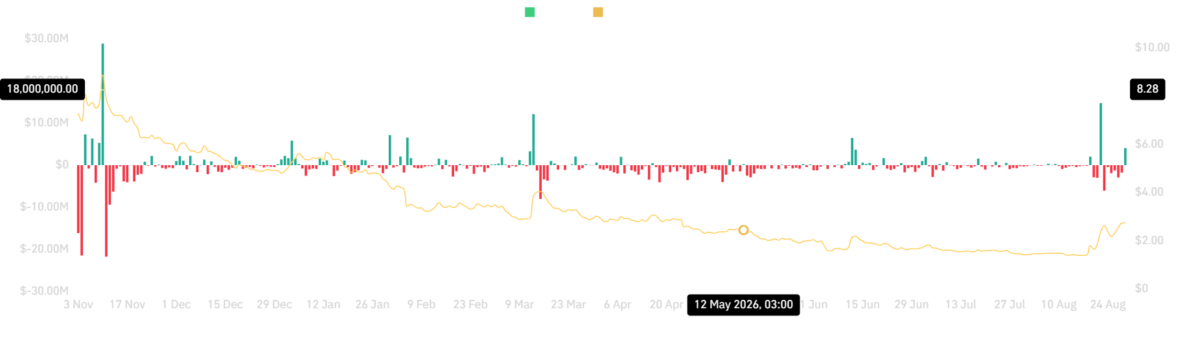
    Previously, the Spot market have been aggressively accumulating, with the Netflow holding negative for five consecutive days. On 29th August, this changed so first, with the Netflow rising to positive zone.

    Source: CoinGlass

    As of this writing Netflow was around $4.5 million, suggesting more $TRUMP entered exchanges, a clear sign of selling pressure.

    What’s next for the memecoin?

    With sellers active on both the spot and futures, the memecoin is unlikely to hold the uptrend. Historically, intense selling pressure has preceded price drops.

    For now, however, $TRUMP momentum still holds bullish. In fact, the Relative Strength Index (RSI) has remained elevated, currently at 73.

    Source: TradingView

    At these levels, the RSI suggest the uptrend is intact, with buyers still in control of the market. Likewise, $TRUMP holds above both short term and long term moving averages, further validating this view.

    Under these circumstances, the bullish structure is intact and likely to hold. If bulls can absorb the arising pressure, $TRUMP will reclaim $3 and eye to flip $3.6 resistance.

    However, if the pressure persist, the memecoin will breach $2.7 with $2.2 as the next support level.


    Final Summary

    • Official Trump [$TRUMP] saw extreme volatility, rising 10%, rising to $3.06 then retracing to $2.7 at press time
    • $TRUMP saw increased liquidation, with $13 million worth of positions liquidated triggering a wave of panic selling.
  • Protests as India’s Hindu nationalists take centre stage in New York

    Protests as India’s Hindu nationalists take centre stage in New York

    Demonstrators rallied against a ‘Universal Oneness’ celebration in New York City that was hosting Mohan Bhagwat, chief of India’s Hindu nationalist group, the Rashtriya Swayamsevak Sangh (RSS).

  • US police officer pulls hair, throws punches during arrest in Arkansas

    US police officer pulls hair, throws punches during arrest in Arkansas

    Footage shows an Arkansas state patrol officer pulling a passenger by his hair and punching him during an arrest following a high-speed police chase. The man was charged with resisting arrest and obstructing governmental operations.