SAVE America Act doesn’t include anti-trans provisions. Why do Trump, White House keep claiming it does?
March 13, 2026
Read More

March 13, 2026
Read More

It’s a lovely Labor Day weekend, and no matter what your plans are, set some time aside for shopping. Holiday deals are here on a wide variety of tech, and Dell’s online store is leading the way with some seriously solid machines. The venerable PC maker has laptops and desktops at deep discounts, and we’ll start off with these six offers on performance-rated laptops, user-friendly all-in-ones, gaming PCs, and more. Additional deals will be added throughout the weekend, so come back often.
Dell’s laptops are used all around the world in enterprise and small business situations, because they’re well-appointed, affordable, and supported by excellent warranties and customer service. The Dell Pro 16 is a very impressive midrange machine with a big screen, solid components, and support for cutting-edge AI functionality. We have a short preview here, as we haven’t taken this model into the lab yet, as well as a full review of the similar (but more expensive Pro Max 16 Plus). Both write-ups note that these machines deliver great performance on productivity tasks. This particular loadout comes with a capacious 55 Wh battery with ExpressCharge support for all-day life and speedy fill-ups. You can snag it for a 24% discount right now.
For something with a little more portability and a little more horsepower, the Dell 14 Plus is a great deal with an 18% Labor Day weekend price drop. This compact performance-oriented productivity machine is loaded for bear with a beefy Intel Core Ultra 7 processor paired with 32GB of system memory, so it’ll keep dozens of browser tabs open and let you multitask without slowdown. We have a detailed review of this model, giving it an “Excellent” rating for its comfortable touchpad and keyboard, long battery life, and premium all-metal construction. It’s exceptionally durable as well, passing multiple lab tests that include being dropped 1,200 times and having the hinge opened and closed 20,000 times. Built to last at a nice price? You can’t beat that.
Dell’s been making a big play for the niche that Apple’s dominated with the MacBook for over a decade, and the New XPS 13 is a terrific Windows portable with style to spare. We have an in-depth review of this new laptop, giving it an Editors’ Choice award for its attractive all-metal build, bright and responsive touchscreen, and solid component loadout for the price. This is an ultra-thin form factor, but it doesn’t compromise on either performance or battery life. We got more than 20 hours out of a single charge in our testing. This configuration is a little more potent than the one we took into the lab, with a full 16GB of RAM the biggest improvement. Save $300 during Dell’s Labor Day sale.
Looking for a great deal on a gaming machine? This $900 price drop brings the Alienware Aurora 16 almost into the budget bracket, and it’s a tremendous value. This is a well-designed portable that doesn’t push the envelope when it comes to dazzle, but it’s thermally efficient thanks to a focused airflow Cryo Chamber system, has decent battery life, and can run all of today’s hottest games. While the RTX 5050 graphics card isn’t the peak of the performance pyramid, it tested well for us in the lab, and the bright 16-inch screen has a peak refresh rate of 120Hz. The keyboard and touchpad are both comfortable, and port selection is solid. At this price, it’s one of the best entry-level gaming laptops out there.
*Deals are selected by our commerce team
Dell’s all-in-one desktops are solid all-around PCs that are great for families, with simple setup and big screens. The Dell 24 has a $100 discount during the Labor Day sale, bringing it in under a thousand bucks. While this isn’t an ultra-powerful machine, with an Intel Core 3 processor running the show and just 8GB of RAM, it’s more than enough to handle everyday household productivity tasks, Web browsing, and watching videos from your streaming service of choice. We have a full review, where strong points included its attractive design with a pair of triangular legs that fit nicely on most surfaces, along with good-quality wireless peripherals and plenty of ports. Wireless connectivity is also quite good, with speedy Wi-Fi 6E support.
*Deals are selected by our commerce team
Dell’s Alienware brand of gaming hardware is also seeing some impressive Labor Day discounts, with the most notable being a full thousand dollars off the very impressive Aurora gaming desktop. This battlestation consistently rates highly in user satisfaction, and in our review, we raved about its customizable AlienFX RGB lighting, efficient and quiet cooling, and wide range of configurations. What we have here is a very capable midrange machine that’ll make today’s top games look better than ever, thanks to a Blackwell-series GeForce RTX 5070 graphics card and a juicy 32GB of dual-channel DDR5 RAM. The rest of the loadout is also quite good, with a full terabyte of SSD storage very welcome. You also get your choice of two free games during the Intel Gamer Days promotion.
*Deals are selected by our commerce team
Want even more bargains on top-rated tech? Our deals page has it all.

K. Thor Jensen
Contributing Writer
Experience
K. Thor Jensen is a writer and cartoonist living in the Pacific Northwest. He has contributed to dozens of prestigious outlets, including PCMag, Tested, Clickhole, and Newsweek. His second graphic novel, Cloud Stories, was released in 2017.
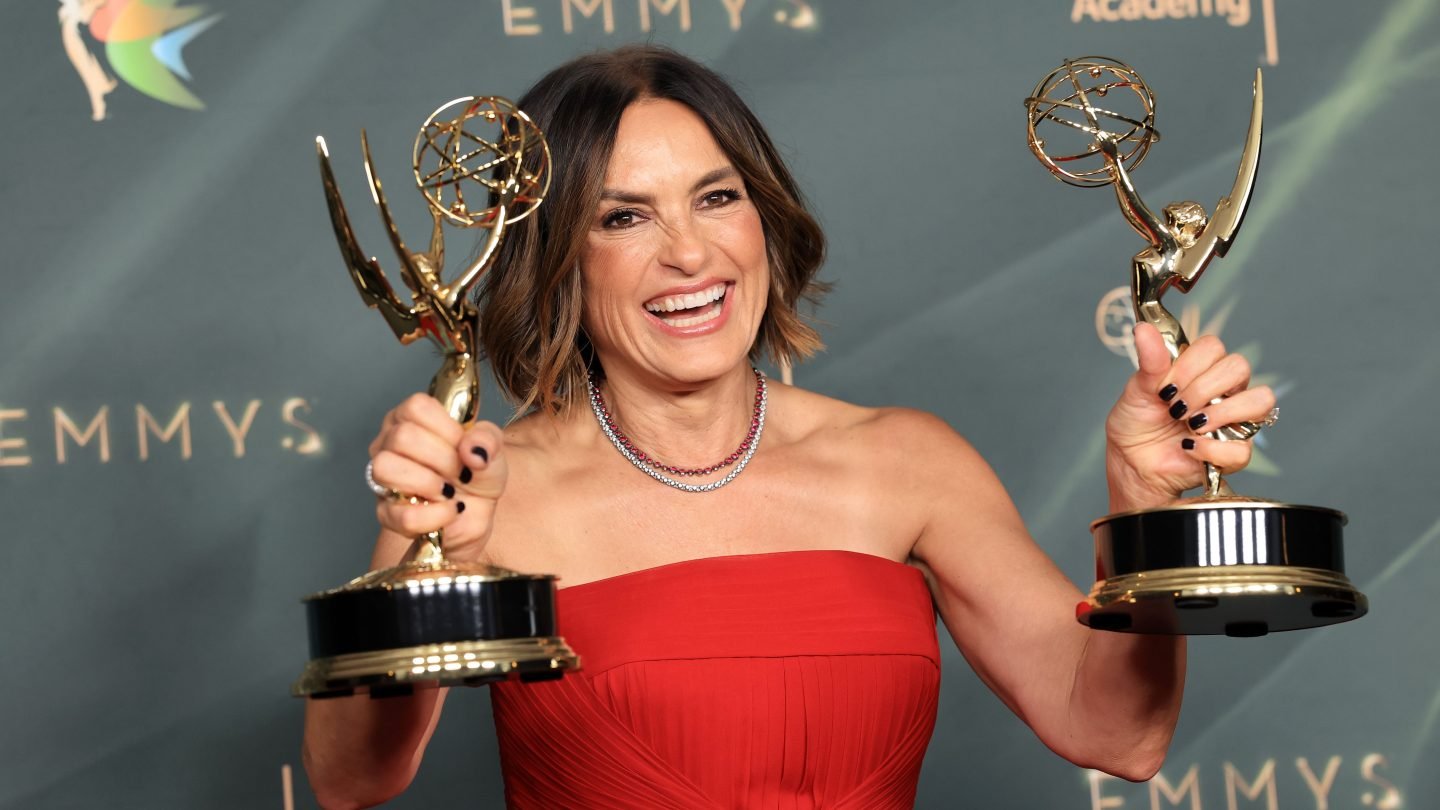
Mariska Hargitay is going into her Emmys hosting gig as a winner.
The star, who is helming the Primetime Emmys on Sept. 14, took home two prizes at the Creative Arts Emmys for My Mom Jayne: A Film By Mariska Hargitay. She landed wins for directing for a documentary/nonfiction program and for outstanding documentary or nonfiction special; the night brings Hargitay’s career Emmy total to three, after she won best actress for Law & Order: Special Victims Unit in 2006.
“It feels extraordinarily new and it’s deeply meaningful for me to have gone into a completely different arena, and to be recognized like this is really beyond my wildest dreams,” she told reporters backstage of how these two trophies compare to her one from two decades ago.
Hargitay also spoke about this particular moment in her career, where she’s living by the motto of “I just say yes. I said yes to Broadway and I said yes to hosting the Emmys — when they called me, I thought it was a joke, and then I went, ‘Why not?’”
“It’s a year of firsts and a year of saying yes and not limiting myself or not being governed by fear. Like, what would I do if I wasn’t afraid? What if it all works out?” she continued. “I’m in that place right now of going, ‘I’ll figure it out.’ I’m really happy right now.”
She also gave a hint at her mindset heading into the main show, admitting, “It’s been a big week, this hosting the Emmys is no joke,” teasing that NBC “undersold it to me” and told her it would just be two days of rehearsal, which was “a lie.” However, she expressed how excited she was to be working with The Late Show with Stephen Colbert writing team on her material and added, “I just can’t believe at this place in my life — my third act is starting and it’s pretty awesome.”
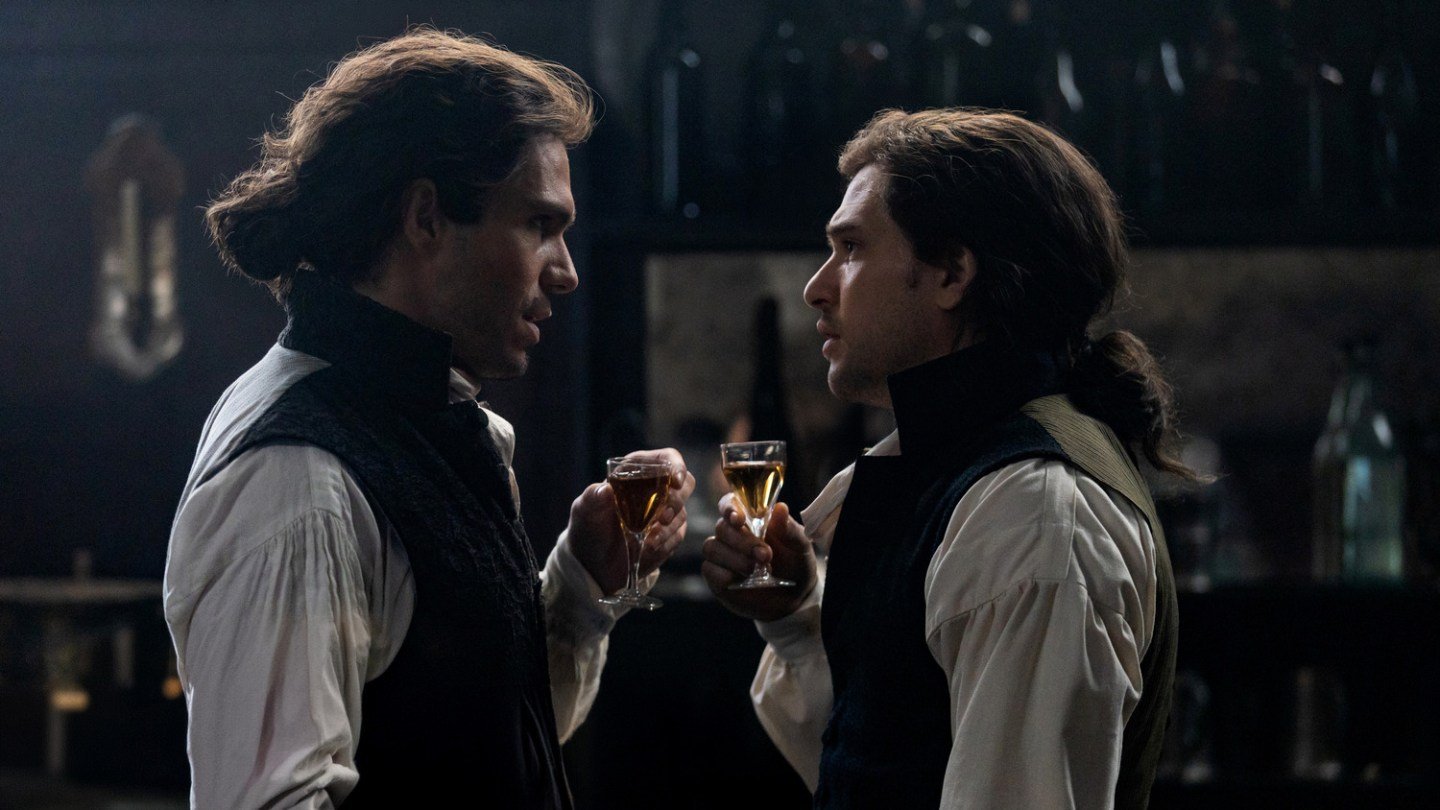
MGM+ and BBC One’s A Tale of Two Cities is neither the best of adaptations nor the worst of adaptations, but Daniel West’s take on the Charles Dickens classic may well be the meh-est of adaptations.
The four-part series benefits somewhat from the lack of an instantly identifiable definitive filmed interpretation of A Tale of Two Cities (depending on how you feel, I suppose, about the best picture-nominated 1935 feature) — a minor oddity given that the novel is in many ways Dickens’ most streamlined, featuring one of his best beginnings, best endings and most approachable narrative hooks.
A Tale of Two Cities
The Bottom Line
Fails to stand out as a romance, thriller or period piece.
Airdate: Sunday, September 6 (MGM+)
Cast: Francois Civil, Kit Harington, Mirren Mack, Roxane Duran
Creator: Daniel West
It’s a love triangle and a thriller set against the backdrop of the French Revolution. It features the usual Dickensian melange of colorful characters, breathless cliffhangers, shocking twists (not Oliver) and trenchant social commentary. It’s very much the epitome of a ripping yarn.
Ultimately, though, freedom from negative comparisons to previous adaptations is not enough to prevent this take on A Tale of Two Cities from being a bland disappointment — one of the least Dickensian adaptations of a Charles Dickens work since Steven Knight adapted A Christmas Carol around the question, “What if Ebenezer Scrooge could say ‘fuck’?” It’s still a love story, but with virtually no passion between any of its three principals; and while it may be a tale of two cities, they both look like nearly identically designed stages in a warehouse in some affordable Eastern European country.
For those who haven’t read A Tale of Two Cities or seen one of the forgettable previous adaptations — none, apparently, since a 1989 take that aired in the States under the Masterpiece Theatre banner — the plot is at once simple and convoluted.
After a brief prelude in Paris in 1764, in which a young Lucie Manette watches her father apparently be killed, the action jumps forward 18 years. Lucie (Mirren Mack) is now living in London hoping to follow in her late father’s footsteps as a doctor. Lucie’s concrete interest in medicine is not, if memory serves, a part of a book in which she’s a more nebulous “healer,” nor is it all that relevant to the series after a strange introduction in which she’s practicing surgery on a corpse. It’s a nearly pointless choice, one of many.
Lucie is living with Mrs. Lorry (Sharon Duncan-Brewster) and doing just fine for herself when her life is turned upside down with the arrival of Charles Darnay (François Civil). Charles is working on behalf of French revolutionaries, embodied by Roxane Duran’s Madame Defarge, to smuggle a generally irrelevant woman to safety in England. He’s also bearing a letter that suggests that Lucie’s dad (Yannick Renier) isn’t actually dead. The letter contains the evocative words “recalled to life,” which are potent on the page and nearly meaningless in the series.
At the English border, Charles is wounded, which lets Lucie utilize her medical knowledge briefly. Then he’s arrested as a spy. Lucie seeks out legal representation for the heroic Charles, but finds only the generally drunk and uncouth Sydney Carton (Kit Harington).
Both Charles and Sydney immediately fall in love with Lucie, because she’s somewhat the protagonist of the story and she’s pretty. Lucie, for her part, falls in love with both Charles and Sydney, which makes a little bit of sense since they look almost identical (assuming they aren’t standing next to each other, allowing one to see that Civil is a lot taller) and they’re both in constant need of chaste undressing. It makes less sense, though, because nothing in her interactions with either man comes across as the least bit romantic and the chemistry between Mack, Civil and Harington is wholly lacking, regardless of the permutation.
As Lucie is reunited with her father, seriously psychologically damaged by his two decades in the Bastille, she learns shocking truths about Charles and his lineage and about the revolutionary motivations of Madame Defarge, whose general intransigence has caused her to be viewed as the villain of the piece, regardless of logic.
Watching A Tale of Two Cities, it’s almost impossible to gauge what attracted West and the producers to the book, other than the IP and the reality that there are only so many times one can adapt Great Expectations, David Copperfield, Oliver Twist and A Christmas Carol before it becomes necessary to cycle back into the Dickens catalogue. The inspiration is nowhere to be found here.
And A Tale of Two Cities is, as I’ve already said, a ripping yarn, featuring doppelgängers and surprises and the French blooming Revolution — featured in one thoroughly lifeless scene — plus it’s eternally timely since the story is one of those reliable Dickens screeds in which the impoverished masses are on the verge of toppling the heartless elite. Madame Defarge is — whether or not you buy her as a villain — one of fiction’s great adversaries, and her backstory is, itself, both eternally timely and specifically timely at a historical moment when you might have noticed one or two headlines about immoral wealthy men preying on defenseless young women.
One could certainly adapt A Tale of Two Cities in a way that steers into the complications of Madame Defarge as a character, resulting in something that might almost resemble Hulu’s summer hit, Furious. She is, as a character, at best a righteous crusader and at worst a rigid zealot, but she’s hard to make uninteresting. Duran captures Defarge’s rage and, in a series plagued by thinly sketched characterizations hers comes closest to rising to the level of interesting. But her cause and her connection to that cause are mechanical pieces of the plot here, making it impossible to hate her or empathize with her. She’s just the person stirring up trouble whenever we go to Paris.
Plus, it’s hard to know when we’re in Paris. As directed by Richard Clark, A Tale of Two Cities is temporally choppy and fails to build any emotional or geographical momentum. Though two cities are in the title, we’re treated to maybe a block or two of London and a block or two of Paris, visually interchangeable in a way that offers no real tangible connection to either staged location.
Presumably, making Paris and London interchangeable is intentional, a parallel to the similarities between Charles and Sydney? Except that the entire purpose of the story’s arc is that one should be able to chart the life Charles was born into and the changes he made (all before the start of the story, since he’s pretty much stagnant onscreen throughout) and compare that to Sydney’s journey from the man he is when we meet him to the man he becomes by the end of the tale. In this case, though, since Harington and Civil are comparably solemn and earnest throughout — the actors do, if nothing else, look as similar as the story necessitates — there isn’t much evolution to trace.
There are supposed to be comparable parallels to the arcs of Lucie and Madame Defarge, one as a force of optimistic good and the other as a force of all-consuming vengeance, but neither progression is all that engaging. Like Duran, Mack brings a little fire to the series, but Lucie is one of those Dickensian women who are unexplained rays of light who exist mostly to fuel the growth of the main male characters.
As for the supporting ensemble from the page, from the bloodthirsty revolutionaries collectively known as Jacques to Sydney’s partner Mr. Stryver (a wasted Fehinti Balogun) to the figure known as The Vengeance, they’re either gone entirely or written so thinly here as to leave no impression.
A Tale of Two Cities is in such a hurry to get from that memorable opening (rendered poorly as a voiceover at the end of the first episode) to that tremendous closing (rendered poorly as another voiceover) that the adaptation might as well have been as a two-hour movie. Certainly the cliffhangers at the end of each episode lack the urgency that Dickens himself understood so well how to evoke. The story itself is probably good enough to pull some viewers along from episode to episode, but the telling definitely is not good enough to inspire anybody to seek out MGM+.
Regardless, there’s a far, far better adaptation of A Tale of Two Cities than has ever been done. This is not it.

For Lucy Liu, who has voiced memorable characters in everything from “Kung Fu Panda” to “Strange World,” being part of the independently made, black-and-white animated film “Moonfish” was all about lending her name and support to first-time filmmaker Daniel Zvereff.
“These are the people that are not just the creatives, but the ones who are going to be the future,” Liu tells Variety. “I’m just fascinated by how people work and how things start when there’s not all this red tape.”
Premiering at the Venice Film Festival on Sept. 6 after receiving a grant from Biennale College Cinema, “Moonfish” follows a pair of astronauts, voiced by Liu and “The Gilded Age” star Morgan Spector, as they embark on an isolating mission to the moon with a corporate quota to meet if they want to return home.
“I really wanted to have the film take place in an environment that was an allegory to our current human condition we’re all experiencing right now, where society is very plugged in, but simultaneously we’re all growing a bit disconnected,” Zvereff says.
Zvereff designed the 2D-animated film so that he could finish it completely on his own, if need be. Thankfully, as Zvereff worked over the course of nine months, he managed to bring on two animators, Hoss Wheeler and Devin Grover.
“When I watch 2D-animated films, I feel like I’m being exposed to the subconscious of that artist,” Zvereff says of his approach.
Liu adds, “It’s amazing what digital has done for the speed of animation but you can really feel the appreciation and the craftsmanship [here]. There is a tenderness and an imperfection that I appreciate.”
Unlike Liu, Spector had never done an animated film before “Moonfish.” The trickiest part was getting into his character’s mental headspace as he goes “a little mad,” as Spector puts it.
“This particular class of people has come to live on the moon, and they’ve evolved, essentially, as moon people. But they’ve also evolved as an underclass; they are the group of people without rights, assets or any real hope for the future,” Spector says of Zvereff’s worldbuilding.
Liu, of course, also voices the talking fish that accompanies the pair (which Zvereff likens to how miners brought along canaries to know when they had to leave) amidst the mundanity of the corporate tasks at hand.
“The future that Daniel’s imagining is one in which the relationship between human beings and their tools has been totally inverted. The corporation has merged with the computer in a sort of perfect authoritarian machine that uses human beings as fodder, basically,” Spector says. “It’s a vision of the world that feels continuous with the one we live in.”
While the film explores isolation and loneliness in space, with the dialogue sparse and to-the-point, Zvereff realized during the writing process that it needed to ultimately be positive about the future of humanity.
“That’s something that happens as an artist. When you’re making something, you’re taking in all these feelings you’re happening and running them through this prism,” he says. “And out comes this beautiful, unexpected light.”
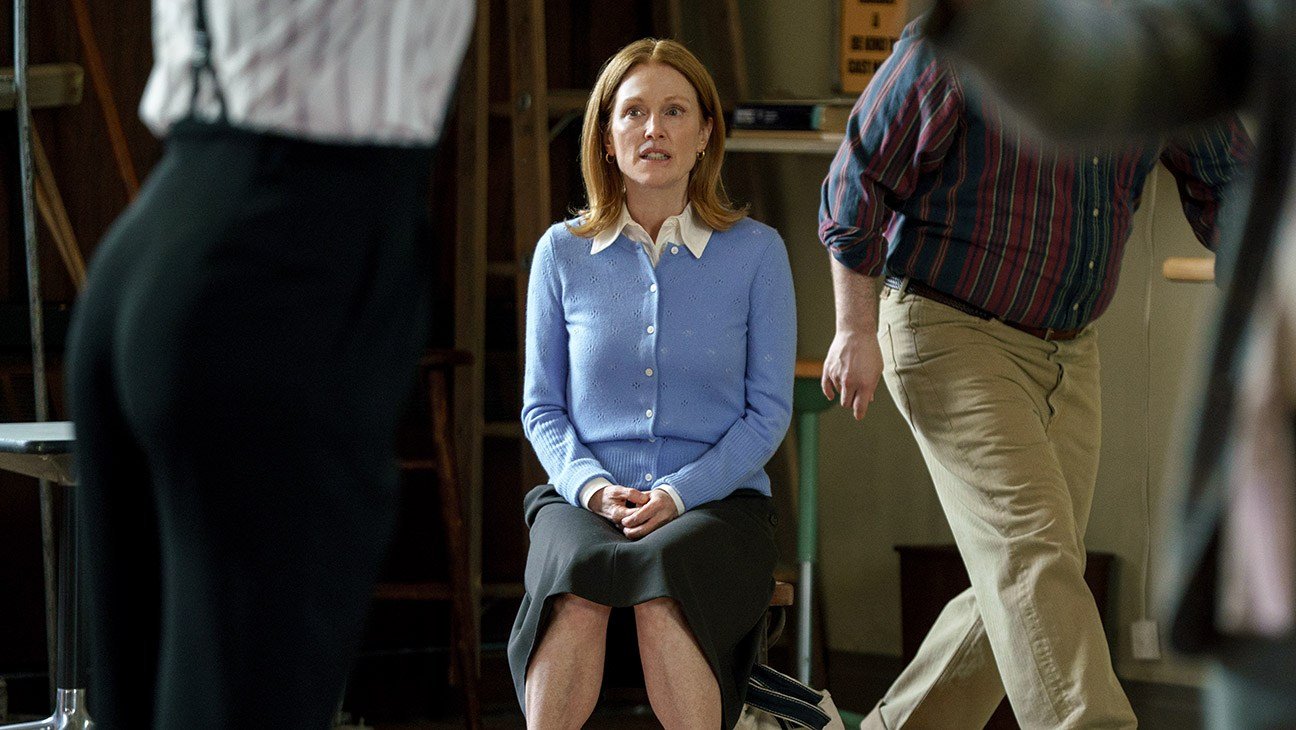
When Mona (Julianne Moore) tells a friend she’s auditioned for a production of a show called Nosy Neighbors at their local theater, he admits he’s never liked musicals. They just don’t feel authentic, he explains, the way the characters are always bursting into song. Who does that?
Well, no one, not even in the musical-loving The Debut. But among the first of the film’s sly tricks is that it builds a world in which it feels like people could, where in fact it feels more unnatural that they don’t. Blessed with swing-for-the-fences brio and, in Moore and Paul Giamatti, a leading duo capable of navigating every one of those wild turns, the latest feature by Jesse Eisenberg makes for a frequently hilarious journey into the mind of an overly committed actor — even if, in the end, it seems unsure quite what it wants to say about the self-destructive pursuit of artistic perfection.
The Debut
The Bottom Line
A very good time, if not necessarily a profound one.
Venue: Telluride Film Festival
Cast: Julianne Moore, Paul Giamatti, Halle Bailey, Jesse Eisenberg, Cara Buono, Craig Bierko, Eldar Isgandarov, Bernadette Peters
Director-screenwriter: Jesse Eisenberg
Rated R,
1 hour 45 minutes
At first, Mona would seem an unlikely candidate to go Method in the way of certain prestige actors or comic book movie stars. When we meet her, she’s a meek suburban housewife who’s never acted a day in her life, and whose audition is so mediocre she doesn’t even realize how mediocre it is. Once she lands a relatively minor role anyway, owing to a twist of fate that she may have ever-so-slightly nudged along, she’s just happy to be there, drinking in any suggestion or note or friendly gesture extended to her.
But even from the start, before Mona properly goes off the deep end, The Debut starts inuring us to her heightened perspective. When Mona gets the call saying she’s gotten the part, a spotlight floods her grin and the camera rushes in, as if she might start belting on the spot. On her first day of rehearsal, the whole world is lit a little brighter than it was a few scenes earlier. When she endears herself to her new colleagues with a joke, the laughter feels slightly too enthusiastic. The effect is almost eerie to start, and it takes some getting used to. But it turns out to be just the tip of the iceberg.
The pivot comes when the production’s director, Jerry (Giamatti) — described in a low-key perfect bit of dialogue as “basically the biggest name in New Jersey community theater” — pulls Mona aside for the private special instruction that she (as a truly godawful singer and actress) so desperately needs. Jerry’s usual method is to break his actors down so he can “put Humpty Dumpty together again,” and it begins exactly as planned in an acting exercise that yields one of the very biggest laughs in a film rich with them.
But then Mona takes a little too well to his guidance. As Mona loses herself in her character, a building superintendent named Miss Danielle, her wardrobe, courtesy of costume designer Stacey Battat, goes from prim cardigans to ripped jeans to an actual coverall she’s stolen from a janitor. (This is neither the first nor last time you’ll think to yourself, “Man, theater people are a menace” and “Jesse Eisenberg’s seen some shit, huh?”) She begins frequenting a seedy motel that production designer Anne Ross has cleverly made into a theater actor’s exaggeratedly noirish version of what a seedy motel would look like, with smoke-blurred neon lights and a trash can fire outside and an inexplicably naked man roaming the halls inside.
Most worryingly for Nosy Neighbors — in-universe a well-known musical that’s been around a few decades, in reality an original concocted by Eisenberg and seen here in perfectly cheesy snippets — Mona starts to question Miss Danielle’s motivations, then her lines, then her actions. Jerry realizes he’s created his own worst nightmare: the sort of difficult actor who thinks she knows her character better than the director or even the script that invented her.
Lively throughout, The Debut ascends to new heights whenever Giamatti and Moore share the screen together. Moore is an absolute hoot as Mona, who starts out looking on paper like one of those disaffected housewives she’s played so often (and so expertly) in her career but turns out to be much, much stranger. Giamatti makes Jerry ferocious but not monstruous, a man who certainly likes barking orders at various underlings but loves making good theater even more. Their scenes opposite each other are not just entertaining but thrillingly dynamic, as the balance of power between them begins to shift.
It’s all so much fun that it’s easy not to notice at first that none of this is headed anywhere particularly profound. There’s a touch of poignancy in the understanding that Mona is so eager to lose herself in Miss Danielle because — like Rita, the protagonist of Telluride 2026’s other “New Jersey suburbanite abandons her family to pursue a more authentic life under the guidance of a charismatic but demanding leader” premiere — she barely knows who she is in the first place.
But the film never builds out the rest of Mona’s world, like her inattentive husband (Patrick Fabian), or even co-stars like Steph (a very endearing Halle Bailey) and Todd (Eisenberg, adorably giving himself an excuse to sing and dance), to take that line of thinking anywhere truly insightful or emotional.
Among the arguments between Mona and Jerry are what theater can or should be. Mona argues that that the stories it tell should be “real,” even at the expense of a happy ending, while Jerry argues that no one cares much about the plot — audiences just want to feel while spying on the intimate lives of other people.
The Debut, in prioritizing style, humor and outrageous plot turns over complex emotionality, would seem to side with Jerry. Maybe it’s not everything it could be. But as I howled over the lengths Mona would go to for the sake of what Jerry unkindly but accurately points out is, in the end, just some “thankless tertiary character,” it felt like more than enough.

Roma filmmaker Alina Șerban broke barriers long before she set foot on the red carpet this week at the Venice Film Festival, where her feature-length directorial debut, “I Matter,” world premieres in the Venice Spotlight section.
Rising from an impoverished background to become a celebrated stage star in Romania, the actress and directing debutante has defied all odds to reach the starry heights of the Lido. Billed as the first feature from a female Roma director to screen at an A-list festival, “I Matter” marks the latest chapter in her life-long quest to reframe the narrative around her marginalized community.
Șerban, however, is taking it all in stride.
“I’m nervous about the pressure of being ‘the first’ — all the firsts,” she tells Variety. “But I also have this immense relief, and the feeling of being grateful that I managed to pull through something almost impossible.”
Inspired by Șerban’s own life, “I Matter” tells the story of a young Roma woman studying to be an actor. She’s faced with the threat of being kicked out of her orphanage and must suddenly embrace her identity and confront the reality of making it through life on her own. Based on the 2021 short of the same name, whose festival run included New Directors/New Films, it’s produced by microFILM, 2Pilots Filmproduction, Frakas Prods. and Lemming Film, with international sales handled by Pluto Film.
For Șerban, the premiere is a capstone in what has already been a remarkable career. Raised in poverty in Bucharest, she was placed in a state-run orphanage at an early age before becoming the first member of her family to graduate from high school. After attending Bucharest’s Academy of Theatrical Arts and Cinematography, she was accepted into NYU’s Tisch School of the Arts, then later earned a master’s degree from the Royal Academy of Dramatic Art in London.
When she returned to Romania, she mounted an acclaimed one-woman show about her life, focusing not only on the rampant discrimination she faced, but on her triumphs and joys. By her 30th birthday, Șerban had written and staged pioneering plays that championed a radical, feminist, Roma perspective — trying, she says, “to show the humanity of these people. Not to portray them as victims nor villains. Not to self-exoticize. But also to celebrate ourselves.”
“I Matter” stars newcomer Denisa Farcaș, bringing both vulnerability and determination to a lead role that she invests with her own life experience, according to the director. Șerban describes working with Farcaș and her co-stars as a “collaborative process,” one in which the group delved deep into “what it means to be accepted” as Roma women while giving the young actors space to “express themselves — to feel that they also own the story.”
This isn’t Șerban’s first visit to the Venice Film Festival; she attended in 2023 with the cast and crew of Goran Stolevski’s “Housekeeping for Beginners,” in which she had a supporting role. But this year’s experience will be something else entirely for the director. Nearly two dozen of the cast members of “I Matter” will be in attendance — including the 16 child performers who populated the film’s orphanage — while Roma band Mahala Rai Banda will serenade the red-carpet arrivals.
“This is such a historical moment for me, and also for the Roma community,” Șerban says. “It’s a moment of celebration. And I want to look back and say I did everything in my power for the people in the team to [share this] moment. And also to put into the world a message of dignity, of celebration, of pain that needs to be seen.”
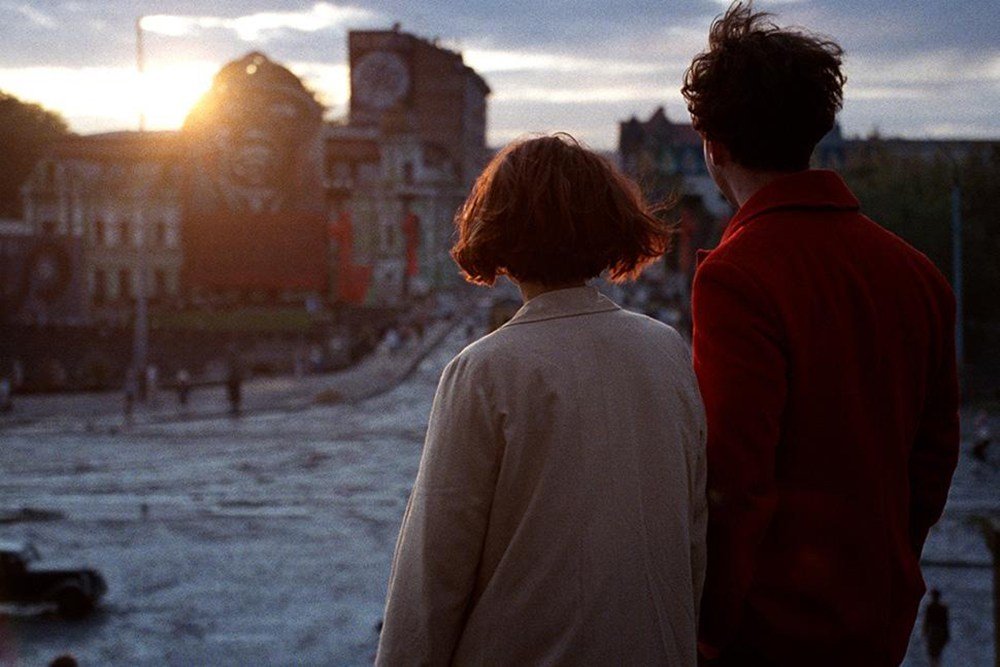
The Venice Film Festival found itself under fire in the weeks leading up to opening night over the inclusion of “DAU,” by Russian filmmaker Ilya Khrzhanovsky, in the main competition of its 83rd edition.
In a joint statement released on Aug. 17, the Ukraine Ministries of Foreign Affairs and Culture and the Ukrainian Embassy in Italy criticized the prestigious fest for selecting what they claimed to be “a project linked to the Russian state and its networks of influence,” maintaining that the decision helped to “restore respectability” to Putin’s pariah state.
The pushback was swift. In an Instagram post responding to the criticism, Venice artistic director Alberto Barbera insisted that “‘DAU’ is not a Russian film; it is not pro-Putin propaganda.” Meanwhile, Khrzhanovsky took to Facebook to refute allegations that the latest installment in his long-running project was backed by Russian financing or is “an instrument of Russian state cultural policy.”
Speaking to Variety on the eve of the festival, the director doubled down, saying: “Since the war started, there was no question of what side I am on, because I am on the side of Ukraine.”
Coming on the heels of a recent controversy surrounding the Venice Art Biennale’s decision to mount shows by Russian and Israeli artists, the “DAU” dust-up speaks to a larger question hanging over film festivals, cultural institutions and other events that, in the immediate aftermath of Russia’s full-scale invasion of Ukraine, largely heeded calls for a boycott of Russian cultural exports.
As the war drags deeper into its fifth year, a rapprochement of sorts is underway. While relations with Moscow remain frosty for much of the world, Russian filmmakers are gradually coming in from the cold.
In the past year alone, Russian-born directors have scooped prizes in Venice (Nastia Korkia’s “Short Summer”) and Cannes (Andrey Zvyagintsev’s “Minotaur”), while Khrzhanovsky is joined on the Lido by fellow exile Victor Kossakovsky, whose latest documentary, “Holly Wood Dust,” premieres out of competition.
Though the Oscar-nominated Kossakovsky (“Gunda”) and Khrzhanovsky both left Russia in the 2000s, a broader exodus began not long after Russian tanks rolled into Ukraine in February 2022. Whether fleeing in protest of the Kremlin’s war machine or out of fear of the brutal crackdown on dissent that quickly followed, many of Russian cinema’s most prominent voices left the country, forging exile communities from Tbilisi to Paris, from Berlin to L.A.
“There are two Russias right now,” says two-time Oscar nominee Alexander Rodnyansky (“Leviathan”), in Venice with Kornél Mundruczó’s “Place to Be,” starring Ellen Burstyn and Taika Waititi. “Russia as the country with this regime controlling everything and censoring all the attempts to speak freely about what’s going on. And there is a Russia outside of the geographical borders.”
That diaspora is experiencing exile in a variety of ways. The Kyiv-born Rodnyansky, who was sentenced in absentia to 8.5 years in prison by a Moscow court over his opposition to the war, remains determined to support dissenting voices and “make movies with Russian filmmakers, especially young ones, who I feel myself committed to help.” Now based in France, Zvyagintsev likewise remains a trenchant critic of a country he says he has “no intention” of returning to. Though filmed in Latvia, his Cannes Grand Prix-winning “Minotaur” is as scathing a portrait of Russian society under Putin as the director’s previous works.
For other filmmakers, the westward flight has offered an opportunity for reinvention. Kantemir Balagov’s “Butterfly Jam,” which opened the Directors’ Fortnight section this year in Cannes, stars Barry Keoghan and Riley Keough and is set in an immigrant community in Newark. Director Kirill Sokolov likewise set off for Hollywood; his latest, the blood-soaked revenge farce “They Will Kill You,” stars Zazie Beetz and Patricia Arquette.
Sokolov’s dark comedy “No Looking Back” was among the first films to bear the brunt of the anti-Russia backlash in 2022, when it was pulled from the Glasgow Film Festival over financing that came in part from the Putin regime. The “DAU” controversy in Venice was similarly driven by ties to Russian financiers who would later be sanctioned following the Ukraine invasion.
But Khrzhanovsky stresses to Variety that their involvement in his decades-spanning project ended years ago; his Venice-bound film is a German production, co-produced with France and Sweden, and has received no Russian funding for seven years, according to the director.
As these and other Russian filmmakers set up new lives in exile, the financial ties that once bound them to Putin’s state have been cut. That, as much as their vocal opposition to the Ukraine war, arguably weakens the case for protest and will ease further reentry into the international film community.
“They’re shot in Europe. They’re financed in Europe,” says Laurent Danielou, of Paris-based Loco Films, who’s currently financing two features from émigré Russian directors. “They’re not Russian anymore.”

As the first week of September closes, Pump.fun ($PUMP) is trading at $0.004195. Buyers have stepped in and defended the $0.0040 zone twice, printing a double bottom and showing that the sellers can’t push through that floor with any conviction.
The neckline likely sits at $0.00455. A clean breakout above that level with volume behind it confirms the double bottom and opens the door toward the projected target at around $0.0052, a crucial move from current levels. Until that breakout is confirmed, the bulls are in a waiting game.
In the early hours, the asset traded at a bottom of $0.004096. With a shift in momentum, it tested and broke multiple price ranges and gradually drove the $PUMP price to a high level of $0.004405. Besides, the 24-hour volume has potentially reached the $147.17 million zone.
With the negative outlook, the recent trading pattern might slip even deeper and test the key support at the $0.004139 range. Further correction on the downside could likely trigger the emergence of the death cross in the $PUMP market, and the bears would send the price below $0.0040.
On the upside, if the bulls re-entered the market, the asset’s price could instantly rise to its nearest resistance level at $0.004251. Extended bullish pressure might push for the formation of the golden cross. Eventually, it could drive the $PUMP price even higher, above the $0.0043 mark.
The Moving Average Convergence Divergence line is slightly above the signal line, while both lines remain below the zero line; it is an early sign of bullish momentum forming within a broader downward trend. The overall background of the $PUMP market is still bearish.
Short-term price moving averages are lower than long-term averages, confirming sustained selling pressure. MACD crossing one point above it forms a fresh bullish crossover, showing that buyers are stepping in and driving price up faster than the immediate recent average. This represents a bullish attempt to counter a macro downtrend.
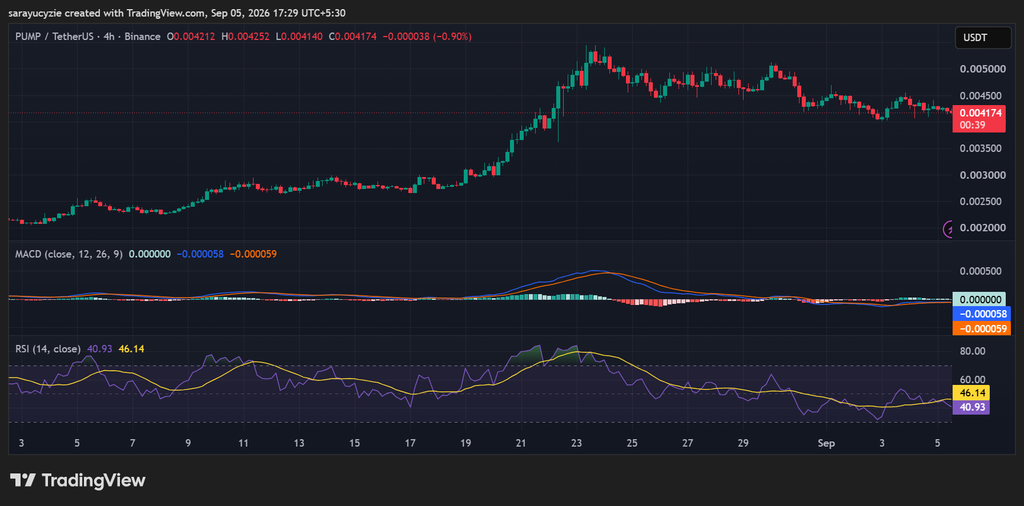
Moreover, the daily Relative Strength Index reading positioned at 40.93 hints at weak or neutral-bearish territory. The sellers currently hold a slight edge over buyers, with average price losses outperforming average gains over the recent lookback period.
The asset still has room to fall further before becoming overextended to the downside. A drop toward 40 signals a healthy pullback before the broader trend resumes. If the broader market is already bearish, an RSI staying in the 40–30 range confirms sustained selling pressure without enough buying momentum to reverse direction.