Author: rb809rb

  • Nedra Talley Ross, Last Surviving Member of the Ronettes, Dies at 80

    Nedra Talley Ross, Last Surviving Member of the Ronettes, Dies at 80

    Nedra Talley Ross, the last surviving founding member of the early 1960s-era girl group and Rock and Roll Hall of Famers the Ronettes, has died, according to a post on the group’s Facebook page. No cause of death was announced; she was 80 years old.

    “It is with heavy hearts that we share the news of Nedra Talley Ross’ passing. She was a light to those who knew and loved her,” the post reads. “As a founding member of The Ronettes, along with her beloved cousins Ronnie and Estelle, Nedra’s voice, style and spirit helped define a sound that would change music. Her contribution to the group’s story and their defining influence will live forever.

    “Rest peacefully dear Nedra. Thanks for the magic.”

    In many ways, the Ronettes — New Yorkers Talley Ross (pictured above, far right, in 1964) and her cousins Veronica “Ronnie” Bennett (later Spector) and Estelle Bennett — were the definitive girl group, and they were certainly the definitive purveyors of producer Phil Spector’s legendary “Wall of Sound,” which dominated American radio in the early 1960s before the advent of the Beatles and the British Invasion.

    With a bad-girl vibe and big, booming singles like “Be My Baby,” “Baby I Love You,” “Walking in the Rain” and “I Can Hear Music,” defined by lead singer Ronnie’s come-hither voice and Spector’s dense, echo-drenched production, the Ronettes’ sound is a time capsule of the Kennedy age. Although the group’s reign was brief, they cast a wide influence across the sound of the ‘60s and every pop era that followed — within a decade artists ranging from the New York Dolls and Bruce Springsteen to Billy Joel and the Ramones would be singing their praises and citing their influence.

    Just as significantly, the group broke down racial barriers in the 1960s, when the sight of three young women of Puerto Rican and Black descent singing pop music on television and opening concerts for the Beatles was a rarity.

    Talley Ross was born in Manhattan on Jan. 27, 1946, of Black, Native American, Irish and Puerto Rican descent, and began singing with her cousins as a child. They played New York sock hops and bar mitzvahs, performing material by Frankie Lymon & the Teenagers and the Shirelles, first as Ronnie and the Relatives and then, at Beatrice Bennett’s suggestion, as the Ronettes. The trio was signed to Colpix Records, the label subsidiary of Columbia Pictures, in 1961, but their Stu Phillips-produced singles flopped.

    In 1963, the Bennett sisters – now working as dancers and sometime vocalists with the Peppermint Lounge twist act Joey Dee & the Starlighters — cold-called the New York office of Phil Spector, then riding high with a run of hit singles by the Crystals, Bobb B. Soxx & the Blue Jeans and Darlene Love.

    Granted an audition with Spector, the Ronettes, fronted by Ronnie, launched into a version of Frankie Lymon’s “Why Do Fools Fall In Love.” According to her autobiography, Spector instantly leaped up from his piano and exclaimed, “That’s the voice I’ve been looking for!”

    With Ronnie in the lead — as well as the object of the producer’s romantic attentions — the group swiftly became the medium for Spector’s vast Wagnerian productions. The Ronettes detonated on the charts in ’63 with the explosive “Be My Baby,” which vaulted to No. 2 nationally; the song was later used unforgettably under the credits of Martin Scorsese’s 1973 breakthrough feature “Mean Streets.” The group also performed three songs on Spector’s Yuletide album “A Christmas Gift to You” that year, which has gone on to become a seasonal classic although its initial impact was dulled by the Kennedy assassination.

    A quartet of masterful top 40 hits followed in 1964: “Baby I Love You,” “(The Best Part of) Breaking Up,” “Do I Love You” and “Walking in the Rain,” written by the pop powerhouse teams of Ellie Greenwich with Jeff Barry and Barry Mann with Cynthia Weil (and a dotted-line credit to Spector). On the back of these successes, the Ronettes toured the U.K., where the Rolling Stones served as their opening act — Keith Richards enthused, “They’re all right little darlings” — and Ronnie deflected advances from the Beatles’ John Lennon.

    Two minor singles were released in 1965, while such magnificent performances as “Paradise” and “I Wish I Never Saw the Sunshine” remained in the can for more than a decade. The group also opened for the Beatles on their last world tour in 1966, alongside their last chart single, “I Can Hear Music” reached No. 100 in 1966.

    The group agreed to split after a 1967 European tour: While the members were still in their early or mid-twenties, their peak era had long since passed, and by that time Phil Spector had divorced his wife and turned his domineering and literally combative attention to Ronnie, effectively squelching her professional career in the process.

    A long series of bitter legal actions against Spector over unpaid royalties and income ensued over the following decades, with a judge finally ordering the producer to pay the group $2.6 million in 2000 (he appealed twice). As a member of the Rock Hall of Fame’s Board of Governors, he effectively blocked their nomination for years, although the group was finally inducted (and introduced by Richards) in 2007, after Spector had been arrested and convicted of the shooting death of actress Lana Clarkson.

    Talley-Ross continued to work as a solo artist, recording a solo contemporary Christian music album in 1978, in addition to several singles. Estelle Bennett and Ronnie Spector died in 2009 and 2022, respectively.

  • Dogecoin Builds Pressure Near $0.1018 as Whale Accumulation Fuels Bullish Case

    Dogecoin Builds Pressure Near $0.1018 as Whale Accumulation Fuels Bullish Case

    Dogecoin ($DOGE) is back at a familiar crossroads, and the market is once again doing what it often does best with $DOGE: waiting for a small technical trigger to decide whether the next move will be a breakout or just another fade. Crypto analyst Ali Martinez said the level he is watching most closely is $0.1018, arguing that $DOGE needs a sustained four-hour close above that resistance, backed by rising volume, to confirm a bullish breakout.

    That call comes as Dogecoin is trading near $0.0985, according to CoinMarketCap, with a 24-hour trading volume of about $956.5 million and a market capitalization of roughly $16.7 billion. What makes Martinez’s setup interesting is that Dogecoin has already spent much of April trading in a tight, frustrating range.

    $DOGE closed at $0.09492 on April 16, $0.09920 on April 17, $0.09955 on April 18, and $0.09490 on April 19, which is exactly the kind of choppy price action that tends to make a nearby resistance level matter even more. In other words, $0.1018 is not just another number on a chart. It is the line separating a market that is still boxed in from one that may finally be ready to expand.

    At current prices, that resistance sits only about 3.4% above $DOGE, while Martinez’s target of $0.1172 would be roughly 19% above the latest quoted level. Martinez’s earlier comments this week added a bigger on-chain story to the technical setup. He explained that Dogecoin saw a major transaction volume spike on April 16, with nearly $800 million moved in 24 hours, and that large holders accumulated more than $330 million in $DOGE over the past week.

    That combination matters because it gives the chart context. A token can sit still for days and still be getting quietly repositioned underneath the surface. When volume jumps and whale balances rise during a consolidation, traders often begin to suspect that the market is building energy for a larger move rather than simply drifting sideways.

    Breakout Scenario for Dogecoin

    The technical case is straightforward. $DOGE has been moving inside a parallel channel, and Martinez says the price has already been rejected from the $0.1018 area five times. That is the kind of resistance that traders start to respect, because repeated failures often force weaker buyers to step aside while patient buyers keep leaning in. The bullish version of this story is simple enough.

    If $DOGE can reclaim $0.1018 on a four-hour basis and hold above it with expanding volume, then the market can begin to price in a move toward the top of the channel at $0.1172. The bearish version is just as easy to understand. If $DOGE keeps losing steam right below resistance, the market stays trapped in the same range that has defined the token through much of April.

    The broader crypto backdrop is also important here. Bitcoin is trading around $77,934 and Ethereum around $2,335.38, which means the major assets are still providing a constructive, if cautious, environment for speculative names like Dogecoin. When $BTC and $ETH are stable enough to keep risk appetite alive, meme coins usually have a better chance of attracting volume.

    That does not guarantee a breakout, but it does make a breakout more believable if one starts to form. $DOGE has always been unusually sensitive to shifts in market mood, and right now the majors are at least giving altcoins some room to breathe. There is also a longer-term institutional angle that should not be ignored. In November 2025, Grayscale launched a Dogecoin-focused fund, a notable sign that $DOGE was starting to move further into the world of investable products rather than remaining only a retail-driven meme asset.

    Moreover, the SEC previously approved generic listing standards for spot crypto ETFs, a change that simplified the path for new digital-asset products and helped accelerate filings across the crypto market. Recently, Canary Capital filed for a first MOG ETF in the meme-coin category, which shows that the idea of packaged exposure to speculative tokens is no longer limited to $BTC and $ETH. That matters for $DOGE because it keeps the asset in the conversation whenever investors talk about the next wave of crypto products.

    For Dogecoin holders, the biggest takeaway may be that this is not the kind of market where patience looks exciting, but it is often the right posture. The token is still sitting just below a key breakout point, and the recent on-chain activity gives the move a bit more credibility than a random chart pattern would on its own.

    At the same time, the recent price history shows that $DOGE has not yet proven it can stay above the 10-cent area with conviction. That is why Martinez’s watch level matters so much. It is close enough to be within reach, but high enough to force the market to show real strength before the next leg higher can be trusted.

    If $DOGE clears $0.1018 cleanly, the move toward $0.1172 becomes a realistic technical target rather than wishful thinking. If it fails again, the market likely stays locked in the same tension-filled range that has defined the token through the middle of April. For now, Dogecoin remains exactly what it has been for much of its life: a market where price action, crowd mood, and a few key levels can change the story very quickly.

  • Crypto market’s weekly winners and losers – H, MemeCore, Ethena, TRUMP

    Crypto market’s weekly winners and losers – H, MemeCore, Ethena, TRUMP

    The crypto market stayed relatively strong this week.

    Bitcoin [BTC] broke above $75K as Spot ETFs recorded major inflows, adding over $2 billion in just eight days. Ethereum [$ETH] remained stable as the backbone of DeFi and tokenization. Overall, risk sentiment improved globally, helping crypto move alongside equities.

    And yet, while some coins capitalized on the momentum with double-digit gains, a few select altcoins reversed earlier advances, extended losses, and got caught in broader macro-driven FUD.

    Weekly winners

    Humanity protocol [H] – Crypto project nearing a key inflection point

    Humanity protocol [H] gained the top weekly winner spot with a 45% uptick, almost 2x the gains of other rallying coins. However, after three straight bullish weekly closes and the price pushing towards the $0.15-level, a short-term pullback now looks increasingly possible.

    From a technical standpoint, momentum also appeared to be stretched at press time.

    The daily RSI climbed above 70, the same overbought zone that previously aligned with resistance near $0.14 and triggered a 15.28% correction, erasing early weekly gains by week’s end. Naturally, the key question now is whether H is setting up for a similar cooldown following its latest weekly run.

    Source: TradingView (H/$USDT)

    On the weekly chart, though, bullish momentum still looks strong.

    After the 45% rally, Humanity Protocol pushed above the $0.15-resistance level – A key psychological zone previously highlighted by AMBCrypto. The breakout suggested buyers might be stepping in aggressively, creating a classic setup where short positions could get squeezed if momentum holds.

    Meanwhile, with two bullish weekly cycles already in place, the overall bias has continued to lean towards the bulls. That said, a short-term pullback would not be surprising. However, if demand remains steady, momentum could rebuild later in the week and drive another move higher.

    MemeCore [M] – Memecoin closed the week with bullish momentum intact

    MemeCore [M] emerged as the second-biggest weekly winner, rallying by 25% this week. While the daily chart showed bears starting to step in, with M pulling back over 5% towards the end of the week, the bigger picture still looks bullish, backed by consecutive weekly gains.

    On the weekly timeframe, M printed six straight higher weekly closes, showing steady trend continuation. This week’s close above $4.3 also marked its strongest weekly candle of April so far, reinforcing bullish market structure.

    Given this setup, a move towards the $5 psychological level now looks within reach.

    Pudgy Penguins [$PENGU] – Memecoin printed its most bullish candle of 2026

    Pudgy Penguins [$PENGU] took the third spot with a 20%+ rally this week.

    This also marked its most bullish weekly candle of 2026. After breaking above the $0.008-level, a short-term barrier previously highlighted by AMBCrypto, FOMO quickly followed. Now, as a memecoin, the main question is whether price can push towards a $0.01 breakout next week.

    Technically, $PENGU seemed quite similar to MemeCore’s setup. While the daily chart showed a small cooldown, the weekly trend still seemed strong, with buyers stepping in around support zones. This kind of structure often traps shorts and rebuilds momentum, keeping the chances of a resistance breakout firmly on the table.

    Other notable winners

    Outside the majors, altcoin movers also stood out this week.

    Block Street [BSB] led the action with a 166% move, followed by BNB Attestation Service [BAS] gaining 111% and Rosa Inu [ROSA] climbing by 101%, rounding out the list of biggest movers.

    Weekly losers

    Ethena [$ENA] – DeFi protocol led weekly losses as price cooled after hitting resistance

    Ethena [$ENA] took the top spot as the biggest weekly loser. However, instead of a full capitulation move, the drop looked more like a normal cooldown after a strong rally.

    On the weekly chart, the pullback came after back-to-back gains of 23% last week and 13.5% the week before, meaning $ENA rallied by nearly 40% in early April. Despite this move, the RSI never entered extreme overbought territory, suggesting momentum had not fully overheated relative to the price action.

    As expected, a pullback followed, especially near the $0.13-level that AMBCrypto previously identified as key resistance. However, with long-term holders increasing their positions and whale accumulation picking up, $ENA appeared to be forming a classic buy-the-dip setup at press time, supported by a still-cool RSI structure.

    Source: TradingView ($ENA/$USDT)

    In this context, the press time move seemed more like a short-term cooldown than a trend reversal, potentially preparing the altcoin for another attempt at a breakout above $0.13.

    Official Trump [$TRUMP] – Memecoin broke below key support amid whale pressure

    Official Trump [$TRUMP] closed the week down over 5%, ranking second among weekly losers.

    However, unlike other assets showing a healthy cooldown, $TRUMP’s price structure has been leaning more bearish. The weekly chart broke below the $2.7 support level, a level it had defended for the past four weeks, signaling a clear loss of structure.

    Adding to the pressure, whale wallets reportedly offloaded around 2.2 million $TRUMP tokens, reinforcing the downside momentum. In this context, the move looked less like a routine pullback and more like the start of a deeper correction in the coming week.

    ether.fi [$ETHFI] – Staking protocol stayed under pressure amid DeFi FUD

    ether.fi [$ETHFI] emerged as the third-biggest weekly loser with a minor 3% decline this week.

    However, as a token tied to Ethereum staking, the drop appeared linked to broader DeFi FUD following the KelpDAO exploit, which triggered over $15 billion in TVL outflows across DeFi protocols. In this context, $ETHFI’s recovery may be indirectly impacted if sentiment around staking and restaking remains weak.

    Meanwhile, the price has been consolidating below $0.50 throughout the week. With both technical and fundamental pressure building, a strong short-term breakout might be unlikely, keeping risk tilted towards a possible retest of $0.40 in the near term.

    Other notable losers

    In the broader market, downside volatility hit hard.

    Request [REQ] led the losers with a 38.8% drop, followed by RaveDAO [RAVE] falling by 37.2%, and Janction [JCT] slipping 26.5% as momentum sharply cooled.

    Conclusion

    This week was a rollercoaster. Big pumps, sharp dips, and non-stop action. As always, stay sharp, do your own research, and trade smart.


    Final Summary

    • Humanity protocol [H], MemeCore [M], and Pudgy Penguins [$PENGU] led the week in gains.
    • Ethena [$ENA], Official Trump [$TRUMP], and ether.fi [$ETHFI] saw significant declines.

  • Ringo Starr on Making a Second Album With T Bone Burnett, ‘Long Long Road’: ‘I’d Love to Be Ray Charles, but My Voice Works for Country’

    Ringo Starr on Making a Second Album With T Bone Burnett, ‘Long Long Road’: ‘I’d Love to Be Ray Charles, but My Voice Works for Country’

    Ringo Starr, crooner. It’s not everyone’s first go-to when we’re talking about someone who has rightly earned a reputation as the most important, and many would say best, drummer in the history of rock ‘n’ roll. But T Bone Burnett has long held the belief that Starr is underrated as a singer. And the reasons for Burnett producing new recordings for the ex-Beatle in a country/Americana vein are not just about exploring the genre, although Starr has always had an association with that flavor, going back to the covers and originals he fronted as an occasional lead singer in the Beatles. It’s that the producer thought this was the best way to reframe one of rock’s most heard, and yet most undersung, voices.

    The just-released “Long Long Road” is the second of the two albums Burnett has done with Starr, following just 15 months after the release of their first collaboration, 2025’s “Look Up.” Its variation on the style they embarked upon with the previous effort is remarkable, and so is the continued presence of younger musicians like Molly Tuttle and Billy Strings as well as great players like David Mansfield, Dennis Crouch, Colin Linden, Daniel Tashian and Paul Franklin. But Burnett was on to something — what may most strike you this time around is the utter sonorousness of Starr’s vocals (not to be confused, of course, with Sonor Drums). There’s a comfort food to hearing him, for any Beatles fan, but also a soothing quality that transcends strict nostalgia and makes you wonder if he could have mined a vein at the end of the countrypolitan era, had he chosen to after his band broke up.

    On a recent visit to Los Angeles (the same week that old pardner Paul McCartney was performing in town), Starr sat down with Variety to discuss the new album and a few other topics, inevitably touching on origin stories for his public persona and the Beatles’ first American breakout as well as the stuff that is currently keeping him occupied at 85. Besides “Long Long Long Road,” the rest of 2026 will see a best-of, a tour and possibly even a yet-to-be-completed EP. As you will see, he was in a convivial mood… but would you expect anything less than loving peacefulness, with a side dish of wry?

    Last summer, at your birthday celebration, amid all the talk about your then-new album, T Bone Burnett and Molly Tuttle were mentioning that you had yet another new album together in the works. Did it feel like you just kind of kept going? Or did it feel like there was a distinct pause before making a fresh start?

    No, it was like, this is great, we’re playing together, we’ve got the band, I’m leading it, my record, and it just seemed natural. We worked very hard to promote that record, and alongside that we did a huge TV special, and we played the Grand Ole Opry, and I was sort of coming to L.A., back to Nashville, back to L.A., back to Nashville. I spent a lot of time there and hung out with some of the players. I didn’t know them physically [while making the previous album]; I knew them from the records, but that was it. And we just got to the next song — you know, “Let’s do another!” And that’s what we did.

    It just seemed like the next thing to do, you know? But to enjoy, not like it’s a job. Let’s make another record, because T Bone and I were getting on well, and all his people who worked there, the engineers and everything, were doing a great job. I was doing the drums and the vocals in L.A. in my little studio. It was a treat, not hard; it was a joy. Then we’d send what I did to him in Nashville. He put on guitars, whatever instruments he wanted, because he is the producer; he’d send me the finished track, and I’d say, yeah.

    Well, you’ve got your All Starr Band. He’s kind of got his all-star band of musicians he uses on studio projects. I was there last year on the night you were in the front row at a small venue to see T Bone and his crew, seeing what they do in the flesh.

    Oh, McCabe’s [in Santa Monica], yeah. It’s crazy, a little, because I’d never heard of that place. It’s been around for like 500 years, and you talk any musician: “Oh yeah, McCabe’s.” But I thought it was great. The atmosphere was great, the audience is close, and he did an acoustic set. It was really good.

    So we’re gonna see you playing there, some time soon?

    Uh, no. [Laughs.]

    Do you feel like this album has a different feel in any way than the previous one you did with T Bone?

    I feel that I was more relaxed, maybe, than when we started. But it seemed like a natural thing to do, so we just moved on to another album. People these days are making an album a year — it’s like the ‘60s.

    Do you think you think you could do more in this country-flavored style, or with T Bone, since you’re on such a roll?

    Well, we don’t know yet. I mean, you know, it may come that we’ll do another one. We’ll see. But let’s get this one up first. I’m not even thinking of another one; I’m thinking about this one.

    Any special meaning in doing a Carl Perkins song for you?

    Well, the one that’s on there… the last interviewer didn’t know the song, I didn’t know the song. T Bone didn’t know the song.

    Oh, really?

    Someone brought it to him in Nashville, and it was great. “I don’t see me in your eyes anymore” —  I mean, what a great line; so beautiful, and so country. And then the last verse is, “I see me in your eyes again.” A beautiful country attitude to that song. And “Matchbox,” which I did with the Beatles, was Carl Perkins…

    Most of the record isn’t distinctly retro or anything, but you go there a little bit with that song, which sounds like it’s right out of Sun Records. And then there’s a different kind of retro with “Choose Love”…

    “Choose Love” is an old song I had recorded [originally for the 2005 album of the name]. I’m a co-writer on that one, and he [Burnett] wanted to do something with it, so that was a change. I re-rerecorded it, played drums again, and we put everything new on it. It just has a country feel to it. The message is country— no matter what you choose, choose love. So, we’re sort of exploring a little more on this than we did on the last one.

    With “Choose Love,” obviously there’s some kind of very Beatle-esque touches on there, and what sounds like a backwards something. I don’t know if it’s actually backwards.

    It’s not backwards, no.

    Oh, OK.

    But you know, some of the lines could have been used by other people. Ha ha ha ha! [The song includes lines that reference Beatles songs — “The long and winding road is more than a song / Tomorrow never knows what goes on” — as well as his own solo hit “It Don’t Come Easy.”]

    How did you you like promoting the last record and doing things like the Grand Ole Opry?

    It was incredible, incredible. We played the Ryman (Auditorium, original home of the Opry) with the All Starrs for the last eight, nine years. That was a thrill, to be on the Ryman stage — ah, wow. Then they did that thing where they invited me to the Grand Ole Opry, and they gave me three songs, and every other band three songs. But with the Ryman,you think all of those great old country artists,  and that’s where they headed; that was the point to get to. Now it’s in a huge place (the circa-1970s Opry House) because it’s bigger than it was. I love and I’ve always loved country music. But I’ve loved music, really. I’ve loved the blues, I’ve loved pop, I’ve loved soul. There’s always a piece of (everything) that I’ve enjoyed.

    Ringo Starr attends Ringo’s Peace & Love Birthday Celebration on July 7, 2025 in Beverly Hills, California.

    Getty Images for ABA

    T Bone is someone who raves constantly about your voice, and how he wanted to frame it right — yours is one of his favorite voices, and he thinks that hasn’t gotten its due nearly as much as your drumming. Listening to this album, there’s something so comforting about hearing your voice and the tone of it.

    Well, it works great, my voice, with country music. It’s just how it is. It’s my voice — what can I say? I’d love to be someone like Ray Charles. When I was in the studio, I used to think I’d be Ray Charles, and then I’d come out and listen: “Oh, it’s me again.” [Laughs.] But the voice works for country; it’s good.

    T Bone Burnett is one of the great characters in music. Now that you know him a little better, how does he strike you?

    Oh, he is hard to be with. I mean, what the hell is he talking about? [Laughs. He leans into the recorder.] Just having fun at your expense, brother! I love you, man. … We get on well, but we’ve known each other for many years. Not known each other, but, “Oh, hey. Oh hi,” and now we got to really know him. We had a meal together in Nashville. He was in L.A. a while back, and we went out for dinner. So we’re hanging out just regularly more now, because we have this common interest, which is the two records.

    T Bone has liked to remark on your roots and your love of early country music and Western films. It’s sometimes easy to forget that the name Ringo came from Westerns, like “Stagecoach,” on into the spaghetti Westerns of the ‘60s. I remember growing up and seeing that name in films, and thinking, why are these cowboys naming themselves after Ringo Starr?

    Well, you know, it wasn’t about a movie. It was about where I lived. If you had any attitude, you’d be called [a nickname]. I’d started wearing rings, and so from Richard it went to “Hey, Ring. Hey, Rings.” And so with Rory Storm and the Hurricanes [his pre-Beatles group in the early ‘60s], we went to Butlin’s holiday camps, and we all changed our name, bar Rory. And so I went, “Ringo Starkey … no, Ringo Starr.” That’s how that came about. We just did it for these gigs we were doing. And I kept wearing rings and they kept calling me “Ringo” —  it just became a natural thing. I mean, there was one guy who lived in Liverpool they called the Hammerman, because he used to carry it and wack you with it if he didn’t like you. [Laughs.]

    Did you ever regret the nickname, or were you always happy you’d adopted it?

    I never regretted it. I mean, sometimes it can get in the way because it takes over the whole being, but… You know, the family all call me “Richie,” you know. Or, if Barbara’s angry, “Richard.” [Laughs.]

    T Bone just loves all those connections to your early career. And the fact that you had a band called the Texans — is that right?

    He said that, but I didn’t want to hurt him. I know I don’t remember it. I don’t remember having a band… He mentioned it to me.

    And you were like, “If you say so, T Bone?”

    Yeah. “OK!”

    Ringo Starr

    Disney via Getty Images

    They’ve reissued a number of your albums on vinyl recently. We have our favorites, but do you have a favorite among your solo albums?

    [Long pause.] No. There’s a lot. I’m trying to think. Now they’re putting out a track from all of those CDs I made, like “The Best of Ringo” [a forthcoming compilaton]. And that’s how “Choose Love” came in (as an idea to re-record). And also, “You Can’t Fight Lightning,” the song I wrote, and we found the tapes at last. [Prior to 1981’s “Stop and Smell the Roses,” Starr had reportedly recorded a “lost” album that had “You Can’t Fight Lightning” as its title track. This, apparently, will be showing up on the forthcoming compilation.]

    But, no, I’d have to have it in front of me. I can’t even remember half of them now. I mean, I loved the “Ringo” album [from 1973] because it really did great for me. You know, we’d broken up, and suddenly I’m No. 1. The other three are, “What the hell?” [Laughs.] And that had some great songs. I mean, they all had; that’s why we did them.

    On a personal note. I still think back on the “Ringo” album, because it was touted at the time as the first Beatles solo album to have all the former members contributing to it. That year, I was on a family vacation, and every time we’d get to a city like New York, I’d go into the nearest record store and ask, “Is the ‘Ringo’ album in yet?” Until finally one day it was.

    Yeah. Well, you know, before that, when George came to America to see his sister [in 1963], he came back and he said, “Oh, it’s gonna be tough,” because he was going into the record stores, and he said, “Have you got the Beatles in?” “Never heard of them.” This was before Shea (Stadium) and Ed Sullivan. He came back and he said, “Oh, it’s gonna be tough.”

    But then we landed. You know, you can’t plan to have the No. 1 record the day you’re arriving [in America], you know what I mean? And Murray the K’s on your side and it just was played a lot and that helped it move in. So, that’s like it says on “Long Long Road” — things like that have happened that just fill your heart with peace and love. A guy gets off the plane at Heathrow — Ed Sullivan. We’re getting off another plane, and it was full of fans. And he books us. He doesn’t know us, we don’t know him. We get to New York that day. It’s been No. 1 for like a week. You can’t plan it, it just happened.

    This is a big week for Beatles fans in L.A., knowing both you and Paul are in town. Are you going to stop by one of Paul’s shows at the Fonda this weekend?

    Well, I’m not telling you… You’ll read it in the paper on Sunday morning. [Laughs.]

    Well, I’ll be there at the first show Friday night. So if you have to pick a night, I’m just saying, pick Friday.

    Yeah, yeah. Well, now that I know that, we’ll be there Saturday. [Laughs.]

    I don’t know how much time you spend dealing with Apple Corps and ongoing business stuff. But obviously there have been changes there…

    Oh, Apple’s great, with the new head of Apple (Tom Greene, appointed CEO last summer). We were Zooming on the board meeting last week, just checking in. And, yeah, it’s gonna go through some changes, which is good. The Beatles are out there and they can put that to some use. But we’re just going through the first stages right now, till it gets closer, then I might talk to you about it. But things are good, thank you.

    Ringo Starr performs at The Grand Ole Opry on February 21, 2025 in Nashville, Tennessee.

    Getty Images

    Finally, on the subject of the All Starr Band coming back this summer, you’ve been keeping the band pretty intact from year to year.

    Yeah. Well, it started as a new band every year; I would change the whole band. And as you get on and you’re doing it, you think, well, I don’t have to change the whole band to tour. So then I started just changing two players, to change the song lineup. And then I got this band, which just works — it’s a treat. I mean, I love this band. And it’s like we’ve become the band, you know what I mean? They know they’re gonna get a little love from my friends, and they’re gonna get Colin (Hay)’s songs, and we’re gonna do them again.

    L.A. fans will be pleased you are getting back to the Greek again this go-round (on June 14).

    Well, we’re doing it because this year I’m only doing 12 gigs. I’ve got the records going, with Universal, and I’ve got the best-of going. And I’ve got this idea for doing some other tracks and maybe an EP and will put that out as well.

    I don’t suppose you can say what the idea for that EP is?

    The idea is just getting the songs and putting ‘em together and seeing how it works. But the plan is an EP, where you can see the end of the road (because of the brevity), though these (the two albums with Burnett) were really quick. But, you know, I can get a lot of lads in L.A. who play, and it’s not heavy or big. That’s what we did in the pandemic. We’d make four tracks, so you could be there with your mask on, and not for an album that could have taken a long time. And we might do one of those again. So this year could be this “Long Long Road,” it could be the best-of, and could be an EP, and one tour thrown in the middle. So that will keep me busy enough.

    We’re glad for that. Thank you.

    OK? They’re throwing you out, brother. [Laughs.]

  • Trump Gets Defensive in ’60 Minutes’ Interview After Norah O’Donnell Reads From Suspect’s Manifesto, Calls Her a “Disgrace”

    Trump Gets Defensive in ’60 Minutes’ Interview After Norah O’Donnell Reads From Suspect’s Manifesto, Calls Her a “Disgrace”

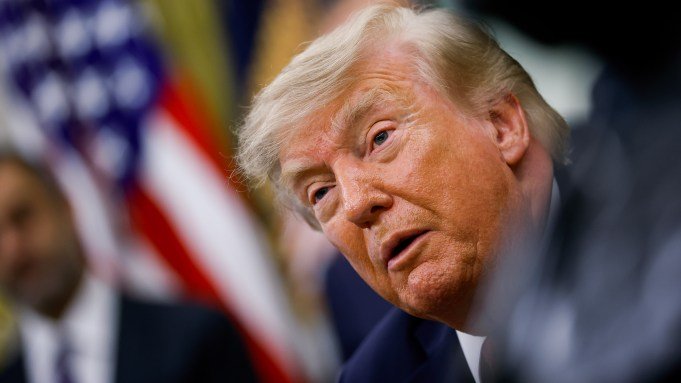
    A subdued — and, at one point, defensive — President Donald Trump sat down with Norah O’Donnell for an interview that aired Sunday night on 60 Minutes to share his perspective of what happened in the moments after shots were fired at the White House Correspondents’ Dinner.

    Allen reportedly emailed a “manifesto” to his family moments before the attack, saying he was targeting members of the Trump administration. 

    Asked if he thought he was the target, Trump told O’Donnell: “I don’t know. It sounded, to me — I read a manifesto — [that] he’s radicalized. He was a Christian, believer, and then he became an anti-Christian, and he had a lotta change. He’s been going through a lot, based on what he wrote. His brother complained about him and I think reported him to the police. And his sister, likewise, complained about him. His family was very concerned. He was probably a pretty sick guy.”

    When O’Donnell started reading from the gunman’s alleged manifesto, the interview got tense. She read this quote, alleged written by the suspect: “I am no longer willing to permit a pedophile, rapist and traitor to coat my hands with his crimes.” 

    Trump, visibly annoyed, replied: “Well, I was waiting for you to read that because I knew you would because you’re horrible people. Horrible people. Yeah, he did write that. I’m not a rapist. I didn’t rape anybody.”

    Interjected O’Donnell: “Oh, you think — do you think he was referring to you?”

    Replied Trump: “I’m not a pedophile. Excuse me. Excuse me. I’m not a pedophile. You read that crap from some sick person? I got associated with all — stuff that has nothing to do with me. I was totally exonerated. Your friends on the other side of the plate are the ones that were involved with, let’s say, Epstein or other things. But I said to myself, ‘You know, I’ll do this interview and they’ll probably’ — I read the manifesto. You know, he’s a sick person. But you should be ashamed of yourself reading that because I’m not any of those things.”

    Said O’Donnell: “Mr. President, these are the gunman’s words — “

    Trump continued: “And I was never — excuse me. Excuse me. You shouldn’t be reading that on 60 Minutes. You’re a disgrace. But go ahead. Let’s finish the interview.”

    When O’Donnell added that the suspect reportedly wrote in his manifesto that the hotel had what he perceived to be a lack of security (“Like, this level of incompetence is insane”), Trump replied: “Well, he was pretty incompetent too, because he got caught. And he got caught pretty easily. So I’d say he was pretty incompetent too. You know, I can take any event having to do with security or anything else. I can always find fault. Those guys did a good job last night. They did a really good job.”

    Trump added that he wants the White House Correspondents’ Dinner to be rescheduled, ideally within the next 30 days.

    “I don’t want to see it be canceled. … I think it’s really bad for a crazy person to be able to cancel something like this,” he said, adding: “There are great people in the press too I can name, but I don’t want to — I don’t want to embarrass your show. We have some great people in the press, some very fair people, and people that are just on my side. But for the most part, it’s a very liberal or very progressive– let’s use the word liberal. Liberal press. But I was just really … happy to see the — I don’t know how long it’ll last — the relationship, the friendship, the spirit after a very bad event took place. Now, the event turned out to be much less bad because nobody was killed. Nobody was hurt.”

    When O’Donnell told Trump that the “White House Correspondents’ Association very much appreciates you going last night and honoring a commitment to do it again,” he replied: “I hope we’re going to do it again. Norah, tell ’em to get it going, and we should do it within 30 days, and they’ll have even more security, and they’ll have bigger perimeter security. It’ll be fine. But tell ’em to do it again. We can’t let something be — it’s not that I wanna go; it’s no, I’m very busy; I don’t need that — I think it’s very important that they do it again.”

    As the event got under way Saturday night at the Washington Hilton, a gunman reportedly charged through a security checkpoint and into ballroom where the event was taking place armed with multiple weapons. He fired multiple shots before being subdued by authorities. He was later identified as Cole Tomas Allen, a 31-year-old teacher from Torrance, California. 

    In a press briefing, U.S. Attorney Jeanine Pirro said Allen will be charged with using a firearm and assaulting a federal officer with a dangerous weapon and that there will likely be “many more charges” to come.

    O’Donnell noted to Trump that the scened looked “chaotic” as Secret Service rushed to protect both the president and Vice President J.D. Vance on Saturday night.

    “Well, what happened is — it was a little bit me,” Trump said. “I wanted to see what was happening, and I wasn’t making it that easy for ’em. I wanted to see what was going on. And by that time we started to realize maybe it was a bad problem, different kind of a problem, bad one. And different than what would be normal noise from a ballroom, which you hear all the time. I was surrounded by great people. And I probably made them act a little bit more slowly. I said, ‘Wait a minute, wait a minute. Lemme see. Wait a minute.’” 

    Asked to clarify what he meant, Trump said he started walking with the Secret Service and then they told him to “go down on the floor.” He said both he and First Lady Melania Trump complied. 

    The reason he was asked to “go down,” he said, was because he was “walking out pretty tall” and they wanted him protected.

    Trump previously said a Secret Service agent had been shot but was wearing a bulletproof vest. He told O’Donnell that the agent is “a hundred percent” OK.

    “He didn’t want to go to the hospital,” Trump said. “He really didn’t. They asked him to go, and … he didn’t want to go. He said, ‘I don’t need to go to the hospital.’ But he went because they asked him to go.”

    Trump added that he “wasn’t worried” that there would be injuries: “I understand life. We live in a crazy world.” When the president realized what was happening, “my thought was, ‘You know, I’ve been through this before a couple of times.’ ” Melania, however, “has not to this extent. She handled it great. I mean, she’s very strong, smart. She got it. She knew what was happening.”

    Trump also noted that the suspect “like a blur” as he was racing into the ballroom and praised the Secret Service for reacting quickly. “I think the NFL should sign him up. He was fast,” Trump said. “When you look at it on tape, it’s almost like a blur. But it was amazing ’cause as soon as they saw that you could see them draw their guns. They were so professional. Aimed their guns, and then they took him down immediately.”

    Trump’s interview with O’Donnell will be broadcast Sunday night on 60 Minutes, which airs at 7 p.m. ET/PT on CBS and Paramount+.

    Carly Thomas contributed to this report.

  • Great Time to Buy Crypto May Follow 50% Index Drop, Bloomberg Strategist Says

    Great Time to Buy Crypto May Follow 50% Index Drop, Bloomberg Strategist Says

    The Bloomberg Galaxy Crypto Index could fall sharply before a clearer crypto buying opportunity emerges. Continued volatility and weak price retention highlight growing pressure on digital assets despite earlier gains.

    Key Takeaways:

    • Bloomberg Galaxy Crypto Index may decline toward lower support, signaling a delayed but clearer crypto entry opportunity.
    • Mike McGlone indicates crypto market pressure persists as volatility and expanding supply continue limiting sustained momentum.
    • Bitcoin’s prior surge above $100,000 may mark a lasting peak if Bloomberg Galaxy Crypto Index weakness continues.

    Bloomberg Galaxy Crypto Index Faces Deeper Support Test

    A potential buying opportunity in cryptocurrency markets may emerge after further declines, according to Bloomberg Intelligence’s senior commodity strategist Mike McGlone. He indicated that the Bloomberg Galaxy Crypto Index (BGCI) could drop another 50% from its 2025 peak near 4,000, pointing to further downside before any recovery in performance.

    McGlone said on social media platform X on April 26:

    “There’s going to be a great time to buy cryptos — it just may be after another 50% decline in the Bloomberg Galaxy Crypto Index.”

    The strategist explained that over roughly the past five years, the Bloomberg Galaxy Crypto Index has remained flat, even as the S&P 500 nearly doubled during that span. The index has shown approximately four times the volatility compared to the S&P 500, while still failing to maintain a consistent upward trend.

    Bloomberg strategist Mike McGlone’s chart showing cryptos fluctuating with beta.

    The chart he shared shows the BGCI hovering just above 2,000 on April 23, a level first reached in 2021. It also marks the index’s 2025 high near 4,000 and a lower reference point around 1,000. McGlone described the pattern as “same-chart-syndrome” with the S&P 500 relative to its 200-day moving average, noting that crypto remains highly correlated to beta but has been unable to hold gains.

    “Oversupplied, overhyped, and overpriced is our view of the crypto market,” he described. “It may require a low-price cure to improve performance.”

    Crypto Supply Pressure Challenges Market Momentum

    The crypto market has expanded significantly since Bitcoin’s introduction in 2009, with millions of additional cryptocurrencies now listed. This growth has contributed to what McGlone views as effectively unlimited supply within the market. Crypto assets have struggled to sustain higher prices, with repeated pullbacks reflecting ongoing volatility and supply pressure.

    The surge above $100,000 in bitcoin during 2025 may represent a lasting peak under current conditions. The 1,000 level was cited as a potential BGCI support level. The strategist detailed:

    “The 2025 rush above $100,000 in the firstborn may have set a lasting peak. A low-price BGCI cure could be near 1,000”

    This view followed McGlone’s earlier warning that bitcoin may face bear-market pressure if performance since spot bitcoin ETFs began trading is a guide. He pointed to elevated volatility, tighter equity correlation and excess crypto supply as risks. The Bloomberg Intelligence strategist previously stated: “My bias is the crypto bust may be just beginning. There was one in 2009 — bitcoin — and now there are millions, most tracking little of substance yet still valued in the billions. Bitcoin may revisit $10,000, especially if beta declines.”

  • DeFi United Secures $160M as Industry Moves to Cover Aave Bad Debt Crisis

    DeFi United Secures $160M as Industry Moves to Cover Aave Bad Debt Crisis

    A coordinated decentralized finance ( DeFi) relief effort has reportedly raised $160 million to cover bad debt created when attackers exploited KelpDAO’s bridge and deposited unbacked collateral into Aave V3 markets on April 18, 2026.

    Key Takeaways:

    • Aave froze rsETH reserves within hours of the April 18 Kelp DAO exploit, which created up to $230.1 million in bad debt.
    • DeFi United raised $160M by April 25, with Mantle and Aave DAO pledging 55,000 $ETH combined.
    • Governance votes on Aave DAO’s 25,000 $ETH contribution are ongoing as the protocol works to fully restore rsETH backing.

    DeFi United Raises $160M to Backstop Aave

    The exploit began at 17:35 UTC, at Ethereum block 24,908,285. Attackers targeted Kelp DAO’s Layerzero V2 bridge on the Unichain-to-Ethereum rsETH route, which was configured as a 1-of-1 DVN with no additional verifiers. They submitted a forged inbound packet that minted 116,500 unbacked rsETH tokens, valued at roughly $292 million at the time, without a corresponding lock or burn on the source chain.

    The attacker moved quickly. About 89,567 rsETH, worth approximately $221 million, was deposited as collateral across Aave V3 markets on Ethereum and Arbitrum. The attacker then borrowed around 82,650 WETH, worth roughly $191 million, plus smaller amounts of wstETH.

    Positions were left with health factors between 1.01 and 1.03, making full repayment unlikely. Aave‘s smart contracts were not exploited. The bad debt originated entirely from the unbacked external collateral.

    Aave’s Protocol Guardian responded within hours. By approximately 19:00 UTC on April 18, all rsETH and wrsETH reserves across V3 deployments were frozen, loan-to-value ratios were set to zero, and interest rate models were adjusted to manage liquidity pressure.

    Aave Labs and risk manager Llamarisk published a formal incident report on April 20. The report modeled two loss scenarios depending on how Kelp DAO socializes the shortfall. In the first scenario, a uniform haircut across all rsETH holders produces approximately $123.7 million in bad debt on Aave. In the second, losses isolated to L2 rsETH holders result in roughly $230.1 million in bad debt, with Mantle and Arbitrum bearing the heaviest exposure. Other estimates placed Aave’s total exposure between $196 million and $200 million.

    The market responded sharply. Aave’s total value locked fell between $6 billion and $9 billion in the days following the incident. The price of AAVE dropped between 10% and 22% in the immediate aftermath. Broader DeFi TVL losses exceeded $13 billion in some reports.

    To contain the fallout, Aave service providers launched DeFi United, a multi-protocol relief fund directing contributions to defiunited.eth, Ethereum address 0x0fCa5194baA59a362a835031d9C4A25970effE68. The fund targets the rsETH shortfall, initially modeled at 68,900 to over 100,000 $ETH, depending on recoveries and final bad debt figures.

    On Saturday, Arkham Intelligence confirmed DeFi United had raised $160 million. Mantle and Aave DAO together contributed 55,000 $ETH, accounting for approximately $127 million of that total. Mantle proposed up to 30,000 $ETH structured as a three-year credit facility at Lido staking yield plus 1%. Aave DAO has proposed 25,000 $ETH from its treasury, with governance voting still in progress.

    Aave founder and CEO Stani Kulechov committed 5,000 $ETH from personal funds. Ether.fi pledged 5,000 $ETH. Lido DAO offered up to 2,500 stETH. Smaller contributors include Golem Foundation at 1,000 $ETH, Aave VP Emilio Frangella at 500 $ETH, and community donations of more than 272 $ETH reported onchain. Ethena, Layerzero, Ink Foundation, Frax, and Tydro also provided support.

    The Arbitrum Security Council froze a portion of attacker funds, reducing the net gap the fund must cover. A follow-on malicious packet for 40,000 rsETH was reverted and recovered by Kelp before it could be processed.

    DeFi United is described by participants as one of the largest coordinated recovery efforts in DeFi history. Governance votes on pending contributions remain active, and the fund continues to accept donations as the protocol works toward restoring full rsETH backing and clearing remaining bad debt.

  • XRP’s Price Recovery Pattern Finally Finished, Ethereum (ETH) $3,000 Breakout Attempt Invalidated, Minor Shiba Inu (SHIB) Uptrend Continues: Crypto Market Review

    XRP’s Price Recovery Pattern Finally Finished, Ethereum (ETH) $3,000 Breakout Attempt Invalidated, Minor Shiba Inu (SHIB) Uptrend Continues: Crypto Market Review

    After a protracted downward trend, $XRP is starting to stabilize, and recent price action indicates that a base may finally be forming. Over the past few weeks, the asset has been holding a horizontal support zone that has been repeatedly tested without collapsing, consolidating just above the $1.40 area. This type of behavior usually indicates that selling pressure is being absorbed rather than increasing.

    The present configuration resembles a possible double bottom. The first leg developed after a precipitous drop earlier in the year, which was followed by a feeble comeback that was unable to overcome descending resistance. Similar lows were retested in the second leg, but a lower breakdown was not there.

    $XRP/$USDT Chart by TradingView

    Rather, a tightening range has been created by the price compressing between a declining resistance line and rising local support. This compression stage is important, since it frequently comes before expansion. A more significant recovery would be possible if $XRP is able to break above the declining resistance, confirming the double bottom setup.

    The initial target would probably be in the $1.50 to $1.53 range, which is currently where moving averages and prior resistance levels are aligned. The broader structure would move away from a series of lower highs, and bullish momentum would be strengthened if that zone were cleared.

    Because of the comparatively low volume, the setup is neutral rather than overtly bullish. However, the absence of heavy selling during repeated support tests is a constructive signal. Additionally, momentum indicators are stabilizing and shifting into a more balanced range from oversold conditions.

    Overall, the macro trend has not yet reversed, because $XRP is still trading below significant long-term averages. The short-term structure is evolving, going from decline to accumulation. The current pattern may indicate the conclusion of the corrective phase and the start of a recovery leg, if buyers intervene with sufficient conviction to push the price through resistance.

    Ethereum’s push failed

    Ethereum recently made an attempt to push toward the $3,000 mark, but the move was not sustained, so the breakout attempt was essentially nullified. $ETH was able to reclaim the $2,300-$2,400 range and create a short-term bullish structure, following a consistent recovery from sub-$2,000 levels earlier this year. But the most recent price action indicates hesitancy just below a significant resistance cluster, which stops further movement.

    As Ethereum got closer to the upper edge of a rising channel, where the price momentarily tested higher levels before retreating, the rejection took place. Buyers who exhibit this type of behavior are usually not yet strong enough to withstand selling pressure at resistance. The push has not resulted in a significant increase in volume, which further undermines the breakout case.

    Although the attempt was unsuccessful, the structure is not completely pessimistic. The pattern of higher lows is still present, and Ethereum is still trading above short-term moving averages. This implies that, rather than reversing, the asset is consolidating.

    Instead of destroying the setup, the invalidation of the breakout merely resets it. $ETH must create more solid support in the current range and gain momentum with rising volume, in order for the $3,000 level to reappear. The path toward higher resistance levels would be reopened by a clear break above the most recent local highs and persistent buying pressure.

    The market is likely to stay range-bound in the absence of that. Immediate support on the downside is located between $2,200 and $2,100, where the current structure’s lower boundary coincides with moving averages. The recovery narrative would be undermined if that zone were lost, and a deeper decline toward the $2,000 range might result.

    Shiba Inu’s shallow uptrend

    At the moment, Shiba Inu is moving in a shallow upward structure, but there is still little power behind this movement. $SHIB has begun to print marginally higher lows after a protracted period of decline, creating a modest ascending channel. Although this change is sufficient to determine a short-term course, it does not indicate a significant reversal of the trend.

    Along a narrow support line, the price is steadily rising, while encountering steady resistance just above current levels. Every attempt to push higher has been contained and has not been followed through on. This behavior is indicative of a market that is not growing, but rather stabilizing. Although there are buyers, they are not forceful enough to push through for a breakout.

    $SHIB/$USDT Chart by TradingView

    This interpretation is enhanced by volume. The fact that trading activity has not increased in tandem with the upward movement usually indicates a lack of conviction. Expanding volume supports rising prices in stronger trends, indicating participation. The opposite dynamic is evident here, as prices rise without a commensurate increase in capital.

    Indicators of momentum are still neutral. Although there isn’t any obvious overbought pressure, there’s also no acceleration that would point to a build-up for a breakout. The structure as a whole tends toward equilibrium, in which neither side is in charge. This type of setup frequently leads to a slow grind or prolonged consolidation that is eventually resolved with a sharper move.

    Broadly speaking, $SHIB remains below important long-term resistance levels, and the overall trend has not changed. Rather than marking the start of sustained growth, the current uptrend functions more as a corrective phase within a larger downtrend.

    In terms of expectations, this gradual upward drift could continue, but without a change in volume and momentum, it is unlikely to result in notable gains.

  • Victor Wembanyama returns to play in Game 4 vs. Blazers

    Victor Wembanyama posts 27 points, 11 rebounds, four steals and seven blocks vs. Trail Blazers as Spurs claim a 3-1 series lead.

    • Download the NBA App

    San Antonio Spurs star Victor Wembanyama was available and returned to play Sunday in Game 4 of the team’s first-round playoff series against the Portland Trail Blazers after clearing the NBA’s concussion protocol.

    Wembanyama, the league’s first unanimous Kia Defensive Player of the Year, missed Game 3 on Friday in Portland while going through the league’s concussion protocol. The Spurs won 120-108 to go up 2-1 in the series.

    Per ESPN’s Shams Charania and Malika Andrews, Wembanyama will play in Game 4 after he received clearance to do so from the Spurs’ medical staff and the NBA.

    Wembanyama sustained the concussion in the first half of Tuesday’s 106-103 loss to the Blazers.

    He traveled to Portland while continuing to complete the steps mandated by the league’s concussion protocol and had been listed as questionable for Sunday’s game.

    Luke Kornet got the Game 2 start against the Trail Blazers in Wembanyama’s absence, finishing with 14 points and 10 rebounds. San Antonio was boosted by Stephon Castle with 33 points and rookie Dylan Harper, who had 27 points and 10 rebounds.

    Players must clear a series of benchmarks before they are allowed to play under the concussion protocol. The results are compared to baseline neurological evaluations players take at the start of the season.

    San Antonio finished with the league’s second-best record behind the versatile 7-foot-4 center from France. It went 12-6 in the regular season without him.

    Wembanyama averaged 25 points, 11.5 rebounds, 3.1 assists and a league-best 3.1 blocks per game this season.

  • 4 takeaways: Cavaliers stars struggle while Scottie Barnes and Collin Murray-Boyles thrive

    The Raptors close Game 4 on a 17-5 run to defeat the Cavaliers and tie their series at 2-2.

    • Download the NBA App

    It was a game in which nobody played well enough to win, until someone finally did.

    The Cleveland Cavaliers and Toronto Raptors endured missed shots and sloppy play for three quarters and at some point, Game 4 demanded composure and clutch play. And the Raptors stepped forward and offered it in the moment of truth.

    As a result, this best-of-seven series is tied at two games each.

    The Raptors responded after trailing by five points with 2 1/2 minutes left to give this series a refreshed outlook with a 93-89 victory. Yes, Toronto, a team that, until now, had no positive playoff answers for Cleveland since the LeBron James days.

    There’s still plenty to do before erasing that stigma, although winning a pair against Donovan Mitchell and James Harden represents a start. Furthermore, the Raptors won despite not bringing their A game; to be fair, neither did Cleveland.

    In the end, Scottie Barnes proved too much to handle and even better for Toronto, there’s a new problem that Cleveland must ultimately address: Collin Murray-Boyles, the Raptors rookie who’s outplaying all other big men.

    Here are the takeaways from Toronto’s four-point Game 4 win:


    1. Mitchell and Harden are thrilled to leave the country.

    To say it wasn’t a fulfilling trip to the North for Mitchell and Harden would be an understatement. For a second straight game in Toronto, the engine of the Cavs couldn’t muster much positive production. And when the Cavs’ starting backcourt has issues, the Cavs don’t stand much of a chance.

    Case in point — the last few minutes of Game 4. Clearly, the Cavs wanted the ball in their hands, and Toronto’s defense recognized as much. The Raptors began trapping them and ignoring the other Cavs, daring Mitchell and Harden to let someone else be the hero.

    This resulted in a key forced turnover by Jamal Shead in the final minute; Mitchell lost the ball as a result and the resulting free throws by Barnes after being fouled put Toronto up for good.

    “[Jamal] being able to make that read and having the clock awareness in that split second shows how smart he is,” said Raptors coach Darko Rajakovic.

    In the two games in Toronto, Mitchell shot 13-for-39 and Harden 11-for-27.

    Mitchell had only eight points in the first three quarters Sunday. Harden also seemed rattled at times Sunday, with seven turnovers compared to just six field goals; he has had more turnovers than field goals for two straight games. And down the stretch of Game 4, they took heavily contested shots; there would be no free looks for them.

    “They just didn’t fall,” said Mitchell.

    Other than a 3-pointer by Sam Merrill, and only because Harden frantically looked for someone with the shot clock winding down, nobody else on the Cavs had a key possession late. It’s a formula that usually works for Cleveland, and a sensible one as well given the reputations and proven results of those two stars, but Toronto was better prepared for it Sunday.

    “We’ve had leads and we’ve had opportunities to go up and we just didn’t do it,” Harden said. “It’s not like they’re doing something crazy.”


    2. Murray-Boyles is manning up

    A game that wasn’t pretty required someone to do the dirty work to help clean up. And what better job description for Murray-Boyles? He did much heavy lifting and earned a spot on the floor in a close game, because he factored in winning.

    Murray-Boyles’ best contribution was offensive rebounds. Five of his 10 rebounds were on the offensive end, and they kept possessions alive. This was crucial, because in a game of so many missed shots, the Raptors could use as many looks at the basket as possible.

    For a rookie in his first taste of the playoffs, Murray-Boyles is ignoring pressure and refusing to be intimidated by the scene. He’s outplaying Jarrett Allen and even Evan Mobley, a pair of Cleveland front-liners who bring far more experience and accomplishments.

    Therefore, his 15 points (by comparison, Mobley and Allen combined for 11 points), 10 rebounds and two steals, was exactly what Toronto needed in a game like this.

    “I’m just cherishing the moment,” he said. “It makes me smile, just being a part of this.”


    3. Beam Scottie up

    The medal for best-player-on-the-floor goes to Scottie Barnes. He played such a splendid all-around game and was seemingly everywhere the Cavs needed him to be.

    The performance he gave was standard for him.

    Barnes made shots, went to the free-throw line, delivered the ball when necessary, helped on the glass, helped on defense. An ace of all trades in Game 4.

    This is the best way for the Raptors to assume the lead in this series or even win it, to have Barnes stand out on a floor shared with Mitchell and Harden. With the Raptors getting mixed results from RJ Barrett and Brandon Ingram, his offense is crucial. And with the Raptors fairly undersized against the Cavs, his work in the post at both ends is needed.

    All told, Barnes was good for 23 points, nine rebounds, six assists and three blocks.

    In a game like this, those were winning numbers.


    4. Offense took a back seat

    Was Game 4 a case of cold shooting or better defense? Perhaps a bit of both, because the Cavs and Raptors conspired to dial back the offense to historical levels.

    Their combined 74 points represented the fewest first-half points in a playoff game in 10 years. The teams also combined to shoot 7-for-39 from deep for the half.

    It was rough all around and nobody was spared, All-Stars and role players.

    As the fourth quarter began, the Raptors sat on 60 points while the Cavs, with 57, couldn’t even muster that much.

    In these situations, possessions suddenly become crucial, because every point tends to matter that much more. And that’s how the Raptors came out ahead.

    Suddenly, it didn’t matter that Ingram once again was inefficient, needing 23 shots to score 23 points. Or that Shead, who was terrific defensively, missed five of his six shots. Or that Ja’Kobe Walter, the replacement for injured starting guard Immanuel Quickley, went 0-for-9.

    What matters is 2-2. That’s where the series stands right now, heading back to Cleveland for the pivotal Game 5 (Wednesday, TBD).

    “This seems like a typical playoff series, 4 vs. 5, tied 2-2,” said Cavs coach Kenny Atkinson. “They did what they were supposed to do. When you’re at home you’re supposed to win in the playoffs.”

    * * *

    Shaun Powell has covered the NBA since 1985. You can e-mail him at spowell@nba.com, find his archive here and follow him on X.